|
시장보고서
상품코드
2114513
수산 사료첨가물 시장 : 점유율 분석, 업계 동향과 통계, 성장 예측(2026-2031년)Aquafeed Additives - Market Share Analysis, Industry Trends & Statistics, Growth Forecasts (2026 - 2031) |
||||||
 Mordor Intelligence
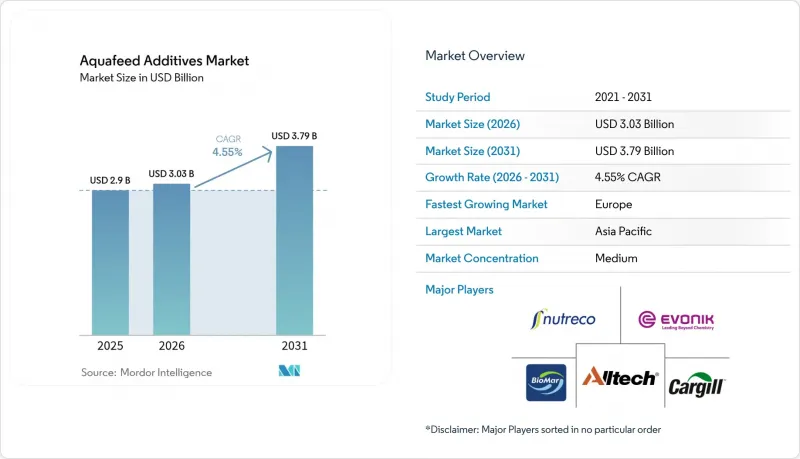
Mordor Intelligence에 의하면, 2026년 수산 사료첨가물 시장 규모는 30억 3,000만 달러로 추정되고 있어 2025년 29억 달러에서 확대해, 2031년에는 37억 9,000만 달러에 이를 것으로 예측됩니다.
2026년부터 2031년까지 연평균 성장률(CAGR) 4.55%로 성장할 것으로 전망됩니다.
본 보고서는 대상 종별(어류, 연체동물, 갑각류, 기타), 첨가제 유형별(비타민, 미네랄, 항산화제,아미노산, 효소, 산미료 등), 형태별(건조 압출 펠렛, 습식 펠렛 등), 지역별(북미, 유럽, 아시아태평양, 남미 등)로 분류되어 있습니다. 시장 전망은 금액(달러) 기준으로 제시되어 있습니다.
세계 수산 사료첨가물 시장 동향 및 인사이트
전 세계 수산물 소비 확대와 단백질 공급원의 변화
세계 단백질 수요는 수산 유래 공급원으로 이동하고 있습니다. 아프리카만 해도 2050년까지 수산물 섭취량이 1,000만 미터톤에서 2,900만 미터톤으로 증가할 것으로 예측되며, 이러한 경향은 아시아에서도 마찬가지로 나타납니다. 아시아에서는 틸라피아 통합 생산 업체들이 수입을 줄이기 위해 사료 공장을 현지화하고 있습니다. FAO는 2030년까지 양식 어류 가격이 24% 상승할 것으로 예측하고 있으며, 이로 인해 생산자들은 성장을 가속하고 생산 주기를 단축하는 첨가제의 채택을 가속화하게 될 것입니다. Albert Heijn과 같은 소매업체들은 현재 곤충 분말이나 조류 오일을 원료로 한 사료로 키운 새우를 취급하고 있으며, 이는 대체 사료 기술에 대한 소비자의 수용을 보여줍니다. 이러한 수요 변화에 따라 어분을 대체하는 식물성 사료에서 아미노산과 효소의 사용이 촉진되어, 생산 성능에 최적화된 아미노산 조성이 유지되고 있습니다. 그 결과, 수산 사료첨가물 시장은 어분 가격 변동에 대한 내성을 높이고 있습니다.
집약형 양식 능력의 확대
사우디아라비아 기업 NAQUA는 500개의 양식장을 운영하고 있으며, 2030년까지 연간 생산량 25만 미터톤을 목표로 하고 있어, 견고한 프로바이오틱스 및 수질 관리 프로그램에 의존하는 고밀도 시스템으로의 전 세계적 전환을 여실히 보여주고 있습니다. 중국에서는 2022년에 집약형 새우 양식장이 209만 미터톤을 생산했으나, 유전자 자원의 고갈과 질병 위험에 직면해 있어, 이는 면역력을 높이는 첨가제의 채택을 촉진하고 있습니다. 재순환식 양식 시스템이나 바이오플록 양식에서는 미생물의 균형을 유지하기 위해 정밀한 영양 패키지가 필요하며, 이로 인해 고품질 제품에 대한 수요가 발생하고 있습니다. 따라서 수산 사료첨가물 시장은 아시아, 중동, 남미 전역에 걸친 기술 주도형 집중 확장의 혜택을 받고 있습니다.
어분·어유 가격 변동이 첨가제 원가 전가에 영향
어분 및 어유 가격 변동은 수산 사료첨가물 제조업체에 혼란을 초래하고, 비용 전가와 수익성을 복잡하게 만들고 있습니다. 페루의 어분 생산량이 300% 증가함에 따라 2025년 1월 세계 생산량은 75% 증가했으나, 가격 변동으로 인해 제조업체가 첨가제의 프리미엄 가격을 전가할 수 있는 능력은 제한되고 있습니다. 어유 생산량은 34% 증가했으나, 사료 제조업체들이 이중의 비용 압박에 시달리는 가운데 공급업체들은 이익률 축소를 배경으로 가격을 책정했습니다. 중국에서는 홍수와 양식업자들의 비용 절감으로 인해 2024년 수산 사료 생산량이 3.5% 감소했습니다. 이는 가격 변동이 첨가제 채택을 억제하고 있는 실태를 여실히 보여줍니다. FAO는 2030년까지 어분 가격이 30% 상승할 것으로 예측하고 있으며, 이에 따라 새로운 첨가제 배합 조정이 필요한 곤충 분말 및 단세포 단백질의 탐색이 가속화될 것으로 전망됩니다. 공급망의 불확실성, 특히 2025년 9월까지 냉동 어류 원료에 대한 의존이 지속되고 있는 상황은 수산 사료첨가물 시장의 재고 계획을 복잡하게 만들고 있습니다.
부문 분석
2025년, 어류는 수산 사료첨가물 시장 점유율의 52.85%를 차지하며, 전 세계적으로 연어, 틸라피아, 잉어 양식이 활발하기 때문에 여전히 최대 소비 그룹으로 남아 있습니다. 이러한 우위는 2025년 수산 사료첨가물 시장 규모에서 약 15억 3,000만 달러의 점유율에 해당하며, 사료 전환율을 확보하기 위해 첨가제 프로토콜을 표준화하고 있는 사업자들의 구매력을 보여줍니다. 노르웨이와 칠레의 연어 생산자들은 고밀도 사육 및 운송 단계에서 발생하는 스트레스를 완화하는 기능성 아미노산과 항산화 물질의 배합을 지속적으로 진행하고 있습니다. 한편, 아시아의 잉어 양식장에서는 엄격한 사료 예산을 충족하기 위해 비용 대비 효과가 높은 비타민 및 효소 패키지를 중시하고 있습니다. 기존 사료 공장에는 이미 디지털 추적 시스템이 도입되어 있어, 사료 효율이나 필레 수율의 측정 가능한 향상을 보여주는 첨가제는 장기 공급 계약을 통해 신속하게 규모를 확대할 수 있습니다. 그 결과, 양식 업계는 대부분공급업체가 신규 원료를 검증할 때 사용하는 기준 사양을 확립하고 있습니다.
새우를 필두로 한 갑각류는 2031년까지 연평균 성장률(CAGR)이 8.92%로 가장 빠른 성장 곡선을 보이고 있으며, 생산자들은 여전히 높은 질병 위험을 상쇄하고 고품질의 색상을 구현하기 위해 첨가제 지출 증가를 정당화하고 있습니다. 아스타잔틴이 풍부한 크릴 오일을 5% 사용한 시험에서는 염분 스트레스 하에서도 생존율 100%를 달성함과 동시에 색소 침착이 깊어짐에 따라 시장 가치가 높아져, 특수 투입 자재에 대한 지불 의향을 뒷받침하고 있습니다. 중국의 양식업자들은 면역 활성화 작용이 있는 프로바이오틱스를 포함한 다단계 기능성 사료로 계속 전환하고 있으며, 남미의 양식업자들은 기수 연못에서의 용출에 내성이 있는 캡슐화된 식물 유래 성분에 주력하고 있습니다. 연체동물이나 해삼과 같은 틈새 종은 규모는 작지만 주목할 만하며, 미세 분말화된 미네랄 블렌드가 껍질의 강도와 식감 특성을 향상시켜 미식가 시장에서 고가로 판매되고 있습니다. 수요가 다양화되는 가운데, 공급업체들은 종별로 최적화된 첨가제 패키지를 제공하고 있으며, 이에 따라 수산 사료첨가물 시장은 각 생산 부문에서 판매량 및 매출액의 꾸준한 증가가 예상됩니다.
지역별 분석
아시아태평양은 2025년에 전 세계 매출의 61.05%를 차지하며, 중국의 새우 생산량이 200만 미터톤을 넘어섬에 따라 판매량 성장을 지속적으로 뒷받침하고 있습니다. 질병 발생 및 단백질 원료의 전환으로 인해 양식장에서는 기본 아미노산 패키지 외에도 면역력을 높이는 첨가제를 병용해야 할 필요성이 대두되고 있습니다. 베트남과 인도에서는 수출 지향형 양식업이 확대되고 있지만, 가격 민감도로 인해 고급 첨가제와 비용 최적화된 블렌드가 공존하는 양극화된 시장이 형성되고 있습니다.
유럽의 양식 사료첨가물 시장 규모는 EU 지침에 따라 지속가능성 요건이 강화됨에 따라,2026년 5억 6,000만 달러에서 2031년까지 연평균 성장률(CAGR) 8.05%로 확대되어 8억 3,000만 달러에 달할 것으로 예측됩니다. 노르웨이 연어 산업은 정밀 사료 급여 도입을 선도하고 있으며, 기능성 첨가제의 이용 효율을 높이는 AI 지원형 투여 시스템의 시험을 촉진하고 있습니다. ‘호라이즌 유럽’ 계획을 통해 연간 600만 유로(695만 달러) 이상이 그린피드 연구에 투입될 전망이며, 조류 유래 항산화 물질 및 식물성 영양소의 상용화가 가속화되고 있습니다.
북미는 성숙한 시장임에도 불구하고 혁신에 우호적인 환경을 갖추고 있습니다. 미국의 ‘수산물 양식 전략 계획’은 첨가제 개발자가 통제된 조건 하에서 새로운 단백질 및 박테리오파지 솔루션의 시범 운영을 수행할 수 있도록 하는 민관 협력 인프라를 지원하고 있습니다. 캐나다의 원주민 권리 보호 노력은 친환경 배합을 평가하는 ESG 요소를 포함하고 있습니다. 한편, 멕시코의 새우 양식업자들은 국경을 초월한 공급업체와의 협력을 강화하며 첨가제 사용량을 늘리고 있습니다.
기타 혜택:
- 엑셀 형식 시장 예측(ME) 시트
- 3개월간 애널리스트의 지원
목차
제1장 서론
제2장 조사 방법
제3장 주요 요약
제4장 시장 구도
제5장 시장 규모와 성장 예측
제6장 경쟁 구도
제7장 시장 기회와 향후 전망
JHSAccording to Mordor Intelligence, aquafeed additives market size market size in 2026 is estimated at USD 3.03 billion, growing from 2025 value of USD 2.9 billion with 2031 projections showing USD 3.79 billion, growing at 4.55% CAGR over 2026-2031.
This report is Segmented by Species Type (Fish, Mollusks, Crustaceans, and Others), by Additives Type (Vitamins, Minerals, Antioxidants, Amino Acids, Enzymes, Acidifiers, and More), by Form (Dry Extruded Pellets, Moist Pellets, and More) and by Geography (North America, Europe, Asia-Pacific, South America, and More). The Market Forecasts are Provided in Terms of Value (USD).
Global Aquafeed Additives Market Trends and Insights
Rising Global Seafood Consumption and Protein Shift
Global protein demand is moving toward aquatic sources. Africa alone is forecast to raise seafood intake from 10 million metric tons to 29 million metric tons by 2050, a trajectory mirrored in Asia, where tilapia integrators are localizing feed mills to cut imports. FAO expects farm-raised fish prices to climb 24% by 2030, encouraging producers to adopt additives that deliver faster growth and shorten production cycles. Retailers such as Albert Heijn now stock shrimp fed on insect meal and algal oil, signaling buyer acceptance of alternative feed technologies. This demand pivot supports amino acid and enzyme use in plant-based diets that replace fishmeal while sustaining optimal amino-acid profiles for performance. Consequently, the aquafeed additives market gains resilience against fishmeal volatility.
Expansion of Intensive Aquaculture Capacity
Saudi firm NAQUA operates 500 ponds and targets 250,000 metric tons of annual output by 2030, highlighting the global shift toward high-density systems that rely on robust probiotic and water-quality programs. In China, intensive shrimp farms produced 2.09 million metric tons in 2022, yet faced germplasm depletion and disease risks that drive uptake of immune-boosting additives. Recirculating aquaculture systems and biofloc require precision nutrient packages to sustain microbial balance, creating premium demand pockets. The aquafeed additives market, therefore, benefits from clustered, technology-driven expansions across Asia, the Middle East, and South America.
Volatile Fishmeal and Fish-Oil Pricing Impacting Additive Cost Pass-Through
Volatile fishmeal and fish-oil prices disrupt aquafeed additive manufacturers, complicating cost pass-through and profitability. Peru's 300% surge in fishmeal output lifted global production by 75% in January 2025, yet price swings restrict manufacturers' ability to price through additive premiums. Fish oil output climbed 34%, but suppliers leveraged compressed margins as feed makers struggled to absorb dual cost pressures. China's aquafeed output fell 3.5% in 2024 amid flooding and farmer cost-cutting, illustrating how volatility curbs additive uptake. FAO foresees fishmeal prices rising 30% by 2030, quickening the search for insect meal or single-cell proteins that demand new additive calibrations. Supply-chain uncertainty, particularly the reliance on frozen fish inputs until September 2025, complicates inventory planning for the aquafeed additives market.
Other drivers and restraints analyzed in the detailed report include:
- Government Subsidies and Sustainability Mandates in Aquaculture
- Functional Additives Replacing In-Feed Antibiotics
- Stringent Multi-Region Approval Timelines for Novel Feed Additives
For complete list of drivers and restraints, kindly check the Table Of Contents.
Segment Analysis
Fish represented 52.85% of the aquafeed additives market share in 2025, remaining the largest consumer group due to the extensive farming of salmon, tilapia, and carp globally. This dominance converted into an estimated USD 1.53 billion slice of the aquafeed additives market size in 2025, illustrating the purchasing power of operators that have standardized additive protocols to safeguard feed-conversion ratios. Salmon producers in Norway and Chile continue to layer functional amino acids and antioxidants that counteract stress during high-density grow-out and transport phases, the Asian carp farms emphasize cost-effective vitamin and enzyme packages to hit tight feed budgets. Established feed mills already integrate digital traceability, so any additive that demonstrates a measurable uplift in feed efficiency or fillet yield quickly scales through long-term supply contracts. Consequently, fish farming sets the baseline specification that most suppliers use when validating new ingredients.
Crustaceans, led by shrimp, display the fastest adoption curve with a 8.92% CAGR through 2031 as producers justify the higher additive spend to offset still-elevated disease risks and achieve premium coloration. Trials using 5% astaxanthin-rich krill oil have delivered 100% survival under salinity stress while raising market value through deeper pigmentation, reinforcing willingness to pay for specialty inputs. Chinese farmers continue turning to multi-phase functional diets that include immunostimulant probiotics, the South American growers focus on encapsulated phytogenics that resist leaching in brackish ponds. Mollusks and niche species such as sea cucumbers remain small but notable, with micronized mineral blends enhancing shell strength and texture attributes that fetch superior prices in gourmet channels. As demand diversifies, suppliers tailor species-specific additive bundles, positioning the aquafeed additives market for steady volume and value gains across distinct production segments.
Complete Report Scope:
- By Species Type
- Fish
- Salmonids
- Tilapia
- Carp
- Catfish
- Mollusks
- Crustaceans
- Others
- Fish
- By Additive Type
- Vitamins
- Minerals
- Antioxidants
- Amino Acids
- Enzymes
- Acidifiers
- Probiotics and Prebiotics
- Phytogenics and Essential Oils
- Others (Carotenoids/Astaxanthin, Pellet Binders/Bentonite, etc.)
- By Form
- Dry Extruded Pellets
- Moist Pellets
- Micro-encapsulated Powders
- By Geography
- North America
- United States
- Canada
- Mexico
- Rest of North America
- Europe
- Germany
- United Kingdom
- France
- Spain
- Russia
- Rest of Europe
- Asia-Pacific
- China
- India
- Japan
- Vietnam
- Rest of Asia-Pacific
- South America
- Brazil
- Argentina
- Rest of South America
- Middle East
- Turkey
- Saudi Arabia
- Rest of Middle East
- Africa
- South Africa
- Rest of Africa
- North America
Geography Analysis
Asia-Pacific contributed 61.05% of global revenue in 2025 and continues to anchor volume growth, led by China's shrimp production surpassing 2 million metric tons. Disease outbreaks and protein-source shifts compel farms to layer immune-enhancing additives on top of core amino-acid packages. Vietnam and India are expanding export-oriented aquaculture, but price sensitivity shapes a two-tier market where premium additives coexist with cost-optimized blends.
Europe's aquafeed additives market size is projected to expand from USD 0.56 billion in 2026 to USD 0.83 billion by 2031 on an 8.05% CAGR as EU directives elevate sustainability requirements. Norway's salmon sector leads precision feeding adoption, catalyzing trials of AI-supported dosing systems that elevate functional additive use efficiency. Horizon Europe projects funnel more than EUR 6 million (USD 6.95 million) into green-feed research annually, accelerating the commercialization of algae-derived antioxidants and phytonutrients.
North America presents a mature but innovation-friendly landscape. The US Strategic Plan for Aquaculture backs public-private infrastructures where additive developers pilot novel proteins or bacteriophage solutions under controlled conditions. Canada's engagement with indigenous rights adds ESG layers that reward eco-friendly formulations. Meanwhile, Mexico's shrimp operators deepen cross-border supplier ties, boosting additive throughput.
- Benchmark Holdings plc (INVE Aquaculture)
- BASF SE
- Evonik Industries AG
- Adisseo
- Cargill, Incorporated
- Archer Daniels Midland (ADM)
- BioMar Group
- Alltech
- Nutreco N.V. (Skretting)
- Zeigler Feeds
- Kemin Industries, Inc.
- Phibro Animal Health Corporation
- Calysta Inc.
- Bentoli
- Phytobiotics Futterzusatzstoffe GmbH
Additional Benefits:
- The market estimate (ME) sheet in Excel format
- 3 months of analyst support
TABLE OF CONTENTS
1 Introduction
- 1.1 Study Assumptions and Market Definition
- 1.2 Scope of the Study
2 Research Methodology
3 Executive Summary
4 Market Landscape
- 4.1 Market Overview
- 4.2 Market Drivers
- 4.2.1 Rising global seafood consumption and protein shift
- 4.2.2 Expansion of intensive aquaculture capacity
- 4.2.3 Government subsidies and sustainability mandates in aquaculture
- 4.2.4 Functional additives replacing in-feed antibiotics
- 4.2.5 Carbon-footprint labeling spurring micro-algae and single-cell additives
- 4.2.6 AI-driven precision feeding enabling higher specialty-additive inclusion
- 4.3 Market Restraints
- 4.3.1 Volatile fishmeal and fish-oil pricing impacting additive cost pass-through
- 4.3.2 Stringent multi-region approval timelines for novel feed additives
- 4.3.3 Micro-plastics scrutiny on pellet binders and coating agents
- 4.3.4 Climate-induced crop failures tightening phytobiotic supply
- 4.4 Regulatory Landscape
- 4.5 Technological Outlook
- 4.6 Porters Five Forces Analysis
- 4.6.1 Threat of New Entrants
- 4.6.2 Bargaining Power of Buyers/Consumers
- 4.6.3 Bargaining Power of Suppliers
- 4.6.4 Threat of Substitute Products
- 4.6.5 Intensity of Competitive Rivalry
5 Market Size and Growth Forecasts (Value)
- 5.1 By Species Type
- 5.1.1 Fish
- 5.1.1.1 Salmonids
- 5.1.1.2 Tilapia
- 5.1.1.3 Carp
- 5.1.1.4 Catfish
- 5.1.2 Mollusks
- 5.1.3 Crustaceans
- 5.1.4 Others
- 5.1.1 Fish
- 5.2 By Additive Type
- 5.2.1 Vitamins
- 5.2.2 Minerals
- 5.2.3 Antioxidants
- 5.2.4 Amino Acids
- 5.2.5 Enzymes
- 5.2.6 Acidifiers
- 5.2.7 Probiotics and Prebiotics
- 5.2.8 Phytogenics and Essential Oils
- 5.2.9 Others (Carotenoids/Astaxanthin, Pellet Binders/Bentonite, etc.)
- 5.3 By Form
- 5.3.1 Dry Extruded Pellets
- 5.3.2 Moist Pellets
- 5.3.3 Micro-encapsulated Powders
- 5.4 By Geography
- 5.4.1 North America
- 5.4.1.1 United States
- 5.4.1.2 Canada
- 5.4.1.3 Mexico
- 5.4.1.4 Rest of North America
- 5.4.2 Europe
- 5.4.2.1 Germany
- 5.4.2.2 United Kingdom
- 5.4.2.3 France
- 5.4.2.4 Spain
- 5.4.2.5 Russia
- 5.4.2.6 Rest of Europe
- 5.4.3 Asia-Pacific
- 5.4.3.1 China
- 5.4.3.2 India
- 5.4.3.3 Japan
- 5.4.3.4 Vietnam
- 5.4.3.5 Rest of Asia-Pacific
- 5.4.4 South America
- 5.4.4.1 Brazil
- 5.4.4.2 Argentina
- 5.4.4.3 Rest of South America
- 5.4.5 Middle East
- 5.4.5.1 Turkey
- 5.4.5.2 Saudi Arabia
- 5.4.5.3 Rest of Middle East
- 5.4.6 Africa
- 5.4.6.1 South Africa
- 5.4.6.2 Rest of Africa
- 5.4.1 North America
6 Competitive Landscape
- 6.1 Market Concentration
- 6.2 Strategic Moves
- 6.3 Market Share Analysis
- 6.4 Company Profiles (Includes Global-level Overview, Market-level Overview, Core Segments, Financials as available, Strategic Information, Market Rank/Share, Products and Services, and Recent Developments)
- 6.4.1 Benchmark Holdings plc (INVE Aquaculture)
- 6.4.2 BASF SE
- 6.4.3 Evonik Industries AG
- 6.4.4 Adisseo
- 6.4.5 Cargill, Incorporated
- 6.4.6 Archer Daniels Midland (ADM)
- 6.4.7 BioMar Group
- 6.4.8 Alltech
- 6.4.9 Nutreco N.V. (Skretting)
- 6.4.10 Zeigler Feeds
- 6.4.11 Kemin Industries, Inc.
- 6.4.12 Phibro Animal Health Corporation
- 6.4.13 Calysta Inc.
- 6.4.14 Bentoli
- 6.4.15 Phytobiotics Futterzusatzstoffe GmbH