

|
시장보고서
상품코드
2114518
신생아 집중치료 시장 : 점유율 분석, 업계 동향과 통계, 성장 예측(2026-2031년)Neonatal Intensive Care - Market Share Analysis, Industry Trends & Statistics, Growth Forecasts (2026 - 2031) |
||||||
 Mordor Intelligence
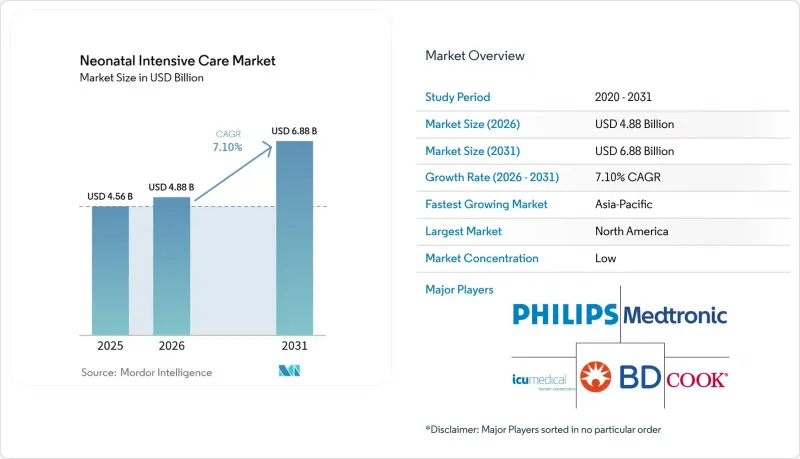
에 의하면, 2026년 신생아 집중치료 시장 규모는 48억 8,000만 달러로 추정되고 있어 2025년 45억 6,000만 달러에서 확대해, 2031년에는 68억 8,000만 달러에 이를 것으로 예측됩니다.
2026년부터 2031년까지 연평균 성장률(CAGR) 7.10%로 성장할 것으로 전망됩니다.
본 보고서는 제품 유형(체온 조절 장치, 호흡 보조 장치 등), 장치 방식(오픈 케어 시스템, 클로즈드 케어 시스템), 최종 사용자(병원, 산부인과 병원 등), 지역(북미, 유럽, 아시아태평양 등)별로 세분화되어 있습니다. 본 보고서에서는 상기 각 부문 시장 규모(백만 달러)를 제시하고 있습니다.
전 세계 신생아 집중치료 시장 동향 및 인사이트
전 세계 조산율 상승
세계적으로 조산으로 인한 합병증은 매년 100만 명 이상의 영유아 사망 원인이 되고 있으며, 조산율이 높은 수준을 유지하고 있는 것은 인공호흡기, 신생아 인큐베이터, 광선 요법 장치의 사용 증가로 직결되고 있습니다. 임신 32주 미만의 출산 비율은 15%에 달하며, 이 그룹의 영아에게는 집중적인 호흡 및 체온 관리 지원이 필요하기 때문에 장비에 대한 수요가 더욱 높아지고 있습니다. 이러한 압박은 조산율이 종종 12%를 초과하는 저·중소득 국가에서 가장 두드러지게 나타나고 있습니다. 각국의 보건부는 자본 예산과 생존율 향상을 점점 더 밀접하게 연계하고 있으며, 첨단 의료기기는 단순한 선택적 구매 품목이 아니라 전략적 투자로 자리 잡고 있습니다.
NICU에서의 기술 급속한 진화(AI 기반 모니터링, IoT)
인공지능(AI)은 신생아 집중치료 시장 전체의 업무 흐름을 혁신하고 있습니다. 스탠포드 메디슨이 개발한 TPN 2.0 알고리즘은 과거 8만 건의 처방 데이터를 통해 학습되었으며, 현재는 몇 초 만에 정밀한 정맥 내 영양 공급량을 산출하는 동시에 조제 시 발생하는 인적 오류를 줄이고 있습니다. 마운트 시나이(Mount Sinai)의 컴퓨터 비전 도구는 1,600만 초 분량의 동영상을 분석하여, 병상 옆 의료진이 간과하기 쉬운 미세한 신경학적 변화를 감지합니다. 비접촉식 카메라와 레이더 시스템은 접착식 센서를 완전히 배제함으로써 피부 취약성에 대한 대응을 한층 더 발전시키고 있습니다. IoT 연결과 예측 분석의 융합을 통해 임상의는 인공호흡기 설정, 인큐베이터 온도, 실시간 생체 신호를 단일 대시보드에 통합하여, 조기 개입과 입원 기간 단축을 뒷받침하는 풍부한 데이터를 담은 프로파일을 생성할 수 있게 되었습니다.
NICU 인프라의 고액 초기 투자 및 유지 관리 비용
잘 갖춰진 NICU 스위트에는 신생아 인큐베이터, 인공호흡기, 주입 펌프, 임상 검사 장비가 필요하며, 이 모든 것을 합친 가격은 8개 병상이 있는 포드당 100만 달러를 초과하는 경우가 많습니다. 우간다의 OMWaNA 연구에 따르면, 즉각적인 캥거루 케어를 시행하기 위해 병원 한 곳당 최대 95,796달러의 추가 인프라 비용이 필요한 것으로 산출되었으며, 이는 기술 수준이 낮은 업그레이드라 할지라도 막대한 투자가 필요함을 보여줍니다. 제조업체들도 인플레이션으로 인한 역풍에 직면해 있습니다. 현재 운송비, 인건비, 원자재비가 매출의 최대 20%를 차지하고 있으며, 기업들은 공급망 서비스에만 3-5%를 할당하고 있습니다. 서비스 계약, 예비 부품의 리드타임, 교정 요건 등은 구매자에게 추가적인 간접비가 되어 장비 교체 주기를 방해하고, 자산의 사용 수명을 감가상각 일정을 훨씬 초과하여 연장시키고 있습니다.
부문 분석
신생아 집중치료 시장에서 체온 조절 장치 시장 규모는 2025년에 12억 9,000만 달러에 달하여 매출의 28.20%를 차지했습니다. 체온의 불안정성은 수 분 이내에 사망 위험을 높일 수 있으므로, 인큐베이터와 복사식 가온기는 여전히 필수적인 존재입니다. 신형 모델에는 서보 제어에 의한 습도 관리, 내장 카메라, 항균 표면 등이 탑재되어 있어 감염 관리 요건을 충족하고 있습니다. 호흡 보조 기기는 임상의들이 비침습적 환기 모드나 폐쇄 루프식 산소 목표 관리를 요구함에 따라 2031년까지 연평균 성장률(CAGR) 8.14%로 가장 높은 성장이 예상됩니다. 고유량 비강 캐뉼라 시스템, 터빈 구동식 인공호흡기 및 정용적 모드는 특히 임신 32주 이전에 태어나는 조산아의 15%를 대상으로 전 세계적으로 표준화가 진행되고 있습니다. 일회용 제품 사용이 많은 감염 예방 대책에 포함되어 있기 때문에 환자 전용 회로 및 가습기 챔버와 같은 소모품에 대한 수요도 마찬가지로 확대되고 있습니다.
모니터링 시스템은 AI와 하드웨어의 융합 지점에 위치하며, 심전도, 맥박 산소 포화도, 뇌 산소화 및 비디오 추적 기능을 통합하고 있습니다. FDA의 분석에 따르면, 새로운 신생아 인큐베이터는 공기 중의 화학 물질을 배출하기 위한 시운전 기간이 필요하지 않은 것으로 확인되어, 이를 통해 장비의 회전율 향상과 이용률 증대가 촉진되고 있습니다. 황달 관리에서는 광선 요법이 여전히 중요한 반면, 신생아 선별 검사 플랫폼은 각국의 의무화에 따라 확대되고 있습니다. 이러한 각 하위 부문은 데이터를 병원의 전자 의료 기록(EMR) 및 연구 레지스트리에 집계하는 연결성의 혜택을 받고 있으며, 신생아 집중치료 시장 전체에서 가치 기반 의료 계약의 중요한 접점이 되고 있습니다.
지역별 분석
북미는 견실한 상환 제도, 지속적인 연구 개발, 그리고 AI의 급속한 보급에 힘입어 2024년에도 주도적인 위치를 유지했습니다. 메디케어의 2025년 지급 개정으로 의료기기의 환급액이 2.9% 인상되어, 장비 도입 계획의 승인이 용이해졌습니다(federalregister.gov). 또한, 미국에서는 FDA 섹션 524B를 준수하는 사이버 보안 인증을 받은 인공호흡기의 조기 도입이 진행되고 있습니다. 캐나다의 1인실 모델 도입은 전 세계 설계 지침 수립에 기여하고 있습니다.
유럽에서는 근거 기반 신생아 치료를 위한 협력적 노력이 진행되고 있습니다. 네덜란드에서는 다기관 공동 스텝웨지(step-wedge) 시험을 통해 가족 참여형 치료에 대한 평가가 이루어지고 있으며, 국경을 초월한 레지스트리를 통해 치료 성과 데이터가 조달 결정에 반영되고 있습니다. EU 의료기기 규정에 따른 규제 조화로 시판 후 감시가 강화되면서, 종합적인 임상 자료를 보유한 공급업체가 유리한 입지를 점하고 있습니다. 독일과 프랑스 등에서는 NICU 가동률과 종합적 지불 모델을 연계하는 인프라 예산이 배정되어, 첨단 모니터 및 인큐베이터에 대한 수요가 촉진되고 있습니다.
아시아태평양은 여전히 가장 빠르게 성장하는 지역입니다. 한국에서는 지난 10년간 조산아의 병원 청구액이 3배로 증가했으며, 입원 기간을 단축하는 정밀 인공호흡 관리로의 전환이 관리자들 사이에서 진행되고 있습니다. 인도에서는 2급 및 3급 도시에서 NICU가 급격히 증가했으나, 산소 및 혈액가스 분석 장비의 부족은 여전히 남아 있습니다. 중국에서는 3자녀 정책과 고령화되는 임산부로 인해 조산율이 높은 수준을 유지하고 있으며, 병원들은 이중 언어 인터페이스를 갖춘 하이브리드 신생아 인큐베이터 도입을 추진하고 있습니다. 사하라 이남 아프리카 및 라틴아메리카에서는 대상에 맞춘 기증자 프로그램에 의존하고 있습니다. 부룬디에서는 저기술 보온 및 산소 투여 프로토콜을 사용하여 임신 32-36주 영아의 생존율을 87%까지 끌어올렸으며, 현지 상황에 적합한 장비의 가치를 입증했습니다. 중동 국가 정부들은 의료 관광을 수용할 수 있는 전문 신생아 중환자실(NICU)에 석유 수입을 투자하고 있으며, 국제 인증 기준을 충족하기 위해 사이버 보안 인증을 획득한 고품질 장비 라인을 요구하고 있습니다.
기타 혜택:
- 엑셀 형식 시장 예측(ME) 시트
- 3개월간의 애널리스트 지원
자주 묻는 질문
목차
제1장 서론
제2장 조사 방법
제3장 주요 요약
제4장 시장 구도
제5장 시장 규모와 성장 예측
제6장 경쟁 구도
제7장 시장 기회와 향후 전망
JHS 26.09.03According to Mordor Intelligence, the neonatal intensive care market size in 2026 is estimated at USD 4.88 billion, growing from 2025 value of USD 4.56 billion with 2031 projections showing USD 6.88 billion, growing at 7.10% CAGR over 2026-2031.
This report is Segmented by Product Type (Thermoregulation Equipment, Respiratory Support Devices and More), by Device Modality (Open Care Systems and Closed Care Systems), by End User (Hospitals, Maternity Hospitals and More) and Geography (North America, Europe, Asia-Pacific and More). The Market Provides the Value (in USD Million) for the Above Segments.
Global Neonatal Intensive Care Market Trends and Insights
Rising Global Pre-term Birth Rates
Global preterm birth complications account for more than 1 million child deaths each year, and persistent high rates translate directly into higher utilization of ventilators, incubators, and phototherapy units. The share of births before 32 weeks stands at 15%, a cohort that requires intensive respiratory and thermal support and magnifies equipment demand. This pressure is strongest in low- and middle-income countries where preterm rates often exceed 12%. Health ministries increasingly link capital budgets to survival gains, making advanced devices a strategic investment rather than a discretionary purchase.
Rapid NICU Technology Upgrades (AI-enabled Monitoring, IoT)
Artificial intelligence is reshaping workflows across the neonatal intensive care market. Stanford Medicine's TPN2.0 algorithm, trained on 80,000 historical prescriptions, now delivers precision parenteral nutrition in seconds and reduces human error during formulation. Mount Sinai's computer-vision tool analyzes 16 million seconds of video to flag subtle neurologic changes that bedside staff might miss. Non-contact camera and radar systems further address skin fragility by removing adhesive sensors altogether. The convergence of IoT connectivity and predictive analytics allows clinicians to pull ventilator settings, incubator temperatures, and real-time vitals into a single dashboard, creating data-rich profiles that support earlier intervention and shorter stays.
High Capital & Maintenance Cost of NICU Infrastructure
Full-featured NICU suites demand incubators, ventilators, infusion pumps, and lab analyzers whose combined price often exceeds USD 1 million per eight-bed pod. Uganda's OMWaNA trial calculated incremental infrastructure outlays of up to USD 95,796 per hospital to implement immediate kangaroo mother care, illustrating the investment required even for low-tech upgrades. Manufacturers face their own inflation headwinds; freight, labor, and raw materials now consume up to 20% of revenue, and firms allocate 3-5% solely to supply-chain services. Service contracts, spare-part lead times, and calibration requirements add further overhead for buyers, deterring refresh cycles and lengthening asset life far beyond depreciation schedules.
Other drivers and restraints analyzed in the detailed report include:
- Expansion of Neonatal Bed Capacity in Tier-2/-3 Hospitals
- Accelerated Reimbursement Approvals for Advanced NICU Devices
- Shortage of Trained Neonatal Nurses & Intensivists
For complete list of drivers and restraints, kindly check the Table Of Contents.
Segment Analysis
The neonatal intensive care market size for thermoregulation devices stood at USD 1.29 billion in 2025, equal to 28.20% of revenue. Incubators and radiant warmers remain indispensable because temperature instability can raise mortality risk within minutes. New models feature servo-controlled humidity, embedded cameras, and antimicrobial surfaces, aligning with infection-control mandates. Respiratory support equipment posted the fastest 8.14% CAGR outlook to 2031 as clinicians seek non-invasive ventilation modes and closed-loop oxygen targeting. High-flow nasal cannula systems, turbine-driven ventilators, and volume-guaranteed modes are standardising worldwide, particularly for the 15% of preterm births occurring before 32 weeks gestation . Consumables such as single-patient circuits and humidifier chambers grow in parallel because disposable use is now embedded in many infection bundles.
Monitoring systems sit at the convergence of AI and hardware, integrating ECG, pulse oximetry, cerebral oxygenation, and video tracking. FDA analysis confirmed that new incubators no longer need run-in periods to clear airborne chemicals, supporting faster turnover and higher utilisation. Phototherapy remains relevant for jaundice management, while newborn screening platforms expand alongside national mandates. Each of these sub-segments benefits from connectivity that funnels data into hospital EMRs and research registries, making them key touchpoints for value-based care contracts across the neonatal intensive care market.
Complete Report Scope:
- By Product Type (Value)
- Thermoregulation Equipment
- Incubators
- Infant Warmers
- Neonatal Cooling Systems
- Respiratory Support Devices
- Ventilators
- CPAP Devices
- Oxygen Therapy Equipment
- Monitoring Systems
- Multiparameter Monitors
- Pulse Oximeters
- EEG & ECG Monitors
- Phototherapy Equipment
- Diagnostic & Screening Devices
- Newborn Screening Panels
- Imaging Systems
- Consumables & Accessories
- Thermoregulation Equipment
- By Device Modality (Value)
- Open Care Systems
- Closed Care Systems
- Hybrid / Convertible Systems
- By End User (Value)
- Hospitals
- Maternity Hospitals
- Pediatric & Neonatal Hospitals
- Clinics & Nursing Homes
- Ambulatory Surgical Centers
- By Geography (Value)
- North America
- US
- Canada
- Mexico
- Europe
- Germany
- United Kingdom
- France
- Italy
- Spain
- Rest of Europe
- Asia-Pacific
- China
- India
- Japan
- South Korea
- Australia
- Rest of Asia-Pacific
- South America
- Brazil
- Argentina
- Rest of South America
- Middle East and Africa
- GCC
- South Africa
- Rest of Middle East and Africa
- North America
Geography Analysis
North America retained leadership in 2024 thanks to robust reimbursement, continuous R&D, and rapid uptake of AI. Medicare's 2025 payment updates raise device reimbursement by 2.9%, making capital acquisition plans easier to approve federalregister.gov. The United States also hosts early adopters of cybersecurity-certified ventilators that comply with FDA Section 524B. Canada's embrace of single-family room models informs global design guidelines.
Europe follows with a coordinated push for evidence-based neonatal care. Multicenter stepped-wedge trials in the Netherlands evaluate family-integrated care, and cross-border registries funnel outcome data into procurement decisions. Regulatory harmonisation under the EU Medical Device Regulation tightens post-market surveillance, favoring vendors with comprehensive clinical dossiers. Countries such as Germany and France allocate infrastructure budgets that link NICU occupancy to bundled payment models, stimulating demand for advanced monitors and incubators.
Asia-Pacific remains the fastest-growing region. South Korea's hospital bills for preterm infants tripled over the past decade, pushing administrators toward precision ventilation that shortens length of stay. India recorded exponential NICU growth across tier-2 and tier-3 cities, though oxygen and blood-gas analyser gaps remain. China's 3-child policy and rising maternal age sustain higher preterm rates, driving hospitals to upgrade hybrid incubators with bilingual interfaces. Sub-Saharan Africa and Latin America rely on targeted donor programs; Burundi achieved 87% survival for 32-36-week infants using low-tech warming and oxygen protocols, proving the value of context-appropriate devices. Middle Eastern governments funnel oil revenues into specialist NICUs that cater to medical tourism, demanding premium, cybersecurity-certified equipment lines to match international accreditation standards.
- GE Healthcare
- Dragerwerk
- Koninklijke Philips
- Atom Medical
- Fisher & Paykel Healthcare
- Natus Medical
- Inspiration Healthcare Group plc
- Medtronic
- Fanem Ltda
- Masimo
- Vyaire Medical
- Phoenix Medical Systems
- Cobams Medical
- Beckton Dickinson
- Smiths Group
- GPC Medical
- Inspiration Healthcare,
- Ningbo David Medical Device
- Pluss Advanced Technologies
- Lowenstein Medical
Additional Benefits:
- The market estimate (ME) sheet in Excel format
- 3 months of analyst support
TABLE OF CONTENTS
1 Introduction
- 1.1 Study Assumptions & Market Definition
- 1.2 Scope of the Study
2 Research Methodology
3 Executive Summary
4 Market Landscape
- 4.1 Market Overview
- 4.2 Market Drivers
- 4.2.1 Rising global pre-term birth rates
- 4.2.2 Rapid NICU technology upgrades (AI-enabled monitoring, IoT)
- 4.2.3 Expansion of neonatal bed capacity in tier-2/-3 hospitals
- 4.2.4 Accelerated reimbursement approvals for advanced NICU devices
- 4.2.5 Shift to family-integrated, modular NICU design
- 4.2.6 Growing demand for single-use neonatal consumables (infection control)
- 4.3 Market Restraints
- 4.3.1 High capital & maintenance cost of NICU infrastructure
- 4.3.2 Shortage of trained neonatal nurses & intensivists
- 4.3.3 Cyber-security certification delays for connected NICU devices
- 4.3.4 Supply-chain crunch for rare-earth heating components
- 4.4 Value / Supply-Chain Analysis
- 4.5 Regulatory Landscape
- 4.6 Technological Outlook
- 4.7 Porter's Five Forces
- 4.7.1 Threat of New Entrants
- 4.7.2 Bargaining Power of Suppliers
- 4.7.3 Bargaining Power of Buyers
- 4.7.4 Threat of Substitutes
- 4.7.5 Competitive Rivalry
5 Market Size & Growth Forecasts
- 5.1 By Product Type (Value)
- 5.1.1 Thermoregulation Equipment
- 5.1.1.1 Incubators
- 5.1.1.2 Infant Warmers
- 5.1.1.3 Neonatal Cooling Systems
- 5.1.2 Respiratory Support Devices
- 5.1.2.1 Ventilators
- 5.1.2.2 CPAP Devices
- 5.1.2.3 Oxygen Therapy Equipment
- 5.1.3 Monitoring Systems
- 5.1.3.1 Multiparameter Monitors
- 5.1.3.2 Pulse Oximeters
- 5.1.3.3 EEG & ECG Monitors
- 5.1.4 Phototherapy Equipment
- 5.1.5 Diagnostic & Screening Devices
- 5.1.5.1 Newborn Screening Panels
- 5.1.5.2 Imaging Systems
- 5.1.6 Consumables & Accessories
- 5.1.1 Thermoregulation Equipment
- 5.2 By Device Modality (Value)
- 5.2.1 Open Care Systems
- 5.2.2 Closed Care Systems
- 5.2.3 Hybrid / Convertible Systems
- 5.3 By End User (Value)
- 5.3.1 Hospitals
- 5.3.2 Maternity Hospitals
- 5.3.3 Pediatric & Neonatal Hospitals
- 5.3.4 Clinics & Nursing Homes
- 5.3.5 Ambulatory Surgical Centers
- 5.4 By Geography (Value)
- 5.4.1 North America
- 5.4.1.1 US
- 5.4.1.2 Canada
- 5.4.1.3 Mexico
- 5.4.2 Europe
- 5.4.2.1 Germany
- 5.4.2.2 United Kingdom
- 5.4.2.3 France
- 5.4.2.4 Italy
- 5.4.2.5 Spain
- 5.4.2.6 Rest of Europe
- 5.4.3 Asia-Pacific
- 5.4.3.1 China
- 5.4.3.2 India
- 5.4.3.3 Japan
- 5.4.3.4 South Korea
- 5.4.3.5 Australia
- 5.4.3.6 Rest of Asia-Pacific
- 5.4.4 South America
- 5.4.4.1 Brazil
- 5.4.4.2 Argentina
- 5.4.4.3 Rest of South America
- 5.4.5 Middle East and Africa
- 5.4.5.1 GCC
- 5.4.5.2 South Africa
- 5.4.5.3 Rest of Middle East and Africa
- 5.4.1 North America
6 Competitive Landscape
- 6.1 Market Concentration
- 6.2 Market Share Analysis
- 6.3 Company Profiles (includes Global level Overview, Market level overview, Core Segments, Financials as available, Strategic Information, Market Rank/Share for key companies, Products & Services, and Recent Developments)
- 6.3.1 GE HealthCare
- 6.3.2 Dragerwerk AG & Co. KGaA
- 6.3.3 Koninklijke Philips N.V.
- 6.3.4 Atom Medical Corporation
- 6.3.5 Fisher & Paykel Healthcare Ltd
- 6.3.6 Natus Medical Incorporated
- 6.3.7 Inspiration Healthcare Group plc
- 6.3.8 Medtronic plc
- 6.3.9 Fanem Ltda
- 6.3.10 Masimo Corporation
- 6.3.11 Vyaire Medical Inc.
- 6.3.12 Phoenix Medical Systems Pvt Ltd
- 6.3.13 Cobams Medical
- 6.3.14 Becton, Dickinson and Company
- 6.3.15 Smiths Medical (ICU Medical)
- 6.3.16 GPC Medical Ltd
- 6.3.17 Inspiration Healthcare,
- 6.3.18 Ningbo David Medical Device Co. Ltd
- 6.3.19 Pluss Advanced Technologies
- 6.3.20 Lowenstein Medical
7 Market Opportunities & Future Outlook
- 7.1 White-space & Unmet-Need Assessment


