|
시장보고서
상품코드
2114520
불임 치료 기기 시장 : 시장 점유율 분석, 업계 동향 및 통계, 성장 예측(2026-2031년)Infertility Treatment Devices - Market Share Analysis, Industry Trends & Statistics, Growth Forecasts (2026 - 2031) |
||||||
 Mordor Intelligence
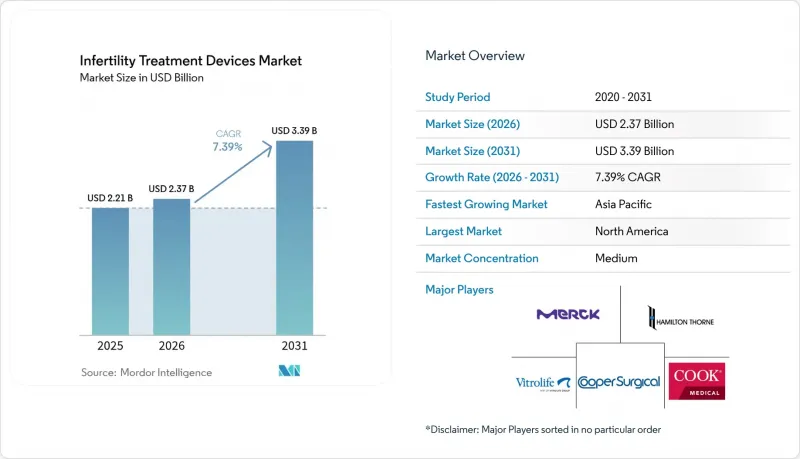
Mordor Intelligence에 의하면, 불임 치료 기기 시장 규모는 2025년 22억 1,000만 달러로 평가되었고, 2026년에는 23억 7,000만 달러로 추정되고, 2026-2031년 CAGR 7.39%로 성장을 지속할 전망이며, 2031년에는 33억 9,000만 달러에 이를 것으로 예측됩니다.
본 보고서는 유형별(정자 분리 장치, 난자 흡입 펌프 등), ART별(보조생식기술), 시술별(체외수정, 세포질 내 정자 주입법 등), 기술 플랫폼별(수동/기존 장치, 반자동 장치 등), 최종 사용자별(불임 치료 클리닉, 병원 및 기타 의료시설 등), 그리고 지역별로 분류되어 있습니다. 시장 전망은 금액(달러) 기준으로 제시되어 있습니다.
세계의 불임 치료 기기 시장 동향 및 인사이트
전 세계 불임 유병률 증가
현재 성인의 약 17.5%가 불임 문제에 직면하고 있으며, 이 수치로 인해 모든 지역에서 보조생식기술에 대한 수요가 증가하고 있습니다. 생활 습관에 기인한 스트레스, 환경 독소, 직업적 위험 요인으로 인해 남성 요인의 진단 범위가 확대되고 있으며, CFAP47 돌연변이 등 단백질 특이적 결함이 현재 정자 무력증과 직접적으로 연관되어 있음에 따라 새로운 진단 분야가 주목받고 있습니다. 불임 상태가 보다 광범위한 건강 지표로 인식됨에 따라 1차 진료 제공업체들은 기초적인 생식 기능 평가를 도입하게 되었고, 불임 치료 기기 시장은 기존의 체외수정(IVF) 클리닉의 범위를 넘어 확장되고 있습니다. 이러한 주류화로 인해 병원 환경에서도 네트워크 연결형 분석기 및 자동화 검사 모듈에 대한 조달 예산이 확대되고 있습니다. 또한, 지속적인 모니터링 기술은 조기 개입을 지원하고 예방 의학을 촉진함으로써 궁극적으로 환자 유입을 확대하는 결과로 이어집니다.
고령 출산과 출산 연기
35세 이상의 여성은 치료를 받는 환자층 중에서 가장 빠르게 증가하고 있으며, 고령 출산에 따른 염색체 이상 위험을 상쇄하기 위해 정교한 난자 품질 평가 지표가 요구되고 있습니다. STORK-A와 같은 비침습적 AI 도구는 현재 70%의 정확도로 염색체 수 이상을 예측할 수 있게 되어, 침습적인 유전자 검사에 대한 의존도를 낮추고 있습니다. 시카고 대학의 휴대용 에스트라디올 측정기는 1회당 0.55달러로 10분 이내에 실험실 수준의 측정 결과를 제공하여, 집에서 생리 주기를 추적하는 데 도움을 주고 있습니다. 응급 난자 동결보존 프로토콜은 개선되었지만, 여전히 환자가 임신을 시도해 온 기간에 크게 의존하고 있어 출산 지연에 따른 시기 선정의 어려움을 더욱 가중시키고 있습니다. 이러한 추세가 맞물리면서, 클리닉들은 AI를 활용한 영상 진단 시스템과 호르몬 분석 장치에 대한 투자를 강요받고 있으며, 이를 통해 검사실의 인사이트를 실제 진료 현장의 한계를 넘어 확장하고 있습니다.
고액의 시술비와 설비비
선진국 시장에서 체외수정(IVF) 1주기 비용은 종종 2만 달러를 초과하여, 충분한 보험 적용을 받지 못하는 가구에게는 감당하기 어려운 가격입니다. 최신 IVF 실험실을 구축하려면 클린룸 정비와 자본 집약적인 로봇 기술이 필요하지만, 소규모 병원의 경우 이러한 투자를 정당화하기 어렵습니다. 2024년의 자재 부족으로 인해 PTFE 카테터의 비용이 상승했고, 공급업체는 인상분을 최종 사용자에게 전가할 수밖에 없어 클리닉의 이익률을 압박하고 있습니다. 자동화는 장기적으로 1주기당 비용 절감을 약속하지만, 역설적으로 현재 시점에서는 가장 막대한 초기 투자가 필요합니다. 그 결과, 비용에 민감한 지역에서는 도입이 지연되고 있어 전 세계 의료 서비스의 양극화를 부추기고 있습니다.
부문 분석
인큐베이터는 2025년 매출의 23.12%를 차지했으며, 최적의 배아 배양에 여전히 필수적입니다. 고사양 모델에는 카메라와 AI 스코어링 모듈이 통합되어 있어, 발육 경과와 환경 로그를 동기화함으로써 프로토콜 조정을 실시간으로 최적화합니다. 마이크로플루이딕스식 정자 선별 칩은 전단 응력을 최소화하여 운동성 정자를 분리하고 수정 확률을 높임으로써 11.78%의 연평균 성장률(CAGR)을 기록하고 있습니다. 정자 분석 장치는 AI 이미지 인식을 활용하여 수동 현미경 관찰보다 일관성 있게 형태를 분류함으로써 진단의 신뢰성을 높이고 있습니다. 난자 흡입 펌프에는 현재 채취 시 난자의 완전성을 보호하는 압력 센서가 내장되어 있으며, 이러한 개선을 통해 시술에 따른 합병증이 감소하고 있습니다. 동결보존 시스템은 견고한 유리화 성능이 높이 평가받는 암 환자의 불임 치료 및 선택적 난자 동결 수요 증가에 힘입어 꾸준히 성장하고 있습니다. 이미징 시스템은 타임랩스 방식으로 진화하고 있으며, Vitrolife사의 ‘EmbryoScope+’에는 자율적인 등급 평가를 수행하는 iDAScore 알고리즘이 내장되어 실험실의 성능을 표준화하고 있습니다. Opto사의 ‘DualStation’과 같은 소형 하이브리드 현미경은 작업대 공간을 절약하면서도 인체공학적 편의성을 높이고 있습니다. 로봇식 마이크로 매니퓰레이터는 완전 자동화된 세포질 내 정자 주입(ICSI)을 가능하게 하여, 조작자의 피로와 실수를 최소화합니다. 배아 이송용 의료용 마이크로 로봇이나 RFID 태그가 부착된 동결보존 랙과 같은 관련 기술 혁신은 워크플로우의 병목 현상을 해소함으로써 불임 치료 기기 시장의 확대에 기여하고 있습니다.
두 번째 성장 요인은 정밀도와 비용 효율성에 중점을 두고 있습니다. 마이크로유체 칩을 도입한 클리닉에서는 처리 시간 단축과 시약 사용량 감소가 보고되고 있으며, 실험실 공간을 확장하지 않고도 1주기당 처리 능력을 향상시킬 수 있게 되었습니다. 예지 유지보수 대시보드를 갖춘 자동 인큐베이터는 가동 중지 시간을 줄이고 점검 주기를 연장합니다. 이는 환자 수가 많은 도시 지역의 의료 센터에 중요한 이점입니다. 고급 영상 기능을 갖춘 인큐베이터는 지역 AI 모델을 재학습시키기 위한 데이터셋도 제공하여, 각 시설이 지역 특유의 인구통계학적 특성에 맞추어 평가 기준을 조정할 수 있도록 지원합니다. 이러한 업그레이드들이 결합되어 표준화를 촉진하고, 규모의 경제를 실현하며, 조기 도입 시설의 경쟁 우위를 강화합니다.
체외수정(IVF)은 매출 점유율의 70.61%를 차지하고 있으며, 이는 남성 요인, 여성 요인 및 원인 불명의 불임증 각 사례에 폭넓게 적용될 수 있음을 반영합니다. 체외수정(IVF)을 중심으로 한 불임 치료용 하드웨어 기기 시장 규모는 클리닉들이 AI 지원 미세 조작 및 배아 배양 모듈을 도입함에 따라 꾸준히 확대될 것으로 전망됩니다. 착상 전 유전자 검사는 연평균 성장률(CAGR) 10.05%를 기록하며 가장 빠르게 성장하고 있는 시술군입니다. 전장 유전체 접근법에서는 현재 3,200개 이상의 유전자를 선별하고 있으며, 그 유용성은 염색체 수 이상 검출에 그치지 않고 다유전자성 위험 감소까지 확대되고 있습니다. 세포질 내 정자 주입법(ICSI)은 바늘 천자 깊이를 표준화하는 로봇 기술의 혜택을 받아, 중증 정자 결핍증에서의 수정률이 향상되고 있습니다. 자궁 내 인공수정(IUI)은 저비용으로 치료를 시작할 수 있는 수단으로서 여전히 그 중요성을 유지하고 있으며, 수동법을 훨씬 능가하는 86%의 운동성 정자를 회수할 수 있는 자동 정자 처리 장치에 의해 뒷받침되고 있습니다. 동결보존 및 유리화 프로토콜은 특히 암 생존자나 경력을 중시하는 전문직 종사자들 사이에서 선택적 불임 치료에 대한 사회적 수용이 확대됨에 따라 그 범위가 넓어지고 있습니다.
긴급 난자 동결보존의 누적 생아 출생률은 29.2%를 보이고 있으며, 그 결과는 남성 요인의 중증도나 연령과 관련이 있기 때문에 신속한 의사 결정 지원 도구의 필요성이 더욱 높아지고 있습니다. AI를 활용한 치료 플래너는 호르몬, 형태학적, 유전학적 정보를 통합하여 개인 맞춤형 자극 요법을 제안함으로써, 약물 투여량을 늘리지 않고도 누적 성공률을 향상시키고 있습니다. 이러한 진보로 인해 환자의 신뢰가 높아지고, 유전자 검사 서비스가 표준 보조 수단으로 자리 잡으며, 각 주기마다 의료기기 관련 추가 수익이 반영되고 있습니다.
지역별 분석
북미는 선진적인 보험 네트워크, 통합된 클리닉 체인, 그리고 프리미엄 AI 모듈의 조기 도입을 통해 2025년 매출의 32.15%를 차지했습니다. 시장 경쟁은 비대면 실험실 견학 및 투명성이 높은 결과 대시보드를 통해 환자 경험을 차별화하는 데 초점이 맞추어져 있습니다. 불임 치료를 보장하는 주 정부의 의무화 조치가 지속적으로 확대되면서, 민간 및 학술 기관의 장비 업그레이드 주기가 안정적으로 유지되고 있습니다. 따라서 지역적 성장세가 둔화되고 있음에도 불구하고, 불임 치료용 장비 시장은 북미의 전략 계획에서 여전히 확고한 입지를 다지고 있습니다.
아시아태평양은 방대한 인구 기반, 가처분 소득 증가, 그리고 부모가 되는 것을 중시하는 문화적 배경에 힘입어 9.23%라는 가장 높은 연평균 성장률(CAGR)을 기록하고 있습니다. 중국의 출산 제한 철폐는 불임률 상승과 맞물려, 처리 능력과 비용의 균형이 잡힌 중간 수준의 자동화 시스템을 도입하는 클리닉이 급증하는 계기가 되고 있습니다. 인도는 불임 치료의 거점으로서의 입지를 확립하며, 가격 면에서의 이점을 누리는 동시에 AI 기반 영상 진단 시스템도 이용할 수 있는 의료 관광객을 유치하고 있습니다. 톰슨 메디컬(Thomson Medical) 등 동남아시아의 사업자들은 중국에서 발생하는 해외 수요의 점유율을 확보하기 위해 지역 내에서 사업을 확장하고 있으며, 이로 인해 불임 치료 기기 시장은 더욱 확대되고 있습니다.
유럽에서는 충실한 보험 환급 제도와 통일된 품질 기준에 힘입어 꾸준한 도입이 진행되고 있습니다. 클리닉들은 MDR 2017/745 준수를 위해 자금을 투자하며, 완전한 기술 문서를 제공할 수 있는 공급업체를 우선적으로 선택하고 있습니다. 중동 및 아프리카에서는 걸프협력회의(GCC) 회원국에서 신규 프로젝트가 진행 중이며, 민관 파트너십을 통해 세계적 수준의 체외수정(IVF) 센터에 자금이 조달되고 있습니다. 카타르의 시드라 메디신은 첨단 배아 영상 진단 시스템을 도입하여, 해외로의 의료 유출에서 국내 의료 제공으로의 전환을 보여주고 있습니다. 남미에서는 브라질이 해외 승인을 규제상 인정하고 있어 수입 기기 시장 출시 기간이 단축되었으며, 다국적 기업들이 저비용 자동화 모듈을 시범 도입하도록 장려되고 있습니다. 이러한 지역별 동향이 맞물리면서, 불임 치료 기기 시장은 수요와 경쟁 기업 간의 경쟁 양면 모두에서 진정한 세계 시장으로 자리매김하고 있습니다.
기타 혜택 :
- 엑셀 형식 시장 예측(ME) 시트
- 3개월간의 애널리스트 지원
자주 묻는 질문
목차
제1장 서론
제2장 조사 방법
제3장 주요 요약
제4장 시장 구도
제5장 시장 규모 및 성장 예측
제6장 경쟁 구도
제7장 시장 기회 및 향후 전망
AJY 26.08.26According to Mordor Intelligence, the infertility treatment devices market size is expected to grow from USD 2.21 billion in 2025 to USD 2.37 billion in 2026 and is forecast to reach USD 3.39 billion by 2031 at 7.39% CAGR over 2026-2031.
This report is Segmented by Type (Sperm Separation Devices, Ovum Aspiration Pumps and More), ART Procedure (IVF, Intracytoplasmic Sperm Injection and More), Tcehnology Platform (Manual / Conventional Devices, Semi-Automated Devices and More), End-User (Fertility Clinics, Hospitals & Other Healthcare Facilities, and More), and Geography. The Market Forecasts are Provided in Terms of Value (USD).
Global Infertility Treatment Devices Market Trends and Insights
Escalating Global Infertility Prevalence
Roughly 17.5% of adults now face fertility challenges, a figure that has elevated demand for assisted reproductive technologies in every region. Lifestyle stressors, environmental toxins, and occupational hazards have widened male-factor diagnoses, and protein-specific defects such as CFAP47 mutations are now directly linked to asthenozoospermia, spotlighting new diagnostic frontiers.As fertility status grows into a broader health marker, primary-care providers add baseline reproductive assessments, enlarging the infertility treatment devices market beyond traditional IVF clinics. This mainstreaming fuels procurement budgets for connected analyzers and automated lab modules even in hospital settings. Continuous monitoring technologies also support early intervention, fostering preventive care that ultimately enlarges the patient funnel.
Rising Maternal Age & Delayed Parenthood
Women aged 35 and older represent the fastest-growing treatment cohort, requiring sophisticated egg-quality metrics to offset chromosomal risks inherent to advanced maternal age. Non-invasive AI tools such as STORK-A now predict aneuploidy with 70% accuracy, shrinking reliance on invasive genetic tests.Handheld estradiol testers from the University of Chicago deliver lab-grade results in 10 minutes at USD 0.55 per test, supporting at-home cycle tracking. Emergency oocyte cryopreservation protocols have improved but still depend heavily on how long patients have attempted conception, magnifying the timing challenge tied to delayed childbearing. Together, these dynamics push clinics to invest in AI-assisted imaging systems and hormone analyzers that extend laboratory insight beyond brick-and-mortar walls.
High Procedure & Equipment Costs
An IVF cycle in developed markets often exceeds USD 20,000, pricing out households lacking robust insurance coverage. Setting up a modern IVF laboratory demands clean-room build-outs and capital-intensive robotics, investments smaller hospitals struggle to justify. Material shortages in 2024 raised PTFE catheter costs, forcing vendors to pass increases to end users and squeezing clinic margins. Automation promises lower per-cycle expenses long term, yet paradoxically requires the highest upfront capital outlay today. Consequently, adoption lags in cost-sensitive regions, reinforcing a two-tier global care model.
Other drivers and restraints analyzed in the detailed report include:
- Wider Reimbursement for ART
- AI-Enabled Embryo-Selection & Imaging Breakthroughs
- Stringent Ethical / Regulatory Hurdles in Many Countries
For complete list of drivers and restraints, kindly check the Table Of Contents.
Segment Analysis
Incubators generated 23.12% of 2025 revenue and remain indispensable for optimal embryo culture. High-end models feature integrated cameras and AI scoring modules that synchronize developmental events with environmental logs, refining protocol adjustments in real time. Microfluidic sperm-sorting chips post a 11.78% CAGR because they isolate motile sperm with minimal shear stress, enhancing fertilization probabilities. Sperm analyzers exploit AI image recognition to classify morphology more consistently than manual microscopy, boosting diagnostic confidence. Ovum aspiration pumps now integrate pressure sensors that safeguard oocyte integrity during retrieval, an upgrade that reduces procedural complications. Cryosystems grow steadily, supported by rising oncofertility and elective egg freezing demand that rewards robust vitrification performance. Imaging systems evolve toward time-lapse modalities; Vitrolife's EmbryoScope+ embeds iDAScore algorithms for autonomous ranking, standardizing lab performance. Compact hybrid microscopes such as Opto's DualStation free bench space while enhancing ergonomics. Robotic micromanipulators facilitate fully automated intracytoplasmic sperm injection, minimizing operator fatigue and error. Adjacent innovations, including medical microrobots for gamete transport and RFID-tagged cryostorage racks, broaden the infertility treatment devices market by solving workflow bottlenecks.
The second-mechanism growth narrative hinges on precision and cost efficiency. Clinics that deploy microfluidic chips report shorter processing times and reduced reagent use, enabling higher cycle throughput without expanding lab footprints. Automated incubators equipped with predictive maintenance dashboards cut downtime and extend service intervals, a key benefit for high-volume urban centers. Imaging-rich incubators also supply datasets that retrain local AI models, helping centers tailor scoring criteria to demographic nuances. Together, these upgrades advance standardization, unlock economies of scale, and reinforce the competitive edge of early adopters.
In-vitro fertilization dominates with 70.61% revenue share, reflecting its versatility across male-factor, female-factor, and unexplained infertility cases. The infertility treatment devices market size for IVF-centric hardware is forecast to expand steadily as clinics integrate AI-assisted micromanipulation and embryo culture modules. Pre-implantation genetic testing support is the fastest-growing procedure group at 10.05% CAGR. Whole-genome approaches now screen over 3,200 genes, extending utility beyond aneuploidy to polygenic risk reduction. Intracytoplasmic sperm injection benefits from robotics that standardize needle penetration depth, elevating fertilization rates in severe oligozoospermia. Intrauterine insemination retains relevance as a low-cost entry, aided by automated sperm processors that recover 86% motile cells, well above manual methods. Cryopreservation and vitrification protocols grow alongside societal acceptance of elective fertility preservation, especially among cancer survivors and career-focused professionals.
Emergency oocyte cryopreservation shows 29.2% cumulative live-birth rates, with outcomes linked to male-factor severity and age, reinforcing the need for rapid decision support tools. AI-driven treatment planners integrate hormonal, morphological, and genetic inputs to propose individualized stimulation regimens, improving cumulative success without raising medication doses. These advancements broaden patient confidence and position genetic testing services as a standard adjunct, embedding additional device revenue in each cycle.
Complete Report Scope:
- By Type
- Sperm Separation Devices
- Ovum Aspiration Pumps
- Sperm Analyzer Systems
- Micromanipulator Systems
- Incubators
- Cryosystems
- Imaging Systems
- Microscopes
- Others
- By Assisted Reproductive Technology (ART) Procedure
- In-Vitro Fertilization (IVF)
- Intracytoplasmic Sperm Injection (ICSI)
- Intrauterine Insemination (IUI)
- Cryopreservation / Vitrification Support
- Pre-implantation Genetic Testing (PGT) Support
- By Technology Platform
- Manual / Conventional Devices
- Semi-Automated Devices
- Fully Automated / Robotic Systems
- AI-Enabled Imaging & Analytics Platforms
- Micro-fluidic Lab-on-Chip Devices
- By End-user
- Fertility Clinics
- Hospitals & Other Healthcare Facilities
- Clinical Research Institutes
- By Geography
- North America
- United States
- Canada
- Mexico
- Europe
- Germany
- United Kingdom
- France
- Italy
- Spain
- Rest of Europe
- Asia-Pacific
- China
- Japan
- India
- Australia
- South Korea
- Rest of Asia-Pacific
- Middle East and Africa
- GCC
- South Africa
- Rest of Middle East and Africa
- South America
- Brazil
- Argentina
- Rest of South America
- North America
Geography Analysis
North America held 32.15% of 2025 revenue thanks to advanced insurance networks, consolidated clinic chains, and early uptake of premium AI modules. Market competition revolves around differentiating patient experience through zero-contact lab tours and transparent outcome dashboards. State mandates covering infertility procedures continue to spread, sustaining steady equipment upgrade cycles in private and academic centers. The infertility treatment devices market therefore remains firmly entrenched in North American strategic planning, even as regional growth moderates.
Asia-Pacific posts the fastest 9.23% CAGR, propelled by massive population bases, rising disposable income, and cultural emphasis on parenthood. China's removal of birth caps intersects with higher infertility rates, spurring a boom in clinics outfitting mid-range automation that balances throughput and cost. India positions itself as the fertility treatment capital, attracting medical tourists who benefit from price advantages while still accessing AI-enabled imaging systems.Southeast Asian operators, such as Thomson Medical, expand regionally to capture a share of outbound Chinese demand, further enlarging the infertility treatment devices market.
Europe displays steady adoption, aided by robust reimbursement and harmonized quality standards. Clinics allocate capital toward compliance with MDR 2017/745, favoring vendors capable of supplying complete technical documentation. Middle East and Africa witness greenfield projects in Gulf Cooperation Council states, where public-private partnerships finance world-class IVF centers. Qatar's Sidra Medicine installed advanced embryo imaging systems, signaling a shift from outbound to domestic care. South America benefits from Brazil's regulatory recognition of foreign approvals, trimming time-to-market for imported hardware and inviting multinationals to pilot lower-cost automation modules. Collectively, geographic dynamics ensure the infertility treatment devices market remains truly global in both demand and competitive rivalry.
- AB Scientific
- Cook Group
- The Cooper Companies
- DxNow (ZyMot Fertility)
- Eppendorf
- Esco Lifesciences
- Hamilton Thorne
- IVFtech ApS
- MedGyn Products
- Merck
- Rocket Medical
- Vitrolife
- Genea Biomedx
- Thermo Fisher Scientific
- Nidacon International
- FUJIFILM
- Gynemed GmbH
- Kitazato
Additional Benefits:
- The market estimate (ME) sheet in Excel format
- 3 months of analyst support
TABLE OF CONTENTS
1 Introduction
- 1.1 Study Assumptions and Market Definition
- 1.2 Scope of the Study
2 Research Methodology
3 Executive Summary
4 Market Landscape
- 4.1 Market Overview
- 4.2 Market Drivers
- 4.2.1 Escalating Global Infertility Prevalence
- 4.2.2 Rising Maternal Age & Delayed Parenthood
- 4.2.3 Wider Reimbursement For ART
- 4.2.4 AI-Enabled Embryo-Selection & Imaging Breakthroughs
- 4.2.5 Launch of Technologically Advanced Products and Their Adoption
- 4.2.6 Surge For Home-Based Fertility Hardware
- 4.3 Market Restraints
- 4.3.1 High Procedure & Equipment Costs
- 4.3.2 Stringent Ethical / Regulatory Hurdles In Many Countries
- 4.3.3 Shortage Of Skilled Embryologists & Lab Technicians
- 4.3.4 Supply-Chain Fragility For Critical IVF Consumables
- 4.4 Value / Supply-Chain Analysis
- 4.5 Regulatory Landscape
- 4.6 Technology Outlook
- 4.7 Porter's Five Forces Analysis
- 4.7.1 Bargaining Power of Suppliers
- 4.7.2 Bargaining Power of Buyers
- 4.7.3 Threat of New Entrants
- 4.7.4 Threat of Substitutes
- 4.7.5 Intensity of Competitive Rivalry
5 Market Size and Growth Forecasts (Value-USD)
- 5.1 By Type
- 5.1.1 Sperm Separation Devices
- 5.1.2 Ovum Aspiration Pumps
- 5.1.3 Sperm Analyzer Systems
- 5.1.4 Micromanipulator Systems
- 5.1.5 Incubators
- 5.1.6 Cryosystems
- 5.1.7 Imaging Systems
- 5.1.8 Microscopes
- 5.1.9 Others
- 5.2 By Assisted Reproductive Technology (ART) Procedure
- 5.2.1 In-Vitro Fertilization (IVF)
- 5.2.2 Intracytoplasmic Sperm Injection (ICSI)
- 5.2.3 Intrauterine Insemination (IUI)
- 5.2.4 Cryopreservation / Vitrification Support
- 5.2.5 Pre-implantation Genetic Testing (PGT) Support
- 5.3 By Technology Platform
- 5.3.1 Manual / Conventional Devices
- 5.3.2 Semi-Automated Devices
- 5.3.3 Fully Automated / Robotic Systems
- 5.3.4 AI-Enabled Imaging & Analytics Platforms
- 5.3.5 Micro-fluidic Lab-on-Chip Devices
- 5.4 By End-user
- 5.4.1 Fertility Clinics
- 5.4.2 Hospitals & Other Healthcare Facilities
- 5.4.3 Clinical Research Institutes
- 5.5 By Geography
- 5.5.1 North America
- 5.5.1.1 United States
- 5.5.1.2 Canada
- 5.5.1.3 Mexico
- 5.5.2 Europe
- 5.5.2.1 Germany
- 5.5.2.2 United Kingdom
- 5.5.2.3 France
- 5.5.2.4 Italy
- 5.5.2.5 Spain
- 5.5.2.6 Rest of Europe
- 5.5.3 Asia-Pacific
- 5.5.3.1 China
- 5.5.3.2 Japan
- 5.5.3.3 India
- 5.5.3.4 Australia
- 5.5.3.5 South Korea
- 5.5.3.6 Rest of Asia-Pacific
- 5.5.4 Middle East and Africa
- 5.5.4.1 GCC
- 5.5.4.2 South Africa
- 5.5.4.3 Rest of Middle East and Africa
- 5.5.5 South America
- 5.5.5.1 Brazil
- 5.5.5.2 Argentina
- 5.5.5.3 Rest of South America
- 5.5.1 North America
6 Competitive Landscape
- 6.1 Market Concentration
- 6.2 Market Share Analysis
- 6.3 Company profiles (includes Global level Overview, Market level overview, Core Segments, Financials as available, Strategic Information, Market Rank/Share for key companies, Products and Services, and Recent Developments)
- 6.3.1 AB Scientific Ltd
- 6.3.2 Cook Medical Inc
- 6.3.3 CooperSurgical Inc
- 6.3.4 DxNow (ZyMot Fertility)
- 6.3.5 Eppendorf AG
- 6.3.6 Esco Micro Pte Ltd
- 6.3.7 Hamilton Thorne Inc
- 6.3.8 IVFtech ApS
- 6.3.9 MedGyn Products
- 6.3.10 Merck KGaA
- 6.3.11 Rocket Medical PLC
- 6.3.12 Vitrolife AB
- 6.3.13 Genea Biomedx
- 6.3.14 Thermo Fisher Scientific
- 6.3.15 Nidacon International
- 6.3.16 FUJIFILM Irvine Scientific
- 6.3.17 Gynemed GmbH
- 6.3.18 Kitazato Corporation
7 Market Opportunities and Future Outlook
- 7.1 White-Space and Unmet-Need Assessment