

|
시장보고서
상품코드
2114529
농업용 생물제제 시험 시장 : 점유율 분석, 업계 동향과 통계, 성장 예측(2026-2031년)Agricultural Biologicals Testing - Market Share Analysis, Industry Trends & Statistics, Growth Forecasts (2026 - 2031) |
||||||
 Mordor Intelligence
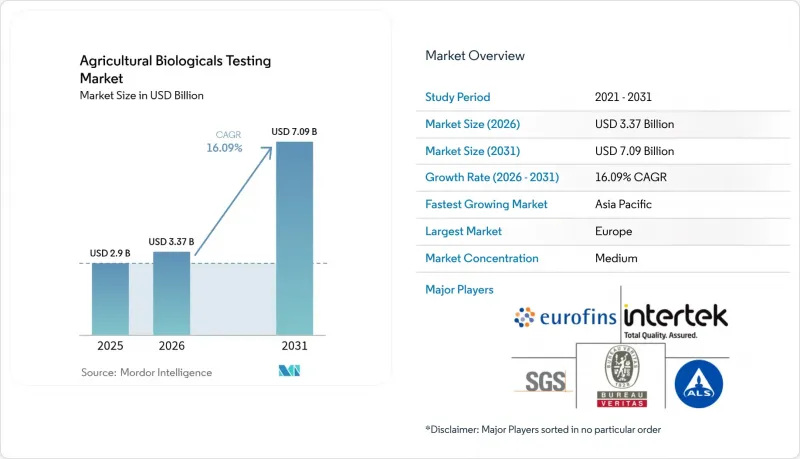
Mordor Intelligence에 의하면, 농업용 생물제제 시험 시장 규모는 2025년에 29억 달러로 평가되었고 2026년 33억 7,000만 달러에서 2031년까지 70억 9,000만 달러에 이를 것으로 예측되며, 예측 기간(2026-2031년) CAGR은 16.09%를 나타낼 전망입니다.
본 보고서는 제품 유형(바이오 농약 등), 용도(농장 지원 등), 작물 유형(곡물 등), 지역(북미, 유럽, 아시아태평양 등)별로 분류되어 있습니다. 시장 예측은 금액(미 달러) 기준으로 제시되어 있습니다.
전 세계 농업용 생물제제 시험 시장 동향 및 인사이트
유기농업 재배 면적의 확대
유기농 경작지 면적은 기존 농지보다 빠른 속도로 계속 확대되고 있으며, 인증 기관은 현재 생물 유래 자재를 승인하기 전에 여러 시즌에 걸친 밭 시험, 잔류물 분석 및 토양 미생물군집 연구를 의무화하고 있습니다. 미국 국가 유기농 프로그램(NOP)은 잔류물 모니터링을 강화하고 있으며, 이로 인해 검사 기관은 첨단 크로마토그래피 및 분자 분석 워크플로우를 통합해야 합니다. 유럽의 유기 인증 제도도 유사한 시험 요건을 반영하고 있으며, 여기에 블록체인 기반 추적성이 추가됨에 따라 검사 기관은 디지털 인프라를 업그레이드할 수밖에 없게 되었습니다. 밭 시험은 변동성을 파악하기 위해 다양한 기후대에서 실시되고 있으며, 그 결과 2-3회의 수확 기간에 걸쳐 시험량이 증가하고 있습니다. 유기 인증 제품의 프리미엄 가격은 증가한 시험 비용을 상쇄하여 검사 서비스에 지속 가능한 자금 순환을 창출하고 있습니다. 규제 당국이 유기 투입 자재 목록을 엄격히 관리하는 가운데, 제조업체들은 수익성이 높은 유기 시장에서 제품의 입지를 지키기 위해 독립적인 ‘적정 실험실 관리 기준(GLP)’ 데이터에 의존하고 있습니다.
생물 유래 제품을 뒷받침하는 엄격한 국제 규제
미국 환경보호청(EPA)은 현재 생화학적 농약에 대해 분자 특성 분석과 종합적인 독성 시험을 의무화하고 있으며, 한편 중국 농업부 산하 농약관리연구소(ICAMA)도 이와 병행하여 미생물계 농약의 등록 프로토콜을 채택하고 있습니다. 이러한 추세로 인해 기본적인 데이터 패키지는 통일되지만, 문서화 장벽은 높아져 대규모 GLP 인증 제공업체가 유리한 입장에 서게 됩니다. 시판 후 감시에 관한 조항에 따라 시험은 제품 출시 후에도 장기간 지속되어 검사 기관에 지속적인 수익을 가져다줍니다. 특정 무역권 내에서의 데이터 상호 인정을 통해 완전한 중복은 피할 수 있지만, 지역 고유의 잔류물 및 환경 조사는 여전히 필요합니다. 신속 심사 경로에서는 종합적인 분석 결과를 포함한 신청 서류가 우대받기 때문에 후원사는 초기부터 고품질 검사 기관에 투자해야만 합니다. 그 결과, 장기적인 규제 준수를 바탕으로 한, 더 대규모이고 예측 가능한 시험 파이프라인이 형성되고 있습니다.
생물제제 시험 지침의 조화 부족
규제의 파편화로 인해 기업들은 관할 구역마다 시험을 반복할 수밖에 없어 비용과 시간이 두 배로 증가하고 있습니다. 통계적 종점 및 환경 안전 기준을 둘러싼 의견 차이로 인해 경제협력개발기구(OECD)의 조화 노력은 지연되고 있으며, 특히 RNA 기반 농약에서 이러한 경향이 두드러집니다. 신흥 시장에서는 시행의 명확성이 확보되지 않은 채 지침 초안이 공표되는 경우가 많아, 조기 시험 투자를 저해하고 있습니다. 중소규모 기업은 병행하여 진행하는 프로그램으로 인해 제한된 자본과 인력이 소모되므로, 불균형한 부담을 감수해야 합니다. 표준적인 조건과 평가 지표가 통일될 때까지는 시험 기관이 제출되는 각 안건마다 프로토콜을 조정해야 하므로, 그 결과 규모의 경제가 훼손되고 개발 주기가 장기화됩니다.
부문 분석
2025년, 바이오 농약 부문은 성숙한 규제 체계와 표준화된 GLP 프로토콜에 힘입어 농업용 생물제제 시험 시장에서 43.62%의 점유율을 차지했습니다. 미생물 유래, 식물 유래 및 RNA 기반 제품이 파이프라인을 통과함에 따라, 바이오 농약 등록과 관련된 농업용 생물제제 시험 시장 규모는 2031년까지 계속 증가할 것으로 예측됩니다. 시험 기관은 확립된 수요 패턴을 활용하여 예측 가능한 일정과 가동률을 실현하고 있습니다. EU 규정 2019/1009에 따라 토양 건전성이 전 세계적으로 주목을 받는 가운데, 바이오 비료는 27.68%의 점유율을 차지했습니다. 생물촉진제의 정의가 명확해지고 있는 만큼, 이 부문은 연평균 성장률(CAGR) 17.15%라는 가장 높은 성장률을 기록하고 있으며, 시험 항목은 식물 대사체학 및 유전자 발현 프로파일링으로 확대되고 있습니다. 검사 기관들은 향후 규제상의 주요 단계에 앞서 이러한 틈새 분야로 사업을 다각화하고 있으며, 이를 통해 처리량이 더욱 확대될 것으로 예측됩니다.
규제 조화에 더해 제품 유형의 다양화는 검사 기관의 경기 변동 대비 저항력을 높이고 있습니다. 장비의 감가상각비는 각종 분석법에 분산되며, 연구원의 교차 교육을 통해 유연한 인력 배치가 가능해집니다. RNA 간섭 제품의 출시가 가까워짐에 따라, 작용기전 및 오프타겟 효과를 검증하는 분자 분석법에 대한 수요가 증가하고 있으며, 서비스의 복잡성과 건당 수익이 높아지고 있습니다.
지역별 분석
아시아태평양이 가장 빠르게 성장하고 있으며, 2031년까지 연평균 성장률(CAGR)은 16.12%로 예상됩니다. 이는 중국이 동남아시아 국가 연합(ICAMA)의 규정에 따라 모든 미생물성 농약에 대해 분자 데이터 제출을 의무화하고 있으며, 일본이 고도의 분자진단을 필요로 하는 RNA 간섭 시험 프로토콜을 도입하고 있기 때문입니다. 중국은 광대한 경작 면적을 보유하고 있으며, 국내 기업과 다국적 기업 모두 신품종을 등록하기 위해 현지에서 시험을 실시해야 하므로 안정적인 수요가 발생하고 있습니다. 한편, 인도의 유기농 경작지는 매년 12% 이상 확대되고 있어 인증 기관을 위한 추가 효능 시험을 견인하고 있습니다. 한국에서는 생물학적 투입제와 스마트 농업용 센서를 결합하고 있기 때문에 현지 검사 기관들은 사물인터넷(IoT) 대시보드에 직접 연결할 수 있는 데이터 플랫폼 업그레이드를 추진하고 있습니다. 또한 인건비가 낮은 점도 더해져, 아시아의 시험 기업들은 많은 유럽 및 미국 공급업체보다 저렴한 가격으로 대규모 및 다중 거점에 걸친 시험을 실시할 수 있게 되었습니다. 아세안(ASEAN)에서는 시험 템플릿의 일관성을 확보하기 위한 새로운 조화 노력이 진행되고 있으며, 이를 통해 향후 몇 년 동안 동남아시아 전역의 규제상 마찰이 완화될 것으로 기대됩니다.
북미는 여전히 가장 큰 매출 점유율을 차지하고 있으며, 2025년에는 34.68%에 육박할 것으로 예측됩니다. 이는 200개 이상의 GLP 인증 시설이 이미 생물제제 시험의 전 범위를 포괄하고 있기 때문입니다. 미국 환경보호청(EPA)과 캐나다 식물관리규제청(PMRA)이 채택한 공통 템플릿 덕분에, 과학적 엄격성을 유지하면서도 후원사는 중복되는 시험 비용을 최대 20%까지 절감할 수 있게 되었습니다. 멕시코의 수출용 생산자들은 미국 및 유럽으로의 출하를 위해 잔류물 제로 인증서 취득을 추진 중이며, 시험 건수를 연평균 18%의 속도로 늘리고 있습니다. 미국의 많은 연구소에 도입된 인공지능(AI) 도구를 통해 데이터 검토 시간이 약 4분의 1로 단축되어, 새로운 미생물 봉쇄 시험에 자원을 할당할 수 있게 되었습니다. 또한, 이 지역은 차세대 프로토콜이 전 세계에 보급되기 전에 시범 운영을 실시하는 대학과의 강력한 파트너십의 혜택도 누리고 있습니다.
유럽에서는 규정 2019/1009에 따라 생물촉진제 시험에 관한 세계에서 가장 상세한 로드맵이 제시되어 진전이 보이고 있습니다. 독일과 프랑스는 대규모 농업 부문과 엄격한 규정 준수 문화 덕분에 이 지역 매출의 40% 이상을 차지하고 있습니다. 영국의 브렉시트 이후 규정에 따라 이중 신청이 의무화됨에 따라, 영국과 프랑스 양측에서 판매되는 제품에 대한 시험 작업이 약 10% 증가하게 될 것입니다. 이번 10년 후반에 시행될 디지털 제품 여권 규정에 따라 블록체인 호환 시험 파일이 요구될 것이며, 이러한 변화는 첨단 데이터 인프라를 갖춘 연구소에 유리하게 작용할 것입니다. ‘그린 딜(Green Deal)’의 인센티브와 온실 재배 작물에 특화된 네덜란드 등의 전문 거점 덕분에, 대륙 전체의 기후대가 크게 다르다는 점에도 불구하고 이 지역의 파이프라인은 항상 탄탄합니다.
기타 혜택:
- 엑셀 형식 시장 예측(ME) 시트
- 3개월간의 애널리스트 지원
자주 묻는 질문
목차
제1장 서론
제2장 조사 방법
제3장 주요 요약
제4장 시장 구도
제5장 시장 규모와 성장 예측
제6장 경쟁 구도
제7장 시장 기회와 향후 전망
JHS 26.09.03According to Mordor Intelligence, the agricultural biologicals testing market size was valued at USD 2.9 billion in 2025 and estimated to grow from USD 3.37 billion in 2026 to reach USD 7.09 billion by 2031, at a CAGR of 16.09% during the forecast period (2026-2031).
This report is Segmented by Product Type (Biopesticides, and More), Application (Field Support, and More), Crop Type (Cereals and Grains, and More), and Geography (North America, Europe, Asia-Pacific, and More). The Market Forecasts are Provided in Terms of Value (USD).
Global Agricultural Biologicals Testing Market Trends and Insights
Expansion of Organic Farming Acreage
Organic acreage continues to grow at a faster rate than conventional land, and certification bodies now require multi-season field trials, residue analytics, and soil microbiome studies before approving biological inputs. The United States National Organic Program has intensified residue surveillance, which requires laboratories to integrate advanced chromatographic and molecular workflows . Europe's organic scheme mirrors these testing demands and adds blockchain traceability, compelling labs to upgrade digital infrastructure. Field trials are conducted across diverse climatic zones to capture variability, thereby increasing testing volume over two to three harvests. Premium pricing for organic-certified products offsets the elevated testing spend, creating a durable funding loop for laboratory services. As regulators tighten organic input lists, manufacturers rely on independent Good Laboratory Practice (GLP) data to protect product positioning in lucrative organic channels.
Stringent Global Regulations Favoring Biologicals
The Environmental Protection Agency now requires molecular characterization and comprehensive toxicology for biochemical pesticides, while China's Institute for the Control of Agrochemicals, Ministry of Agriculture (ICAMA), has adopted parallel microbial registration protocols . This convergence harmonizes fundamental data packages but raises documentation thresholds, favoring large GLP-certified providers. Post-market surveillance clauses extend testing well beyond launch, creating recurring laboratory revenue. Mutual recognition of data within selected trade blocs prevents full duplication, yet still necessitates region-specific residue and environment studies. Accelerated review lanes reward dossiers that include exhaustive analytics, pushing sponsors to invest in premium lab partners from the outset. The net effect is a larger, more predictable testing pipeline anchored to long-term regulatory compliance.
Lack of Harmonized Biological Testing Guidelines
Regulatory fragmentation forces companies to repeat studies for each jurisdiction, multiplying cost and time. Disagreements over statistical endpoints and environmental safety benchmarks slow Organisation for Economic Co-operation and Development (OECD) harmonization efforts, particularly for RNA-based pesticides. Emerging markets often publish draft guidelines without enforcement clarity, deterring early testing investments. Smaller firms face disproportionate burdens, as parallel programs exhaust limited capital and personnel. Until standard terms and endpoints converge, laboratories must tailor protocols for every submission, reducing economies of scale and extending development cycles.
Other drivers and restraints analyzed in the detailed report include:
- Rising Consumer Demand for Residue-Free Food
- Accelerated Research and Development Investments by Agro-Chemical Majors
- High Cost and Duration of Multi-Location Field Trials
For complete list of drivers and restraints, kindly check the Table Of Contents.
Segment Analysis
The biopesticide segment held 43.62% agricultural biologicals testing market share in 2025, supported by mature regulatory frameworks and standardized GLP protocols. The agricultural biologicals testing market size associated with biopesticide registration is projected to keep rising through 2031 as microbial, botanical, and RNA-based products move through pipelines. Laboratories capitalize on established demand patterns, enabling predictable scheduling and utilization rates. Biofertilizers captured a 27.68% share as soil health gained global attention under EU Regulation 2019/1009. Growing clarity around biostimulant definitions propels that category to the fastest 17.15% CAGR, with test menus expanding into plant metabolomics and gene expression profiling. Labs are diversifying into these niches ahead of impending regulatory milestones that should unlock incremental volume.
Coupled with regulatory harmonization, product-type diversification buffers laboratories against cyclicality. Equipment amortization is spread across assay types, and cross-training scientists allows flexible staffing. As RNA-interference products approach launch, demand grows for molecular assays that verify mode of action and off-target effects, deepening service complexity and revenue per study.
Complete Report Scope:
- By Product Type
- Biopesticides
- Biofertilizers
- Biostimulants
- Other Product Types
- By Application
- Field Support
- Regulatory
- Analytical
- Other Applications
- By Crop Type
- Cereals and Grains
- Fruits and Vegetables
- Oilseeds and Pulses
- Others
- By Geography
- North America
- United States
- Canada
- Mexico
- Rest of North America
- Europe
- United Kingdom
- Germany
- France
- Italy
- Spain
- Russia
- Rest of Europe
- Asia-Pacific
- China
- India
- Japan
- Australia
- Rest of Asia-Pacific
- South America
- Brazil
- Argentina
- Rest of South America
- Middle East
- Turkey
- Saudi Arabia
- Rest of Middle East
- Africa
- South Africa
- Kenya
- Rest of Africa
- North America
Geography Analysis
The Asia-Pacific region is the fastest-growing, with a 16.12% CAGR through 2031, as China enforces molecular data requirements for every microbial pesticide under its Association of Southeast Asian Nations (ICAMA) rules and Japan rolls out RNA-interference test protocols that necessitate advanced molecular diagnostics. China's vast acreage generates steady demand because both domestic and multinational firms must run local trials to register new strains, while India's organic acreage is expanding more than 12% each year and drives additional efficacy studies for certification bodies. South Korea is pairing biological inputs with smart-farm sensors, so laboratories there are upgrading data platforms that plug directly into Internet of Things dashboards. Lower labor costs also enable Asian testing companies to run large, multi-location trials at prices that undercut many Western providers. A nascent Association of Southeast Asian Nations (ASEAN) harmonization effort is underway to align study templates, which is expected to reduce regulatory friction across Southeast Asia over the next few years.
North America still holds the largest revenue share, at nearly 34.68% in 2025, as more than 200 GLP-certified facilities already cover the full spectrum of biological assays. A common template adopted by the United States Environmental Protection Agency and Canada's est Management Regulatory Agency (PMRA) now saves sponsors up to 20% in duplicative study spend while keeping scientific rigor intact. Mexico's export growers are sending testing volumes up 18% annually as they pursue residue-free certificates for shipments to the United States and Europe. Artificial-intelligence tools embedded in many United States labs cut data-review time by roughly one-quarter, freeing capacity for novel microbial containment studies. The region also benefits from strong university partnerships that pilot next-generation protocols before they spread worldwide.
Europe advances as Regulation 2019/1009 delivers the world's most detailed roadmap for biostimulant testing. Germany and France account for more than 40% of regional revenue thanks to large farming sectors and strict compliance cultures. The United Kingdom's post-Brexit rules set forces dual submissions, adding roughly 10% in extra study work for products sold on both sides of the Channel. Digital product passport rules that take effect later in the decade will require blockchain-ready test files, a shift that favors labs with sophisticated data infrastructure. Green Deal incentives and specialty hubs such as the Netherlands for greenhouse crops keep the regional pipeline full even as climatic zones vary widely across the continent.
- Eurofins Scientific SE
- SGS SA
- Intertek Group plc
- Bureau Veritas SA
- ALS Limited
- Syntech Research Group
- Staphyt SA
- Anadiag Group
- i2LResearch Ltd. (Cawood Scientific Limited)
- Fera Science Ltd. (Bridgepoint Group plc)
- RJ Hill Laboratories Ltd.
- LAUS GmbH
- Bionema Ltd.
- Biotecnologie B.T. Srl
Additional Benefits:
- The market estimate (ME) sheet in Excel format
- 3 months of analyst support
TABLE OF CONTENTS
1 Introduction
- 1.1 Study Assumptions and Market Definition
- 1.2 Scope of the Study
2 Research Methodology
3 Executive Summary
4 Market Landscape
- 4.1 Market Overview
- 4.2 Market Drivers
- 4.2.1 Expansion of Organic Farming Acreage
- 4.2.2 Stringent Global Regulations Favoring Biologicals
- 4.2.3 Rising Consumer Demand for Residue-Free Food
- 4.2.4 Accelerated Research and Development Investments by Agro-Chemical Majors
- 4.2.5 Outsourcing Surge from Mid-Tier Biological Start-Ups
- 4.2.6 Digital Traceability and Crop Passport Mandates
- 4.3 Market Restraints
- 4.3.1 Lack of Harmonized Biological Testing Guidelines
- 4.3.2 High Cost and Duration of Multi-Location Field Trials
- 4.3.3 Limited Reference Material Libraries for New Microbes
- 4.3.4 Scarcity of Bioassay Statisticians and QA Auditors
- 4.4 Regulatory Landscape
- 4.5 Technological Outlook
- 4.6 Porter's Five Forces Analysis
- 4.6.1 Bargaining Power of Buyers
- 4.6.2 Bargaining Power of Suppliers
- 4.6.3 Threat of New Entrants
- 4.6.4 Threat of Substitutes
- 4.6.5 Intensity of Competitive Rivalry
5 Market Size and Growth Forecasts (Value)
- 5.1 By Product Type
- 5.1.1 Biopesticides
- 5.1.2 Biofertilizers
- 5.1.3 Biostimulants
- 5.1.4 Other Product Types
- 5.2 By Application
- 5.2.1 Field Support
- 5.2.2 Regulatory
- 5.2.3 Analytical
- 5.2.4 Other Applications
- 5.3 By Crop Type
- 5.3.1 Cereals and Grains
- 5.3.2 Fruits and Vegetables
- 5.3.3 Oilseeds and Pulses
- 5.3.4 Others
- 5.4 By Geography
- 5.4.1 North America
- 5.4.1.1 United States
- 5.4.1.2 Canada
- 5.4.1.3 Mexico
- 5.4.1.4 Rest of North America
- 5.4.2 Europe
- 5.4.2.1 United Kingdom
- 5.4.2.2 Germany
- 5.4.2.3 France
- 5.4.2.4 Italy
- 5.4.2.5 Spain
- 5.4.2.6 Russia
- 5.4.2.7 Rest of Europe
- 5.4.3 Asia-Pacific
- 5.4.3.1 China
- 5.4.3.2 India
- 5.4.3.3 Japan
- 5.4.3.4 Australia
- 5.4.3.5 Rest of Asia-Pacific
- 5.4.4 South America
- 5.4.4.1 Brazil
- 5.4.4.2 Argentina
- 5.4.4.3 Rest of South America
- 5.4.5 Middle East
- 5.4.5.1 Turkey
- 5.4.5.2 Saudi Arabia
- 5.4.5.3 Rest of Middle East
- 5.4.6 Africa
- 5.4.6.1 South Africa
- 5.4.6.2 Kenya
- 5.4.6.3 Rest of Africa
- 5.4.1 North America
6 Competitive Landscape
- 6.1 Market Concentration
- 6.2 Strategic Moves
- 6.3 Market Share Analysis
- 6.4 Company Profiles (Includes Global-level Overview, Market-level Overview, Core Segments, Financials, Strategic Information, Market Rank/Share for key companies, Products and Services, and Recent Developments)
- 6.4.1 Eurofins Scientific SE
- 6.4.2 SGS SA
- 6.4.3 Intertek Group plc
- 6.4.4 Bureau Veritas SA
- 6.4.5 ALS Limited
- 6.4.6 Syntech Research Group
- 6.4.7 Staphyt SA
- 6.4.8 Anadiag Group
- 6.4.9 i2LResearch Ltd. (Cawood Scientific Limited)
- 6.4.10 Fera Science Ltd. (Bridgepoint Group plc)
- 6.4.11 RJ Hill Laboratories Ltd.
- 6.4.12 LAUS GmbH
- 6.4.13 Bionema Ltd.
- 6.4.14 Biotecnologie B.T. Srl


