

|
시장보고서
상품코드
2114543
녹농균 감염 치료 시장 : 시장 점유율 분석, 업계 동향 및 통계, 성장 예측(2026-2031년)Pseudomonas Aeruginosa Infection Treatment - Market Share Analysis, Industry Trends & Statistics, Growth Forecasts (2026 - 2031) |
||||||
 Mordor Intelligence
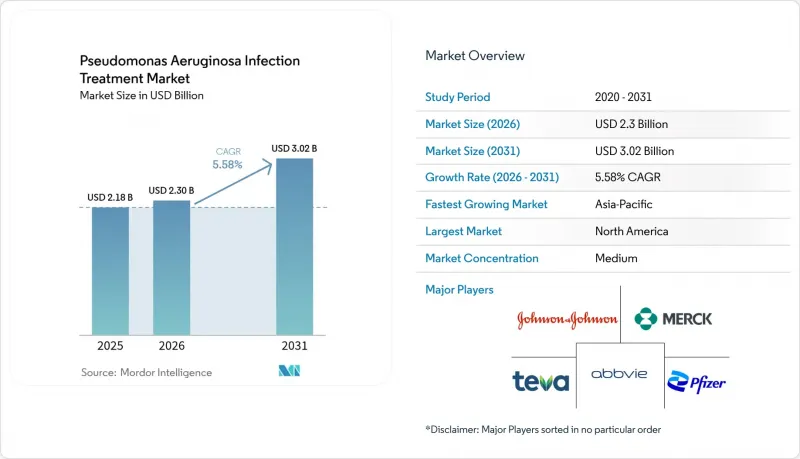
Mordor Intelligence에 의하면, 2026년 녹농균 감염 치료 시장 규모는 23억 달러로 추정되고, 2025년 21억 8,000만 달러에서 확대해, 2031년에는 30억 2,000만 달러에 이를 것으로 예측됩니다.
2026-2031년 연평균 성장률(CAGR) 5.58%로 성장할 것으로 전망됩니다.
본 보고서는 치료법별(단일 요법 및 병용 요법), 투여 경로별(정맥 내 투여, 경구 투여, 흡입/비강 투여 및 외용), 유통 채널별(병원 약국, 소매 약국, 온라인 약국), 그리고 지역별(북미, 유럽, 아시아태평양, 중동 및 아프리카, 남미)로 세분화되어 있습니다. 시장 전망은 금액(달러) 기준으로 제시되어 있습니다.
세계의 녹농균 감염 치료 시장 동향 및 인사이트
병원 내 감염 증가
병원 환경은 특히 중환자실에서 인공호흡기나 침습적 카테터가 사용되는 경우, 녹농균에게 거의 이상적인 번식지가 됩니다. 유럽의 감시 데이터에 따르면, 연간 350만 건 이상의 의료 관련 감염이 발생하여 9만 명 이상의 사망으로 이어지고 있으며, 그중 71%는 항생제 내성균에 의한 것입니다. 인공호흡기 관련 폐렴은 여전히 심각한 문제이며, 광범위한 약물 내성을 보이는 사례에서는 사망률이 35.1%까지 상승하고 있습니다. 이러한 통계 데이터를 배경으로, 병원에서는 생물막을 파괴하고 적응성 내성에 대처할 수 있는 2제 병용 요법이 중요시되고 있습니다.
슈도모나스균 대응 약물에 대한 연구개발 투자 확대
CARB-X 등의 자금 지원 컨소시엄은 Forge Therapeutics사의 금속 효소 억제제나 Phico Therapeutics사의 유전자 변형 파지 플랫폼에 대한 지원에서 볼 수 있듯이, 새로운 작용기전에 대한 연구에 막대한 자금을 투입하고 있습니다. ‘GAIN법’에 따라 147건의 감염증 치료제가 적격으로 지정되어, 획기적인 약물의 심사 주기가 가속화되고 있습니다. 일라이 릴리사와 OpenAI간의 제휴 등은 인공지능이 현재 선도 화합물 창출 파이프라인을 어떻게 뒷받침하고 있는지를 보여줍니다.
다제내성의 급속한 출현
유전적 가소성이 급속한 적응을 촉진하고 있으며, 포르투갈의 3차 의료기관 보고에 따르면 광범위한 약물 내성 유병률은 3.7%, 사망률은 35.1%에 달할 전망입니다. OprD 폴린의 결핍은 카르바페넴 내성을 유발하지만, 완전한 다제내성이 되려면 배설 시스템과 β-락타마제 경로가 서로 얽혀 있는 메커니즘이 필요하며, 이로 인해 임상의들은 2제 병용 요법을 선택할 수밖에 없습니다.
부문 분석
2025년에는 병용 요법이 녹농균 감염 치료 시장의 54.95%를 차지했으며, 2031년까지 연평균 성장률(CAGR) 9.58%로 성장할 전망입니다. 이러한 우위는 카르바페넴 내성 감염증에 대해 세프트로잔-타조바텀과 아미카신의 병용 요법이 단일 요법보다 뛰어난 효과를 보인다는 확고한 3상 임상시험 증거에 의해 뒷받침됩니다. 푸른곰팡이 감염증 치료 시장에서 병용 요법 시장 규모는 배출을 억제하고, β-락타마제를 비활성화하며, 생물막 매트릭스를 파괴하는 시너지 작용기전을 바탕으로 2031년까지 20억 7,000만 달러에 달할 것으로 예측됩니다. 완전 감수성 균주나 특정 외래 치료 적응증에서는 단일 요법이 여전히 중요하지만, 아즈트레오남/아비박탐이나 세페핌/엔메타조박탐과 같은 차세대 하이브리드 제제는 적절한 치료 효과를 얻기 위한 임상적 기준을 재정의하고 있습니다. 파지-항생제 칵테일은 박테리오파지를 이용하여 생물막에 구멍을 뚫고, 보호된 미세 콜로니 내부로 항생제를 주입함으로써 임상 도구 키트를 더욱 확충하고 있습니다.
더 깊이 살펴보면, 2제 병용 프로토콜이 공급망 혼란을 어떻게 완화하고 있는지 명확해집니다. 병원들은 여러 작용기전을 아우르는 범용성이 높은 병용 요법을 비축함으로써 단일 약제의 부족에 대한 완충책을 마련하고 있으며, 이를 통해 항균제에서 나타나는 42% 높은 부족률을 완화하고 있습니다. 한편, 항균제 적정 사용 위원회는 신속한 살균 작용을 가져와 입원 기간을 단축하고, 중환자실(ICU)에서의 장기 치료에 따른 후속 비용을 절감하는 병용 요법을 권장하고 있습니다. 이러한 임상적 및 경제적 이점이 녹농균 감염 치료 시장이 계속해서 2제 병용 전략으로 기울고 있는 이유를 설명해 줍니다.
지역별 분석
북미는 재정력이 탄탄한 병원, 적극적인 항균제 적정 사용 의무화, 그리고 QIDP 지정 의약품의 조기 도입에 힘입어 매출 점유율 34.02%를 견고하게 유지하고 있습니다. 이 지역의 재향군인 보건국(VHA)이 실시한 감시 조사에서는 14년에 걸친 내성 프로파일의 변화가 나타났으며, 이에 따라 프로토콜의 지속적인 갱신과 처방집의 우선순위 재검토가 진행되고 있습니다. 미국에서는 EXBLIFEP 및 EMBLAVEO의 승인이 1년도 채 되지 않아 가속화되었으며, 혁신을 촉진하는 실용적인 규제 환경이 강화되었습니다. 캐나다의 주 차원 의료 개혁에서는 신속한 진단에 대한 보험 환급이 중시되고 있는 반면, 멕시코에서는 항균제 적정 사용이 국가 인증 프로그램에 점점 더 많이 포함되고 있어, 녹농균 감염 치료 시장은 지역적으로 큰 성장 여지가 있습니다.
아시아태평양은 가장 빠른 성장을 보이고 있으며, 각국 보건부가 보편적 의료 보장 및 분자 검사실 확충을 추진하는 가운데 연평균 성장률(CAGR)은 8.55%로 성장을 지속하고, 있습니다. 이 지역 전체에서 카르바페넴계 항생제에 대한 내성률은 평균 31.3%에 달하고 있어, 신속 진단법 및 파지 연구에 대한 적극적인 투자가 요구되고 있습니다. 일본은 모범 사례의 일관성을 구현하고 있으며, B-락타마제 억제제 병용 요법으로 전환되고 있는 발열성 호중구 감소증 지침 준수율은 78.8%에 달할 전망입니다. 중국의 전국 감시 네트워크는 현재 실시간 유전체 추적 기능을 통합하고 있는 반면, 인도는 세계 항생제 공급국으로서의 역할과 규격 미달 수출을 억제하기 위한 품질 관리 노력 사이에서 균형을 맞추고 있습니다.
유럽에서는 안정적이면서도 큰 비즈니스 기회가 예상되고 있습니다. 유럽질병예방통제센터(ECDC)의 협력적 감시를 통해 항생제 사용과 내성의 연관성이 밝혀졌으며, 이는 경구용 약물로 신속히 전환하거나 고용량의 장기 정맥 주입을 권장하는 지침 개정으로 이어지고 있습니다. 규제 조화를 통해 유럽집행위원회는 치료 선택지가 제한적인 병원체에 대해 ‘EMBLAVEO’의 사용을 승인하며, 임상적 증거에 기반한 유연한 정책을 보여주었습니다. 남유럽에서는 내성 부담이 높아 병용 요법의 도입이 진행되고 있는 반면, 스칸디나비아 국가들은 항생제 소비량이 적은 점을 활용하여 비교적 낮은 내성 수준을 유지하고 있습니다. 전반적으로, 녹농균 감염 치료 시장은 서유럽의 주요 시장에서 꾸준한 성장이 예상될 뿐만 아니라, 중동유럽의 전환기 경제국에서도 성장이 가속화될 것으로 전망됩니다.
기타 혜택 :
- 엑셀 형식 시장 예측(ME) 시트
- 3개월간의 애널리스트 지원
자주 묻는 질문
목차
제1장 서론
제2장 조사 방법
제3장 주요 요약
제4장 시장 구도
제5장 시장 규모 및 성장 예측
제6장 경쟁 구도
제7장 시장 기회 및 향후 전망
AJY 26.08.26According to Mordor Intelligence, the pseudomonas aeruginosa infection treatment market size in 2026 is estimated at USD 2.3 billion, growing from 2025 value of USD 2.18 billion with 2031 projections showing USD 3.02 billion, growing at 5.58% CAGR over 2026-2031.
This report is Segmented by Treatment (Monotherapy and Combination Therapy), Route of Administration (Intravenous, Oral, Inhalation / Nasal and Topical), Distribution Channel (Hospital Pharmacies, Retail Phamacies and Online Phamacies) and Geography (North America, Europe, Asia-Pacific, Middle East and Africa, and South America). The Market Forecasts are Provided in Terms of Value (USD).
Global Pseudomonas Aeruginosa Infection Treatment Market Trends and Insights
Rising Prevalence of Hospital-Acquired Infections
Hospital environments create a near-ideal reservoir for Pseudomonas aeruginosa, especially where intensive care units rely on mechanical ventilation and invasive catheters. European surveillance indicates more than 3.5 million healthcare-associated infections yearly, leading to over 90,000 deaths, of which 71% involve antibiotic-resistant organisms. Ventilator-associated pneumonia remains a critical subset, with mortality climbing to 35.1% in extensively drug-resistant episodes.These statistics spur hospitals to favor dual-agent protocols able to break through biofilms and tackle adaptive resistance.
Growing R&D Investment in Antipseudomonal Drugs
Funding consortia such as CARB-X have channelled significant capital toward novel mechanisms, exemplified by support for Forge Therapeutics' metallo-enzyme inhibitors and Phico Therapeutics' engineered phage platform. The GAIN Act has granted 147 qualified infectious disease product designations, accelerating review cycles for breakthrough agents.Partnerships such as Eli Lilly-OpenAI illustrate how artificial intelligence now underpins lead-compound discovery pipelines.
Rapid Emergence of Multidrug Resistance
Genetic plasticity fuels swift adaptation, with Portuguese tertiary centers reporting 3.7% extensively drug-resistant prevalence and 35.1% mortality. OprD porin loss confers carbapenem resistance, yet complete multidrug resistance requires intertwined efflux and B-lactamase pathways that force clinicians toward dual agents.
Other drivers and restraints analyzed in the detailed report include:
- Increasing Chronic Lung Disease Burden (CF, COPD)
- Regulatory Incentives for Phage & Novel Antibiotic Platforms
- High Cost of Next-Generation Antibiotics
For complete list of drivers and restraints, kindly check the Table Of Contents.
Segment Analysis
Combination regimens commanded 54.95% of the Pseudomonas aeruginosa infection treatment market in 2025 and are advancing at a 9.58% CAGR through 2031. This dominance is anchored in robust Phase 3 evidence showing ceftolozane-tazobactam plus amikacin outperforming monotherapy for carbapenem-resistant infections. The Pseudomonas aeruginosa infection treatment market size for combination therapy is expected to reach USD 2.07 billion by 2031 on the back of synergistic mechanisms that block efflux, disable B-lactamases, and disrupt biofilm matrices. Even as monotherapies remain pivotal for fully susceptible isolates and select outpatient indications, next-generation hybrids such as aztreonam/avibactam or cefepime/enmetazobactam are redefining clinical thresholds for adequate coverage. Phage-antibiotic cocktails further expand the clinical toolkit, leveraging bacteriophages to perforate biofilms and ferry antibiotics into protected micro-colonies.
A deeper examination reveals how dual-agent protocols also mitigate supply-chain disruptions. Hospitals cushion against single-drug shortages by stocking versatile combinations spanning multiple mechanisms, thereby tempering the 42% higher shortage rate seen with antimicrobials. Meanwhile, stewardship committees favor combinations that deliver rapid bactericidal activity, shorten hospital stays, and cut downstream costs associated with prolonged ICU support. These clinical and economic advantages explain why the Pseudomonas aeruginosa infection treatment market continues to gravitate toward dual-agent strategies.
Complete Report Scope:
- By Treatment
- Monotherapy
- Combination Therapy
- By Route of Administration
- Intravenous
- Oral
- Inhalation / Nasal
- Topical
- By Distribution Channel
- Hospital Pharmacies
- Retail Pharmacies
- Online / Mail-Order Pharmacies
- By Geography
- North America
- United States
- Canada
- Mexico
- Europe
- Germany
- United Kingdom
- France
- Italy
- Spain
- Rest of Europe
- Asia-Pacific
- China
- Japan
- India
- Australia
- South Korea
- Rest of Asia-Pacific
- Middle East and Africa
- GCC
- South Africa
- Rest of Middle East and Africa
- South America
- Brazil
- Argentina
- Rest of South America
- North America
Geography Analysis
North America holds firm at a 34.02% revenue share thanks to well-funded hospitals, aggressive stewardship mandates, and early uptake of QIDP-designated drugs. The region's Veterans Health Administration surveillance shows shifting resistance profiles across 14 years, prompting continuous protocol updates and shifting formulary priorities. The United States accelerated approvals for EXBLIFEP and EMBLAVEO in less than a year, reinforcing a pragmatic regulatory environment that accelerates innovation. Canada's provincial health reforms emphasize rapid diagnostic reimbursement, while Mexico increasingly codifies stewardship into national accreditation programs, giving the Pseudomonas aeruginosa infection treatment market strong regional headroom.
Asia-Pacific is the fastest riser, clocking an 8.55% CAGR as health ministries expand universal coverage and molecular labs. Carbapenem resistance reaches a mean 31.3% across the region, necessitating robust investment in rapid diagnostics and phage research. Japan exemplifies best-practice alignment, with 78.8% adherence to febrile neutropenia guidelines that pivot toward B-lactamase inhibitor combinations. China's national surveillance network now integrates real-time genomic tracking, while India balances its role as the world's antibiotic supplier with quality-control initiatives to curb substandard exports.
Europe demonstrates stable but sizable opportunity. Coordinated ECDC surveillance links antimicrobial use to resistance, informing guideline updates that favor rapid switch-to-oral strategies and high-dose prolonged infusions. Regulatory alignment enabled the European Commission to green-light EMBLAVEO for pathogen-limited options, illustrating responsive policy to clinical evidence. Southern Europe's higher resistance burden drives combination therapy uptake, while Scandinavian countries leverage low antibiotic consumption to maintain comparatively lower resistance levels. Overall, the Pseudomonas aeruginosa infection treatment market remains primed for steady gains within western European strongholds and accelerated growth in central and eastern transition economies.
- Abbvie
- Teva Pharmaceutical Industries
- Pfizer
- Lupin
- AstraZeneca
- Merck
- Bristol-Myers Squibb
- Johnson & Johnson
- Neopharma
- CARB-X
- Sanofi
- Shionogi & Co.
- GlaxoSmithKline
- Novartis
- Roche
- Basilea Pharmaceutica
- Insmed
- Zambon S.p.A.
- Cipla
- Hikma Pharmaceuticals
Additional Benefits:
- The market estimate (ME) sheet in Excel format
- 3 months of analyst support
TABLE OF CONTENTS
1 Introduction
- 1.1 Study Assumptions and Market Definition
- 1.2 Scope of the Study
2 Research Methodology
3 Executive Summary
4 Market Landscape
- 4.1 Market Overview
- 4.2 Market Drivers
- 4.2.1 Rising Prevalence Of Hospital-Acquired Infections
- 4.2.2 Growing R&D Investment In Antipseudomonal Drugs
- 4.2.3 Increasing Chronic Lung Disease Burden (CF, COPD)
- 4.2.4 Regulatory Incentives For Phage & Novel Antibiotic Platforms
- 4.2.5 Adoption Of Inhaled Nano-Formulations Improving Adherence
- 4.2.6 Expansion Of Rapid Molecular Diagnostics
- 4.3 Market Restraints
- 4.3.1 Rapid Emergence Of Multidrug Resistance
- 4.3.2 High Cost Of Next-Generation Antibiotics
- 4.3.3 Cold-Chain Gaps For Liposomal Inhaled Products In LICs
- 4.3.4 Tighter Antimicrobial-Stewardship Protocols In High-Income Health Systems
- 4.4 Value / Supply-Chain Analysis
- 4.5 Regulatory Landscape
- 4.6 Technology Outlook
- 4.7 Porter's Five Forces Analysis
- 4.7.1 Bargaining Power of Suppliers
- 4.7.2 Bargaining Power of Buyers
- 4.7.3 Threat of New Entrants
- 4.7.4 Threat of Substitutes
- 4.7.5 Intensity of Competitive Rivalry
5 Market Size and Growth Forecasts (Value-USD)
- 5.1 By Treatment
- 5.1.1 Monotherapy
- 5.1.2 Combination Therapy
- 5.2 By Route of Administration
- 5.2.1 Intravenous
- 5.2.2 Oral
- 5.2.3 Inhalation / Nasal
- 5.2.4 Topical
- 5.3 By Distribution Channel
- 5.3.1 Hospital Pharmacies
- 5.3.2 Retail Pharmacies
- 5.3.3 Online / Mail-Order Pharmacies
- 5.4 By Geography
- 5.4.1 North America
- 5.4.1.1 United States
- 5.4.1.2 Canada
- 5.4.1.3 Mexico
- 5.4.2 Europe
- 5.4.2.1 Germany
- 5.4.2.2 United Kingdom
- 5.4.2.3 France
- 5.4.2.4 Italy
- 5.4.2.5 Spain
- 5.4.2.6 Rest of Europe
- 5.4.3 Asia-Pacific
- 5.4.3.1 China
- 5.4.3.2 Japan
- 5.4.3.3 India
- 5.4.3.4 Australia
- 5.4.3.5 South Korea
- 5.4.3.6 Rest of Asia-Pacific
- 5.4.4 Middle East and Africa
- 5.4.4.1 GCC
- 5.4.4.2 South Africa
- 5.4.4.3 Rest of Middle East and Africa
- 5.4.5 South America
- 5.4.5.1 Brazil
- 5.4.5.2 Argentina
- 5.4.5.3 Rest of South America
- 5.4.1 North America
6 Competitive Landscape
- 6.1 Market Concentration
- 6.2 Market Share Analysis
- 6.3 Company profiles (includes Global level Overview, Market level overview, Core Segments, Financials as available, Strategic Information, Market Rank/Share for key companies, Products and Services, and Recent Developments)
- 6.3.1 AbbVie (Allergan)
- 6.3.2 Teva Pharmaceutical Industries
- 6.3.3 Pfizer
- 6.3.4 Lupin
- 6.3.5 AstraZeneca
- 6.3.6 Merck & Co.
- 6.3.7 Bristol Myers Squibb
- 6.3.8 Johnson & Johnson
- 6.3.9 Neopharma
- 6.3.10 CARB-X
- 6.3.11 Sanofi
- 6.3.12 Shionogi & Co.
- 6.3.13 GSK
- 6.3.14 Novartis
- 6.3.15 F. Hoffmann-La Roche Ltd
- 6.3.16 Basilea Pharmaceutica
- 6.3.17 Insmed Incorporated
- 6.3.18 Zambon S.p.A.
- 6.3.19 Cipla
- 6.3.20 Hikma Pharmaceuticals
7 Market Opportunities and Future Outlook
- 7.1 White-Space and Unmet-Need Assessment


