|
시장보고서
상품코드
2114552
트로카 : 시장 점유율 분석, 업계 동향 및 통계, 성장 예측(2026-2031년)Trocars - Market Share Analysis, Industry Trends & Statistics, Growth Forecasts (2026 - 2031) |
||||||
 Mordor Intelligence
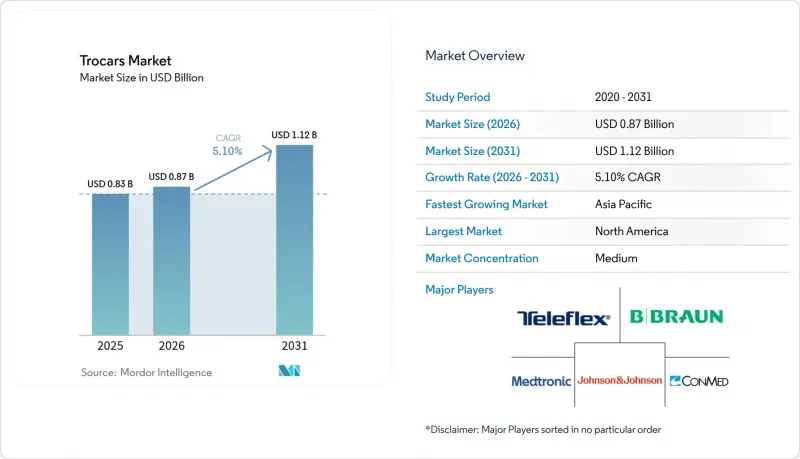
Mordor Intelligence에 의하면, 트로카 시장 규모는 2025년에 8억 3,000만 달러로 평가되었습니다. 2026년 8억 7,000만 달러에서 성장하여 2031년까지 11억 2,000만 달러에 이를 것으로 추정되고 있습니다.
예측 기간(2026-2031년) 동안 연평균 성장률(CAGR)은 5.10%를 나타낼 것으로 전망됩니다.
본 보고서는 제품 유형(일회용, 재사용 가능), 팁 유형(블레이드 포함, 블레이드 없음, 광학 등), 용도(일반외과, 산부인과 수술, 비뇨기과 수술 등), 최종 사용자(병원, 외래수술센터(ASC), 전문 클리닉) 및 지역(북미, 유럽 등)별로 분류되어 있습니다. 시장 전망은 금액(달러) 기준으로 제시되어 있습니다.
세계의 트로카 시장 동향 및 인사이트
개복 수술에서 최소 침습 수술로의 급속한 전환
외상 진단에서 복강경 검사는 사망 위험을 90%, 심각한 합병증을 62% 감소시키기 때문에 현재 외과의들은 개복 수술보다 복강경 수술을 선호하고 있습니다. 입원 기간의 단축은 병원의 예산 절감과 병상 회전율 향상으로 이어져, 트로카에 의존하는 수술법에 대한 의료 기관의 선호도를 높이고 있습니다. 이에 대응하여 의료기기 제조업체들은 액세스 포트, 송기 필터, 연기 배출 밸브를 세트로 구성한 수술별 전용 키트를 제공하고 있으며, 이러한 변화가 프리미엄 가격 책정을 뒷받침하고 있습니다. 근거에 기반한 임상적 이점의 급증이 트로카 시장을 견인하고 있습니다. 특히, 보다 안전한 첫 천자를 실현하는 광학 유도 기능을 통합한 시스템에서 이러한 경향이 두드러집니다. 그 결과, 병원 측은 설비 투자 계획을 재검토하여 복강경 타워와 이에 수반되는 트로카용 일회용 부품을 우선적으로 도입하게 되었으며, 이는 공급업체에게 지속적인 수익원을 확보해 주고 있습니다.
비만 수술 건수 증가
비만 유병률 증가로 인해 비만 수술은 연평균 성장률(CAGR) 6.96%로 계속 증가하고 있으며, 더 두꺼운 복벽을 관통할 수 있는 장축·저저항 트로카에 대한 수요를 자극하고 있습니다. 보험사가 외래에서 시행되는 대사 수술을 인정함에 따라, 퇴원 당일에 귀가가 가능한 로봇 보조 단일 문합 십이지장-회장 우회술(SADI) 기법이 도입을 더욱 가속화하고 있습니다. 현재 엔지니어링 팀은 복강 내 기압을 유지하면서 삽입 토크를 줄일 수 있도록 트로카 끝부분을 설계하고 있으며, 이러한 발전은 BMI 수치가 높은 환자층으로부터 높은 평가를 받고 있습니다. 비만 외과 센터 오브 엑설런스(Center of Excellence)의 추천을 받은 공급업체는 외과의사들이 워크플로우 숙련도를 높이기 위해 단일 플랫폼을 표준화하는 경향이 있기 때문에 견고한 채널 파트너십을 구축할 수 있습니다. 비만 수술 분야의 이러한 모멘텀은 안정적인 수술 건수와 연장형 광학 관찰기 등 수술에 특화된 부가 상품 판매를 통해 트로카 시장 전체의 성장을 더욱 가속화하고 있습니다.
트로카와 관련된 합병증
트로카 삽입 부위의 탈장은 발생 빈도는 낮지만, 추가 수술이 필요하며 특정 포트 직경에 대해 보험사의 반발을 불러일으키고 있습니다. 2024년 사례 보고서에서는 로봇 보조 자궁 적출술 후 감금성 복벽 탈장이 발생하여 응급 복원이 필요했던 사례가 상세하게 기술되어 있습니다. 소송 위험을 우려하여 일부 의료 기관에서는 10mm를 초과하는 포트에 대해 근막 폐쇄 장치의 사용을 의무화하고 있으며, 이로 인해 수술 시간과 비용이 증가하고 있습니다. 블레이드리스나 방사형으로 확장 가능한 선단부는 근막 결손을 완화하지만, 잔존하는 합병증 위험으로 인해 임상 현장의 우려는 여전히 남아 있으며, 병적 비만 환자나 고령자 같은 고위험군에서 트로카 시장의 성장을 다소 둔화시키고 있습니다.
부문별 분석
2025년, 일회용 제품은 개봉 후 바로 사용할 수 있는 멸균 상태이며 재처리 과정이 필요 없습니다는 점 때문에 트로카 시장 점유율의 60.95%를 차지했습니다. 복강경 수술 건수가 많은 병원에서는 수술 부위 감염(SSI) 예방 효과가 단가를 상회하기 때문에 지속적인 지출을 감수하고 있습니다. 그러나 지속가능성에 대한 요구와 자본 예산의 압박으로 인해, 재사용 가능한 핸들과 멸균된 캐뉼라를 결합한 하이브리드 모델에 대한 관심이 높아지고 있습니다. 이러한 하이브리드화는 트로카 시장 규모의 22.00%를 차지하고 있으며, 연평균 성장률(CAGR) 5.96%로 업계 전체를 상회하는 성장이 예상됩니다. 생명주기 평가에 따르면, 하이브리드 설계는 완전 일회용 세트에 비해 온실가스 배출량을 50% 감축하는 것으로 나타났습니다. 검증된 세척 및 소독 워크플로우에 투자하는 의료 기관은 핸들의 감가상각으로 인해 1건당 실질 비용이 낮아지므로, 10년 단위의 비용 절감을 실현하고 있습니다. 그 결과, 유럽 및 캐나다의 조달 위원회에서는 입찰에 탄소 감축 점수를 반영하기 시작하면서 하이브리드 제품에 대한 수요가 더욱 높아지고 있습니다.
재사용 가능한 제품은 멸균 처리 부서의 인력이 충분히 확보되어 있고, 설비 투자 비용이 수천 건의 사례에 분산되는 교육 병원에서 확고한 입지를 유지하고 있습니다. 일부 미국의 통합 의료 네트워크(IDN)에서는 유지보수 계약을 포함하더라도 재사용 가능한 포트의 투자 회수 기간이 6년인 것으로 기록하고 있습니다. 다만, 경량 폴리머 하우징을 선호하는 외과의사의 경향으로 인해, 완전히 재사용 가능한 스테인리스 세트는 틈새 시장 수준에 머물러 있습니다. 예측 기간 동안, 경쟁 우위는 한 손으로 오브투레이터를 제거할 수 있게 해주는 모듈식 설계, 일체형 공기 공급 밸브, 그리고 사용 현황 추적을 위한 RFID 태그를 중심으로 전개될 것입니다. 초기 비용을 늘리지 않으면서 이러한 기능을 최적화하는 공급업체는 비용에 민감한 의료 시스템에서 트로카 시장 점유율을 점진적으로 확대해 나갈 것으로 전망됩니다.
블레이드리스 제품은 복막 천자에 필요한 힘을 줄여주는 조직 분리 콘이 호평을 받아 2025년 매출의 46.10%를 차지했습니다. 그러나 광학식/직시형 모델은 실시간 천자 경로 시각화가 치료 성과 데이터로 입증됨에 따라 연평균 7.33%의 속도로 시장을 확대되고 있습니다. 한 다기관 공동 연구에서는 1,187건의 사례에서 광학식 오뷰레이터를 채택한 결과, 중대한 혈관 손상이 단 한 건도 없었습니다고 보고되었습니다. 이러한 뛰어난 안전성 프로파일은 지급 기관의 품질 지표 및 의료 과실 위험 감소와 부합하며, 병원이 프리미엄 가격 책정을 정당화할 수 있게 해줍니다.
고저항 조직에 대한 기존의 주력 제품이었던 블레이드가 장착된 트로카는 신속한 접근이 최우선으로 요구되는 외상 및 비만 수술 분야에서 여전히 널리 사용되고 있습니다. 복막에 도달했을 때만 후퇴하는 비외상성 실드 등의 혁신적인 기술로 인해 조직 관통 위험이 경감되어 그 유용성이 유지되고 있습니다. 2024년 비교 연구에서 직접 트로카 삽입법의 합병증 발생률이 3.3%인 반면, 베레스 바늘을 이용한 천자에서는 15.7%로 나타난 것을 계기로, 직접 트로카 삽입법에 대한 지지가 높아지고 있습니다. 향후 경쟁 우위는 광학 모드와 블레이드리스 모드를 전환할 수 있는 멀티모달 포트에 있으며, 다양한 환자의 해부학적 구조에 걸쳐 유용성을 확대함으로써 트로카 시장에 대한 공급업체의 침투를 더욱 심화시키는 데 있을 것입니다.
지역별 분석
2025년, 북미는 복강경 수술 건수 400만 건과 외래수술센터(ASC)의 적극적인 확장에 힘입어 트로카 시장의 41.95%를 차지했습니다. 캐나다의 국민건강보험 제도에서는 지방 외상 센터의 광학식 장비 업그레이드 비용이 환급되는 반면, 멕시코는 미국 퇴직자들을 사립 병원으로 유도하는 국경 간 의료 관광의 혜택을 받고 있습니다. 규제의 예측 가능성과 확립된 멸균 기준이 프리미엄 가격(ASP)을 뒷받침하고 있으며, 이는 북미가 전체 트로카 시장 규모에 기여하는 비중을 더욱 높이고 있습니다.
아시아태평양은 6.69%라는 가장 높은 연평균 성장률(CAGR)을 기록하고 있습니다. 중국은 현립 병원의 복강경 수술 기술 실습실에 자금을 지원하고 있으며, 이로 인해 트로카 판매량이 두 자릿수 성장을 보이며 해안 지역의 3차 의료 센터와의 기술 격차가 줄어들고 있습니다. 인도의 중산층은 민간 비만 치료 패키지를 점점 더 많이 선택하고 있으며, 이는 연장형 광학 포트의 꾸준한 재주문으로 이어지고 있습니다. 일본에서는 보다 안전한 삽입을 원하는 고령화되는 외과의사층을 배경으로, 광학식 삽입 시스템의 조기 도입이 진행되고 있습니다. 한국과 호주에서는 연기 흡입 기능을 통합한 최고급 일회용 키트가 주류를 이루고 있습니다. 이러한 동향들이 맞물려 해당 지역의 트로카 시장 점유율 확대를 뒷받침하고 있으며, 수입 관세를 억제하기 위한 현지 생산의 타당성을 입증하고 있습니다.
유럽은 매출의 약 27.80%를 차지하고 있으며, 수술 건수 면에서는 독일, 프랑스, 영국이 선두를 달리고 있습니다. EU의 그린 딜(Green Deal)에 따라 병원은 매년 환경 영향에 관한 정보를 공개해야 할 의무가 있으며, 이로 인해 전적으로 플라스틱으로 만들어진 일회용 제품에서 하이브리드 핸들로의 전환이 시급해지고 있습니다. 스칸디나비아 국가들의 입찰에서는 수명 주기 내 탄소 배출량 지표에 최대 20%의 비중이 부여되면서, 재사용 가능한 제품의 도입이 가속화되고 있습니다. 중동부 유럽은 구매력 면에서는 뒤처져 있지만, 기부금으로 지원되는 복강경 수술 프로그램이 유치되면서 트로카에 대한 기초적인 수요를 자극하고 있습니다. EU 이외 지역에서는 중동의 GCC 국가들이 로봇 수술실과 고성능 광학 포트를 갖춘 새로운 메가 병원을 구축하고 있으며, 아프리카에서의 보급은 남아프리카공화국의 대학 병원과 나이지리아의 민간 의료 센터를 중심으로 진행되고 있습니다.
라틴아메리카는 시장 점유율이 한 자릿수 중반에 머물러 있지만, 브라질이 주요 의료기기의 수입 관세를 자유화하고 있어 성장 여지가 있습니다. 아르헨티나의 환율이 불안정하여 자본 유입은 제한되고 있으나, 재사용 가능한 스테인리스 세트에 대한 그레이 마켓 수요가 발생하고 있습니다. 이러한 격차를 메우는 지역 간 유통업체들은 규제 조화를 앞서가며 선점 우위를 확보하고 있습니다. 전반적으로 지리적 분산화로 인해 전 세계 트로카 시장은 지역별 상환 제도나 공급망 혼란의 영향을 덜 받게 되어 안정적인 총 수요 곡선이 유지되고 있습니다.
기타 혜택 :
- 엑셀 형식 시장 예측(ME) 시트
- 3개월간의 애널리스트 지원
자주 묻는 질문
목차
제1장 서론
제2장 조사 방법
제3장 주요 요약
제4장 시장 구도
제5장 시장 규모 및 성장 예측
제6장 경쟁 구도
제7장 시장 기회 및 향후 전망
KTH 26.08.28According to Mordor Intelligence, the trocars market size was valued at USD 0.83 billion in 2025 and estimated to grow from USD 0.87 billion in 2026 to reach USD 1.12 billion by 2031, at a CAGR of 5.10% during the forecast period (2026-2031).
This report is Segmented by Product Type (Disposable Trocars and Reusable Trocars), Tip Type (Bladeless Trocars, Optical Trocare and More), Application (General Surgery, Gynaecological Surgery, Urological Surgery, and More), End User (Hospital, Ambulatory Surgical Centers, and Specialty Clinics) and Geography (North America, Europe, and More). The Market Forecasts are Provided in Terms of Value (USD).
Global Trocars Market Trends and Insights
Rapid Shift from Open to Minimally Invasive Procedures
Surgeons now favor laparoscopy over laparotomy because it cuts mortality odds by 90% and major complications by 62% in trauma diagnostics. Shorter inpatient stays translate to leaner hospital budgets and faster bed turnover, intensifying institutional preference for trocar-dependent approaches. Device makers answer with procedure-specific kits that package access ports, insufflation filters, and smoke evacuation valves, a shift that fuels premium pricing. The surge in evidence-backed clinical benefits propels the trocars market, especially in systems that integrate optical guidance for safer first entry. Hospitals are therefore rewriting capital expenditure plans to prioritize laparoscopic towers and complementary trocar disposables, anchoring recurring revenue streams for vendors.
Rising Bariatric Surgery Volumes
Obesity prevalence keeps bariatric interventions on a 6.96% CAGR upswing, spurring demand for long-shaft, low-drag trocars able to traverse thicker abdominal walls . Robotic single-anastomosis duodeno-ileal bypass (SADI) techniques that enable same-day discharge further accelerate adoption, as payers reward outpatient metabolic surgery. Engineering teams now model trocar tips to cut insertion torque while safeguarding pneumoperitoneum, an advance valued by high-BMI patient cohorts. Vendors that secure bariatric center-of-excellence endorsements capture sticky channel partnerships because surgeons tend to standardize on a single platform for workflow familiarity. This bariatric momentum compounds overall trocars market growth through dependable case volumes and procedure-specific up-sells such as extended-length optical obturators.
Trocar-related Complications
Trocar-site hernia, although infrequent, incurs added surgeries and drives insurer pushback on certain port diameters. A 2024 case report details an incarcerated ventral hernia following robotic hysterectomy that necessitated emergent repair. Litigation fears compel some facilities to mandate fascial-closure devices for ports larger than 10 mm, increasing procedure time and cost. While bladeless and radially expandable tips reduce fascial defects, residual complication risks sustain clinical reservations, modestly damping trocars market growth in high-risk cohorts such as morbidly obese or elderly patients.
Other drivers and restraints analyzed in the detailed report include:
- Industry Migration toward Optical Entry Systems
- OEM-ASC Bulk-Purchase Contracts
- Increasing Regulatory Scrutiny on Sharps Waste Disposal
For complete list of drivers and restraints, kindly check the Table Of Contents.
Segment Analysis
Disposable units commanded 60.95% of trocars market share in 2025 due to ready-to-use sterility and zero reprocessing labor. Hospitals running high laparoscopy volumes accept the recurrent spend because SSI avoidance outweighs unit cost. Yet sustainability mandates and capital-budget pressures are redirecting attention to hybrid models whose reusable handle pairs with a sterile cannula. This hybridization captured 22.00% of the trocars market size and is projected to outpace the overall industry at a 5.96% CAGR. Life-cycle assessments show hybrid designs cut greenhouse emissions by 50% compared with fully disposable sets. Providers that invest in validated washer-disinfector workflows realize decade-scale savings as handle amortization lowers effective cost per case. Consequently, purchasing committees in Europe and Canada now embed carbon-reduction scoring into tenders, strengthening hybrid demand.
Reusables maintain a foothold in teaching hospitals where sterile-processing staffing is ample and capital amortization spreads over thousands of cases. Some U.S. integrated delivery networks (IDNs) record six-year payback periods on reusable ports, inclusive of maintenance contracts. Even so, surgeon preference for lightweight polymer housings keeps fully reusable stainless-steel sets niche. Over the forecast horizon, competitive positioning will revolve around modular designs that allow single-handed obturator release, integrated insufflation valves, and RFID tags for usage tracking. Vendors optimizing those features without inflating upfront price are poised to win incremental trocars market share across value-conscious health systems.
Bladeless devices delivered 46.10% of 2025 revenue, favored for their tissue-separating cones that lower peritoneal puncture force. However, optical/direct-vision models are expanding 7.33% annually as outcomes data vindicate real-time entry visualization. One multi-center trial reported zero major vascular injuries when an optical obturator was employed in 1,187 cases. The superior safety profile aligns with payer quality metrics and malpractice risk reduction, allowing hospitals to justify premium pricing
Bladed trocars, historically the mainstay for high-resistance tissue, still populate trauma and bariatric sets where rapid access is paramount. Innovations such as atraumatic shields that retract only upon reaching peritoneum mitigate cut-through risk, preserving their relevance. Direct trocar insertion techniques are gaining endorsement after a 2024 comparative study showed a 3.3% complication rate versus 15.7% with Veress needle entry. Future competitive edge lies in multi-modal ports that toggle between optical and bladeless modes, extending utility across diverse patient anatomies and thereby deepening vendor penetration into the trocars market.
Complete Report Scope:
- By Product Type
- Disposable
- Reusable
- By Tip Design
- Bladed
- Bladeless
- Optical
- By Application
- General & Gastrointestinal Surgery
- Gynecological Surgery
- Urological Surgery
- Bariatric Surgery
- Other Laparoscopic Procedures
- By End-user
- Hospitals
- Ambulatory Surgery Centers (ASCs)
- Specialty Clinics
- By Geography (Value)
- North America
- United States
- Canada
- Mexico
- Europe
- Germany
- United Kingdom
- France
- Italy
- Spain
- Rest of Europe
- Asia-Pacific
- China
- Japan
- India
- South Korea
- Australia
- Rest of Asia- Pacific
- Middle East and Africa
- GCC
- South Africa
- Rest of Middle East and Africa
- South America
- Brazil
- Argentina
- Rest of South America
- North America
Geography Analysis
North America occupied 41.95% of the trocars market in 2025, anchored by 4 million laparoscopic cases and aggressive ASC growth. Canada's universal payment system reimburses optical upgrades for rural trauma centers, while Mexico benefits from cross-border medical tourism that channels U.S. retirees into private hospitals. Regulatory predictability and established sterilization standards sustain premium ASPs, reinforcing North America's contribution to overall trocars market size.
Asia-Pacific posts the highest 6.69% CAGR. China funds laparoscopic skill labs in county hospitals, spurring double-digit trocar volume gains and shortening the capability gap with coastal tertiary centers. India's middle class increasingly opts for private bariatric packages, translating into robust reorder activity for extended-length optical ports. Japan favors early adoption of optical entry systems due to its aging surgeon workforce seeking safer insertions. South Korea and Australia champion top-of-the-line disposable kits integrated with smoke evacuation. Together these dynamics underpin the region's growing slice of trocars market share and justify localized manufacturing to curb import tariffs.
Europe represents around 27.80% revenue, with Germany, France, and the United Kingdom leading procedure counts. The EU's Green Deal forces hospitals to file annual environmental impact disclosures, pressuring them to shift from all-plastic disposables to hybrid handles. Scandinavian tenders now award up to 20% weightage to lifecycle carbon metrics, accelerating reposable adoption. Central and Eastern Europe trail in spending power but attract donor-funded laparoscopic programs that stimulate baseline trocar demand. Beyond the EU, the Middle East's GCC states are outfitting new mega-hospitals with robotic suites and high-spec optical ports, while Africa's uptake centers on South Africa's academic hospitals and Nigeria's private centers.
Latin America holds a mid-single-digit share yet offers upside as Brazil liberalizes import duties on critical medical devices. Argentina's volatile currency restricts capital imports but creates gray-market demand for reusable stainless-steel sets. Pan-regional distributors filling these gaps build first-mover advantage ahead of regulatory harmonization. Collectively, geographic diversification insulates the global trocars market against localized reimbursement or supply chain shocks, sustaining a steady aggregate demand curve.
- Ethicon Inc. (Johnson & Johnson)
- Medtronic
- B. Braun
- Teleflex
- Conmed
- Applied Medical Resources
- The Cooper Companies
- Olympus
- Karl Storz
- Stryker
- Richard Wolf
- Purple Surgical UK Ltd
- GENICON Inc.
- Grena
- LaproSurge Ltd
- Microline Surgical Inc.
- KLS Martin Group
- SeonMed Tech Co. Ltd
- Zhejiang Geyi Medical Instrument Co. Ltd
- Trokamed GmbH
Additional Benefits:
- The market estimate (ME) sheet in Excel format
- 3 months of analyst support
TABLE OF CONTENTS
1 Introduction
- 1.1 Study Assumptions & Market Definition
- 1.2 Scope of the Study
2 Research Methodology
3 Executive Summary
4 Market Landscape
- 4.1 Market Overview
- 4.2 Market Drivers
- 4.2.1 Rapid Shift from Open to Minimally-Invasive Procedures
- 4.2.2 Rising Bariatric Surgery Volumes owing to Soaring Obesity Prevalence
- 4.2.3 Accelerated Replacement Cycles for Disposable Trocars Driven by Strict Infection-Control Mandates
- 4.2.4 Government-Funded Laparoscopic Skills Programs Boosting Adoption in Middle-Income Countries
- 4.2.5 Industry Migration toward Optical Entry Systems to Reduce Visceral Injury Risk
- 4.2.6 OEM-ASC Bulk-Purchase Contracts Elevating Unit Sales Volumes in the U.S.
- 4.3 Market Restraints
- 4.3.1 Increasing Regulatory Scrutiny on Sharps Waste Disposal
- 4.3.2 Complications Associated With the Use of Trocars
- 4.3.3 Regulatory Challenges for Device Approvals
- 4.4 Supply-Chain Analysis
- 4.5 Regulatory or Technological Outlook
- 4.6 Porter's Five Forces Analysis
- 4.6.1 Threat of New Entrants
- 4.6.2 Bargaining Power of Suppliers
- 4.6.3 Bargaining Power of Buyers
- 4.6.4 Threat of Substitutes
- 4.6.5 Competitive Rivalry
5 Market Size & Growth Forecasts (Value, USD)
- 5.1 By Product Type
- 5.1.1 Disposable
- 5.1.2 Reusable
- 5.2 By Tip Design
- 5.2.1 Bladed
- 5.2.2 Bladeless
- 5.2.3 Optical
- 5.3 By Application
- 5.3.1 General & Gastrointestinal Surgery
- 5.3.2 Gynecological Surgery
- 5.3.3 Urological Surgery
- 5.3.4 Bariatric Surgery
- 5.3.5 Other Laparoscopic Procedures
- 5.4 By End-user
- 5.4.1 Hospitals
- 5.4.2 Ambulatory Surgery Centers (ASCs)
- 5.4.3 Specialty Clinics
- 5.5 By Geography (Value)
- 5.5.1 North America
- 5.5.1.1 United States
- 5.5.1.2 Canada
- 5.5.1.3 Mexico
- 5.5.2 Europe
- 5.5.2.1 Germany
- 5.5.2.2 United Kingdom
- 5.5.2.3 France
- 5.5.2.4 Italy
- 5.5.2.5 Spain
- 5.5.2.6 Rest of Europe
- 5.5.3 Asia-Pacific
- 5.5.3.1 China
- 5.5.3.2 Japan
- 5.5.3.3 India
- 5.5.3.4 South Korea
- 5.5.3.5 Australia
- 5.5.3.6 Rest of Asia- Pacific
- 5.5.4 Middle East and Africa
- 5.5.4.1 GCC
- 5.5.4.2 South Africa
- 5.5.4.3 Rest of Middle East and Africa
- 5.5.5 South America
- 5.5.5.1 Brazil
- 5.5.5.2 Argentina
- 5.5.5.3 Rest of South America
- 5.5.1 North America
6 Competitive Landscape
- 6.1 Market Concentration
- 6.2 Strategic Moves
- 6.3 Market Share Analysis
- 6.4 Company Profiles (includes Global level Overview, Market level overview, Core Segments, Financials as available, Strategic Information, Market Rank/Share for key companies, Products & Services, and Recent Developments)
- 6.4.1 Ethicon Inc. (Johnson & Johnson)
- 6.4.2 Medtronic plc
- 6.4.3 B. Braun Melsungen AG
- 6.4.4 Teleflex Incorporated
- 6.4.5 CONMED Corporation
- 6.4.6 Applied Medical Resources Corp.
- 6.4.7 CooperSurgical Inc.
- 6.4.8 Olympus Corporation
- 6.4.9 Karl Storz SE & Co. KG
- 6.4.10 Stryker Corporation
- 6.4.11 Richard Wolf GmbH
- 6.4.12 Purple Surgical UK Ltd
- 6.4.13 GENICON Inc.
- 6.4.14 Grena Ltd
- 6.4.15 LaproSurge Ltd
- 6.4.16 Microline Surgical Inc.
- 6.4.17 KLS Martin Group
- 6.4.18 SeonMed Tech Co. Ltd
- 6.4.19 Zhejiang Geyi Medical Instrument Co. Ltd
- 6.4.20 Trokamed GmbH
7 Market Opportunities & Future Outlook
- 7.1 White-space & Unmet-Need Assessment