|
시장보고서
상품코드
2114571
CRISPR 및 CRISPR 관련(Cas) 유전자 : 시장 점유율 분석, 업계 동향 및 통계, 성장 예측(2026-2031년)CRISPR And CRISPR-associated (Cas) Genes - Market Share Analysis, Industry Trends & Statistics, Growth Forecasts (2026 - 2031) |
||||||
 Mordor Intelligence
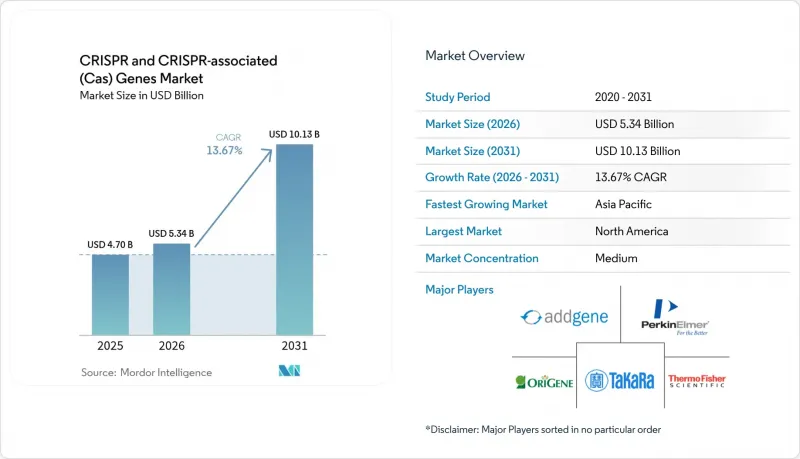
Mordor Intelligence에 의하면, 2026년 CRISPR 및 CRISPR 관련(Cas) 유전자 시장 규모는 53억 4,000만 달러로 추정되고 2025년 47억 달러에서 확대해, 2031년에는 101억 3,000만 달러에 이를 것으로 예측됩니다.
2026년부터 2031년에 걸쳐 연평균 성장률(CAGR) 13.67%로 성장할 것으로 전망됩니다.
본 보고서는 구성 요소(제품, 서비스), 용도(의생명과학, 농업 등), 최종 사용자(생명공학·제약 기업 등), 기술 유형(CRISPR-Cas9 등), 전달 방법(바이러스 벡터, 비바이러스), 지역(북미, 유럽 등)별로 분류되어 있습니다. 시장 전망은 금액(달러) 기준으로 제시되어 있습니다.
세계의 CRISPR 및 CRISPR 관련(Cas) 유전자 시장 동향과 인사이트
CRISPR 기반 치료법에 대한 FDA 승인
2023년 12월 Casgevy의 승인으로 안전성 및 유효성에 관한 기준이 확립되었으며, 현재 전 세계적으로 최소 8개의 추가 후기 임상시험 프로그램이 이 기준을 지침으로 삼고 있습니다. Prime Medicine은 인간 임상시험 단계에 도달한 최초의 프라임 편집 치료제인 PM359에 대해 곧 승인을 획득했습니다. 이는 규제 당국이 차세대 플랫폼을 위험이 아닌 점진적인 개선으로 간주하고 있음을 시사합니다. Intellia Therapeutics는 두 가지 후보 약물을 동시에 3상 임상시험 단계로 진행하며, 지금까지의 승인이 가져온 신뢰감을 입증하고 있습니다. 가격 측면의 압박은 여전히 지속되고 있으며, Casgevy의 1회 투여당 정가가 200만 달러인 점을 감안할 때, 투여 및 제조 효율화를 위한 노력이 더욱 활발해지고 있습니다.
전달 기술(바이러스성 및 비바이러스성)의 발전
조직 특이적 캡시드 공학을 통해 Sangamo의 STAC-BBB와 같은 벡터가 개발되었습니다. 이는 AAV9에 비해 혈액-뇌 장벽을 통해 700배 더 많은 트랜스유전자를 전달하여, 수익성이 높은 신경학 분야의 적응증을 개척하고 있습니다. COVID-19 백신 제조 과정에서 개선된 지질 나노입자는 현재 CRISPR Therapeutics에서 생체 내 심혈관계 적용을 위한 CRISPR 운반체로 활용되고 있습니다. Regeneron이 Mammoth Biosciences에 9,500만 달러를 투자한 전략적 투자는 바이러스의 페이로드 제한 범위 내에서 면역원성 위험을 줄이는 초소형 뉴클레아제를 목표로 하고 있습니다. 표적 지향성 바이러스 벡터와 확장 가능한 합성 캐리어를 결합한 하이브리드 시스템은 장기에 대한 도달 범위를 넓히고 제조상의 병목 현상을 완화하기 위해 현재 평가가 진행 중입니다.
오프타겟 안전성 및 윤리적 우려
규제 당국은 생체 내의 영구적인 변화는 되돌릴 수 없기 때문에 의도파관 않은 편집을 감지하기 위한 다층적인 검출 분석을 의무화하고 있으며, 이로 인해 전임상 개발 기간이 장기화되고 비용이 증가하고 있습니다. 면역종양학의 초기 임상시험에서 심근경색이나 뇌졸중의 징후가 보고된 연구를 계기로 경계심이 높아지고 있으며, 유럽 규제 당국은 중추신경계를 표적으로 하는 경우 특히 보수적인 입장을 취하고 있습니다. 또한, 해충 방제를 목적으로 한 유전자 드라이브 제안과 관련하여 윤리적 논쟁이 일고 있으며, 이는 인간 건강에의 응용으로도 파급되어 일부 지역에서는 일반 시민들의 인식을 흐리게 하고 있습니다. 베이스 편집이나 프라임 편집은 이중 가닥 절단을 회피함으로써 위험을 줄이는 것을 목표로 하고 있지만, 규제 당국이 현재의 안전 기준을 완화하기 위해서는 수년에 걸친 안전성 데이터 세트가 필요할 것입니다.
부문별 분석
2025년에는 제품이 총 매출의 78.45%를 차지했습니다. 이는 신약 개발 및 번역 의학 워크플로우 전반에서 사용되는 가이드 RNA 키트, Cas 효소, 형질 도입 시약에 대한 지속적인 수요를 반영한 것입니다. Thermo Fisher와 Merck KGaA는 연구 처리 능력에 따라 확장 가능한 카탈로그 시약을 제공함으로써, 치료제 개발의 주요 단계에서 발생하는 변동을 완화하는 예측 가능한 수익 기반을 뒷받침하고 있습니다. 생명공학 기업 고객들이 분석법 개발, 세포주 공학, GMP 준수 바이러스 벡터 제조를 전문 CRO에 아웃소싱함에 따라 서비스 부문은 연평균 성장률(CAGR) 14.12%로 확대되고 있습니다. Charles River Laboratories는 신약 개발부터 1상 제조에 이르는 전 과정의 파트너로서의 입지를 확고히 하고 있으며, 이는 CRISPR 및 CRISPR 관련(Cas) 유전자 시장에서 외부 통합 역량으로의 전환이라는 광범위한 추세를 반영합니다.
치료 파이프라인의 확대에 따라 공정 개발, 품질 관리, 규제 관련 문서 작성에 대한 수요가 증가하고 있으며, 예측 기간 동안 서비스 침투율은 해마다 높아지고 있습니다. 공급업체들은 전환 비용을 확보하고 다운스트림 공정의 가치에서 더 큰 점유율을 확보하기 위해 시약, 전달 벡터, 분석 소프트웨어를 플랫폼 패키지로 묶어 제공합니다.
2025년 매출의 81.40%는 고부가가치 치료법, 동반 진단, 그리고 고가 책정 및 장기적인 파트너십이 필요한 신약 스크리닝에 힘입은 생의학 프로그램에서 창출되었습니다. 잠재적 위험 프로파일은 강력한 벤처 캐피탈 지원과 희귀질환에 대한 인센티브 확대로 균형을 이루고 있습니다. 연평균 성장률(CAGR) 15.18%로 성장하고 있는 농업 분야는 미국의 규제 간소화 혜택을 받고 있습니다. 전통적인 육종을 통해 얻은 유전자 편집 작물은 장기적인 환경 평가가 면제되므로 시장 출시 기간이 대폭 단축되어 농가 수요가 확대되고 있습니다.
중국이 2025년을 목표로 내세운 밀, 옥수수, 대두의 생명공학 기반 재배 장려 지침은 생산량 확대를 더욱 촉진하여 아시아태평양의 성장 동력을 뒷받침할 전망입니다. 특수 화학물질의 바이오 생산 등 합성생물학의 활용 사례는 현재 매출 규모가 여전히 작지만, 아직 발전 단계에 있음에도 유망한 틈새 시장을 형성하고 있습니다. 치료 분야와 농업 분야 간의 지식 교류는 특히 전달 벡터 및 컴퓨터 설계 분야에서 플랫폼의 진화를 가속화하여, CRISPR 산업 생태계 전체를 심화시키고 있습니다.
지역별 분석
북미는 FDA의 명확한 지침, 풍부한 벤처 캐피탈 자금, 그리고 보스턴과 샌프란시스코 베이 지역에 집중된 전문 인력 덕분에 2025년에도 매출의 47.10%를 차지하며 주도적인 위치를 유지했습니다. 또한 이 지역은 특정 유전자 편집 작물을 기존 육종 품종과 동일하게 취급하는 미국 농무부(USDA) 규정의 혜택을 받아, 치료제 이외의 분야에서 다양한 수익원을 확보하고 있습니다. 비용 압박과 제조상의 병목 현상으로 인해 기업들은 저비용 지역에 생산 거점을 설립하려는 동기가 높아지고 있으며, 성장은 다소 둔화되겠지만 2030년까지는 전략적 중심지로서의 지위를 유지할 전망입니다.
아시아태평양은 중국의 강력한 국가 자금 지원, 풍부한 인재 기반, 그리고 현재 미국을 능가하는 700건 이상의 CRISPR 임상시험이 진행 중이라는 점 덕분에 15.89%라는 가장 높은 연평균 성장률(CAGR)을 기록하고 있습니다. 일본의 스마트셀 프로젝트와 같은 정책 이니셔티브는 제약 및 산업용 유전자 변형 세포 공장의 상용화를 목표로 하고 있으며, 고부가가치 바이오 제조로 지역 전체가 전환되는 것을 뒷받침하고 있습니다. 인도는 농가의 CRISPR 작물 도입을 제한하는 엄격한 라이선싱 제도로 인해 어려움을 겪고 있으며, 이는 지역 발전 궤적을 형성하는 데 있어 지적재산권 체계가 얼마나 중요한지를 여실히 보여주고 있습니다.
유럽은 뛰어난 과학기술 역량을 보유하고 있지만, 유전자 편집 생물이 기존의 유전자 변형 생물(GMO)과 동일한 엄격한 규제의 대상이 되기 때문에 승인까지의 기간이 길어지고 규정 준수 비용이 증가함에 따라 상용화 측면에서 뒤처지고 있습니다. 그 결과, 많은 유럽 기업들은 자국에 연구개발 거점을 유지하면서도 임상시험은 북미나 아시아에서 실시했습니다.
라틴아메리카,중동 및 아프리카는 여전히 신흥 시장이며, 규제 체계는 발전 단계에 있고, 의료비 지출도 낮은 상황이지만, 브라질의 애그리테크 분야에서의 조기 도입은 세계 공급망이 성숙해지고 현지 정책이 과학의 진보와 보조를 맞춘다면, 장래에 기회가 생길 것임을 시사하고 있습니다.
기타 혜택 :
- 엑셀 형식 시장 예측(ME) 시트
- 3개월간의 애널리스트 지원
자주 묻는 질문
목차
제1장 서론
제2장 조사 방법
제3장 주요 요약
제4장 시장 구도
제5장 시장 규모 및 성장 예측
제6장 경쟁 구도
제7장 시장 기회 및 향후 전망
KTH 26.08.28According to Mordor Intelligence, CRISPR and CRISPR-associated (CAS) genes market size in 2026 is estimated at USD 5.34 billion, growing from 2025 value of USD 4.70 billion with 2031 projections showing USD 10.13 billion, growing at 13.67% CAGR over 2026-2031.
This report is Segmented by Component (Product and Services), by Application (Biomedical, Agriculture and More), by End User (Biotechnology & Pharmaceutical Company and More), by Technology Type (CRISPR-Cas9 and More), by Delivery Method (Viral Vectors and Non-Viral) and Geography (North America, Europe, and More). The Market Forecasts are Provided in Terms of Value (USD).
Global CRISPR And CRISPR-associated (Cas) Genes Market Trends and Insights
FDA Approvals of CRISPR-Based Therapies
The December 2023 approval of Casgevy established a safety and efficacy template that is now guiding at least eight additional late-stage programs worldwide. Prime Medicine soon received clearance for PM359, the first prime-editing therapy to reach human trials, signaling that regulators view next-generation platforms as incremental improvements rather than risks . Intellia Therapeutics advanced two candidates to Phase 3 simultaneously, underscoring the confidence provided by prior approvals. Pricing pressure remains, as the USD 2 million per-dose list price of Casgevy has intensified the hunt for delivery and manufacturing efficiencies.
Advances in Delivery Technologies (Viral and Non-Viral)
Tissue-specific capsid engineering has produced vectors like Sangamo's STAC-BBB, which delivers 700-fold more transgene across the blood-brain barrier than AAV9 and opens lucrative neurology indications. Lipid nanoparticles, refined during COVID-19 vaccine production, now package CRISPR cargos for in-vivo cardiovascular applications at CRISPR Therapeutics. A USD 95 million strategic investment by Regeneron into Mammoth Biosciences targets ultracompact nucleases that fit within viral payload limits while cutting immunogenicity risks. Hybrid systems that marry targeted viral vectors with scalable synthetic carriers are under evaluation to widen organ reach and ease manufacturing bottlenecks.
Off-Target Safety and Ethical Concerns
Regulators require multi-layer detection assays for unintended edits because permanent changes cannot be reversed in vivo, extending pre-clinical development and adding cost. Studies citing myocardial infarction and stroke signals in early immuno-oncology trials have heightened vigilance, with European agencies adopting especially conservative positions for central-nervous-system targets. Ethical debate also surrounds gene-drive proposals for pest control, spilling over into human-health applications and clouding public perception in some regions. Base and prime editing aim to mitigate risk by avoiding double-strand breaks, but multi-year safety datasets will be needed before regulators relax current guardrails
Other drivers and restraints analyzed in the detailed report include:
- Rising R&D Funding and Strategic Partnerships
- AI-Driven sgRNA Design Accelerates Time-to-Lead
- High CMC and Manufacturing Cost Structure
For complete list of drivers and restraints, kindly check the Table Of Contents.
Segment Analysis
Products controlled 78.45% of total revenue in 2025, reflecting sustained demand for guide RNA kits, Cas enzymes, and transfection reagents used across discovery and translational workflows. Thermo Fisher and Merck KGaA offer catalogue reagents that scale with research throughput, underpinning a predictable revenue base that buffers volatility in therapeutic milestones. Services are pacing at a 14.12% CAGR as biotech clients outsource assay development, cell-line engineering, and GMP viral-vector production to specialist CROs. Charles River Laboratories positions itself as an end-to-end partner from discovery to Phase I manufacturing, mirroring a broader shift in the CRISPR and CRISPR-associated (CAS) genes market toward integrated external capabilities.
Growing therapeutic pipelines multiply demand for process development, quality control, and regulatory documentation, lifting service penetration every year of the forecast. Suppliers are bundling reagents, delivery vectors, and analytics software into platform packages to secure switching costs and capture a larger slice of downstream value.
Biomedical programs generated 81.40% of 2025 revenue, sustained by high-value therapies, companion diagnostics, and drug discovery screens that command premium pricing and long-term partnerships. The implicit risk profile is balanced by strong venture capital support and expanding orphan-disease incentives. Agriculture, growing at 15.18% CAGR, benefits from streamlined regulation in the United States where gene-edited plants that could be derived through conventional breeding skip protracted environmental assessments, slashing the time to market and expanding farmer.
China's 2025 guidance encouraging biotech cultivation of wheat, corn, and soy is set to unlock additional volume and reinforce the Asia-Pacific growth story. Synthetic biology use cases such as bio-production of specialty chemicals represent a nascent yet promising niche, though current revenue remains modest. Cross-fertilisation of knowledge between therapeutic and agricultural segments accelerates platform evolution, particularly around delivery vectors and computational design, deepening the overall CRISPR industry ecosystem.
Complete Report Scope:
- By Component
- Products
- Services
- By Application
- Biomedical
- Agriculture
- Industrial & Synthetic Biology
- By End User
- Biotechnology & Pharmaceutical Cos.
- Academic & Government Institutes
- Contract Research / Manufacturing Orgs.
- By Technology Type
- CRISPR-Cas9
- Base Editing
- Prime Editing
- CRISPR-Cas12/13 & Others
- By Delivery Method
- Viral Vectors
- Non-viral (LNPs, Electroporation, Nanocarriers)
- By Geography
- North America
- United States
- Canada
- Mexico
- Europe
- Germany
- United Kingdom
- France
- Italy
- Spain
- Rest of Europe
- Asia-Pacific
- China
- Japan
- India
- South Korea
- Australia
- Rest of Asia-Pacific
- Middle East and Africa
- GCC
- South Africa
- Rest of Middle East and Africa
- South America
- Brazil
- Argentina
- Rest of South America
- North America
Geography Analysis
North America retained leadership with 47.10% revenue in 2025 thanks to FDA clarity, deep venture capital pools, and concentration of specialised talent in Boston and the San Francisco Bay Area. The region further benefits from USDA rules that treat certain gene-edited crops like conventionally bred varieties, supporting diversified revenue streams beyond therapeutics. Cost pressure and manufacturing bottlenecks create incentives for firms to establish production sites in lower-cost jurisdictions, slightly tempering growth yet maintaining strategic centrality through 2030.
Asia-Pacific posts the fastest CAGR at 15.89%, led by China's strong state financing, a large talent base, and more than 700 active CRISPR clinical trials that now outnumber those in the United States. Policy initiatives like Japan's Smart Cell Project aim to commercialise gene-engineered cellular factories for pharma and industrial applications, reinforcing a region-wide pivot to high-value biomanufacturing. India wrestles with restrictive licensing regimes that limit farmers' adoption of CRISPR crops, underscoring the importance of intellectual-property frameworks in shaping local trajectories.
Europe holds significant scientific prowess but lags in commercialisation because gene-edited organisms fall under the same stringent rules as traditional GMOs, stretching approval timelines and raising compliance costs. Consequently many European firms conduct clinical trials in North America or Asia while maintaining R&D bases at home.
Latin America, the Middle East, and Africa remain emergent; regulatory frameworks are still evolving and healthcare spending is lower, yet early adoption in Brazil's agritech sector suggests future opportunity once global supply chains mature and local policy aligns with scientific progress.
- CRISPR Therapeutic
- Editas Medicine
- Intellia Therapeutics
- Beam Therapeutics
- Caribou Biosciences
- Mammoth Biosciences
- Synthego
- Thermo Fisher Scientific
- Merck
- Agilent Technologies
- Horizon Discovery
- Origene Technologies
- Charles River
- Sangamo Therapeutics
- ERS Genomics
- Aldevron
- Ubigene Biosciences
- Cellecta
- Applied StemCell
- Integrated DNA Technologies
- Verve Therapeutics
Additional Benefits:
- The market estimate (ME) sheet in Excel format
- 3 months of analyst support
TABLE OF CONTENTS
1 Introduction
- 1.1 Study Assumptions & Market Definition
- 1.2 Scope of the Study
2 Research Methodology
3 Executive Summary
4 Market Landscape
- 4.1 Market Overview
- 4.2 Market Drivers
- 4.2.1 FDA approvals of CRISPR-based therapies
- 4.2.2 Advances in delivery technologies (viral & non-viral)
- 4.2.3 Rising R&D funding & strategic partnerships
- 4.2.4 Mitochondrial in-vivo CRISPR opens rare-disease pipeline
- 4.2.5 AI-driven sgRNA design accelerates time-to-lead
- 4.2.6 Regulatory easing for gene-edited crops
- 4.3 Market Restraints
- 4.3.1 Off-target safety & ethical concerns
- 4.3.2 High CMC & manufacturing cost structure
- 4.3.3 Supply-chain concentration in Cas nucleases
- 4.3.4 Public backlash over gene-drive ecology risk
- 4.4 Value / Supply-Chain Analysis
- 4.5 Regulatory Landscape
- 4.6 Technological Outlook
- 4.7 Porter's Five Forces
- 4.7.1 Threat of New Entrants
- 4.7.2 Bargaining Power of Suppliers
- 4.7.3 Bargaining Power of Buyers
- 4.7.4 Threat of Substitutes
- 4.7.5 Competitive Rivalry
5 Market Size & Growth Forecasts (Value)
- 5.1 By Component
- 5.1.1 Products
- 5.1.2 Services
- 5.2 By Application
- 5.2.1 Biomedical
- 5.2.2 Agriculture
- 5.2.3 Industrial & Synthetic Biology
- 5.3 By End User
- 5.3.1 Biotechnology & Pharmaceutical Cos.
- 5.3.2 Academic & Government Institutes
- 5.3.3 Contract Research / Manufacturing Orgs.
- 5.4 By Technology Type
- 5.4.1 CRISPR-Cas9
- 5.4.2 Base Editing
- 5.4.3 Prime Editing
- 5.4.4 CRISPR-Cas12/13 & Others
- 5.5 By Delivery Method
- 5.5.1 Viral Vectors
- 5.5.2 Non-viral (LNPs, Electroporation, Nanocarriers)
- 5.6 By Geography
- 5.6.1 North America
- 5.6.1.1 United States
- 5.6.1.2 Canada
- 5.6.1.3 Mexico
- 5.6.2 Europe
- 5.6.2.1 Germany
- 5.6.2.2 United Kingdom
- 5.6.2.3 France
- 5.6.2.4 Italy
- 5.6.2.5 Spain
- 5.6.2.6 Rest of Europe
- 5.6.3 Asia-Pacific
- 5.6.3.1 China
- 5.6.3.2 Japan
- 5.6.3.3 India
- 5.6.3.4 South Korea
- 5.6.3.5 Australia
- 5.6.3.6 Rest of Asia-Pacific
- 5.6.4 Middle East and Africa
- 5.6.4.1 GCC
- 5.6.4.2 South Africa
- 5.6.4.3 Rest of Middle East and Africa
- 5.6.5 South America
- 5.6.5.1 Brazil
- 5.6.5.2 Argentina
- 5.6.5.3 Rest of South America
- 5.6.1 North America
6 Competitive Landscape
- 6.1 Market Concentration
- 6.2 Market Share Analysis
- 6.3 Company Profiles (includes Global level Overview, Market level overview, Core Segments, Financials as available, Strategic Information, Market Rank/Share for key companies, Products & Services, and Recent Developments)
- 6.3.1 CRISPR Therapeutics
- 6.3.2 Editas Medicine
- 6.3.3 Intellia Therapeutics
- 6.3.4 Beam Therapeutics
- 6.3.5 Caribou Biosciences
- 6.3.6 Mammoth Biosciences
- 6.3.7 Synthego
- 6.3.8 Thermo Fisher Scientific
- 6.3.9 Merck KGaA (Sigma-Aldrich)
- 6.3.10 Agilent Technologies
- 6.3.11 Horizon Discovery
- 6.3.12 Origene Technologies
- 6.3.13 Charles River Laboratories
- 6.3.14 Sangamo Therapeutics
- 6.3.15 ERS Genomics
- 6.3.16 Aldevron
- 6.3.17 Ubigene Biosciences
- 6.3.18 Cellecta
- 6.3.19 Applied StemCell
- 6.3.20 Integrated DNA Technologies
- 6.3.21 Verve Therapeutics
7 Market Opportunities & Future Outlook
- 7.1 White-space & Unmet-Need Assessment