|
시장보고서
상품코드
2114572
무선 시험 시장 : 시장 점유율 분석, 업계 동향 및 통계, 성장 예측(2026-2031년)Over-The-Air (OTA) Testing - Market Share Analysis, Industry Trends & Statistics, Growth Forecasts (2026 - 2031) |
||||||
 Mordor Intelligence
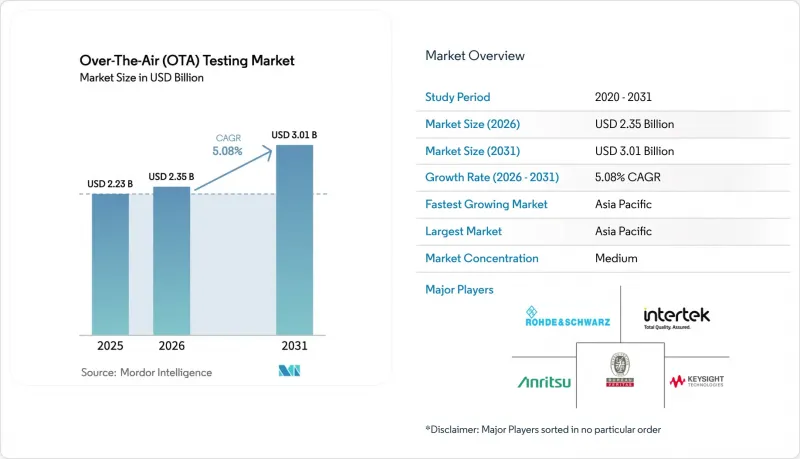
Mordor Intelligence에 의하면, 무선 시험 시장 규모는 2025년에 22억 3,000만 달러로 평가되었고, 2026년 23억 5,000만 달러에서 2031년까지 30억 1,000만 달러에 이를 것으로 추정되며, 예측 기간(2026-2031년) CAGR은 5.08%를 나타낼 전망입니다.
본 보고서는 제공 내용별(하드웨어, 소프트웨어 및 분석, 서비스), 기술별(5G NR, LTE, UMTS, GSM, Wi-Fi, Bluetooth, LPWAN), 테스트 유형별(안테나 성능, 적합성, 호환성, 생산), 용도별(통신, 기타), 테스트 환경별(원거리, CATR, 근거리, 잔향), 지역별로 분류되어 있습니다. 시장 예측은 금액(달러) 기준으로 제시되어 있습니다.
세계의 무선 시험 시장 동향 및 인사이트
새로운 적합성 프로토콜이 필요한 5G 비독립형(NSA) 및 독립형(SA) 구축의 확대
300개 이상의 통신 사업자가 네트워크 슬라이싱 및 저지연 서비스를 구현함에 따라, 독립형 5G 코어 네트워크는 2025년에 일반 시장에 정착했습니다. 3GPP 릴리스 17에서는 3.5GHz를 초과하는 주파수 대역에서 64 스트림의 매시브 MIMO를 위한 테스트 케이스가 도입됨에 따라, 시험소는 동시 샘플링이 가능한 듀얼 편파 프로브 어레이를 도입할 수밖에 없었습니다. 미국 이동통신산업협회(CTIA)는 OTA 5.9 사양을 강화하여 52.6GHz를 초과하는 주파수 대역에서의 방사 스퓨리어스 방출 검사를 추가했습니다. 이에 따라 기기 제조업체들은 기존 측정 장비를 업그레이드할 수밖에 없게 되었습니다. 논-스탠드얼론 아키텍처가 단계적으로 폐지됨에 따라, 각 스마트폰 벤더들은 듀얼 모드 검증 기간을 단축하고, 예산을 스탠드얼론 전용 측정 장비에 할당하며, 자사 설계 센터 내 실험실로 수요를 분산시키고 있습니다.
소비자용 디바이스에서 밀리파 및 매시브 MIMO 안테나의 OTA 규정 준수 수요 급증
현재 플래그십 스마트폰은 최대 16개의 위상 배열 소자를 탑재하고 있으며, 각 소자에 대해 360도의 방위각 및 180도의 고도 평면에 걸친 총 방사 전력 및 등방성 감도의 스윕 측정이 필요합니다. 연방통신위원회(FCC)의 24.25-29.5GHz 대역에 관한 규정에 따라, 6GHz 미만 시험에 비해 시험실 점유 시간이 40% 연장되어 전 세계 시험 역량에 부담이 가중되고 있습니다. Apple이 2025년에 밀리파 단말기를 출시함에 따라, 수탁 제조업체로부터의 무선 시험 장비 주문이 급증하여 멀티 프로브 시스템의 납기 기간이 18개월을 초과하고 있습니다. 동시에, 차이나모바일(China Mobile)의 192 소자 기지국에서는 상호운용성 보정이 필요하게 되어, 서비스 중단 없이 빔포밍을 검증할 수 있는 휴대용 근거리장 스캐너에 대한 수요가 발생하고 있습니다.
자본 집약적인 무반향실 및 잔향실이 2차 연구소의 도입을 방해하고 있습니다.
5미터 밀리파 챔버의 비용은 250만-400만 달러, 잔향실은 80만-120만 달러에 달하지만, 이용률이 60% 미만인 경우 신흥 시장의 시험소에서는 이러한 지출을 정당화하기 어렵습니다. 국제전기표준회의(IEC)에 의한 2024년 교반 효율 개정에 따라 개보수 주기가 단축되어 투자 회수 기간이 단축되었습니다. 그 결과, 라틴아메리카와 아프리카의 시험 센터들은 세계 네트워크에 업무를 위탁하게 되었으며, 리드타임이 길어지는 동시에 수익이 상위 5개 인증 기관에 집중되는 경향을 보이고 있습니다.
부문 분석
2025년 하드웨어용 무선 시험 시장 규모는 총 매출의 48%를 차지하며, 무반향실, 소형 측정 범위, 계측 기기 스택에 대한 꾸준한 투자를 반영하고 있습니다. 한편, 소프트웨어 및 분석 플랫폼은 클라우드 호스팅형 오케스트레이션 툴이 보고서 작성 시간을 대폭 단축하고, 여러 거점의 측정값을 실시간으로 상호 연관시킴으로써 연평균 성장률(CAGR) 5.99%로 확대되고 있습니다. 현재, 지속적 통합(CI) 파이프라인은 애플리케이션 프로그래밍 인터페이스(API)를 통해 테스트 스크립트를 호출함으로써, 무반향실을 정적인 설비가 아닌 온디맨드 자산으로 변화시키고 있습니다.
서비스가 이 카테고리를 마무리하고 있으며, 각 OEM 업체들은 셀룰러 V2X(Cellular Vehicle-to-Everything) 검증을 전문 실험실에 외주하고 있습니다. 이러한 실험실에서는 적합성, 전자기 호환성 및 안전성 인증 신청을 통합된 캠페인으로 패키지화하고 있습니다. 소프트웨어 정의 무선 측정 장비의 기세는 단일 재구성 가능한 트랜시버가 Sub-6GHz 대역과 mm파 대역을 모두 커버할 수 있기 때문에 개별 하드웨어에 대한 수요를 더욱 잠식하고 있습니다. 이러한 변화는 코드 라이브러리, 분석 대시보드 및 원격 액세스 제어 기능을 모듈형 섀시와 번들로 제공할 수 있는 벤더에게 유리하게 작용하며, 일회성 장비 판매 대신 구독 모델이 주류를 이루는 가운데 지속적인 수익원을 확보할 수 있는 입지를 마련해 주고 있습니다.
2025년에는 5G New Radio가 37.5%의 점유율을 차지하며, 최신 휴대폰 단말기 및 고정 무선 액세스 포인트 출시의 기준으로 그 입지를 공고히 했습니다. 그러나 위성 직접 링크 서비스는 가장 빠르게 성장하는 분야로, 연평균 성장률(CAGR) 6.21%로 확대되고 있으며, 시험실에는 궤도 운동 에뮬레이터, 높은 동적 범위의 도플러 발생원, 그리고 낮은 엘리베이션 빔 트래커의 통합이 요구되고 있습니다. LTE(Long Term Evolution) 및 MTE(Machine Type Evolution)는 10년에 이르는 수명 주기 동안 지속적인 하위 호환성이 요구되는 산업용 IoT 분야에서 여전히 주력 기술로 자리 잡고 있습니다.
한편, 통신 사업자들이 주파수 대역 재편을 추진함에 따라 2세대 및 3세대 셀룰러 프로토콜은 점차 쇠퇴하고 있지만, 인증 기관에서는 여전히 신흥 시장을 겨냥한 수명 주기 말기의 단말기에 대한 인증 절차를 진행하고 있습니다. Wi-Fi 6, Wi-Fi 7, Bluetooth Low Energy 및 초광대역(UWB)이 라인업을 완성하고 있으며, 협업 빔포밍과 320 MHz 채널이 새로운 무선 통신 요구 사항을 창출하고 있습니다. 단일 시설 내에서 다중 프로토콜·다중 대역 검증이 가능한 시험소는 기존의 단일 대역 시설에서는 실현할 수 없는 기술 간 시너지 효과를 최대한 활용할 수 있는 위치에 있습니다.
지역별 분석
아시아태평양은 2025년 매출의 32.4%를 차지했으며, 2031년까지 연평균 성장률(CAGR) 5.56%로 확대될 것으로 예측됩니다. 이는 2025년에 1,200대 이상의 5G 스마트폰 인증을 승인한 중국의 인증 파이프라인과, 인도의 통신공학센터(TEC)가 국내 브랜드를 대상으로 시행하는 신속 심사 제도에 힘입은 결과입니다. 현지 기기 제조업체들은 리드 타임을 단축하기 위해 사내 실험실을 구축하는 경향이 강해지고 있지만, 자사의 전문 지식이 성숙해지기 전까지는 mm파 검증에 대해서는 여전히 외부 공급업체에 의존하고 있습니다. 한국과 일본의 정부 인센티브는 비지상파 시험 인프라에 대한 지원을 통해 지역 내 수요를 더욱 부추기고 있습니다.
북미는 2위를 차지했습니다. 이는 자동차 OEM 각사가 ‘Cellular Vehicle-to-Everything(C-V2X)’ 검증에 예산을 투입하고, 연방통신위원회(FCC)가 엄격한 mm파 방사 제한을 시행했기 때문입니다. 디트로이트와 실리콘밸리 주변에서는 자사 연구소가 급증했으나, 독립 인증 기관들은 실제 환경의 멀티패스 및 도플러 효과를 재현하는 리플레이 챔버를 전문으로 함으로써 검사 건수를 유지했습니다. 캐나다에서는 견고한 기기의 검증이 필요한 자원 채굴 현장에서 프라이빗 5G가 도입되면서 추가적인 성장이 나타났습니다.
유럽에서는 독일, 프랑스, 북유럽 국가들의 스마트 팩토리 구축이 견조한 성장세를 보였습니다. 이 지역에서는 시간 민감형 네트워킹 컨트롤러의 무선(OTA) 검증이 의무화되어 있습니다. 산업용 IoT 모듈의 경우 잔향실 이용이 확대된 반면, 위성을 이용한 비지상파 시험은 뮌헨과 툴루즈에 집중되었습니다. 남미에서는 브라질의 5G 서비스 개통이 견인 역할을 하며 완만한 성장세를 보였으나, 인증 실험실 부족으로 인해 인증 업무가 북미 시설에 집중되면서 일정이 장기화되었습니다. 중동 및 아프리카은 여전히 발전 단계에 있지만, 주파수 경매가 진행됨에 따라 아프리카 전기통신 연합(ATU)의 상호 인정 체계가 지역 역량 강화를 촉진할 가능성이 있습니다.
기타 혜택 :
- 엑셀 형식 시장 예측(ME) 시트
- 3개월간의 애널리스트 지원
자주 묻는 질문
목차
제1장 서론
제2장 조사 방법
제3장 주요 요약
제4장 시장 구도
제5장 시장 규모 및 성장 예측
제6장 경쟁 구도
제7장 시장 기회 및 향후 전망
AJY 26.08.26According to Mordor Intelligence, the over-The-Air testing market size was valued at USD 2.23 billion in 2025 and is estimated to grow from USD 2.35 billion in 2026 to reach USD 3.01 billion by 2031, at a CAGR of 5.08% during the forecast period (2026-2031).
This report is Segmented by Offering (Hardware, Software and Analytics, and Services), Technology (5G NR, LTE, UMTS, GSM, Wi-Fi, Bluetooth, and LPWAN), Test Type (Antenna Performance, Conformance, Compatibility, and Production), Application (Telecom, and More), Test Environment (Far-Field, CATR, Near-Field, and Reverberation), and Geography. Market Forecasts are Provided in Terms of Value (USD).
Global Over-The-Air (OTA) Testing Market Trends and Insights
Proliferation of 5G Non-Standalone and Stand-Alone Deployments Requiring New Conformance Protocols
Stand-alone 5G cores reached mass-market status in 2025 as more than 300 operators enabled network slicing and low-latency services. Third Generation Partnership Project Release 17 introduced test cases for 64-stream massive-MIMO above 3.5 GHz, compelling laboratories to install dual-polarized probe arrays capable of simultaneous sampling. The Cellular Telecommunications Industry Association tightened its OTA 5.9 specification to include radiated spurious-emission checks at frequencies beyond 52.6 GHz, forcing device makers to upgrade legacy fixtures. With non-stand-alone architectures being phased out, smartphone vendors are compressing dual-mode validation windows, migrating budgets to stand-alone-specific instrumentation, and fragmenting demand across captive design-center labs.
Surging OTA Compliance Demand For mmWave And Massive-MIMO Antennas in Consumer Devices
Flagship phones now integrate up to 16 phased-array elements, each requiring total radiated power and isotropic sensitivity sweeps over 360-degree azimuth and 180-degree elevation planes. Federal Communications Commission rules for 24.25-29.5 GHz bands extend chamber occupancy by 40% versus sub-6 GHz tests, straining global capacity. Apple's 2025 millimeter-wave launches sparked a surge of over-the-air orders from contract manufacturers, pushing lead times for multi-probe systems beyond 18 months. Concurrently, China Mobile's 192-element base stations require reciprocity calibration, creating demand for portable near-field scanners that validate beamforming without service downtime.
Capital-Intensive Anechoic and Reverberation Chambers Discouraging Adoption by Tier-2 Labs
A 5-meter millimeter-wave chamber costs USD 2.5-4 million, while reverberation rooms run USD 0.8-1.2 million, outlays that emerging-market labs struggle to justify at sub-60% utilization. The International Electrotechnical Commission's 2024 stirrer-efficiency revision shortened refurbishment cycles, tightening return-on-investment timelines. Consequently, Latin American and African test centers outsource to global networks, increasing lead times and concentrating revenue among the top five certification houses.
Other drivers and restraints analyzed in the detailed report include:
- Accelerating Satellite-To-Device Direct-Link Constellations Necessitating New Near-Field OTA Protocols
- Automotive OEM Shift to Software-Defined and V2X Connectivity Platforms in North America
- Technical Skill Scarcity For mmWave Near-Field-To-Far-Field Transform Algorithms
For complete list of drivers and restraints, kindly check the Table Of Contents.
Segment Analysis
The Over-The-Air testing market size for hardware stood at 48% of total revenue in 2025, reflecting entrenched investments in anechoic chambers, compact ranges, and instrument stacks. Software and analytics platforms, however, are expanding at a 5.99% CAGR as cloud-hosted orchestration tools slash report-generation time and correlate multi-site measurements in real time. Continuous-integration pipelines now call test scripts through application programming interfaces, turning chambers into on-demand assets rather than static fixtures.
Services round out the category, with OEMs outsourcing Cellular Vehicle-to-Everything validation to specialist labs that package conformance, electromagnetic compatibility, and safety submissions into unified campaigns. The momentum behind software-defined radio instrumentation further erodes discrete hardware demand, as a single reconfigurable transceiver can span sub-6 GHz and millimeter-wave bands. This shift favours vendors capable of bundling code libraries, analytics dashboards, and remote-access controls with modular enclosures, positioning them for recurring revenue streams as subscription models replace one-off equipment sales.
5G New Radio commanded 37.5% share in 2025, underlining its status as the baseline for modern handset launches and fixed-wireless access points. Yet satellite direct-link services represent the fastest-growing slice, advancing at 6.21% CAGR and forcing laboratories to integrate orbital-motion emulators, high-dynamic-range Doppler sources, and low-elevation beam trackers. Long-Term Evolution and machine-type evolutions remain staples in industrial Internet-of-Things segments where decade-long lifecycles demand relentless backward compatibility.
Conversely, second- and third-generation cellular protocols fade as operators reform spectrum, though certification houses still process late-cycle devices destined for emerging markets. Wi-Fi 6, Wi-Fi 7, Bluetooth low energy, and ultra-wideband round out the roster, with coordinated beamforming and 320-MHz channels driving fresh over-the-air requirements. Laboratories capable of multi-protocol, multi-band validation under a single roof stand to capture cross-technology synergies that legacy single-band facilities cannot match.
Complete Report Scope:
- By Offering
- Hardware
- Chambers (Anechoic, Reverberation, Compact Range)
- Instrumentation (Signal Generators, Spectrum Analysers, Controllers)
- Software and Analytics
- Services
- Testing and Certification Services
- Consulting and Integration
- Hardware
- By Technology
- 5G NR (Sub-6 GHz and mmWave)
- LTE, LTE-A and LTE-M
- UMTS and WCDMA
- GSM and CDMA
- Wi-Fi 6, Wi-Fi 7 and Wi-Fi HaLow
- Bluetooth and UWB
- LPWAN (NB-IoT, LoRaWAN, Sigfox)
- By Test Type
- Antenna Performance (TRP, TIS, EIRP, EIS)
- Conformance and Certification
- Compatibility and Inter-operability
- Production and End-of-Line
- By Application
- Telecom and Consumer Electronics
- Automotive and Transportation
- Industrial and Manufacturing IoT
- Aerospace and Defense
- Healthcare Devices and Wearables
- Smart Home and Building Automation
- By Test Environment
- Far-Field Anechoic Chambers
- Compact Antenna Test Range
- Near-Field Systems
- Reverberation Chambers
- By Geography
- North America
- United States
- Canada
- Mexico
- Europe
- Germany
- United Kingdom
- France
- Nordics
- Rest of Europe
- South America
- Brazil
- Rest of South America
- Asia Pacific
- China
- Japan
- India
- South-East Asia
- Rest of Asia Pacific
- Middle East
- Gulf Cooperation Council Countries
- Turkey
- Rest of Middle East
- Africa
- South Africa
- Rest of Africa
- North America
Geography Analysis
Asia Pacific held 32.4% of 2025 revenue and is projected to expand at a 5.56% CAGR through 2031, buoyed by China's certification pipeline that cleared more than 1,200 5G smartphones in 2025 and India's Telecommunications Engineering Centre fast-track for domestic brands. Local device makers increasingly house captive labs to cut lead times yet still rely on external providers for millimeter-wave validation until homegrown expertise matures. Government incentives in South Korea and Japan further elevate regional demand by subsidizing non-terrestrial test infrastructure.
North America ranked second as automotive OEMs funnelled budgets into Cellular Vehicle-to-Everything validation and the Federal Communications Commission enforced stringent millimeter-wave emissions limits. Captive labs mushroomed around Detroit and Silicon Valley, but independent certifiers sustained volumes by specializing in replay chambers that emulate real-world multipath and Doppler. Canada contributed incremental growth via private-5G deployments in resource extraction sites that require ruggedized device validation.
Europe posted steady gains anchored by smart-factory rollouts in Germany, France, and the Nordics that mandate over-the-air verification of time-sensitive networking controllers. Reverberation chambers gained traction for industrial Internet-of-Things modules, while satellite non-terrestrial tests clustered in Munich and Toulouse. South America saw modest momentum led by Brazil's 5G launches, yet a paucity of accredited labs funnelled certifications to North American facilities, elongating schedules. Middle East and Africa remain nascent, though the African Telecommunications Union's mutual-recognition framework could catalyse regional capacity as spectrum auctions proceed.
- Keysight Technologies Inc.
- Rohde and Schwarz GmbH and Co. KG
- Anritsu Corporation
- SGS SA
- Intertek Group plc
- Bureau Veritas SA
- UL Solutions Inc.
- Eurofins Scientific SE
- Microwave Vision Group
- CETECOM GmbH
- BluFlux LLC
- Element Materials Technology
- National Technical Systems Inc.
- TUV Rheinland AG
- Spirent Communications plc
- VIAVI Solutions Inc.
- ETS-Lindgren Inc.
- Chotest Technology Inc.
- Shenzhen Sunwave Communications Co., Ltd.
Additional Benefits:
- The market estimate (ME) sheet in Excel format
- 3 months of analyst support
TABLE OF CONTENTS
1 INTRODUCTION
- 1.1 Study Assumptions and Market Definition
- 1.2 Scope of the Study
2 RESEARCH METHODOLOGY
3 EXECUTIVE SUMMARY
4 MARKET LANDSCAPE
- 4.1 Market Overview
- 4.2 Market Drivers
- 4.2.1 Proliferation of 5G Non-Standalone and Stand-Alone Deployments Requiring New Conformance Protocols
- 4.2.2 Surging OTA Compliance Demand for mmWave and Massive-MIMO Antennas in Consumer Devices
- 4.2.3 Automotive OEM Shift to Software-Defined and V2X Connectivity Platforms in North America
- 4.2.4 Industrial Private-5G Roll-outs in Europe for Smart Factories Requiring Robust RF Validation
- 4.2.5 Rapid Certification Cycles Mandated by CTIA and GCF for IoT Modules Below USD-10 BOM
- 4.2.6 Accelerating Satellite-to-Device Direct-Link Constellations Necessitating New Near-Field OTA Protocols
- 4.3 Market Restraints
- 4.3.1 Capital-Intensive Anechoic and Reverberation Chambers Discouraging Adoption by Tier-2 Labs
- 4.3.2 Technical Skill Scarcity for mmWave Near-Field-to-Far-Field Transform Algorithms
- 4.3.3 Lack of Harmonised Global Standards for LPWAN OTA Testing Delaying Market Convergence
- 4.3.4 Supply-Chain Volatility of RF Absorber Materials Inflating Test Infrastructure Costs
- 4.3.5 Rising Cyber-Security Concerns over Remote OTA Testbed Connectivity in Shared Facilities
- 4.4 Industry Value-Chain Analysis
- 4.5 Regulatory and Technological Outlook
- 4.5.1 Standardisation Roadmap (3GPP Rel-17/18, CTIA OTA 5.x)
- 4.5.2 Emerging Test Methodologies (OTA for Reconfigurable Intelligent Surfaces, 6G Terahertz)
- 4.6 Impact of Macroeconomic Factors on the Market
- 4.7 Porter's Five Forces Analysis
- 4.7.1 Bargaining Power of Suppliers
- 4.7.2 Bargaining Power of Buyers
- 4.7.3 Threat of New Entrants
- 4.7.4 Threat of Substitutes
- 4.7.5 Intensity of Competitive Rivalry
5 MARKET SIZE AND GROWTH FORECASTS (VALUES)
- 5.1 By Offering
- 5.1.1 Hardware
- 5.1.1.1 Chambers (Anechoic, Reverberation, Compact Range)
- 5.1.1.2 Instrumentation (Signal Generators, Spectrum Analysers, Controllers)
- 5.1.2 Software and Analytics
- 5.1.3 Services
- 5.1.3.1 Testing and Certification Services
- 5.1.3.2 Consulting and Integration
- 5.1.1 Hardware
- 5.2 By Technology
- 5.2.1 5G NR (Sub-6 GHz and mmWave)
- 5.2.2 LTE, LTE-A and LTE-M
- 5.2.3 UMTS and WCDMA
- 5.2.4 GSM and CDMA
- 5.2.5 Wi-Fi 6, Wi-Fi 7 and Wi-Fi HaLow
- 5.2.6 Bluetooth and UWB
- 5.2.7 LPWAN (NB-IoT, LoRaWAN, Sigfox)
- 5.3 By Test Type
- 5.3.1 Antenna Performance (TRP, TIS, EIRP, EIS)
- 5.3.2 Conformance and Certification
- 5.3.3 Compatibility and Inter-operability
- 5.3.4 Production and End-of-Line
- 5.4 By Application
- 5.4.1 Telecom and Consumer Electronics
- 5.4.2 Automotive and Transportation
- 5.4.3 Industrial and Manufacturing IoT
- 5.4.4 Aerospace and Defense
- 5.4.5 Healthcare Devices and Wearables
- 5.4.6 Smart Home and Building Automation
- 5.5 By Test Environment
- 5.5.1 Far-Field Anechoic Chambers
- 5.5.2 Compact Antenna Test Range
- 5.5.3 Near-Field Systems
- 5.5.4 Reverberation Chambers
- 5.6 By Geography
- 5.6.1 North America
- 5.6.1.1 United States
- 5.6.1.2 Canada
- 5.6.1.3 Mexico
- 5.6.2 Europe
- 5.6.2.1 Germany
- 5.6.2.2 United Kingdom
- 5.6.2.3 France
- 5.6.2.4 Nordics
- 5.6.2.5 Rest of Europe
- 5.6.3 South America
- 5.6.3.1 Brazil
- 5.6.3.2 Rest of South America
- 5.6.4 Asia Pacific
- 5.6.4.1 China
- 5.6.4.2 Japan
- 5.6.4.3 India
- 5.6.4.4 South-East Asia
- 5.6.4.5 Rest of Asia Pacific
- 5.6.5 Middle East
- 5.6.5.1 Gulf Cooperation Council Countries
- 5.6.5.2 Turkey
- 5.6.5.3 Rest of Middle East
- 5.6.6 Africa
- 5.6.6.1 South Africa
- 5.6.6.2 Rest of Africa
- 5.6.1 North America
6 COMPETITIVE LANDSCAPE
- 6.1 Market Concentration
- 6.2 Strategic Moves
- 6.3 Market Share Analysis
- 6.4 Company Profiles (includes Global Level Overview, Market Level Overview, Core Segments, Financials as Available, Strategic Information, Market Rank/Share for Key Companies, Products and Services, and Recent Developments)
- 6.4.1 Keysight Technologies Inc.
- 6.4.2 Rohde and Schwarz GmbH and Co. KG
- 6.4.3 Anritsu Corporation
- 6.4.4 SGS SA
- 6.4.5 Intertek Group plc
- 6.4.6 Bureau Veritas SA
- 6.4.7 UL Solutions Inc.
- 6.4.8 Eurofins Scientific SE
- 6.4.9 Microwave Vision Group
- 6.4.10 CETECOM GmbH
- 6.4.11 BluFlux LLC
- 6.4.12 Element Materials Technology
- 6.4.13 National Technical Systems Inc.
- 6.4.14 TUV Rheinland AG
- 6.4.15 Spirent Communications plc
- 6.4.16 VIAVI Solutions Inc.
- 6.4.17 ETS-Lindgren Inc.
- 6.4.18 Chotest Technology Inc.
- 6.4.19 Shenzhen Sunwave Communications Co., Ltd.
7 MARKET OPPORTUNITIES AND FUTURE OUTLOOK
- 7.1 White-Space and Unmet-Need Assessment