

|
시장보고서
상품코드
2114574
오피오이드 유발성 변비 시장 : 시장 점유율 분석, 업계 동향 및 통계, 성장 예측(2026-2031년)Opioid Induced Constipation - Market Share Analysis, Industry Trends & Statistics, Growth Forecasts (2026 - 2031) |
||||||
 Mordor Intelligence
Mordor Intelligence에 의하면, 오피오이드 유발성 변비 시장 규모는 2025년에 30억 6,000만 달러로 평가되었고, 2026년 32억 6,000만 달러에서 2031년까지 44억 9,000만 달러에 이를 것으로 예측되며, 예측 기간(2026-2031년) CAGR은 6.61%를 나타낼 전망입니다.
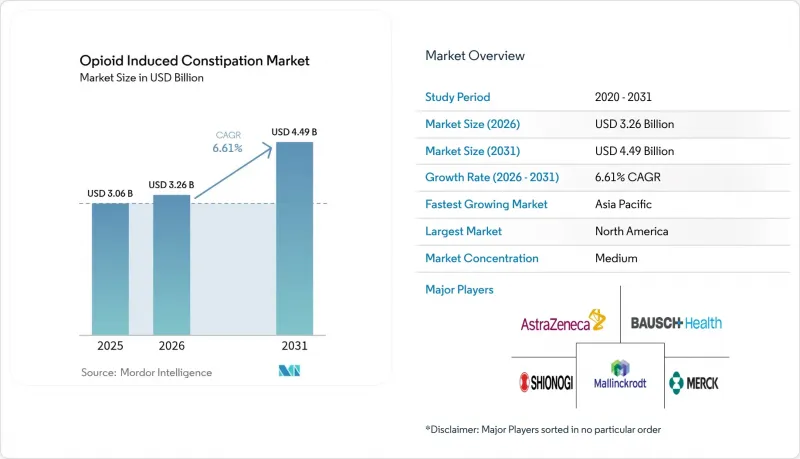
본 보고서는 약물 분류별(염소 이온 채널 2 활성화제 등), 처방 형태별(처방약 등),투여 경로(경구 투여 등), 환자층별(암성 통증 환자 등), 유통 채널별(병원 약국, 소매 약국 등), 지역별(북미, 유럽 등)로 세분화되어 있습니다. 시장 규모 및 전망은 금액(달러) 기준으로 제시되어 있습니다.
세계의 오피오이드 유발성 변비 시장 동향 및 인사이트
만성 통증 관리에서 오피오이드 처방 증가
적절한 통증 관리에서 오피오이드에 대한 지속적인 의존은 남용을 억제하기 위한 광범위한 노력에도 불구하고 제품 수요를 뒷받침하고 있습니다. 2025년 일본에서 실시된 코호트 연구에 따르면, 저용량 오피오이드를 사용하는 비암 환자에서 오피오이드 유발성 변비(OIC)의 발생률은 30%였으며, 치료 시작 14일째에는 49.2%까지 상승했습니다. 암 환자 코호트에서는 오피오이드 투여 시작 후 2주 이내에 56%의 누적 발생률이 보고되었으며, 이는 진통이 오피오이드에 기반을 둘 경우 장 기능 장애가 불가피함을 여실히 보여줍니다. 현재 미국의 많은 병원에서는 오피오이드 첫 투여 후 24시간 이내에 예방적 완하제 투여를 의무화하고 있으며, 이 치료법을 통증 관리의 표준적인 구성 요소로 정착시키고 있습니다.
적응증 확대 및 신규 PAMORA 제제 출시
규제 당국은 충분한 치료를 받지 못하고 있는 환자군에 대한 적응증 확대를 추진하고 있습니다. 2024년 5월, FDA가 6-17세 소아에 대한 리나크로티드 사용을 승인함에 따라 미국에서 최초의 소아용 치료 옵션이 확립되었습니다. 유럽의약품청(EMA)은 2024년 6월,아스트라제네카사의 나록세고르 신청 서류를 접수하며 미국 기준과의 일관성을 보여주었습니다. 한편, FDA는 2024년 8월 ENTEREG(알비모판)의 승인을 철회함으로써 엄격한 심사가 진행되고 있음을 여실히 드러냈습니다. 오피오이드 진통 작용과 과다 복용 방지 기능을 겸비한 PF614-MPAR 등 개발 중인 약제들이 경쟁의 무대를 넓혀가고 있습니다.
차세대 비오피오이드 진통제
FDA는 2025년 1월, 수제트리긴을 승인했습니다. 이 약물은 오피오이드 수용체에 작용하지 않으면서도 강력한 급성 진통 효과를 발휘하며, 변비 위험을 배제합니다. 1정당 15.50달러로 비싸지만, 수술 후 통증 치료제로 병원 처방 목록에 채택된다면 향후 오피오이드 유발성 변비(OIC) 사례를 줄일 수 있을 가능성이 있습니다. 또한, 학술 연구팀은 전신 흡수를 동반하지 않고 내장 통증을 진정시키는 장관 선택적 옥시토신 모방약의 개발도 진행하고 있습니다.
부문 분석
PAMORA 계열 약물은 장관 한정적인 수용체 차단 작용을 통해 중추성 진통 효과를 유지할 수 있기 때문에 2025년에는 22억 3,000만 달러 시장 규모를 기록하며 오피오이드 유발성 변비(OIC) 시장 전체의 72.88%를 차지했습니다. 알비모판이 FDA에 의해 승인이 취소되었음에도 불구하고, 이 약물군에 대한 의사의 신뢰는 유지되고 있습니다. 이는 나르데메진 등의 대체 약물이 일본에서 실시된 임상시험에서 81-90%의 자발적 배변 반응을 보였기 때문입니다. 향후, 구아니레이트 사이클라제 C 작용제는 소아 적응증 확대를 배경으로 11.02%라는 가장 높은 연평균 성장률(CAGR)을 보일 것으로 예측됩니다. 오피오이드와 PAMORA의 복합제에 대한 지속적인 투자를 통해, 동 계열 간의 경쟁이 심화되는 상황에서도 말초 작용형 약물의 오피오이드 유발성 변비 시장 내 점유율을 계속 지켜나갈 것으로 기대됩니다.
각 제약사는 작용기전의 다양화를 통해 리스크를 헤지하고 있습니다. 심장 안전성이 향상된 5-HT4 수용체 작용제, 대마 유래 운동성 증강제, 그리고 장 선택성 펩타이드는 현재 2상 임상시험 단계에 있습니다. 이러한 신규 진입 약물은 설사나 복부 경련을 견디기 어려운 틈새 환자층을 흡수할 가능성이 있습니다. 그러나 직접 비교 시험을 통해 동등성이 확인되기 전까지는 처방 의사가 정평이 나 있는 PAMORA를 선호할 가능성이 있어, 그 결과 오피오이드 유발성 변비 시장은 전망 기간의 대부분 동안 기존 제품이 계속 지배할 것으로 예측됩니다.
2025년 매출액 중 처방약이 90.80%를 차지했으며, 이는 μ-오피오이드 수용체를 표적으로 하는 약물의 취급에 있어 임상의의 감독이 여전히 필수적임을 뒷받침합니다. 오피오이드 유발성 변비 시장에서 OTC 제제의 규모는 작았으나, 소비자 인지도가 높아짐에 따라 성장할 것으로 예측됩니다. 규제 당국은 시판 후 조사를 통해 오용 위험이 낮음이 입증되는 대로, 특정 PAMORA를 약사의 지도 하에 판매하도록 전환하는 것에 대해 계속해서 논의했습니다.
지지자들은 처방약에서 일반의약품(OTC)으로의 전환이 성공하면 만성적인 완하제 오용으로 인한 응급실 방문을 줄일 수 있을 것으로 보고 있습니다. 그러나 오피오이드 길항 작용의 메커니즘이 복잡하고 급격한 금단 증상을 유발할 가능성이 있기 때문에 현재로서는 대부분의 분자가 처방약 범주에 머물러 있습니다. 디지털 처방 플랫폼은 이러한 경계를 모호하게 만들 가능성이 있습니다. 검증된 배변 추적 앱과 의약품 쿠폰을 결합함으로써 반자동적인 사후 관리가 가능해지며, 오피오이드 유발성 변비 치료 시장의 일부가 점차 자가 관리 패러다임으로 전환될 것입니다.
지역별 분석
2025년, 북미는 전 세계 매출의 44.10%를 차지했으며, 그 중심에는 전 세계 오피오이드 소비량의 80% 가까이를 차지하는 미국이 있습니다. 보험사의 광범위한 급여, 확립된 통증 관리 지침, 그리고 혁신적인 약물군의 승인에 있어 FDA가 주도적인 역할을 함에 따라 이 지역은 계속해서 최전선에 위치하고 있습니다. 시더스-사이나이에서 메이요 클리닉에 이르는 병원 네트워크에서는 24시간 이내에 배변이 기록되지 않을 경우 즉시 완하제 용량 증량을 권장하는 디지털 배변 모니터가 도입되어, 예방적 치료에 대한 의료 기관의 노력을 강조하고 있습니다. 캐나다도 규모는 작지만 미국과 유사한 추세를 보이고 있으며, 전국적인 오피오이드 적정 사용 체계의 일환으로 3차 의료기관에서 정해진 배변 관리 프로토콜이 채택되고 있습니다. 오피오이드 남용을 억제하기 위한 정책 개혁으로 인해 오피오이드 신규 처방 건수는 꾸준히 감소하고 있지만, 만성 사용자의 유병률이 높기 때문에 변비 치료가 필요한 환자층은 여전히 상당한 규모를 유지하고 있습니다. 그 결과, 북미의 오피오이드 유발성 변비 시장은 성숙기에 접어들었음에도 불구하고 견조한 성장 전망을 유지하고 있습니다.
아시아태평양은 2031년까지 연평균 성장률(CAGR)이 7.28%로 가장 높습니다. 일본에서는 제3상 임상시험에서 이상반응 발생률이 88-90%였음에도 불구하고 81-90%의 반응률이 보고된 나르데메딘의 급속한 보급이 관찰되어, 임상적 신뢰도가 높음을 보여주고 있습니다. 중국에서는 PAMORA가 각 성의 보험 적용 목록에 포함됨에 따라 치료비 부담이 경감되고 있습니다. 또한, 2024년 퇴행성 관절염에 관한 메타분석에서 오피오이드 사용으로 인한 변비 위험이 3.57배라는 사실이 확인된 것은 보다 광범위한 도입을 검토하고 있는 정책 입안자들에게 중요한 정보가 되고 있습니다. 인도에서는 제네릭 의약품의 제조거점이 급속히 확대되고 있으며, 국제 특허가 만료되는 대로 국내 기업이 비용 대비 효과가 높은 제네릭 의약품을 시장에 출시할 수 있는 체제가 갖춰져 있어, 저소득층의 치료 보급이 촉진될 전망입니다.
유럽에서는 지불 기관의 엄격한 감독 하에서도 꾸준한 보급이 진행되고 있습니다. 2024년 6월 유럽의약품청(EMA)이 나록세골을 승인한 것과 독일이 소화기계 디지털 치료제를 영구적으로 보험 적용 대상으로 지정한 것은 혁신과 비용 억제의 균형이 잘 잡혀 있음을 보여줍니다. 각국의 의료기술평가기관은 약제 가격뿐만 아니라 의료비 총액을 평가하고 있으며, 이에 따라 제약 기업들은 PAMORA(오피오이드 유발성 변비 치료제)에 복약 순응도 지원 플랫폼을 결합하도록 권장받고 있습니다. 프랑스 등 일부 시장의 환급액 소급 조정으로 인해 정가는 억제되고 있으나, 고령화 및 종양학 분야에서의 오피오이드 사용으로 인해 판매량은 견조한 추세를 보이고 있습니다. 따라서 오피오이드 유발성 변비 치료제 시장은 유럽 전역에서 완만하지만 확실한 확장을 보이고 있습니다.
기타 혜택 :
- 엑셀 형식 시장 예측(ME) 시트
- 3개월간의 애널리스트 지원
자주 묻는 질문
목차
제1장 서론
제2장 조사 방법
제3장 주요 요약
제4장 시장 구도
제5장 시장 규모 및 성장 예측
제6장 경쟁 구도
제7장 시장 기회 및 향후 전망
AJY 26.08.26According to Mordor Intelligence, the opioid induced constipation market size was valued at USD 3.06 billion in 2025 and estimated to grow from USD 3.26 billion in 2026 to reach USD 4.49 billion by 2031, at a CAGR of 6.61% during the forecast period (2026-2031).
This report is Segmented by Drug Class (Chloride-Channel-2 Activators, and More), Prescription Type (Prescription and More), Route of Administration (Oral and More), Patient Group (Cancer-Pain Patients and More), Distribution Channel (Hospital Pharmacies, Retail Pharmacies, and More), and Geography (North America, Europe, and More). The Market Sizes and Forecasts are Provided in Terms of Value (USD).
Global Opioid Induced Constipation Market Trends and Insights
Rising Opioid Prescriptions for Chronic Pain Management
Steady reliance on opioids for legitimate pain control sustains product demand despite broader efforts to curb misuse. A 2025 Japanese cohort study found 30% opioid-induced constipation (OIC) incidence among non-cancer patients using weak opioids, climbing to 49.2% by day 14 of therapy.Cancer cohorts reported 56% cumulative incidence within two weeks of opioid initiation, underlining the inevitability of bowel dysfunction when analgesia is opioid-based. Many U.S. hospitals now require prophylactic laxatives within 24 hours of the first opioid dose, formalizing treatment as a default component of pain care.
Label Expansions & Launches of Novel PAMORAs
Regulators are broadening indications to underserved populations. FDA clearance of linaclotide for children aged 6-17 in May 2024 established the first U.S. pediatric option. The European Medicines Agency accepted AstraZeneca's naloxegol dossier in June 2024, signaling alignment with U.S. standards. Conversely, the FDA withdrew ENTEREG (alvimopan) in August 2024, highlighting close scrutiny. Pipeline assets such as PF614-MPAR, which combines opioid analgesia with built-in overdose protection, widen the competitive field.
Next-Generation Non-Opioid Analgesics
The FDA approved suzetrigine in January 2025. It offers strong acute analgesia with no opioid receptor action, removing the risk of constipation. Although priced at USD 15.50 per pill, hospital formularies may adopt it for postsurgical pain, trimming future OIC cases. Academic teams are also advancing gut-selective oxytocin mimetics that calm visceral pain without systemic absorption.
Other drivers and restraints analyzed in the detailed report include:
- High Prevalence of Chronic Non-Cancer & Cancer Pain
- Digital-Therapeutic Co-Prescription Boosting Adherence
- Patient Reluctance Due to Adverse-Event Awareness
For complete list of drivers and restraints, kindly check the Table Of Contents.
Segment Analysis
PAMORAs contributed USD 2.23 billion in 2025, equal to 72.88% of the opioid induced constipation market size, as their gut-restricted receptor blockade preserves central analgesia. The class retains physician confidence despite the FDA withdrawal of alvimopan because alternatives such as naldemedine yield 81-90% spontaneous bowel movement response in Japanese trials. Looking ahead, guanylate cyclase-C agonists are forecast to post the highest 11.02% CAGR, underpinned by pediatric label extensions. Sustained investment in combination opioid-PAMORA pills promises to defend the opioid induced constipation market share of peripherally acting agents amid mounting class competition.
Manufacturers hedge risk by diversifying their mode of action. 5-HT4 receptor agonists with improved cardiac safety, hemp-derived motility enhancers, and gut-selective peptides are now in Phase II. These entrants could capture niche cohorts intolerant of diarrhea or abdominal cramping. Nonetheless, prescribers may prefer well-established PAMORAs until head-to-head outcomes trials confirm equivalence, ensuring the opioid induced constipation market remains dominated by incumbents through most of the outlook period.
Prescription products represented 90.80% of 2025 revenue, confirming clinician oversight remains essential when manipulating µ-opioid receptors. The opioid induced constipation market size for OTC formulations was modest but is predicted to grow as consumer familiarity rises. Regulatory bodies continue to debate switching select PAMORAs to pharmacist-guided status once post-marketing surveillance demonstrates low misuse risk.
Advocates believe successful Rx-to-OTC switches could reduce emergency visits caused by chronic laxative misuse. Yet the mechanistic complexity of opioid antagonism and potential for precipitated withdrawal keep most molecules in prescription channels for now. Digital prescription platforms may blur lines: validated bowel-tracking apps bundled with drug coupons offer semi-automated follow-up, gradually shifting portions of the opioid induced constipation industry toward a self-management paradigm.
Complete Report Scope:
- By Drug Class
- PAMORAs
- Chloride-Channel-2 Activators
- Guanylate Cyclase-C Agonists
- Others
- By Prescription Type
- Prescription
- Over-the-Counter (OTC)
- By Route of Administration
- Oral
- Parenteral
- By Patient Group
- Cancer-Pain Patients
- Non-Cancer Chronic-Pain Patients
- By Distribution Channel
- Hospital Pharmacies
- Retail Pharmacies
- Online Pharmacies
- Geography
- North America
- United States
- Canada
- Mexico
- Europe
- Germany
- United Kingdom
- France
- Italy
- Spain
- Rest of Europe
- Asia Pacific
- China
- Japan
- India
- South Korea
- Australia
- Rest of Asia Pacific
- Middle East & Africa
- GCC
- South Africa
- Rest of Middle East & Africa
- South America
- Brazil
- Argentina
- Rest of South America
- North America
Geography Analysis
North America contributed 44.10% of global revenue in 2025, anchored by the United States, which consumes nearly 80% of worldwide opioid volumes. Widespread payer coverage, entrenched pain management guidelines, and FDA leadership in approving innovative classes keep the region at the forefront. Hospital networks, from Cedars-Sinai to Mayo Clinic, have embedded digital stool monitors that trigger immediate laxative escalation when no bowel movement is recorded within 24 hours, underscoring an institutional commitment to proactive care. Canada mirrors U.S. dynamics ,though on a smaller scale, with national opioid stewardship frameworks adopting fixed bowel regimen bundles in tertiary hospitals. Policy reforms aimed at curbing opioid misuse steadily reduce new opioid starts, yet high chronic-user prevalence maintains a sizeable patient pool requiring constipation therapies. Consequently, the opioid induced constipation market retains robust, if maturing, growth prospects in North America.
Asia Pacific exhibits the highest 7.28% CAGR through 2031. Japan's rapid uptake of naldemedine, validated in Phase III trials reporting 81-90% response despite 88-90% adverse-event incidence, showcases clinical confidence. China's inclusion of PAMORAs in provincial reimbursement lists improves affordability, while a 2024 osteoarthritis meta-analysis confirming a 3.57-fold constipation risk with opioids informs policymakers considering broader adoption. India's burgeoning generic manufacturing base positions domestic firms to launch cost-effective entrants once international patents lapse, enhancing treatment penetration across lower-income populations.
Europe maintains steady uptake amid payer scrutiny. The EMA's June 2024 acceptance of naloxegol and Germany's permanent reimbursement for a gastrointestinal digital therapeutic illustrate balanced innovation and cost containment. National health technology assessment bodies evaluate not just drug price but total cost of care, encouraging manufacturers to package PAMORAs with adherence-support platforms. Reimbursement claw-backs in markets such as France temper list prices, yet volume remains resilient due to aging demographics and oncologic opioid use. The opioid induced constipation market therefore shows moderate but reliable expansion across the continent.
- AstraZeneca
- Mallinckrodt Pharmaceuticals
- Bausch Health
- Merck
- Shionogi
- GSK plc / Theravance Biopharma
- Takeda Pharmaceutical Co Ltd
- Novartis
- RedHill Biopharma
- BioDelivery Sciences Intl (Collegium)
- Nektar Therapeutics
- Daiichi Sankyo Co Ltd
- Kyowa Kirin Co Ltd
- Purdue Pharma
- Ferring Pharmaceuticals
- Lupin
- Hikma Pharmaceuticals
- Viatris
- Sun Pharmaceuticals Industries
- Abbvie
Additional Benefits:
- The market estimate (ME) sheet in Excel format
- 3 months of analyst support
TABLE OF CONTENTS
1 Introduction
- 1.1 Study Assumptions & Market Definition
- 1.2 Scope of the Study
2 Research Methodology
3 Executive Summary
4 Market Landscape
- 4.1 Market Overview
- 4.2 Market Drivers
- 4.2.1 Rising Opioid Prescriptions For Chronic Pain Management
- 4.2.2 Label Expansions & Launches Of Novel PAMORAs
- 4.2.3 High Prevalence Of Chronic Non-Cancer & Cancer Pain
- 4.2.4 Digital-Therapeutic Co-Prescription Boosting Adherence
- 4.2.5 Pipeline Combo Opioid-PAMORA Formulations
- 4.2.6 Hospital Opioid-Stewardship Mandates For Bowel Regimens
- 4.3 Market Restraints
- 4.3.1 Next-Generation Non-Opioid Analgesics
- 4.3.2 Patient Reluctance Due To Adverse-Event Awareness
- 4.3.3 European Reimbursement Claw-Backs On PAMORA Pricing
- 4.3.4 Medical-Cannabis Substitution Lowering Opioid Doses
- 4.4 Supply-Chain Analysis
- 4.5 Regulatory Landscape
- 4.6 Technological Outlook
- 4.7 Porter's Five Forces Analysis
- 4.7.1 Threat of New Entrants
- 4.7.2 Bargaining Power of Buyers
- 4.7.3 Bargaining Power of Suppliers
- 4.7.4 Threat of Substitutes
- 4.7.5 Competitive Rivalry
5 Market Size & Growth Forecasts (Value)
- 5.1 By Drug Class
- 5.1.1 PAMORAs
- 5.1.2 Chloride-Channel-2 Activators
- 5.1.3 Guanylate Cyclase-C Agonists
- 5.1.4 Others
- 5.2 By Prescription Type
- 5.2.1 Prescription
- 5.2.2 Over-the-Counter (OTC)
- 5.3 By Route of Administration
- 5.3.1 Oral
- 5.3.2 Parenteral
- 5.4 By Patient Group
- 5.4.1 Cancer-Pain Patients
- 5.4.2 Non-Cancer Chronic-Pain Patients
- 5.5 By Distribution Channel
- 5.5.1 Hospital Pharmacies
- 5.5.2 Retail Pharmacies
- 5.5.3 Online Pharmacies
- 5.6 Geography
- 5.6.1 North America
- 5.6.1.1 United States
- 5.6.1.2 Canada
- 5.6.1.3 Mexico
- 5.6.2 Europe
- 5.6.2.1 Germany
- 5.6.2.2 United Kingdom
- 5.6.2.3 France
- 5.6.2.4 Italy
- 5.6.2.5 Spain
- 5.6.2.6 Rest of Europe
- 5.6.3 Asia Pacific
- 5.6.3.1 China
- 5.6.3.2 Japan
- 5.6.3.3 India
- 5.6.3.4 South Korea
- 5.6.3.5 Australia
- 5.6.3.6 Rest of Asia Pacific
- 5.6.4 Middle East & Africa
- 5.6.4.1 GCC
- 5.6.4.2 South Africa
- 5.6.4.3 Rest of Middle East & Africa
- 5.6.5 South America
- 5.6.5.1 Brazil
- 5.6.5.2 Argentina
- 5.6.5.3 Rest of South America
- 5.6.1 North America
6 Competitive Landscape
- 6.1 Market Concentration
- 6.2 Market Share Analysis
- 6.3 Company Profiles (includes Global-level Overview, Market-level Overview, Core Segments, Financials as available, Strategic Information, Market Rank/Share, Products & Services, Recent Developments)
- 6.3.1 AstraZeneca plc
- 6.3.2 Mallinckrodt Pharmaceuticals
- 6.3.3 Bausch Health
- 6.3.4 Merck & Co Inc
- 6.3.5 Shionogi & Co Ltd
- 6.3.6 GSK plc / Theravance Biopharma
- 6.3.7 Takeda Pharmaceutical Co Ltd
- 6.3.8 Novartis AG (Sandoz)
- 6.3.9 RedHill Biopharma
- 6.3.10 BioDelivery Sciences Intl (Collegium)
- 6.3.11 Nektar Therapeutics
- 6.3.12 Daiichi Sankyo Co Ltd
- 6.3.13 Kyowa Kirin Co Ltd
- 6.3.14 Purdue Pharma L.P.
- 6.3.15 Ferring Pharmaceuticals
- 6.3.16 Lupin Ltd
- 6.3.17 Hikma Pharmaceuticals plc
- 6.3.18 Viatris Inc
- 6.3.19 Sun Pharma
- 6.3.20 AbbVie Inc
7 Market Opportunities & Future Outlook
- 7.1 White-space & Unmet-Need Assessment


