|
시장보고서
상품코드
2114575
심장 인공 장치 : 시장 점유율 분석, 업계 동향 및 통계, 성장 예측(2026-2031년)Cardiac Prosthetic Devices - Market Share Analysis, Industry Trends & Statistics, Growth Forecasts (2026 - 2031) |
||||||
 Mordor Intelligence
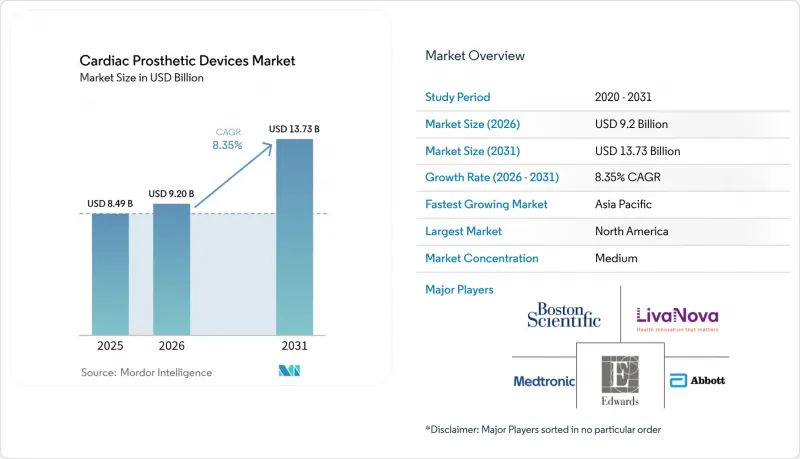
Mordor Intelligence에 의하면, 심장 인공 장치 시장 규모는 2025년에 84억 9,000만 달러로 평가되었습니다. 2026년 92억 달러에서 2031년까지 137억 3,000만 달러에 이를 것으로 예상되며, 예측 기간(2026-2031년) CAGR은 8.35%를 나타낼 전망입니다.
본 보고서는 제품 유형(심장 판막, 심박조율기, 기타), 소재(금속 합금, 생체 조직, 고분자 및 하이브리드), 최종 사용자(병원, 전문 클리닉, 외래수술센터(ASC), 기타), 지역(북미, 유럽, 아시아태평양, 중동 및 아프리카, 남미)별로 분류되어 있습니다. 시장 예측은 금액(달러) 기준으로 제시되어 있습니다.
세계의 심장 인공 장치 시장 동향 및 인사이트
심장 질환 유병률 증가와 고령화
심혈관 질환의 발병률은 65세 이후 급격히 증가하고 있으며, 현재 해당 연령대의 인구 비율은 미국에서 17% 이상, 일본에서 21%, 서유럽 전체에서 20%를 초과하고 있습니다. 따라서 평균 수명의 연장에 따라 중증 대동맥판막 협착증, 심방세동 또는 심부전을 발병하여 임플란트 치료가 필요한 환자 수가 증가하고 있습니다. 생존 기간의 연장에 따라 의료 현장에서는 의료기기의 내구성에 대한 기대도 높아지고 있으며, 이에 따라 각 벤더사는 재수술 없이 수십년동안 사용할 수 있는 판막 개발을 요구받고 있습니다. 고령 환자들은 입원 기간을 단축할 수 있는 최소 침습적 치료를 선호하는 경향이 있으며, 이는 경카테터 치료법에 대한 수요를 더욱 부추기고 있습니다. 이러한 인구통계학적 요인들이 맞물려 시술 건수와 단가가 모두 확대되고 있으며, 이는 심장 보철 기기 시장의 지속적인 수익 성장을 뒷받침하고 있습니다.
저침습 TAVR 시술의 급속한 보급
저침습 TAVR 시술의 급속한 보급 : 경카테터 대동맥판막 치환술(TAVR)은 5년간의 확실한 데이터를 통해 개흉 수술과 동등한 생존율이 확인됨에 따라, 고위험군의 틈새 치료법에서 저위험군 환자에게도 권장되는 주류 치료법으로 전환되었습니다. 평균 입원 일수가 2일 미만이므로 병원은 운영 효율을 높일 수 있고, 혼잡한 심장병동의 병상을 확보할 수 있게 됩니다. Valve-in-valve 기술은 개흉술 없이 퇴행성 생체 판막을 치료할 수 있어 대상 환자층을 더욱 확대하고 있으며, 이 기능은 특히 고령 환자분들로부터 높은 평가를 받고 있습니다. 차세대 플랫폼에서는 판막 끝단의 정합성이 향상되고 관상동맥 접근도 용이해져, 향후 경피적 관상동맥 중재술의 시행이 보장됩니다. 보험사의 정책에 따라 3차 의료기관 이외의 곳에서 TAVR에 대한 보험 급여가 확대됨에 따라 시술 건수가 증가하고 있으며, 이는 심장 보철 기기 시장의 연평균 성장률(CAGR)에 긍정적인 영향을 더욱 강화하고 있습니다.
여러 지역에서의 엄격한 규제 승인
유럽 의료기기 규정(MDR)은 임상 증거 요건을 부과하고 있으며, 이로 인해 기존의 CE 마크 취득 절차에 비해 문서 작성 부담이 약 3배로 증가했습니다. 기업이 제출한 자료에 따르면, 이로 인해 일반적인 승인까지 소요되는 기간이 18-24개월 연장되었으며, 고위험 의료기기 1대당 시장 출시 전 비용이 1,200만 달러 증가했습니다. 동시에, 미국 FDA의 승인 후 장기 추적 조사 요건도 제조업체에 지속적인 자원 부담을 가중시키고 있습니다. 소규모 혁신 기업들은 이러한 의무 이행에 필요한 자금 조달에 어려움을 겪고 있으며, 그 결과 유망한 기술을 타사에 라이선싱하거나 이 분야에서 완전히 철수하는 기업도 몇 군데 보입니다. 다국적 기업은 이러한 비용을 감당할 수 있지만, 수익화까지의 과정이 길어짐에 따라 연구개발비 회수가 지연되어 예측 기간 동안 심장 보철 기기 시장의 연평균 성장률(CAGR)을 소폭 끌어내리는 요인이 됩니다.
부문별 분석
2031년까지의 연평균 성장률(CAGR)에서 심장 판막은 9.12%를 기록하여, 2025년에 심박조율기가 심장 보철 기기 시장의 59.85% 점유율을 유지했음에도 불구하고 다른 모든 카테고리를 앞질렀습니다. TAVR, TMVR 및 신흥 경카테터 삼첨판 시스템은 치료 가능한 환자층을 확대하는 동시에 높은 평균 판매 가격을 유지하고 있어 전체 매출을 끌어올리고 있습니다. 병원 측은 이러한 임플란트를 통한 신속한 회복을 높이 평가하고 있으며, 환자 측도 흉골 절개를 피할 수 있다는 점을 중요하게 여기고 있어 연간 시술 건수는 지속적으로 두 자릿수 성장을 이어가고 있습니다. 심박조율기 매출은 서맥성 부정맥 환자의 막대한 수로 인해 견조한 모습을 유지하고 있지만, 시장의 성숙과 가격 압박으로 인해 부문의 성장은 제한되고 있습니다. 심실 보조 장치를 포함한 기타 부문은 계속해서 획기적인 의료기기로 지정받고 있으며, 핵심인 부정맥 관리 분야를 넘어선 수익 다각화로 이어질 장기적인 상승 추세가 시사되고 있지만, 단기적인 기여도는 여전히 미미한 수준입니다.
석회화 방지 기술이 적용된 2세대 생체 판막은 특히 평생에 걸친 항응고 요법을 피하고자 하는 50-65세 환자층에서 기계 판막 시장 점유율을 서서히 빼앗고 있습니다. 동시에, AI를 활용한 분석 기능을 갖춘 리드리스 심박조율기는 성장이 정체된 카테고리 내에서도 프리미엄 하위 부문을 개척하고 있습니다. 이러한 시너지 효과로 인해 제품 구성은 수익률이 높은 첨단 기술을 구사한 솔루션으로 점차 전환되고 있으며, 이것이 시장 전체의 성장 궤도를 뒷받침하고 있습니다.
지역별 분석
북미는 전 세계 매출을 주도하고 있으며, 2025년에는 40.92%를 차지했습니다. 이는 메디케어가 TAVR의 적용 범위를 저위험군으로 확대하고, 외래 진료 청구 코드를 승인했기 때문입니다. 광범위한 임상시험 네트워크 덕분에 인간을 대상으로 한 초기 시험을 쉽게 수행할 수 있어, 신기술 도입에 있어 미국의 의료기관은 해외 동종 업계보다 12-18개월의 선점 기간을 확보하는 경우가 많습니다. FDA의 ‘브레이크스루 디바이스(Breakthrough Device)’ 제도와 같은 규제 프로그램은 혁신적인 플랫폼 시장 출시 기간을 단축시켜, 이 지역의 선도적 지위를 더욱 공고히 하고 있습니다. 그러나 가치 기반 구매 계약 및 일괄 지급의 확대에 따라 이익률의 압박은 피할 수 없습니다. 주요 제조업체들은 평균 판매 가격(ASP)을 유지하기 위해 디지털 서비스나 연장 보증을 가격 제안에 포함시켜 위험을 헤지하고 있습니다.
아시아태평양은 연평균 성장률(CAGR) 9.39%로 가장 높은 성장률을 보이고 있으며, 이는 3차 의료의 현대화를 위한 정부의 추진과 고도의 의료 시술을 자비로 감당할 수 있는 급성장 중인 중산층의 존재에 힘입은 것입니다. 중국의 Centers for Excellence 보조금은 하이브리드 수술실 설비 투자를 지원하여 잠재적 수요를 불러일으키고 있습니다. 일본에서는 개정된 진료 보수 기준에 따라 AI를 활용한 원격 모니터링 진료 코드가 인정되어, 벤더의 현금 흐름을 안정시키는 지속적인 수익원이 창출되고 있습니다. 환자 1인당 지출은 북미보다 낮지만, 인구 규모로 인해 상쇄되고 있으며, 현지 제조업체와의 제휴를 통해 수입 관세가 감면되어 합리적인 가격으로 제품을 제공할 수 있게 되었습니다.
유럽에서는 국민건강보험 모델이 경제 변동으로부터 수술 건수를 보호하고 있어, 안정적인 한 자릿수 중반대의 성장이 나타나고 있습니다. 독일의 DRG(진단 관련 군) 제도는 입원 일수 단축을 장려하고 있어, 경카테터 치료에 직접적인 이점을 가져다주고 있습니다. MDR(의료기기 규정)은 초기 비용을 부과하지만, 의료기기의 안전성에 대한 환자의 신뢰를 높여 간접적으로 도입을 촉진하고 있습니다. 한편, 영국의 의약품 및 의료제품규제청(MHRA)은 브렉시트 이후 이식형 의료기기를 대상으로 한 신속 심사 시범 운영을 실시하고 있으며, 현지에서 근거를 구축할 의향이 있는 기업에 대해 시장 진입을 위한 별도의 패스트트랙을 제공합니다. 이러한 지역별 동향이 결합되어 심장 보철 기기 시장의 성장 궤도를 뒷받침하는 균형 잡힌 성장의 모자이크를 형성하고 있습니다.
기타 혜택 :
- 엑셀 형식 시장 예측(ME) 시트
- 3개월간의 애널리스트 지원
자주 묻는 질문
목차
제1장 서론
제2장 조사 방법
제3장 주요 요약
제4장 시장 구도
제5장 시장 규모 및 성장 예측
제6장 경쟁 구도
제7장 시장 기회 및 향후 전망
KTH 26.08.28According to Mordor Intelligence, the cardiac prosthetic devices market size was valued at USD 8.49 billion in 2025 and estimated to grow from USD 9.2 billion in 2026 to reach USD 13.73 billion by 2031, at a CAGR of 8.35% during the forecast period (2026-2031).
This report is Segmented by Product Type (Heart Valves, Pacemakers, Others), Material (Metal Alloys, Biological Tissue, Polymeric and Hybrid), End User (Hospitals, Specialty Clinics, Ambulatory Surgical Centres, Others), and Geography (North America, Europe, Asia-Pacific, Middle East and Africa, South America). The Market Forecasts are Provided in Terms of Value (USD).
Global Cardiac Prosthetic Devices Market Trends and Insights
Rise in prevalence of cardiac diseases & ageing population
Cardiovascular disease incidence climbs steeply after age 65, and the share of citizens in that age bracket now exceeds 17% in the United States, 21% in Japan and 20% across Western Europe. Higher life expectancy therefore enlarges the pool of patients living long enough to develop severe aortic stenosis, atrial fibrillation or heart failure that necessitate implant therapy. Longer survivorship also raises clinical expectations for device longevity, which pushes vendors to engineer valves that can last decades without re-operation. Geriatric patients tend to favor minimally-invasive therapies that shorten hospital stays, reinforcing demand for transcatheter solutions. Together these demographic forces are expanding procedure volumes as well as unit prices, supporting sustained revenue growth for the cardiac prosthetic devices market.
Rapid adoption of minimally-invasive TAVR procedures
Rapid adoption of minimally-invasive TAVR proceduresTranscatheter aortic valve replacement (TAVR) has shifted from a high-risk niche therapy to a mainstream option endorsed for low-risk patients after robust five-year data confirmed comparable survival versus open surgery. Hospitals gain operational efficiencies because typical length of stay falls below two days, freeing capacity in crowded cardiac wards. Valve-in-valve techniques further widen the addressable pool by treating degenerated bioprostheses without sternotomy, a capability especially valued by elderly patients. Next-generation platforms now feature enlarged commissural alignment and easier coronary access, ensuring future percutaneous coronary interventions remain feasible. As payer policies increasingly reimburse TAVR outside tertiary centers, procedure counts accelerate, amplifying the positive impact on the cardiac prosthetic devices market CAGR.
Stringent multi-region regulatory approvals
The European Medical Device Regulation (MDR) enforces clinical-evidence requirements that roughly triple the documentation burden relative to the former CE-mark process, adding 18-24 months to typical approval timelines and inflating pre-market costs by USD 12 million per high-risk device according to company filings . Simultaneously, the U.S. FDA's requirement for long-term post-approval studies places ongoing resource demands on manufacturers. Smaller innovators struggle to finance these obligations, leading several to out-license promising technologies or exit the field entirely. Multinational players can absorb the expense, but the longer path to revenue delays return on R&D spending, marginally dampening the CAGR of the cardiac prosthetic devices market during the forecast window.
Other drivers and restraints analyzed in the detailed report include:
- Continuous technology upgrades in leadless & MRI-safe pacemakers
- Favourable reimbursement pathways in US, EU & Japan
- High procedure & device cost, limited access in LMICs
For complete list of drivers and restraints, kindly check the Table Of Contents.
Segment Analysis
Heart valves contributed 9.12% CAGR through 2031, outpacing every other category even though pacemakers retained a 59.85% cardiac prosthetic devices market share in 2025. TAVR, TMVR and emerging transcatheter tricuspid systems have expanded the treatable patient pool while commanding high average selling prices that lift overall revenue. Hospitals prize the rapid recovery dynamics of these implants, and patients value the avoidance of sternotomy, fueling sustained double-digit annual procedure growth. Pacemaker sales remain resilient due to the sheer size of the bradyarrhythmia population, yet their mature status and pricing compression restrain segment expansion. The others segment, including ventricular assist devices, continues to receive breakthrough-device designations, suggesting a long-term upswing that could diversify revenue beyond the core rhythm-management base, but near-term contribution remains modest.
Second-generation tissue valves integrating anti-calcification chemistry now capture share from mechanical valves, especially in patients aged 50-65 who prefer to avoid lifelong anticoagulation. Simultaneously, leadless pacemakers with AI-enabled analytics are carving a premium sub-segment even within a plateauing category. The combined effect is a gradual tilt of the product mix toward higher-margin, technology-rich solutions that sustain the broader cardiac prosthetic devices market growth trajectory.
Complete Report Scope:
- By Product Type
- Heart Valves
- Mechanical Valves
- Tissue Valves
- Transcatheter Valves
- Pacemakers
- Leaded
- Leadless
- Others
- Heart Valves
- By Material
- Metal Alloys
- Biological Tissue
- Polymeric and Hybrid
- By End User
- Hospitals
- Specilaty Clinics
- Ambulatory Surgical Centres
- Others
- By Geography
- North America
- United States
- Canada
- Mexico
- Europe
- Germany
- United Kingdom
- France
- Italy
- Spain
- Rest of Europe
- Asia-Pacific
- China
- Japan
- India
- Australia
- South Korea
- Rest of Asia-Pacific
- Middle East and Africa
- GCC
- South Africa
- Rest of Middle East and Africa
- South America
- Brazil
- Argentina
- Rest of South America
- North America
Geography Analysis
North America leads global revenue, accounting for 40.92% in 2025 as Medicare broadened TAVR coverage to low-risk cohorts and approved ambulatory billing codes. The presence of vast clinical-trial networks facilitates first-in-human studies, often granting U.S. facilities 12-18-month lead time over international peers in new-technology adoption. Regulatory programs such as the FDA Breakthrough Device pathway shorten time-to-market for transformative platforms, further cementing the region's leadership. Yet margin compression is inevitable as value-based purchasing agreements and bundled payments expand; leading manufacturers hedge by bundling digital services and extended warranties into pricing proposals to preserve ASPs.
Asia-Pacific is the fastest climber at 9.39% CAGR, supported by governmental push to modernize tertiary care and a burgeoning middle class able to self-pay for advanced interventions. Chinese Centers for Excellence grants subsidize the capital expenditure for hybrid operating suites, unlocking latent demand. Japan's revised reimbursement schedule recognizes AI-driven remote monitoring codes, creating recurring revenue that stabilizes vendor cash flows. Although per-patient spend is lower than in North America, population scale compensates, and local manufacturing partnerships reduce import tariffs, improving affordability.
Europe demonstrates steady mid-single-digit expansion as universal-payer models shield procedure volumes from economic volatility. Germany's DRG system rewards shorter length of stay, directly benefiting transcatheter approaches. The MDR imposes up-front costs but enhances patient confidence in device safety, indirectly supporting adoption. Meanwhile, the United Kingdom's Medicines & Healthcare products Regulatory Agency is piloting an expedited review for implantables post-Brexit, offering an alternate fast-track to market for companies willing to invest in localized evidence generation. Collectively, these regional dynamics shape a balanced growth mosaic that underpins the upward trajectory of the cardiac prosthetic devices market.
- Abbott Laboratories
- Medtronic
- Edward Lifesciences
- Boston Scientific
- LivaNova
- BIOTRONIK
- Lepu Medical
- Meril Life Sciences
- Colibri Heart Valve
- Siemens Healthineers
- Venus Medtech
- On-X Life Technologies
- SynCardia Systems
- Foldax Inc.
- CryoLife (Artivion)
- Terumo
- Getinge
- W. L. Gore & Associates
- MicroPort
- Shockwave Medical
Additional Benefits:
- The market estimate (ME) sheet in Excel format
- 3 months of analyst support
TABLE OF CONTENTS
1 Introduction
- 1.1 Study Assumptions & Market Definition
- 1.2 Scope of the Study
2 Research Methodology
3 Executive Summary
4 Market Landscape
- 4.1 Market Overview
- 4.2 Market Drivers
- 4.2.1 Rise in prevalence of cardiac diseases & ageing population
- 4.2.2 Rapid adoption of minimally-invasive TAVR procedures
- 4.2.3 Continuous technology upgrades in lead-less & MRI-safe pacemakers
- 4.2.4 Favourable reimbursement pathways in US, EU & Japan
- 4.2.5 AI-driven remote programming & monitoring of pacemakers
- 4.2.6 Polymeric RESILIA-like valves extending durability beyond 25 yrs
- 4.3 Market Restraints
- 4.3.1 Stringent multi-region regulatory approvals
- 4.3.2 High procedure & device cost, limited access in LMICs
- 4.3.3 Dependency on bovine & porcine tissue supply chains
- 4.3.4 Catheter-based ablation therapies delaying implant need
- 4.4 Regulatory Landscape
- 4.5 Technological Outlook
- 4.6 Porter's Five Forces Analysis
- 4.6.1 Threat of New Entrants
- 4.6.2 Bargaining Power of Buyers
- 4.6.3 Bargaining Power of Suppliers
- 4.6.4 Threat of Substitutes
- 4.6.5 Intensity of Competitive Rivalry
5 Market Size & Growth Forecasts (Value, USD)
- 5.1 By Product Type
- 5.1.1 Heart Valves
- 5.1.1.1 Mechanical Valves
- 5.1.1.2 Tissue Valves
- 5.1.1.3 Transcatheter Valves
- 5.1.2 Pacemakers
- 5.1.2.1 Leaded
- 5.1.2.2 Leadless
- 5.1.3 Others
- 5.1.1 Heart Valves
- 5.2 By Material
- 5.2.1 Metal Alloys
- 5.2.2 Biological Tissue
- 5.2.3 Polymeric and Hybrid
- 5.3 By End User
- 5.3.1 Hospitals
- 5.3.2 Specilaty Clinics
- 5.3.3 Ambulatory Surgical Centres
- 5.3.4 Others
- 5.4 By Geography
- 5.4.1 North America
- 5.4.1.1 United States
- 5.4.1.2 Canada
- 5.4.1.3 Mexico
- 5.4.2 Europe
- 5.4.2.1 Germany
- 5.4.2.2 United Kingdom
- 5.4.2.3 France
- 5.4.2.4 Italy
- 5.4.2.5 Spain
- 5.4.2.6 Rest of Europe
- 5.4.3 Asia-Pacific
- 5.4.3.1 China
- 5.4.3.2 Japan
- 5.4.3.3 India
- 5.4.3.4 Australia
- 5.4.3.5 South Korea
- 5.4.3.6 Rest of Asia-Pacific
- 5.4.4 Middle East and Africa
- 5.4.4.1 GCC
- 5.4.4.2 South Africa
- 5.4.4.3 Rest of Middle East and Africa
- 5.4.5 South America
- 5.4.5.1 Brazil
- 5.4.5.2 Argentina
- 5.4.5.3 Rest of South America
- 5.4.1 North America
6 Competitive Landscape
- 6.1 Market Concentration
- 6.2 Market Share Analysis
- 6.3 Company Profiles (includes Global level Overview, Market level overview, Core Segments, Financials as available, Strategic Information, Market Rank/Share for key companies, Products & Services, and Recent Developments)
- 6.3.1 Abbott Laboratories
- 6.3.2 Medtronic plc
- 6.3.3 Edwards Lifesciences Corporation
- 6.3.4 Boston Scientific Corporation
- 6.3.5 LivaNova PLC
- 6.3.6 Biotronik SE & Co. KG
- 6.3.7 Lepu Medical Technology
- 6.3.8 Meril Life Sciences
- 6.3.9 Colibri Heart Valve
- 6.3.10 Siemens Healthineers
- 6.3.11 Venus Medtech
- 6.3.12 On-X Life Technologies
- 6.3.13 SynCardia Systems
- 6.3.14 Foldax Inc.
- 6.3.15 CryoLife (Artivion)
- 6.3.16 Terumo Corporation
- 6.3.17 Getinge AB
- 6.3.18 W. L. Gore & Associates
- 6.3.19 MicroPort Scientific
- 6.3.20 Shockwave Medical
7 Market Opportunities & Future Outlook
- 7.1 White-space & Unmet-need Assessment