
|
시장보고서
상품코드
2114592
반자동 및 수동 충전 장비 시장 : 시장 점유율 분석, 업계 동향 및 통계, 성장 예측(2026-2031년)Semi-Automatic And Manual Filling Equipment - Market Share Analysis, Industry Trends & Statistics, Growth Forecasts (2026 - 2031) |
||||||
 Mordor Intelligence
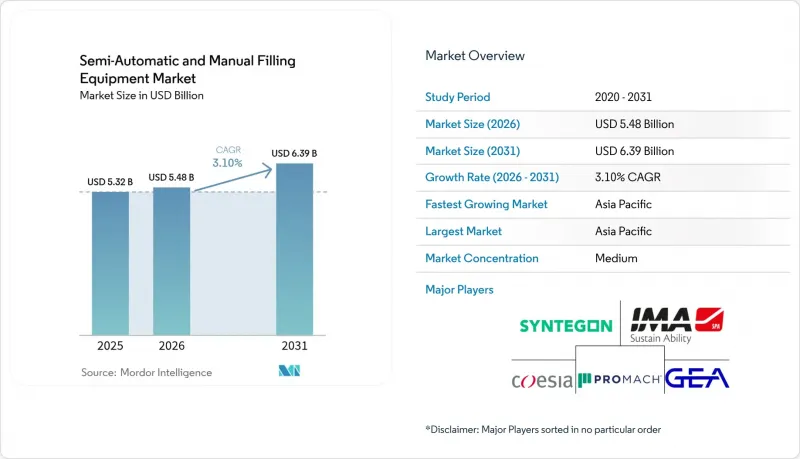
Mordor Intelligence에 의하면, 2026년 반자동 및 수동 충전 장비 시장 규모는 54억 8,000만 달러로 추정되고, 2025년 53억 2,000만 달러에서 확대해, 2031년에는 63억 9,000만 달러에 이를 것으로 예측됩니다.
2026-2031년 연평균 성장률(CAGR) 3.10%로 성장할 것으로 전망됩니다.
본 보고서는 제품 유형별(고형, 반고형, 액체), 최종 사용자 산업별(식품, 음료, 의약품, 화장품 및 가정용품, 기타 최종 사용자 산업), 기계 유형별(반자동 충전 장치 등), 용기 유형별(병·항아리 등), 지역별(북미 등)로 분류되어 있습니다. 시장 전망은 금액(달러) 기준으로 제시되어 있습니다.
세계의 반자동 및 수동 충전 장비 시장 동향과 인사이트
중소 식품 가공업체의 모듈식 반자동 라인 도입 가속화
중소규모 식품 기업들은 21 CFR Part 117에 따른 예방적 관리 요건을 충족하면서, 단계적인 생산 규모 확대를 가능하게 하는 모듈식 반자동 설비에 대한 투자를 진행하고 있습니다. 플러그 앤 플레이 방식의 충전 장비는 설치에 따른 가동 중단 시간을 최소화하고, 가공업체가 대규모 설비 재조정 없이 계절별 SKU(재고 관리 단위)를 생산할 수 있게 하며, 모듈의 단계적 교체를 통해 기계의 수명을 연장함으로써 반자동 및 수동 충전 설비 시장을 뒷받침하고 있습니다. 각 장비 제조업체는 감사관이 현재 라인 수준의 상세한 데이터를 요구하고 있는 생산 데이터를 수집하기 위해 클라우드 기반 모니터링 기능을 세트로 판매하고 있습니다. 또한, 모듈식 스키드 프레임은 가공업체가 새로운 식품 등급 시설로 이전할 때 이동을 용이하게 하여, 기존 설비 투자를 효과적으로 활용할 수 있도록 합니다.
수동 충전 장비가 필요한 소량 맞춤형 의약품 생산의 급증
환자 맞춤형 치료로의 전환에 따라, 수천 단위를 넘기는 경우가 드문 배치에 적합하며 정확한 투여량 제어가 가능한 수동 및 반자동 충전 장비에 대한 수요가 증가하고 있습니다. 첨단 제조에 관한 FDA 지침에서는 단순한 속도보다 장비의 유연성이 더 중요시되고 있습니다. 수동 충전 장비는 전환이 빈번하고 엄격한 세척 검증이 필수적인 임상시험 배치나 희귀질환 치료제 제조에 대응하고 있습니다. 각 공급업체는 교차 오염 위험을 줄이기 위해 폐쇄형 중량 점검 및 일회용 제품 경로를 통합하고 있습니다. 제약 기업의 구매 담당자들이 고정형 고속 라인보다 유연성이 높은 스키드를 선호함에 따라, 이 틈새 시장이 반자동 및 수동 충전 장비 시장의 기반을 공고히 하고 있습니다.
반자동 충전 장비의 유지보수 및 가동 중단에 드는 높은 비용
반자동 충전 장비에는 정기적인 유지보수 및 숙련된 문제 해결이 필요한 공압 장치, 서보 드라이브, PLC가 채택되어 있습니다. 독자적인 사양의 밸브나 센서 교체 부품은 가격이 비쌀 수 있으며, 예기치 못한 가동 중단은 납기에 차질을 빚게 됩니다. ISO/TC 313에서는 예방 정비 프로토콜이 규정되어 있지만, 중소규모 기업에서는 이를 미루는 경우가 있어, 그 결과 마모가 진행되고 평균 수리 소요 시간(MTTR)이 길어지게 됩니다. 이로 인해 발생하는 운영 비용(OPEX)에 대한 우려로 인해, 반자동 및 수동 충전 장치 시장에서 자금 사정이 어려운 기업들의 구매 결정이 신중해지고 있습니다.
부문 분석
2025년에는 액체 제품이 매출의 49.02%를 차지한 것으로 평가되었으며, 음료, 의약품, 화장품 분야에서 표준 노즐 설계와 처리 능력 사이에 확고한 상관관계가 있는 것으로 나타났습니다. 고점도 펌프와 CIP(정지 세척) 대응 매니폴드가 생산성을 안정적으로 유지하고 있기 때문에 이 점유율이 반자동 및 수동 충전 장치 시장의 기반을 형성하고 있습니다. 반고체 제품은 소수이긴 하지만, 정밀한 투여를 위해 에어프리 피스톤이 필요한 고급 스킨케어용 밤이나 외용약에 힘입어 연평균 성장률(CAGR) 3.92%로 성장을 지속하고, 있습니다. 각 공급업체들은 점도 변동을 관리하고 투여량의 재현성을 확보하기 위해 가열 재킷이나 진공 보조 모듈을 세트로 판매하고 있습니다. 고형제 충전은 캡슐 충전, 조미료 소포장, 비타민 분말 스틱 등을 포함하는 전문 분야이며, 이들은 용적식 피스톤이 아닌 중량식 오거에 의존합니다. 이 분야의 성장은 대량 처리 능력보다는 영양 보충제의 인기에 달려 있습니다.
규제상의 관심은 모든 제품 범주에 미칩니다. 21 CFR Part 177에 규정된 FDA의 식품 접촉 규정에 따르면, 스테인리스 스틸으로 제작된 습윤 부품 및 개스킷은 고온 살균에 대응하는 규격을 충족해야 합니다. 이 규정은 식품용과 외용 제품의 SKU 간에 설비를 공유하는 화장품 및 OTC(일반의약품) 제조 공장에도 동일하게 적용됩니다. 고체 및 반고체 제품의 경우, 일회용 접촉 키트를 사용하면 세척이 간소화되며, 감사관에게 배치 간 분리가 완벽하게 보장되고 있음을 입증할 수 있습니다.
2025년에는 음료가 매출의 24.41%를 차지한 것으로 평가되었으며, 이는 병 및 캔 관련 인프라가 정착되어 있고 크래프트 맥주 라이선싱이 지속적으로 확대되고 있음을 반영합니다. 탄산음료의 배합 변경, 하드 셀처, 기능성 물에는 여전히 정확한 탈기 및 기포 억제 모듈이 요구되며, 이러한 모듈은 일반적으로 반자동 라인에 탑재되어 있습니다. 한편, 식품 가공 분야는 중소규모의 스낵 및 소스 제조업체들이 자체 개발한 공정을 상업적 규모로 전환하고 있어 연평균 성장률(CAGR) 4.12%의 속도로 성장하고 있습니다. ‘예방적 관리 규정(Preventive Controls rule)’ 준수에 따라 알레르기 유발 물질 전환용으로 사전 검증된 충전 장비 구매가 촉진되고 있으며, 그 결과 시장 침투율이 더욱 높아질 것으로 예측됩니다. 의약품 분야에서는 맞춤형 의료 및 희귀질환 치료제(오르판 드럭)에 관한 정책에 힘입어 점진적인 성장을 유지하고 있으며, 이에 따라 유연성이 높고 설치 면적이 작은 스키드형 설비에 대한 수요가 증가하고 있습니다. 화장품 및 가정용품 분야는 시장 점유율이 작지만, 유리 드롭퍼, 에어리스 펌프, 재활용 가능한 알루미늄 등을 활용한 브랜드의 프리미엄화로 인해, 기존과는 다른 용기에 대응하기 위한 설비 개조가 정당화되고 있습니다.
업계를 아우르는 공통점으로는 배치 추적성, 위생적인 설계, 제품 손실 최소화 등 감사 시 요구되는 요건들을 들 수 있습니다. 따라서 반자동 및 수동 충전 장비 시장에서는 유사한 위생 기준을 충족하면서도 제품별 점도 차이에 따라 금형을 신속하게 교체할 수 있는 설계가 선호되고 있습니다.
지역별 분석
아시아태평양은 2025년에 매출의 43.12%를 차지한 것으로 평가되었으며, 2031년까지 연평균 성장률(CAGR) 4.55%로 확대될 것으로 전망되어, 반자동 및 수동 충전 장치 시장에서 가장 크고 가장 빠르게 성장하는 지역이 되고 있습니다. 중국 국가의약품감독관리국은 신청 서류 요건을 현대화하여, 데이터 로깅 기능을 갖춘 충전 장비 도입을 촉진하는 제약 라인 개조가 진행되고 있습니다. 동시에, 아세안(ASEAN)의 스낵 브랜드들은 수출 거점을 확대하고 있으며, 할랄 및 HACCP 기준을 준수하는 반자동 충전 장비를 도입하고 있습니다. 한국과 싱가포르에서 ‘인더스트리 4.0’으로의 업그레이드에 대한 정부 보조금은 스마트 설비 교체를 더욱 촉진하고 있습니다.
북미의 성숙한 시장에서는 전자 배치 기록 및 CIP 매니폴드를 통합하기 위해 구형 기계가 단계적으로 교체되고 있습니다. 미국과 캐나다의 수제 음료 스타트업 기업들은 일부 주에서 라이선스 취득 절차가 간소화된 것을 호재로 삼아, 생산 규모가 서보 구동식 캡퍼에 대한 투자를 정당화할 수 있는 단계에 도달할 때까지 수동 충전 장비 구매를 활발히 이어가고 있습니다. 또한, 식품 안전 관련 소송 위험도 미국 가공업체들이 위생 인증을 획득한 충전 장비를 우선적으로 선택하도록 하는 동기가 되고 있으며, 그로 인해 반자동 및 수동 충전 장비 시장의 애프터마켓 수익이 유지되고 있습니다.
유럽은 북미와 동등한 성숙도를 자랑하지만, 지출은 주로 베네룩스 국가와 북유럽 국가에서 지속가능성, 병 경량화 프로젝트, 리필 키오스크 시범 사업에 집중되고 있습니다. CE 마크를 획득한 장비는 통관 절차가 간소화되어 있어, EU 제조업체의 중동 허브로의 수출을 촉진하고 있습니다. 한편, 유럽연합(EU)의 디지털 제품 여권 도입 검토는 추적 기능을 갖춘 기계에 대한 자본 투자를 뒷받침하고 있습니다.
남미 및 중동 및 아프리카은 절대적인 규모 면에서는 뒤처져 있지만, 마이크로 팩토리의 활동이 활발해지고 있습니다. 현지에서 생산된 스낵용 향료, 허브 추출물, 수제 가정용 세제가 국내 슈퍼마켓에 등장하며, 입문용 수동 키트 수요를 견인하고 있습니다. 환율 변동으로 인해 대규모 설비 투자가 지연되기도 하지만, 기부자가 자금을 지원하는 식량 안보 프로그램에서는 반자동 충전 장비가 턴키 방식의 생산 라인에 통합되는 경우가 많습니다.
기타 혜택 :
- 엑셀 형식 시장 예측(ME) 시트
- 3개월간의 애널리스트 지원
자주 묻는 질문
목차
제1장 서론
제2장 조사 방법
제3장 주요 요약
제4장 시장 구도
제5장 시장 규모 및 성장 예측
제6장 경쟁 구도
제7장 시장 기회 및 향후 전망
AJY 26.08.26According to Mordor Intelligence, the semi-Automatic and Manual filling equipment market size in 2026 is estimated at USD 5.48 billion, growing from 2025 value of USD 5.32 billion with 2031 projections showing USD 6.39 billion, growing at 3.10% CAGR over 2026-2031.
This report is Segmented by Product Type (Solid, Semi-Solid, and Liquid), End-User Industry (Food, Beverage, Pharmaceutical, Cosmetics and Household, and Other End-User Industries), Machine Type (Semi-Automatic Filling Equipment, and More), Container Type (Bottles and Jars, and More), and Geography (North America, and More). The Market Forecasts are Provided in Terms of Value (USD).
Global Semi-Automatic And Manual Filling Equipment Market Trends and Insights
Accelerated Adoption of Modular Semi-Automatic Lines by SME Food Processors
Small and mid-size food companies are investing in modular semi-automatic equipment that permits stepwise scale-up while meeting preventive-control mandates under 21 CFR Part 117. Plug-and-play fillers minimize installation downtime, let processors run seasonal stock-keeping units without extensive retooling, and support the Semi-Automatic and Manual filling equipment market by extending machine life through incremental module swaps. Equipment houses are bundling cloud-based monitoring to capture production data that auditors now request at line-level granularity. Modular skid frames also facilitate relocation when processors move to new food-grade premises, thereby preserving earlier capital investments.
Surge in Low-Volume Personalised Pharma Production Needing Manual Fillers
The move toward patient-specific treatments has increased demand for manual and semi-automatic fillers with precise dose control, suitable for batches that rarely exceed several thousand units. FDA guidance on advanced manufacturing highlights equipment agility over sheer speed. Manual fillers support clinical trial lots and orphan-drug runs where changeovers are frequent and stringent cleaning verification is mandatory. Vendors are integrating closed-loop weight checks and single-use product paths to reduce the risk of cross-contamination. This niche solidifies the Semi-Automatic and Manual filling equipment market, as pharmaceutical buyers favor flexible skids over fixed-format, high-speed lines.
High Maintenance and Downtime Costs for Semi-Automatic Machines
Semi-automatic fillers introduce pneumatics, servo drives, and PLCs that need scheduled servicing and skilled troubleshooting. Replacement parts for proprietary valves or sensors can be costly, and unplanned stoppages disrupt delivery timetables. ISO/TC 313 prescribes preventive protocols that smaller firms sometimes defer, compounding wear and increasing mean-time-to-repair. Resulting OPEX concerns temper purchasing decisions in cash-constrained enterprises within the Semi-Automatic and Manual filling equipment market.
Other drivers and restraints analyzed in the detailed report include:
- Expansion of Craft Beverage Brands Demanding Flexible Filling Solutions
- Regulatory Push for E-Batch Records Spurring Smart Semi-Automatic Retrofits
- Skilled-Operator Shortages in Developing Regions
For complete list of drivers and restraints, kindly check the Table Of Contents.
Segment Analysis
Liquid formats generated 49.02% of the revenue in 2025, illustrating an enduring alignment between standard nozzle designs and throughput for beverages, pharmaceuticals, and cosmetics. That share anchors the Semi-Automatic and Manual Filling Equipment market, as high-viscosity pumps and CIP-enabled manifolds keep productivity steady. Semi-solid products, although a minority, chart a 3.92% CAGR on the back of premium skincare balms and topical medicines that demand air-free pistons for precise dosing. Vendors bundle heated jackets and vacuum-assist modules to manage viscosity fluctuations, protecting dose repeatability. Solid dosing remains a specialized field that involves capsule filling, seasoning sachets, or vitamin powder sticks, which rely on gravimetric augers versus volumetric pistons. Growth here hinges on the popularity of nutraceuticals rather than mass throughput.
Regulatory attention spans every product class. FDA food-contact rules, as outlined in 21 CFR Part 177, require stainless steel wetted components and gaskets to be rated for high-temperature sanitation. The same rules also apply to cosmetic and OTC factories that share equipment between edible and topical SKUs. For solids and semi-solids, single-use contact kits simplify cleaning and demonstrate to auditors that batch segregation is airtight.
Beverages accounted for 24.41% revenue in 2025, reflecting entrenched bottle-and-can infrastructure and sustained craft-brew licensing expansion. Carbonated drink reformulations, hard seltzers, and functional waters continue to require accurate degassing or foam-control modules, which are typically found in semi-automatic lines. Food processing, however, is on pace for a 4.12% CAGR as SME snack and sauce producers convert home-grown processes into commercial volumes. Compliance with the Preventive Controls rule encourages them to purchase pre-validated fillers for allergen changeovers, thereby nudging penetration higher. Pharmaceuticals maintain incremental gains through personalized medicine and orphan-drug policies, which increase demand for flexible, small-footprint skids. Cosmetics and household goods, although smaller slices, leverage brand premiumization utilizing glass droppers, airless pumps, and recyclable aluminum to justify equipment retrofits that support non-traditional containers.
Cross-industry commonalities lie in audit expectations, including batch traceability, hygienic design, and minimized product loss. The Semi-Automatic and Manual filling equipment market, therefore, favors designs that replicate similar hygienic baselines while offering tooling quick swaps for divergent product viscosities.
Complete Report Scope:
- By Product Type
- Solid
- Semi-Solid
- Liquid
- By End-User Industry
- Food
- Beverage
- Pharmaceutical
- Cosmetics and Household
- Other End-User Industries
- By Machine Type
- Semi-Automatic Filling Equipment
- Manual Filling Equipment
- By Container Type
- Bottles and Jars
- Pouches and Sachets
- Cans
- Tubes
- Other Container Types
- By Geography
- North America
- United States
- Canada
- Mexico
- South America
- Brazil
- Argentina
- Rest of South America
- Europe
- Germany
- France
- United Kingdom
- Italy
- Spain
- Russia
- Rest of Europe
- Asia-Pacific
- China
- Japan
- India
- South Korea
- Australia
- Rest of Asia-Pacific
- Middle East and Africa
- Middle East
- Saudi Arabia
- United Arab Emirates
- Turkey
- Rest of Middle East
- Africa
- South Africa
- Egypt
- Nigeria
- Rest of Africa
- Middle East
- North America
Geography Analysis
The Asia-Pacific region held 43.12% of the revenue in 2025 and is projected to advance at a 4.55% CAGR through 2031, making it both the largest and fastest-growing region within the Semi-Automatic and Manual filling equipment market. China's National Medical Products Administration modernized dossier requirements, prompting pharma line refurbishments that favor data-logging fillers. Simultaneously, ASEAN snack brands are expanding their export footprints and adopting semi-automatic fillers that are compatible with halal and HACCP directives. Government grants for Industry 4.0 upgrades in South Korea and Singapore further subsidize smart retrofits.
North America's mature base incrementally replaces legacy machines to embed electronic batch records and CIP manifolds. Craft beverage start-ups in the United States and Canada, buoyed by simplified licensing in several states, continue to make brisk manual filler purchases until scale justifies investments in servo-driven cappers. Food-safety litigation risk also motivates U.S. processors to prefer fillers with hygienic certifications, thereby sustaining the aftermarket revenue of the Semi-Automatic and Manual filling equipment market.
Europe matches North American maturity but channels spending toward sustainability, lightweighting bottle projects, and refill kiosk pilots largely in the Benelux and Nordic countries. CE-marked equipment enjoys streamlined customs processing, facilitating EU manufacturers' exports to Middle East hubs. Meanwhile, European Union digital product-passport deliberations are steering capital toward traceability-enabled machines.
South America and the Middle East-Africa cluster trail in absolute terms, yet show rising micro-factory activity. Local snack flavors, herbal extracts, and artisanal household cleaners are entering domestic supermarkets, driving demand for entry-level manual kits. Currency volatility occasionally delays larger capex, but donor-financed food-security programs often bundle semi-automatic fillers into turnkey lines.
- IMA Group
- Robert Bosch GmbH (Syntegon Technology GmbH)
- ProMach Inc.
- Coesia S.p.A.
- GEA Group AG
- Krones AG
- JBT Corporation
- Nordson Corporation
- Accutek Packaging Equipment Company, Inc.
- Liquid Packaging Solutions Inc.
- Neostarpack Co. Ltd.
- Universal Filling Machine Co.
- Vitro Phamra Company
- IC Filling Systems
- Shanghai Gieni Industry Co. Ltd.
- Jet Pack Machines Pvt Ltd.
- Lodha International LLP
- Machpack Process Machines Pvt. Ltd.
- Guangdong Rich Packing Machinery Co. Ltd.
- Shenzhen Penglai Industrial Corporation Limited
Additional Benefits:
- The market estimate (ME) sheet in Excel format
- 3 months of analyst support
TABLE OF CONTENTS
1 INTRODUCTION
- 1.1 Study Assumptions and Market Definition
- 1.2 Scope of the Study
2 RESEARCH METHODOLOGY
3 EXECUTIVE SUMMARY
4 MARKET LANDSCAPE
- 4.1 Market Overview
- 4.2 Market Drivers
- 4.2.1 Accelerated Adoption of Modular Semi-Automatic Lines by SME Food Processors
- 4.2.2 Surge in Low-Volume Personalised Pharma Production Needing Manual Fillers
- 4.2.3 Expansion of Craft Beverage Brands Demanding Flexible Filling Solutions
- 4.2.4 Regulatory Push for E-Batch Records Spurring Smart Semi-Automatic Retrofits
- 4.2.5 Retail Refill-Station Boom Boosting Portable Manual Fillers
- 4.2.6 Micro-Factory Growth in Emerging Economies Favouring Low-CAPEX Manual Kits
- 4.3 Market Restraints
- 4.3.1 High Maintenance and Downtime Costs for Semi-Automatic Machines
- 4.3.2 Skilled-Operator Shortages in Developing Regions
- 4.3.3 Global Phase-Out of Legacy Pneumatics Inflating Retrofit Spend
- 4.3.4 Volatile Food-Grade Lubricant Pricing Raising Total Cost of Ownership
- 4.4 Industry Value Chain Analysis
- 4.5 Porter's Five Forces Analysis
- 4.5.1 Threat of New Entrants
- 4.5.2 Bargaining Power of Buyers
- 4.5.3 Bargaining Power of Suppliers
- 4.5.4 Threat of Substitute Products
- 4.5.5 Intensity of Competitive Rivalry
- 4.6 Impact of Macroeconomic Factors on the Market
- 4.7 Technological Outlook
- 4.8 Regulatory Landscape
5 MARKET SIZE AND GROWTH FORECASTS (VALUE)
- 5.1 By Product Type
- 5.1.1 Solid
- 5.1.2 Semi-Solid
- 5.1.3 Liquid
- 5.2 By End-User Industry
- 5.2.1 Food
- 5.2.2 Beverage
- 5.2.3 Pharmaceutical
- 5.2.4 Cosmetics and Household
- 5.2.5 Other End-User Industries
- 5.3 By Machine Type
- 5.3.1 Semi-Automatic Filling Equipment
- 5.3.2 Manual Filling Equipment
- 5.4 By Container Type
- 5.4.1 Bottles and Jars
- 5.4.2 Pouches and Sachets
- 5.4.3 Cans
- 5.4.4 Tubes
- 5.4.5 Other Container Types
- 5.5 By Geography
- 5.5.1 North America
- 5.5.1.1 United States
- 5.5.1.2 Canada
- 5.5.1.3 Mexico
- 5.5.2 South America
- 5.5.2.1 Brazil
- 5.5.2.2 Argentina
- 5.5.2.3 Rest of South America
- 5.5.3 Europe
- 5.5.3.1 Germany
- 5.5.3.2 France
- 5.5.3.3 United Kingdom
- 5.5.3.4 Italy
- 5.5.3.5 Spain
- 5.5.3.6 Russia
- 5.5.3.7 Rest of Europe
- 5.5.4 Asia-Pacific
- 5.5.4.1 China
- 5.5.4.2 Japan
- 5.5.4.3 India
- 5.5.4.4 South Korea
- 5.5.4.5 Australia
- 5.5.4.6 Rest of Asia-Pacific
- 5.5.5 Middle East and Africa
- 5.5.5.1 Middle East
- 5.5.5.1.1 Saudi Arabia
- 5.5.5.1.2 United Arab Emirates
- 5.5.5.1.3 Turkey
- 5.5.5.1.4 Rest of Middle East
- 5.5.5.2 Africa
- 5.5.5.2.1 South Africa
- 5.5.5.2.2 Egypt
- 5.5.5.2.3 Nigeria
- 5.5.5.2.4 Rest of Africa
- 5.5.5.1 Middle East
- 5.5.1 North America
6 COMPETITIVE LANDSCAPE
- 6.1 Market Concentration
- 6.2 Strategic Moves
- 6.3 Market Share Analysis
- 6.4 Company Profiles (includes Global level Overview, Market level overview, Core Segments, Financials as available, Strategic Information, Market Rank/Share for key companies, Products and Services, and Recent Developments)
- 6.4.1 IMA Group
- 6.4.2 Robert Bosch GmbH (Syntegon Technology GmbH)
- 6.4.3 ProMach Inc.
- 6.4.4 Coesia S.p.A.
- 6.4.5 GEA Group AG
- 6.4.6 Krones AG
- 6.4.7 JBT Corporation
- 6.4.8 Nordson Corporation
- 6.4.9 Accutek Packaging Equipment Company, Inc.
- 6.4.10 Liquid Packaging Solutions Inc.
- 6.4.11 Neostarpack Co. Ltd.
- 6.4.12 Universal Filling Machine Co.
- 6.4.13 Vitro Phamra Company
- 6.4.14 IC Filling Systems
- 6.4.15 Shanghai Gieni Industry Co. Ltd.
- 6.4.16 Jet Pack Machines Pvt Ltd.
- 6.4.17 Lodha International LLP
- 6.4.18 Machpack Process Machines Pvt. Ltd.
- 6.4.19 Guangdong Rich Packing Machinery Co. Ltd.
- 6.4.20 Shenzhen Penglai Industrial Corporation Limited
7 MARKET OPPORTUNITIES AND FUTURE OUTLOOK
- 7.1 White-Space and Unmet-Need Assessment