|
시장보고서
상품코드
2114593
특수 효소 : 시장 점유율 분석, 업계 동향 및 통계, 성장 예측(2026-2031년)Specialty Enzymes - Market Share Analysis, Industry Trends & Statistics, Growth Forecasts (2026 - 2031) |
||||||
 Mordor Intelligence
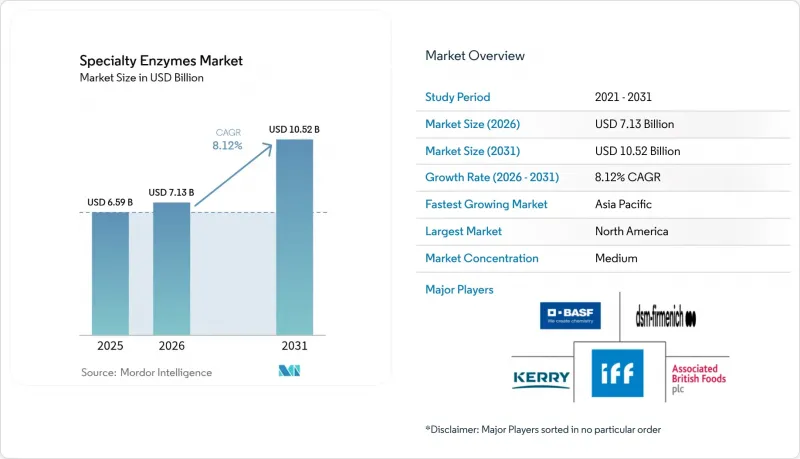
Mordor Intelligence에 의하면, 2026년 특수 효소 시장 규모는 71억 3,000만 달러로 추정되고 2025년 65억 9,000만 달러에서 성장하여 2031년에는 105억 2,000만 달러에 이를 것으로 예측됩니다.
2026년부터 2031년까지 연평균 성장률(CAGR) 8.12%로 성장할 것으로 전망됩니다.
본 보고서는 원료별(식물 유래, 미생물 유래, 동물 유래), 형태별(액체, 건조), 유형별(탄수화물 분해 효소, 프로테아제, 리파제, 기타),용도별(식품 및 음료, 의약품, 동물사료, 기타), 지역별(북미, 유럽, 아시아태평양, 남미, 중동 및 아프리카)로 분류되어 있습니다. 시장 예측은 금액(달러) 기준으로 제시되어 있습니다.
세계의 특수 효소 시장 동향 및 인사이트
의약품 제조 분야에서 친환경 생체 촉매의 채택 확대
제약 제조업체들은 환경에 미치는 영향을 줄이고 공정 효율을 높이기 위해 화학 촉매를 바이오 촉매로 대체하는 움직임을 강화하고 있습니다. 이러한 전환은 효소의 정밀도로 인해 복잡한 정제 공정의 필요성이 최소화되는 바이오의약품 분야에서 특히 가치가 있습니다. 2025년에 POMBILITI 및 EPKINLY를 포함한 바이오의약품에 대한 미국 식품의약국(FDA)의 규제 심사 기간이 단축된 것은 효소 기반 치료제에 대한 승인 절차가 간소화되고 있음을 보여줍니다. 유전자 재조합 효소를 통해 기존 방법에 비해 선택성이 향상되고, 폐기물이 감소된 키랄 의약품 중간체의 제조가 가능해집니다. 컴퓨터 지원 설계 도구를 통해 효소 개발 주기가 단축됨에 따라, 제약 기업은 특정 의약품 합성 경로에 적합한 생체 촉매를 보다 효율적으로 개발할 수 있게 되었습니다. 효소의 응용 범위는 현재 첨단 약물 전달 시스템 및 유전성 질환 치료법까지 확대되어, 특수 효소 분야의 제조업체들에게 비즈니스 기회를 넓혀주고 있습니다.
정부의 지원이 정책 및 자금 제공을 통해 시장 성장을 견인
정부의 이니셔티브는 연구, 상용화 및 산업 도입을 지원하는 정책 체계와 직접적인 자금 지원을 통해 특수 효소 시장의 성장을 가속화하고 있습니다. 각국 정부는 보조금, 세제 혜택, 그리고 학계와 산업계를 연결하는 민관 협력(PPP)을 통해 효소 혁신에 적극적으로 자금을 지원하고 있습니다. 인도의 BioE3 정책은 생명공학 분야에서 정부의 주요 개입책으로, 바이오 화학 물질 및 효소의 바이오 제조 허브를 설립하기 위해 9,197 카롤 루피(11억 달러)가 배정되었습니다. 이 정책은 2030년까지 3,000억 달러 규모의 바이오 경제를 실현하는 것을 목표로 하며, 효소를 정밀 바이오 치료제 및 기후 변화에 강한 농업을 포함한 6개 분야의 필수 구성 요소로 자리매김하고 있습니다. 중국에서 개정된 식품 안전 규제 제도는 안전성이 입증된 실적을 보유한 기존 기업에 유리한 의무적 등록 절차를 통해 효소 제조업체에 비즈니스 기회를 제공합니다. 유럽연합(EU)의 식품용 효소에 대한 시판 전 승인 요건은 안전성 평가를 표준화하여 요건을 충족하는 제조업체 시장 진입 장벽을 낮추고 있습니다.
맞춤형 효소의 높은 생산 비용
맞춤형 효소의 설계, 개발 및 생산 규모 확대에는 복잡한 과정이 수반되며, 첨단 기술, 숙련된 인력, 품질 관리 조치에 대한 막대한 투자가 필요합니다. 특수 원자재의 필요성과 엄격한 규제 준수 요건 또한 생산 비용을 상승시키고 있습니다. 특정 산업 공정을 위해 효소를 맞춤형으로 제작하려면 막대한 연구개발 투자가 필요하며, 제품이 상용화되기까지 2-3년이 소요되는 경우가 많습니다. 중소규모 생명공학 기업들은 생산량을 실험실 수준에서 상업적 수준으로 확대할 때 큰 과제에 직면하고 있습니다. 필요한 발효 인프라에는 막대한 설비 투자와 전문적인 노하우가 요구됩니다. 산업용 효소와 의약품용 효소의 가격 차이는 각각의 서로 다른 가치 제안을 반영하며, 의약품용 단백질은 산업용에 비해 고가 범주에 속합니다. 제조의 경제성에는 다양한 최종 용도의 규제 기준을 준수하는 특수한 정제 공정 및 품질 관리 시스템 요건이 영향을 미치고 있습니다.
부문별 분석
효소 생산에 있어 재조합 DNA 기술의 확장성과 비용 면에서의 우위 덕분에, 2025년에는 미생물 유래 효소가 시장 점유율의 68.05%를 차지했습니다. 식물 유래 효소는 식품 및 화장품 분야에서 천연 성분에 대한 소비자 수요와 지속가능성에 대한 요구를 배경으로, 2026년부터 2031년에 걸쳐 연평균 성장률(CAGR) 9.35%로 성장하고 있습니다. 동물 유래 효소의 경우, 윤리적 우려와 규제상의 제약으로 인해 수요가 감소하고 있으며, 특히 대체 원료에 대한 수요가 증가하고 있는 유럽 시장에서 이러한 경향이 두드러집니다.
미생물 유래 효소는 통제된 발효 조건에서 생산할 수 있어 품질의 안정성을 확보하고 오염 위험을 최소화할 수 있기 때문에 시장을 독점하고 있습니다. 미생물 생산 시스템에서는 합성생물학의 발전을 활용하여 효소 분비 능력을 향상시키고, 제품별 생성물을 최소화한 생산 균주의 개발이 진행되고 있습니다. 식물 유래 효소의 성장은 농업 폐기물로부터의 새로운 효소 추출 방법에 의해 뒷받침되고 있으며, 이를 통해 순환형 경제의 기회가 창출되고 원자재 비용 절감으로 이어지고 있습니다.
2025년에는 뛰어난 성능 특성과 용도의 범용성을 바탕으로 액상 제제가 시장 점유율의 56.60%를 차지하며 시장을 주도했으며, 2031년까지 연평균 성장률(CAGR) 9.98%를 나타낼 것으로 예측됩니다. 건조 효소 제제는 특히 동물사료나 산업용 세정 분야 등, 장기 보존성과 운송 비용 절감이 필수적인 특수 용도에서 그 입지를 유지하고 있습니다. 액상 제제가 시장에서 선호되는 이유는 즉각적인 생체 이용이 가능하며, 용해 공정 없이도 제조 공정에 원활하게 통합될 수 있다는 점에 있습니다. 새로운 안정화 기술로 인해 액상 효소의 보존 기간이 연장되어, 기존 주요 과제 중 하나가 극복되었습니다.
기질의 용해성을 높이고 피드백 억제를 저감해야 하는 용도에서는 비수성 액상 제제의 채택이 증가하고 있습니다. 고농도 액상 제제는 효소 활성을 유지하면서 보관 및 운송 비용 절감을 실현합니다. 건조 제제의 경우, 탈수 공정에서도 효소의 구조와 활성을 유지하는 첨단 분무 건조 및 동결 건조 기술을 통해 품질 향상이 이루어지고 있습니다.
지역별 분석
2025년, 북미는 강력한 연구개발 능력과 효소 치료제를 위한 합리화된 규제 절차에 힘입어 특수 효소 시장에서 32.78%라는 압도적인 점유율을 차지했습니다. 이 지역의 주요 대학들이 AI를 활용한 효소 설계를 주도하며 국내 혁신을 추진하고 있습니다. 또한, 지속 가능한 제조를 뒷받침하는 세제 혜택으로 인해 다양한 산업 공정에서 효소의 활용이 확대되면서 북미의 우위성이 확고해지고 있습니다. 이 지역의 기술 혁신에 대한 강력한 집중과 산학 협력은 세계 시장에서의 경쟁 우위를 더욱 공고히 하고 있습니다.
아시아태평양은 정부의 지원책, 비용 측면의 우위, 숙련된 노동력의 뒷받침으로 연평균 성장률(CAGR) 9.62%를 나타낼 것으로 예측되는 가장 빠르게 성장하는 지역으로 부상하고 있습니다. 지원적인 정책과 고유한 비용 측면의 우위가 이러한 성장의 기반이 되고 있습니다. 인도의 BioE3 전략과 중국의 식품용 효소 규제 개정이 맞물려 시장 진입의 길이 원활해졌습니다. 또한, 이 지역의 저비용 생산 환경, 풍부한 숙련된 인력, 그리고 최첨단 인프라가 전 세계 효소 제조업체들을 끌어들이고 있습니다. 생명공학에 대한 관심이 높아지고 있는 점과 효소 생산 능력 강화를 위한 정부 주도의 노력도 이 지역의 급속한 성장에 더욱 기여하고 있습니다.
유럽, 남미, 중동 및 아프리카도 꾸준한 진전을 보이고 있습니다. 유럽에서는 엄격한 안전 기준과 지속가능성을 중시하는 규제 환경이 혁신과 소비자 신뢰를 지속적으로 키워가고 있습니다. 또한, 이 지역에서 그린 케미스트리와 친환경 효소 용도에 대한 집중은 지속가능성 목표와 부합하며, 시장의 추가적인 확장을 주도하고 있습니다. 한편, 남미에서는 유리한 무역 협정과 바이오 경제 관련 노력에 힘입어 브라질과 아르헨티나의 생명공학 벤처 기업들이 식품 및 농업 분야의 성장을 주도하고 있습니다. 중동 및 아프리카에서는 의료 서비스 확충 및 식량 안보를 위한 노력에 힘입어 진전이 나타나고 있습니다.
기타 혜택 :
- 엑셀 형식 시장 예측(ME) 시트
- 3개월간의 애널리스트 지원
자주 묻는 질문
목차
제1장 서론
제2장 조사 방법
제3장 주요 요약
제4장 시장 구도
제5장 시장 규모 및 성장 예측
제6장 경쟁 구도
제7장 시장 기회 및 향후 전망
KTH 26.08.28According to Mordor Intelligence, specialty enzymes market size in 2026 is estimated at USD 7.13 billion, growing from 2025 value of USD 6.59 billion with 2031 projections showing USD 10.52 billion, growing at 8.12% CAGR over 2026-2031.
This report is Segmented by Source (Plant, Microbial, and Animal), by Form (Liquid, and Dry), by Enzyme Type (Carbohydrases, Proteases, Lipases, and Others), by Application (Food and Beverages, Pharmaceutical, Animal Feed, and Others), and Geography (North America, Europe, Asia-Pacific, South America, and Middle East and Africa). The Market Forecasts are Provided in Terms of Value (USD).
Global Specialty Enzymes Market Trends and Insights
Increasing adoption of eco-friendly biocatalysts in pharmaceutical manufacturing
Pharmaceutical producers are increasingly replacing chemical catalysts with biocatalysts to reduce environmental impact and improve process efficiency. This shift is particularly valuable in biologics, where enzyme precision minimizes the need for complex purification steps. The Food and Drug Administration (FDA)'s regulatory review periods for biologics, including POMBILITI and EPKINLY in 2025, indicate streamlined approval processes for enzyme-based therapeutics . Engineered enzymes enable the production of chiral pharmaceutical intermediates with improved selectivity and reduced waste compared to traditional methods. Computational design tools have shortened enzyme development cycles, enabling pharmaceutical companies to develop biocatalysts for specific drug synthesis routes more efficiently. Enzyme applications now extend to advanced drug delivery systems and therapies for genetic disorders, broadening opportunities for manufacturers in the specialty enzyme space.
Government support drives market growth through policy and funding
Government initiatives are accelerating the growth of the specialty enzymes market through policy frameworks and direct funding that support research, commercialization, and industrial adoption. Governments are actively funding enzyme innovation through grants, tax benefits, and PPP collaborations that bridge academia and industry. India's BioE3 policy represents a major government intervention in biotechnology, with an allocation of INR 9,197 crore (USD 1.1 billion) to establish biomanufacturing hubs for bio-based chemicals and enzymes. The policy aims to achieve a USD 300 billion bioeconomy by 2030, identifying enzymes as essential components across six areas, including precision biotherapeutics and climate-resilient agriculture . China's updated food safety regulatory system has created opportunities for enzyme manufacturers through mandatory registration procedures that benefit established companies with proven safety records . The European Union's pre-market approval requirements for food enzymes have standardized safety assessments, reducing market entry barriers for compliant manufacturers.
High production cost for customized enzymes
The complex processes involved in designing, engineering, and scaling up tailored enzymes require substantial investment in advanced technologies, skilled labor, and quality control measures. The need for specialized raw materials and stringent regulatory compliance increases production costs. Tailoring enzymes for specialized industrial processes requires heavy research and developments investment, often taking two to three years before the product reaches commercial readiness. Small and medium-sized biotechnology companies encounter significant challenges in scaling production from laboratory to commercial quantities. The required fermentation infrastructure demands substantial capital investment and specialized expertise. The pricing difference between industrial and pharmaceutical enzymes reflects their distinct value propositions, with pharmaceutical proteins priced at higher end compared to industrial applications. Manufacturing economics are impacted by the requirement for specialized purification processes and quality control systems that comply with regulatory standards for different end-use applications.
Other drivers and restraints analyzed in the detailed report include:
- Advancement in enzyme engineering and directed evolution
- Demand from cosmetic and dermatology sectors for enzymatic peels
- Short shelf life and stability challenges
For complete list of drivers and restraints, kindly check the Table Of Contents.
Segment Analysis
Microbial sources hold a 68.05% market share in 2025, due to the scalability and cost advantages of recombinant DNA technology for enzyme production. Plant-derived enzymes are growing at 9.35% CAGR (2026-2031), driven by consumer demand for natural ingredients and sustainability requirements in food and cosmetic applications. Animal-derived enzymes experience declining demand due to ethical concerns and regulatory restrictions, especially in European markets where alternative sources are increasingly required.
Microbial enzymes dominate because they can be produced under controlled fermentation conditions, ensuring consistent quality and minimizing contamination risks. Microbial production systems leverage advances in synthetic biology to develop production strains with improved enzyme secretion and minimized by-product formation. The growth in plant sources is supported by new enzyme extraction methods from agricultural waste, which create circular economy opportunities and lower raw material costs.
Liquid formulations dominate the market with a 56.60% share in 2025 and are projected to grow at a CAGR of 9.98% through 2031, driven by their superior performance characteristics and application versatility. Dry enzyme formulations maintain their position in specialized applications where extended shelf life and reduced shipping costs are essential, particularly in animal feed and industrial cleaning sectors. The market preference for liquid formulations stems from their immediate bioavailability and seamless integration into manufacturing processes without dissolution requirements. New stabilization technologies have helped extend the shelf life of liquid enzymes, overcoming one of their main historical drawbacks.
Non-aqueous liquid systems are increasing in adoption for applications that require better substrate solubility and reduced feedback inhibition. Concentrated liquid formulations offer reduced storage and transportation costs while maintaining enzyme activity. Dry formulations continue to improve through advanced spray-drying and freeze-drying techniques that maintain enzyme structure and activity during dehydration.
Complete Report Scope:
- By Source
- Plant
- Microbial
- Animal
- By Form
- Liquid
- Dry
- By Type
- Carbohydrases
- Proteases
- Lipases
- Others
- By Application
- Food and Beverages
- Pharmaceutical
- Animal Feed
- Others
- By Geography
- North America
- United States
- Canada
- Mexico
- Rest of North America
- Europe
- Germany
- France
- United Kingdom
- Spain
- Netherlands
- Italy
- Sweden
- Poland
- Belgium
- Rest of Europe
- Asia-Pacific
- China
- India
- Japan
- Australia
- South Korea
- Indonesia
- Thailand
- Singapore
- Rest of Asia-Pacific
- South America
- Brazil
- Argentina
- Chile
- Colombia
- Peru
- Rest of South America
- Middle East and Africa
- United Arab Emirates
- South Africa
- Nigeria
- Saudi Arabia
- Egypt
- Morocco
- Turkey
- Rest of Middle East and Africa
- North America
Geography Analysis
In 2025, North America clinched a commanding 32.78% share of the specialty enzymes market, supported by strong research and development capabilities and streamlined regulatory pathways for enzyme therapeutics. Leading universities in the region spearhead AI-driven enzyme design, propelling domestic innovation. Furthermore, tax incentives championing sustainable manufacturing have amplified enzyme utilization across various industrial processes, solidifying North America's preeminence. The region's strong focus on technological advancements and partnerships between academia and industry further strengthens its competitive edge in the global market.
Asia-Pacific is emerging as the fastest-growing region, driven by supportive government initiatives, cost advantages, and a skilled workforce, with a projected 9.62% CAGR. Supportive policies and inherent cost advantages underpin this growth. India's BioE3 strategy, coupled with China's revised food enzyme regulations, has smoothed the path for market entry. Moreover, the region's affordable production costs, a reservoir of skilled talent, and state-of-the-art infrastructure are luring global enzyme manufacturers. The region's growing focus on biotechnology and government-backed initiatives to enhance enzyme production capacity further contribute to its rapid growth.
Europe, South America, the Middle East, and the Africa region are also making strides. In Europe, strict safety standards and a sustainability-focused regulatory environment continue to foster innovation and consumer confidence. Additionally, the region's emphasis on green chemistry and eco-friendly enzyme applications aligns with its sustainability goals, driving further market expansion. Meanwhile, in South America, biotech ventures in Brazil and Argentina, buoyed by favorable trade agreements and bioeconomy initiatives, are driving growth in the food and agriculture sectors. The Middle East and Africa region is witnessing advancements, owing to healthcare enhancements and initiatives aimed at food security.
- International Flavors & Fragrances
- dsm-firmenich
- Kerry Group plc
- BASF SE
- Associated British Foods plc
- Amano Enzyme
- Novozymes A/S
- Specialty Enzymes & Probiotics
- Suntaq International Limited
- Biocatalysts Ltd.
- Advanced Enzyme Technologies
- ENZIQUIM
- Nagase America LLC
- AST Enzymes
- Sunson Industry Group
- Enzyme Development Corporation
- Antozyme Biotech Pvt Ltd,
- NOOR ENZYMES (DWC) LLC
- Bioseutica BV
- Apex International
Additional Benefits:
- The market estimate (ME) sheet in Excel format
- 3 months of analyst support
TABLE OF CONTENTS
1 INTRODUCTION
- 1.1 Study Assumptions and Market Definition
- 1.2 Scope of the Study
2 RESEARCH METHODOLOGY
3 EXECUTIVE SUMMARY
4 MARKET LANDSCAPE
- 4.1 Market Overview
- 4.2 Market Drivers
- 4.2.1 Increasing adoption of eco-friendly biocatalysts in pharmaceutical manufacturing
- 4.2.2 Government support drives market growth through policy and funding
- 4.2.3 Advancement in enzyme engineering and directed evolution
- 4.2.4 Demand from cosemetic and dermatology sectors for enzymatic peels
- 4.2.5 Surge in demand for enzymatic wound debridement products
- 4.2.6 Growing focus on green chemistry and sustainable industrial process
- 4.3 Market Restraints
- 4.3.1 High production cost for customised enzymes
- 4.3.2 Short shelf life and stability challenges
- 4.3.3 Risk of allergic reaction and immunogenicity in enzyme therapy
- 4.3.4 Ethical concern in use of animal-derived enzymes
- 4.4 Supply Chain Analysis
- 4.5 Regulatory Outlook
- 4.6 Porter's Five Forces
- 4.6.1 Threat of New Entrants
- 4.6.2 Bargaining Power of Buyers/Consumers
- 4.6.3 Bargaining Power of Suppliers
- 4.6.4 Threat of Substitute Products
- 4.6.5 Intensity of Competitive Rivalry
5 MARKET SIZE AND GROWTH FORECASTS (VALUE)
- 5.1 By Source
- 5.1.1 Plant
- 5.1.2 Microbial
- 5.1.3 Animal
- 5.2 By Form
- 5.2.1 Liquid
- 5.2.2 Dry
- 5.3 By Type
- 5.3.1 Carbohydrases
- 5.3.2 Proteases
- 5.3.3 Lipases
- 5.3.4 Others
- 5.4 By Application
- 5.4.1 Food and Beverages
- 5.4.2 Pharmaceutical
- 5.4.3 Animal Feed
- 5.4.4 Others
- 5.5 By Geography
- 5.5.1 North America
- 5.5.1.1 United States
- 5.5.1.2 Canada
- 5.5.1.3 Mexico
- 5.5.1.4 Rest of North America
- 5.5.2 Europe
- 5.5.2.1 Germany
- 5.5.2.2 France
- 5.5.2.3 United Kingdom
- 5.5.2.4 Spain
- 5.5.2.5 Netherlands
- 5.5.2.6 Italy
- 5.5.2.7 Sweden
- 5.5.2.8 Poland
- 5.5.2.9 Belgium
- 5.5.2.10 Rest of Europe
- 5.5.3 Asia-Pacific
- 5.5.3.1 China
- 5.5.3.2 India
- 5.5.3.3 Japan
- 5.5.3.4 Australia
- 5.5.3.5 South Korea
- 5.5.3.6 Indonesia
- 5.5.3.7 Thailand
- 5.5.3.8 Singapore
- 5.5.3.9 Rest of Asia-Pacific
- 5.5.4 South America
- 5.5.4.1 Brazil
- 5.5.4.2 Argentina
- 5.5.4.3 Chile
- 5.5.4.4 Colombia
- 5.5.4.5 Peru
- 5.5.4.6 Rest of South America
- 5.5.5 Middle East and Africa
- 5.5.5.1 United Arab Emirates
- 5.5.5.2 South Africa
- 5.5.5.3 Nigeria
- 5.5.5.4 Saudi Arabia
- 5.5.5.5 Egypt
- 5.5.5.6 Morocco
- 5.5.5.7 Turkey
- 5.5.5.8 Rest of Middle East and Africa
- 5.5.1 North America
6 COMPETITIVE LANDSCAPE
- 6.1 Market Concentration
- 6.2 Strategic Moves
- 6.3 Market Ranking Analysis
- 6.4 Company Profiles (includes Global-level Overview, Market-level Overview, Core Segments, Financials (if available), Strategic Information, Market Rank/Share, Products and Services, Recent Developments)
- 6.4.1 International Flavors & Fragrances
- 6.4.2 dsm-firmenich
- 6.4.3 Kerry Group plc
- 6.4.4 BASF SE
- 6.4.5 Associated British Foods plc
- 6.4.6 Amano Enzyme
- 6.4.7 Novozymes A/S
- 6.4.8 Specialty Enzymes & Probiotics
- 6.4.9 Suntaq International Limited
- 6.4.10 Biocatalysts Ltd.
- 6.4.11 Advanced Enzyme Technologies
- 6.4.12 ENZIQUIM
- 6.4.13 Nagase America LLC
- 6.4.14 AST Enzymes
- 6.4.15 Sunson Industry Group
- 6.4.16 Enzyme Development Corporation
- 6.4.17 Antozyme Biotech Pvt Ltd,
- 6.4.18 NOOR ENZYMES (DWC) LLC
- 6.4.19 Bioseutica BV
- 6.4.20 Apex International