
|
시장보고서
상품코드
2114598
실크 실 : 시장 점유율 분석, 업계 동향 및 통계, 성장 예측(2026-2031년)Silk Yarn - Market Share Analysis, Industry Trends & Statistics, Growth Forecasts (2026 - 2031) |
||||||
 Mordor Intelligence
Mordor Intelligence에 의하면, 실크 실 시장 규모는 2025년 4,490만 달러로 평가되었습니다. 2026년 4,730만 달러에서 2031년까지 6,100만 달러로 확대되며 2026년부터 2031년까지 연평균 복합 성장률(CAGR) 은 5.22%를 나타낼 전망입니다.
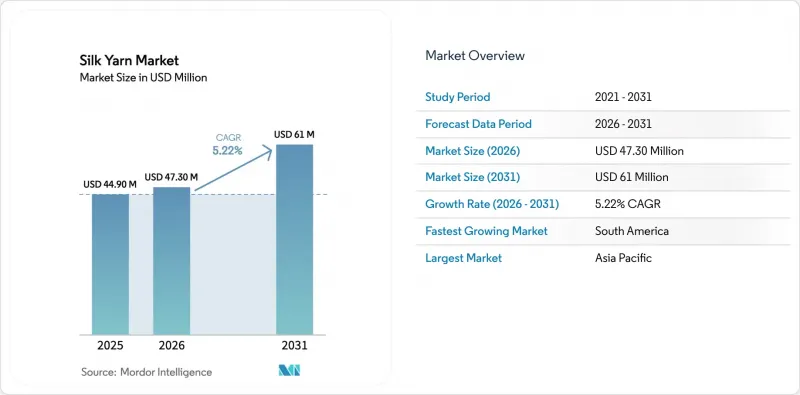
본 보고서는 지역별(북미, 유럽, 아시아태평양, 남미, 중동 및 아프리카)로 분류되어 있습니다. 본 조사에는 생산 분석(수량), 소비 분석(금액 및 수량), 수출 시장 분석(금액 및 수량), 수입 시장 분석(금액 및 수량), 도매 가격 동향 분석 등이 포함되어 있습니다. 시장 전망은 금액(달러) 및 수량(메트릭 톤) 단위로 제시됩니다.
세계의 실크 실 시장 동향 및 인사이트
고급 섬유 시장의 회복이 농장 출하 단계에서의 누에고치 수요를 견인
2024년부터 2025년에 걸쳐 부유층의 전통 직물에 대한 지출이 회복되었습니다. FENDI의 보고서에 따르면, 이 회사의 실크 중 67%가 지속가능성 기준을 충족하며, 이는 2023년의 54%에서 증가한 수치입니다. 럭셔리 브랜드들은 원산지에 대한 스토리를 활용하여 가격 프리미엄을 정당화하고, 프리미엄 필라멘트 원단을 합성 섬유 대체재와의 경쟁으로부터 보호하고 있습니다. 2025년, 스텔라 매카트니(Stella McCartney)는 볼트 스레드(Bolt Threads)의 마이크로 실크 스카프를 테스트하여, 동물 친화적이라는 메시지가 소비자의 구매 의욕을 높인다는 사실을 입증했습니다. 케링(Kering)의 2025년 원자재 기준에 따른 공급망 감사 결과, 중국의 전통적인 공급업체 중 약 40%가 인증 기준을 충족하지 못하게 되어 인증을 받은 누에고치 실 생산 업체에 대한 수요가 증가했습니다. 2024년, 저장성에서 농장 출하 시 누에고치 가격은 전년 대비 18% 상승하여, ESG 규정 준수에 따른 조달 압박이 반영되었습니다. 다년 계약을 체결한 브랜드는 재고 및 가격 안정이라는 혜택을 누리고 있으며, 이는 업스트림 공정에서 고품질 사료 및 질병 대책에 대한 투자를 뒷받침하고 있습니다.
천연섬유 및 생분해성 섬유에 대한 소비자 선호도 증가
미세 플라스틱에 대한 우려로 인해, 특히 액티브웨어 등 피부에 직접 닿는 제품 카테고리에서 폴리에스터로부터의 전환이 가속화되고 있습니다. 비단은 합성 섬유에 비해 비교적 단기간에 완전히 생분해되므로, 주요 시장의 순환 경제 관련 규정을 충족합니다. 셀룰로오스계 섬유에 대한 수요 둔화와 재생 셀룰로오스계 섬유 경쟁사의 철수로 인해, 지속가능성 투자는 비단 찌꺼기의 가치 제고 프로젝트로 방향을 전환하고 있습니다. 연구에 따르면 누에고치를 제품별로 수익화할 수 있는 큰 가능성이 지적되고 있으며, 이는 생산자의 소득 기회가 향상될 것임을 시사합니다. 비단과 합성 섬유 사이에는 여전히 가격 차이가 존재하며, 그 보급은 프리미엄 의류 분야로 한정되어 있지만, 혁신과 순환 경제에 대한 인센티브로 인해 지속 가능한 패션 분야에서 비단의 위상은 강화되고 있습니다.
합성 필라멘트에 비해 높은 누에고치 및 인건비
2024년 3분기, 장쑤성의 생사 가격은 1kg당 48달러였습니다. 이는 열 스트레스로 인해 누에고치 생산량이 감소함에 따라 2023년 대비 22% 상승한 수치입니다. 2025년 초, 인도의 폴리에스터 필라멘트 원사 가격은 1kg당 평균 1.80-2달러였으며, 실크 실은 계속해서 프리미엄 제품으로서의 위상을 유지하고 있습니다. 최근 수작업 감기 인건비가 상승하고 있으며, 지역별로 그 정도는 다르지만 소규모 사업자의 이익률을 압박하고 있습니다. 자동 감기 기계는 인력을 대폭 절감할 수 있지만, 초기 비용이 높고 투자 회수 기간이 약 5년이 소요되기 때문에 보조금 대상 대출을 받을 수 없는 소규모 농가에게는 도입에 있어 큰 장벽이 되고 있습니다.
지역별 분석
아시아태평양은 전 세계 비단 생산량의 78%를 차지하고 있으며, 이는 주로 중국의 광범위한 뽕나무 재배와 높은 고치 수확량 덕분입니다. 인도는 병해 관련 과제가 여전히 남아 있음에도 불구하고, 기계화를 통해 양잠 산업의 현대화를 추진하고 있습니다. 태국과 우즈베키스탄을 포함한 이 지역의 다른 국가들도 병해 감시 체계를 강화하고 인프라 구축을 추진하고 있습니다. 또한, 일본의 생명공학 기업들은 동남아시아의 시설을 활용하여 수출 시장을 겨냥한 단백질 기반 비단을 생산하고 있습니다.
유럽은 이탈리아 코모 지역을 중심으로 비단 시장에서 틈새 시장을 차지하고 있습니다. 향후 도입될 디지털 추적성 규제는 프리미엄 부문에 혜택을 가져다줄 것입니다. 독일과 영국은 주로 맞춤 제작 및 고급 제품 용도를 위한 유통 거점 역할을 수행하며, 하이엔드 패션 공급망에서 해당 지역의 입지를 공고히 하고 있습니다.
북미와 남미는 신흥 성장 지역으로 주목받고 있습니다. 북미에서는 의료용 비단 개발과 수공예품 시장에 주력하고 있습니다. 남미는 연평균 성장률(CAGR) 7.8%를 기록하며, 생명공학 기업과 식물성 단백질 생산자 간의 협력을 통한 혁신 촉진에 힘입어 가장 빠르게 성장하는 지역입니다. 중동 및 아프리카에서는 케냐, 에티오피아, 튀니지 등 국가에서 소규모 농가 지원 프로그램이 진전되고 있습니다. 그러나 생산량은 아시아태평양과 비교하면 여전히 제한적입니다. 각 브랜드가 지정학적 리스크 분산을 위해 니어쇼어링 기회를 모색하고 있는 반면, 아시아태평양은 계속해서 전 세계 비단 생산을 주도하고 있습니다.
- 엑셀 형식 시장 예측(ME) 시트
- 3개월간의 애널리스트 지원
자주 묻는 질문
목차
제1장 서론
제2장 조사 방법
제3장 주요 요약
제4장 시장 구도
제5장 시장 규모 및 성장 예측
제6장 최종 용도 및 산업
제7장 경쟁 구도
제8장 시장 기회 및 향후 전망
KTH 26.08.28According to Mordor Intelligence, the silk yarn market size is projected to expand from USD 44.9 million in 2025 and USD 47.3 million in 2026 to USD 61.0 million by 2031, registering a CAGR of 5.22% between 2026 to 2031.
This report is Segmented by Geography (North America, Europe, Asia-Pacific, South America, Middle East, and Africa). The Study Includes Production Analysis (Volume), Consumption Analysis (Value and Volume), Export Analysis (Value and Volume), Import Analysis (Value and Volume), Wholesale Price Trend Analysis, and More. The Market Forecasts are Provided in Terms of Value (USD) and Volume (Metric Tons).
Global Silk Yarn Market Trends and Insights
Luxury-Textile Rebound Fuels Farm-Gate Cocoon Demand
High-net-worth spending on heritage fabrics experienced a rebound in 2024-2025, with FENDI reporting that 67% of its silk met sustainability criteria, an increase from 54% in 2023. Luxury brands leverage provenance stories to justify markups, protecting premium filament fabrics from competition with synthetic alternatives. In 2025, Stella McCartney tested Bolt Threads' Microsilk scarves, demonstrating that cruelty-free messaging enhances consumers' willingness to pay. Supply chain audits under Kering's 2025 raw-material standards disqualified approximately 40% of traditional Chinese suppliers, driving increased demand for certified reelers. Farm-gate cocoon prices in Zhejiang rose by 18% year-over-year in 2024, reflecting the procurement pressures driven by ESG compliance. Brands securing multi-year contracts benefit from inventory and pricing stability, which supports upstream investments in quality feed and disease control.
Rising Consumer Shift Toward Natural and Biodegradable Fibers
Concerns about microplastics are accelerating a shift away from polyester, particularly in skin-contact categories such as activewear. Silk offers full biodegradability within a relatively short timeframe compared to synthetics, aligning with circularity regulations in major markets. Demand softness for cellulosic fibers and the exit of a recycled-cellulosic competitor have redirected sustainability investments toward silk-waste valorization projects. Studies highlight significant potential to monetize cocoon by-products, improving income opportunities for producers. While price gaps persist between silk and synthetics, limiting penetration to premium apparel segments, innovation and circularity incentives are strengthening silk's position in the sustainable fashion landscape.
High Cocoon and Labor Costs Versus Synthetic Filament
Raw silk was priced at USD 48 per kilogram in Jiangsu during Q3 2024, reflecting a 22% increase compared to 2023, as heat stress reduced cocoon production volumes. In early 2025, polyester filament yarn prices in India averaged between USD 1.80 and USD 2.00 per kilogram, maintaining silk yarn as a premium product. Manual reeling wages have increased in recent years, reducing profit margins for small operators, though the extent varies by region. While automatic reeling machines can substantially reduce labor needs, their high initial costs and a payback period of approximately five years remain significant barriers to adoption for small farms that lack access to subsidized financing.
Other drivers and restraints analyzed in the detailed report include:
- Government Sericulture Modernization Incentives
- Bio-Engineered Spider-Silk Breakthroughs Expanding Yarn lends
- Climate-Driven Disease Outbreaks Reducing Yield
For complete list of drivers and restraints, kindly check the Table Of Contents.
Complete Report Scope:
- By Geography
- North America
- United States
- Production Analysis (Area Harvested, Yield, Production Volume)
- Consumption Analysis (Value and Volume)
- Import Market Analysis (Value, Volume, Key Supplying Markets)
- Export Market Analysis (Value, Volume, Key Destination Markets)
- Wholesale Price Trend Analysis and Forecast
- Regulatory Framework
- List of Key Players
- Logistics and Infrastructure
- Seasonality Analysis
- Canada
- Production Analysis (Area Harvested, Yield, Production Volume)
- Consumption Analysis (Value and Volume)
- Import Market Analysis (Value, Volume, Key Supplying Markets)
- Export Market Analysis (Value, Volume, Key Destination Markets)
- Wholesale Price Trend Analysis and Forecast
- Regulatory Framework
- List of Key Players
- Logistics and Infrastructure
- Seasonality Analysis
- United States
- South America
- Brazil
- Production Analysis (Area Harvested, Yield, Production Volume)
- Consumption Analysis (Value and Volume)
- Import Market Analysis (Value, Volume, Key Supplying Markets)
- Export Market Analysis (Value, Volume, Key Destination Markets)
- Wholesale Price Trend Analysis and Forecast
- Regulatory Framework
- List of Key Players
- Logistics and Infrastructure
- Seasonality Analysis
- Argentina
- Production Analysis (Area Harvested, Yield, Production Volume)
- Consumption Analysis (Value and Volume)
- Import Market Analysis (Value, Volume, Key Supplying Markets)
- Export Market Analysis (Value, Volume, Key Destination Markets)
- Wholesale Price Trend Analysis and Forecast
- Regulatory Framework
- List of Key Players
- Logistics and Infrastructure
- Seasonality Analysis
- Brazil
- Europe
- Italy
- Production Analysis (Area Harvested, Yield, Production Volume)
- Consumption Analysis (Value and Volume)
- Import Market Analysis (Value, Volume, Key Supplying Markets)
- Export Market Analysis (Value, Volume, Key Destination Markets)
- Wholesale Price Trend Analysis and Forecast
- Regulatory Framework
- List of Key Players
- Logistics and Infrastructure
- Seasonality Analysis
- Germany
- Production Analysis (Area Harvested, Yield, Production Volume)
- Consumption Analysis (Value and Volume)
- Import Market Analysis (Value, Volume, Key Supplying Markets)
- Export Market Analysis (Value, Volume, Key Destination Markets)
- Wholesale Price Trend Analysis and Forecast
- Regulatory Framework
- List of Key Players
- Logistics and Infrastructure
- Seasonality Analysis
- United Kingdom
- Production Analysis (Area Harvested, Yield, Production Volume)
- Consumption Analysis (Value and Volume)
- Import Market Analysis (Value, Volume, Key Supplying Markets)
- Export Market Analysis (Value, Volume, Key Destination Markets)
- Wholesale Price Trend Analysis and Forecast
- Regulatory Framework
- List of Key Players
- Logistics and Infrastructure
- Seasonality Analysis
- Italy
- Asia-Pacific
- China
- Production Analysis (Area Harvested, Yield, Production Volume)
- Consumption Analysis (Value and Volume)
- Import Market Analysis (Value, Volume, Key Supplying Markets)
- Export Market Analysis (Value, Volume, Key Destination Markets)
- Wholesale Price Trend Analysis and Forecast
- Regulatory Framework
- List of Key Players
- Logistics and Infrastructure
- Seasonality Analysis
- India
- Production Analysis (Area Harvested, Yield, Production Volume)
- Consumption Analysis (Value and Volume)
- Import Market Analysis (Value, Volume, Key Supplying Markets)
- Export Market Analysis (Value, Volume, Key Destination Markets)
- Wholesale Price Trend Analysis and Forecast
- Regulatory Framework
- List of Key Players
- Logistics and Infrastructure
- Seasonality Analysis
- Thailand
- Production Analysis (Area Harvested, Yield, Production Volume)
- Consumption Analysis (Value and Volume)
- Import Market Analysis (Value, Volume, Key Supplying Markets)
- Export Market Analysis (Value, Volume, Key Destination Markets)
- Wholesale Price Trend Analysis and Forecast
- Regulatory Framework
- List of Key Players
- Logistics and Infrastructure
- Seasonality Analysis
- Uzbekistan
- Production Analysis (Area Harvested, Yield, Production Volume)
- Consumption Analysis (Value and Volume)
- Import Market Analysis (Value, Volume, Key Supplying Markets)
- Export Market Analysis (Value, Volume, Key Destination Markets)
- Wholesale Price Trend Analysis and Forecast
- Regulatory Framework
- List of Key Players
- Logistics and Infrastructure
- Seasonality Analysis
- China
- Middle East
- Turkey
- Production Analysis (Area Harvested, Yield, Production Volume)
- Consumption Analysis (Value and Volume)
- Import Market Analysis (Value, Volume, Key Supplying Markets)
- Export Market Analysis (Value, Volume, Key Destination Markets)
- Wholesale Price Trend Analysis and Forecast
- Regulatory Framework
- List of Key Players
- Logistics and Infrastructure
- Seasonality Analysis
- Saudi Arabia
- Production Analysis (Area Harvested, Yield, Production Volume)
- Consumption Analysis (Value and Volume)
- Import Market Analysis (Value, Volume, Key Supplying Markets)
- Export Market Analysis (Value, Volume, Key Destination Markets)
- Wholesale Price Trend Analysis and Forecast
- Regulatory Framework
- List of Key Players
- Logistics and Infrastructure
- Seasonality Analysis
- Turkey
- Africa
- Ethiopia
- Production Analysis (Area Harvested, Yield, Production Volume)
- Consumption Analysis (Value and Volume)
- Import Market Analysis (Value, Volume, Key Supplying Markets)
- Export Market Analysis (Value, Volume, Key Destination Markets)
- Wholesale Price Trend Analysis and Forecast
- Regulatory Framework
- List of Key Players
- Logistics and Infrastructure
- Seasonality Analysis
- Egypt
- Production Analysis (Area Harvested, Yield, Production Volume)
- Consumption Analysis (Value and Volume)
- Import Market Analysis (Value, Volume, Key Supplying Markets)
- Export Market Analysis (Value, Volume, Key Destination Markets)
- Wholesale Price Trend Analysis and Forecast
- Regulatory Framework
- List of Key Players
- Logistics and Infrastructure
- Seasonality Analysis
- Ethiopia
- North America
Geography Analysis
The Asia-Pacific region accounts for 78% of global silk production, primarily due to China's extensive mulberry cultivation and high cocoon yield. India is working towards modernizing its sericulture industry through mechanization, despite ongoing challenges related to diseases. Other countries in the region, including Thailand and Uzbekistan, are improving disease surveillance and upgrading infrastructure. Additionally, Japan's biotechnology companies are leveraging facilities in Southeast Asia to produce protein-based silk for export markets.
Europe holds a niche position in the silk market, with Italy's Como region at its core. Upcoming digital traceability regulations will benefit premium segments. Germany and the United Kingdom primarily act as distribution hubs for bespoke tailoring and luxury applications, solidifying the region's role in high-end fashion supply chains.
North America and South America are identified as emerging growth regions. North America is focusing on the development of medical-grade silk and the artisanal craft markets. South America, with a CAGR of 7.8%, is the fastest-growing region, driven by collaborations between biotech firms and plant-protein producers to foster innovation. In the Middle East and Africa, smallholder programs in countries such as Kenya, Ethiopia, and Tunisia are making progress. However, production levels remain limited compared to those in the Asia-Pacific region. While brands are exploring near-shoring opportunities for geopolitical diversification, the Asia-Pacific continues to lead global silk production.
- The market estimate (ME) sheet in Excel format
- 3 months of analyst support
TABLE OF CONTENTS
1 Introduction
- 1.1 Study Assumptions and Market Definition
- 1.2 Scope of the Study
2 Research Methodology
3 Executive Summary
4 Market Landscape
- 4.1 Market Overview
- 4.2 Market Drivers
- 4.2.1 Luxury-textile rebound fuels farm-gate cocoon demand
- 4.2.2 Rising consumer shift toward natural and biodegradable fibers
- 4.2.3 Government sericulture modernization incentives
- 4.2.4 Bio-engineered spider-silk breakthroughs expanding yarn blends
- 4.2.5 Digital farm-to-reel traceability platforms
- 4.2.6 Carbon-credit programs for mulberry plantations
- 4.3 Market Restraints
- 4.3.1 High cocoon and labor costs versus synthetic filament
- 4.3.2 Climate-driven disease outbreaks reducing yield
- 4.3.3 Fragmented farmer base limits quality consistency
- 4.3.4 Competition from recycled cellulosics and bio-nylon substitutes
- 4.4 Opportunities
- 4.5 Challenges
- 4.6 Value and Supply-Chain Analysis
- 4.7 Technologies and Usage of AI in the Industry
- 4.8 Input Market Analysis
- 4.8.1 Raw Silk
- 4.8.2 Labor Costs
- 4.9 Distribution Channel Analysis
- 4.10 Market Sentiment Analysis
- 4.11 PESTLE Analysis
5 Market Size and Growth Forecasts (Value and Volume)
- 5.1 By Geography
- 5.1.1 North America
- 5.1.1.1 United States
- 5.1.1.1.1 Production Analysis (Area Harvested, Yield, Production Volume)
- 5.1.1.1.2 Consumption Analysis (Value and Volume)
- 5.1.1.1.3 Import Market Analysis (Value, Volume, Key Supplying Markets)
- 5.1.1.1.4 Export Market Analysis (Value, Volume, Key Destination Markets)
- 5.1.1.1.5 Wholesale Price Trend Analysis and Forecast
- 5.1.1.1.6 Regulatory Framework
- 5.1.1.1.7 List of Key Players
- 5.1.1.1.8 Logistics and Infrastructure
- 5.1.1.1.9 Seasonality Analysis
- 5.1.1.2 Canada
- 5.1.1.2.1 Production Analysis (Area Harvested, Yield, Production Volume)
- 5.1.1.2.2 Consumption Analysis (Value and Volume)
- 5.1.1.2.3 Import Market Analysis (Value, Volume, Key Supplying Markets)
- 5.1.1.2.4 Export Market Analysis (Value, Volume, Key Destination Markets)
- 5.1.1.2.5 Wholesale Price Trend Analysis and Forecast
- 5.1.1.2.6 Regulatory Framework
- 5.1.1.2.7 List of Key Players
- 5.1.1.2.8 Logistics and Infrastructure
- 5.1.1.2.9 Seasonality Analysis
- 5.1.1.1 United States
- 5.1.2 South America
- 5.1.2.1 Brazil
- 5.1.2.1.1 Production Analysis (Area Harvested, Yield, Production Volume)
- 5.1.2.1.2 Consumption Analysis (Value and Volume)
- 5.1.2.1.3 Import Market Analysis (Value, Volume, Key Supplying Markets)
- 5.1.2.1.4 Export Market Analysis (Value, Volume, Key Destination Markets)
- 5.1.2.1.5 Wholesale Price Trend Analysis and Forecast
- 5.1.2.1.6 Regulatory Framework
- 5.1.2.1.7 List of Key Players
- 5.1.2.1.8 Logistics and Infrastructure
- 5.1.2.1.9 Seasonality Analysis
- 5.1.2.2 Argentina
- 5.1.2.2.1 Production Analysis (Area Harvested, Yield, Production Volume)
- 5.1.2.2.2 Consumption Analysis (Value and Volume)
- 5.1.2.2.3 Import Market Analysis (Value, Volume, Key Supplying Markets)
- 5.1.2.2.4 Export Market Analysis (Value, Volume, Key Destination Markets)
- 5.1.2.2.5 Wholesale Price Trend Analysis and Forecast
- 5.1.2.2.6 Regulatory Framework
- 5.1.2.2.7 List of Key Players
- 5.1.2.2.8 Logistics and Infrastructure
- 5.1.2.2.9 Seasonality Analysis
- 5.1.2.1 Brazil
- 5.1.3 Europe
- 5.1.3.1 Italy
- 5.1.3.1.1 Production Analysis (Area Harvested, Yield, Production Volume)
- 5.1.3.1.2 Consumption Analysis (Value and Volume)
- 5.1.3.1.3 Import Market Analysis (Value, Volume, Key Supplying Markets)
- 5.1.3.1.4 Export Market Analysis (Value, Volume, Key Destination Markets)
- 5.1.3.1.5 Wholesale Price Trend Analysis and Forecast
- 5.1.3.1.6 Regulatory Framework
- 5.1.3.1.7 List of Key Players
- 5.1.3.1.8 Logistics and Infrastructure
- 5.1.3.1.9 Seasonality Analysis
- 5.1.3.2 Germany
- 5.1.3.2.1 Production Analysis (Area Harvested, Yield, Production Volume)
- 5.1.3.2.2 Consumption Analysis (Value and Volume)
- 5.1.3.2.3 Import Market Analysis (Value, Volume, Key Supplying Markets)
- 5.1.3.2.4 Export Market Analysis (Value, Volume, Key Destination Markets)
- 5.1.3.2.5 Wholesale Price Trend Analysis and Forecast
- 5.1.3.2.6 Regulatory Framework
- 5.1.3.2.7 List of Key Players
- 5.1.3.2.8 Logistics and Infrastructure
- 5.1.3.2.9 Seasonality Analysis
- 5.1.3.3 United Kingdom
- 5.1.3.3.1 Production Analysis (Area Harvested, Yield, Production Volume)
- 5.1.3.3.2 Consumption Analysis (Value and Volume)
- 5.1.3.3.3 Import Market Analysis (Value, Volume, Key Supplying Markets)
- 5.1.3.3.4 Export Market Analysis (Value, Volume, Key Destination Markets)
- 5.1.3.3.5 Wholesale Price Trend Analysis and Forecast
- 5.1.3.3.6 Regulatory Framework
- 5.1.3.3.7 List of Key Players
- 5.1.3.3.8 Logistics and Infrastructure
- 5.1.3.3.9 Seasonality Analysis
- 5.1.3.1 Italy
- 5.1.4 Asia-Pacific
- 5.1.4.1 China
- 5.1.4.1.1 Production Analysis (Area Harvested, Yield, Production Volume)
- 5.1.4.1.2 Consumption Analysis (Value and Volume)
- 5.1.4.1.3 Import Market Analysis (Value, Volume, Key Supplying Markets)
- 5.1.4.1.4 Export Market Analysis (Value, Volume, Key Destination Markets)
- 5.1.4.1.5 Wholesale Price Trend Analysis and Forecast
- 5.1.4.1.6 Regulatory Framework
- 5.1.4.1.7 List of Key Players
- 5.1.4.1.8 Logistics and Infrastructure
- 5.1.4.1.9 Seasonality Analysis
- 5.1.4.2 India
- 5.1.4.2.1 Production Analysis (Area Harvested, Yield, Production Volume)
- 5.1.4.2.2 Consumption Analysis (Value and Volume)
- 5.1.4.2.3 Import Market Analysis (Value, Volume, Key Supplying Markets)
- 5.1.4.2.4 Export Market Analysis (Value, Volume, Key Destination Markets)
- 5.1.4.2.5 Wholesale Price Trend Analysis and Forecast
- 5.1.4.2.6 Regulatory Framework
- 5.1.4.2.7 List of Key Players
- 5.1.4.2.8 Logistics and Infrastructure
- 5.1.4.2.9 Seasonality Analysis
- 5.1.4.3 Thailand
- 5.1.4.3.1 Production Analysis (Area Harvested, Yield, Production Volume)
- 5.1.4.3.2 Consumption Analysis (Value and Volume)
- 5.1.4.3.3 Import Market Analysis (Value, Volume, Key Supplying Markets)
- 5.1.4.3.4 Export Market Analysis (Value, Volume, Key Destination Markets)
- 5.1.4.3.5 Wholesale Price Trend Analysis and Forecast
- 5.1.4.3.6 Regulatory Framework
- 5.1.4.3.7 List of Key Players
- 5.1.4.3.8 Logistics and Infrastructure
- 5.1.4.3.9 Seasonality Analysis
- 5.1.4.4 Uzbekistan
- 5.1.4.4.1 Production Analysis (Area Harvested, Yield, Production Volume)
- 5.1.4.4.2 Consumption Analysis (Value and Volume)
- 5.1.4.4.3 Import Market Analysis (Value, Volume, Key Supplying Markets)
- 5.1.4.4.4 Export Market Analysis (Value, Volume, Key Destination Markets)
- 5.1.4.4.5 Wholesale Price Trend Analysis and Forecast
- 5.1.4.4.6 Regulatory Framework
- 5.1.4.4.7 List of Key Players
- 5.1.4.4.8 Logistics and Infrastructure
- 5.1.4.4.9 Seasonality Analysis
- 5.1.4.1 China
- 5.1.5 Middle East
- 5.1.5.1 Turkey
- 5.1.5.1.1 Production Analysis (Area Harvested, Yield, Production Volume)
- 5.1.5.1.2 Consumption Analysis (Value and Volume)
- 5.1.5.1.3 Import Market Analysis (Value, Volume, Key Supplying Markets)
- 5.1.5.1.4 Export Market Analysis (Value, Volume, Key Destination Markets)
- 5.1.5.1.5 Wholesale Price Trend Analysis and Forecast
- 5.1.5.1.6 Regulatory Framework
- 5.1.5.1.7 List of Key Players
- 5.1.5.1.8 Logistics and Infrastructure
- 5.1.5.1.9 Seasonality Analysis
- 5.1.5.2 Saudi Arabia
- 5.1.5.2.1 Production Analysis (Area Harvested, Yield, Production Volume)
- 5.1.5.2.2 Consumption Analysis (Value and Volume)
- 5.1.5.2.3 Import Market Analysis (Value, Volume, Key Supplying Markets)
- 5.1.5.2.4 Export Market Analysis (Value, Volume, Key Destination Markets)
- 5.1.5.2.5 Wholesale Price Trend Analysis and Forecast
- 5.1.5.2.6 Regulatory Framework
- 5.1.5.2.7 List of Key Players
- 5.1.5.2.8 Logistics and Infrastructure
- 5.1.5.2.9 Seasonality Analysis
- 5.1.5.1 Turkey
- 5.1.6 Africa
- 5.1.6.1 Ethiopia
- 5.1.6.1.1 Production Analysis (Area Harvested, Yield, Production Volume)
- 5.1.6.1.2 Consumption Analysis (Value and Volume)
- 5.1.6.1.3 Import Market Analysis (Value, Volume, Key Supplying Markets)
- 5.1.6.1.4 Export Market Analysis (Value, Volume, Key Destination Markets)
- 5.1.6.1.5 Wholesale Price Trend Analysis and Forecast
- 5.1.6.1.6 Regulatory Framework
- 5.1.6.1.7 List of Key Players
- 5.1.6.1.8 Logistics and Infrastructure
- 5.1.6.1.9 Seasonality Analysis
- 5.1.6.2 Egypt
- 5.1.6.2.1 Production Analysis (Area Harvested, Yield, Production Volume)
- 5.1.6.2.2 Consumption Analysis (Value and Volume)
- 5.1.6.2.3 Import Market Analysis (Value, Volume, Key Supplying Markets)
- 5.1.6.2.4 Export Market Analysis (Value, Volume, Key Destination Markets)
- 5.1.6.2.5 Wholesale Price Trend Analysis and Forecast
- 5.1.6.2.6 Regulatory Framework
- 5.1.6.2.7 List of Key Players
- 5.1.6.2.8 Logistics and Infrastructure
- 5.1.6.2.9 Seasonality Analysis
- 5.1.6.1 Ethiopia
- 5.1.1 North America
6 End Use Applications and Industries
- 6.1 Primary Applications and Emerging Applications
- 6.2 Consumption Breakdown by Industries
7 Competitive Landscape
- 7.1 Overview of the Competition
- 7.2 Recent Developments
- 7.3 Market Concentration Analysis