

|
시장보고서
상품코드
2114603
셀프 클리닝 유리 시장 : 시장 점유율 분석, 업계 동향 및 통계, 성장 예측(2026-2031년)Self-Cleaning Glass - Market Share Analysis, Industry Trends & Statistics, Growth Forecasts (2026 - 2031) |
||||||
 Mordor Intelligence
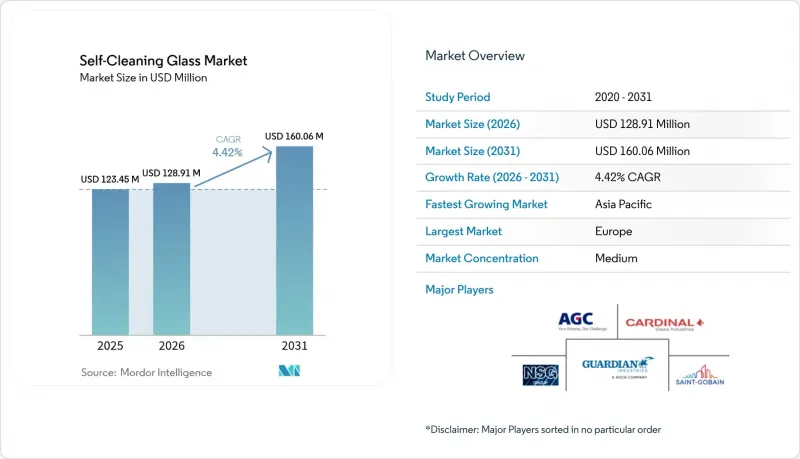
Mordor Intelligence에 의하면, 2026년 셀프 클리닝 유리 시장 규모는 1억 2,891만 달러로 추정되고, 2025년 1억 2,345만 달러에서 확대해, 2031년에는 1억 6,006만 달러에 이를 것으로 예측됩니다.
2026-2031년 연평균 성장률(CAGR) 4.42%로 성장할 것으로 전망됩니다.
본 보고서는 코팅 유형별(친수성 코팅, 소수성 코팅), 용도별(파사드 및 창문, 지붕 및 채광창, 기타), 최종 사용자 산업별(건축 및 건설, 자동차 및 운송, 태양에너지, 기타), 지역별(북미, 유럽, 아시아태평양, 남미, 중동 및 아프리카)로 분류되어 있습니다. 시장 전망은 금액(달러) 기준으로 제시되어 있습니다.
세계의 셀프 클리닝 유리 시장 동향 및 인사이트
친환경 건축 규제의 확대
당국이 탄소 배출 목표를 달성하기 위해 에너지 규제를 강화함에 따라, 규제에 따라 유리 사양 기준이 재검토되고 있습니다. 유럽연합(EU)의 ‘건물의 에너지 성능에 관한 지침(2024/1275)’에서는 모든 회원국에 2050년까지 탄소 배출 제로 건물 재고를 실현할 것을 요구하고 있으며, 이에 따라 운영 부담을 줄여주는 첨단 유리에 대한 수요가 직접적으로 증가하고 있습니다. 현재 미국과 아시아태평양의 주요 경제국에서도 유사한 규제가 도입되고 있습니다. LEED나 BREEAM과 같은 인증 프로그램에서는 유지보수 부담 경감이 자원 사용량 감소로 이어지기 때문에 셀프 클리닝 시스템에 가산점이 부여됩니다. 이러한 인센티브 체계 덕분에, 높은 등급의 건축 인증을 목표로 하는 개발자들 사이에서 셀프 클리닝 유리 시장이 활기를 띠고 있습니다. 건물의 탄소 배출량이 전체의 40%를 차지한다는 정부 데이터는 고성능 파사드를 지향하는 정책 추진을 뒷받침하고 있습니다.
고층 빌딩 개보수 시 파사드의 급속한 교체
1980년대부터 1990년대에 걸쳐 건설된 수많은 초고층 빌딩이 커튼월 시스템의 교체 시기를 맞이하고 있습니다. 20층 이상의 건물에서는 로프 액세스를 이용한 세척이 비용이 많이 들고 위험도 높기 때문에 경제성 측면에서 셀프 클리닝 유리가 유리합니다. AGC사는 리모델링 붐에 대응하기 위해 연속 코팅 장비를 업그레이드하고 있으며, 도시 재생 프로젝트와 관련된 수주가 증가하고 있다고 보고하고 있습니다. 유럽과 북미의 보험사들은 파사드 유지보수 과정에서 발생하는 사고를 줄인 건물에 대해 보험료 할인을 제공하고 있어, 소유주들의 관심이 높아지고 있습니다. 안전성과 운영 비용 양면에서의 이점으로 인해, 비즈니스 중심 지역에서의 셀프 클리닝 유리 시장 침투가 가속화되고 있습니다.
비용 효율을 중시하는 분야에서의 도입 지연
셀프 클리닝 유리는 표준 플로트 유리에 비해 20-40% 비싸며, 초기 예산이 의사 결정의 주요 요소가 되는 주택 및 공공 조달 프로젝트에서는 가격이 너무 높아 도입이 저해되고 있습니다. 신흥국에서는 창문 청소 인건비가 여전히 낮은 수준에 머물러 있어, 수명 주기 비용 절감이라는 이점을 충분히 어필하지 못하고 있습니다. 이러한 제약으로 인해 저층 주택, 기숙사, 공공시설에서의 셀프 클리닝 유리 시장 확산은 더딘 양상을 보이고 있습니다. 보다 광범위한 보급을 위해서는 코팅 비용을 절감할 수 있는 대량 생산과, 소유주가 운영 비용 절감분을 수익화할 수 있는 자금 조달 구조가 핵심이 됩니다.
부문 분석
2025년 시점에서 친수성 기술은 셀프 클리닝 유리 시장의 55.02%를 차지했습니다. NSG 그룹의 ‘Pilkington Activ’ 및 유사 제품은 이산화티타늄을 사용하여 유기물을 분해하고, 비가 올 때 파사드를 씻어내는 물의 흐름을 촉진합니다. 이러한 우위에도 불구하고, 소수성 코팅은 2031년까지 연평균 성장률(CAGR)이 5.32%로 가장 빠르게 성장하는 대안입니다. 커틴 대학교가 개발한 초음파 표면 개질 기술은 물을 영구적으로 밀어내는 공유 결합성 유기층을 형성하여 화학 코팅의 필요성을 없앱니다. 초발수성 나노 복합 필름은 현재 물 접촉각이 160°를 초과하고 장시간 자외선 조사에도 견디기 때문에 자동차 앞유리나 실외 디스플레이로의 적용 범위가 확대되고 있습니다. 이러한 획기적인 기술이 대규모 상용화에서도 내구성을 입증함에 따라, 발수성 솔루션은 친수성 기존 제품의 셀프 클리닝 유리 시장 점유율을 서서히 잠식해 나갈 가능성이 있습니다.
지역별 분석
2025년, 유럽은 여전히 셀프 클리닝 유리 시장에서 36.10%를 차지하며 가장 규모가 큰 지역 기여원이 되었습니다. '건축물의 에너지 성능에 관한 지침' 등의 규제에 따라, 첨단 유리 제품을 우대하는 법적 구속력이 있는 효율 목표가 설정되어 있습니다. AGC Glass Europe이 태양광 발전용 커버 유리를 재활용하여 평판유리 생산에 활용하는 계획은 순환형 경제 정책에 부합하며, 공급의 안정성을 높이고 있습니다.
아시아태평양은 6.05%라는 가장 높은 연평균 성장률(CAGR)을 기록하며, 2030년까지 생산량 격차를 좁힐 전망입니다. 중국은 태양광 패널 생산을 주도하고 있으며, 수출 경쟁력과 국내 발전량을 유지하기 위해 셀프 클리닝 커버를 도입하고 있습니다. 스마트 시티의 확산과 ‘제14차 5개년 계획’의 환경 목표가 공공 및 민간 부동산 프로젝트에서의 채택을 뒷받침하고 있습니다.
북미, 남미, 중동 및 아프리카는 셀프 클리닝 유리 시장에서 점유율은 작지만 확대 추세를 보이고 있습니다. 미국의 연방 정부 우대 조치와 LEED 인증 크레딧 덕분에 상업시설로의 도입이 촉진되고 있으며, 특히 염분을 포함한 바닷바람으로 인해 유리 오염이 가속화되는 연안 지역에서 이러한 경향이 두드러집니다.
기타 혜택 :
- 엑셀 형식 시장 예측(ME) 시트
- 3개월간의 애널리스트 지원
자주 묻는 질문
목차
제1장 서론
제2장 조사 방법
제3장 주요 요약
제4장 시장 구도
제5장 시장 규모 및 성장 예측
제6장 경쟁 구도
제7장 시장 기회 및 향후 전망
AJY 26.08.26According to Mordor Intelligence, self-Cleaning glass market size in 2026 is estimated at USD 128.91 million, growing from 2025 value of USD 123.45 million with 2031 projections showing USD 160.06 million, growing at 4.42% CAGR over 2026-2031.
This report is Segmented by Coating Type (Hydrophilic Coating, Hydrophobic Coating), Application (Facades and Windows, Roofs and Skylights, and More), End-User Industry (Buildings and Construction, Automotive and Transportation, Solar Energy, and More), and Geography (North America, Europe, Asia-Pacific, South America, and Middle-East and Africa). The Market Forecasts are Provided in Terms of Value (USD).
Global Self-Cleaning Glass Market Trends and Insights
Growing Green-Building Mandates
Regulations are resetting glazing specifications as authorities tighten energy codes to reach carbon targets. The European Union's Energy Performance of Buildings Directive 2024/1275 requires that all member states deliver zero-emission building stock by 2050, which directly boosts demand for advanced glazing that lowers operational loads. Similar rules now appear in the United States and major Asia Pacific economies. Certification programs such as LEED and BREEAM award points for self-cleaning systems because lower maintenance cuts resource use. This incentive framework helps the self-cleaning glass market gain traction among developers chasing premium building ratings. Government data showing buildings account for 40% of carbon emissions strengthens the policy drive toward high-performance facades.
Rapid Facade Replacement in High-Rise Retrofits
A large cohort of towers built during the 1980s and 1990s is entering the replacement window for curtain-wall systems. For buildings above 20 stories, the economics favor self-cleaning glass because rope-access washing is expensive and risky. AGC has upgraded continuous coaters to serve the retrofit boom and reports rising orders linked to urban renewal projects. Insurers in Europe and North America offer premium discounts for properties that reduce facade maintenance accidents, increasing owner interest. The combined safety and operating-cost rationale is accelerating the penetration of the self-cleaning glass market in central business districts.
Slow Adoption in Cost-Sensitive Sectors
Self-cleaning panes carry a 20-40% premium over standard float glass, which deters residential and public procurement projects where upfront budgets dominate decision-making. In emerging economies, labor rates for window washing remain low, blunting lifecycle savings arguments. These constraints slow the penetration of the self-cleaning glass market in low-rise housing, student dormitories, and public facilities. Wider adoption hinges on scaled production that trims coating costs and on financing structures that let owners monetize operating savings.
Other drivers and restraints analyzed in the detailed report include:
- Increasing Demand from the Energy Sector
- Widespread Adoption in Institutional and Healthcare Buildings for Hygiene Control
- Complex Manufacturing Process Increases Production Time and Cost
For complete list of drivers and restraints, kindly check the Table Of Contents.
Segment Analysis
Hydrophilic technology held 55.02% of the self-cleaning glass market in 2025. NSG Group's Pilkington Activ and similar products use titanium dioxide to break down organic matter and promote water sheeting that rinses facades during rain events. Despite that dominance, hydrophobic coatings are the fastest-growing option with a 5.32% CAGR through 2031. Ultrasonic surface modification from Curtin University forms a covalent organic layer that permanently repels water and removes the need for chemical coatings. Superhydrophobic nanocomposite films now exceed 160° water contact angles and survive long UV exposure, widening the scope in automotive windscreens and outdoor displays. As these breakthroughs prove durable at scale, hydrophobic solutions may chip away at the self-cleaning glass market share of hydrophilic incumbents.
Complete Report Scope:
- By Coating Type
- Hydrophilic Coating
- Hydrophobic Coating
- By Application
- Facades and Windows
- Roofs and Skylights
- Solar Panels and BIPV
- Mirrors and Glass Partitions
- Vehicle Windscreens and Sunroofs
- By End-user Industry
- Buildings and Construction
- Automotive and Transportation
- Solar Energy (PV and CSP)
- Consumer Electronics and Appliances
- Others (Marine, Aerospace)
- By Geography
- Asia-Pacific
- China
- India
- Japan
- South Korea
- Rest of Asia-Pacific
- North America
- United States
- Canada
- Mexico
- Europe
- Germany
- United Kingdom
- France
- Italy
- Rest of Europe
- South America
- Brazil
- Argentina
- Rest of South America
- Middle-East and Africa
- Saudi Arabia
- South Africa
- Rest of Middle-East and Africa
- Asia-Pacific
Geography Analysis
Europe remained the largest regional contributor with 36.10% of the self-cleaning glass market in 2025. Regulations such as the Energy Performance of Buildings Directive set binding efficiency targets that favor advanced glazing. AGC Glass Europe's plan to recycle photovoltaic cover glass into flat production aligns with circular-economy policies and adds supply stability.
Asia Pacific delivered the fastest 6.05% CAGR and will likely narrow the volume gap by 2030. China dominates solar panel output and integrates self-cleaning covers to preserve export competitiveness and domestic generation. Smart-city roll-outs and the 14th Five-Year Plan's green targets spur adoption in both public and private real-estate projects.
North America, South America, and Middle-East, and Africa together hold a smaller but expanding slice of the self-cleaning glass market. United States federal incentives and LEED certification credits lift commercial installations, especially in coastal regions where salt spray accelerates pane fouling.
- AGC Inc.
- CARDINAL GLASS INDUSTRIES, INC
- Fuyao Group
- Glas Trosch
- Guardian Industries
- Morley Glass & Glazing Ltd
- Nanovations Pty Ltd
- Nippon Sheet Glass Co., Ltd
- PPG Industries Inc
- Qingdao Morn Building Materials Co.,Ltd
- Saint-Gobain
- Schott AG
- Tuffx Glass
- Xinyi Glass Holdings Limited
Additional Benefits:
- The market estimate (ME) sheet in Excel format
- 3 months of analyst support
TABLE OF CONTENTS
1 Introduction
- 1.1 Study Assumptions and Market Definition
- 1.2 Scope of the Study
2 Research Methodology
3 Executive Summary
4 Market Landscape
- 4.1 Market Overview
- 4.2 Market Drivers
- 4.2.1 Growing Green-Building Mandates
- 4.2.2 Rapid Facade Replacement in High-Rise Retrofits
- 4.2.3 Increasing Demand from the Energy Sector
- 4.2.4 Widespread Adoption in Institutional and Healthcare Buildings for Hygiene Control
- 4.2.5 Growth of Solar Panel Installations
- 4.3 Market Restraints
- 4.3.1 Slow Adoption in Cost-Sensitive Sectors
- 4.3.2 Complex Manufacturing Process Increases Production Time and Cost
- 4.3.3 Regulatory Inconsistencies Across Countries Affecting Adoption
- 4.4 Value Chain Analysis
- 4.5 Porter's Five Forces
- 4.5.1 Threat of New Entrants
- 4.5.2 Bargaining Power of Buyers
- 4.5.3 Bargaining Power of Suppliers
- 4.5.4 Threat of Substitute Products
- 4.5.5 Degree of Competition
5 Market Size and Growth Forecasts (Value)
- 5.1 By Coating Type
- 5.1.1 Hydrophilic Coating
- 5.1.2 Hydrophobic Coating
- 5.2 By Application
- 5.2.1 Facades and Windows
- 5.2.2 Roofs and Skylights
- 5.2.3 Solar Panels and BIPV
- 5.2.4 Mirrors and Glass Partitions
- 5.2.5 Vehicle Windscreens and Sunroofs
- 5.3 By End-user Industry
- 5.3.1 Buildings and Construction
- 5.3.2 Automotive and Transportation
- 5.3.3 Solar Energy (PV and CSP)
- 5.3.4 Consumer Electronics and Appliances
- 5.3.5 Others (Marine, Aerospace)
- 5.4 By Geography
- 5.4.1 Asia-Pacific
- 5.4.1.1 China
- 5.4.1.2 India
- 5.4.1.3 Japan
- 5.4.1.4 South Korea
- 5.4.1.5 Rest of Asia-Pacific
- 5.4.2 North America
- 5.4.2.1 United States
- 5.4.2.2 Canada
- 5.4.2.3 Mexico
- 5.4.3 Europe
- 5.4.3.1 Germany
- 5.4.3.2 United Kingdom
- 5.4.3.3 France
- 5.4.3.4 Italy
- 5.4.3.5 Rest of Europe
- 5.4.4 South America
- 5.4.4.1 Brazil
- 5.4.4.2 Argentina
- 5.4.4.3 Rest of South America
- 5.4.5 Middle-East and Africa
- 5.4.5.1 Saudi Arabia
- 5.4.5.2 South Africa
- 5.4.5.3 Rest of Middle-East and Africa
- 5.4.1 Asia-Pacific
6 Competitive Landscape
- 6.1 Market Concentration
- 6.2 Strategic Moves
- 6.3 Market Share Analysis
- 6.4 Company Profiles (includes Global level Overview, Market level overview, Core Segments, Financials as available, Strategic Information, Market Rank/Share for key companies, Products and Services, and Recent Developments)
- 6.4.1 AGC Inc.
- 6.4.2 CARDINAL GLASS INDUSTRIES, INC
- 6.4.3 Fuyao Group
- 6.4.4 Glas Trosch
- 6.4.5 Guardian Industries
- 6.4.6 Morley Glass & Glazing Ltd
- 6.4.7 Nanovations Pty Ltd
- 6.4.8 Nippon Sheet Glass Co., Ltd
- 6.4.9 PPG Industries Inc
- 6.4.10 Qingdao Morn Building Materials Co.,Ltd
- 6.4.11 Saint-Gobain
- 6.4.12 Schott AG
- 6.4.13 Tuffx Glass
- 6.4.14 Xinyi Glass Holdings Limited
7 Market Opportunities and Future Outlook
- 7.1 White-space and Unmet-Need Assessment


