
|
시장보고서
상품코드
2114604
전문가용 헤드셋 시장 : 시장 점유율 분석, 업계 동향 및 통계, 성장 예측(2026-2031년)Professional Headset - Market Share Analysis, Industry Trends & Statistics, Growth Forecasts (2026 - 2031) |
||||||
 Mordor Intelligence
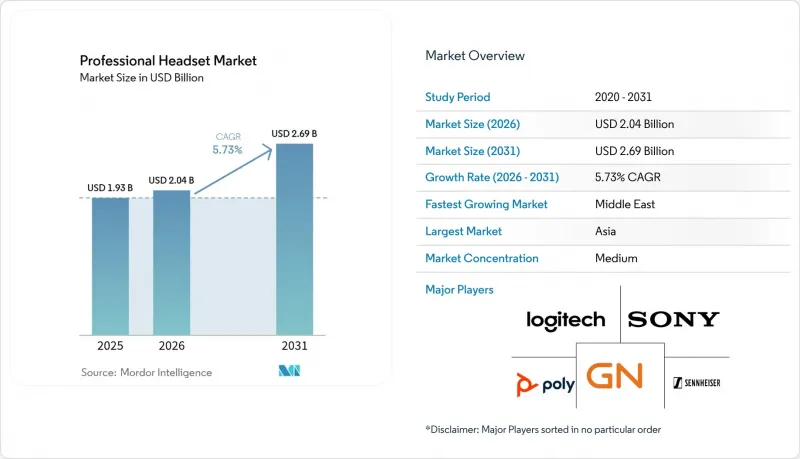
Mordor Intelligence에 의하면, 전문가용 헤드셋 시장 규모는 2025년 19억 3,000만 달러로 평가되었고, 2026년에는 20억 4,000만 달러로 추정되고, 2026-2031년 CAGR 5.73%로 성장을 지속할 전망이며, 2031년까지 26억 9,000만 달러에 이를 것으로 예측됩니다.
본 보고서는 유형별(유선, 무선), 기술별(USB, 블루투스, DECT 등), 착용 방식별(온이어(귀걸이형) 등), 소음 차단 기능별(패시브 노이즈 아이솔레이션, 액티브 노이즈 캔슬링), 최종 사용자(기업 및 콜센터 등), 유통 채널(온라인 B2B 포털 등), 지역별로 분류되어 있습니다. 시장 예측은 금액(달러)으로 제시되어 있습니다.
세계의 전문가용 헤드셋 시장 동향 및 인사이트
북미 및 유럽에서의 하이브리드 근무 모델의 급속한 확산
협업 도구에 대한 직원들의 신뢰 부족을 배경으로, IT 팀은 고음질을 우선시하게 되었으며, 조달 대상이 기본적인 USB 헤드셋에서 음향을 동적으로 최적화하는 AI 탑재 기기로 전환되고 있습니다. 기업들이 책상 위의 복잡함을 해소하고 기기 관리를 간소화하기 위해, 동글이 필요 없는 원활한 블루투스 연결이 지지를 얻고 있습니다. 사무 공간 재구성이 지속되는 가운데, 신뢰성이 높고 모든 환경에서 안정적인 성능을 발휘하는 제품에 대한 수요가 증가하고 있으며, 프로페셔널 헤드셋 시장은 하이브리드 근무의 생산성을 뒷받침하는 핵심 요소가 되고 있습니다.
전 세계 방송 스튜디오의 프로 AV 장비 업그레이드 주기
IBC 2024에서는 클라우드 네이티브 오디오 워크플로우로의 대규모 전환이 주목받고 있으며, 각 스튜디오 업체들은 소프트웨어 정의 인프라에 대응하는 모니터링 장비의 업데이트를 서둘러야 하는 상황에 놓여 있습니다. 젠하이저의 ‘Spectera’ 무선 생태계 및 이와 유사한 신제품의 등장은 견고한 암호화, 멀티채널 지원, 그리고 케이블이 없는 기동성에 대한 수요가 높아지고 있음을 여실히 보여주고 있습니다. 4K 및 8K 영상 파이프라인이 정착됨에 따라, 낮은 지연 시간과 고음질을 유지하는 헤드셋에 대한 수요가 증가하고 있으며, 이는 전문가용 헤드셋 시장의 안정적인 성장을 뒷받침하고 있습니다.
공급망 내 칩 부족으로 블루투스 오디오 SoC 공급 제한
54주를 넘는 리드 타임과 10-20%의 부품 비용 상승이 생산 일정을 압박하고 있어, 무선 제품의 출시가 지연되는 동시에 일부 구매자들을 유선 제품으로 되돌리고 있습니다. 운임 급등이 가격 면에서의 압박을 더욱 가중시키고 있어, 전문가용 헤드셋 시장에서 프리미엄 블루투스 모델의 보급 속도를 둔화시키고 있습니다.
부문 분석
유선 솔루션은 예측 가능한 성능과 보안이라는 강점을 바탕으로 2025년 프로페셔널 헤드셋 시장에서 63.02%의 점유율을 확보했습니다. 조달 부서는 배터리나 전파 간섭의 위험이 없습니다는 점을 중시하고 있으며, 이는 금융, 정부, 규제 대상 산업에서 수요를 뒷받침하고 있습니다. 그러나 USB-C의 보급과 동글을 통한 번거로움을 덜어주는 PC 직결형 블루투스의 등장에 힘입어 무선 제품의 출하 대수는 연평균 성장률(CAGR) 7.7%로 증가했습니다.
블루투스 LE 오디오(Bluetooth LE Audio) 및 WMAS 멀티채널 방식과 같은 기술적 진보로 인해 지연 시간이 단축되고 암호화가 강화되면서, 기존에 존재하던 신뢰성 격차가 줄어들고 있습니다. 방송 제어실이나 하이브리드 오피스에서의 모빌리티 주도형 워크플로우는 케이블이 없는 설계에 대한 지지를 높이고 있으며, 프로페셔널 헤드셋 시장의 진화에 따라 2010년 말까지 무선 제품 출하량이 유선 제품과 어깨를 나란히 할 가능성이 시사되고 있습니다.
2025년에는 USB 연결이 총 매출의 48.05%를 차지했으며, 헬프데스크 팀으로부터 지지를 받는 ‘플러그 앤 플레이’의 편의성을 제공할 전망입니다. 기업들은 확실한 오디오 경로와 지원 티켓의 감소를 높이 평가하고 있으며, 핵심적인 커뮤니케이션 역할을 담당하는 프로페셔널 헤드셋 시장에서 USB 헤드셋은 대량 도입의 중심적인 위치를 계속 차지하고 있습니다.
한편, 블루투스는 운영 체제에 LE 오디오가 점차 통합되고, 데스크 공유에서 멀티 디바이스 로밍이 필수화됨에 따라 연평균 성장률(CAGR) 6.21%로 성장하고 있습니다. DECT는 보안이 극히 중요한 틈새 시장을 유지하고 있는 반면, USB의 신뢰성과 블루투스의 기동성을 결합한 듀얼 모드 설계가 일반화되면서 사용자는 하드웨어를 교체하지 않고도 사용 환경을 전환할 수 있게 되었습니다.
지역별 분석
아시아는 중국, 인도, 일본의 방대한 콜센터 직원 수와 능동형 소음 제거(ANC) 기술의 적극적인 보급에 힘입어 2025년에는 전 세계 매출의 31.08%를 차지했습니다. 인도의 전자기기 생산 급증과 유리한 PLI(생산 연계형 인센티브) 제도는 현지 ‘빌트-투-서브(Built-to-Serve)’ 전략을 더욱 촉진하여 도입 비용을 절감하는 동시에 지역 OEM 생태계를 육성하고 있습니다. 정부의 디지털 교육 정책 또한 중기적으로는 판매량 증가에 기여할 것으로 예측됩니다.
북미와 유럽은 합쳐서 성숙하기는 했지만 수익성이 높은 시장을 형성하고 있으며, 헤드셋의 평균 판매 가격(ASP)이 가장 높습니다. 하이브리드 형식의 회의가 거의 보편화된 점, 엄격한 청각 보호 규정, 그리고 Microsoft Teams와 Zoom의 보급이 교체 주기를 짧게 유지하며 업무용 헤드셋 시장을 뒷받침하고 있습니다. 이 지역 기업들은 사용자 경험과 규정 준수를 최적화하기 위해 AI를 활용한 소음 관리 및 기기 플릿 분석을 중시하고 있습니다.
중동은 리야드와 두바이가 e스포츠 시설 및 미디어 허브에 자금을 투자하고 있어 연평균 성장률(CAGR) 6.01%로 가장 높은 성장세를 기록하고 있습니다. ‘비전 2030’ 이니셔티브를 통해 기술과 엔터테인먼트가 경제 다각화의 중심에 자리 잡으면서 프리미엄 오디오에 대한 수요가 창출되고 있습니다. 남미와 아프리카는 여전히 초기 단계에 있으며, 보급 속도는 거시경제의 안정성과 광대역 보급률에 좌우되지만, 가격이 합리적으로 형성된다면 장기적으로는 큰 성장 잠재력을 지니고 있습니다.
기타 혜택 :
- 엑셀 형식 시장 예측(ME) 시트
- 3개월간의 애널리스트 지원
자주 묻는 질문
목차
제1장 서론
제2장 조사 방법
제3장 주요 요약
제4장 시장 구도
제5장 시장 규모 및 성장 예측-
제6장 경쟁 구도
제7장 시장 기회 및 향후 전망
AJY 26.08.26According to Mordor Intelligence, the professional headset market size is expected to grow from USD 1.93 billion in 2025 to USD 2.04 billion in 2026 and is forecast to reach USD 2.69 billion by 2031 at 5.73% CAGR over 2026-2031.
This report is Segmented by Type (Wired, and Wireless), Technology Type (USB, Bluetooth, DECT, and More), Wearing Style (On-Ear (Supra-Aural), and More), Noise Cancellation (Passive Noise Isolation, and Active Noise Cancellation), End-User (Corporate and Call Centers, and More), Distribution Channel (Online B2B Portals, and More), and Geography. The Market Forecasts are Provided in Terms of Value (USD).
Global Professional Headset Market Trends and Insights
Rapid Expansion of Hybrid Work Models in North America and Europe
Employee confidence gaps around collaboration tools are motivating IT teams to prioritize high-fidelity audio, shifting procurement from basic USB headsets toward AI-enabled devices that optimize acoustics dynamically. Seamless Bluetooth without dongles is gaining favor as enterprises cut desk clutter and simplify device management. Continued office-space reconfiguration reinforces demand for reliable, cross-environment performance, making the professional headset market a core enabler of hybrid productivity.
Pro-AV Upgrade Cycle Across Global Broadcast Studios
IBC 2024 highlighted large-scale moves to cloud-native audio workflows, pushing studios to refresh monitoring gear compatible with software-defined infrastructures. Sennheiser's Spectera wireless ecosystem and similar launches underscore the quest for robust encryption, multichannel capacity, and cable-free mobility. As 4K and 8K video pipelines harden, demand for headsets that maintain low latency and pristine fidelity rises, supporting stable growth in the professional headset market.
Supply-Chain Chip Constraints Limiting Bluetooth Audio SoC Availability
Lead times topping 54 weeks and component cost inflation of 10-20% squeeze production schedules, delaying wireless-product launches and nudging some buyers back toward wired SKUs. Freight-rate spikes aggravate pricing pressure, slowing adoption of premium Bluetooth models within the professional headset market.
Other drivers and restraints analyzed in the detailed report include:
- Surging ANC Adoption in Asia-Pacific Call Centers
- Government-Funded Digital-Learning Programs Boosting Education Demand
- Growing BYOD Trend Diluting Employer Budgets
For complete list of drivers and restraints, kindly check the Table Of Contents.
Segment Analysis
Wired solutions secured 63.02% professional headset market share in 2025 on the strength of predictable performance and security. Procurement teams value freedom from batteries and radio-interference risk, anchoring demand among finance, government, and regulated verticals. Yet wireless shipments climbed at 7.7% CAGR, aided by USB-C ubiquity and direct-to-PC Bluetooth that removes dongle overhead.
Advances such as Bluetooth LE Audio and WMAS multichannel schemes shorten latency and enhance encryption, narrowing the historic reliability gap. Mobility-driven workflows in broadcast control rooms and hybrid offices tilt sentiment toward cable-free designs, suggesting wireless volumes could approach parity with wired by decade-end as the professional headset market evolves.
USB connections held 48.05% of total revenue in 2025, providing plug-and-play clarity that resonates with help-desk teams. Enterprises appreciate deterministic audio paths and lower support tickets, keeping USB headsets central to bulk deployments within the professional headset market size for core communication roles.
Bluetooth, however, is pacing 6.21% CAGR as operating systems embed LE Audio and as multi-device roaming proves vital for desk-sharing. DECT maintains security-critical niches, while dual-mode designs that combine USB reliability with Bluetooth mobility become common, allowing users to toggle contexts without swapping hardware.
Complete Report Scope:
- By Connectivity
- Wired
- Wireless
- By Technology Type
- USB
- Bluetooth
- DECT
- Unified Communication (UC)
- By Wearing Style
- Over-ear (Circumaural)
- On-ear (Supra-aural)
- In-ear (Canal)
- By Noise Cancellation
- Passive Noise Isolation
- Active Noise Cancellation (ANC)
- By End-User
- Corporate and Call Centers
- Education and Digital Learning
- Broadcast and Media Production
- Gaming and Esports Arenas
- Music Recording and Live Sound
- Others
- By Distribution Channel
- Online B2B Portals
- Direct Sales
- Retail (Specialty and Mass)
- By Geography
- North America
- United States
- Canada
- Mexico
- Europe
- Germany
- United Kingdom
- France
- Nordics
- Rest of Europe
- South America
- Brazil
- Rest of South America
- Asia-Pacific
- China
- Japan
- India
- South-East Asia
- Rest of Asia-Pacific
- Middle East and Africa
- Middle East
- Gulf Cooperation Council Countries
- Turkey
- Rest of Middle East
- Africa
- South Africa
- Rest of Africa
- Middle East
- North America
Geography Analysis
Asia generated 31.08% of global revenue in 2025, propelled by enormous contact-center headcount and aggressive ANC uptake in China, India, and Japan. India's electronics-production surge and favorable PLI incentives further nurture local build-to-serve strategies, lowering landed costs and fostering regional OEM ecosystems. Government digital-education schemes add incremental volumes over the medium term.
North America and Europe together represent a mature but lucrative base where headset ASPs are highest. Nearly universal hybrid meeting formats, strict hearing-protection rules, and strong Microsoft Teams and Zoom adoption keep refresh intervals tight, sustaining the professional headset market. Enterprises in these regions favor AI-driven noise management and device-fleet analytics to optimize user experience and compliance.
The Middle East logs the fastest 6.01% CAGR as Riyadh and Dubai fund esports complexes and media hubs. Vision 2030 initiatives position technology and entertainment at the center of economic diversification, creating demand for premium audio. South America and Africa remain early-stage, with uptake paced by macro-economic stability and broadband penetration, but represent long-run whitespace once affordability improves.
- Logitech International S.A.
- HP Inc. (Poly/Plantronics)
- GN Store Nord A/S (Jabra)
- Sennheiser Electronic GmbH and Co. KG
- Sony Corporation
- Shure Inc.
- beyerdynamic GmbH
- Audio-Technica Corp.
- AKG Acoustics (Harman)
- Bose Corporation
- Razer Inc.
- SteelSeries ApS
- Turtle Beach Corporation
- Kingston Technology (HyperX)
- V-Moda LLC
- Bang and Olufsen A/S
- Creative Technology Ltd.
- Koss Corporation
- Klipsch Group Inc.
- Skullcandy Inc.
Additional Benefits:
- The market estimate (ME) sheet in Excel format
- 3 months of analyst support
TABLE OF CONTENTS
1 INTRODUCTION
- 1.1 Study Assumptions and Market Definition
- 1.2 Scope of the Study
2 RESEARCH METHODOLOGY
3 EXECUTIVE SUMMARY
4 MARKET LANDSCAPE
- 4.1 Market Overview
- 4.2 Market Drivers
- 4.2.1 Rapid Expansion of Hybrid Work Models in North America and Europe
- 4.2.2 Pro-AV Upgrade Cycle Across Global Broadcast Studios
- 4.2.3 Surging Adoption of ANC-Enabled Headsets in Asia-Pacific Call-Centers
- 4.2.4 Government-funded Digital?Learning Programs Boosting Education Headset Demand (India, ASEAN)
- 4.2.5 Esports Arena Construction Spurring Premium Gaming Headset Uptake (MENA and Nordics)
- 4.2.6 USB-C Port Standardization in Enterprise Laptops Accelerating Refresh Purchases
- 4.3 Market Restraints
- 4.3.1 Supply-Chain Chip Constraints Limiting Bluetooth Audio SoC Availability
- 4.3.2 Growing BYOD Trend Diluting Employer-Funded Procurement Budgets
- 4.3.3 Price-sensitive SMEs Switching to Low-cost Asian ODM Brands
- 4.3.4 Health and Safety Regulations on Continuous SPL Exposure Restricting Music Studio Volumes
- 4.4 Industry Ecosystem Analysis
- 4.5 Regulatory and Technological Outlook
- 4.6 Porter's Five Forces Analysis
- 4.6.1 Threat of New Entrants
- 4.6.2 Bargaining Power of Buyers
- 4.6.3 Bargaining Power of Suppliers
- 4.6.4 Threat of Substitutes
- 4.6.5 Intensity of Competitive Rivalry
5 Market Size and Growth Forecasts - (Value)
- 5.1 By Connectivity
- 5.1.1 Wired
- 5.1.2 Wireless
- 5.2 By Technology Type
- 5.2.1 USB
- 5.2.2 Bluetooth
- 5.2.3 DECT
- 5.2.4 Unified Communication (UC)
- 5.3 By Wearing Style
- 5.3.1 Over-ear (Circumaural)
- 5.3.2 On-ear (Supra-aural)
- 5.3.3 In-ear (Canal)
- 5.4 By Noise Cancellation
- 5.4.1 Passive Noise Isolation
- 5.4.2 Active Noise Cancellation (ANC)
- 5.5 By End-User
- 5.5.1 Corporate and Call Centers
- 5.5.2 Education and Digital Learning
- 5.5.3 Broadcast and Media Production
- 5.5.4 Gaming and Esports Arenas
- 5.5.5 Music Recording and Live Sound
- 5.5.6 Others
- 5.6 By Distribution Channel
- 5.6.1 Online B2B Portals
- 5.6.2 Direct Sales
- 5.6.3 Retail (Specialty and Mass)
- 5.7 By Geography
- 5.7.1 North America
- 5.7.1.1 United States
- 5.7.1.2 Canada
- 5.7.1.3 Mexico
- 5.7.2 Europe
- 5.7.2.1 Germany
- 5.7.2.2 United Kingdom
- 5.7.2.3 France
- 5.7.2.4 Nordics
- 5.7.2.5 Rest of Europe
- 5.7.3 South America
- 5.7.3.1 Brazil
- 5.7.3.2 Rest of South America
- 5.7.4 Asia-Pacific
- 5.7.4.1 China
- 5.7.4.2 Japan
- 5.7.4.3 India
- 5.7.4.4 South-East Asia
- 5.7.4.5 Rest of Asia-Pacific
- 5.7.5 Middle East and Africa
- 5.7.5.1 Middle East
- 5.7.5.1.1 Gulf Cooperation Council Countries
- 5.7.5.1.2 Turkey
- 5.7.5.1.3 Rest of Middle East
- 5.7.5.2 Africa
- 5.7.5.2.1 South Africa
- 5.7.5.2.2 Rest of Africa
- 5.7.5.1 Middle East
- 5.7.1 North America
6 COMPETITIVE LANDSCAPE
- 6.1 Market Concentration
- 6.2 Strategic Moves
- 6.3 Market Share Analysis
- 6.4 Company Profiles {(includes Global level Overview, Market level overview, Core Segments, Financials as available, Strategic Information, Market Rank/Share for key companies, Products and Services, and Recent Developments)}
- 6.4.1 Logitech International S.A.
- 6.4.2 HP Inc. (Poly/Plantronics)
- 6.4.3 GN Store Nord A/S (Jabra)
- 6.4.4 Sennheiser Electronic GmbH and Co. KG
- 6.4.5 Sony Corporation
- 6.4.6 Shure Inc.
- 6.4.7 beyerdynamic GmbH
- 6.4.8 Audio-Technica Corp.
- 6.4.9 AKG Acoustics (Harman)
- 6.4.10 Bose Corporation
- 6.4.11 Razer Inc.
- 6.4.12 SteelSeries ApS
- 6.4.13 Turtle Beach Corporation
- 6.4.14 Kingston Technology (HyperX)
- 6.4.15 V-Moda LLC
- 6.4.16 Bang and Olufsen A/S
- 6.4.17 Creative Technology Ltd.
- 6.4.18 Koss Corporation
- 6.4.19 Klipsch Group Inc.
- 6.4.20 Skullcandy Inc.
7 MARKET OPPORTUNITIES AND FUTURE OUTLOOK
- 7.1 White-space and Unmet-Need Assessment