|
시장보고서
상품코드
2114609
헤모글로빈 이상증 치료 : 시장 점유율 분석, 업계 동향 및 통계, 성장 예측(2026-2031년)Hemoglobinopathies Treatment - Market Share Analysis, Industry Trends & Statistics, Growth Forecasts (2026 - 2031) |
||||||
 Mordor Intelligence
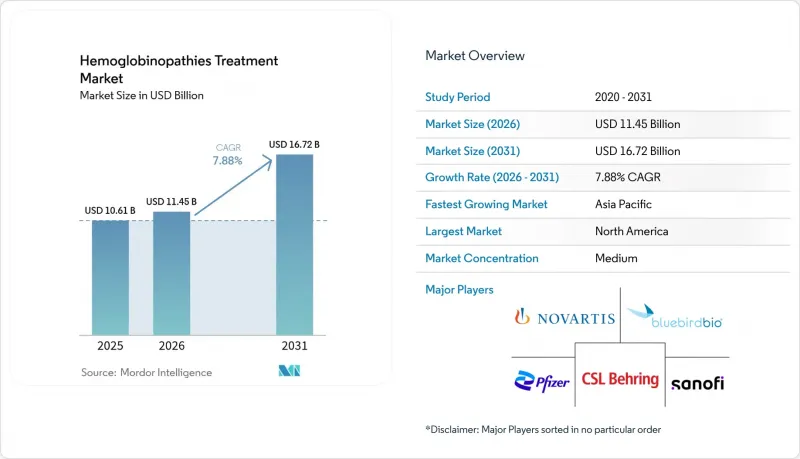
Mordor Intelligence에 의하면, 2026년 헤모글로빈 이상증 치료 시장 규모는 114억 5,000만 달러로 추정되고 2025년 106억 1,000만 달러에서 확대해, 2031년에는 167억 2,000만 달러에 이를 것으로 예측됩니다.
2026년부터 2031년까지 연평균 성장률(CAGR) 7.88%로 성장할 것으로 전망됩니다.
본 보고서는 치료법(줄기세포 이식, 수혈, 철 킬레이트 요법, 약리학적 제제 등), 용도(지중해빈혈 등), 투여 경로(경구, 비경구, 수혈), 최종 사용자(병원, 전문 클리닉 등), 지역(북미, 유럽 등)별로 분류되어 있습니다. 시장 전망은 금액(달러) 기준으로 제시되어 있습니다.
세계의 헤모글로빈 이상증 치료 시장 동향 및 인사이트
최초의 유전자 치료제 승인으로 도입 가속화
2023년 하반기부터 2024년 초에 걸쳐 CASGEVY 및 LYFGENIA가 FDA 승인을 획득함에 따라, 근치적 치료법에 대한 임상의들의 기대가 재구성되었습니다. 승인 후 실제 임상 데이터에 따르면, 평가 가능한 환자의 94%에서 추적 조사 시작 후 첫 18개월 이내에 중증 혈관 폐색 사건이 소실된 것으로 나타났습니다. 유럽의약품청(EMA)의 승인으로 27개 회원국 전체에서 접근성이 확대되었으며, 향후 등장할 CRISPR 플랫폼에 대한 규제 경로의 조화가 시사되고 있습니다. 초기 임상적 성공에 힘입어, 특히 평생에 걸친 수혈이나 킬레이트 요법을 피하고자 하는 청년층을 중심으로 근치적 치료로 의뢰되는 경향이 강해지고 있습니다. 치료 센터에서는 대기 목록이 증가하고 있다고 보고되고 있으며, 이에 따라 벡터 생산 능력과 아페레시스 인프라에 대한 투자가 진행되고 있습니다. 유전자 치료의 보급이 가속화됨에 따라, 높은 가격 책정과 생존 기간 연장에 따른 혜택을 통해 헤모글로빈 이상증 치료 시장이 확대될 것으로 예측됩니다.
신생아·산전 선별 검사 프로그램의 확대
인도의 발병률이 높은 주에서 선별검사를 의무화한 데 더해, 나이지리아와 브라질에서도 도입이 진행됨에 따라 조기 진단과 의료 연계가 가능해졌습니다. 인도의 다기관 공동 코호트 연구는 7개 3차 의료기관에 걸쳐 있으며, 종단적 추적 조사를 위한 디지털 등록 시스템을 통합하고 있습니다. WHO의 모델 추산에 따르면, 보편적인 선별 검사를 통해 겸상적혈구증 관련 사망의 70%를 예방할 수 있는 것으로 나타나, 이는 사하라 이남 아프리카 전역에서 기부금을 통한 검사실 장비 현대화를 촉진하고 있습니다. Gazelle 멀티 스펙트럼 리더기와 같은 신속 진단법은 생후 3일 이내에 96.8%의 정확도를 달성하고 있습니다. 선진국 시장에서는 산전 검사 시 이중 확인 프로토콜을 통해 결과 해석이 표준화되고, 상담 이용률이 향상되고 있습니다. 조기 발견으로 인해 근치적 치료 대상 환자층이 확대되면서, 헤모글로빈 이상증 치료 시장의 지속적인 수요 증가가 촉진되고 있습니다.
근치적 치료의 높은 비용
200만 달러를 초과하는 정가가 즉각적인 도입을 방해하고 있으며, 보험사들은 장기적인 비용 대비 효과 분석을 요구하고 있습니다. EU의 일부 회원국에서는 성과 연동형 보상 모델을 통해 환자가 2년 동안 수혈이 필요 없는 상태를 유지할 때까지 지불액의 70%가 유예되고 있습니다. 저소득 국가에서는 대폭적인 가격 인하 협상이 이루어지고 있지만, 냉장 물류에 따른 공급망상의 가격 인상이라는 과제에 여전히 직면해 있습니다. 제조업체의 지원 프로그램은 환자의 부담을 어느 정도 경감시켜 주지만, 예산 상한선에 의해 제약을 받고 있습니다. 바이오시밀러나 동종 기성 제제의 선택지가 등장하기 전까지는 고가의 가격으로 인한 충격이 헤모글로빈 이상증 치료 시장의 성장 곡선을 둔화시킬 것입니다.
부문별 분석
유전자 치료를 통한 헤모글로빈 이상증 치료 시장 규모는 연평균 성장률(CAGR) 19.06%로 확대될 것으로 예측되지만, 2025년 시점에서도 수혈 요법은 37.89%의 점유율을 유지했습니다. CRISPR 기반 제품이 규제 당국의 승인을 획득함에 따라, 일회성 완치 치료의 경제성이 입증되었고, 전 세계적인 파이프라인 투자가 활발해지고 있습니다. Vertex와 CRISPR Therapeutics는 미국 및 EU에서 수요 급증에 대응하기 위해 벡터 생산 능력을 3배로 확대할 예정입니다. 줄기세포 이식은 여전히 근치적 치료법이지만, 기증자 확보 및 이식편 대 숙주 질환의 위험으로 인해 제한을 받고 있으므로, 유전자 편집을 적용한 자가 이식 요법의 역할은 앞으로도 유지될 것입니다.
복셀로톨이나 크리잔리주맙과 같은 약리학적 질병 수정제는 유전자 치료의 보험 적용이 지연되고 있는 지역에서 여전히 그 가치를 유지하고 있습니다. 수혈 의존성 지중해빈혈에 필수적인 철 킬레이트 요법은 분산형 수혈 네트워크의 구축에 따라 꾸준히 확대되고 있습니다. CorrectSequence에서 등장한 새로운 염기 편집 후보 약물은 중국과 싱가포르에서 임상시험 승인이 가속화되는 가운데, 혁신의 지리적 확산을 보여주고 있습니다. 전반적으로, 치료법 조합의 진화는 지속적인 효과를 가져오는 기술을 뒷받침하고 있으며, 근치적 플랫폼이 헤모글로빈 이상증 치료 시장에서 질적 변화를 주도하는 주요 동력으로서의 입지를 확고히 하고 있습니다.
2025년에는 겸상 적혈구증이 헤모글로빈 이상증 치료 시장의 48.03%를 차지했으며, 북미와 유럽에서 수십 년에 걸친 표준화된 치료 경로의 혜택을 받고 있습니다. 그럼에도 불구하고, 지중해 지역과 동남아시아에서 의무화된 선별 검사로 인해 잠재적 보균자가 관리 대상 환자로 전환되고 있는 것을 배경으로, 지중해 빈혈은 연평균 성장률(CAGR) 10.73%를 기록하며 적응증군 중 선두를 달리고 있습니다. 알파-지중해빈혈(HbH 질환)을 대상으로 한 루스파타셉트의 임상시험은 수혈 의존을 넘어선 치료법의 다양화가 진행 중임을 여실히 보여주고 있습니다. 지중해빈혈국제연맹(Thalassemia International Federation)의 디지털 환자 등록 제도는 복약 순응도 모니터링을 개선하는 동시에 고가 치료제에 대한 보험사와의 협상 기반이 되고 있습니다. 헤모글로빈 E 질환을 포함한 희귀 돌연변이는 차세대 염기서열 분석 프로그램을 통해 주목도가 높아지고 있지만, 여전히 틈새 상업화 분야에 머물러 있습니다. 지역마다 다른 역학적 특성을 가지고 있기 때문에 적응 분야 성장 요인은 지역별 정책 시행 및 문화를 고려한 인식 제고 활동에 좌우되며, 헤모글로빈 이상증 치료 시장 내에서 서로 다르면서도 상호 보완적인 동향을 강화하고 있습니다.
지역별 분석
북미는 2025년에 34.92%의 점유율을 차지하며 헤모글로빈 이상증 치료 시장 규모를 선도했습니다. 이는 종합적인 보험 적용과 FDA 승인된 완치적 치료법의 조기 도입에 따른 혜택을 받고 있습니다. 유전자 치료 투여 센터는 2023년 이후 2배로 증가했으며, 치료 성과에 기반한 보상 시범 사업이 지속적인 고가 책정을 뒷받침하고 있습니다. 유럽은 이에 이어 EMA(유럽의약품청)의 일관된 규제와 CASGEVY를 희귀질환 의약품 목록에 신속하게 임베디드시킨 공공 의료 제도를 활용하고 있습니다. EU 전역의 공동 조달에 관한 협의는 대량 구매를 통한 할인 확보를 목적으로 하고 있으며, 제조업체의 이익률을 유지하면서도 병원에서의 도입 확대로 이어질 가능성이 있습니다.
아시아태평양은 인도, 태국, 중국 남부의 보균자 유병률이 높은 점을 배경으로, 2031년까지 연평균 성장률(CAGR) 9.43%로 가장 높은 성장세를 보일 것으로 예측됩니다. 인도의 국가보건미션은 주 차원의 신생아 선별 검사에 자금을 지원하고 있으며, 이는 민관 파트너십과 맞물려 새로 진단된 영아를 치료 체계로 유도하고 있습니다. 중국 국가약품감독관리국은 국내 유전자 편집 치료법에 대해 우선 심사를 승인함으로써, 국산 혁신 의약품 및 수입 대체품에 대한 정책적 지원을 보여주고 있습니다. 동남아시아 국가들에서는 지중해빈혈 당일 치료 시설이 확대되고 있으며, 수혈 서비스가 집중화되고 킬레이트제 판매가 가속화되고 있습니다. 이러한 노력들이 맞물려 치료의 양과 복잡성이 모두 증가함에 따라, 헤모글로빈 이상증 치료 시장의 세계 공급망 계획에 대한 이 지역의 영향력이 강화되고 있습니다.
중동 및 아프리카는 인프라 격차에 직면해 있습니다. 나이지리아의 겸상적혈구빈혈에 관한 국가 정책은 야심찬 목표를 제시하고 있지만, 콜드체인의 부족으로 인해 생물학적 제제의 보급이 제한되고 있습니다. 가나에서 시범적으로 도입된 분산형 수혈 허브는 농촌 지역에서의 이동 시간을 40% 단축시켰으며, 더 광범위한 도입을 위한 확장 가능한 모델을 제시하고 있습니다. 남미는 완만한 성장을 유지하고 있으며, 브라질의 희귀질환 관련 조례와 하이드록시우레아의 국가 처방집 등재가 꾸준한 수요를 촉진하고 있습니다. 각 지역에서 의료 재원, 유전성 질환 유병률, 기술 도입 현황의 편차가 헤모글로빈 이상증 치료 시장에서 서로 다르면서도 상호 연관된 향후 전개를 계속해서 형성해 나갈 것입니다.
기타 혜택 :
- 엑셀 형식 시장 예측(ME) 시트
- 3개월간의 애널리스트 지원
자주 묻는 질문
목차
제1장 서론
제2장 조사 방법
제3장 주요 요약
제4장 시장 구도
제5장 시장 규모 및 성장 예측
제6장 경쟁 구도
제7장 시장 기회 및 향후 전망
KTH 26.08.28According to Mordor Intelligence, hemoglobinopathies treatment market size in 2026 is estimated at USD 11.45 billion, growing from 2025 value of USD 10.61 billion with 2031 projections showing USD 16.72 billion, growing at 7.88% CAGR over 2026-2031.
This report is Segmented by Treatment (Stem Cell Transplantation, Blood Transfusion, Iron Chelation Therapy, Pharmacological Agents, and More), Application (Thalassemia, and More), Route of Administration (Oral, Parenteral, and Transfusion), End User (Hospitals, Specialty Clinics, and More), and Geography (North America, Europe, and More). The Market Forecasts are Provided in Terms of Value (USD).
Global Hemoglobinopathies Treatment Market Trends and Insights
First-in-class gene-therapy approvals accelerate adoption
FDA clearance of CASGEVY and LYFGENIA between late-2023 and early-2024 has reshaped clinician expectations around curative options. Post-approval real-world data show 94% of evaluable patients eliminating severe vaso-occlusive events within the first 18 months of follow-up. European Medicines Agency authorization widens access across 27 member states and signals a harmonized regulatory pathway for subsequent CRISPR platforms. Early clinical success is driving referral patterns toward definitive therapy, particularly among adolescents who aim to avoid lifelong transfusions and chelation. Treatment centers report rising wait-lists, prompting investments in vector-manufacturing capacity and apheresis infrastructure. The acceleration of gene-therapy uptake is expected to lift the hemoglobinopathies treatment market through premium pricing and extended survival benefits.
Expanding newborn & antenatal screening programs
Mandated screening across high-burden states in India, coupled with roll-outs in Nigeria and Brazil, is enabling earlier diagnosis and linkage to care. India's multicentric cohort initiative spans seven tertiary hospitals and integrates digital registries for longitudinal follow-up. WHO modeling indicates universal screening could avert 70% of sickle-cell-related mortality, galvanizing donor-funded laboratory upgrades across Sub-Saharan Africa. Rapid diagnostics such as the Gazelle multispectral reader achieve 96.8% accuracy within 3 days of birth. In advanced markets, dual-review antenatal protocols standardize result interpretation and improve counseling uptake. Earlier identification expands the candidate pool for curative therapies and supports sustainable volume growth in the hemoglobinopathies treatment market.
High cost of curative therapies
List prices above USD 2 million constrain immediate uptake, prompting insurers to demand long-horizon cost-effectiveness analyses. In several EU states, pay-for-performance models defer 70% of payment until patients remain transfusion-free for two years. Low-income settings negotiate deep discounts but still face supply-chain mark-ups tied to cold-storage logistics. Manufacturer assistance programs mitigate some patient liability yet are limited by budget caps. Until biosimilar or allogeneic off-the-shelf options emerge, sticker shock will temper the upward curve of the hemoglobinopathies treatment market.
Other drivers and restraints analyzed in the detailed report include:
- Rare-disease reimbursement roll-outs in middle-income nations
- AI-enabled point-of-care diagnostics integration
- Donor-match scarcity for stem-cell transplantation
For complete list of drivers and restraints, kindly check the Table Of Contents.
Segment Analysis
The hemoglobinopathies treatment market size for gene therapy is projected to rise at a 19.06% CAGR, whereas blood transfusion maintains a 37.89% share in 2025. Regulatory wins for CRISPR-based products validate one-time curative economics and ignite global pipeline investment. Vertex-CRISPR Therapeutics intend to scale vector capacity by three times to meet US and EU demand waves. Stem-cell transplantation remains curative but is limited by donor availability and graft-versus-host risks, preserving a role for gene-edited autologous options.
Pharmacological disease-modifiers such as voxelotor and crizanlizumab preserve value in regions where reimbursement for gene therapy lags. Iron chelation therapy, indispensable for transfusion-dependent thalassemia, grows steadily alongside decentralized transfusion networks. Emerging base-editing candidates from CorrectSequence illustrate the geographic broadening of innovation as China and Singapore accelerate trial approvals. Overall, treatment-mix evolution favors technologies offering durable benefit, positioning curative platforms as the primary driver of qualitative change in the hemoglobinopathies treatment market.
Sickle cell disease controls 48.03% of hemoglobinopathies treatment market share in 2025 and benefits from decades of standardized care pathways in North America and Europe. Nonetheless, thalassemia's 10.73% CAGR leads the application set, propelled by Mediterranean and South-East Asian screening mandates that convert latent carriers into managed patients. Luspatercept trials for alpha-thalassemia HbH disease highlight ongoing therapeutic diversification beyond transfusion reliance. The Thalassemia International Federation's digital patient registry improves adherence monitoring and underpins payer negotiations for high-cost therapies. Rare variants, including hemoglobin E disorders, gain visibility through next-generation sequencing programs but remain commercialization niches. With distinct epidemiological footprints, application growth vectors hinge on regional policy implementation and culturally tailored outreach, reinforcing divergent yet complementary flows within the hemoglobinopathies treatment market.
Complete Report Scope:
- By Treatment
- Stem Cell Transplantation
- Blood Transfusion
- Iron Chelation Therapy
- Pharmacological Agents
- Gene Therapy
- Other Supportive Treatments
- By Application
- Thalassemia
- Sickle Cell Disease
- Other Hemoglobinopathies
- By Route of Administration
- Oral
- Parenteral
- Transfusion
- By End User
- Hospitals
- Specialty Clinics
- Academic & Research Institutes
- Others
- Geography
- North America
- United States
- Canada
- Mexico
- Europe
- Germany
- United Kingdom
- France
- Italy
- Spain
- Rest of Europe
- Asia-Pacific
- China
- Japan
- India
- South Korea
- Australia
- Rest of Asia-Pacific
- Middle East and Africa
- GCC
- South Africa
- Rest of Middle East and Africa
- South America
- Brazil
- Argentina
- Rest of South America
- North America
Geography Analysis
North America leads the hemoglobinopathies treatment market size with 34.92% share in 2025, benefiting from robust insurance coverage and early adoption of FDA-approved curative options. Gene-therapy infusion centers have doubled since 2023, and outcome-based reimbursement pilots underpin continued premium pricing. Europe follows, leveraging EMA regulatory cohesion and public health systems that swiftly incorporated CASGEVY into rare-disease formularies. Pan-EU joint procurement discussions aim to secure bulk-buy discounts, potentially widening hospital adoption while preserving manufacturer margins.
Asia-Pacific will post the fastest 9.43% CAGR through 2031, driven by high carrier prevalence in India, Thailand, and southern China. India's National Health Mission funds state-level newborn screening which, coupled with public-private partnerships, funnels newly diagnosed infants into treatment pipelines. China's National Medical Products Administration granted priority review to domestic base-editing therapies, signaling policy support for indigenous innovation and import alternatives. Southeast Asian nations expand thalassemia day-care units, concentrating transfusion services and accelerating chelation sales. Collectively these initiatives elevate both volume and complexity of care, amplifying regional influence on global supply-chain planning for the hemoglobinopathies treatment market.
Middle East & Africa face infrastructural gaps: Nigeria's national sickle-cell policy sets ambitious targets, yet cold-chain deficits limit biologic penetration. Pilot decentralized transfusion hubs in Ghana cut rural travel times by 40%, indicating scalable blueprints for broader implementation. South America maintains moderate growth; Brazil's rare-disease ordinance and inclusion of hydroxyurea in the national formulary stimulate steady demand. Across regions, heterogeneity in healthcare financing, genetic prevalence, and technology adoption will continue to shape disparate yet interlinked trajectories for the hemoglobinopathies treatment market.
- Sanofi
- Novartis
- Pfizer
- bluebird bio
- Vertex Pharmaceuticals
- CRISPR Therapeutic
- Sangamo Therapeutics
- Gamida Cell
- Emmaus Life Sciences
- CSL Behring
- Agios Pharmaceuticals
- Editas Medicine
- Intellia Therapeutics
- Rocket Pharmaceuticals
- Acceleron Pharma
- Silence Therapeutics
- Vifor Pharma
- Bioverativ (Genzyme unit)
Additional Benefits:
- The market estimate (ME) sheet in Excel format
- 3 months of analyst support
TABLE OF CONTENTS
1 Introduction
- 1.1 Study Assumptions & Market Definition
- 1.2 Scope of the Study
2 Research Methodology
3 Executive Summary
4 Market Landscape
- 4.1 Market Overview
- 4.2 Market Drivers
- 4.2.1 Increasing Prevalence Of Hemoglobinopathies
- 4.2.2 Expanding Newborn & Antenatal Screening Programs
- 4.2.3 First-In-Class Gene-Therapy Approvals Accelerate Adoption
- 4.2.4 Government Rare-Disease Reimbursement Roll-Outs In Middle-Income Nations
- 4.2.5 Decentralized Blood-Transfusion Networks In Sub-Saharan Africa
- 4.2.6 AI-Enabled Point-Of-Care Diagnostics Integration
- 4.3 Market Restraints
- 4.3.1 High Cost Of Curative Therapies
- 4.3.2 Donor-Match Scarcity For Stem-Cell Transplantation
- 4.3.3 Cold-Chain Gaps For Biologics In Tropical Markets
- 4.3.4 Regulatory Ambiguity For CRISPR-Edited Products
- 4.4 Porter's Five Forces
- 4.4.1 Threat of New Entrants
- 4.4.2 Bargaining Power of Buyers/Consumers
- 4.4.3 Bargaining Power of Suppliers
- 4.4.4 Threat of Substitute Products
- 4.4.5 Intensity of Competitive Rivalry
5 Market Size & Growth Forecasts (Value, USD)
- 5.1 By Treatment
- 5.1.1 Stem Cell Transplantation
- 5.1.2 Blood Transfusion
- 5.1.3 Iron Chelation Therapy
- 5.1.4 Pharmacological Agents
- 5.1.5 Gene Therapy
- 5.1.6 Other Supportive Treatments
- 5.2 By Application
- 5.2.1 Thalassemia
- 5.2.2 Sickle Cell Disease
- 5.2.3 Other Hemoglobinopathies
- 5.3 By Route of Administration
- 5.3.1 Oral
- 5.3.2 Parenteral
- 5.3.3 Transfusion
- 5.4 By End User
- 5.4.1 Hospitals
- 5.4.2 Specialty Clinics
- 5.4.3 Academic & Research Institutes
- 5.4.4 Others
- 5.5 Geography
- 5.5.1 North America
- 5.5.1.1 United States
- 5.5.1.2 Canada
- 5.5.1.3 Mexico
- 5.5.2 Europe
- 5.5.2.1 Germany
- 5.5.2.2 United Kingdom
- 5.5.2.3 France
- 5.5.2.4 Italy
- 5.5.2.5 Spain
- 5.5.2.6 Rest of Europe
- 5.5.3 Asia-Pacific
- 5.5.3.1 China
- 5.5.3.2 Japan
- 5.5.3.3 India
- 5.5.3.4 South Korea
- 5.5.3.5 Australia
- 5.5.3.6 Rest of Asia-Pacific
- 5.5.4 Middle East and Africa
- 5.5.4.1 GCC
- 5.5.4.2 South Africa
- 5.5.4.3 Rest of Middle East and Africa
- 5.5.5 South America
- 5.5.5.1 Brazil
- 5.5.5.2 Argentina
- 5.5.5.3 Rest of South America
- 5.5.1 North America
6 Competitive Landscape
- 6.1 Market Concentration
- 6.2 Market Share Analysis
- 6.3 Company Profiles (includes Global level Overview, Market level overview, Core Segments, Financials as available, Strategic Information, Market Rank/Share for key companies, Products & Services, and Recent Developments)
- 6.3.1 Sanofi SA
- 6.3.2 Novartis AG
- 6.3.3 Pfizer Inc.
- 6.3.4 bluebird bio
- 6.3.5 Vertex Pharmaceuticals
- 6.3.6 CRISPR Therapeutics
- 6.3.7 Sangamo Therapeutics
- 6.3.8 Gamida Cell
- 6.3.9 Emmaus Life Sciences
- 6.3.10 CSL Behring
- 6.3.11 Agios Pharmaceuticals
- 6.3.12 Editas Medicine
- 6.3.13 Intellia Therapeutics
- 6.3.14 Rocket Pharmaceuticals
- 6.3.15 Acceleron Pharma
- 6.3.16 Silence Therapeutics
- 6.3.17 Vifor Pharma
- 6.3.18 Bioverativ (Genzyme unit)
7 Market Opportunities & Future Outlook
- 7.1 White-space & Unmet-need Assessment