
|
시장보고서
상품코드
2114618
신경중재 기기 : 시장 점유율 분석, 업계 동향 및 통계, 성장 예측(2026-2031년)Neurointerventional Devices - Market Share Analysis, Industry Trends & Statistics, Growth Forecasts (2026 - 2031) |
||||||
 Mordor Intelligence
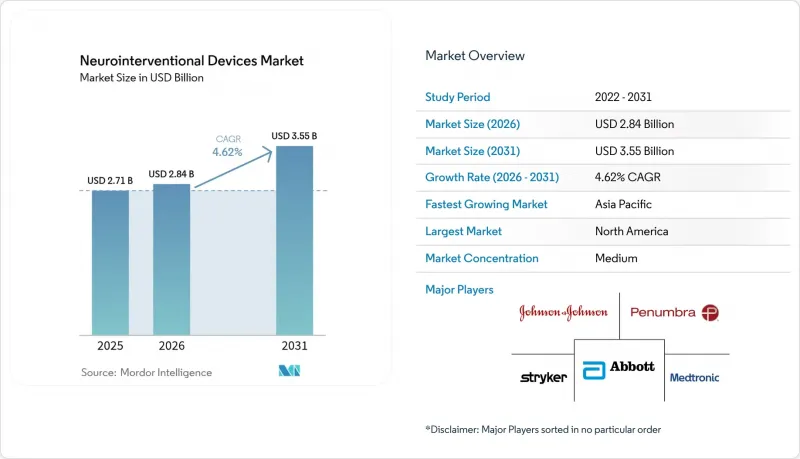
Mordor Intelligence에 의하면, 2026년 신경중재 기기 시장 규모는 28억 4,000만 달러로 추정되고 2025년 27억 1,000만 달러에서 확대해, 2031년에는 35억 5,000만 달러에 이를 것으로 예측됩니다.
2026년부터 2031년까지 연평균 성장률(CAGR) 4.62%로 성장할 것으로 전망됩니다.
본 보고서는 제품별(동맥류 코일, 색전술 기기 등), 용도별(허혈성 뇌졸중 등), 최종 사용자별(3차 의료 병원, 전문 신경과학 센터, 외래수술센터(ASC)·카테터 검사 센터), 지역별(북미, 유럽,아시아태평양, 중동 및 아프리카, 남미)로 분류되어 있습니다. 시장 예측은 금액(달러) 기준으로 제시되어 있습니다.
세계의 신경중재 기기 시장 동향 및 인사이트
뇌졸중 및 뇌동맥류 발생률 증가
2019년에도 뇌졸중은 여전히 전 세계 사망 원인 2위를 차지하며, 연간 1,220만 명이 이 질환을 앓았습니다. 선진국의 고령화 진행과 신흥 지역의 고혈압 및 당뇨병 유병률 상승으로 인해 신경혈관 치료 솔루션에 대한 수요가 증가하고 있습니다. 치료 가능 시간이 확대됨에 따라 2017년부터 2019년에 걸쳐 기계적 혈전 제거술 시행 건수는 거의 3배로 증가했으며, 혈관 내 치료로의 임상적 전환이 두드러지고 있습니다. 중경막동맥 색전술 시행 건수는 2019년 4,014건에서 2023년에는 2만 836건으로 증가했으며, 2029년까지 7만 9,483건에 달할 것으로 예측되어 이 수술 건수의 지속적인 증가가 입증되고 있습니다. 저침습적 접근법의 보급으로 인해 전반적인 입원 기간과 비용이 절감되어, 신경중재 기기 시장에 대한 장기적인 수요가 확고해지고 있습니다.
신경혈관용 기기 분야의 지속적인 기술 혁신
신속한 개발 주기를 통해 성공률을 높이고 적응 범위를 확대하는 의료기기가 잇달아 등장하고 있습니다. 밀리 스피너 혈전 제거 기술은 피브린 그물을 고밀도화하여 기존 성능을 2배로 높이고, 혈전 제거 성공률을 90% 이상으로 끌어올렸습니다. AI 가이드 기반 뇌동맥류 코일링은 인간을 대상으로 한 첫 임상시험에서 92.7%의 정확도와 97.2%의 재현성을 보였습니다. Pipeline Vantage와 같은 4세대 플로우 다이버터는 6개월 시점에서 81.7%의 폐쇄율을 달성했으며, 전개에 문제는 없었습니다. 한편, CorPath GRX와 같은 로봇 시스템은 117명의 색전술 환자를 대상으로 94%의 시술 유효성을 보여주었습니다. 이러한 획기적인 발전은 경쟁사와의 차별화를 촉진하고, 신경중재 기기 시장을 활성화시키고 있습니다.
엄격한 다지역 규제 승인 절차
FDA, 유럽 및 중국 국가의약품감독관리국(NMPA)의 요건이 서로 다르기 때문에 시장 출시까지의 기간이 길어지고 개발 비용이 증가하고 있습니다. EU의 의료기기 규정에서는 시판 후 추가 의무가 부과되는 반면, FDA의 신경혈관 내 모니터링에 관한 요건은 여전히 통일되지 않은 상태입니다. 중국에서는 개정된 클래스 III 의료기기 규정에 따라 국내 임상 데이터와 종합적인 품질 관리 시스템이 요구되고 있어, 해외 임상시험 승인이 제한되고 있습니다. AI를 활용한 신형 기기나 로봇 기기는 현재도 수립 중인 규제 프레임워크에 직면해 있으며, 이로 인해 광범위한 상용화가 지연되고 신경중재 기기 시장의 발전이 주춤하고 있습니다.
부문별 분석
2025년, 동맥류 코일 및 색전술 기기는 37.68%의 점유율을 유지하며 계속해서 시장을 주도했습니다. Pipeline Vantage와 같은 플로우 다이버터 스텐트는 6개월간 폐색률이 81.7%에 달했으며, Artisse와 같은 액체 색전제는 96.6%의 이식 성공률을 기록했습니다. 기계적 혈전 제거술은 규모는 작지만 연평균 성장률(CAGR) 6.42%로 가장 빠르게 성장하는 부문입니다. 밀리 스피너 시스템이 피브린이 풍부한 혈전에 대해 90% 이상의 제거 성공률을 달성함에 따라, 기계적 혈전 제거술을 위한 신경중재 기기 시장 규모는 급격히 확대될 것으로 예측됩니다. FreeClimb 88 흡입 카테터는 합병증 없이 67.9%의 1차 통과 재개통률을 달성하여 임상의들의 신뢰를 한층 더 높였습니다. 대규모 경색 및 원위부 폐색으로의 적응증 확대로 대상 환자층이 넓어지면서 신경중재 기기 시장을 견인하고 있습니다.
각 제조업체가 차세대 카테터와 AI 유도 영상 진단을 결합한 제품을 지속적으로 제공함에 따라 경쟁은 계속해서 치열해지고 있습니다. 이러한 통합 솔루션은 시술 시간을 단축하고 합병증 발생률을 낮추기 때문에 프리미엄 제품의 채택을 촉진하고 있습니다. 기존에는 적용 대상에서 제외되었던 환자군에서도 기계적 혈전 제거술의 유효성을 뒷받침하는 임상적 근거가 확보됨에 따라, 조달 위원회는 더 많은 예산을 배정하게 되었고, 그 결과 이 제품 카테고리의 신경중재 기기 시장 점유율이 유지되고 있습니다.
지역별 분석
북미는 선진적인 인프라, 풍부한 임상시험, 조기 제품 출시 덕분에 2025년에 매출의 40.12%를 차지했습니다. Terumo Neuro의 2층식 경동맥 스텐트 및 Crossroads의 풍선 가이드 카테터에 대한 FDA 승인은 성장 파이프라인을 새롭게 바꿨습니다. 이 지역은 혈전 제거술 비용의 5분의 1밖에 보장하지 않는 메디케어의 낮은 평가로 인한 압박에 직면해 있어 병원 운영에 어려움을 겪고 있습니다. Stryker가 Inari를 49억 달러에 인수한 것과 같은 전략적 인수는 포트폴리오의 폭을 넓히고, 신경중재 기기 시장의 경쟁력을 유지하고 있습니다.
아시아태평양은 연평균 성장률(CAGR) 5.28%로 가장 빠르게 성장하고 있습니다. 중국 국가약품감독관리국(NMPA)은 2023년에 1만 2,213건의 의료기기 신청을 승인했으며, 25.4% 증가율은 규제 측면에서의 개방성을 보여줍니다. 보험 적용 범위 확대와 설비 투자를 통해 시술 보급률은 향상되고 있지만, 기술자 부족이나 각국 고유의 규제 같은 과제는 여전히 남아 있습니다. 일본에서는 플로우 다이버터에 대한 체계적인 감시 체제가 안전성을 중시하여 신뢰를 조성하고 있습니다. 전반적으로 현대화와 인구 고령화가 해당 지역의 신경중재 기기 시장의 강력한 성장을 견인하고 있습니다.
유럽에서는 의료기기 규정(MDR) 준수 및 충실한 임상 연구를 바탕으로 꾸준한 진전이 나타나고 있습니다. 시장 진출기업들은 Cerenovus의 CEREGLIDE 71 및 Penumbra의 뉴로액세스 스위트를 도입하며 지속적인 혁신을 강조하고 있습니다. 그러나 회원국마다 환급 제도가 다르기 때문에 주요 기업들은 전략적으로 출시 순서를 조정하고 있습니다. 가치 기반 의료(Value-Based Care) 프로그램의 확충으로 신경중재 기기 시장의 침투를 지속하기 위해서는 장기적인 치료 성과 데이터의 중요성이 부각되고 있습니다.
기타 혜택 :
- 엑셀 형식 시장 예측(ME) 시트
- 3개월간의 애널리스트 지원
자주 묻는 질문
목차
제1장 서론
제2장 조사 방법
제3장 개요
제4장 시장 구도
제5장 시장 규모 및 성장 예측
제6장 경쟁 구도
제7장 시장 기회 및 향후 전망
KTH 26.08.31According to Mordor Intelligence, the neurointerventional devices market size in 2026 is estimated at USD 2.84 billion, growing from 2025 value of USD 2.71 billion with 2031 projections showing USD 3.55 billion, growing at 4.62% CAGR over 2026-2031.
This report is Segmented by Product (Aneurysm Coiling & Embolization Devices, and More), Application (Ischemic Stroke, and More), End User (Tertiary Care Hospitals, Specialized Neuroscience Centers, Ambulatory Surgical & Cath-Lab Centers), and Geography (North America, Europe, Asia-Pacific, Middle East & Africa, South America). The Market Forecasts are Provided in Terms of Value (USD).
Global Neurointerventional Devices Market Trends and Insights
Rising Incidence of Stroke and Cerebral Aneurysm
Stroke remained the second leading global cause of death in 2019, affecting 12.2 million people annually. Aging demographics in developed economies and climbing hypertension and diabetes prevalence in emerging regions intensify demand for neurovascular solutions. Mechanical thrombectomy volumes nearly tripled between 2017 and 2019 after treatment time windows expanded, underscoring the clinical shift toward endovascular therapy. Middle meningeal artery embolization procedures climbed from 4,014 in 2019 to 20,836 in 2023 with forecasts of 79,483 by 2029, proving sustained procedure growth. Wider adoption of minimally invasive approaches lowers overall hospital stays and costs, cementing long-term demand for the neurointerventional devices market.
Continuous Technological Innovations in Neurovascular Devices
Rapid engineering cycles introduce tools that lift success rates and broaden eligibility. Milli-spinner thrombectomy technology reaches clot-removal success above 90%, doubling traditional performance by densifying fibrin networks. AI-guided cerebral aneurysm coiling demonstrated 92.7% precision and 97.2% recall in first-in-human trials. Fourth-generation flow diverters such as Pipeline Vantage achieved 81.7% occlusion at six months with flawless deployment, while robotic systems like CorPath GRX delivered 94% procedural effectiveness across 117 embolization patients. These breakthroughs fuel competitive differentiation and uplift the neurointerventional devices market.
Stringent Multiregional Regulatory Approval Processes
Differing FDA, European, and NMPA requirements elongate time-to-market and inflate development costs. The EU Medical Device Regulation adds extra post-market obligations, while the FDA's neuroendovascular surveillance mandates remain uneven. China's updated Class III device rules require domestic clinical data and comprehensive quality systems, limiting acceptance of overseas trials. Novel AI-enabled and robotic devices face evolving frameworks that remain under development, delaying broad commercialization and tempering progress in the neurointerventional devices market.
Other drivers and restraints analyzed in the detailed report include:
- Growing Acceptance of Mechanical Thrombectomy as Standard of Care
- Integration of Robotics and Artificial Intelligence for Precision Navigation
- Limited Availability of Skilled Neurointerventional Specialists
For complete list of drivers and restraints, kindly check the Table Of Contents.
Segment Analysis
Aneurysm coiling and embolization devices sustained leadership with 37.68% share in 2025. Flow-diverter stents such as Pipeline Vantage reached 81.7% six-month occlusion while liquid embolics like Artisse recorded 96.6% implantation success. Mechanical thrombectomy, though smaller, is the fastest rising category at 6.42% CAGR. The neurointerventional devices market size for mechanical thrombectomy is projected to expand sharply as milli-spinner systems exceed 90% removal success on fibrin-rich clots. FreeClimb 88 aspiration catheters delivered 67.9% first-pass recanalization without complications, reinforcing clinician confidence. Expanded indications into large infarcts and distal occlusions broaden its addressable base, lifting the neurointerventional devices market.
Competitive traction continues as manufacturers bundle next-generation catheters with AI-guided imaging. Such integrated solutions drive premium adoption because they shorten procedure times and lower complication rates. Clinical evidence supporting mechanical thrombectomy across previously excluded populations encourages procurement committees to allocate higher budgets, thereby sustaining the neurointerventional devices market share of this product class.
Complete Report Scope:
- By Product
- Aneurysm Coiling & Embolization Devices
- Flow-Diverter Stents
- Cerebral Balloon Angioplasty & Stenting Systems
- Mechanical Thrombectomy Devices
- Liquid Embolics & Intrasaccular Implants
- By Application
- Ischemic Stroke
- Cerebral Aneurysm
- Arteriovenous Malformations/Fistulas
- Intracerebral Hemorrhage
- By End User
- Tertiary Care Hospitals
- Specialized Neuroscience Centers
- Ambulatory Surgical & Cath-Lab Centers
- Geography
- North America
- United States
- Canada
- Mexico
- Europe
- Germany
- United Kingdom
- France
- Italy
- Spain
- Rest of Europe
- Asia-Pacific
- China
- Japan
- India
- Australia
- South Korea
- Rest of Asia-Pacific
- Middle East & Africa
- GCC
- South Africa
- Rest of Middle East & Africa
- South America
- Brazil
- Argentina
- Rest of South America
- North America
Geography Analysis
North America held 40.12% of revenue in 2025 owing to advanced infrastructure, abundant clinical trials, and early product launches. FDA clearances for Terumo Neuro's dual-layer carotid stent and Crossroads' balloon guide catheter refreshed growth pipelines. The region faces pressure from Medicare undervaluations that cover just one fifth of thrombectomy cost, challenging hospital economics. Strategic acquisitions such as Stryker buying Inari for USD 4.9 billion add breadth to portfolios, keeping the neurointerventional devices market competitive.
Asia-Pacific is the fastest growing at 5.28% CAGR. China's NMPA approved 12,213 medical device applications in 2023, a 25.4% rise that signals regulatory openness. Broader insurance and capacity investments boost procedure penetration, though skill shortages and country-specific rules persist. Japan's structured surveillance for flow diverters emphasizes safety and fosters confidence. Collectively, modernization and demographic aging drive strong upside for the neurointerventional devices market in the region.
Europe shows steady advancement supported by Medical Device Regulation alignment and strong clinical research. Market players introduced Cerenovus's CEREGLIDE 71 and Penumbra's neuro access suite, underscoring ongoing innovation. Still, reimbursement varies across member states, leading companies to sequence launches strategically. Strength of value-based care programs underscores the importance of long-term outcome data for sustaining neurointerventional devices market penetration.
- Medtronic
- Stryker
- Johnson & Johnson (Cerenovus)
- Penumbra
- Terumo (MicroVention)
- Abbott Laboratories
- MicroPort
- W. L. Gore & Associates
- Balt Extrusion
- Rapid Medical
- Phenox
- Kaneka QOL
- Cerus Endovascular
- Sequent Medical
- VESALIO
- Imperative Care
- InNeuroCo
- InspireMD
- Integra LifeSciences
- Acandis
Additional Benefits:
- The market estimate (ME) sheet in Excel format
- 3 months of analyst support
TABLE OF CONTENTS
1 Introduction
- 1.1 Study Assumptions & Market Definition
- 1.2 Scope Of The Study
2 Research Methodology
3 Executive Summary
4 Market Landscape
- 4.1 Market Overview
- 4.2 Market Drivers
- 4.2.1 Rising Incidence of Stroke and Cerebral Aneurysm
- 4.2.2 Continuous Technological Innovations in Neurovascular Devices
- 4.2.3 Expanding Reimbursement Coverage for Endovascular Procedures
- 4.2.4 Growing Acceptance of Mechanical Thrombectomy as Standard Of Care
- 4.2.5 Penetration of Neurointerventional Suites in Secondary Hospitals
- 4.2.6 Integration of Robotics and Artificial Intelligence for Precision Navigation
- 4.3 Market Restraints
- 4.3.1 Stringent Multiregional Regulatory Approval Processes
- 4.3.2 Limited Availability of Skilled Neurointerventional Specialists
- 4.3.3 High Capital and Procedure Costs in Resource-Constrained Settings
- 4.3.4 Volatility in Platinum and Cobalt Supply Chains Affecting Device Pricing
- 4.4 Regulatory Landscape
- 4.5 Reimbursement Scenario Analysis
- 4.6 Porter's Five Forces Analysis
- 4.6.1 Threat Of New Entrants
- 4.6.2 Bargaining Power Of Buyers
- 4.6.3 Bargaining Power Of Suppliers
- 4.6.4 Threat Of Substitutes
- 4.6.5 Competitive Rivalry Intensity
- 4.7 Investment & Funding Trends
5 Market Size & Growth Forecasts (Value, USD)
- 5.1 By Product
- 5.1.1 Aneurysm Coiling & Embolization Devices
- 5.1.2 Flow-Diverter Stents
- 5.1.3 Cerebral Balloon Angioplasty & Stenting Systems
- 5.1.4 Mechanical Thrombectomy Devices
- 5.1.5 Liquid Embolics & Intrasaccular Implants
- 5.2 By Application
- 5.2.1 Ischemic Stroke
- 5.2.2 Cerebral Aneurysm
- 5.2.3 Arteriovenous Malformations/Fistulas
- 5.2.4 Intracerebral Hemorrhage
- 5.3 By End User
- 5.3.1 Tertiary Care Hospitals
- 5.3.2 Specialized Neuroscience Centers
- 5.3.3 Ambulatory Surgical & Cath-Lab Centers
- 5.4 Geography
- 5.4.1 North America
- 5.4.1.1 United States
- 5.4.1.2 Canada
- 5.4.1.3 Mexico
- 5.4.2 Europe
- 5.4.2.1 Germany
- 5.4.2.2 United Kingdom
- 5.4.2.3 France
- 5.4.2.4 Italy
- 5.4.2.5 Spain
- 5.4.2.6 Rest of Europe
- 5.4.3 Asia-Pacific
- 5.4.3.1 China
- 5.4.3.2 Japan
- 5.4.3.3 India
- 5.4.3.4 Australia
- 5.4.3.5 South Korea
- 5.4.3.6 Rest of Asia-Pacific
- 5.4.4 Middle East & Africa
- 5.4.4.1 GCC
- 5.4.4.2 South Africa
- 5.4.4.3 Rest of Middle East & Africa
- 5.4.5 South America
- 5.4.5.1 Brazil
- 5.4.5.2 Argentina
- 5.4.5.3 Rest of South America
- 5.4.1 North America
6 Competitive Landscape
- 6.1 Market Concentration
- 6.2 Market Share Analysis
- 6.3 Company Profiles (includes Global level Overview, Market level overview, Core Business Segments, Financials, Headcount, Key Information, Market Rank, Market Share, Products and Services, and analysis of Recent Developments)
- 6.3.1 Medtronic
- 6.3.2 Stryker
- 6.3.3 Johnson & Johnson (Cerenovus)
- 6.3.4 Penumbra
- 6.3.5 Terumo (MicroVention)
- 6.3.6 Abbott
- 6.3.7 MicroPort Scientific
- 6.3.8 W. L. Gore & Associates
- 6.3.9 Balt Extrusion
- 6.3.10 Rapid Medical
- 6.3.11 Phenox GmbH
- 6.3.12 Kaneka QOL
- 6.3.13 Cerus Endovascular
- 6.3.14 Sequent Medical
- 6.3.15 Vesalio
- 6.3.16 Imperative Care
- 6.3.17 InNeuroCo
- 6.3.18 InspireMD
- 6.3.19 Integra Lifesciences
- 6.3.20 Acandis GmbH
7 Market Opportunities & Future Outlook
- 7.1 White-Space & Unmet-Need Assessment