|
시장보고서
상품코드
2114622
신생아용 인공호흡기 : 시장 점유율 분석, 업계 동향 및 통계, 성장 예측(2026-2031년)Neonatal Ventilators - Market Share Analysis, Industry Trends & Statistics, Growth Forecasts (2026 - 2031) |
||||||
 Mordor Intelligence
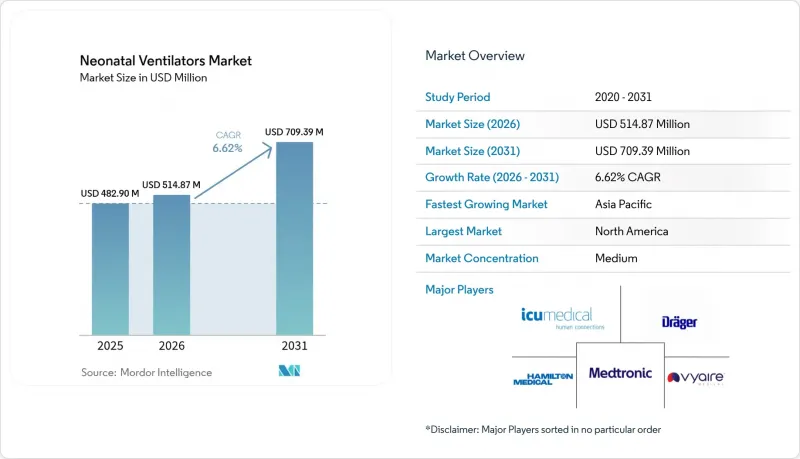
Mordor Intelligence에 의하면, 신생아용 인공호흡기 시장 규모는 2025년에 4억 8,290만 달러로 평가되었습니다. 2026년 5억 1,487만 달러에서 2031년까지 7억 939만 달러에 이를 것으로 예상되며, 예측 기간(2026-2031년) CAGR은 6.62%를 나타낼 전망입니다.
본 보고서는 제품별(침습적 인공호흡, 비침습적 인공호흡), 이동성별(중환자실용 인공호흡기, 휴대형/이송용 인공호흡기, 기타), 모드별(압력 제어, 용적 제어, 복합 모드, 기타),최종 사용자(병원, 외래수술센터(ASC), 기타), 지역(북미, 유럽, 아시아태평양, 중동 및 아프리카, 남미)별로 분류되어 있습니다. 시장 예측은 금액(미 달러) 기준으로 제시되어 있습니다.
세계의 신생아용 인공호흡기 시장 동향 및 인사이트
미숙아의 호흡곤란증후군(RDS) 유병률 증가
RDS는 극조산아의 80% 이상에서 발병하고 있으며, 취약한 폐 조직을 보호하면서 1회 환기량 2ml까지 공급 가능한 기기에 대한 구조적인 수요가 유지되고 있습니다. RDS 환자의 사망률은 6.0%인 반면, 비-RDS 영아의 경우 2.3%에 그치고 있어, 이로 인해 임상의들은 자발 호흡과 동기화된 지원을 제공하는 용적 보장 환기나 신경 조절식 호흡 보조와 같은 첨단 환기법으로 눈을 돌리고 있습니다. 조기 비침습적 전략이 질환의 진행을 억제한다는 근거에 기반하여, 침습적 모드와 비침습적 모드를 원활하게 전환할 수 있는 하이브리드 인공호흡기에 대한 조달 예산이 배정되고 있습니다. 이러한 경향은 극저재태주수의 신생아를 치료하는 병동에서 특히 두드러지게 나타납니다. 이 환자군에서는 생존율이 향상되고 있지만, RDS 발생률은 여전히 높은 수준을 유지하고 있습니다. 그 결과, 선진국 및 신흥 지역의 병원에서는 정밀한 압력 제어와 인공호흡기 유발성 폐손상을 경감시키는 알고리즘을 결합한 솔루션이 우선적으로 도입되고 있습니다.
전 세계적으로 증가하는 조산율
매년 약 1,500만 건의 조산이 발생하고 있어, 호흡 지원 시스템이 필요한 환자층이 확대되고 있습니다. 사하라 이남 아프리카에서는 출생 1,000명당 27명의 신생아 사망이 기록되고 있으며, 사망 원인의 대부분을 조산에 따른 합병증이 차지하고 있습니다. 한편, 선진국 시장에서는 고령 출산이 위험을 두 배로 증가시키는 요인으로 대두되고 있습니다. 중국의 CARE-Preterm 코호트 연구(60개 신생아 중환자실, 1만 명 이상의 영아 대상)에서는 10.74%의 사망률이 확인되었으며, 생존자 중에서는 기관지폐이형성증의 발생률이 높아지고 있는 것으로 밝혀졌습니다.
신생아용 인공호흡기의 고액 도입·유지 비용
최고급 신생아용 인공호흡기는 1대당 5만 달러를 초과하며, 연간 유지보수 계약 비용은 정가의 15-20%에 달하기도 하여, 제한된 자본 예산으로 운영되는 의료기관에 큰 부담이 되고 있습니다. 메디케어의 임대 지급 모델에서는 유지보수 비용이 월별 상환액에 포함되어 있지만, 복잡한 서류 작성 요건으로 인해 행정 부담이 증가하고 있습니다. 신흥 시장의 구매자들은 자금 조달 장벽이 더욱 높아지고 있습니다. 이는 기부자로부터의 보조금이 장비 조달보다 소모품이나 교육에 우선적으로 배정되는 경우가 많기 때문입니다. 공급망 혼란이 비용 리스크를 더욱 악화시키고 있습니다. 의료기기 제조업체의 보고에 따르면, 지정학적 혼란의 영향으로 2024년에는 물류비가 매출의 20%에 달했다고 합니다.
부문별 분석
2025년, 침습적 환기에 기인한 신생아용 인공호흡기 시장 규모는 2억 7,583만 달러로 여전히 시장 점유율의 57.12%를 차지하며 시장을 주도했습니다. 그러나 비침습적 부문은 연평균 성장률(CAGR) 7.02%로 급성장하고 있으며, 이는 임상의들이 폐 보호 전략을 중시하고 있으며 인공호흡기로 인한 폐 손상에 대한 인식이 높아지고 있음을 반영합니다. 침습적 모드와 비침습적 모드를 융합한 통합 플랫폼을 통해 기기를 교체하지 않고도 신속하게 모드를 전환할 수 있어 워크플로우의 효율성이 향상됩니다. 조기 CPAP를 뒷받침하는 증거에 따르면, 경증 RDS를 보이는 조산아의 40%에서 기관 삽관을 피할 수 있는 것으로 나타나, 이에 따라 하이브리드 기기의 대상 환자층이 확대되고 있습니다.
성장 전망은 중증 호흡기 질환에 대한 고주파 진동 환기(HFOV) 등 고급 모드를 지원할 수 있는 시스템에 유리하게 작용하고 있습니다. Vyaire Medical사의 3100A/B 시리즈는 산소 요법 기간 단축과 만성 폐질환 발병률 감소를 보여주고 있어, 침습적 환기의 임상적 필요성을 뒷받침하고 있습니다. 비침습적 인공호흡기의 주요 제조업체들은 정밀한 유량 제어, 소프트 씰 방식의 환자 인터페이스, 그리고 탈산소화 사건을 사전에 방지하는 AI 알고리즘에 대한 투자를 진행하고 있습니다. 지불 주체의 정책이 가치 기반 의료로 전환됨에 따라, 신생아용 인공호흡기 시장에서는 치료 성과와 보험 급여가 연동되게 되어, 임상적으로 적절한 경우 병원이 환자 관리 방식을 비침습적 치료로 전환할 유인이 생길 것입니다.
2025년, 중환자용 인공호흡기 시장 규모는 2억 9,447만 달러에 달하여 신생아용 인공호흡기 시장 전체의 60.98%를 차지했습니다. 이러한 시스템은 서보 제어 루프, 광범위한 모드 라이브러리, 그리고 NICU의 복잡한 증례에 적합한 다중 매개변수 모니터링 기능을 통합하고 있습니다. 2025년에 1억 2,130만 달러 시장 규모를 전망하는 휴대용 및 이송용 인공호흡기는 안전하고 수준 높은 응급 이송이 필요한 지역 밀착형 주산기 네트워크 덕분에 연평균 성장률(CAGR) 7.11%로 성장하고 있습니다. 설계상의 우선 순위에는 경량화, 배터리 수명 연장, 고주파 기기를 위한 ISO 80601-2-87 성능 기준 준수가 포함됩니다.
제품 로드맵에서는 교육 효율화를 위해 고정형과 이송형 모델 간의 사용자 인터페이스를 통일하는 데 중점을 두고 있습니다. 신생아용 인공호흡기 시장에는 신생아 수술 중 수술 중 지원 등 제한된 이용 사례를 대상으로 하는 특수한 탁상형 또는 카트 장착형 시스템으로 구성된 소규모의 기타 휴대용 부문도 포함됩니다. 판매 대수는 여전히 소폭에 그치고 있지만, 이 틈새 시장은 휴대성을 저해하지 않으면서도 고유한 임상적 과제를 해결할 수 있는 제조업체에게 높은 가격 책정 가능성을 내포하고 있습니다.
지역별 분석
북미는 2025년에 전 세계 매출의 41.02%를 차지했으며, 이는 고도로 발달된 NICU 네트워크, 견실한 보험 환급, 그리고 임상의들의 신뢰를 뒷받침하는 활발한 규제 환경에 힘입은 결과입니다. 지난 30년 동안 신생아과 의사가 227% 증가하고 NICU 병상 수도 48% 확대되었음에도 불구하고, 사망률 감소는 정체되어 있으며, 시장의 관심은 병상 수 증가보다 치료의 질 향상으로 이동하고 있습니다. 소프트웨어 관련 인공호흡기의 리콜 및 이에 따른 가동 중단은 공급망과 시판 후 감시의 중요성을 부각시키고 있습니다.
아시아태평양은 가장 빠르게 성장하는 지역으로, 각국 정부의 신생아 프로그램 확충, 다국적 기업의 현지 생산 확대, 그리고 장비 구매를 지원하는 기부자들의 노력에 힘입어 2031년까지 연평균 성장률(CAGR) 7.72%를 나타낼 것으로 예측됩니다. 중국은 조산아 생존율 지표를 개선한 다기관 공동 프로그램을 통해 지역 수요를 주도하고 있는 반면, 인도는 병원용 기술 시장 점유율 확대를 목표로 외국인 투자를 유치하고 있습니다.
유럽은 안정적이고 혁신 지향적인 시장입니다. 보편적 의료 보장(Universal Coverage)을 통해 의료기기 도입이 촉진되고, 규제 변경으로 인해 엄격한 임상 증거가 요구됨에 따라 질 높은 경쟁이 촉진되고 있습니다. 특허 출원 건수는 연구 개발에 대한 강력한 집중을 보여주고 있습니다. Philips(Philips)는 2024년에 594건의 의료 기술 관련 출원을 진행했으며, 17억 유로를 연구 개발에 투자하고 있으며, 그 대부분은 AI를 활용한 신생아 관리 솔루션에 할당되고 있습니다.
중동, 아프리카 및 남미는 신흥 개척 시장입니다. NEST360과 같은 프로젝트는 사하라 이남 아프리카 전역의 신생아 관리에 6,500만 달러를 투입하고 있으며, 임상 역량 향상에 따라 의료기기 수요 증가가 예상됩니다. 규제 조화와 인재 양성은 지속적인 보급을 위한 전제조건으로 남아 있지만, 기부자들의 지원과 영아 사망률 감축에 주력하는 각국 정부의 이니셔티브이 견고한 장기적 전망을 뒷받침하고 있습니다.
기타 혜택 :
- 엑셀 형식 시장 예측(ME) 시트
- 3개월간의 애널리스트 지원
자주 묻는 질문
목차
제1장 서론
제2장 조사 방법
제3장 개요
제4장 시장 구도
제5장 시장 규모 및 성장 예측
제6장 경쟁 구도
제7장 시장 기회 및 향후 전망
KTH 26.08.31According to Mordor Intelligence, the neonatal ventilators market size was valued at USD 482.90 million in 2025 and estimated to grow from USD 514.87 million in 2026 to reach USD 709.39 million by 2031, at a CAGR of 6.62% during the forecast period (2026-2031).
This report is Segmented by Product (Invasive Ventilation, Non-Invasive Ventilation), Mobility (Intensive-Care Ventilators, Portable/Transport Ventilators, Others), Mode (Pressure-Mode, Volume-Mode, Combined-Mode, Other Modes), End User (Hospitals, Ascs, Others), and Geography (North America, Europe, Asia-Pacific, MEA, South America). Market Forecasts are Provided in Terms of Value (USD).
Global Neonatal Ventilators Market Trends and Insights
Increasing Prevalence Of Respiratory Distress Syndrome In Pre-Term Infants
RDS affects more than 80% of extremely pre-term neonates, maintaining structural demand for devices capable of delivering tidal volumes down to 2 ml while safeguarding fragile lung tissue. Mortality stands at 6.0% in RDS cases compared with 2.3% among non-RDS infants, pushing clinicians toward advanced modalities such as volume-guarantee ventilation and neurally adjusted ventilatory assist that synchronize support with native breathing. Evidence links early non-invasive strategies to lower disease progression, directing procurement budgets toward hybrid ventilators able to toggle seamlessly between invasive and non-invasive modes. This emphasis is keenly felt in units treating extremely-low-gestational-age neonates, a cohort whose survival has improved while RDS incidence persists. As a result, hospitals in both developed and emerging regions prioritize solutions that combine precise pressure control with algorithms mitigating ventilator-induced lung injury.
Rising Pre-Term Birth Rate Globally
Roughly 15 million pre-term births occur each year, expanding the candidate pool for respiratory support systems . Sub-Saharan Africa records 27 neonatal deaths per 1,000 live births, with pre-term complications dominating mortality profiles, while developed markets confront later maternal age as a risk multiplier. China's CARE-Preterm cohort, spanning 60 NICUs and more than 10,000 infants, identified a 10.74% mortality rate accompanied by elevated bronchopulmonary dysplasia among survivors.
High Capital & Maintenance Cost Of Neonatal Ventilators
Top-tier neonatal ventilators exceed USD 50,000 per unit; annual service contracts can equal 15-20% of list price, straining facilities that operate on limited capital budgets. Medicare's rental-payment model aggregates maintenance into monthly reimbursements, but complex documentation requirements heighten administrative burden. Emerging-market purchasers face steeper financing hurdles because donor grants often prioritize consumables or training over equipment procurement. Supply chain shocks compound cost risks: medical-device manufacturers report that logistics expenses reached 20% of revenue in 2024 amid geopolitical disruptions.
Other drivers and restraints analyzed in the detailed report include:
- Technological Shift Toward Non-Invasive & Hybrid Ventilators
- AI-Driven Closed-Loop Ventilation Algorithms Gaining Clinical Validation
- Shortage Of Trained Neonatal-Intensive Respiratory Therapists
For complete list of drivers and restraints, kindly check the Table Of Contents.
Segment Analysis
The neonatal ventilators market size attributed to invasive ventilation remained dominant at USD 275.83 million in 2025, equal to 57.12% share. Yet the non-invasive category is accelerating at 7.02% CAGR, reflecting clinician emphasis on lung-protective strategies and heightened awareness of ventilation-induced lung injury. Integrated platforms blending invasive and non-invasive modes allow rapid modality shifts without exchanging equipment, enhancing workflow efficiency. Evidence supporting early CPAP shows that intubation can be avoided in 40% of pre-term infants presenting with mild RDS, extending the addressable pool for hybrid devices.
Growth prospects favor systems capable of advanced modalities such as high-frequency oscillatory ventilation (HFOV) for severe respiratory pathology. Vyaire Medical's 3100A/B series demonstrates shorter oxygen-therapy duration and lower chronic lung-disease rates, reinforcing invasive ventilation's clinical necessity. Non-invasive leaders invest in precision flow control, soft-seal patient interfaces, and AI algorithms that pre-empt desaturation events. As payer policies evolve toward value-based care, the neonatal ventilators market will see reimbursement linkage to outcomes, incentivizing hospitals to shift case mixes toward non-invasive care where clinically appropriate.
Hospital-stationary intensive-care ventilators commanded USD 294.47 million in 2025, equating to 60.98% share of the neonatal ventilators market. These systems integrate servo-control loops, broad mode libraries, and multi-parameter monitoring suited to complex NICU cases. Portable and transport ventilators, valued at USD 121.3 million in 2025, are advancing at 7.11% CAGR thanks to regionalized perinatal networks that require safe, high-acuity transfers. Design priorities include weight reduction, longer battery life, and compliance with ISO 80601-2-87 performance standards for high-frequency devices.
Product roadmaps emphasize shared user interfaces across stationary and transport models to streamline training. The neonatal ventilators market also contains a small "others" mobility segment comprising specialized tabletop or cart-mounted systems targeting narrow use cases, such as intra-operative support during neonatal surgery. While volume remains modest, this niche offers premium pricing potential for manufacturers able to address unique clinical challenges without sacrificing portability.
Complete Report Scope:
- By Product
- Invasive Ventilation
- Non-invasive Ventilation
- By Mobility
- Intensive-Care Ventilators
- Portable / Transport Ventilators
- Others
- By Mode
- Pressure-Mode Ventilation
- Volume-Mode Ventilation
- Combined-Mode Ventilation
- Other Modes
- By End User
- Hospitals
- Ambulatory Surgical Centers
- Other End Users
- By Geography
- North America
- United States
- Canada
- Mexico
- Europe
- Germany
- United Kingdom
- France
- Italy
- Spain
- Rest of Europe
- Asia-Pacific
- China
- Japan
- India
- Australia
- South Korea
- Rest of Asia-Pacific
- Middle East & Africa
- GCC
- South Africa
- Rest of Middle East & Africa
- South America
- Brazil
- Argentina
- Rest of South America
- North America
Geography Analysis
North America held 41.02% of global revenue in 2025, supported by sophisticated NICU networks, robust reimbursement, and an active regulatory environment that sustains clinician confidence. Despite a 227% rise in neonatologists and a 48% expansion in NICU beds over three decades, mortality reductions have plateaued, focusing market attention on care quality improvements rather than bed count growth. Software-related ventilator recalls-and associated downtime-underscore supply-chain and post-market-surveillance importance.
Asia-Pacific is the fastest-growing region, expected to post an 7.72% CAGR through 2031 as governments expand neonatal programs, multinational companies localize manufacturing, and donor initiatives fund equipment purchases. China spearheads regional demand with multicenter programs that have improved pre-term survival metrics, while India attracts foreign investment targeting hospital-technology market share gains.
Europe presents a stable, innovation-oriented market. Universal coverage eases device adoption, and regulatory changes demand rigorous clinical evidence, promoting high-quality competition. Patent filings highlight intense R&D focus: Philips submitted 594 medical-technology applications in 2024 and invested EUR 1.7 billion in research, much directed to AI-powered neonatal care solutions.
Middle East & Africa and South America represent emerging frontiers. Projects like NEST360 channel USD 65 million into neonatal care across Sub-Saharan Africa, promising to lift equipment demand as clinical capacity builds. Regulatory harmonization and workforce development remain prerequisites for sustained uptake, but donor backing and government focus on infant-mortality reduction underpin a solid long-range outlook.
- Air Liquide
- Allied Healthcare Products
- Atom Medical
- Becton Dickinson & Co.
- Dragerwerk
- Fisher & Paykel Healthcare
- Fosun Pharma
- GE Healthcare
- Getinge
- Hamilton Medical
- ICU Medical
- Koninklijke Philips
- Medtronic
- Mindray Bio-Medical Electronics
- Nihon Kohden
- Resmed
- Siare Engineering
- Smiths Group
- Schiller
- Vyaire Medical
Additional Benefits:
- The market estimate (ME) sheet in Excel format
- 3 months of analyst support
TABLE OF CONTENTS
1 Introduction
- 1.1 Study Assumptions & Market Definition
- 1.2 Scope of the Study
2 Research Methodology
3 Executive Summary
4 Market Landscape
- 4.1 Market Overview
- 4.2 Market Drivers
- 4.2.1 Increasing Prevalence Of Respiratory Distress Syndrome In Pre-Term Infants
- 4.2.2 Rising Pre-Term Birth Rate Globally
- 4.2.3 Technological Shift Toward Non-Invasive & Hybrid Ventilators
- 4.2.4 Hospital Upgrades In Nicus Across Emerging Economies
- 4.2.5 Ai-Driven Closed-Loop Ventilation Algorithms Gaining Clinical Validation
- 4.2.6 Donor-Funded Nicu Expansion In Sub-Saharan Africa
- 4.3 Market Restraints
- 4.3.1 High Capital & Maintenance Cost Of Neonatal Ventilators
- 4.3.2 Reimbursement Gaps For Nicu Respiratory Care In Low-Income Markets
- 4.3.3 Shortage Of Trained Neonatal-Intensive Respiratory Therapists
- 4.3.4 Fragile Supply Chain For Critical Sensors & Valves
- 4.4 Value / Supply-Chain Analysis
- 4.5 Regulatory Landscape
- 4.6 Technological Outlook
- 4.7 Porter's Five Forces
- 4.7.1 Threat of New Entrants
- 4.7.2 Bargaining Power of Buyers
- 4.7.3 Bargaining Power of Suppliers
- 4.7.4 Threat of Substitutes
- 4.7.5 Intensity of Competitive Rivalry
5 Market Size & Growth Forecasts (Value - USD million)
- 5.1 By Product
- 5.1.1 Invasive Ventilation
- 5.1.2 Non-invasive Ventilation
- 5.2 By Mobility
- 5.2.1 Intensive-Care Ventilators
- 5.2.2 Portable / Transport Ventilators
- 5.2.3 Others
- 5.3 By Mode
- 5.3.1 Pressure-Mode Ventilation
- 5.3.2 Volume-Mode Ventilation
- 5.3.3 Combined-Mode Ventilation
- 5.3.4 Other Modes
- 5.4 By End User
- 5.4.1 Hospitals
- 5.4.2 Ambulatory Surgical Centers
- 5.4.3 Other End Users
- 5.5 By Geography
- 5.5.1 North America
- 5.5.1.1 United States
- 5.5.1.2 Canada
- 5.5.1.3 Mexico
- 5.5.2 Europe
- 5.5.2.1 Germany
- 5.5.2.2 United Kingdom
- 5.5.2.3 France
- 5.5.2.4 Italy
- 5.5.2.5 Spain
- 5.5.2.6 Rest of Europe
- 5.5.3 Asia-Pacific
- 5.5.3.1 China
- 5.5.3.2 Japan
- 5.5.3.3 India
- 5.5.3.4 Australia
- 5.5.3.5 South Korea
- 5.5.3.6 Rest of Asia-Pacific
- 5.5.4 Middle East & Africa
- 5.5.4.1 GCC
- 5.5.4.2 South Africa
- 5.5.4.3 Rest of Middle East & Africa
- 5.5.5 South America
- 5.5.5.1 Brazil
- 5.5.5.2 Argentina
- 5.5.5.3 Rest of South America
- 5.5.1 North America
6 Competitive Landscape
- 6.1 Market Concentration
- 6.2 Market Share Analysis
- 6.3 Company Profiles (includes Global level Overview, Market level overview, Core Segments, Financials as available, Strategic Information, Market Rank/Share for key companies, Products & Services, and Recent Developments)
- 6.3.1 Air Liquide Medical Systems
- 6.3.2 Allied Healthcare Products
- 6.3.3 Atom Medical
- 6.3.4 Becton Dickinson & Co.
- 6.3.5 Dragerwerk AG & Co. KGaA
- 6.3.6 Fisher & Paykel Healthcare
- 6.3.7 Fosun Pharma
- 6.3.8 General Electric Company
- 6.3.9 Getinge AB
- 6.3.10 Hamilton Medical
- 6.3.11 ICU Medical
- 6.3.12 Koninklijke Philips NV
- 6.3.13 Medtronic
- 6.3.14 Mindray Bio-Medical Electronics
- 6.3.15 Nihon Kohden Corporation
- 6.3.16 ResMed
- 6.3.17 Siare Engineering
- 6.3.18 Smiths Medical
- 6.3.19 Schiller AG
- 6.3.20 Vyaire Medical
7 Market Opportunities & Future Outlook
- 7.1 White-space & Unmet-Need Assessment