|
시장보고서
상품코드
2114624
칼슘 채널 차단제 : 시장 점유율 분석, 업계 동향 및 통계, 성장 예측(2026-2031년)Calcium Channel Blocker - Market Share Analysis, Industry Trends & Statistics, Growth Forecasts (2026 - 2031) |
||||||
 Mordor Intelligence
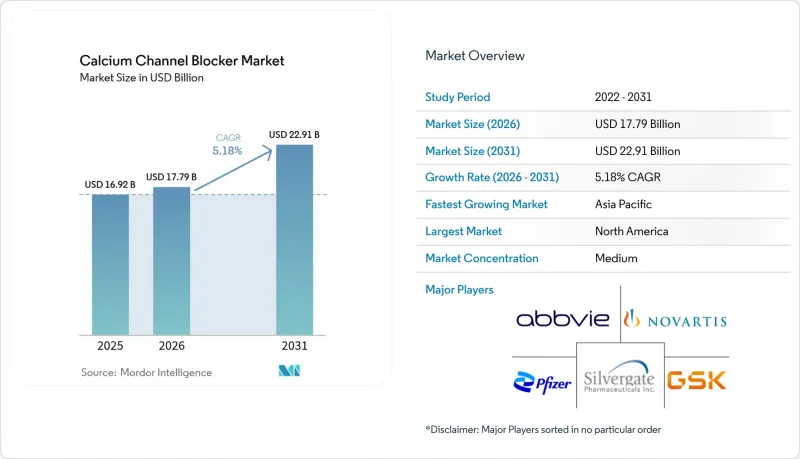
Mordor Intelligence에 의하면, 2026년 칼슘 채널 차단제 시장 규모는 177억 9,000만 달러로 추정되고 2025년 169억 2,000만 달러에서 확대해, 2031년에는 229억 1,000만 달러에 이를 것으로 예측됩니다.
2026년부터 2031년까지의 연평균 성장률(CAGR)은 5.18%를 나타낼 전망입니다.
본 보고서는 약물 분류(디하이드로피리딘계, 비디하이드로피리딘계), 적응증(고혈압 등), 제형(즉방성 등), 유통 채널(병원 약국, 소매 약국, 기타),및 지역(북미, 유럽, 아시아태평양, 중동 및 아프리카, 남미)별로 분류되어 있습니다. 시장 예측은 금액(달러) 기준으로 제시되어 있습니다.
세계의 칼슘 채널 차단제 시장 동향 및 인사이트
장기적인 혈압 강하 요법이 필요한 고령 인구 증가
65세 이상 성인의 비율은 2024년 전 세계적으로 11%를 나타냈으며, 특히 일본과 남유럽에서 가장 빠르게 증가했습니다. 55세 이후 뇌졸중 위험은 10년마다 2배로 증가하며, 칼슘 채널 차단제는 신장 기능을 손상시키지 않으면서 지속적인 보호 효과를 발휘합니다. 고혈압을 앓는 고령자 71만 4,000명을 2.5년 동안 추적 조사한 임상 연구에 따르면, 암로디핀의 지속적인 투여가 비투여군에 비해 치매 발병률 감소와 관련이 있는 것으로 나타났습니다. 이러한 심혈관계와 인지 기능 양면에서의 시너지 효과로 인해, 노인내과 의사들은 복잡한 다제 병용 요법에서 1일 1회 투여하는 디하이드로피리딘계 약물을 우선적으로 선택하게 되었으며, 이는 칼슘 채널 차단제 시장의 성장 궤도를 더욱 공고히 하고 있습니다.
저렴한 가격의 제네릭 의약품 접근성 향상
암로디핀은 몇년전 대부분의 지역에서 독점권을 상실했으며, 이로 인해 치료비가 최대 70% 절감되어 저소득층 환자의 접근성이 확대되었습니다. 현재 인도와 중국이 전 세계 원료의약품(API) 생산량의 대부분을 차지하고 있지만, 2025년의 운송 차질로 인해 공장 인도 가격이 일시적으로 두 자릿수 상승을 보였습니다. 때때로 가격 변동이 있기는 하지만, 치료 동등성 시험을 통해 제네릭 암로디핀이 동등한 혈압 조절 효과를 발휘한다는 것이 확인되었으며, 이는 임상의들의 불안을 해소하고 높은 대체율을 뒷받침하고 있습니다. 제네릭으로 인한 이익률 압박을 받는 가운데, 오리지널 제약사들은 복합제 출시나 서방형 제제로의 재조제와 같은 라이프사이클 전략을 통해 시장 점유율 유지를 도모하고 있습니다.
니트로소아민 불순물에 대한 규제 당국의 엄격한 감시
미국 FDA의 2024년 지침에서는 모든 제조업체에 대해 잠재적인 니트로소아민 생성 경로의 특정, 규격 한계의 엄격화, 그리고 배치 출하 전 저감 조치의 검증을 요구하고 있습니다. 현재 유럽 및 일본에서도 유사한 요건이 적용되고 있습니다. 이러한 규정 준수 대응으로 인해 기업들은 분석 기법의 업그레이드, 첨가제 공급업체 심사, 그리고 구형 시설의 개조를 강요받고 있으며, 이는 제품 원가 상승으로 이어지고 있습니다. 조사 기간 중 자발적인 생산 중단으로 인해 일시적으로 공급이 제한되고 있지만, 시정 조치가 규제 당국의 요건을 충족하면 대부분의 기업은 결국 생산을 재개할 것입니다. 이러한 추가적인 부담으로 인해 단기적인 수익성은 저하되겠지만, 칼슘 채널 차단제 시장의 장기적인 성장 궤도가 훼손될 가능성은 낮을 것으로 보입니다.
부문별 분석
2025년에는 디하이드로피리딘계 약물이 매출의 61.78%를 차지했습니다. 이는 암로디핀, 실니디핀, 페로디핀 등의 약물에 대해 처방 의사의 익숙함과 1일 1회 투여의 편의성이 반영된 결과입니다. 이 계열의 칼슘 채널 차단제 시장 규모는 보험사가 제네릭 의약품에 대한 접근성을 확대하고, 의사가 전도 장애를 피하기 위해 혈관 선택성을 활용함에 따라 2031년까지 한 자릿수 중반의 성장률을 달성할 것으로 예측됩니다. 아시아태평양에서는 가이드라인 위원회가 모든 연령대의 환자에게 암로디핀을 1차 선택 약물로 권장하는 경우가 많기 때문에 특히 높은 보급률을 유지하고 있습니다.
베라파밀과 질티아제로 구성된 비디하이드로피리딘계 약물은 연평균 성장률(CAGR) 7.12%를 기록하며, 칼슘 채널 차단제 시장 전체를 상회하는 성장이 예상됩니다. 이러한 약물은 혈관 및 결절에 대한 이중 작용을 하기 때문에 심방 빈맥, 수술 후 심박수 관리 및 동반된 협심증 치료에 유용합니다. 또한, 만성 신장 질환에서 교감 신경의 과도한 활성화를 억제할 가능성이 있는 실니디핀과 같은 N형 및 L형 이중 억제제에 대한 연구도 시장 성장에 기여하고 있습니다. 따라서 혁신은 기존의 디하이드로피리딘계 약물의 우위를 훼손하지 않으면서 시장의 다각화를 뒷받침하고 있습니다.
고혈압은 2025년 처방 건수의 70.65%를 차지하며, 북미, 유럽 및 아시아 대부분 지역에서 1차 선택 약제로서의 지위를 유지했습니다. L형 차단제가 베타 차단제보다 뇌졸중 위험을 대폭 감소시킨다는 증거에 힘입어, 1차 진료 의사들 사이에서 신뢰가 유지되고 있습니다. 처방량 기준으로는 치료 관성 및 2제 병용 요법을 권장하는 지침의 업데이트에도 불구하고, 고혈압에 대한 칼슘 채널 차단제 시장 규모는 저-중 1자리 수의 성장 궤도를 유지할 것으로 전망됩니다.
신경 질환 분야는 2031년까지 연평균 성장률(CAGR) 7.86%로 확대될 전망이며, 이는 모든 이용 사례 중 가장 높은 수치입니다. 실세계 데이터에 기반한 분석에 따르면, 장기 투여로 파킨슨병 발병률이 20% 감소하는 것으로 나타났으며, 군발성 두통에 대한 베라파밀과 신경성 고혈압에 대한 실니디핀의 유효성을 평가하는 무작위 임상시험이 진행되고 있습니다. 따라서 규모는 작지만 점차 확대되고 있는 적응증 외 사용 수요는 칼슘 채널 차단제 시장에서 추가적인 다각화의 길을 열어주고 있습니다.
지역별 분석
북미는 높은 보험 적용률과 새로운 폴리필의 급속한 보급을 배경으로, 2025년에도 전 세계 매출의 39.12%를 차지했습니다. 처방 감사에 따르면, JNC 8 위원회가 이 약물군을 1차 치료법으로 권장한 후, 2018년부터 2019년에 걸쳐 흑인 환자에서의 칼슘 채널 차단제 사용률이 이전 연도에 비해 41% 급증했습니다. 제네릭 의약품의 보급 확대가 가격 하락을 상쇄하는 한편, 주 1회 부착형 패치와 같은 브랜드 제품의 확장은 복약 순응도에 어려움을 겪는 틈새 환자층을 끌어들이고 있습니다. 지속적인 의학 교육을 통해 이 약물군에 대한 인지도가 높아지면서, 칼슘 채널 차단제 시장을 단기적인 경쟁으로부터 보호하고 있습니다.
유럽은 2위를 차지했으며, 비용 절감과 적극적인 안전성 감시가 특징입니다. 2025년 초에 발생한 암로디핀 정제의 클래스 2 리콜은 이 지역에서 미생물학적 품질 관리에 대한 경각심이 높음을 여실히 보여주었습니다. NICE와 같은 의료 기술 평가 기관은 일반적으로 저가의 제네릭 의약품을 우선시하지만, 경제 모델을 통해 심혈관 사건의 감소가 입증된 경우에는 브랜드 의약품의 복합제에 대해서도 보험 적용을 하고 있습니다. 만성 항문열상 치료용 니페디핀·리도카인 연고의 등장은 심장 이외의 새로운 적응증을 추가하여 지역 수요를 다각화하고 있습니다.
아시아태평양은 연평균 성장률(CAGR) 6.18%를 기록하며 여전히 가장 빠르게 성장하는 지역입니다. 역학적 전환과 공적 보험 확대라는 두 가지 요인이 맞물려 연간 처방량을 끌어올리고 있습니다. 중국과 인도의 현지 기업들은 경쟁력 있는 가격의 원료의약품(API)과 제제를 공급하여 합리적인 가격을 확보하고 있습니다. 12개국을 대상으로 한 관찰 연구에 따르면, 칼슘 채널 차단제가 가장 빈번하게 처방되는 항고혈압제 계열임이 확인되었으나, 지역 내에서는 여전히 편차가 존재합니다. 정부의 일괄 구매 제도는 환자 대상 보급 범위를 지속적으로 확대하고 있으며, 칼슘 채널 차단제 시장에 구조적인 성장을 가져오고 있습니다.
그 밖의 지역에서는 라틴아메리카와 중동 및 아프리카에서 도시화가 진행됨에 따라 심혈관 질환의 위험이 높아지는 가운데, 꾸준한 수요 증가가 나타나고 있습니다. 외딴 지역의 진료소에 필수적인 고혈압 치료제를 공급하는 국제 지원 프로그램은 여전히 소규모인 시장 기반을 확대하며, 판매량 증가에 기여하고 있습니다.
기타 혜택 :
- 엑셀 형식 시장 예측(ME) 시트
- 3개월간의 애널리스트 지원
자주 묻는 질문
목차
제1장 서론
제2장 조사 방법
제3장 개요
제4장 시장 구도
제5장 시장 규모 및 성장 예측
제6장 경쟁 구도
제7장 시장 기회 및 향후 전망
KTH 26.08.31According to Mordor Intelligence, calcium channel blocker market size in 2026 is estimated at USD 17.79 billion, growing from 2025 value of USD 16.92 billion with 2031 projections showing USD 22.91 billion, growing at 5.18% CAGR over 2026-2031.
This report is Segmented by Drug Class (Dihydropyridines and Non-Dihydropyridines), Indication (Hypertension, and More), Formulation (Immediate-Release, and More), Distribution Channel (Hospital Pharmacies, Retail Pharmacies, Other Distribution Channels), and Geography (North America, Europe, Asia-Pacific, Middle East & Africa, South America). The Market Forecasts are Provided in Terms of Value (USD).
Global Calcium Channel Blocker Market Trends and Insights
Growing Geriatric Population Demanding Long-Term Antihypertensive Therapy
The proportion of adults aged >= 65 years rose to 11% globally in 2024 and is climbing fastest in Japan and Southern Europe. Stroke risk doubles every decade after 55, and calcium channel blockers demonstrate durable protection without compromising renal function. A real-world study that followed 714,000 hypertensive seniors for 2.5 years linked continuous amlodipine therapy to lower dementia incidence relative to non-users. These overlapping cardiovascular and cognitive benefits encourage geriatricians to prioritize once-daily dihydropyridines in complex polypharmacy regimens, strengthening the growth trajectory of the calcium channel blocker market.
Increasing Availability of Affordable Generic Formulations
Amlodipine lost exclusivity in most territories years ago, shaving up to 70% off treatment costs and widening access among low-income patients. India and China now account for a majority of global API output, yet freight disruptions in 2025 briefly pushed ex-works prices up by double digits. Despite episodic volatility, therapeutic equivalence studies confirm that generic amlodipine delivers identical blood-pressure control, reassuring clinicians and supporting high substitution rates. Margin pressure from generics prompts originators to defend share through lifecycle strategies such as polypill launches and controlled-release reformulations.
Stringent Regulatory Scrutiny Over Nitrosamine Impurities
The US FDA's 2024 guidance requires every manufacturer to map potential nitrosamine formation pathways, tighten specification limits, and validate mitigation steps before batch release. Similar expectations now apply across Europe and Japan. Compliance forces companies to upgrade analytical methods, vet excipient suppliers, and retrofit older facilities, elevating cost of goods. Voluntary suspensions during investigation phases have temporarily restricted supply, although most firms ultimately resume production once corrective actions satisfy regulators. The extra burden trims near-term profitability but is unlikely to derail the long-term trajectory of the calcium channel blocker market.
Other drivers and restraints analyzed in the detailed report include:
- Expanding Use of Fixed-Dose Combination Therapies to Improve Compliance
- Emerging Clinical Evidence Supporting Neuroprotective Applications
- Supply Chain Vulnerabilities in Active Pharmaceutical Ingredient Sourcing
For complete list of drivers and restraints, kindly check the Table Of Contents.
Segment Analysis
Dihydropyridines held 61.78% of revenue in 2025, reflecting prescriber familiarity and once-daily convenience for drugs such as amlodipine, cilnidipine, and felodipine. The calcium channel blocker market size for this class is forecast to achieve mid-single-digit growth through 2031 as payers widen access to generics and physicians exploit vascular selectivity to avoid conduction disturbances. Uptake remains particularly strong in Asia-Pacific, where guideline committees often recommend amlodipine as the preferred starter drug for patients of any age group.
Non-dihydropyridines, comprising verapamil and diltiazem, are projected to post a 7.12% CAGR, outpacing the broader calcium channel blocker market. Their dual vascular and nodal activity makes them attractive in atrial tachyarrhythmias, postoperative rate control, and concomitant angina. Growth also benefits from research into N- and L-type dual inhibitors like cilnidipine that may reduce sympathetic overdrive in chronic kidney disease. Innovation therefore supports diversification without undermining the primacy of traditional dihydropyridines.
Hypertension accounted for 70.65% of 2025 prescriptions, preserving first-line status across North America, Europe, and most of Asia. Evidence that L-type blockade cuts stroke risk more than beta-blockade sustains confidence among primary-care physicians. In volume terms, the calcium channel blocker market size for hypertension should maintain a low-mid single-digit trajectory despite therapeutic inertia and guideline updates that encourage starting two agents at once.
Neurological disorders are on track to expand at an 7.86% CAGR to 2031, the highest among all use cases. Real-world analyses link chronic exposure to a 20% lower Parkinson's disease incidence, and randomised trials are evaluating verapamil for cluster headache and cilnidipine for neurogenic hypertension. Small but growing off-label demand therefore provides an incremental avenue of diversification within the calcium channel blocker market.
Complete Report Scope:
- By Drug Class
- Dihydropyridines
- Amlodipine
- Nifedipine
- Felodipine & Others
- Non-Dihydropyridines
- Phenylalkylamine (Verapamil)
- Benzothiazepine (Diltiazem)
- Dihydropyridines
- By Indication
- Hypertension
- Angina Pectoris
- Arrhythmia
- Raynaud's Phenomenon
- Neurological Disorders (Migraine, SAH)
- Other Indications
- By Formulation
- Immediate-Release
- Extended / Controlled-Release
- Fixed-Dose Combinations
- By Distribution Channel
- Hospital Pharmacies
- Retail Pharmacies
- Other Distribution Channels
- Geography
- North America
- United States
- Canada
- Mexico
- Europe
- Germany
- United Kingdom
- France
- Italy
- Spain
- Rest of Europe
- Asia-Pacific
- China
- Japan
- India
- Australia
- South Korea
- Rest of Asia-Pacific
- Middle East & Africa
- GCC
- South Africa
- Rest of Middle East & Africa
- South America
- Brazil
- Argentina
- Rest of South America
- North America
Geography Analysis
North America retained 39.12% of global turnover in 2025 on the back of high insurance coverage and rapid adoption of novel polypills. Prescription audits show that calcium channel blocker use among Black patients jumped 41% between 2018-2019 compared with earlier years after the JNC 8 committee advocated the class as first-line therapy. Generic intensification offsets price erosion, while brand extensions like once-weekly patches attract niche cohorts with adherence challenges. Continuous medical education reinforces class familiarity, cushioning the calcium channel blocker market from short-term competition.
Europe ranked second, characterized by cost-containment and proactive safety surveillance. Class 2 recalls for amlodipine tablets in early 2025 underscored the region's vigilance in microbial quality management. Health technology appraisal agencies such as NICE routinely favour low-priced generics but still reimburse branded combinations when economic models demonstrate fewer cardiovascular events. The advent of nifedipine-lidocaine ointment for chronic anal fissure adds a novel non-cardiac dimension, diversifying regional demand.
Asia-Pacific remains the fastest-growing territory at 6.18% CAGR. The twin forces of epidemiological transition and public insurance expansion elevate annual prescription volumes. Local firms in China and India supply competitively priced APIs and finished doses, ensuring affordability. Observational studies across 12 countries confirm that calcium channel blockers constitute the most frequently prescribed antihypertensive class, although intra-regional heterogeneity persists. Government bulk-purchase schemes continue to widen patient reach, supplying structural growth to the calcium channel blocker market.
Elsewhere, Latin America and the Middle East & Africa record steady uptake as urbanization increases cardiovascular risk. International donor programs that supply essential antihypertensive drugs to remote clinics enlarge the still-small baseline, contributing additional incremental units.
- Abbvie
- Alvogen
- Arbor Pharmaceuticals
- Bausch Health
- Covis Pharma
- Exela Pharma Sciences
- GlaxoSmithKline
- Lupin
- Novartis
- Pfizer
- Sanofi
- Silvergate Pharmaceuticals
- Teva Pharmaceutical Industries
- Viatris
- Sun Pharma Industries Ltd.
- Aurobindo Pharma Ltd.
- Cipla
- Hikma Pharmaceuticals
- Zydus Lifesciences Ltd.
- Daiichi Sankyo Co. Ltd.
Additional Benefits:
- The market estimate (ME) sheet in Excel format
- 3 months of analyst support
TABLE OF CONTENTS
1 Introduction
- 1.1 Study Assumptions & Market Definition
- 1.2 Scope Of The Study
2 Research Methodology
3 Executive Summary
4 Market Landscape
- 4.1 Market Overview
- 4.2 Market Drivers
- 4.2.1 Rising Prevalence of Hypertension and Cardiovascular Disorders
- 4.2.2 Growing Geriatric Population Demanding Long-Term Antihypertensive Therapy
- 4.2.3 Increasing Availability of Affordable Generic Formulations
- 4.2.4 Expanding Use of Fixed-Dose Combination Therapies to Improve Compliance
- 4.2.5 Emerging Clinical Evidence Supporting Neuroprotective Applications
- 4.2.6 Government Initiatives for Universal Health Coverage in Emerging Markets
- 4.3 Market Restraints
- 4.3.1 Stringent Regulatory Scrutiny over Nitrosamine Impurities
- 4.3.2 Adverse Effect Profile Leading to Therapy Switches
- 4.3.3 Supply Chain Vulnerabilities in Active Pharmaceutical Ingredient Sourcing
- 4.3.4 Competitive Pressure from Novel Cardiovascular Drug Classes
- 4.4 Regulatory Landscape
- 4.5 Technological Outlook
- 4.6 Porter's Five Forces
- 4.6.1 Threat Of New Entrants
- 4.6.2 Bargaining Power Of Buyers
- 4.6.3 Bargaining Power Of Suppliers
- 4.6.4 Threat Of Substitutes
- 4.6.5 Competitive Rivalry
5 Market Size & Growth Forecasts (Value, USD)
- 5.1 By Drug Class
- 5.1.1 Dihydropyridines
- 5.1.1.1 Amlodipine
- 5.1.1.2 Nifedipine
- 5.1.1.3 Felodipine & Others
- 5.1.2 Non-Dihydropyridines
- 5.1.2.1 Phenylalkylamine (Verapamil)
- 5.1.2.2 Benzothiazepine (Diltiazem)
- 5.1.1 Dihydropyridines
- 5.2 By Indication
- 5.2.1 Hypertension
- 5.2.2 Angina Pectoris
- 5.2.3 Arrhythmia
- 5.2.4 Raynaud's Phenomenon
- 5.2.5 Neurological Disorders (Migraine, SAH)
- 5.2.6 Other Indications
- 5.3 By Formulation
- 5.3.1 Immediate-Release
- 5.3.2 Extended / Controlled-Release
- 5.3.3 Fixed-Dose Combinations
- 5.4 By Distribution Channel
- 5.4.1 Hospital Pharmacies
- 5.4.2 Retail Pharmacies
- 5.4.3 Other Distribution Channels
- 5.5 Geography
- 5.5.1 North America
- 5.5.1.1 United States
- 5.5.1.2 Canada
- 5.5.1.3 Mexico
- 5.5.2 Europe
- 5.5.2.1 Germany
- 5.5.2.2 United Kingdom
- 5.5.2.3 France
- 5.5.2.4 Italy
- 5.5.2.5 Spain
- 5.5.2.6 Rest of Europe
- 5.5.3 Asia-Pacific
- 5.5.3.1 China
- 5.5.3.2 Japan
- 5.5.3.3 India
- 5.5.3.4 Australia
- 5.5.3.5 South Korea
- 5.5.3.6 Rest of Asia-Pacific
- 5.5.4 Middle East & Africa
- 5.5.4.1 GCC
- 5.5.4.2 South Africa
- 5.5.4.3 Rest of Middle East & Africa
- 5.5.5 South America
- 5.5.5.1 Brazil
- 5.5.5.2 Argentina
- 5.5.5.3 Rest of South America
- 5.5.1 North America
6 Competitive Landscape
- 6.1 Market Concentration
- 6.2 Market Share Analysis
- 6.3 Company Profiles (Includes Global Level Overview, Market Level Overview, Core Segments, Financials As Available, Strategic Information, Market Rank/Share For Key Companies, Products & Services, And Recent Developments)
- 6.3.1 AbbVie Inc.
- 6.3.2 Alvogen
- 6.3.3 Arbor Pharmaceuticals LLC
- 6.3.4 Bausch Health Companies Inc.
- 6.3.5 Covis Pharma BV
- 6.3.6 Exela Pharma Sciences LLC
- 6.3.7 GlaxoSmithKline plc
- 6.3.8 Lupin Pharmaceuticals Inc.
- 6.3.9 Novartis AG
- 6.3.10 Pfizer Inc.
- 6.3.11 Sanofi SA
- 6.3.12 Silvergate Pharmaceuticals Inc.
- 6.3.13 Teva Pharmaceutical Industries Ltd.
- 6.3.14 Viatris Inc.
- 6.3.15 Sun Pharma Industries Ltd.
- 6.3.16 Aurobindo Pharma Ltd.
- 6.3.17 Cipla Ltd.
- 6.3.18 Hikma Pharmaceuticals plc
- 6.3.19 Zydus Lifesciences Ltd.
- 6.3.20 Daiichi Sankyo Co. Ltd.
7 Market Opportunities & Future Outlook
- 7.1 White-Space & Unmet-Need Assessment