|
시장보고서
상품코드
2114625
재택 주입 : 시장 점유율 분석, 업계 동향 및 통계, 성장 예측(2026-2031년)Home Infusion - Market Share Analysis, Industry Trends & Statistics, Growth Forecasts (2026 - 2031) |
||||||
 Mordor Intelligence
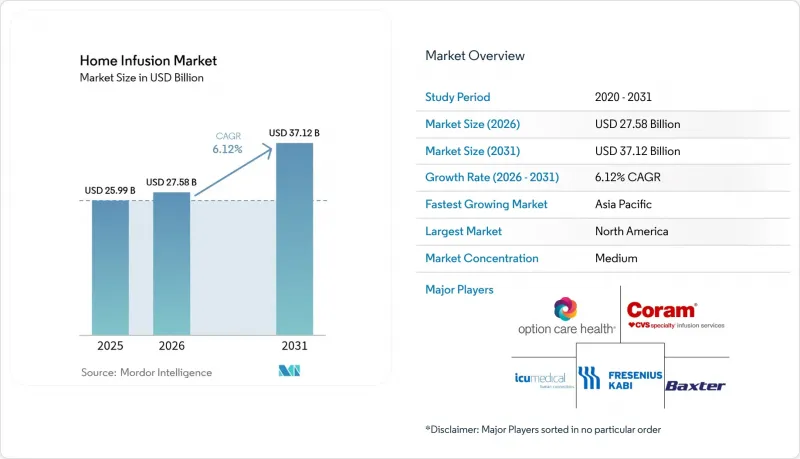
Mordor Intelligence에 의하면, 2026년 재택 주입 시장 규모는 275억 8,000만 달러로 추정되고 2025년 259억 9,000만 달러에서 확대해, 2031년에는 371억 2,000만 달러에 이를 것으로 예측됩니다.
2026년부터 2031년까지 연평균 성장률(CAGR) 6.12%로 성장할 것으로 전망됩니다.
본 보고서는 제품별(주입 펌프(대용량, 주사기 등), 액세서리 등), 용도별(감염증 치료, 비경구 영양(TPN) 등), 최종 사용자별(재택치료, 병원 외래 진료부 등), 지역별(북미, 유럽, 아시아태평양 등)로 분류되어 있습니다. 시장 규모 및 전망은 금액(달러) 기준으로 제시되어 있습니다.
세계의 재택 주입 시장 동향 및 인사이트
고령화와 만성 질환의 부담
고령화는 의료 서비스 제공의 우선순위를 재편하고 있으며, 유엔의 예측에 따르면 2050년까지 전 세계 65세 이상 인구는 16억 명에 달할 것으로 예측됩니다. 이 고령 인구의 3분의 2는 아시아에 거주하게 될 것이며, 병원 밖에서 투여 가능한 만성 질환 치료법에 대한 수요가 증가하고 있습니다. 유럽에서는 2022년에 암 신규 환자 수가 320만 명에 달했으며, 2023년에는 치료비가 2배인 1,460억 유로로 증가했습니다. 이러한 임상적 부담으로 인해 면역 요법, 비경구 영양 공급, 장기 항생제 투여를 지원하는 휴대용 및 엘라스토머 펌프의 채택이 지속적으로 확대되고 있습니다. 이해관계자들은 정확한 재택 투여를 병원 병상 부족 및 예산 압박에 대한 해결책으로 간주하고 있으며, 이로 인해 재택 주입 시장의 성장 전망은 확고해지고 있습니다.
병원 비용 절감을 위한 재택 간호 확산
재택 서비스 제공은 시설 운영 비용을 절감하고, 입원 기간을 단축하며, 환자 만족도를 향상시키기 때문에 보험사로부터 높은 평가를 받고 있습니다. 2025년 재택치료 관련 개정으로 재택치료 기관에 대한 메디케어 환급액이 2.7% 인상됨에 따라, 수액 서비스를 병원에서 재택으로 전환하는 것의 경제적 이점이 더욱 강화되었습니다. 코로나19는 이러한 전환을 가속화했으며, 2023년에는 전문 수액 치료 지출이 38% 증가했습니다. 이러한 추세는 고가의 세포 및 유전자 치료가 상업화 단계에 접어들면서 앞으로도 지속될 것으로 예측됩니다. 사모펀드의 투자도 이러한 인센티브를 반영하고 있으며, Court Square Capital Partners의 Soleo Health에 대한 투자는 확장성이 뛰어난 재택 주입 플랫폼에 대한 재정적 신뢰를 뒷받침하고 있습니다. 의료 시스템이 진료 제공 장소의 구성을 합리화하는 가운데, 더 낮은 총비용으로 동등한 치료 성과를 입증할 수 있는 정맥주사 서비스 제공업체들은 우선 네트워크로서의 지위를 확보하고 있습니다.
주입 펌프의 높은 도입 및 유지 비용
첨단 펌프는 기계적 정밀도와 복잡한 소프트웨어를 결합하고 있어, 초기 투자 수요와 지속적인 서비스 요금을 상승시키고 있습니다. 소규모 사업자들은 최신 스마트 모델 도입 자금을 마련하는 데 어려움을 겪고 있으며, 프레스콧(Prescott)과 같은 제3자 엔지니어링 기업과의 제휴가 확대되고 있습니다. Morgan Stanley Capital Partners는 각 제공 거점의 장비 가동 시간을 향상시키기 위해 Prescott을 인수했습니다. 사이버 보안 패치 및 펌웨어 검증에 관한 규제 요건은 지속적인 비용을 추가하게 되며, 이를 쉽게 감당할 수 있는 것은 대규모 기업뿐입니다. 그 결과, 비용 측면의 장벽이 기술의 보급과 신흥 시장에서의 장비 교체 속도를 둔화시키고 있으며, 성숙한 지역에서는 업계 재편의 압력을 강화하고 있습니다.
부문별 분석
주입 펌프는 2025년 매출의 49.60%를 차지하며, 가정 내 투여의 정확성을 뒷받침하는 핵심으로서의 입지를 확고히 했습니다. 컴팩트한 디자인과 직관적인 인터페이스로 호평을 받고 있는 휴대용 모델은 2031년까지 연평균 성장률(CAGR) 10.7%를 나타낼 것으로 예측됩니다. 따라서 재택 주입 시장 내 휴대용 펌프 시장 규모는 높은 유량의 수분 및 영양 공급이 필요한 환자에게 여전히 사용되고 있는 기존의 대형 모델보다 훨씬 빠른 속도로 확대될 전망입니다. 외부 전원이 필요 없는 엘라스토머 펌프는 리필 프로그램을 도입할 경우, 1회 치료당 4,031유로의 비용 절감 효과가 입증되어 외래 항생제 치료 분야에서 의사들의 지지를 얻고 있습니다. 스마트 연결 기능을 통해 임상의가 원격으로 매개변수를 조정하거나, 보험사의 감사에 대응할 수 있는 감사 추적을 생성할 수 있어 프리미엄 기종의 차별화가 더욱 진전되고 있습니다. 점적 세트나 항균 필터 등의 소모품은 이미 도입된 기기의 보급에 따라 제조업체의 재무 모델을 뒷받침하는 지속적인 수익원을 창출하고 있습니다.
이러한 성장세는 관련 분야로도 파급되고 있습니다. 환자 자가 조절 진통(PCA) 장치는 오피오이드 투여량을 실시간 통증 점수에 맞추어 조절함으로써, 자택에서의 수술 후 회복을 개선하고, 그 결과 재입원율을 낮춥니다. 인슐린 패치 펌프는 연속 혈당 모니터링과 폐쇄 루프 알고리즘을 결합하고 있습니다. 초기 데이터에서는 혈당 조절의 개선이 나타나고 있으나, 기기 비용과 환자에 대한 교육 요건으로 인해 보급은 더딘 상황입니다. 소프트웨어 업데이트는 여전히 규제상의 쟁점으로 남아 있습니다. 2025년 4월 FDA가 ICU Medical에 발령한 경고는 사용자 인터페이스 및 무선 프로토콜을 강화할 때 제조업체가 충족해야 할 규정 준수 요건을 여실히 보여주고 있습니다. 전반적으로 제품 혁신이 매출 성장의 기반이 되고 있으며, 전기 기계적 신뢰성과 클라우드 분석을 통합할 수 있는 기업의 경쟁력을 강화하고 있습니다.
지역별 분석
북미는 메디케어(Medicare)의 충실한 재택 주입 요법 급여와 인증 공급업체의 긴밀한 네트워크에 힘입어 전 세계 매출의 51.85%를 차지하고 있습니다. 정책 분석가들에 따르면, 미국에서만 2025년까지 최대 2,650억 달러의 시설 내 지출을 재택 환경으로 전환했으며, 이로 인해 재택 주입 치료 시장 규모는 비교할 수 없는 성장 여지를 갖게 되었습니다. 캐나다 각 주의 제도도 유사한 치료 전환 전략을 채택하고 있는 반면, 멕시코의 민간 보험사들은 확대되는 중산층을 포섭하기 위해 재택 주입 요법 패키지 플랜을 도입하고 있습니다. 의료기기 제조업체들은 엄격한 FDA 및 캐나다 보건부의 요건을 준수하기 위해 UL 인증 제품과 사이버 보안 기능을 우선시하고 있으며, 이는 결과적으로 의료진의 신뢰를 높이고 있습니다.
아시아태평양은 2031년까지 연평균 성장률(CAGR)이 8.74%로, 지역별 가장 높은 성장률을 보이고 있습니다. 급속한 고령화, 만성 질환 유병률 증가, 그리고 아시아 인프라 투자 은행(AIIB)의 보건 전략에 기반한 인프라 투자가 3대 강력한 촉진요인으로 작용하고 있습니다. 중국의 ‘건강 중국 2030’ 정책은 재택 만성기 치료 방식을 중시하고 있어, 현지 펌프 제조업체와 다국적 기업 모두를 끌어들이는 잠재 시장을 창출하고 있습니다. 이미 초고령 사회가 된 일본은 장기 보험 제도를 확충하여 수액 기기 대여 비용을 보조하는 한편, 한국은 전국 규모의 5G 네트워크를 활용한 AI 탑재 펌프 모니터링 시스템을 선도적으로 도입하고 있습니다. 남아시아 및 동남아시아에서는 인도와 싱가포르의 제약 생산 클러스터가 공급망의 현지화를 추진하여 수입 관세 인하와 리드타임 단축을 실현하고 있습니다.
유럽에서는 환급 제도에 차이가 보이지만, 유럽의약품청(EMA)의 집중적인 의약품 승인 제도의 혜택을 받고 있습니다. 독일과 프랑스에서는 사회보험 제도 하에 전국적인 재택 점적 치료용 의약품 목록이 도입되어 있으며, 영국의 국민보건서비스(NHS)는 지역 간호 기관을 활용한 외래 화학요법 시범 운영을 진행하고 있습니다. 남유럽 및 동유럽 국가들은 예산 제약으로 인해 뒤처지고 있지만, EU 지역 기금이 때때로 디지털 헬스 도입을 지원하고 있습니다.
중동 및 아프리카는 아직 발전 단계에 있지만, 미래가 기대되고 있습니다. 사우디아라비아와 아랍에미리트(UAE)가 주도하는 걸프협력회의(GCC) 회원국들은 높은 광대역 보급률을 기반으로 한 스마트 병원 및 재택 간호 생태계에 투자하고 있습니다. 사하라 이남 아프리카에서는 HIV나 결핵의 재택 치료에 관한 시범 프로그램이 곳곳에서 나타나고 있지만, 인프라 부족과 보험 환급 제도의 미비로 인해 규모 확대에는 한계가 있습니다. 남미에서는 인구 동향의 변화와 민간 보험의 확대를 배경으로 브라질과 아르헨티나가 도입을 주도하고 있습니다. 그러나 환율 변동으로 인해 장비 가격이 급등하고 있어, 벤더 리스나 성과 연동형 계약과 같은 독창적인 자금 조달 솔루션이 요구되고 있습니다.
기타 혜택 :
- 엑셀 형식 시장 예측(ME) 시트
- 3개월간의 애널리스트 지원
자주 묻는 질문
목차
제1장 서론
제2장 조사 방법
제3장 개요
제4장 시장 구도
제5장 시장 규모 및 성장 예측
제6장 경쟁 구도
제7장 시장 기회 및 향후 전망
KTH 26.08.31According to Mordor Intelligence, the home infusion market size in 2026 is estimated at USD 27.58 billion, growing from 2025 value of USD 25.99 billion with 2031 projections showing USD 37.12 billion, growing at 6.12% CAGR over 2026-2031.
This report is Segmented by Product (Infusion Pump Sets {Large-Volume, Syringe, and More}, Accessories and More), Applications ( Anti-Infective Therapy, Parenteral Nutrition (TPN), and More), End User ( Hom Ame-Care Settings, Hospital Out-Patient Departments, and More), and Geography (North America, Europe, Asia-Pacific, More). The Market Sizes and Forecasts are Provided in Terms of Value (USD).
Global Home Infusion Market Trends and Insights
Aging Population and Chronic-Disease Burden Population
Aging reshapes care-delivery priorities, with the United Nations projecting the global 65-plus cohort to reach 1.6 billion by 2050. Two-thirds of these seniors will live in Asia, intensifying demand for chronic-disease therapies that can be administered outside hospitals. In Europe, new cancer cases climbed to 3.2 million in 2022, while treatment spending doubled to EUR 146 billion in 2023. The clinical load drives sustained uptake of portable and elastomeric pumps that support immunotherapy, parenteral nutrition, and long-term antibiotic regimens. Stakeholders view precise home delivery as a counterbalance to hospital bed shortages and budget pressures, solidifying the growth outlook for the home infusion market.
Uptake of Home Care to Cut Hospital Costs
Payers increasingly reward home-based delivery because it trims facility overhead, shortens inpatient stays, and improves patient satisfaction. The 2025 home health update raised Medicare reimbursement for home health agencies by 2.7%, reinforcing the economics of shifting infusion services away from hospitals. COVID-19 accelerated this migration, and specialty infusion expenditures grew 38% in 2023, a trend projected to continue as high-cost cell and gene therapies enter commercial rollout. Private-equity investment mirrors these incentives; Court Square Capital Partners' stake in Soleo Health underlines financial confidence in scalable home infusion platforms. As health systems rationalize site-of-care mix, infusion providers that demonstrate outcomes equivalence at lower total cost gain preferred-network status.
High Acquisition and Maintenance Cost of Infusion Pumps
Advanced pumps blend mechanical precision with complex software, raising up-front capital needs and ongoing service fees. Smaller operators struggle to fund the latest smart models, encouraging partnership with third-party engineering firms such as Prescott's, which Morgan Stanley Capital Partners acquired to improve device uptime across provider sites. Regulatory demands for cybersecurity patches and firmware validation add recurring expense that only scaled enterprises can absorb readily. Consequently, cost hurdles slow technology, refresh rates in emerging markets and intensify consolidation pressure in mature geographies.
Other drivers and restraints analyzed in the detailed report include:
- Expansion Of Medicare Home-Infusion Benefit
- Private-Equity Funding Surge for Ambulatory Infusion Centers
- Device-related Adverse Events and Recalls
For complete list of drivers and restraints, kindly check the Table Of Contents.
Segment Analysis
Infusion pumps captured 49.60% of 2025 revenue, cementing their role as the backbone of home dosing accuracy. Portable models, favored for their compact designs and intuitive interfaces, are projected to log an 10.7% CAGR to 2031. The home infusion market size for portable pumps is therefore set to expand far faster than legacy large-volume models, which still serve patients discharged with high-flow hydration or nutrition needs. Elastomeric pumps, which operate without external power, earn physician support in outpatient antimicrobial therapy thanks to proven cost savings of EUR 4,031 per episode when refill programs are deployed. Smart connectivity functions further differentiate premium units by enabling clinicians to adjust parameters remotely and create audit trails that satisfy payer audits. Consumables such as IV sets and antimicrobial filters ride the installed-base wave, yielding recurring revenue streams that buttress manufacturers' financial models.
Growth momentum ripples across adjunct categories as well. Patient-controlled analgesia units improve post-operative recovery at home by aligning opioid dosing with real-time pain scores, thereby reducing hospital readmissions. Insulin patch pumps combine continuous glucose sensing with closed-loop algorithms; early data show improved glycemic control yet adoption lags due to device cost and patient-training requirements. Software updates remain a regulatory flashpoint: the April 2025 FDA warning to ICU Medical exemplifies the compliance expectations that manufacturers must meet when enhancing user interfaces or wireless protocols. Overall, product innovation anchors revenue growth, reinforcing the competitive weight of firms that can integrate electromechanical reliability with cloud analytics.
Complete Report Scope:
- By Product
- Infusion Pumps
- Large-volume pumps
- Syringe pumps
- Elastomeric pumps
- Insulin pumps
- Patient-controlled analgesia (PCA) pumps
- IV Administration Sets
- Accessories & Disposables
- Infusion Pumps
- By Application
- Anti-infective Therapy
- Parenteral Nutrition (TPN)
- Chemotherapy/Oncology
- Hydration Therapy
- Pain & Analgesia Management
- Endocrinology
- Other Applications
- By End User
- Home-care Settings
- Ambulatory Infusion Centers
- Hospital Out-patient Departments
- Specialty Pharmacies
- By Geography
- North America
- United States
- Canada
- Mexico
- Europe
- Germany
- United Kingdom
- France
- Italy
- Spain
- Rest of Europe
- Asia Pacific
- China
- Japan
- India
- South Korea
- Australia
- Rest of Asia Pacific
- Middle East and Africa
- GCC
- South Africa
- Rest of Middle East and Africa
- South America
- Brazil
- Argentina
- Rest of South America
- North America
Geography Analysis
North America commands 51.85% of global revenue, powered by Medicare's robust home infusion benefit and a dense web of accredited suppliers. The United States alone could redirect up to USD 265 billion of facility spend to home settings by 2025, according to policy analysts, giving the home infusion market size unparalleled expansion leeway. Canada's provincial systems adopt similar care-migration strategies, while Mexico's private insurers introduce bundled home-infusion packages to court its growing middle class. Device manufacturers prioritize UL-listed products and cybersecurity features to align with stringent FDA and Health Canada requirements, which in turn nurture clinician confidence.
Asia-Pacific exhibits the fastest regional CAGR at 8.74% through 2031. Rapid population aging, rising chronic-disease prevalence, and infrastructure investments under the Asian Infrastructure Investment Bank's health strategy form a potent triad of growth drivers. China's Healthy China 2030 policy elevates home-based chronic-care modalities, creating an addressable market that attracts both local pump makers and multinationals. Japan, already a super-aged society, expands its long-term insurance program to subsidize infusion equipment rentals, while South Korea pioneers AI-enabled pump oversight through nationwide 5G networks. In South and Southeast Asia, pharmaceutical production clusters in India and Singapore localize supply chains, trimming import duties and shortening lead times.
Europe presents heterogeneity in reimbursement but benefits from the European Medicines Agency's centralized drug approvals. Germany and France implement national home-infusion formularies under social-insurance umbrellas; the United Kingdom's National Health Service pilots "out-of-hospital chemotherapy" that leverages local nursing agencies. Southern and Eastern European countries lag due to budget constraints, though EU regional funds occasionally subsidize digital-health adoption.
The Middle East and Africa remain nascent yet promising. Gulf Cooperation Council nations, led by Saudi Arabia and the United Arab Emirates, invest in smart-hospital and home-care ecosystems powered by high broadband penetration. Sub-Saharan Africa sees sporadic pilot programs for HIV and tuberculosis home therapy, but infrastructure deficits and reimbursement gaps limit scale. In South America, Brazil and Argentina spearhead adoption, driven by demographic shifts and expanding private insurance. Currency volatility, however, raises equipment prices, necessitating creative financing solutions such as vendor leasing and outcome-based contracts.
- Baxter
- B. Braun
- Fresenius
- ICU Medical
- Smiths Group
- Option Care Health
- Coram CVS Health
- UnitedHealth/Optum Infusion
- Terumo Corp.
- Medtronic
- Moog Medical
- Nipro Corp.
- Beckton Dickinson
- CareFusion (BD)
- Apria Healthcare
- Aveanna Healthcare
- InfuSystem Holdings
- KabaFusion
Additional Benefits:
- The market estimate (ME) sheet in Excel format
- 3 months of analyst support
TABLE OF CONTENTS
1 Introduction
- 1.1 Study Assumptions & Market Definition
- 1.2 Scope of the Study
2 Research Methodology
3 Executive Summary
4 Market Landscape
- 4.1 Market Overview
- 4.2 Market Drivers
- 4.2.1 Aging Population & Chronic-Disease Burden
- 4.2.2 Uptake Of Home Care to Cut Hospital Costs
- 4.2.3 Expansion Of Medicare Home-Infusion Benefit
- 4.2.4 Growth Of Sub-Q Biologics Suited for Ambulatory Pumps
- 4.2.5 AI-Driven Remote Pump Monitoring & Predictive Maintenance
- 4.2.6 Private-Equity Funding Surge for Ambulatory Infusion Centers
- 4.3 Market Restraints
- 4.3.1 High Acquisition & Maintenance Cost of Infusion Pumps
- 4.3.2 Device-Related Adverse Events & Recalls
- 4.3.3 Home-Care Nursing Shortages Constraining Capacity
- 4.3.4 Fragmented Payer Rules Delaying Reimbursement
- 4.4 Value Chain Analysis
- 4.5 Regulatory Landscape
- 4.6 Technological Outlook
- 4.7 Porter's Five Forces
- 4.7.1 Threat of New Entrants
- 4.7.2 Bargaining Power of Buyers
- 4.7.3 Bargaining Power of Suppliers
- 4.7.4 Threat of Substitutes
- 4.7.5 Competitive Rivalry
5 Market Size & Growth Forecast (Value)
- 5.1 By Product
- 5.1.1 Infusion Pumps
- 5.1.1.1 Large-volume pumps
- 5.1.1.2 Syringe pumps
- 5.1.1.3 Elastomeric pumps
- 5.1.1.4 Insulin pumps
- 5.1.1.5 Patient-controlled analgesia (PCA) pumps
- 5.1.2 IV Administration Sets
- 5.1.3 Accessories & Disposables
- 5.1.1 Infusion Pumps
- 5.2 By Application
- 5.2.1 Anti-infective Therapy
- 5.2.2 Parenteral Nutrition (TPN)
- 5.2.3 Chemotherapy/Oncology
- 5.2.4 Hydration Therapy
- 5.2.5 Pain & Analgesia Management
- 5.2.6 Endocrinology
- 5.2.7 Other Applications
- 5.3 By End User
- 5.3.1 Home-care Settings
- 5.3.2 Ambulatory Infusion Centers
- 5.3.3 Hospital Out-patient Departments
- 5.3.4 Specialty Pharmacies
- 5.4 By Geography
- 5.4.1 North America
- 5.4.1.1 United States
- 5.4.1.2 Canada
- 5.4.1.3 Mexico
- 5.4.2 Europe
- 5.4.2.1 Germany
- 5.4.2.2 United Kingdom
- 5.4.2.3 France
- 5.4.2.4 Italy
- 5.4.2.5 Spain
- 5.4.2.6 Rest of Europe
- 5.4.3 Asia Pacific
- 5.4.3.1 China
- 5.4.3.2 Japan
- 5.4.3.3 India
- 5.4.3.4 South Korea
- 5.4.3.5 Australia
- 5.4.3.6 Rest of Asia Pacific
- 5.4.4 Middle East and Africa
- 5.4.4.1 GCC
- 5.4.4.2 South Africa
- 5.4.4.3 Rest of Middle East and Africa
- 5.4.5 South America
- 5.4.5.1 Brazil
- 5.4.5.2 Argentina
- 5.4.5.3 Rest of South America
- 5.4.1 North America
6 Competitive Landscape
- 6.1 Market Concentration
- 6.2 Market Share Analysis
- 6.3 Company Profiles (includes Global level Overview, Market level overview, Core Segments, Financials as available, Strategic Information, Market Rank/Share for key companies, Products & Services, and Recent Developments)
- 6.3.1 Baxter International
- 6.3.2 B. Braun Melsungen
- 6.3.3 Fresenius Kabi
- 6.3.4 ICU Medical
- 6.3.5 Smiths Medical
- 6.3.6 Option Care Health
- 6.3.7 Coram CVS Health
- 6.3.8 UnitedHealth/Optum Infusion
- 6.3.9 Terumo Corp.
- 6.3.10 Medtronic
- 6.3.11 Moog Medical
- 6.3.12 Nipro Corp.
- 6.3.13 Becton Dickinson
- 6.3.14 CareFusion (BD)
- 6.3.15 Apria Healthcare
- 6.3.16 Aveanna Healthcare
- 6.3.17 InfuSystem Holdings
- 6.3.18 KabaFusion
7 Market Opportunities & Future Outlook
- 7.1 White-space & Unmet-Need Assessment