

|
시장보고서
상품코드
2114626
프로게스테론 : 시장 점유율 분석, 업계 동향 및 통계, 성장 예측(2026-2031년)Progesterone - Market Share Analysis, Industry Trends & Statistics, Growth Forecasts (2026 - 2031) |
||||||
 Mordor Intelligence
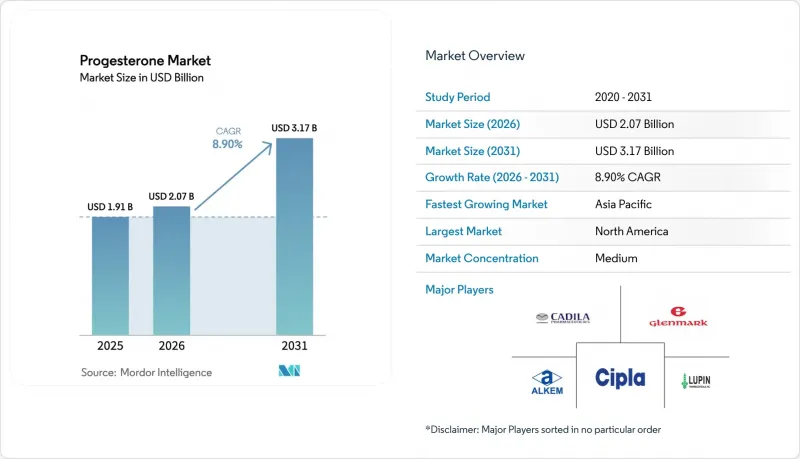
Mordor Intelligence에 의하면, 프로게스테론 시장 규모는 2025년 19억 1,000만 달러로 평가되었습니다. 2026년 20억 7,000만 달러에서 2031년까지 31억 7,000만 달러로 확대되고 2026년부터 2031년까지 연평균 성장률(CAGR)은 8.90%를 나타낼 전망입니다.
본 보고서는 제품 유형(천연 프로게스테론, 합성 프로게스테론), 투여 방법(주사제, 기타), 용도(갱년기 장애 등), 최종 사용자(병원 및 클리닉 등), 유통 채널(처방약, 일반의약품, 조제 약국), 지역(북미 등)별로 분류되어 있습니다. 시장 전망은 금액(달러) 기준으로 제시되어 있습니다.
세계의 프로게스테론 시장 동향 및 인사이트
호르몬 관련 질환 유병률 증가
다낭성 난소 증후군, 자궁내막증 및 기능성 자궁 출혈은 생식 연령 여성의 약 10-15%에 영향을 미치고 있으며, 프로게스테론 요법에 대한 지속적인 수요를 창출하고 있습니다. 비만과 대사증후군 증가는 특히 도시화가 진행되고 있는 아시아 국가들에서 이러한 증상을 악화시키고 있습니다. 의료 지침에서는 에스트로겐의 단독 작용에 대항하고 자궁내막 과형성을 예방하기 위해 프로게스테론 사용을 권장하고 있으며, 이를 통해 외과적 시술로의 전환을 지연시킬 수 있습니다. 중소득 국가에서 진단에 대한 인식이 높아지고 산부인과 의료 서비스에 대한 접근성이 개선됨에 따라 프로게스테론 시장은 확대되고 있습니다. 제약사들은 안전성 프로파일이 우수한 미립자 제제를 1차 선택 약물로 포지셔닝함으로써 이러한 시장 기회를 활용하고 있습니다.
체외수정(IVF) 및 보조생식기술(ART) 시술 증가
동결 배아 이식 프로토콜에서는 황체기 프로게스테론 보충이 필수로 규정되어 있습니다. 미국에서는 2022년에 43만 5,426건의 ART 주기가 시행되어 2020년 대비 33% 증가했습니다. 중국에서는 이미 연간 100만 주기를 넘어섰으며, 인도와 동남아시아에서는 불임 치료 클리닉 체인이 급속히 확대되고 있습니다. 피하 투여 및 경구 투여가 인기를 끌고 있는 이유는 동등성 시험에서 근육 내 주사제와 비교하여 출생 수에 불리한 점이 없음이 입증되었기 때문입니다. 이러한 환자 중심의 변화로 인해 미립자화 및 지질 코팅된 경구 캡슐 수요가 두 자릿수 성장세를 보이고 있습니다.
장기 호르몬 요법에 수반되는 부작용 및 안전성 우려
합성 프로게스틴에 비해 미분화된 프로게스테론프로파일이 더 우수하다는 데이터가 있음에도 불구하고, 유방암 및 혈전색전증 위험에 대한 우려는 여전히 남아 있습니다. EMA(유럽의약품청)는 라벨에 심혈관계 관련 경고 문구를 표기하도록 의무화하고 있으며, 이는 환자들의 불안을 더욱 증폭시키고 있습니다. 이러한 경계심 때문에 고위험군에서 시장 침투가 억제되고 있으며, 선진국 시장에서의 처방 건수 증가세가 둔화되고 있습니다.
부문별 분석
매출액 면에서는 여전히 합성 분자가 주류를 이루고 있지만, 임상의들이 안전성 및 환자 선호도에 대한 신호에 대응함에 따라 천연 유래 제제의 성장 속도는 가속화되고 있습니다. 이 부문의 연평균 성장률(CAGR) 10.45%에 힘입어, 2031년까지 천연 유래 제품은 소수파의 위치에서 합성 제품과 동등한 시장 점유율을 차지할 것으로 전망됩니다. 현재 미국과 EU의 많은 처방 의사들은 미세 분말 프로게스테론을 갱년기 치료의 표준 선택지로 간주하고 있으며, 체외수정(IVF) 프로토콜에서도 효능을 저해하지 않으면서 황체기 지원제로 채택되는 사례가 증가하고 있습니다. 신흥국 시장에서는 여전히 가격에 대한 민감성이 나타나고 있지만, 규제 통합 및 생산 규모 확대를 통해 비용 차이가 축소되고, 이에 따라 보다 광범위한 채택이 촉진될 것으로 예측됩니다. 이러한 변화로 인해 천연 유래 제품은 보험 적용 대상인 고부가가치 적응증 분야에서 프로게스테론 시장 점유율을 서서히 확대하는 한편, 합성 제품은 비용 제약이 있는 공공 입찰 시장에서 입지를 유지하게 될 것입니다.
주사제는 체외수정(IVF) 및 종양학 분야에서 여전히 자리 잡고 있지만, 환자의 불편함과 통원 치료의 부담을 이유로 치료 프로토콜 재검토가 진행되고 있습니다. 경구용 미세화 캡슐은 동등한 임신율을 달성하고 있으며, 갱년기 장애 및 기능성 부정출혈 적응증에서 두 자릿수의 성장률을 보이고 있습니다. 피하 자가 주사기는 미국의 불임 치료 프로그램에 도입되어 자가 투여를 가능하게 하고, 간호 인력의 업무 부담을 경감시키고 있습니다. 한편, 질 내 삽입제는 유효성과 전신 노출량의 저감을 동시에 달성하고 있지만, 투여의 불편성으로 인해 복약 순응도 문제에 직면해 있습니다. 아직 임상시험 단계에 있는 경피 흡수형 및 이식형 시스템은 특히 콜드체인 물류에 의존하지 않는 자율성이 요구되는 자원이 부족한 환경에서 프로게스테론 시장의 주사제 점유율을 더욱 잠식할 가능성이 있습니다.
지역별 분석
북미는 불임 치료에 대한 보험 적용과 생체 동등 호르몬에 대한 성숙한 수요에 힘입어 40.34%의 점유율을 차지하며 여전히 매출 1위를 유지하고 있습니다. 미국 시장은 체외수정(ART) 시술 건수가 많고, 복합제에 대한 주 정부의 규제가 비교적 완화된 덕분에 혜택을 보고 있지만, FDA의 품질 관리는 더욱 엄격해지고 있습니다. 캐나다에서는 보험 적용 범위가 주마다 다르지만, 민간 클리닉이 충족되지 않은 수요를 흡수하고 있습니다. 멕시코에서는 지속적으로 성장하는 의료 관광 부문과 경쟁력 있는 가격 책정이 미국 환자들을 끌어들이고 있으며, 그로 인해 지역 판매량이 확대되고 있습니다.
유럽은 매출의 약 28-30%를 차지하고 있습니다. 유럽의약품청(EMA)이 규제 승인을 일원화하고 있지만, 보험 급여 및 가격 책정은 각국의 권한에 맡겨져 있습니다. 독일의 기준 가격 제도와 프랑스의 집중 입찰 제도로 인해 제네릭 의약품 간의 경쟁이 치열해지는 한편, 영국의 NICE(국립의료기술평가기구) 지침에서는 갱년기 치료에 미분화 프로게스테론의 사용을 권장하고 있습니다. 동유럽 국가들에서는 체외수정(IVF)에 대한 접근성이 확대되고 중산층의 소득이 증가함에 따라, 낮은 기저 수준에서 더 빠른 성장률을 보이고 있습니다.
아시아태평양은 성장의 원동력이며, 연평균 성장률(CAGR) 9.54%로 확대되고 있습니다. 중국에서 연간 100만 건을 넘는 ART(보조생식기술) 시술 건수와 인도에서 확대되고 있는 민간 불임 치료 체인이 시장 규모를 견인하고 있습니다. 일본 및 한국 시장에서는 엄격한 규제 체계 속에서 프리미엄 브랜드 의약품이 우선시되고 있습니다. 동남아시아 국가들에서는 ART 관련 규제가 완화되고 있으며, 가처분 소득 증가가 클리닉 확장을 뒷받침하고 있습니다. 인도의 API(원료의약품) 클러스터에서 공급되는 비용 경쟁력이 있는 제네릭 의약품이 국내 시장 및 수출 시장 모두에 침투하며 접근성 확대에 기여하고 있습니다.
중동 및 아프리카 시장 점유율은 작지만, 특정 지역에서는 높은 성장이 나타나고 있습니다. GCC 국가들, 특히 사우디아라비아와 UAE 정부는 체외수정(IVF)에 보조금을 지급하고 있어 고품질 브랜드 제품에 대한 수요를 자극하고 있습니다. 사하라 이남 아프리카의 기부금 지원 가족 계획 이니셔티브에서는 프로게스테론 이식제가 우선시되고 있으며, 서방형 천연 제제가 규제상의 장벽을 극복한다면 수요 증가의 기회가 생길 것입니다. 브라질과 아르헨티나를 필두로 한 남미에서는 환율의 역풍과 현지 제네릭 의약품 생산을 뒷받침하는 수입 관세가 있음에도 불구하고 꾸준한 성장이 예상됩니다.
기타 혜택 :
- 엑셀 형식 시장 예측(ME) 시트
- 3개월간의 애널리스트 지원
자주 묻는 질문
목차
제1장 서론
제2장 조사 방법
제3장 개요
제4장 시장 구도
제5장 시장 규모 및 성장 예측
제6장 경쟁 구도
제7장 시장 기회 및 향후 전망
KTH 26.08.31According to Mordor Intelligence, the progesterone market size is projected to expand from USD 1.91 billion in 2025 and USD 2.07 billion in 2026 to USD 3.17 billion by 2031, registering a CAGR of 8.90% between 2026 to 2031.
This report is Segmented by Product Type (Natural Progesterone and Synthetic Progesterone), Mode of Delivery (Injectable, and Other Modes), Application (Menopause, and More), End User (Hospitals & Clinics, and More), Distribution Channel (Prescription, Over-The-Counter, and Compounding Pharmacies), and Geography (North America, and More). The Market Forecasts are Provided in Terms of Value (USD).
Global Progesterone Market Trends and Insights
Rising Prevalence of Hormone-Related Disorders
Polycystic ovary syndrome, endometriosis, and dysfunctional uterine bleeding affect roughly 10-15% of women of reproductive age, generating durable demand for progesterone therapy. Rising obesity and metabolic syndrome exacerbate these conditions, especially in urbanizing Asian economies. Medical guidelines advocate progesterone to oppose unopposed estrogen and prevent endometrial hyperplasia, delaying surgical escalation. Strengthening diagnostic awareness, along with better access to gynecologic services in middle-income countries, is expanding the progesterone market. Pharmaceutical brands capitalize by positioning micronized formulations as first-line options with favorable safety profiles.
Growing IVF & Assisted Reproductive Technology Procedures
Luteal-phase progesterone supplementation is mandatory in frozen-embryo transfer protocols. The United States completed 435,426 ART cycles in 2022, a 33% jump over 2020. China already surpasses 1 million cycles annually, and fertility clinic chains are scaling rapidly across India and Southeast Asia. Subcutaneous and oral routes are gaining popularity because equivalence studies show no live-birth disadvantage compared to intramuscular injectables. This patient-centric shift fuels double-digit demand for micronized and lipid-encapsulated oral capsules.
Adverse Events & Safety Concerns with Long-Term Hormone Therapy
Residual fears about breast cancer and thromboembolic risk persist despite data showing micronized progesterone's favorable profile compared with synthetic progestins. EMA mandates cardiovascular warnings on labels, amplifying patient apprehension. This caution curbs penetration among high-risk cohorts, slowing prescription growth in developed markets.
Other drivers and restraints analyzed in the detailed report include:
- Expanding Use of Progesterone in Menopause Hormone Therapy
- Increasing Adoption of Micronized Progesterone in Neuroprotective Trials
- Availability of Cost-Effective Generic Hydroxyprogesterone Alternatives
For complete list of drivers and restraints, kindly check the Table Of Contents.
Segment Analysis
Synthetic molecules still dominate revenue, yet natural formulations are growing faster as clinicians respond to safety and patient-preference signals. The segment's 10.45% CAGR will lift natural products from a minority position toward parity by 2031. Many U.S. and EU prescribers now view micronized progesterone as the default choice for menopause therapy, and IVF protocols increasingly accept it for luteal support without efficacy compromise. Emerging economies remain price-sensitive; however, regulatory alignment and larger production runs are expected to narrow cost differentials, thereby fostering broader adoption. This evolution positions natural products to capture incremental progesterone market share in premium reimbursed indications, while synthetics retain footholds in cost-constrained public tenders.
Injectables remain entrenched in IVF and oncology settings; however, patient discomfort and clinic-visit burden are prompting protocol revisions. Oral micronized capsules achieve comparable pregnancy rates and command double-digit growth in menopause and dysfunctional-bleeding indications. Subcutaneous autoinjectors have entered U.S. fertility programs, allowing self-administration and reducing nursing workload - vaginal inserts balance efficacy and lower systemic exposure but face adherence issues due to application inconvenience. Transdermal and implantable systems, which are still investigational, could further erode the injectable share within the progesterone market, particularly in low-resource settings that require autonomy from cold-chain logistics.
Complete Report Scope:
- By Product Type
- Natural Progesterone
- Plant-Sterol-Derived
- Animal-Source-Derived
- Synthetic Progesterone
- Steroidal (17-?-Hydroxyprogesterone Caproate, etc.)
- Non-Steroidal (Norethindrone, etc.)
- Natural Progesterone
- By Mode Of Delivery
- Injectable
- Suspended Form
- Oral
- Other Modes Of Delivery
- By Application
- Menopause
- Dysfunctional Uterine Bleeding
- Endometrial Cancer
- Contraception
- Hyperplastic Precursor Lesions
- Other Applications
- By End User
- Hospitals & Clinics
- Fertility Centers
- Ambulatory Surgical Centers
- Retail & Online Pharmacies
- Research & Academic Institutes
- By Distribution Channel
- Prescription (Rx)
- Over-The-Counter (OTC)
- Compounding Pharmacies
- Geography
- North America
- United States
- Canada
- Mexico
- Europe
- Germany
- United Kingdom
- France
- Italy
- Spain
- Rest Of Europe
- Asia-Pacific
- China
- Japan
- India
- Australia
- South Korea
- Rest Of Asia-Pacific
- Middle East And Africa
- GCC
- South Africa
- Rest Of Middle East And Africa
- South America
- Brazil
- Argentina
- Rest Of South America
- North America
Geography Analysis
North America remains the revenue leader, with a 40.34% share, supported by insurance mandates for fertility treatments and mature demand for bioidentical hormones. The U.S. market benefits from high ART procedural volumes and relatively permissive state rules for compounded products, though FDA oversight of quality is tightening. Canada's coverage varies provincially, yet private clinics absorb unmet demand. Mexico's growing medical tourism sector and competitive pricing attract U.S. patients, thereby expanding regional volumes.
Europe contributes roughly 28-30% of sales. EMA centralizes regulatory approval, but reimbursement and pricing are national prerogatives. Germany's reference-price system and France's centralized tenders intensify generic competition, while NICE guidelines in the U.K. endorse micronized progesterone for menopause therapy. Eastern European countries experience faster percentage growth from a lower base as access to IVF broadens and middle-class incomes rise.
Asia-Pacific is the growth engine, advancing at a 9.54% CAGR. China's one million-plus annual ART cycles and India's expanding private fertility chains dominate volume. The Japanese and South Korean markets prioritize premium, branded drugs within rigorous regulatory frameworks. Southeast Asian nations are liberalizing ART regulations, and rising disposable income supports the expansion of clinics. Cost-competitive generics from Indian API clusters penetrate both domestic and export markets, widening access.
The Middle East and Africa hold smaller shares but show selected high-growth pockets. GCC governments, notably Saudi Arabia and the UAE, subsidize IVF, stimulating demand for high-quality branded products. Donor-funded family-planning initiatives in sub-Saharan Africa prioritize progesterone implants, presenting volume opportunities once sustained-release natural formulations clear regulatory hurdles. South America, led by Brazil and Argentina, is experiencing steady growth despite currency headwinds and import tariffs that favor local generic production.
- Actavis
- Alkem Laboratories
- Bayer
- Besins Healthcare
- Bionpharma
- Zydus Group
- Cipla
- Estrellas Life Sciences Pvt. Ltd
- Ferring Pharmaceuticals
- Glenmark Pharmaceuticals
- Johnson & Johnson
- Lupin
- Merck
- Mylan (Viatris)
- Pfizer
- Sun Pharmaceuticals Industries
- Teva Pharmaceutical Industries
- TherapeuticsMD
Additional Benefits:
- The market estimate (ME) sheet in Excel format
- 3 months of analyst support
TABLE OF CONTENTS
1 Introduction
- 1.1 Study Assumptions & Market Definition
- 1.2 Scope of the Study
2 Research Methodology
3 Executive Summary
4 Market Landscape
- 4.1 Market Overview
- 4.2 Market Drivers
- 4.2.1 Rising Prevalence of Hormone-Related Disorders
- 4.2.2 Growing IVF & Assisted Reproductive Technology Procedures
- 4.2.3 Expanding Use of Progesterone in Menopause Hormone Therapy
- 4.2.4 Increasing Adoption of Micronized Progesterone in Neuroprotective Clinical Trials
- 4.2.5 Shift Toward Bio-Identical Plant-Derived Progesterone in Compounding Pharmacies
- 4.2.6 Emerging Demand for Sustained-Release Progesterone Drug-Delivery Implants In Low-Income Settings
- 4.3 Market Restraints
- 4.3.1 Adverse Events & Safety Concerns with Long-Term Hormone Therapy
- 4.3.2 Availability of Cost-Effective Generic Hydroxyprogesterone Alternatives
- 4.3.3 Supply Chain Constraints in Plant Steroid Feedstock
- 4.3.4 Regulatory Scrutiny on Compounded Hormone Therapy Quality Standards
- 4.4 Value / Supply-Chain Analysis
- 4.5 Regulatory Landscape
- 4.6 Technological Outlook
- 4.7 Porter's Five Forces Analysis
- 4.7.1 Threat Of New Entrants
- 4.7.2 Bargaining Power Of Buyers / Consumers
- 4.7.3 Bargaining Power Of Suppliers
- 4.7.4 Threat Of Substitute Products
- 4.7.5 Intensity Of Competitive Rivalry
5 Market Size & Growth Forecasts (Value, USD)
- 5.1 By Product Type
- 5.1.1 Natural Progesterone
- 5.1.1.1 Plant-Sterol-Derived
- 5.1.1.2 Animal-Source-Derived
- 5.1.2 Synthetic Progesterone
- 5.1.2.1 Steroidal (17-?-Hydroxyprogesterone Caproate, etc.)
- 5.1.2.2 Non-Steroidal (Norethindrone, etc.)
- 5.1.1 Natural Progesterone
- 5.2 By Mode Of Delivery
- 5.2.1 Injectable
- 5.2.2 Suspended Form
- 5.2.3 Oral
- 5.2.4 Other Modes Of Delivery
- 5.3 By Application
- 5.3.1 Menopause
- 5.3.2 Dysfunctional Uterine Bleeding
- 5.3.3 Endometrial Cancer
- 5.3.4 Contraception
- 5.3.5 Hyperplastic Precursor Lesions
- 5.3.6 Other Applications
- 5.4 By End User
- 5.4.1 Hospitals & Clinics
- 5.4.2 Fertility Centers
- 5.4.3 Ambulatory Surgical Centers
- 5.4.4 Retail & Online Pharmacies
- 5.4.5 Research & Academic Institutes
- 5.5 By Distribution Channel
- 5.5.1 Prescription (Rx)
- 5.5.2 Over-The-Counter (OTC)
- 5.5.3 Compounding Pharmacies
- 5.6 Geography
- 5.6.1 North America
- 5.6.1.1 United States
- 5.6.1.2 Canada
- 5.6.1.3 Mexico
- 5.6.2 Europe
- 5.6.2.1 Germany
- 5.6.2.2 United Kingdom
- 5.6.2.3 France
- 5.6.2.4 Italy
- 5.6.2.5 Spain
- 5.6.2.6 Rest Of Europe
- 5.6.3 Asia-Pacific
- 5.6.3.1 China
- 5.6.3.2 Japan
- 5.6.3.3 India
- 5.6.3.4 Australia
- 5.6.3.5 South Korea
- 5.6.3.6 Rest Of Asia-Pacific
- 5.6.4 Middle East And Africa
- 5.6.4.1 GCC
- 5.6.4.2 South Africa
- 5.6.4.3 Rest Of Middle East And Africa
- 5.6.5 South America
- 5.6.5.1 Brazil
- 5.6.5.2 Argentina
- 5.6.5.3 Rest Of South America
- 5.6.1 North America
6 Competitive Landscape
- 6.1 Market Concentration
- 6.2 Market Share Analysis
- 6.3 Company Profiles (includes Global Level Overview, Market Level Overview, Core Segments, Financials As Available, Strategic Information, Market Rank/Share, Products & Services, Recent Developments)
- 6.3.1 Actavis
- 6.3.2 Alkem Labs
- 6.3.3 Bayer AG
- 6.3.4 Besins Healthcare
- 6.3.5 Bionpharma
- 6.3.6 Cadila Pharmaceuticals
- 6.3.7 Cipla Limited
- 6.3.8 Estrellas Life Sciences Pvt. Ltd
- 6.3.9 Ferring Pharmaceuticals
- 6.3.10 Glenmark Pharmaceuticals
- 6.3.11 Johnson & Johnson (Janssen)
- 6.3.12 Lupin Limited
- 6.3.13 Merck KGaA
- 6.3.14 Mylan (Viatris)
- 6.3.15 Pfizer Inc.
- 6.3.16 Sun Pharmaceutical Industries
- 6.3.17 Teva Pharmaceuticals
- 6.3.18 TherapeuticsMD
7 Market Opportunities & Future Outlook
- 7.1 White-Space & Unmet-Need Assessment


