

|
시장보고서
상품코드
2114629
기면증 치료제 : 시장 점유율 분석, 업계 동향 및 통계, 성장 예측(2026-2031년)Narcolepsy Therapeutics - Market Share Analysis, Industry Trends & Statistics, Growth Forecasts (2026 - 2031) |
||||||
 Mordor Intelligence
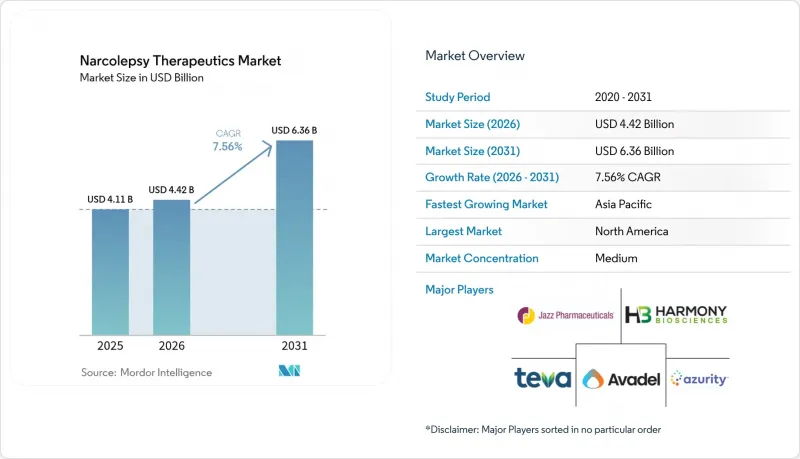
Mordor Intelligence에 의하면, 기면증 치료제 시장 규모는 2025년 41억 1,000만 달러로 평가되었습니다. 2026년에는 44억 2,000만 달러로 확대되어 2026년부터 2031년에 걸쳐 CAGR 7.56%로 성장을 지속하여, 2031년까지 63억 6,000만 달러에 이를 것으로 예측됩니다.
본 보고서에서는 시장을 유형(1형 나르콜레프시, 2형 나르콜레프시, 이차성 나르콜레프시),제품 분류(중추신경 자극제, 옥시베이트 나트륨 등), 유통 채널(병원 약국, 소매 약국, 온라인 약국), 지역별(북미, 유럽, 아시아태평양, 중동 및 아프리카, 남미)로 분류하고 있습니다. 시장 전망은 금액(미 달러) 기준으로 제시되어 있습니다.
세계의 기면증 치료제 시장 동향 및 인사이트
FDA/EMA의 신약 승인
새로운 승인을 통해 오렉신에 대한 지식이 단순한 흥분제의 범위를 넘어 입증되었습니다. Lumryz는 최초의 1일 1회(야간) 투여 서방형 옥시베이트 나트륨으로 승인되었으며, REST-ON 3상 임상시험에서 유효성이 입증되었습니다. 소아 적응증 승인으로 적용 범위가 확대되어, 서방형 옥시베이트 나트륨은 현재 7세부터 적응증이 적용됩니다. TAK-861은 2b상 임상시험에서 입면 잠복기 및 카타플렉시에 유의미한 개선을 보여, 전 세계적인 3상 임상시험 프로그램 추진으로 이어지고 있습니다. 희귀질환 치료제(오펀 드럭)에 대한 독점권은 7년간의 보호를 제공하여 연구개발 파이프라인을 뒷받침하고 있습니다. EMA와의 조화를 통해 중복 임상시험이 줄어들었으며, 옥시베이트 나트륨 및 히스타민 H3 길항제의 유럽 내 출시가 가속화되고 있습니다.
나르콜레프시 치료제의 임상시험 증가
임상시험이 단순한 증상 관리가 아닌 질병 경과 수정을 목적으로 진행되고 있어 업계의 신뢰도가 높아지고 있습니다. AXS-12는 SYMPHONY 3상 임상시험의 평가 지표를 달성하고, 카타플렉시를 83% 경감시킨 성과를 바탕으로 신약 허가 신청(NDA) 준비가 진행 중입니다. Alkermes의 ALKS-2680은 초기 연구에서 입면 잠복기를 최대 34분 단축했습니다. Harmony Biosciences는 HBS-102를 확보하여 렘수면 조절 장애를 치료하기 위해 MCHR1 길항제 분야에 진출했습니다. Beacon Biosignals는 Takeda와 제휴하여, 평가 지표를 명확히 하고 임상시험 기간을 단축할 가능성이 있는 신경 바이오마커의 활용을 추진하고 있습니다. 중추신경계(CNS) 이미징에 대한 투자가 증가하고 있으며, Clario의 NeuroRx 인수가 그 한 예입니다. 이를 통해 후기 임상시험 프로그램에서 fMRI를 활용할 수 있게 되었습니다.
고액의 치료비와 희귀질환 치료제의 가격 책정
Lumryz의 미국 내 연간 정가는 17만 7,034달러로, 기존의 옥시베이트 나트륨에 비해 경쟁력은 있지만, 각성제 계열 약물의 몇 배나 비싸 경제적 과제가 되고 있습니다. Xyrem은 2007년 1만 1,169달러에서 18만 2,804달러로 상승하여 반경쟁적 행위에 대한 조사가 촉발되었습니다. 지급 기관은 2023년에 승인된 의약품의 51%가 희귀질환 치료제였다는 점을 지적하고 있으며, 측정 가능한 효과에 상응하는 가격 책정이 시급한 과제로 대두되고 있습니다. 신흥 시장에서는 미국 중심의 가격 책정을 수용하기 어렵다고 보고 있어, 출시 지연이나 보험 적용 범위 제한으로 이어지고 있습니다. 에프워스 졸음 척도(ESS) 점수의 개선이나 카타플렉시 발작의 감소와 지불을 연계하는 성과 연계형 계약이 등장하기 시작했습니다.
부문별 분석
2025년에도 제1형 기면증 치료제 시장은 총 치료비의 60.92%를 차지하며 시장을 독점했으며, 이는 카타플렉시를 대상으로 한 옥시베이트 나트륨의 처방에 의해 주도되고 있습니다. 제2형은 특발성 과수면증과 구별하기 위한 정교화된 다중 수면 잠복기 검사에 힘입어 연평균 성장률(CAGR) 10.79%로 가장 빠르게 성장하고 있습니다. HPLC를 이용한 뇌척수액 분석을 통해 비활성 히포크레틴 단편을 식별할 수 있게 되어 오분류 위험이 감소하고, 정확한 치료 방침 수립이 촉진되고 있습니다. 임상의들은 옥시베이트 나트륨을 주로 1형에 한정하여 처방하는 반면, 2형에는 각성제나 히스타민 H3 길항제를 선호하는 경향이 있어, 이로 인해 가격 체계와 보험사의 방침이 갈리고 있습니다. 뇌의 구조적 손상으로 인한 이차성 기면증은 틈새 시장이지만 임상적으로 중요한 분야이며, 재활 프로토콜 및 신경 영상 검사로의 의뢰 경로에 관심이 집중되고 있습니다.
진단 처리 능력의 향상도 기면증 치료제 시장의 확대에 기여하고 있으며, 지역 신경과 의사들이 비정상적인 렘 수면 전환을 감지하는 간소화된 채점 방식을 채택하고 있습니다. 학술 기관에서는 원격 수면 다원 검사(polysomnography)의 시범 도입이 진행되고 있으며, 이를 통해 대기 목록이 단축되고 질병 수정 임상시험의 조기 개시가 촉진되고 있습니다. 제2형 나르콜레프시 환자 보고 결과에 따르면, 정확하게 분류될 경우 노동 생산성 향상이 빨라지는 것으로 나타나, 보험사가 확정 진단을 위한 뇌척수액 검사에 자금을 지원하는 경제적 근거가 강화되고 있습니다. 환자 단체의 인식 제고 캠페인으로 인해 연구 레지스트리가 확대되어, 신약의 적응증 확대를 뒷받침하는 실세계 데이터가 제공되고 있습니다. 다만, 지역 간 격차는 여전히 존재하며, 아시아태평양에서는 MSLT 실시 능력이 제한적이어서 제2형 진단이 미흡한 실정이며, 이는 휴대용 진단 기기 시장 기회를 시사합니다.
지역별 분석
북미는 유리한 환급 제도, 전문의 밀도가 높고, 1일 1회(야간) 투여하는 옥시베이트 나트륨의 조기 도입을 배경으로 2025년 기면증 치료제 시장에서 42.05%의 점유율을 유지했습니다. 보험사의 처방약 목록에서는 에프워스 졸음 척도(ESS)의 감소를 기준으로 하는 가치 기반 계약이 우선시되고 있으며, 이러한 방침에 따라 임상적으로 우수한 치료법으로의 신속한 전환이 촉진되고 있습니다. 디지털 헬스 관련 규제로 인해 지속적인 원격 모니터링이 가능해져, 수면 센터에서 복약 순응도를 추적하기가 용이해졌을 뿐만 아니라, 도시와 지방 간의 의료 격차 해소에도 기여하고 있습니다.
유럽에서는 희귀질환 치료제(오펀 드럭)에 대한 우대 조치와 유럽의약품청(EMA)의 중앙 심사 절차에 따라 승인부터 보험 적용까지의 기간이 단축되어 꾸준한 성장이 예상됩니다. 서유럽의 본인부담금 상한선 설정은 폭넓은 접근성을 유지하고 있는 반면, 중동유럽 국가들에서는 대규모 시장의 결과 데이터를 벤치마크로 삼는 의료기술평가(HTA) 개혁을 통해 보험 적용 격차가 서서히 해소되고 있습니다. EU의 국경 간 의료 서비스에 관한 규정은 복잡한 수면 검사를 받기 위한 환자의 이동을 촉진하여, 간접적으로 진단 건수 증가에 기여하고 있습니다.
아시아태평양은 진단율 상승, 규제 개혁, 도시 지역 병원에 대한 투자로 인해 연평균 성장률(CAGR) 11.87%를 기록하며 가장 빠르게 성장하고 있는 지역입니다. 중국이 최근 불면증 치료제로 렘보렉산트를 승인한 것은 수면 치료제에 대한 수용도가 높아지고 있음을 보여 주며, 오렉신 계열 약물에 관한 규제상의 선례를 마련하고 있습니다. 일본에서는 기면증 환자 1인당 연간 의료비가 2,531달러인 반면, 대조군은 266달러에 그쳐 효과적인 치료의 경제적 이점이 부각되고 있습니다. 호주에서는 의약품 급여 제도(Pharmaceutical Benefits Scheme)의 적용 범위가 확대되고 있으며, 인도의 민간 보험사는 원격 수면 패키지형 서비스에 대한 실증 실험을 진행하고 있습니다. 중동 및 아프리카, 라틴아메리카에서는 여전히 보험 환급의 불균형과 신경과 전문의 부족 문제에 직면해 있지만, 개발은행이 자금을 지원하는 원격의료 시범 프로젝트는 비용 장벽이 완화된다면 잠재적 수요가 발생할 것임을 시사하고 있습니다.
기타 혜택 :
- 엑셀 형식 시장 예측(ME) 시트
- 3개월간의 애널리스트 지원
자주 묻는 질문
목차
제1장 서론
제2장 조사 방법
제3장 개요
제4장 시장 구도
제5장 시장 규모 및 성장 예측
제6장 경쟁 구도
제7장 시장 기회 및 향후 전망
KTH 26.08.31According to Mordor Intelligence, the narcolepsy therapeutics market size is expected to grow from USD 4.11 billion in 2025 to USD 4.42 billion in 2026 and is forecast to reach USD 6.36 billion by 2031 at 7.56% CAGR over 2026-2031.
This report Segments the Industry Into by Type (Narcolepsy Type 1, Narcolepsy Type 2, and Secondary Narcolepsy), Product Class (CNS Stimulants, Sodium Oxybate, and More), Distribution Channel (Hospital Pharmacies, Retail Pharmacies, Online Pharmacies), and Geography (North America, Europe, Asia-Pacific, Middle East and Africa, South America). The Market Forecasts are Provided in Terms of Value (USD).
Global Narcolepsy Therapeutics Market Trends and Insights
FDA/EMA Approvals of Novel Agents
New approvals validate orexin biology beyond stimulants. Lumryz gained clearance as the first once-nightly extended-release sodium oxybate and demonstrated efficacy in the REST-ON Phase 3 trial. Pediatric approvals broaden reach, with extended-release sodium oxybate now indicated from age 7 years. TAK-861 showed significant improvements in sleep latency and cataplexy in Phase 2b trials, encouraging a Phase 3 global programme. Orphan-drug exclusivity offers seven-year protection and fuels R&D pipelines. EMA alignment reduces duplicate testing and accelerates European launches for sodium oxybate and histamine H3 antagonists.
Increasing Clinical Trials for Narcolepsy Therapeutics
Industry confidence rises as trials pursue disease-modifying goals rather than symptom control. AXS-12 met SYMPHONY Phase 3 endpoints with an 83% cataplexy reduction, prompting NDA preparation. Alkermes' ALKS-2680 improved sleep latency by up to 34 minutes in early studies. Harmony Biosciences acquired HBS-102, expanding into MCHR1 antagonism to tackle REM dysregulation. Beacon Biosignals partners with Takeda to apply neuro-biomarkers that sharpen endpoints and may cut trial time. Investment in CNS imaging rises, evidenced by Clario's NeuroRx acquisition that brings fMRI capacity to late-stage programmes.
High Therapy Cost and Orphan-Drug Pricing
Lumryz carries an annual US list price of USD 177,034, which, while competitive with legacy oxybate, remains many times higher than stimulants and poses affordability challenges. Xyrem rose from USD 11,169 in 2007 to USD 182,804, triggering investigation into anti-competitive tactics. Payers note that 51% of 2023 drug approvals were orphan, adding urgency to align prices with measurable benefit. Emerging markets find US-centric pricing untenable, delaying launches or limiting reimbursement scope. Outcomes-based contracts start to appear, linking payment to improved Epworth Sleepiness Scale scores and reduced cataplexy episodes.
Other drivers and restraints analyzed in the detailed report include:
- Regulatory Support and Reimbursement Expansion
- Growing Focus on Personalised and Combination-Therapy Protocols
- Adverse-Event Profile and Abuse Potential of Sodium Oxybate
For complete list of drivers and restraints, kindly check the Table Of Contents.
Segment Analysis
The Narcolepsy therapeutics market size for Type 1 remained dominant in 2025 as 60.92% of total therapy spending, driven by cataplexy-targeted sodium oxybate prescriptions. Type 2 is growing fastest at an 10.79% CAGR, supported by refined multiple sleep latency testing that differentiates it from idiopathic hypersomnia. Cerebrospinal fluid analysis via HPLC now discerns inactive hypocretin fragments, cutting misclassification risk and boosting accurate therapy alignment. Clinicians often reserve oxybate for Type 1 while favouring stimulants or histamine H3 antagonists for Type 2, creating separate pricing ladders and payer policies. Secondary narcolepsy from structural brain injuries forms a niche but clinically significant slice that draws attention to rehabilitation protocols and neuro-imaging referral pathways.
Improved diagnostic throughput also widens the Narcolepsy therapeutics market, with community neurologists adopting simplified scoring that flags abnormal REM transitions. Academic centres pilot tele-polysomnography which reduces waitlists and facilitates earlier start of disease-modifying trials. Type 2 patient-reported outcomes show faster work productivity gains once correctly classified, strengthening the economic rationale for payers to fund confirmatory CSF testing. Awareness campaigns run by patient groups increase research registries, offering real-world evidence that supports label expansion for novel agents. Regional variance persists, though, with Asia-Pacific under-diagnosing Type 2 due to limited MSLT capacity, signalling opportunity for portable diagnostic devices.
Complete Report Scope:
- By Type
- Narcolepsy Type 1
- Narcolepsy Type 2
- Secondary Narcolepsy
- By Product Class
- CNS Stimulants
- Sodium Oxybate
- Histamine H3 Antagonists
- Dopamine
- Antidepressants
- OX2R Agonists
- Other Therapies
- By Distribution Channel
- Hospital Pharmacies
- Retail Pharmacies
- Online Pharmacies
- By Geography
- North America
- United States
- Canada
- Mexico
- Europe
- Germany
- United Kingdom
- France
- Italy
- Spain
- Rest of Europe
- Asia-Pacific
- China
- Japan
- India
- Australia
- South Korea
- Rest of Asia-Pacific
- Middle East & Africa
- GCC
- South Africa
- Rest of Middle East & Africa
- South America
- Brazil
- Argentina
- Rest of South America
- North America
Geography Analysis
North America retained 42.05% of the Narcolepsy therapeutics market in 2025 on the back of favourable reimbursement, specialist density, and early uptake of once-nightly oxybate. Payer formularies prioritise value-based contracts that hinge on Epworth Sleepiness Scale reduction, a policy that encourages rapid cycling toward clinically superior regimens. Digital health regulations allow continuous remote monitoring, facilitating adherence tracking by sleep centres and plugging gaps between urban and rural care.
Europe contributes steady growth as orphan-drug incentives and EMA centralised procedures shorten time from approval to reimbursement. Co-payment caps in Western Europe sustain broad access, while Central and Eastern Europe gradually close reimbursement gaps through HTA reforms that benchmark outcomes data from larger markets. EU cross-border healthcare rules have spurred patient travel for complex sleep studies, indirectly boosting diagnostic throughput.
Asia-Pacific is the fastest expanding region at a 11.87% CAGR, thanks to rising diagnosis rates, regulatory reforms, and urban hospital investment. China's recent endorsement of lemborexant for insomnia signals growing acceptance of sleep therapeutics and sets a regulatory precedent for orexin agents. Japan reports USD 2,531 annual healthcare spend per narcolepsy patient versus USD 266 for controls, illuminating the economic benefit of effective therapy. Australia widens coverage under the Pharmaceutical Benefits Scheme, and India's private insurers experiment with bundled tele-sleep packages. Middle East, Africa, and Latin America still struggle with reimbursement asymmetry and neurologist shortages, yet pilot telemedicine projects funded by development banks hint at latent demand once cost barriers ease.
- Jazz Pharmaceuticals plc
- Harmony Biosciences
- Avadel Pharmaceuticals
- Takeda Pharmaceuticals
- Teva Pharmaceutical Industries
- Axsome Therapeutics
- Alkermes plc
- Zevra Therapeutics
- Amneal Pharmaceuticals
- Azurity Pharmaceuticals Inc.
- Novartis
- Hikma Pharmaceuticals
- Arena Pharmaceuticals
- Prasco LLC
- Sunovion Pharmaceuticals
- Johnson & Johnson
- Lundbeck A/S
- Lupin
- Torrent Pharmaceuticals
Additional Benefits:
- The market estimate (ME) sheet in Excel format
- 3 months of analyst support
TABLE OF CONTENTS
1 Introduction
- 1.1 Study Assumptions & Market Definition
- 1.2 Scope of the Study
2 Research Methodology
3 Executive Summary
4 Market Landscape
- 4.1 Market Overview
- 4.2 Market Drivers
- 4.2.1 Regulatory Support & Reimbursement Expansion
- 4.2.2 Growing Focus on Personalised and Combination-Therapy Protocols
- 4.2.3 FDA/EMA Approvals of Novel Agents
- 4.2.4 Increasing Clinical Trials for Narcolepsy Therapeutics
- 4.2.5 Rising Prevalence of Narcolepsy
- 4.2.6 Awareness Programs & Improving Diagnosis Rates
- 4.3 Market Restraints
- 4.3.1 Adverse-Event Profile & Abuse Potential of Sodium Oxybate
- 4.3.2 High Therapy Cost & Orphan-Drug Pricing
- 4.3.3 Patent Cliffs Vs Litigation Delaying Generics
- 4.3.4 Reimbursement Gaps in Emerging Markets
- 4.4 Regulatory Landscape
- 4.5 Emerging Therapies Pipeline Analysis
- 4.6 Porter's Five Forces Analysis
- 4.6.1 Threat of New Entrants
- 4.6.2 Bargaining Power of Buyers
- 4.6.3 Bargaining Power of Suppliers
- 4.6.4 Threat of Substitutes
- 4.6.5 Competitive Rivalry
5 Market Size & Growth Forecasts (Value in USD)
- 5.1 By Type
- 5.1.1 Narcolepsy Type 1
- 5.1.2 Narcolepsy Type 2
- 5.1.3 Secondary Narcolepsy
- 5.2 By Product Class
- 5.2.1 CNS Stimulants
- 5.2.2 Sodium Oxybate
- 5.2.3 Histamine H3 Antagonists
- 5.2.4 Dopamine
- 5.2.5 Antidepressants
- 5.2.6 OX2R Agonists
- 5.2.7 Other Therapies
- 5.3 By Distribution Channel
- 5.3.1 Hospital Pharmacies
- 5.3.2 Retail Pharmacies
- 5.3.3 Online Pharmacies
- 5.4 By Geography
- 5.4.1 North America
- 5.4.1.1 United States
- 5.4.1.2 Canada
- 5.4.1.3 Mexico
- 5.4.2 Europe
- 5.4.2.1 Germany
- 5.4.2.2 United Kingdom
- 5.4.2.3 France
- 5.4.2.4 Italy
- 5.4.2.5 Spain
- 5.4.2.6 Rest of Europe
- 5.4.3 Asia-Pacific
- 5.4.3.1 China
- 5.4.3.2 Japan
- 5.4.3.3 India
- 5.4.3.4 Australia
- 5.4.3.5 South Korea
- 5.4.3.6 Rest of Asia-Pacific
- 5.4.4 Middle East & Africa
- 5.4.4.1 GCC
- 5.4.4.2 South Africa
- 5.4.4.3 Rest of Middle East & Africa
- 5.4.5 South America
- 5.4.5.1 Brazil
- 5.4.5.2 Argentina
- 5.4.5.3 Rest of South America
- 5.4.1 North America
6 Competitive Landscape
- 6.1 Market Concentration
- 6.2 Market Share Analysis
- 6.3 Company Profiles (includes Global-level Overview, Market-level Overview, Core Segments, Financials as available, Strategic Information, Market Rank/Share for key companies, Products & Services, Recent Developments)
- 6.3.1 Jazz Pharmaceuticals plc
- 6.3.2 Harmony Biosciences
- 6.3.3 Avadel Pharmaceuticals
- 6.3.4 Takeda Pharmaceutical Co. Ltd.
- 6.3.5 Teva Pharmaceutical Industries Ltd.
- 6.3.6 Axsome Therapeutics Inc.
- 6.3.7 Alkermes plc
- 6.3.8 Zevra Therapeutics
- 6.3.9 Amneal Pharmaceuticals Inc.
- 6.3.10 Azurity Pharmaceuticals Inc.
- 6.3.11 Novartis AG
- 6.3.12 Hikma Pharmaceuticals plc
- 6.3.13 Arena Pharmaceuticals
- 6.3.14 Prasco LLC
- 6.3.15 Sunovion Pharmaceuticals Inc.
- 6.3.16 Johnson & Johnson
- 6.3.17 Lundbeck A/S
- 6.3.18 Lupin Ltd.
- 6.3.19 Torrent Pharma
7 Market Opportunities & Future Outlook
- 7.1 White-space & unmet-need assessment


