|
시장보고서
상품코드
2114632
심정지 치료 시장 : 시장 점유율 분석, 업계 동향 및 통계, 성장 예측(2026-2031년)Global Cardiac Arrest Treatment - Market Share Analysis, Industry Trends & Statistics, Growth Forecasts (2026 - 2031) |
||||||
 Mordor Intelligence
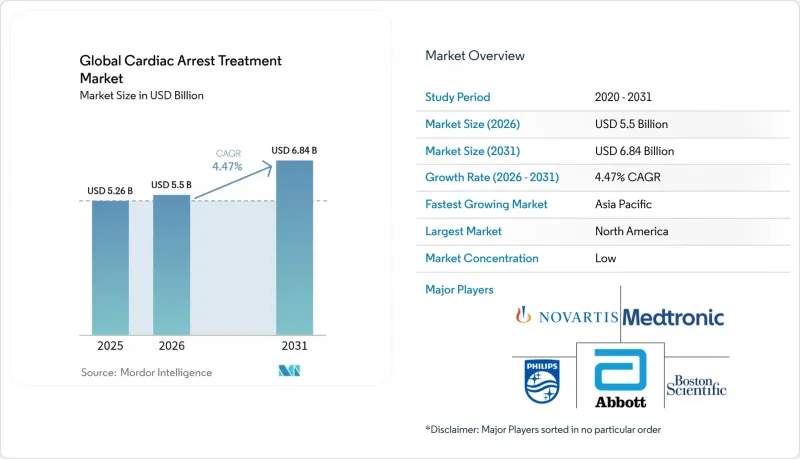
심정지 치료 세계 시장 규모는 2026년에 55억 달러로 추정되고 있으며, 2025년 52억 6,000만 달러에서 2031년에는 68억 4,000만 달러에 달할 것으로 예측됩니다.
2026-2031년 연평균 성장률(CAGR)은 4.47%를 나타낼 것으로 전망됩니다.
본 보고서에서는 업계를 치료법별(의료기기(제세동기, 체외막형 인공폐(ECMO) 등), 의약품(클래스 I-나트륨 채널 차단제, 클래스 II-베타 차단제 등)), 유통 채널별(병원, 약국 등),지역별(북미, 유럽, 아시아태평양 등)로 분류하고 있습니다. 시장 전망은 금액(달러) 기준으로 제시되어 있습니다.
전 세계 심정지 치료 시장 동향 및 인사이트
갑작스러운 심정지의 부담 증가와 고령화
인구 고령화에 따라, 특히 65세 이상 성인에서 갑작스러운 심정지의 발생률이 증가하고 있습니다. 미국심장협회(AHA)에 따르면, 매년 35만 6,000명의 미국인이 병원 밖에서 심정지를 경험하고 있으며, 생존율은 여전히 8-10%에 그치고 있습니다. 이 협회의 ‘2030 임팩트 목표’에서는 구급대 도착 전 일반 시민에 의한 심폐소생술(CPR) 실시율을 50% 이상,자동제세동기(AED) 사용률을 20% 이상으로 높이는 것을 목표로 하고 있으며, 이를 통해 처치를 받지 못한 채 1분이 지날 때마다 10%씩 떨어지는 생존율의 하락을 상쇄하고자 합니다. 이러한 목표에 따라 의료 시스템은 단일 기기가 아닌 통합된 디바이스 생태계의 도입을 요구받고 있습니다. 젊은 층에서 COVID-19 관련 심근 미세 흉터에 대한 인식이 높아지고 있는 점도 대상 환자층을 더욱 확대되고 있습니다. 그 결과, 심정지 치료 시장에서는 모니터링, 예측 소프트웨어, 치료 제공을 단일 케어 연속체로 통합한 확장성이 뛰어난 플랫폼이 계속해서 우선시되고 있습니다.
공공 제세동기 프로그램 및 법규
학교, 스포츠 경기장, 교통 거점에서의 주 정부 차원의 AED 설치 의무화로 인해 기기 설치 밀도가 높아지고, 일반 구조자의 대응 준비 태세가 향상되고 있습니다. 사우스캐롤라이나주의 ‘스마트 하트 법’ 및 오하이오주의 ‘하원 법안 제47호’는 AED 설치와 심장 응급 대응 계획 수립을 모두 의무화함으로써, 과거 시설 관리자들을 주저하게 만들었던 법적 장벽을 낮추고 있습니다. 미국 질병통제예방센터(CDC)는 조달 및 유지보수를 표준화하는 13개 항목의 도입 툴킷을 제공하고 있으며, 한편 ‘심정지 생존법(Cardiac Arrest Survival Act)’의 재승인을 목표로 하는 연방 정부의 제안은 법적 책임 보호를 강화하고 있습니다. 그 결과, 상태 데이터를 911 신고 네트워크로 전송하는 연결형 AED 플랫폼은 특히 구독형 교육 모듈과 함께 제공될 경우 도입이 활발히 진행되고 있습니다.
제품 리콜 및 의료기기와 관련된 유해 사건
품질상의 결함은 여전히 주요 우려 사항으로 남아 있습니다. 보스턴 사이언티피크는 기기가 ‘안전 모드’로 전환된 데 기인한 832건의 부상 및 2건의 사망이 확인됨에 따라, 특정 ‘아콜레이드(Accolade)’ 심박조율기에 대해 클래스 I 리콜을 발표했습니다. 애보트(Abbott)사도 동시에 전원 장치 고장을 이유로 ‘하트메이트(HeartMate)’ 펌프 부속품을 리콜했으며, 이에 따라 심혈관 임플란트와 관련된 공중 안전 경보를 신속하게 발령하는 FDA의 시범 프로그램이 가동되었습니다. 이러한 사건들은 임상의들의 신뢰를 훼손하고, 신제품 승인을 지연시키며, 기업들에게 시판 후 조사에 대한 예산 증액을 강요함으로써 심정지 치료 시장 전체의 성장을 둔화시키고 있습니다.
부문별 분석
2025년에는 의료기기가 36억 4,000만 달러의 매출을 기록하여 총 수익의 69.12%를 차지했습니다. AI를 활용한 부정맥 예측 및 ECMO의 소형화와 같은 기술적 도약에 힘입어 이 부문은 연평균 성장률(CAGR) 6.33%로 성장하고 있으며, 심정지 치료 시장에서 의료기기 시장 규모는 약물 요법에 의한 대체 수단을 계속해서 앞지르고 있습니다. 병원의 응급 카트에서는 제세동기가 주류를 이루는 반면, 드론 탑재형 AED는 외딴 지역의 지역사회에 대한 대응 범위를 확대되고 있습니다. 휴대용 ECMO 플랫폼은 난치성 사례에 대한 가이드라인의 권고를 받고 있으며, 임펠라(Impella)와 같은 기계적 순환 보조 시스템은 혈역학적 안정성을 더욱 높이고 있습니다. VARIPULSE 펄스 필드 절제 시스템의 FDA 승인은 규제 당국이 영향력이 큰 의료기기의 신속 승인을 적극적으로 추진하고 있음을 보여주며, 공급업체들의 지속적인 연구 개발에 대한 자신감을 강화하고 있습니다.
의약품 부문은 나머지 매출을 차지하고 있지만, 처방약 목록의 제약과 제네릭 의약품과의 경쟁이 치열해짐에 따라 성장 속도는 둔화되고 있습니다. 아미오다론과 같은 클래스 III 약물은 심실성 부정맥의 표준 치료법으로 자리 잡았으나, 에피네프린과 같은 혈압 상승제공급 부족으로 인해 중환자 치료 공급망에 산발적인 혼란이 발생하고 있습니다(nih.gov). AZD8601을 포함한 임상시험 중인 mRNA 치료법은 2009년 드로네달론 출시 이후 처음으로 중요한 작용기전의 전환을 의미하지만, 대규모 유효성 데이터는 아직 확보되지 않았습니다. 부정맥 유발 경로를 억제하는 RNAi 접근법은 전임상 단계에서 유망하게 평가되고 있으나, 상용화까지의 일정은 현재 예측 기간을 초과하여 전망이 불투명한 상황입니다.
지역별 분석
북미는 2025년 매출의 41.83%를 차지하고 있으며, 확립된 응급의료(EMS) 프로토콜, AED의 광범위한 보급, 그리고 구명 기기에 대해 ‘획기적인 의료기기 지정(Breakthrough Device Designation)’을 제공하는 FDA의 생태계로부터 혜택을 받고 있습니다. ‘심정지 생존법(Cardiac Arrest Survival Act)’에 따른 연방 정부의 책임 면제 조치는 지역 사회의 응급 대응 요원들을 뒷받침하고 있으며, 미국심장협회(American Heart Association)는 각 주에 일반 시민이 이용할 수 있는 AED 프로그램 강화를 촉구하고 있습니다. 통합형 의료 제공 네트워크는 제세동기 및 모니터링 플랫폼에 대해 모든 기기를 대상으로 하는 서비스 계약을 체결하고 있으며, 이를 통해 예측 가능한 교체 주기가 유지되고 있습니다. 이와 병행하여, 농촌 지역에서 드론을 이용한 AED 배송에 대한 대규모 현장 시험 결과, 대응 시간이 4-6분 단축되고 신경학적 예후가 크게 개선된 것으로 나타났습니다(nih.gov).
아시아태평양은 연평균 성장률(CAGR) 7.55%로 가장 빠르게 성장하는 지역이며, 그 주된 요인은 심혈관 질환으로 인한 사망률 상승과 도시 지역의 응급 의료 예산 확대에 있습니다. 중국과 일본의 국내 제조업체들은 비용 대비 효과가 높은 AED의 수출을 확대하고 있으며, 국제전기기술위원회(IEC)의 기준을 충족하면서 가격 면에서 유럽과 미국의 기존 제조업체들에 도전하고 있습니다. 그러나 보험 환급 제도가 통일되어 있지 않아 고가의 ECMO나 전도계 심박조율기의 보급은 여전히 더딘 편이며, 고가 의료기기가 차지하는 심정지 치료 시장 점유율은 제한적인 수준에 머물고 있습니다. ‘아시아 조화 실무그룹(Asian Harmonisation Working Party)’을 비롯한 다자간 규제 조화 프로젝트는 신청 서류 요건을 통일함으로써 승인 기간 단축을 목표로 하고 있으며, 이러한 움직임에 따라 세계 브랜드 시장 진입 장벽은 점차 낮아지고 있습니다.
유럽에서는 임상 근거의 확충을 중시하는 통일된 의료기기 규제 하에서 착실하면서도 신중한 성장이 나타나고 있습니다. 이 지역에서는 임상 품질 레지스트리가 추진되고 있으며, 이를 통해 얻은 결과 데이터가 가이드라인 개정에 반영됨으로써 병원이 근거에 기반한 구매 결정을 내릴 수 있도록 유도하고 있습니다. 네덜란드에서 드론 네트워크 시범 운영을 통해 심정지 현장에 AED를 5분 이내에 전달하는 데 성공함에 따라, 유럽연합(EU)은 국경을 초월한 재현성 연구에 대한 자금 지원을 결정했습니다(nhs.uk). 예산 부족으로 인해 구매 결정은 의료기술평가(HTA)의 심사 대상에 놓여 있지만, 결과 중심의 조달 모델에서는 병원 외 사망률을 명확히 감소시키는 플랫폼이 우대받고 있습니다. EU 의료기기 규정(MDR)으로의 전환 비용은 여전히 고려 대상이지만, 견고한 시판 후 감시 역량을 갖춘 유서 깊은 공급업체들은 입찰 목록에서 유리한 위치를 유지하고 있습니다.
기타 혜택:
- 엑셀 형식 시장 예측(ME) 시트
- 3개월간의 애널리스트 지원
자주 묻는 질문
목차
제1장 서론
제2장 조사 방법
제3장 주요 요약
제4장 시장 구도
제5장 시장 규모와 성장 예측
제6장 경쟁 구도
제7장 시장 기회와 향후 전망
LSH 26.08.26According to Mordor Intelligence, the global cardiac arrest treatment market size in 2026 is estimated at USD 5.5 billion, growing from 2025 value of USD 5.26 billion with 2031 projections showing USD 6.84 billion, growing at 4.47% CAGR over 2026-2031.
This report Segments the Industry Into by Treatment (Devices [Defibrillators, Extracorporeal Membrane Oxygenation (ECMO) and More], Drugs [Class I - Sodium-Channel Blockers, Class II - Beta-Blockers and More]), by Distribution Channel (Hospitals, Pharmacies and More), and Geography (North America, Europe, Asia-Pacific and More). The Market Forecasts are Provided in Terms of Value (USD).
Global Cardiac Arrest Treatment Market Trends and Insights
Growing Burden of Sudden Cardiac Arrest & Ageing Populations
Population ageing increases sudden cardiac death incidence, especially among adults over 65. The American Heart Association notes that 356,000 Americans experience out-of-hospital cardiac arrest each year, with survival remaining at 8-10%. Its 2030 Impact Goals target more than 50% bystander CPR and 20% AED use before EMS arrival to offset the 10% survival decline that occurs for every untreated minute. These goals push health systems to procure integrated device ecosystems rather than one-off equipment. Growing recognition of COVID-19-related myocardial micro-scarring in younger age groups further broadens the addressable patient pool. Consequently, the cardiac arrest treatment market continues to prioritize scalable platforms that combine monitoring, predictive software, and therapy delivery in a single continuum of care.
Public-Access Defibrillator Programmes and Legislation
State-mandated AED deployment in schools, sports arenas, and transit hubs expands device density and improves lay-rescuer readiness. South Carolina's Smart Heart Act and Ohio's House Bill 47 require both AED placement and cardiac emergency response plans, lowering legal barriers that once deterred facility managers. The Centers for Disease Control and Prevention offers a 13-point implementation toolkit that standardises procurement and maintenance, while federal proposals to reauthorise the Cardiac Arrest Survival Act strengthen liability protections. Connected AED platforms that feed status data into 911 dispatch networks therefore enjoy higher adoption, especially when bundled with subscription-based training modules.
Product Recalls & Device-Related Adverse Events
Quality lapses remain a central concern. Boston Scientific issued a Class I recall for certain Accolade pacemakers after 832 injuries and 2 deaths were linked to devices entering Safety Mode. Abbott simultaneously recalled HeartMate pump accessories due to power unit failures, triggering the FDA's pilot programme that accelerates public safety alerts for cardiovascular implants. These incidents reduce clinician confidence, delay new-product clearances, and push companies to allocate larger budgets to post-market surveillance, thereby slowing the overall cardiac arrest treatment market.
Other drivers and restraints analyzed in the detailed report include:
- Advances in Implantable & Wearable Defibrillator Technology
- Miniaturised ECMO for Refractory Cardiac Arrest
- High Capital Cost & Reimbursement Gaps in Emerging Markets
For complete list of drivers and restraints, kindly check the Table Of Contents.
Segment Analysis
Devices contributed USD 3.64 billion in 2025, equal to 69.12% of total revenue. Technological leaps like AI-driven arrhythmia prediction and miniaturised ECMO propel this category toward a 6.33% CAGR, keeping the cardiac arrest treatment market size for devices ahead of pharmacologic alternatives. Defibrillators dominate hospital code carts, while drone-mounted AEDs extend reach to remote communities. Portable ECMO platforms win guideline endorsements for refractory cases, and mechanical circulatory support systems such as Impella add incremental hemodynamic stability. FDA approval of the VARIPULSE pulsed-field ablation system confirms regulators' willingness to fast-track high-impact devices, reinforcing vendor confidence in sustained R&D.
The drug segment accounts for the remaining revenue and grows at a slower pace as formulary constraints and generic competition bite. Class III agents like amiodarone remain standard for ventricular arrhythmias, yet shortages of vasopressors such as epinephrine sporadically disrupt critical-care supply chains nih.gov. Investigational mRNA therapies, including AZD8601, mark the first significant mechanistic shift since dronedarone's 2009 launch, but large-scale efficacy data are pending. RNAi approaches that silence arrhythmogenic pathways show promise in preclinical settings, although commercial timelines extend beyond the current forecast window.
Complete Report Scope:
- By Product (Value)
- Devices
- Defibrillators
- Extracorporeal Membrane Oxygenation (ECMO)
- Intra-aortic Balloon Pump (IABP)
- Percutaneous VAD (Impella)
- Other Devices
- Drugs
- Anti-arrhythmic Drugs
- Class I - Sodium-channel Blockers
- Class II - Beta-blockers
- Class III - Potassium-channel Blockers
- Class IV - Calcium-channel Blockers|||
- Others (Digoxin, Adenosine)
- Vasopressors & Inotropes
- Anti-arrhythmic Drugs
- Devices
- By End User (Value)
- Hospitals & Cardiac Centres
- Emergency Medical Services (EMS)
- Home & Alternate Care Settings
- By Region
- North America
- United States
- Canada
- Mexico
- Europe
- Germany
- United Kingdom
- France
- Italy
- Spain
- Russia
- Rest of Europe
- Asia-Pacific
- China
- Japan
- India
- South Korea
- Australia
- Rest of Asia-Pacific
- Middle East & Africa
- GCC
- South Africa
- Rest of Middle East & Africa
- North America
Geography Analysis
North America holds 41.83% of 2025 revenue, benefiting from established EMS protocols, widespread AED saturation, and an FDA ecosystem that offers breakthrough device designations for life-saving tools. Federal liability shields under the Cardiac Arrest Survival Act nurture community responders, and the American Heart Association's targets push states to intensify public-access programmes. Integrated delivery networks negotiate fleet-wide service contracts for defibrillators and monitoring platforms, which sustains predictable replacement cycles. In parallel, large-scale field trials of drone-delivered AEDs in rural regions demonstrate response-time cuts of 4-6 minutes, materially improving neurological outcomes nih.gov.
Asia-Pacific is the fastest-growing territory at 7.55% CAGR, chiefly due to rising cardiovascular mortality and expanded emergency-care funding in urban provinces. Domestic manufacturers from China and Japan increase exports of cost-effective AEDs, challenging Western incumbents on price while meeting International Electrotechnical Commission (IEC) standards. Nevertheless, fragmented reimbursement landscapes still slow uptake of high-ticket ECMO and conduction-system pacing devices, keeping the cardiac arrest treatment market share for expensive capital equipment modest. Multilateral regulatory harmonisation projects, including the Asian Harmonisation Working Party, aim to trim approval times by synchronising dossier requirements-a factor that gradually reduces entry hurdles for global brands.
Europe delivers steady but cautious growth under unified medical-device regulations that emphasise clinical-evidence depth. The region champions clinical quality registries that feed outcome data into guideline updates, guiding hospitals toward evidence-backed purchases. Pilot drone networks in the Netherlands achieved sub-5-minute AED delivery to cardiac arrest scenes, prompting the European Union to fund cross-border replication studies nhs.uk. Budget pressures keep purchasing decisions under health-technology assessment review, yet outcome-based procurement models reward platforms that present clear reductions in out-of-hospital mortality. EU MDR transition costs remain a factor, but established suppliers with robust post-market surveillance capabilities maintain favourable status on tender lists
- Medtronic PLc
- Boston Scientific
- Koninklijke Vjke
- ZOLL Corporation
- Abbott Laboratories
- Stryker
- Nihon Corporation
- BIOTRONIK
- GE Technologies
- Shenzhen Electronic
- MicroPort Corporation
- LivaNova
- Abiomed
- Getinge
- Edwards Corporation
- Masimo Corpoporation
- Amphastar Inc
- Adamis Pharmaceuticals
- Zoll Medical
- Bristol-Myers Squibb
- Teleflex
Additional Benefits:
- The market estimate (ME) sheet in Excel format
- 3 months of analyst support
TABLE OF CONTENTS
1 Introduction
- 1.1 Study Assumptions & Market Definition
- 1.2 Scope of the Study
2 Research Methodology
3 Executive Summary
4 Market Landscape
- 4.1 Market Overview
- 4.2 Market Drivers
- 4.2.1 Growing burden of Sudden Cardaic Arrest & ageing Populations
- 4.2.2 Public-access defibrillator programmes and Legislation
- 4.2.3 Advances in implantable & wearable Defibrillator Technology
- 4.2.4 Miniaturised ECMO for refractory cardiac arrest
- 4.2.5 AI-powered rhythm-prediction integrated into EMS workflows
- 4.2.6 mRNA-based anti-arrhythmic therapeutics in pipeline
- 4.3 Market Restraints
- 4.3.1 Product recalls & device-related adverse events
- 4.3.2 High capital cost & reimbursement gaps in emerging markets
- 4.3.3 API shortages for key vasopressors
- 4.3.4 Ethical & regulatory hurdles for field-deployed hypothermia drones
- 4.4 Supply-Chain Analysis
- 4.5 Regulatory Landscape
- 4.6 Technological Outlook
- 4.7 Porter's Five Forces
- 4.7.1 Bargaining Power of Suppliers
- 4.7.2 Bargaining Power of Buyers
- 4.7.3 Threat of New Entrants
- 4.7.4 Threat of Substitutes
- 4.7.5 Competitive Rivalry
5 Market Size & Growth Forecasts (Value)
- 5.1 By Product (Value)
- 5.1.1 Devices
- 5.1.1.1 Defibrillators
- 5.1.1.2 Extracorporeal Membrane Oxygenation (ECMO)
- 5.1.1.3 Intra-aortic Balloon Pump (IABP)
- 5.1.1.4 Percutaneous VAD (Impella)
- 5.1.1.5 Other Devices
- 5.1.2 Drugs
- 5.1.2.1 Anti-arrhythmic Drugs
- 5.1.2.1.1 Class I - Sodium-channel Blockers
- 5.1.2.1.2 Class II - Beta-blockers
- 5.1.2.1.3 Class III - Potassium-channel Blockers
- 5.1.2.1.4 Class IV - Calcium-channel Blockers|||
- 5.1.2.1.5 Others (Digoxin, Adenosine)
- 5.1.2.2 Vasopressors & Inotropes
- 5.1.2.1 Anti-arrhythmic Drugs
- 5.1.1 Devices
- 5.2 By End User (Value)
- 5.2.1 Hospitals & Cardiac Centres
- 5.2.2 Emergency Medical Services (EMS)
- 5.2.3 Home & Alternate Care Settings
- 5.3 By Region
- 5.3.1 North America
- 5.3.1.1 United States
- 5.3.1.2 Canada
- 5.3.1.3 Mexico
- 5.3.2 Europe
- 5.3.2.1 Germany
- 5.3.2.2 United Kingdom
- 5.3.2.3 France
- 5.3.2.4 Italy
- 5.3.2.5 Spain
- 5.3.2.6 Russia
- 5.3.2.7 Rest of Europe
- 5.3.3 Asia-Pacific
- 5.3.3.1 China
- 5.3.3.2 Japan
- 5.3.3.3 India
- 5.3.3.4 South Korea
- 5.3.3.5 Australia
- 5.3.3.6 Rest of Asia-Pacific
- 5.3.4 Middle East & Africa
- 5.3.4.1 GCC
- 5.3.4.2 South Africa
- 5.3.4.3 Rest of Middle East & Africa
- 5.3.1 North America
6 Competitive Landscape
- 6.1 Market Concentration
- 6.2 Competition Benchmarking
- 6.3 Market Share Analysis
- 6.4 Company Profiles (includes Global level Overview, Market level overview, Core Segments, Financials as available, Strategic Information, Market Rank/Share for key companies, Products & Services, and Recent Developments)
- 6.4.1 Medtronic PLc
- 6.4.2 Boston Scientific
- 6.4.3 Koninklijke Vjke
- 6.4.4 ZOLL Corporation
- 6.4.5 Abbott Laboratories
- 6.4.6 Stryker
- 6.4.7 Nihon Corporation
- 6.4.8 Biotronik
- 6.4.9 GE Technologies
- 6.4.10 Shenzhen Electronic
- 6.4.11 MicroPort Corporation
- 6.4.12 LivaNova PLC
- 6.4.13 Abiomed
- 6.4.14 Getinge AB
- 6.4.15 Edwards Corporation
- 6.4.16 Masimo Corpoporation
- 6.4.17 Amphastar Inc
- 6.4.18 Adamis Pharmaceuticals
- 6.4.19 ZOLL Medical Corporation
- 6.4.20 Bristol Myers Squibb
- 6.4.21 Teleflex Incorporated
7 Market Opportunities & Future Outlook
- 7.1 White-space & Unmet-need Assessment