

|
시장보고서
상품코드
2114635
정맥내 수액 시장 : 시장 점유율 분석, 업계 동향 및 통계, 성장 예측(2026-2031년)Intravenous Solutions - Market Share Analysis, Industry Trends & Statistics, Growth Forecasts (2026 - 2031) |
||||||
 Mordor Intelligence
Mordor Intelligence에 의하면, 정맥내 수액 시장 규모는 2025년에 135억 8,000만 달러로 평가되었고, 2026년 142억 7,000만 달러에서 2031년까지 182억 8,000만 달러에 이를 것으로 예측되며, 예측 기간(2026-2031년) CAGR은 5.08%를 나타낼 전망입니다.
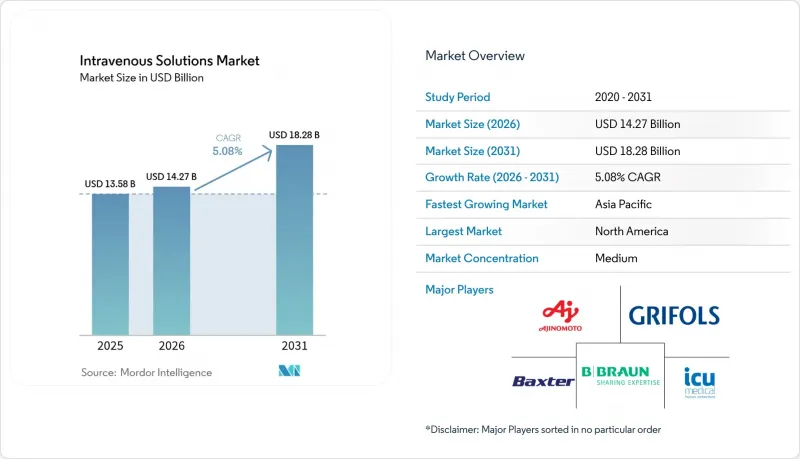
본 보고서는 유형별(완전 정맥 영양, 말초 정맥 영양), 용액의 조성별(생리식염수, 탄수화물 등), 포장재별(유리병, PVC 플라스틱 백 등), 최종 사용자별(병원 및 진료소 등), 지역별(북미, 유럽, 아시아태평양, 중동 및 아프리카, 남미)로 분류되어 있습니다. 시장 예측은 금액(달러)으로 제시되어 있습니다.
세계의 정맥내 수액 시장 동향 및 인사이트
AI를 활용한 맞춤형 정맥영양 프로토콜 도입
AI 기반 소프트웨어를 통해 전문의의 TPN 처방과의 일치율은 94%에 달하며, 투여 오류 발생률은 54% 감소했습니다. 연간 수만 건의 영양 처방전을 처리하는 병원에서는 1회 조제당 몇 분을 절약할 수 있어, 약제 부서의 부담을 줄이고 비용을 절감하고 있습니다. 표준화되면서도 개인화된 투여 계획은 근거에 기반한 치료 순응도를 향상시키고, 신생아 및 성인 중환자실(ICU)의 대사적 결과를 보호합니다. 확장성이 뛰어나기 때문에 전담 영양사를 두지 못한 자원이 제한된 의료 기관에게도 이 접근 방식은 매력적입니다. 그 결과, 임상 프로토콜은 수작업 계산에서 알고리즘 기반 처방으로 전환되고 있으며, 정맥내 수액 시장에서 제제의 유연성에 대한 수요가 증가하고 있습니다.
만성 질환 유병률의 꾸준한 증가
2024년, 미국 성인의 76.4%가 적어도 하나의 만성 질환을 앓고 있는 것으로 보고되었으며, 이는 비경구 수분 및 영양 공급에 의존하는 재입원 건수를 증가시키고 있습니다. 젊은 연령대의 환자들 사이에서도 다중 질환 병존이 점점 더 흔해지고 있어, 평생에 걸친 정맥 내 요법 수혜 기간이 길어지고 있습니다. 외과 의사들은 2040년까지 흉요추 고정술 건수가 29만 7,994건에 달할 것으로 예측하고 있으며, 이에 따라 수술 전후 기간의 수액 수요가 더욱 확대될 것으로 전망됩니다. 따라서 병원에서는 다제 병용 요법에 대응할 수 있는 광범위한 정맥 내 투여 플랫폼이 선호되고 있습니다. 이러한 추세는 정맥내 수액 시장의 근본적인 성장을 뒷받침하는 요인입니다.
GMP에 따른 높은 규정 준수 부담
개정된 EU 부속서 1에서는 종합적인 오염 관리 전략과 광범위한 장벽 기술이 의무화되어, 중소기업의 자본 투자 장벽이 높아지고 있습니다. 즉시 사용 가능한 용기의 유효성 검사로 인해 시장 출시까지의 기간이 최대 18개월이나 길어지며, 문서 작성에만 개발 예산의 20%가 소요되기도 합니다. 신흥 지역에서는 국가별로 상이한 규제로 인해 병행 감사가 의무화되어, 규제 대응을 위한 자원이 소모되고 있습니다. 이러한 부담이 신규 진입을 저해하고 가격 경쟁을 제한함으로써, 정맥내 수액 시장의 성장을 둔화시키고 있습니다.
부문 분석
2025년에는 완전 정맥 영양(TPN)이 가장 큰 수익을 창출하여 정맥내 수액 시장 점유율의 61.72%를 차지했습니다. 현재 AI를 활용한 계산 도구를 통해 대사 마커에 맞추어 아미노산, 지질, 전해질의 투여량을 조정할 수 있게 되어, TPN은 획일적인 처방의 틀을 넘어 정밀한 치료 도구로 변모하고 있습니다. 장 기능이 손상된 신생아 병동이나 종양과 병동에서는 여전히 수요가 꾸준한 상황입니다.
말초 정맥 영양(PPN)은 시장 규모는 작지만, 8.26%라는 가장 높은 연평균 성장률(CAGR)을 나타낼 전망입니다. 재택 수액 프로그램에서는 말초 라인을 사용함으로써 중심정맥 카테터로 인한 감염 위험을 피할 수 있고, 간호 관리도 간소화되기 때문에 PPN이 선호되고 있습니다. 다실식 PPN 백은 조제 오류를 줄이고, 안정성이 향상된 제제는 수액 투여 시간을 연장하기 때문에 병원 밖에서의 도입을 촉진하고 있습니다. 그 결과, 임상의들이 위험, 비용, 환자의 편안함을 종합적으로 고려함에 따라 정맥내 수액 시장에서 각 제품의 점유율은 꾸준히 재조정되고 있습니다.
생리식염수는 2025년에도 매출 점유율 52.60%를 유지했으며, 소생술 및 희석 처치에서의 보편성을 입증하고 있습니다. 그럼에도 불구하고, 오메가-3가 강화된 지질 유제는 2026년부터 2031년에 걸쳐 연평균 성장률(CAGR) 9.02%로 확대되고 있습니다. SMOFlipid와 같은 복합 제품은 간독성을 억제하고 염증을 조절함으로써 중환자실(ICU) 환자 집단에서 측정 가능한 생존율 향상을 가져오고 있습니다.
패혈증이나 외상 후 회복기에 더 엄격한 영양 관리가 필요하다는 증거가 뒷받침되는 가운데, 단백질 가수분해물, 탄수화물 블렌드, 미량 원소 칵테일은 틈새 시장에서 성장을 이루고 있습니다. 저온 살균 후에도 생물학적 활성을 유지하는 내열성 단백질 캐리어에 대한 연구 결과, 가까운 시일 내에 콜드체인에 대한 의존도가 해소될 가능성이 있습니다. 이를 통해 새로운 시장이 개척되고, 정맥내 수액 시장의 지리적 다양성이 더욱 강화될 것입니다.
지역별 분석
북미는 선진적인 병원 네트워크와 AI 투여량 계산 소프트웨어의 조기 도입에 힘입어 2025년 매출의 39.35%를 차지하며 지역별 최대 점유율을 유지했습니다. 대통령령 제14293호 및 각 주의 병행 인센티브 정책에 힘입어 현재 중서부 지역에서 새로운 무균 충전 시설 건설이 촉진되고 있으며, 허리케인이 빈번하게 발생하는 지역으로부터의 위험 분산이 진행되고 있습니다. 높은 보험 가입률 또한 혁신적인 비PVC 백의 높은 가격 책정을 뒷받침하고 있어, 해당 지역의 정맥내 수액 시장 실적을 더욱 끌어올리고 있습니다.
아시아태평양은 2031년까지 연평균 성장률(CAGR)이 6.93%로 예측되어 가장 강력한 성장세를 보이고 있습니다. 중국 각 성의 입찰에서는 국내 생산 능력 확대가 우선시되고 있는 반면, 인도에서는 수출 계약을 위해 저비용의 충전 및 마무리 작업 인력을 활용하고 있습니다. 일본에서는 엄격한 고령자 의료 지침을 충족하는 장쇄 지방산을 풍부하게 함유한 유제의 개발에 연구 개발(R&D) 보조금이 투입되고 있습니다. 동남아시아에서 당뇨병 및 비만 유병률의 상승 역시 전해질 조절 수액에 대한 수요를 높이고 있으며, 이 지역은 수액 제제 시장의 중요한 성장 동력이 되고 있습니다.
유럽에서는 GMP 준수를 평가하는 엄격한 품질 기준을 바탕으로 꾸준한 확장이 이루어지고 있습니다. 병원에서는 DEHP가 포함되지 않은 제품의 조달을 우선시하고 있으며, 이에 따라 비PVC화가 가속화되어 프리미엄 틈새 시장이 개척되고 있습니다. 한편, 동유럽의 수탁 제조업체들은 서유럽공급 부족을 보완하기 위한 추가 생산 수주를 확보하기 위해 움직이고 있습니다. 이러한 동향들이 맞물리면서, 환경세나 약전 기준의 변경에도 불구하고 수액 제제 업계는 견조한 성장세를 유지하고 있습니다.
기타 혜택 :
- 엑셀 형식 시장 예측(ME) 시트
- 3개월간의 애널리스트 지원
자주 묻는 질문
목차
제1장 서론
제2장 조사 방법
제3장 주요 요약
제4장 시장 구도
제5장 시장 규모 및 성장 예측
제6장 경쟁 구도
제7장 시장 기회 및 향후 전망
AJY 26.08.26According to Mordor Intelligence, the intravenous solutions market size was valued at USD 13.58 billion in 2025 and estimated to grow from USD 14.27 billion in 2026 to reach USD 18.28 billion by 2031, at a CAGR of 5.08% during the forecast period (2026-2031).
This report is Segmented by Type (Total Parenteral Nutrition, Peripheral Parenteral Nutrition), Solution Composition (Saline, Carbohydrates, and More), Packaging Material (Glass Bottles, PVC Plastic Bags, and More), End User (Hospitals & Clinics, and More), and Geography (North America, Europe, Asia-Pacific, Middle East & Africa, South America). The Market Forecasts are Provided in Terms of Value (USD).
Global Intravenous Solutions Market Trends and Insights
Adoption of AI-Enabled, Personalized Parenteral Nutrition Protocols
AI-driven software now matches expert TPN orders with 94% concordance, while cutting dosing-error rates by 54%. Hospitals processing tens of thousands of nutrition prescriptions annually save minutes per preparation, freeing pharmacy labor and lowering cost. Standardized yet individualized regimens enhance evidence-based compliance and safeguard metabolic outcomes across neonatal and adult ICUs. Scalability makes the approach attractive for resource-limited centers that lack full-time nutritionists. Consequently, clinical protocols are shifting from manual calculations toward algorithm-guided prescriptions, reinforcing demand for formulation flexibility in the intravenous solutions market.
Steady Rise in Chronic Disease Prevalence
In 2024, 76.4% of US adults reported at least one chronic ailment, driving recurrent hospitalizations that depend on parenteral hydration and nutrition. Younger patients increasingly present with multimorbidity, extending lifetime exposure to IV therapy. Surgeons anticipate thoracolumbar fusion procedures to rise to 297,994 cases by 2040, creating larger perioperative fluid needs. Hospitals therefore favor broad-spectrum IV platforms capable of supporting multi-drug regimens, a trend that reinforces baseline growth in the intravenous solutions market.
High Compliance Burden Associated With GMP
Revised EU Annex 1 now requires full contamination-control strategies and extensive barrier technology, raising capital thresholds for smaller firms. Validation of ready-to-use containers prolongs launch timelines by as much as 18 months, and documentation can consume 20% of development budgets. In emerging regions, diverging national rules oblige parallel audits, draining regulatory resources. These burdens deter new entrants and limit price competition, moderating growth in the intravenous solutions market.
Other drivers and restraints analyzed in the detailed report include:
- Rapid Growth of Home-Based and Ambulatory Care Models
- Ageing Population Coupled with Increased Surgical Volumes
- Ongoing Supply-Chain Constraints
For complete list of drivers and restraints, kindly check the Table Of Contents.
Segment Analysis
Total parenteral nutrition generated the largest revenue, equal to 61.72% of intravenous solutions market share in 2025. AI-guided calculators now tailor amino-acid, lipid, and electrolyte loads to metabolic markers, transforming TPN into a precision tool rather than a static recipe. Demand remains entrenched in neonatal and oncologic wards where gut function is compromised.
Peripheral Parenteral Nutrition, although accounting for a smaller base, is forecast to post the leading 8.26% CAGR. Home infusion programs favor PPN because peripheral lines avoid central-catheter infection risk and simplify nursing care. Multi-chamber PPN bags cut compounding errors, and stability-enhanced formulations extend hang times, supporting out-of-hospital uptake. The result is a steady re-balancing of volumes inside the intravenous solutions market as clinicians weigh risk, cost, and patient comfort.
Saline maintained a 52.60% revenue share in 2025, underscoring its ubiquity in resuscitation and dilution tasks. Nevertheless, omega-3 enriched lipid emulsions are advancing at 9.02% CAGR between 2026 and 2031. Composite products such as SMOFlipid curb hepatotoxicity and modulate inflammation, creating measurable survival benefits in ICU cohorts.
Protein hydrolysates, carbohydrate blends, and trace-element cocktails enjoy niche growth as evidence supports tighter nutrient control during sepsis and trauma recovery. Research into heat-stable protein carriers that remain bioactive after pasteurization may soon eliminate cold-chain dependence, opening frontier markets and reinforcing geographical diversity of the intravenous solutions market.
Complete Report Scope:
- By Type
- Total Parenteral Nutrition (TPN)
- Peripheral Parenteral Nutrition (PPN)
- By Solution Composition
- Saline
- Carbohydrates
- Amino-acid & Protein Hydrolysates
- Lipid Emulsions
- Electrolytes, Vitamins & Trace Elements
- By Packaging Material
- Glass Bottles
- PVC Plastic Bags
- Non-PVC/Polyolefin Bags
- By End User
- Hospitals & Clinics
- Ambulatory Surgery & Infusion Centres
- Home-Care Settings
- By Geography
- North America
- United States
- Canada
- Mexico
- Europe
- Germany
- United Kingdom
- France
- Italy
- Spain
- Rest of Europe
- Asia-Pacific
- China
- Japan
- India
- Australia
- South Korea
- Rest of Asia-Pacific
- Middle East & Africa
- GCC
- South Africa
- Rest of Middle East & Africa
- South America
- Brazil
- Argentina
- Rest of South America
- North America
Geography Analysis
North America retained the largest regional stake with 39.35% of 2025 revenue, backed by advanced hospital networks and early uptake of AI dosing software. Executive Order 14293 and parallel state incentives are now underwriting new sterile-fill facilities in the Midwest, dispersing risk away from hurricane-prone regions. High insurance penetration also supports premium pricing for innovative non-PVC bags, further boosting the region's intravenous solutions market performance.
Asia-Pacific displays the strongest momentum with a forecast 6.93% CAGR through 2031. China's provincial tenders favor local capacity additions, while India leverages low-cost fill-finish labor for export contracts. Japan channels R&D subsidies into emulsions enriched with long-chain fatty acids that meet stringent geriatrics guidelines. Rising prevalence of diabetes and obesity in Southeast Asia likewise elevates demand for electrolyte-controlled solutions, making the region a critical growth engine for the intravenous solutions market.
Europe shows steady expansion anchored in stringent quality rules that reward GMP compliance. Hospitals prioritize DEHP-free sourcing, accelerating non-PVC conversion and opening premium niches. Meanwhile, Eastern European contract manufacturers bid for supplemental production to backstop Western shortages. Collectively, these dynamics keep the intravenous solutions industry resilient despite environmental taxes and evolving pharmacopoeia standards.
- Baxter
- B. Braun
- Fresenius
- Grifols
- ICU Medical
- Ajinomoto Co., Inc.
- Otsuka
- PHARMASYNTEZ JSC
- SGD Pharma
- Vifor Pharma Ltd.
- Hospira Inc. (Pfizer)
- JW Life Science Co., Ltd.
- Sichuan Kelun Pharmaceutical
- Terumo
- Aculife Healthcare Pvt. Ltd.
- SSY Group Limited
- Nipro
- Axa Parenterals Ltd.
- JMS Co., Ltd.
- Qilu Pharmaceutical Co., Ltd.
Additional Benefits:
- The market estimate (ME) sheet in Excel format
- 3 months of analyst support
TABLE OF CONTENTS
1 Introduction
- 1.1 Study Assumptions & Market Definition
- 1.2 Scope of the Study
2 Research Methodology
3 Executive Summary
4 Market Landscape
- 4.1 Market Overview
- 4.2 Market Drivers
- 4.2.1 Adoption of AI-Enabled, Personalized Parenteral Nutrition Protocols
- 4.2.2 Steady Rise in Chronic Disease Prevalence
- 4.2.3 Rapid Growth of Home-Based and Ambulatory Care Models
- 4.2.4 Ageing Global Population Coupled with Increased Surgical Intervention Volumes
- 4.2.5 Emergence of Stability-Optimized Large-Volume Parenterals
- 4.2.6 Government-Backed Onshoring Initiatives
- 4.3 Market Restraints
- 4.3.1 High Compliance Burden Associated With GMP
- 4.3.2 Ongoing Supply Chain Constraints
- 4.3.3 Environmental Scrutiny of Single-Use IV Plastics
- 4.3.4 Clinical Shift Toward Subcutaneous and Enteral Administration Routes
- 4.4 Porter's Five Forces Analysis
- 4.4.1 Threat of New Entrants
- 4.4.2 Bargaining Power of Buyers
- 4.4.3 Bargaining Power of Suppliers
- 4.4.4 Threat of Substitutes
- 4.4.5 Intensity of Competitive Rivalry
5 Market Size & Growth Forecasts (Value in USD)
- 5.1 By Type
- 5.1.1 Total Parenteral Nutrition (TPN)
- 5.1.2 Peripheral Parenteral Nutrition (PPN)
- 5.2 By Solution Composition
- 5.2.1 Saline
- 5.2.2 Carbohydrates
- 5.2.3 Amino-acid & Protein Hydrolysates
- 5.2.4 Lipid Emulsions
- 5.2.5 Electrolytes, Vitamins & Trace Elements
- 5.3 By Packaging Material
- 5.3.1 Glass Bottles
- 5.3.2 PVC Plastic Bags
- 5.3.3 Non-PVC/Polyolefin Bags
- 5.4 By End User
- 5.4.1 Hospitals & Clinics
- 5.4.2 Ambulatory Surgery & Infusion Centres
- 5.4.3 Home-Care Settings
- 5.5 By Geography
- 5.5.1 North America
- 5.5.1.1 United States
- 5.5.1.2 Canada
- 5.5.1.3 Mexico
- 5.5.2 Europe
- 5.5.2.1 Germany
- 5.5.2.2 United Kingdom
- 5.5.2.3 France
- 5.5.2.4 Italy
- 5.5.2.5 Spain
- 5.5.2.6 Rest of Europe
- 5.5.3 Asia-Pacific
- 5.5.3.1 China
- 5.5.3.2 Japan
- 5.5.3.3 India
- 5.5.3.4 Australia
- 5.5.3.5 South Korea
- 5.5.3.6 Rest of Asia-Pacific
- 5.5.4 Middle East & Africa
- 5.5.4.1 GCC
- 5.5.4.2 South Africa
- 5.5.4.3 Rest of Middle East & Africa
- 5.5.5 South America
- 5.5.5.1 Brazil
- 5.5.5.2 Argentina
- 5.5.5.3 Rest of South America
- 5.5.1 North America
6 Competitive Landscape
- 6.1 Market Concentration
- 6.2 Market Share Analysis
- 6.3 Company Profiles (includes Global level Overview, Market level overview, Core Segments, Financials as available, Strategic Information, Market Rank/Share for key companies, Products & Services, and Recent Developments)
- 6.3.1 Baxter International Inc.
- 6.3.2 B. Braun SE
- 6.3.3 Fresenius Kabi AG
- 6.3.4 Grifols S.A.
- 6.3.5 ICU Medical Inc.
- 6.3.6 Ajinomoto Co., Inc.
- 6.3.7 Otsuka Pharmaceutical Co., Ltd.
- 6.3.8 PHARMASYNTEZ JSC
- 6.3.9 SGD Pharma
- 6.3.10 Vifor Pharma Ltd.
- 6.3.11 Hospira Inc. (Pfizer)
- 6.3.12 JW Life Science Co., Ltd.
- 6.3.13 Sichuan Kelun Pharmaceutical Co., Ltd.
- 6.3.14 Terumo Corporation
- 6.3.15 Aculife Healthcare Pvt. Ltd.
- 6.3.16 SSY Group Limited
- 6.3.17 Nipro Corporation
- 6.3.18 Axa Parenterals Ltd.
- 6.3.19 JMS Co., Ltd.
- 6.3.20 Qilu Pharmaceutical Co., Ltd.
7 Market Opportunities & Future Outlook
- 7.1 White-Space & Unmet-Need Assessment


