

|
시장보고서
상품코드
2114637
이경 시장 : 시장 점유율 분석, 업계 동향 및 통계, 성장 예측(2026-2031년)Otoscope - Market Share Analysis, Industry Trends & Statistics, Growth Forecasts (2026 - 2031) |
||||||
 Mordor Intelligence
에 의하면, 이경 시장 규모는 2025년에 2억 669만 달러로 평가되었고, 2026년 2억 1,541만 달러에서 2031년까지 2억 6,481만 달러에 이를 것으로 예측되며, 예측 기간(2026-2031년) CAGR은 4.22%를 나타낼 전망입니다.
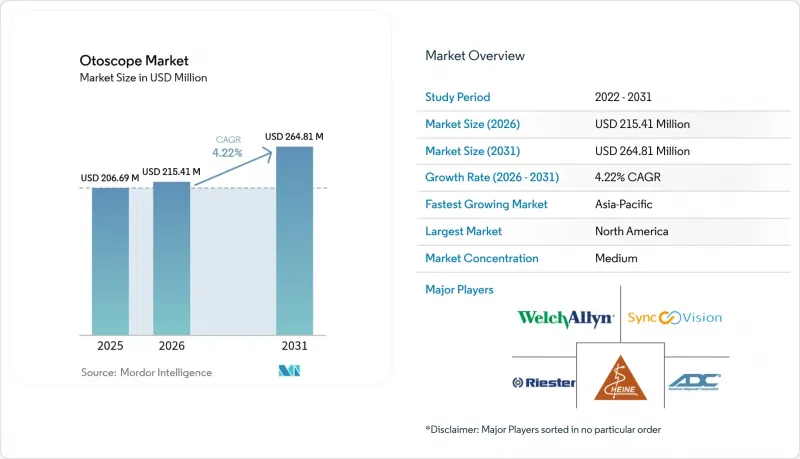
본 보고서는 제품 유형별(표준 크기 이경, 포켓 사이즈 이경), 휴대성별(휴대형, 벽걸이형), 전원별(배터리식, 전원 연결식), 용도별(진단, 외과/중재 치료), 최종 사용자별(병원, 이비인후과 클리닉, 외래수술센터(ASC), 기타), 지역별(북미, 유럽, 아시아태평양, 중동 및 아프리카, 남미)로 분류되어 있습니다.
세계의 이경 시장 동향 및 인사이트
이비인후과 관련 질환의 부담 증가
PhotoniCare사의 OtoSight 플랫폼이 보여주듯이, 보다 정밀한 이과용 영상 진단을 통해 불필요한 항생제 사용을 50% 줄일 수 있습니다. 폐렴구균 결합형 백신이 보급되고 있음에도 불구하고, 중이염의 유병률은 여전히 높은 수준을 유지하고 있어 충족되지 않은 진단 수요가 부각되고 있습니다. 2024년에 도입된 고해상도 OTO 내시경은 만성 중이염 평가에 탁월한 영상을 제공하며, Mallige Hospital과 같은 진료소의 진단 정확도를 향상시키고 있습니다. 의료 당국은 현재 예방 가능한 소아 청력 손실과 학업 성취도 간의 연관성을 지적하며, 의료 서비스가 부족한 지역의 첨단 이경기 도입 예산을 확대되고 있습니다.
디지털 및 비디오형 이경 기기의 기술적 발전
광간섭 단층 촬영(OCT) 기술 덕분에 남캘리포니아 대학교의 휴대용 기기를 통해 고막의 단면 이미지를 획득할 수 있게 되어, 기존의 이경으로는 확인할 수 없었던 고막염 등의 병변을 밝혀내고 있습니다. 심층 잔차 재귀형 신경망은 급성 중이염에 대한 임상 의사 수준의 분류를 실현하여 AI 강화형 이경 시장의 성장을 뒷받침하고 있습니다. 연구 개발 분야에서는 와세다 대학에서 개발 중인 테라헤르츠 내시경이 비침습적인 달팽이관 시각화를 가능하게 할 전망이며, 귀 질환 관리에 있어 향후 큰 도약이 기대되고 있습니다.
이비인후과 질환에 따른 사회적 편견
미국에서는 시판 제품의 이용 확대를 위한 규제 완화가 진행되고 있음에도 불구하고, 전통적인 사회에서는 미적 우려가 보청기 보급을 방해하고 있습니다. Nuance Audio의 안경과 같은 혁신적인 디자인은 세련된 프레임에 보청기를 통합하고 있지만, 그 보급을 위해서는 인식 제고 캠페인과 눈에 띄지 않는 진단 옵션이 핵심이 될 것입니다.
부문 분석
2025년, 표준 크기의 기기는 이경 시장의 55.26%를 차지한 것으로 평가되었으며, 이는 고품질 광학 시스템과 내구성이 뛰어난 구조에 대한 임상 현장의 선호도를 반영합니다. 조달 부서는 특히 액세서리 호환성이나 장기 서비스 계약이 중요한 대량 사용 환경에서 이러한 기기를 선호하여 채택하고 있습니다. 그럼에도 불구하고, 1차 진료에서의 기동성과 지역 의료로의 확대에 힘입어 포켓 사이즈 디자인은 연평균 성장률(CAGR) 5.09%로 시장을 주도할 전망입니다. 남캘리포니아 대학교가 개발한 휴대용 OCT 스코프는 고품질 영상 진단과 핸디유형의 편의성을 모두 갖추고 있습니다. 스마트폰과 연동되는 하위 부문에서는 AI를 통합하여 93.8%의 진단 민감도를 실현함으로써, 학습 곡선을 단축하는 동시에 활용 범위를 넓히고 있습니다. 생산 비용이 매출의 약 20%까지 상승한 상황에서 공급망 비용 절감이 추진됨에 따라, 콤팩트하고 재료 효율이 높은 설계가 유리해져 포켓형 모델의 보급을 뒷받침하고 있습니다.
2025년에는 휴대용 모델이 이경 시장 규모의 72.12%를 차지했으며, 5.36%라는 가장 높은 연평균 성장률(CAGR)을 나타낼 전망입니다. 이러한 이중 주도적 지위는 시장 침투의 초기 단계라기보다는 분산형 의료로의 구조적 전환을 시사합니다. OtoSpec과 같은 영상 기능을 갖춘 스코프를 통해 환자에 대한 실시간 교육이 가능해지면서 도입이 급증했습니다. 배터리 기술의 발전으로 벽걸이형 시스템과의 성능 격차가 좁혀지고 설치 부담도 줄어들었기 때문에 휴대용 모델은 원격 의료 네트워크나 학교 건강검진에서 표준적인 선택지로 자리 잡고 있습니다.
지역별 분석
북미는 보험 적용, 표준화된 이비인후과 프로토콜, 그리고 신규 이경 기기를 위한 보다 명확한 ‘데 노보(de novo)’ 절차를 포함하게 된 미국 FDA의 신속 승인 절차에 힘입어 2025년 매출의 37.15%를 차지했습니다. 캐나다의 국민건강보험 제도 덕분에 이경 검사는 1차 의료 건강 검진에 포함되어 있는 반면, 멕시코는 공립 병원의 현대화를 위해 의료기기 수입 할당량을 확대되고 있습니다.
아시아태평양은 2026-2031년 5.92%라는 가장 높은 연평균 성장률(CAGR)을 나타낼 전망입니다. 중국에서는 건강 장수에 대한 중점적인 노력과 유리한 환급 규정에 힘입어, 2025년까지 의료기기에 2,100억 달러를 지출할 것으로 예측됩니다. 인도의 ‘2023년 국가 의료기기 정책’ 및 ‘원스톱 승인 제도’로 인해 라이선스 발급 절차가 효율화되고 있지만, 2025년 의회 위원회가 지적한 지연으로 인해 일부 제조업체들은 베트남이나 말레이시아로의 이전을 검토하고 있습니다. 일본의 고도로 발달된 의사 네트워크, 호주의 국민건강보험제도, 그리고 한국의 디지털 헬스 인센티브가 이 지역의 성장세를 더욱 뒷받침하고 있습니다.
유럽에서는 임상 증거 요건 및 시판 후 심사를 강화하는 보다 엄격한 의료기기 규정(MDR) EU 2017/745가 시행되고 있음에도 불구하고, 한 자릿수 중반대의 성장률을 유지하고 있습니다. 독일, 영국, 프랑스가 도입을 주도하는 한편, 이탈리아와 스페인에서는 의료 현대화 보조금을 활용하여 이비인후과(ENT) 설비를 갱신하고 있습니다. 유럽 의회가 2025년에 요구한 MDR 개정안은 구속력 있는 적합성 평가 기한을 설정함으로써 공급 부족을 방지하는 것을 목표로 하고 있습니다.
기타 혜택 :
- 엑셀 형식 시장 예측(ME) 시트
- 3개월간의 애널리스트 지원
자주 묻는 질문
목차
제1장 서론
제2장 조사 방법
제3장 주요 요약
제4장 시장 구도
제5장 시장 규모 및 성장 예측
제6장 경쟁 구도
제7장 시장 기회 및 향후 전망
AJY 26.08.26According to Mordor Intelligence, the otoscope market size was valued at USD 206.69 million in 2025 and estimated to grow from USD 215.41 million in 2026 to reach USD 264.81 million by 2031, at a CAGR of 4.22% during the forecast period (2026-2031).
This report is Segmented by Product Type (Standard-Sized Otoscopes, Pocket-Sized Otoscopes), by Portability (Portable, Wall-Mounted), by Power Source (Battery-Operated, Mains-Powered), by Application (Diagnosis, Surgical / Interventional), by End-User (Hospitals, ENT Clinics, Ambulatory Surgery Centers, Others), by Geography (North America, Europe, Asia-Pacific, Middke East and Africa, South America).
Global Otoscope Market Trends and Insights
Growing burden of ENT-related diseases
More precise otologic imaging reduces unnecessary antibiotic use by 50%, as shown with PhotoniCare's OtoSight platform. Despite pneumococcal conjugate vaccines, otitis media prevalence remains stubborn, spotlighting unmet diagnostic needs. High-definition OTO Endoscopes introduced in 2024 deliver superior visuals for chronic otitis media assessment, enhancing diagnostic accuracy at clinics such as Mallige Hospital. Healthcare authorities now link preventable childhood hearing loss to educational performance, strengthening procurement budgets for advanced otoscopes in underserved districts.
Technological advancement in digital & video otoscopes
Optical coherence tomography (OCT) enables cross-sectional tympanic-membrane imaging via the University of Southern California's handheld device, revealing pathologies such as myringitis previously hidden from traditional scopes. Deep residual-recurrent neural networks achieve clinician-level classification of acute otitis media, underpinning AI-enhanced otoscope market growth. On the research horizon, terahertz endoscopes under development at Waseda University promise non-invasive cochlear visualization, suggesting a future leap in ear-disease management.
Social stigma associated with ENT disorders
Cosmetic concerns slow adoption of hearing assistance in traditional societies, despite United States regulatory moves to widen over-the-counter access. Innovative designs like Nuance Audio glasses embed hearing aids into stylish frames, but uptake hinges on public-awareness campaigns and discreet diagnostic options.
Other drivers and restraints analyzed in the detailed report include:
- Rising geriatric population-linked hearing disorders
- Tele-otoscopy adoption in primary care & remote triage
- Shortage of skilled ENT professionals in LMICs
For complete list of drivers and restraints, kindly check the Table Of Contents.
Segment Analysis
Standard-sized instruments controlled 55.26% of the otoscope market in 2025, reflecting clinical preference for high-end optics and durable construction. Procurement departments favor these units for high-volume environments, particularly where accessory compatibility and long-term service contracts matter. Nonetheless, pocket designs will outpace at a 5.09% CAGR, supported by primary-care mobility and community health outreach. Portable OCT scopes from the University of Southern California bridge premium imaging with handheld convenience. Smart-phone-linked sub-segments integrate AI to deliver 93.8% diagnostic sensitivity, cutting training curves and broadening access. Supply-chain savings during a period when production costs have risen to about 20% of revenue favor compact material-efficient builds, reinforcing pocket uptake.
Portable models contributed 72.12% of the otoscope market size in 2025 and will also log the fastest 5.36% CAGR. Their twin leadership position signals a structural shift toward distributed care rather than early-cycle penetration. Adoption surged when video-enabled scopes such as OtoSpec allowed real-time patient education. Battery advances narrow performance gaps with wall-mounted systems and trim installation overhead, making portable units the default choice for tele-medicine networks and school screenings.
Complete Report Scope:
- By Product Type
- Standard-sized Otoscopes
- Pocket-sized Otoscopes
- By Portability
- Portable
- Wall-mounted
- By Power Source
- Battery-operated
- Mains-powered
- By Application
- Diagnosis
- Surgical / Interventional
- By End-User
- Hospitals
- ENT Clinics
- Ambulatory Surgery Centers
- Others
- Geography
- North America
- United States
- Canada
- Mexico
- Europe
- Germany
- United Kingdom
- France
- Italy
- Spain
- Rest of Europe
- Asia-Pacific
- China
- Japan
- India
- Australia
- South Korea
- Rest of Asia-Pacific
- Middle East and Africa
- GCC
- South Africa
- Rest of Middle East and Africa
- South America
- Brazil
- Argentina
- Rest of South America
- North America
Geography Analysis
North America accounted for 37.15% of 2025 revenue, buoyed by insurance coverage, standardized ENT protocols, and expedited U.S. FDA approval pathways that now include a clearer De Novo route for novel otoscopes. Canadian universal coverage embeds otoscopy in primary-care check-ups, whereas Mexico expands device import quotas to modernize public hospitals.
Asia-Pacific posts the swiftest 5.92% CAGR during 2026-2031. China is projected to spend USD 210 billion on medical devices by 2025, spurred by healthy-aging priorities and favorable reimbursement rules. India's National Medical Devices Policy 2023 and its single-window approval system streamline licensing, though delays noted by a 2025 Parliamentary panel have driven some manufacturers to weigh relocation to Vietnam or Malaysia. Japan's advanced physician networks, Australia's universal system, and South Korea's digital-health incentives round out regional momentum.
Europe sustains mid-single-digit growth despite the stricter Medical Device Regulation (MDR) EU 2017/745, which raises clinical-evidence demands and post-market scrutiny. Germany, United Kingdom, and France lead adoption, while Italy and Spain upgrade ENT suites under health-modernization grants. The European Parliament's 2025 call for MDR revisions seeks to avoid supply shortages by setting binding conformity-assessment timelines.
- HEINE Optotechnik
- Welch Allyn (Hill-Rom / Baxter)
- Rudolf Riester
- American Diagnostic
- Kirchner & Wilhelm (KaWe)
- Midmark
- Luxamed
- Olympus
- Sync Vision
- Adam Rouilly
- Fazzini
- AUG Medical
- orlvision GmbH
- OtoNexus Medical Technologies
- Firefly Global
- Spengler SA
- Inventis SRL
- Interacoustics
Additional Benefits:
- The market estimate (ME) sheet in Excel format
- 3 months of analyst support
TABLE OF CONTENTS
1 Introduction
- 1.1 Study Assumptions & Market Definition
- 1.2 Scope of the Study
2 Research Methodology
3 Executive Summary
4 Market Landscape
- 4.1 Market Overview
- 4.2 Market Drivers
- 4.2.1 Growing burden of ENT-related diseases
- 4.2.2 Technological advancement in digital & video otoscopes
- 4.2.3 Rising geriatric population-linked hearing disorders
- 4.2.4 Expanding healthcare expenditure in emerging economies
- 4.2.5 Tele-otoscopy adoption in primary care & remote triage
- 4.2.6 School-based ear-health screening initiatives
- 4.3 Market Restraints
- 4.3.1 Social stigma associated with ENT disorders
- 4.3.2 Shortage of skilled ENT professionals in LMICs
- 4.3.3 Regulatory delays for smartphone-connected devices
- 4.3.4 Supply-chain dependence on high-precision optics
- 4.4 Value / Supply-Chain Analysis
- 4.5 Regulatory Landscape
- 4.6 Technological Outlook
- 4.7 Porter's Five Forces Analysis
- 4.7.1 Threat of New Entrants
- 4.7.2 Bargaining Power of Buyers
- 4.7.3 Bargaining Power of Suppliers
- 4.7.4 Threat of Substitutes
- 4.7.5 Intensity of Competitive Rivalry
5 Market Size & Growth Forecasts (Value)
- 5.1 By Product Type
- 5.1.1 Standard-sized Otoscopes
- 5.1.2 Pocket-sized Otoscopes
- 5.2 By Portability
- 5.2.1 Portable
- 5.2.2 Wall-mounted
- 5.3 By Power Source
- 5.3.1 Battery-operated
- 5.3.2 Mains-powered
- 5.4 By Application
- 5.4.1 Diagnosis
- 5.4.2 Surgical / Interventional
- 5.5 By End-User
- 5.5.1 Hospitals
- 5.5.2 ENT Clinics
- 5.5.3 Ambulatory Surgery Centers
- 5.5.4 Others
- 5.6 Geography
- 5.6.1 North America
- 5.6.1.1 United States
- 5.6.1.2 Canada
- 5.6.1.3 Mexico
- 5.6.2 Europe
- 5.6.2.1 Germany
- 5.6.2.2 United Kingdom
- 5.6.2.3 France
- 5.6.2.4 Italy
- 5.6.2.5 Spain
- 5.6.2.6 Rest of Europe
- 5.6.3 Asia-Pacific
- 5.6.3.1 China
- 5.6.3.2 Japan
- 5.6.3.3 India
- 5.6.3.4 Australia
- 5.6.3.5 South Korea
- 5.6.3.6 Rest of Asia-Pacific
- 5.6.4 Middle East and Africa
- 5.6.4.1 GCC
- 5.6.4.2 South Africa
- 5.6.4.3 Rest of Middle East and Africa
- 5.6.5 South America
- 5.6.5.1 Brazil
- 5.6.5.2 Argentina
- 5.6.5.3 Rest of South America
- 5.6.1 North America
6 Competitive Landscape
- 6.1 Market Concentration
- 6.2 Market Share Analysis
- 6.3 Company Profiles (includes Global level Overview, Market level overview, Core Segments, Financials as available, Strategic Information, Market Rank/Share for key companies, Products & Services, and Recent Developments)
- 6.3.1 Heine Optotechnik GmbH & Co. KG
- 6.3.2 Welch Allyn (Hill-Rom / Baxter)
- 6.3.3 Rudolf Riester GmbH
- 6.3.4 American Diagnostic Corporation
- 6.3.5 Kirchner & Wilhelm (KaWe)
- 6.3.6 Midmark Corporation
- 6.3.7 Luxamed Medizintechnik
- 6.3.8 Olympus Medical Systems
- 6.3.9 Sync Vision
- 6.3.10 Adam Rouilly
- 6.3.11 Fazzini Srl
- 6.3.12 AUG Medical
- 6.3.13 orlvision GmbH
- 6.3.14 OtoNexus Medical Technologies
- 6.3.15 Firefly Global
- 6.3.16 Spengler SA
- 6.3.17 Inventis SRL
- 6.3.18 Interacoustics A/S
7 Market Opportunities & Future Outlook
- 7.1 White-space & Unmet-need Assessment


