|
시장보고서
상품코드
2114638
페닐케톤뇨증 치료 시장 : 시장 점유율 분석, 업계 동향 및 통계, 성장 예측(2026-2031년)Phenylketonuria Treatment - Market Share Analysis, Industry Trends & Statistics, Growth Forecasts (2026 - 2031) |
||||||
 Mordor Intelligence
Mordor Intelligence에 의하면, 페닐케톤뇨증 치료 시장 규모는 2025년 9억 2,000만 달러로 평가되었고, 2026년에는 10억 1,000만 달러로 추정되고, 2026-2031년 CAGR 10.46%로 성장을 지속할 전망이며, 2031년에는 16억 6,000만 달러에 이를 것으로 예측됩니다.
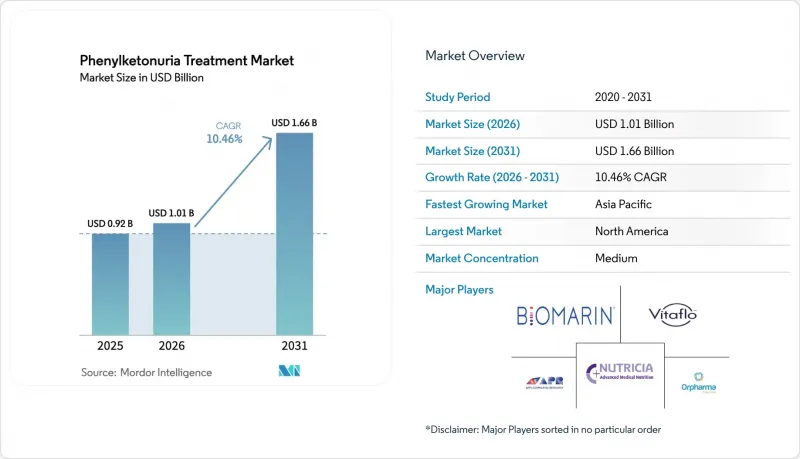
본 보고서는 약제 유형별(사프로프테린 및 그 유사체, 페그발리아제, 유전자 치료 후보 약물 등), 투여 경로별(경구, 비경구/주사), PKU 중증도별(전형 PKU 등), 최종 사용자별(병원 약국 등), 지역별(북미, 유럽, 아시아태평양, 중동 및 아프리카, 남미)로 분류되어 있습니다. 시장 예측은 금액(달러) 기준으로 제시되어 있습니다.
세계의 페닐케톤뇨증 치료 시장 동향 및 인사이트
신생아 선별검사 의무화의 진전
북미, 유럽, 일본, 한국의 보편적 선별 검사 프로그램에서는 출생 후 2일 이내에 페닐케톤뇨증을 검출하고 있으나, 중국에서는 2024년에 31개 성도로 확대됨에 따라 그동안 놓쳤던 연간 1만 4,000건의 진단이 추가되었습니다. 인도에서는 2025년, 3개 주요 주에서 실시된 시범 사업을 통해 120만 명의 영아가 선별 검사를 받았으며, 유병률은 1만 8,000명 중 1명인 것으로 밝혀졌습니다. 이는 저렴한 의료용 식품 및 향후 효소 제제에 대한 접근성과 관련된 미충족 수요를 여실히 드러내고 있습니다. 조기 발견은 인지 기능 장애의 위험을 줄여주는 한편, 치료에 있어 광범위한 불평등을 드러내고 있습니다. 고소득 시장에서는 효소 요법이나 유전자 치료로 전환이 진행되고 있는 반면, 저소득 지역에서는 페닐알라닌이 함유되지 않은 분유조차 구입할 자금을 마련하는 데 어려움을 겪고 있습니다. 장애를 미연에 방지함으로써 평생에 걸친 생산성 향상을 가져오고, 선별 검사 비용을 상쇄할 수 있기 때문에 예방을 중시하는 투자 회수 모델이 지불 주체의 결정에 점점 더 큰 영향을 미치고 있습니다.
희귀질환 치료제에 대한 규제상의 호재
2024년 3월, FDA가 세피아프테린에 ‘획기적 치료제(Breakthrough Therapy)’ 지정을 부여함에 따라 심사 기간이 6개월로 단축되어 2025년 7월 미국 시장 출시가 가능해졌습니다. 2032년까지의 희귀질환 치료제 독점권으로 인해 제네릭 의약품의 진입이 차단되어, 후원사는 프리미엄 가격을 책정할 수 있는 반면, 분기별로 페닐알라닌에 관한 실세계 데이터를 보고해야 할 의무가 부과됩니다. EMA는 2024년 7월, 페그발리아제의 소아용 프로그램 일부를 면제하여 2026년 초로 예정된 사춘기 환자 적응증 승인을 가속화했습니다. 신속한 승인 절차는 임상 비용을 절감하지만, 승인 후 위험을 높이는 결과를 초래합니다. 왜냐하면 실제 임상에서 대사 조절이 임상시험의 평가 지표에 미치지 못할 경우, 지급 기관이 수익 반환을 요구할 가능성이 있기 때문입니다. 일본은 2025년에 이러한 인센티브를 반영하여 희귀질환 치료제 개발 기업에 조화로운 3대 시장 환경을 제공했습니다.
전문 의약품의 가격 압박과 지불 기관에 의한 단계별 심사
2025년, 미국에서 페그발리아제의 청구 건 중 92%에서 식이 요법 실패를 입증하는 서류가 요구되었으며, 그 결과 승인까지 4.3개월의 지연이 발생했고, 첫 투여 전에 18%의 환자가 치료를 중단했습니다. 독일의 G-BA는 페그발리아제를 ‘경미한 기타 혜택’으로 판단하여 환급 상한선을 18만 유로(19만 5,000달러)로 설정하는 한편, 미국에 비해 38%의 할인을 의무화했습니다. 프랑스와 영국에서도 유사한 심사가 진행되고 있으며, 이로 인해 유럽 대륙 전체의 기준이 확립되면서 환자 1인당 순수익이 감소하고, 치료 결과에 기반한 리베이트에 대한 의존도가 높아지고 있습니다.
부문 분석
페그발리아제는 2025년에 페닐케톤뇨증 치료 시장 매출의 66.32%를 차지했으며, 이 분야에서 가장 큰 단일 제품 프랜차이즈를 뒷받침하고 있습니다. 그러나 유전자 치료 후보 약물은 2026-2031년 연평균 성장률(CAGR) 11.09%를 나타낼 것으로 예측되며, 일회성 치료로 완치가 가능한 치료법이 규제상의 장애물을 극복한다면 궁극적으로 시장 재편이 일어날 것임을 시사합니다. 저분자 화합물 및 합성생물학적 제제 프로그램은 여전히 실험 단계에 있으며, 2상 임상시험 데이터를 통해 지속적인 페닐알라닌 저감 효과가 입증되지 않으면 개발이 중단될 위험이 있습니다.
현재 가격 하락을 겪고 있는 사프로프테린의 제네릭 의약품은 단계적 치료법을 중시하는 의료 시스템에서는 여전히 중요하지만, 세피아프테린의 높은 반응률과 경구 투여의 편의성으로 인해 이 기존의 틈새 시장은 잠식될 것입니다. 2028년까지 유럽에서 출시될 것으로 예상되는 바이오시밀러인 페그발리아제는 브랜드 제품의 이익률을 압박하여, 기존 제조업체들이 가격 경쟁이 아닌 환자 지원 서비스 분야에서 경쟁하도록 만들 가능성이 있습니다.
페그발리아제를 배경으로 2025년 매출의 54.07%를 비경구 제제가 차지했으나, 가족들이 주사보다 정제를 선호하는 경향이 있어 경구 요법은 2031년까지 연평균 성장률(CAGR) 13.11%를 기록할 전망입니다. 세피아프테린의 보급이 정점에 달하고, 실크 필름형 PAL의 대량 생산이 정착되면, 2031년까지 페닐케톤뇨증 치료 시장에서 경구약의 점유율은 45%를 넘어설 것으로 예측됩니다. 열대 지역이나 번거로운 냉장 요건에 직면한 이동이 잦은 성인 환자에게는 상온 보관이 가능한 제형이 가장 중요합니다.
그러나 현재의 경구약 생체이용률로는 얻을 수 없는 높은 효소 활성이 필요한 전형적인 PKU 사례에서는 주사제의 우위가 여전히 지속되고 있습니다. 향후 시장 균형은 경증에서 중등도의 유전자형에는 경구용 약물, 중증 표현형에는 주사제, 그리고 적격하고 항체 음성인 환자에게는 유전자 주입 요법이라는 형태로 계층화될 가능성이 높습니다.
지역별 분석
2025년, 북미는 전 세계 매출의 49.11%를 차지했으나, 보험사가 치료 개시에 상한선을 설정하는 방식으로 개입함에 따라 성장이 둔화되고 있으며, 환자 보급률은 진단받은 환자의 약 7%에 그치고 있습니다. 곧 예정된 페그바리아제의 FDA에 의한 사춘기 환자 승인에 따라 미국에서 1,500명의 환자가 증가할 가능성이 있지만, 광범위한 예산 심사가 상승폭을 억제하고 있습니다. 캐나다의 단일 지불자 모델에서는 더 낮은 순가격이 협상되므로 수익 성장이 더욱 억제되고 있습니다.
유럽은 매출액 기준으로 2위를 차지하고 있지만, 가격에 대한 민감도가 매우 높은 지역입니다. 독일의 18만 유로 상한선과 프랑스의 유사한 가격 상한선이 EU 전체의 가격 협상에 걸림돌이 되고 있습니다. 등록 데이터를 기반으로 한 환자 추적 조사에 따르면, 성인의 대사 조절 수준은 가이드라인 목표치보다 훨씬 낮으며, 이는 미충족 의료 수요이지만, 지급 기관이 단계적 적용 제한을 완화한다면 효소 요법을 통해 해결될 가능성이 있습니다.
아시아태평양은 중국이 보편적 선별 검사를 확대하고, 일본이 2025년 희귀질환 의약품 제도를 활용하여 페그발리아제의 보험 적용을 추진함에 따라 연평균 성장률(CAGR) 14.69%를 나타낼 것으로 예측됩니다. 인도의 시범 사업은 미개척 유병률을 시사하고 있지만, 전문 의약품에 대한 국가 차원의 자금 지원이 부족합니다. 호주와 한국은 보험 적용 범위 및 고비용 치료법의 보험 적용에 대한 의지 양면에서 서유럽과 유사한 경향을 보이고 있으며, 2020년대 후반에는 유전자 주입 요법을 조기에 도입하는 국가가 될 것입니다.
중동 및 아프리카 및 남미에서는 선별 검사율이 낮고 콜드체인이 미비하여 여전히 보급이 더딘 상황입니다. 브라질이 2024년 신생아 선별 검사 항목에 PKU(페닐케톤뇨증)를 추가함에 따라 의료용 식품에 대한 잠재적 수요가 발생했으나, 효소 제제에 대한 접근은 민간 보험사에 맡겨져 있습니다. 상온 보관이 가능한 경구용 효소 제제는 후기 임상시험 결과가 발표되는 대로, 이들 지역에서 주사제를 능가할 가능성이 있습니다.
기타 혜택 :
- 엑셀 형식 시장 예측(ME) 시트
- 3개월간의 애널리스트 지원
자주 묻는 질문
목차
제1장 서론
제2장 조사 방법
제3장 주요 요약
제4장 시장 구도
제5장 시장 규모 및 성장 예측
제6장 경쟁 구도
제7장 시장 기회 및 향후 전망
AJY 26.08.26According to Mordor Intelligence, the phenylketonuria treatment market size is expected to grow from USD 0.92 billion in 2025 to USD 1.01 billion in 2026 and is forecast to reach USD 1.66 billion by 2031 at 10.46% CAGR over 2026-2031.
This report is Segmented by Drug Type (Sapropterin & Analogues, Pegvaliase, Gene Therapy Candidates, and More), Route of Administration (Oral, Parenteral/Injectable), PKU Severity (Classic PKU, and More), End User (Hospital Pharmacies, and More), and Geography (North America, Europe, Asia-Pacific, Middle East & Africa, South America). The Market Forecasts are Provided in Terms of Value (USD).
Global Phenylketonuria Treatment Market Trends and Insights
Mandatory Newborn-Screening Momentum
Universal screening programs in North America, Europe, Japan, and South Korea detect phenylketonuria within 2 days of birth, but China's 2024 expansion to 31 provincial capitals added 14,000 annual diagnoses previously missed. India's 2025 pilots in three large states screened 1.2 million babies and identified a prevalence of 1 in 18,000, underscoring the unmet demand for affordable medical foods and future access to enzymes. Early detection lessens cognitive-impairment risk yet exposes wide treatment inequities: high-income markets migrate to enzyme and gene platforms, whereas low-income regions struggle to finance even phenylalanine-free formula. Prevention-driven payback models increasingly influence payer calculus, because averting disability yields lifetime productivity gains that offset screening costs.
Regulatory Tailwinds for Orphan Drugs
The FDA's March 2024 breakthrough-therapy tag for sepiapterin compressed review to six months, enabling a July 2025 market debut in the United States. Orphan exclusivity through 2032 blocks generic entry, letting sponsors command premium pricing while mandating quarterly real-world phenylalanine reporting. The EMA waived parts of pegvaliase's pediatric program in July 2024, accelerating an adolescent label expected in early 2026. Faster pathways reduce clinical cost but heighten post-approval risk, because payers can claw back revenue if real-world metabolic control lags trial endpoints. Japan mirrored these incentives in 2025, giving rare-disease developers a harmonized tripolar market.
Specialty-Drug Pricing Pressure & Payer Step Edits
92% of U.S. pegvaliase claims required diet-failure documentation in 2025, generating a 4.3-month approval lag and 18% abandonment before the first dose. Germany's G-BA judged pegvaliase a "minor additional benefit," capping reimbursement at EUR 180,000 (USD 195,000) and requiring a 38% discount compared with the United States. Similar scrutiny in France and the United Kingdom sets a continental benchmark that lowers net revenue per patient and increases dependence on outcomes-based rebates.
Other drivers and restraints analyzed in the detailed report include:
- Diet-Liberalizing Enzyme Therapies Gain Adoption
- Oral Sepiapterin Approvals Broaden Treatable Genotypes
- Adult Adherence Drop-Off to Rigid Dietary Regimens
For complete list of drivers and restraints, kindly check the Table Of Contents.
Segment Analysis
Pegvaliase secured 66.32% of phenylketonuria treatment market revenue in 2025 and underpins the largest single-product franchise in the space. However, gene-therapy candidates have the prospective 11.09% CAGR between 2026 and 2031, signaling an eventual reshuffle once one-time cures clear regulatory hurdles. Small-molecule and synthetic-biotic programs remain experimental and risk culling if Phase 2 data fail to demonstrate durable phenylalanine reduction.
Sapropterin generics, now price-eroded, stay relevant in health systems that favor step-therapy ladders, but sepiapterin's higher response rates and oral convenience will cannibalize this legacy niche. A biosimilar pegvaliase expected in Europe by 2028 could compress branded margins and force incumbents to compete on patient support services rather than price.
Parenteral formats retained 54.07% of 2025 turnover on the back of pegvaliase, yet oral therapies are on track for a 13.11% CAGR through 2031 as families gravitate toward pills over injections. The phenylketonuria treatment market share for oral drugs should exceed 45% by 2031 once sepiapterin approaches peak uptake and silk-film PAL secures at-scale manufacturing. Ambient-stable formats matter most in tropical regions and among highly mobile adult patients who face burdensome refrigeration requirements.
Even so, injectable supremacy persists in classic PKU cases that require higher enzyme activity than current oral bioavailability allows. Future market equilibrium will likely stratify: oral drugs for mild-to-moderate genotypes, injectables for severe phenotypes, and gene infusions for those eligible and antibody-negative.
Complete Report Scope:
- By Drug Type
- Sapropterin & Analogues
- Pegvaliase
- Gene Therapy Candidates
- Synthetic Biotics & Small-Molecule Transport Inhibitors
- Other Drug Type
- By Route of Administration
- Oral
- Parenteral / Injectable
- By PKU Severity
- Classic PKU
- Moderate / Variant PKU
- Mild PKU
- Hyperphenylalaninemia
- By End User
- Hospital Pharmacies
- Retail Pharmacies
- Online Pharmacies
- By Geography
- North America
- United States
- Canada
- Mexico
- Europe
- Germany
- United Kingdom
- France
- Italy
- Spain
- Rest of Europe
- Asia-Pacific
- China
- Japan
- India
- Australia
- South Korea
- Rest of Asia-Pacific
- Middle East & Africa
- GCC
- South Africa
- Rest of Middle East & Africa
- South America
- Brazil
- Argentina
- Rest of South America
- North America
Geography Analysis
North America accounted for 49.11% of global turnover in 2025, yet growth moderates as payers step in to cap therapy initiation, and patient penetration sits near 7% of the diagnosed population. The upcoming FDA adolescent approval for pegvaliase could add 1,500 U.S. patients, but widespread budget scrutiny tempers upside. Canada's single-payer model negotiates lower net pricing, further restraining revenue growth.
Europe ranks second in revenue but is highly price-sensitive; Germany's EUR 180,000 cap and France's similar ceiling anchor EU-wide negotiations. Registration-based patient tracking shows adult metabolic control well below guideline targets, a clinical unmet need that enzyme therapies can fix if payers relax step edits.
Asia-Pacific is forecast to grow at a 14.69% CAGR as China scales universal screening and Japan leverages its 2025 orphan-drug pathway to reimburse pegvaliase. India's pilots hint at untapped prevalence but lack national funding for specialty drugs. Australia and South Korea mirror Western Europe in both coverage and willingness to reimburse high-cost therapies, making them early adopters of gene infusions later in the decade.
Middle East & Africa and South America remain underpenetrated due to low screening rates and cold-chain gaps. Brazil's inclusion of PKU in its 2024 neonatal panel creates latent demand for medical foods but leaves enzyme access to private insurers. Ambient-stable oral enzymes could leapfrog injectables in these regions once late-stage data read out.
- Abbott Laboratories
- APR Applied Pharma Research (PKU GOLIKE)
- BASF
- Biomarin Pharmaceutical
- Cambrooke Therapeutics (Danone)
- Codexis
- Daiichi Sankyo Co. Ltd.
- Dr. Reddy's Laboratories
- Erytech Pharma
- Homology Medicines
- Jnana Therapeutics
- Nutricia Advanced Medical Nutrition
- Orpharma Pty Ltd
- Par Pharmaceutical (Endo)
- PTC Therapeutics
- SOM Innovation Biotech
- Synlogic
- Ultragenyx Pharmaceutical
- Vitaflo International (Nestle Health Science)
Additional Benefits:
- The market estimate (ME) sheet in Excel format
- 3 months of analyst support
TABLE OF CONTENTS
1 Introduction
- 1.1 Study Assumptions & Market Definition
- 1.2 Scope of the Study
2 Research Methodology
3 Executive Summary
4 Market Landscape
- 4.1 Market Overview
- 4.2 Market Drivers
- 4.2.1 Mandatory Newborn-Screening Momentum
- 4.2.2 Regulatory Tailwinds for Orphan Drugs
- 4.2.3 Diet-Liberalizing Enzyme Therapies Gain Adoption
- 4.2.4 Oral Sepiapterin Approvals Broaden Treatable Genotypes
- 4.2.5 Gene-Transfer One-Time Cures Approach Late-Phase Trials
- 4.2.6 Silk-Film Oral PAL Technology Removes Cold-Chain Burden
- 4.3 Market Restraints
- 4.3.1 Specialty-Drug Pricing Pressure & Payer Step Edits
- 4.3.2 Adult Adherence Drop-Off to Rigid Dietary Regimens
- 4.3.3 Cold-Chain Logistics for Injectable Biologics in LMICs
- 4.3.4 Low BH4-Response Rates in High-Consanguinity Regions
- 4.4 Regulatory Landscape
- 4.5 Technological Outlook
- 4.6 Porter's Five Forces Analysis
- 4.6.1 Threat of New Entrants
- 4.6.2 Bargaining Power of Buyers
- 4.6.3 Bargaining Power of Suppliers
- 4.6.4 Threat of Substitute Products
- 4.6.5 Intensity of Competitive Rivalry
5 Market Size & Growth Forecasts
- 5.1 By Drug Type
- 5.1.1 Sapropterin & Analogues
- 5.1.2 Pegvaliase
- 5.1.3 Gene Therapy Candidates
- 5.1.4 Synthetic Biotics & Small-Molecule Transport Inhibitors
- 5.1.5 Other Drug Type
- 5.2 By Route of Administration
- 5.2.1 Oral
- 5.2.2 Parenteral / Injectable
- 5.3 By PKU Severity
- 5.3.1 Classic PKU
- 5.3.2 Moderate / Variant PKU
- 5.3.3 Mild PKU
- 5.3.4 Hyperphenylalaninemia
- 5.4 By End User
- 5.4.1 Hospital Pharmacies
- 5.4.2 Retail Pharmacies
- 5.4.3 Online Pharmacies
- 5.5 By Geography
- 5.5.1 North America
- 5.5.1.1 United States
- 5.5.1.2 Canada
- 5.5.1.3 Mexico
- 5.5.2 Europe
- 5.5.2.1 Germany
- 5.5.2.2 United Kingdom
- 5.5.2.3 France
- 5.5.2.4 Italy
- 5.5.2.5 Spain
- 5.5.2.6 Rest of Europe
- 5.5.3 Asia-Pacific
- 5.5.3.1 China
- 5.5.3.2 Japan
- 5.5.3.3 India
- 5.5.3.4 Australia
- 5.5.3.5 South Korea
- 5.5.3.6 Rest of Asia-Pacific
- 5.5.4 Middle East & Africa
- 5.5.4.1 GCC
- 5.5.4.2 South Africa
- 5.5.4.3 Rest of Middle East & Africa
- 5.5.5 South America
- 5.5.5.1 Brazil
- 5.5.5.2 Argentina
- 5.5.5.3 Rest of South America
- 5.5.1 North America
6 Competitive Landscape
- 6.1 Market Concentration
- 6.2 Market Share Analysis
- 6.3 Company Profiles (includes Global Level Overview, Market Level Overview, Core Segments, Financials as Available, Strategic Information, Market Rank/Share for Key Companies, Products & Services, and Recent Developments)
- 6.3.1 Abbott Laboratories
- 6.3.2 APR Applied Pharma Research (PKU GOLIKE)
- 6.3.3 BASF SE
- 6.3.4 BioMarin Pharmaceutical Inc.
- 6.3.5 Cambrooke Therapeutics (Danone)
- 6.3.6 Codexis Inc.
- 6.3.7 Daiichi Sankyo Co. Ltd.
- 6.3.8 Dr. Reddy's Laboratories
- 6.3.9 Erytech Pharma SA
- 6.3.10 Homology Medicines Inc.
- 6.3.11 Jnana Therapeutics
- 6.3.12 Nutricia Advanced Medical Nutrition
- 6.3.13 Orpharma Pty Ltd
- 6.3.14 Par Pharmaceutical (Endo)
- 6.3.15 PTC Therapeutics Inc.
- 6.3.16 SOM Innovation Biotech SL
- 6.3.17 Synlogic Inc.
- 6.3.18 Ultragenyx Pharmaceutical
- 6.3.19 Vitaflo International (Nestle Health Science)
7 Market Opportunities & Future Outlook
- 7.1 White-space & Unmet-Need Assessment