

|
시장보고서
상품코드
2114643
니트릴 의료용 장갑 : 시장 점유율 분석, 업계 동향 및 통계, 성장 예측(2026-2031년)Nitrile Medical Gloves - Market Share Analysis, Industry Trends & Statistics, Growth Forecasts (2026 - 2031) |
||||||
 Mordor Intelligence
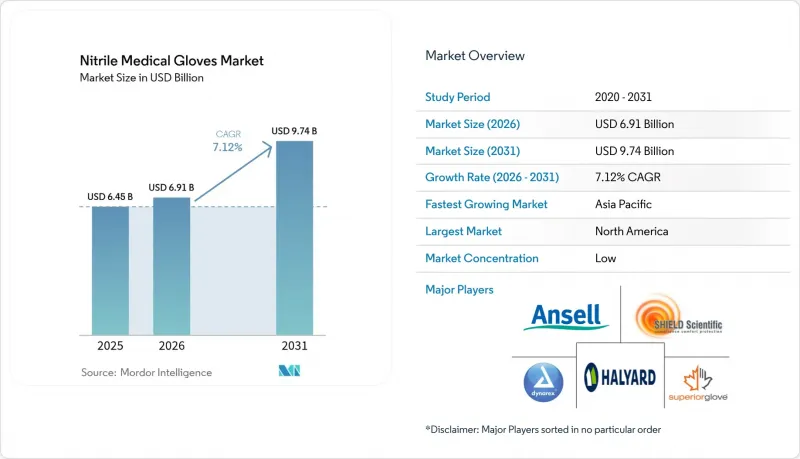
니트릴 의료용 장갑 시장 규모는 2026년에 69억 1,000만 달러로 추정되고 있으며, 2025년 64억 5,000만 달러에서 2031년에는 97억 4,000만 달러에 달할 것으로 예측됩니다.
또한, 2026년부터 2031년까지의 연평균 성장률(CAGR)은 7.12%를 기록할 것으로 전망됩니다.
본 보고서는 제품 유형(진찰용 장갑, 수술용 장갑, 화학요법용 인증 장갑), 형태(파우더 프리 및 파우더 포함), 멸균 상태(비멸균 및 멸균), 최종 사용자(병원 및 진료소, 외래수술센터(ASC), 진단실험실 등), 지역(북미, 유럽 등)별로 분류되어 있습니다. 시장 전망은 금액(달러) 기준으로 제시되어 있습니다.
전 세계 니트릴 의료용 장갑 시장 동향 및 인사이트
전 세계 외과 수술 건수 증가
현재 외래수술센터(ASC)에서는 최소 침습 수술의 시행 비율이 높아지고 있으며, 수술 전·중·후 각 단계에서 1건당 15-20켤레의 장갑이 소비되고 있습니다. 고령화와 만성 질환 유병률의 상승으로 인해 수술 건수는 증가 추세를 보이고 있으며, 이는 장갑 수요를 직접적으로 끌어올리고 있습니다. 무분 니트릴 제품은 천공 저항성과 낮은 알레르기 위험을 모두 갖추고 있어 외과 수술에서 선호되고 있습니다. 심혈관, 정형외과 및 암 치료 분야의 시술이 증가함에 따라 니트릴 의료용 장갑 시장은 꾸준한 수요 증가를 보이고 있습니다.
엄격한 감염 관리 규정 및 OSHA 준수
2024년 OSHA 개정으로 인해 검사 범위와 문서화 요건이 확대됨에 따라, 장갑은 단순한 상품이 아닌 전략적 안전 자산으로 재정의되었습니다. 병원들은 계약을 체결하기 전에 문서화된 핀홀 발생률, 인장 강도 데이터 및 추적성 기록을 신중하게 검토하고 있습니다. EU 의료기기 규정에서 제시된 유사한 요건은 성능 기준을 통일하고, 저비용 생산업체 시장 진입 장벽을 높이고 있습니다. 미국에서 의료 관련 감염에 대한 규정 준수 비용이 연간 280억-450억 달러에 달하는 만큼, 구매자들은 책임을 경감하기 위해 고품질 니트릴 제품을 점점 더 많이 선택하고 있습니다.
부타디엔 공급에 기인한 NBR 원료 가격 변동
정유시설 가동 중단으로 인한 부타디엔 공급 부족과 다가오는 천연고무 공급 부족은 비용의 40-50%를 라텍스 원료에 지출하는 제조업체에 시급한 이익률 압박을 가하고 있습니다. 의료용 등급의 대체품이 제한적이기 때문에 장갑 제조업체들은 원료 선물 거래를 통해 헤지를 하고, 공급업체를 다각화함으로써 가격 변동에 대응하고 있습니다.
부문별 분석
2025년, 진찰용 장갑은 니트릴 의료용 장갑 시장 점유율의 64.62%를 차지했습니다. 이는 모든 의료 현장에서 환자와의 일상적인 접촉에 기인한 것입니다. OSHA(미국 산업안전보건청)의 광범위한 노출 위험 정의로 인해 채혈, 이송, 검체 취급 등 모든 작업에서 일회용 보호구가 필요하기 때문에 진찰용 수요는 견조한 추세를 보이고 있습니다. 그 결과, 진찰용 제품군에 할당된 니트릴 의료용 장갑 시장 규모는 41억 7,000만 달러를 넘어섰으며, 제조업체에게는 예측 가능한 높은 생산량을 가져다주고 있습니다.
수술용 장갑은 수술 건수 증가와 외과의사들의 핀홀 규격 강화 요구가 높아짐에 따라 2031년까지 연평균 성장률(CAGR) 6.31%로 시장이 확대되고 있습니다. 현재 니트릴 의료용 장갑 시장 전체에서 차지하는 비중은 작지만, 이 부문은 무균성 검증, 정확한 사이즈 지정, 긴 커프 길이 등의 특징으로 인해 프리미엄 가격을 유지하고 있습니다. 항암 치료용 장갑은 틈새 시장이지만, 높은 이익률을 기록하는 분야를 형성하고 있습니다. 이는 종양학과 병동에서 세포 독성에 대한 내성을 확보하기 위해 더 두꺼운 소재가 요구되기 때문이며, 가치가 단순한 가격이 아닌 용도에 특화된 성능으로 전환되고 있음을 보여줍니다.
2025년 현재, 니트릴 의료용 장갑 시장 규모의 87.05%를 파우더 프리 제품이 차지하고 있으며, 이는 미국 FDA의 수술용 장갑 파우더 사용 금지 조치와 옥수수 전분으로 인한 오염에 대한 우려가 뒷받침하고 있습니다. 내부에 폴리머 코팅을 적용함으로써 장갑 착용의 편의성을 재현하고, 업무 흐름에 대한 지장을 최소화하면서 병원 내 신속한 전환을 가능하게 하고 있습니다.
현재, 파우더 처리된 장갑은 주로 위험이 낮은 산업용이나 저소득층을 대상으로 하는 의료 현장에서 제공되고 있으며, 그 시장 점유율은 극히 미미한 수준입니다. 최신 고속 성형기 및 폴리머 코팅 기술로 인해 비용 차이가 5% 미만으로 축소됨에 따라, 비용에 민감한 구매자조차도 파우더 프리 제품을 채택하게 되어 니트릴 의료용 장갑 시장 전체의 품질 수준이 향상되고 있습니다.
지역별 분석
북미는 2025년 매출의 37.20%를 차지하고 있으며, 이는 OSHA(미국 직업안전보건청)의 엄격한 규제 집행, 1인당 수술 건수의 많음, 그리고 지정학적으로 안전한 것으로 간주되는 공급망에 대한 선호도를 반영합니다. 2026년까지 중국의 장갑에 대한 미국의 관세가 25%로 인상될 예정인 만큼, 구매자들은 주문을 멕시코나 캐나다로 돌리고 있어 니어쇼어링 추세가 더욱 강화되고 있습니다. 니트릴 의료용 장갑 시장에서는 이러한 지역적 프리미엄을 포착하기 위해 북미의 신규 생산 라인에 대한 자금 투자가 진행되고 있습니다.
아시아태평양은 공립 병원 건설, 건강 보험 확대, 감염 예방에 대한 인식 제고로 장갑 보급이 가속화되어 2031년까지 7.16%라는 가장 높은 연평균 성장률(CAGR)을 기록하고 있습니다. 말레이시아와 태국의 제조업체들은 지역 내 NBR(니트릴 고무) 공급원과의 근접성과 자동화에 대한 투자를 활용하여 수출 시장에 공급함으로써, 관세로 인해 중국 경쟁사들이 제약을 받는 가운데 시장 점유율을 확대되고 있습니다. 인도네시아, 베트남, 필리핀에서는 국민건강보험 제도로 의료 접근성이 확대됨에 따라 국내 수요가 증가하고 있습니다.
유럽은 규정 준수가 주도하는 시장이며, 의료 폐기물에 대한 생산자 책임이 확대됨에 따라 조달 활동은 수명 주기 데이터를 중시하는 방향으로 전환되고 있습니다. 병원에서는 생분해성 니트릴 제품의 시범 도입이 진행되고 있으며, 환경 제품 선언(EPD)의 제시가 요구됨에 따라 공급업체는 탄소 발자국 공개를 강요받고 있습니다. 한편, 중동 및 아프리카, 남미는 규모는 작지만 두 자릿수 성장이 예상되는 인접 시장이며, 수술 건수 증가와 가격 민감도가 맞물려 중가대 니트릴 제품에 대한 수요가 촉진되고 있습니다.
기타 혜택:
- 엑셀 형식 시장 예측(ME) 시트
- 3개월간의 애널리스트 지원
자주 묻는 질문
목차
제1장 서론
제2장 조사 방법
제3장 주요 요약
제4장 시장 구도
제5장 시장 규모와 성장 예측
제6장 경쟁 구도
제7장 시장 기회와 향후 전망
LSH 26.08.26According to Mordor Intelligence, the nitrile medical gloves market size in 2026 is estimated at USD 6.91 billion, growing from 2025 value of USD 6.45 billion with 2031 projections showing USD 9.74 billion, growing at 7.12% CAGR over 2026-2031.
This report is Segmented by Product Type (Examination Gloves, Surgical Gloves and Chemotherapy-Rated Gloves), Form (Powder-Free and Powdered), Sterility (Non-Sterile and Sterile), End-User (Hospitals & Clinics, Ambulatory Surgery Centers, Diagnostic Laboratories and More) and Geography (North America, Europe and More). The Market Forecasts are Provided in Terms of Value (USD).
Global Nitrile Medical Gloves Market Trends and Insights
Rising Surgical Procedure Volumes Worldwide
Outpatient centers now perform a larger share of minimally invasive surgeries, each consuming 15-20 glove pairs across peri-operative phases. Aging demographics and chronic illness prevalence keep procedure counts on an upward trend, directly scaling glove demand. Powder-free nitrile products are preferred for surgical tasks because they combine puncture resistance with low allergenic risk. As cardiovascular, orthopedic, and cancer interventions climb, the nitrile medical gloves market absorbs steady incremental volume.
Stringent Infection-Control Regulations & OSHA Compliance
OSHA's 2024 update expanded inspection scope and documentation requirements, repositioning gloves as strategic safety assets rather than commodities. Hospitals weigh documented pin-hole rates, tensile strength data, and traceability records before awarding contracts. Similar requirements under the EU Medical Device Regulation harmonize performance baselines, raising the entry bar for low-cost producers. As compliance costs of healthcare-associated infections reach USD 28-45 billion per year in the United States, buyers increasingly select premium nitrile options to reduce liability.
Volatile NBR Raw-Material Prices Linked to Butadiene Supply
Butadiene shortages stemming from refinery outages and a looming natural-rubber gap place immediate margin pressure on manufacturers that spend 40-50% of cost on latex inputs. With limited medical-grade substitutes, glove plants hedge feedstock futures and diversify suppliers to manage swings.
Other drivers and restraints analyzed in the detailed report include:
- Shift from Latex to Nitrile Due to Allergy Concerns
- AI-Enabled Glove Defect-Detection Lines Improving Yield
- Rising Environmental Scrutiny Over Non-Biodegradable Nitrile Waste
For complete list of drivers and restraints, kindly check the Table Of Contents.
Segment Analysis
Examination gloves held 64.62% of nitrile medical gloves market share in 2025, underpinned by routine patient contact across all healthcare settings. OSHA's broad definition of exposure risk keeps examination demand resilient as every blood draw, transport, or specimen handling task requires disposable protection. As a result, the nitrile medical gloves market size allocated to examination lines surpasses USD 4.17 billion, giving manufacturers predictable high-throughput volumes.
Surgical gloves are gaining at a 6.31% CAGR through 2031 as procedure counts rise and surgeons demand tighter pin-hole specifications. Although accounting for a smaller piece of nitrile medical gloves market size today, the segment secures premium pricing because of sterility validation, exact sizing, and extended cuff lengths. Chemotherapy-rated gloves form a niche but high-margin pocket as oncology units require thicker materials for cytotoxic resistance, demonstrating how value migrates toward application-specific performance rather than price alone.
Powder-free variants represented 87.05% of nitrile medical gloves market size in 2025, fueled by the US FDA ban on surgical glove powder and cornstarch contamination concerns. Polymer-coated interiors replicate easy donning, enabling swift hospital conversion with minimal workflow disruption.
Powdered gloves now cater mainly to lower-risk industrial or low-income healthcare settings, holding a thin residual share. As modern high-speed formers and polymer coatings narrow cost gaps to under 5%, even cost-sensitive buyers adopt powder-free lines, raising the baseline quality level across the nitrile medical gloves market.
Complete Report Scope:
- By Product Type
- Examination Gloves
- Surgical Gloves
- Chemotherapy-rated Gloves
- By Form
- Powder-Free
- Powdered
- By Sterility
- Non-Sterile
- Sterile
- By End User
- Hospitals & Clinics
- Ambulatory Surgery Centers
- Diagnostic Laboratories
- Home Healthcare & Tele-medicine Kits
- Dental & Veterinary Practices
- By Geography
- North America
- United States
- Canada
- Mexico
- Europe
- Germany
- United Kingdom
- France
- Italy
- Spain
- Russia
- Rest of Europe
- Asia-Pacific
- China
- Japan
- India
- South Korea
- Australia
- Rest of Asia-Pacific
- Middle East and Africa
- GCC
- South Africa
- Rest of Middle East and Africa
- South America
- Brazil
- Argentina
- Rest of South America
- North America
Geography Analysis
North America commanded 37.20% of 2025 revenue, reflecting OSHA enforcement intensity, high per-capita surgical rates, and the preference for supply chains viewed as geopolitically secure. With US tariffs on Chinese gloves slated for 25% by 2026, buyers redirect orders to Mexico and Canada, reinforcing near-shoring trajectories. The nitrile medical gloves market sees new North American lines financed to capture that regional premium.
Asia-Pacific records the fastest 7.16% CAGR to 2031 as public-hospital construction, health-insurance expansion, and greater infection-control awareness accelerate glove penetration. Malaysian and Thai producers capitalize on regional NBR proximity and automation investment to supply export markets, gaining share as tariffs constrain Chinese competitors. Domestic demand in Indonesia, Vietnam, and the Philippines climbs as universal healthcare schemes widen access.
Europe is a compliance-driven market where extended-producer responsibility for medical waste is shaping procurement toward lifecycle data. Hospitals pilot biodegradable nitrile options and require environmental product declarations, nudging suppliers to disclose carbon footprints. Meanwhile, Middle East, Africa, and South America represent smaller but double-digit growth adjacencies, where rising surgical volumes intersect with price sensitivity, encouraging mid-tier nitrile offerings.
- Top Glove
- Hartalega Holdings
- Kossan Rubber Industries
- Supermax
- Ansell
- Cardinal Health
- Medline Industries
- Kimberly-Clark Worldwide
- Molnlycke Health Care
- Sempermed GmbH (Semperit AG)
- Sri Trang Gloves Thailand PLC
- YTY Group
- Riverstone Holdings Limited
- Careplus Group Berhad
- INTCO Medical Technology Co. Ltd.
- Zhonghong Pulin Medical Products Co. Ltd.
- Comfort Rubber Gloves Industries
- Robinson Healthcare Ltd.
- 3M
- Honeywell International
Additional Benefits:
- The market estimate (ME) sheet in Excel format
- 3 months of analyst support
TABLE OF CONTENTS
1 Introduction
- 1.1 Study Assumptions & Market Definition
- 1.2 Scope of the Study
2 Research Methodology
3 Executive Summary
4 Market Landscape
- 4.1 Market Overview
- 4.2 Market Drivers
- 4.2.1 Rising surgical procedure volumes worldwide
- 4.2.2 Stringent infection-control regulations & OSHA compliance
- 4.2.3 Shift from latex to nitrile due to allergy concerns
- 4.2.4 Capacity investments in NBR latex plants in ASEAN boosting supply & price stability
- 4.2.5 AI-enabled glove defect-detection lines improving yield & reducing cost
- 4.2.6 Surge in tele-health home-testing kits requiring disposable exam gloves
- 4.3 Market Restraints
- 4.3.1 Volatile NBR raw-material prices linked to butadiene supply
- 4.3.2 Rising environmental scrutiny over non-biodegradable nitrile waste
- 4.3.3 Over-capacity risk as pandemic-driven demand normalizes
- 4.3.4 Trade protectionism & anti-dumping duties on Asian glove exports
- 4.4 Value / Supply-Chain Analysis
- 4.5 Regulatory Landscape
- 4.6 Technological Outlook
- 4.7 Porter's Five Forces
- 4.7.1 Threat of New Entrants
- 4.7.2 Bargaining Power of Suppliers
- 4.7.3 Bargaining Power of Buyers
- 4.7.4 Threat of Substitutes
- 4.7.5 Industry Rivalry
5 Market Size & Growth Forecasts (Value)
- 5.1 By Product Type
- 5.1.1 Examination Gloves
- 5.1.2 Surgical Gloves
- 5.1.3 Chemotherapy-rated Gloves
- 5.2 By Form
- 5.2.1 Powder-Free
- 5.2.2 Powdered
- 5.3 By Sterility
- 5.3.1 Non-Sterile
- 5.3.2 Sterile
- 5.4 By End User
- 5.4.1 Hospitals & Clinics
- 5.4.2 Ambulatory Surgery Centers
- 5.4.3 Diagnostic Laboratories
- 5.4.4 Home Healthcare & Tele-medicine Kits
- 5.4.5 Dental & Veterinary Practices
- 5.5 By Geography
- 5.5.1 North America
- 5.5.1.1 United States
- 5.5.1.2 Canada
- 5.5.1.3 Mexico
- 5.5.2 Europe
- 5.5.2.1 Germany
- 5.5.2.2 United Kingdom
- 5.5.2.3 France
- 5.5.2.4 Italy
- 5.5.2.5 Spain
- 5.5.2.6 Russia
- 5.5.2.7 Rest of Europe
- 5.5.3 Asia-Pacific
- 5.5.3.1 China
- 5.5.3.2 Japan
- 5.5.3.3 India
- 5.5.3.4 South Korea
- 5.5.3.5 Australia
- 5.5.3.6 Rest of Asia-Pacific
- 5.5.4 Middle East and Africa
- 5.5.4.1 GCC
- 5.5.4.2 South Africa
- 5.5.4.3 Rest of Middle East and Africa
- 5.5.5 South America
- 5.5.5.1 Brazil
- 5.5.5.2 Argentina
- 5.5.5.3 Rest of South America
- 5.5.1 North America
6 Competitive Landscape
- 6.1 Market Concentration
- 6.2 Market Share Analysis
- 6.3 Company Profiles (includes Global level Overview, Market level overview, Core Segments, Financials as available, Strategic Information, Market Rank/Share for key companies, Products & Services, and Recent Developments)
- 6.3.1 Top Glove Corporation Berhad
- 6.3.2 Hartalega Holdings Berhad
- 6.3.3 Kossan Rubber Industries Bhd
- 6.3.4 Supermax Corporation Berhad
- 6.3.5 Ansell Limited
- 6.3.6 Cardinal Health Inc.
- 6.3.7 Medline Industries LP
- 6.3.8 Kimberly-Clark Corporation
- 6.3.9 Molnlycke Health Care AB
- 6.3.10 Sempermed GmbH (Semperit AG)
- 6.3.11 Sri Trang Gloves Thailand PLC
- 6.3.12 YTY Group
- 6.3.13 Riverstone Holdings Limited
- 6.3.14 Careplus Group Berhad
- 6.3.15 INTCO Medical Technology Co. Ltd.
- 6.3.16 Zhonghong Pulin Medical Products Co. Ltd.
- 6.3.17 Comfort Rubber Gloves Industries
- 6.3.18 Robinson Healthcare Ltd.
- 6.3.19 3M Company
- 6.3.20 Honeywell International Inc.
7 Market Opportunities & Future Outlook
- 7.1 White-space & Unmet-Need Assessment


