

|
시장보고서
상품코드
2114656
리도카인 염산염 시장 : 시장 점유율 분석, 업계 동향 및 통계, 성장 예측(2026-2031년)Lidocaine Hydrochloride - Market Share Analysis, Industry Trends & Statistics, Growth Forecasts (2026 - 2031) |
||||||
 Mordor Intelligence
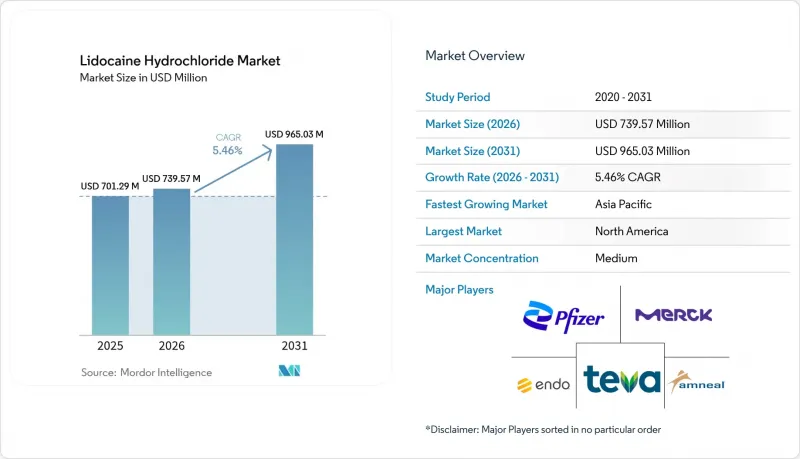
Mordor Intelligence에 의하면, 리도카인 염산염 시장 규모는 2025년 7억 129만 달러로 평가되었고, 2026년에는 7억 3,957만 달러로 추정되고, 2026-2031년 CAGR 5.46%로 성장을 지속할 전망이며, 2031년에는 9억 6,503만 달러에 이를 것으로 예측됩니다.
본 보고서에서는 시장을 제형별(크림, 패치, 주사제 등), 용도별(부정맥, 치과 시술, 간질 관리 등), 최종 사용자별(병원, 외래수술센터(ASC), 전문 클리닉), 지역별(북미, 유럽, 아시아태평양, 중동 및 아프리카, 남미)로 분류하고 있습니다. 시장 예측은 금액(달러) 기준으로 제시되어 있습니다.
세계의 리도카인 염산염 시장 동향 및 인사이트
저침습 수술 및 선택적 수술 건수 증가
외래에서 시행되는 복강경 수술 및 내시경 검사에서는 당일 퇴원이 가능한 속효성 마취제로서 리도카인에 대한 의존도가 높아지고 있습니다. 연구 결과에 따르면, 정맥 내 투여된 리도카인은 복부 수술 환자의 수술 후 통증 점수를 40% 감소시키고, 오피오이드 사용량을 줄이는 것으로 나타났습니다. 병원에서는 장기 입원에 따른 비용을 관리하기 위해 이 약물을 ‘회복 촉진 프로토콜’에 포함시키고 있습니다. 외래수술센터(ASC)들이 처리 능력을 놓고 경쟁을 벌이는 가운데, 예측 가능한 진통에 대한 수요가 높아지면서 리도카인 염산염 시장이 확대되고 있습니다. 팬데믹으로 인한 침체 이후, 선택적 수술 건수가 가장 빠르게 회복되고 있는 지역에서는 주사제의 지속적인 공급을 보장할 수 있는 공급업체가 시장 점유율을 확보하고 있습니다.
심실성 부정맥 유병률 증가
심혈관 질환은 고령화 사회에서 큰 부담이 되고 있으며, 클래스 IB 항부정맥제로서 리도카인의 임상적 사용이 증가하고 있습니다. 응급실에서는 특히 경피적 관상동맥 중재술(PCI) 시, 심장 박동 리듬을 제어하고 안정화하기 위한 리도카인의 신속한 작용과 짧은 반감기가 중요하게 여겨지고 있습니다. 개정된 프로토콜에서는 심장 카테터 검사실에서 부정맥 관련 합병증을 줄이기 위해 리도카인의 사용을 권장하고 있습니다. 신흥 경제국에서 첨단 심장 의료가 보급됨에 따라 이 약물의 대상 환자층은 더욱 확대되고 있습니다.
중추신경계 및 심혈관계에 대한 유해 작용의 위험
리도카인의 치료 범위는 여전히 좁으며, 규제 당국은 미용 시술용으로 판매되는 고농도 외용 제제를 감시하고 있습니다. 2024년 3월, FDA는 승인되지 않은 40% 리도카인 크림을 판매하던 제조업체에 경고를 발령하며 안전성 감시의 중요성을 강조했습니다. 임상의는 투여량의 유연성을 제한할 수 있는 간 기능 장애 및 메트헤모글로빈혈증의 위험에 대해 선별 검사를 실시해야 합니다. 이러한 우려로 인해, 안전성 여유가 더 넓은 대체 약물이 널리 보급되고 있는 선택적 미용 의료 현장에서는 리도카인의 사용이 제한되고 있습니다.
부문 분석
주사제 하위 부문은 외과 수술 및 응급 의료 현장에서 필수적이기 때문에 2025년 리도카인 염산염 시장 규모의 42.28%를 차지했습니다. 화이자(Pfizer)나 프레제니우스 카비(Fresenius Kabi)와 같은 기존 제조업체공급 부족으로 인해 리드타임이 길어졌지만, 한편으로는 2024년 초에 즉시 사용 가능한 바이알을 가장 먼저 도입한 기동성이 뛰어난 공급업체에게는 시장 점유율을 확대할 수 있는 호기가 되었습니다. 두 번째 성장 동력은 패치로, 의사와 환자가 비침습적 치료법을 선호하는 추세에 힘입어 2031년까지 연평균 성장률(CAGR) 7.33%를 나타낼 것으로 전망됩니다. 2025년 3월 제네릭 의약품의 승인으로, 미국에서는 3개월 이내에 단가가 35% 인하되고 보험 적용 범위가 확대되어 보급이 가속화되었습니다. 크림, 젤, 그리고 신흥 분야인 온도 반응성 나노겔은 서방형 특성이 유리한 피부과 및 구강·상처 치료 분야에서 수요를 뒷받침하고 있습니다. 고분자 나노캡슐을 채택한 나노기술 강화형 제제는 점막 투과성을 향상시켜, 이익률 유지를 목표로 하는 제조업체에게 향후 경쟁상 차별화 요소가 될 것입니다.
병원 약제부에서는 범용성이 높다는 이유로 여전히 다회 투여용 앰플이 우선시되고 있지만, 외래수술센터(ASC)에서는 조제 시간 단축 및 투약 오류 방지를 위해 프리필드 주사기의 발주가 증가하고 있습니다. 리도카인 염산염 시장에서는 수술 후 절개 부위 관리를 위해 설계된 3D 프린팅 방식의 용해형 마이크로니들 어레이 등 강력한 파이프라인이 유지되고 있습니다. 이러한 맞춤형 투여 방식의 동향은 기술 주도형 브랜드의 혁신을 통한 경쟁 우위를 확대하고, 주사제 분야의 순수한 가격 경쟁을 완화하고 있습니다. 동시에, 패치는 만성 신경병성 통증에서 나타나는 복약 순응도 문제를 해결하고 있어, 리도카인 염산염 업계 전체에서 판매량 확대를 위한 가장 매력적인 기회로 부상하고 있습니다.
지역별 분석
북미는 2025년, 성숙한 보험 환급 제도와 높은 선택적 수술 건수에 힘입어 매출 점유율 37.05%를 유지했습니다. 또한, 이 지역은 최초의 1.8% 제네릭 패치가 출시된 거점이 되어 메디케어 및 민간 보험 가입자의 접근성 확대로 이어졌습니다. 미국 의약품 부족 데이터에 따르면, 리도카인 바이알공급 부족이 반복적으로 발생하고 있으며, 이로 인해 병원 그룹은 공급처 다각화 및 장기 계약 재협상을 강요받고 있습니다.
유럽은 고령화와 신제형 승인을 신속화하는 조화된 규제 절차에 힘입어 안정적인 수요를 보이고 있습니다. 독일의 외래 진료 센터에서는 2024년 외래 관절경 수술 건수가 12% 증가했다고 보고되었으며, 이는 리도카인 소비량을 직접적으로 끌어올렸습니다. 프랑스와 이탈리아에 기인한 리도카인 염산염 시장 규모는 통증 관리 지침이 오피오이드보다 국소 투여를 권장하고 있기 때문에 견조한 한 자릿수 중반대의 성장세를 보이고 있습니다.
아시아태평양은 보험 적용 범위 확대와 국내 API 생산 능력에 대한 투자를 반영하여 8.34%라는 가장 높은 연평균 성장률(CAGR)을 기록하고 있습니다. 인도의 ‘벌크 드럭 파크(Bulk Drug Park)’ 계획은 수입 의존도를 줄이기 위해 주요 중간체의 현지 생산을 장려하고 있습니다. 중국의 바이오의약품 부문은 시설 설립 비용을 절감해 주는 성(省) 차원의 보조금 혜택을 받고 있으며, 이를 통해 리도카인 API 생산이 빠르게 확대되어 지역 제제 제조업체에 대한 공급 안정성이 강화되고 있습니다.
라틴아메리카에서는 브라질과 멕시코가 외과 의료 인프라를 정비하고 치과 관광 유입이 증가함에 따라 완만한 성장이 나타나고 있습니다. 규제 당국은 마약 부족을 방지하기 위해 주요 마취제에 대해 신속 심사를 채택하고 있으며, 이 정책은 이미 승인 신청 서류를 보유한 기업들에게 유리하게 작용하고 있습니다. 중동 및 아프리카은 여전히 발전 단계에 있지만, 도시 지역의 주요 거점에서 민간 병원 체인이 당일 수술센터를 개설함에 따라 판매량은 두 자릿수 성장을 기록하고 있습니다. 필수 마취제에 대한 공공 부문의 조달 예산 증가는 수요 기반을 확고히 하고 있으며, 공급업체들은 이를 활용하여 고품질 외용제 시장 침투를 더욱 가속화하고 있습니다.
기타 혜택 :
- 엑셀 형식 시장 전망(ME) 시트
- 3개월간의 애널리스트 지원
자주 묻는 질문
목차
제1장 서론
제2장 조사 방법
제3장 주요 요약
제4장 시장 구도
제5장 시장 규모 및 성장 예측
제6장 경쟁 구도
제7장 시장 기회 및 향후 전망
AJY 26.08.26According to Mordor Intelligence, the lidocaine hydrochloride market size is expected to grow from USD 701.29 million in 2025 to USD 739.57 million in 2026 and is forecast to reach USD 965.03 million by 2031 at 5.46% CAGR over 2026-2031.
This report Segments the Industry Into by Dosage Form (Creams, Patches, Injectables, and More), Application (Heart Arrhythmia, Dental Procedures, Epilepsy Management, and More), End User (Hospitals, Ambulatory Surgical Centers, Specialty Clinics), and Geography (North America, Europe, Asia-Pacific, Middle East and Africa, South America). The Market Forecasts are Provided in Terms of Value (USD).
Global Lidocaine Hydrochloride Market Trends and Insights
Rising Volume of Minimally Invasive & Elective Surgeries
Outpatient laparoscopic and endoscopic procedures increasingly rely on lidocaine for swift onset anesthesia that supports same-day discharge. Evidence shows that intravenous lidocaine reduces postoperative pain scores by 40% and lowers opioid consumption in abdominal surgery patients.Hospitals incorporate the drug into enhanced-recovery pathways to manage costs tied to extended admissions. As ambulatory surgical centers compete on throughput, demand for predictable analgesia augments the lidocaine hydrochloride market. Suppliers able to guarantee continuous injectable supply capture share in regions where elective surgery volumes rebound most rapidly following pandemic-related slowdowns.
Increasing Prevalence of Ventricular Arrhythmias
Cardiovascular disease burdens an aging demographic, elevating the clinical use of lidocaine as a class IB anti-arrhythmic. Emergency departments value its rapid onset and brief half-life for controlled rhythm stabilization, particularly during percutaneous coronary interventions. Updated protocols recommend lidocaine to mitigate arrhythmia-related complications in cardiac catheterization labs. Broader availability of advanced cardiac care in emerging economies further enlarges the drug's addressable patient pool.
Adverse CNS & Cardiovascular Toxicity Risks
The therapeutic window for lidocaine remains narrow, prompting regulators to monitor high-strength topical products marketed for cosmetic procedures. In March 2024 the FDA warned a manufacturer marketing unapproved 40% lidocaine creams, underscoring safety vigilance. Clinicians must screen for hepatic impairment and methemoglobinemia risk, which can limit dosing flexibility. These concerns moderate uptake in elective aesthetic settings where alternatives with wider margins of safety are gaining traction.
Other drivers and restraints analyzed in the detailed report include:
- Growing Adoption of Topical Lidocaine Patches for Neuropathic Pain
- Rapid Expansion of Dental Procedures in Emerging Economies
- Generic Price Erosion & Reimbursement Pressures
For complete list of drivers and restraints, kindly check the Table Of Contents.
Segment Analysis
The injectables sub-segment represented 42.28% of the lidocaine hydrochloride market size in 2025 owing to its indispensability in surgical and emergency settings. Supply shortages from incumbent producers such as Pfizer and Fresenius Kabi prolonged lead times, yet facilitated share gains for agile suppliers introducing ready-to-use vials early in 2024. A second growth engine stems from patches, which post a 7.33% CAGR through 2031 as physicians and patients gravitate to non-invasive regimens. The March 2025 generic approval slashed unit costs by 35% within three months in the United States, broadening payer coverage and accelerating uptake. Creams, gels, and the emerging class of thermoresponsive nanogels sustain demand in dermatology and oral-wound applications where extended release is advantageous. Nanotechnology-enhanced formats employing polymeric nanocapsules improve mucosal permeation and represent a future competitive differentiator for manufacturers seeking margin defense.
Hospital pharmacies still prioritize multidose ampoules for versatility, but ambulatory surgical centers increasingly order pre-filled syringes to minimize preparation time and medication errors. The lidocaine hydrochloride market maintains a strong pipeline of 3D-printed dissolvable microneedle arrays tailored for post-operative incision care. This personalized-delivery trend widens the innovation moat for technology-driven brands and mitigates pure price competition in the injectables space. At the same time, patches address adherence challenges in chronic neuropathic pain, presenting the most compelling opportunity for volume expansion across the lidocaine hydrochloride industry.
Complete Report Scope:
- By Dosage Form
- Creams
- Patches
- Injectables
- Gels
- Aerosol Solutions
- Other Dosage Forms
- By Application
- Heart Arrhythmia
- Dental Procedures
- Epilepsy Management
- Post-Herpetic Neuralgia
- Cosmetic Dermatology
- Other Applications
- By End User
- Hospitals
- Ambulatory Surgical Centers
- Specialty Clinics
- By Geography
- North America
- United States
- Canada
- Mexico
- Europe
- Germany
- United Kingdom
- France
- Italy
- Spain
- Rest of Europe
- Asia-Pacific
- China
- Japan
- India
- Australia
- South Korea
- Rest of Asia-Pacific
- Middle East & Africa
- GCC
- South Africa
- Rest of Middle East & Africa
- South America
- Brazil
- Argentina
- Rest of South America
- North America
Geography Analysis
North America retained a 37.05% revenue share in 2025, underpinned by mature reimbursement systems and high elective-surgery volumes. The region also became the launchpad for the first generic 1.8% patch, which broadened access for Medicare and commercial-plan beneficiaries. United States drug-shortage data reveal recurring deficits in lidocaine vials, prompting hospital groups to diversify suppliers and renegotiate long-term contracts.
Europe follows with consistent demand driven by aging populations and harmonized regulatory pathways that expedite new-format approvals. German ambulatory centers reported a 12% rise in outpatient arthroscopic procedures in 2024, directly lifting lidocaine consumption. The lidocaine hydrochloride market size attributed to France and Italy shows resilient mid-single-digit growth as pain-management guidelines endorse topical routes before opioids.
Asia-Pacific delivers the highest 8.34% CAGR, reflecting broader insurance coverage and investment in domestic API capacity. India's Bulk Drug Parks scheme incentivizes local production of key intermediates to curb dependency on imports. China's biopharmaceutical sector benefits from provincial subsidies that lower facility-setup costs, enabling quick scale-up of lidocaine API manufacturing and reinforcing supply security for regional formulators.
Latin America experiences moderate expansion as Brazil and Mexico upgrade surgical infrastructure and dental-tourism inflows increase. Regulatory agencies are adopting fast-track reviews for critical anesthetics to avert shortages, a policy that favors established dossier holders. Middle East and Africa remain nascent but record double-digit volume gains where private hospital chains open day-surgery centers in urban hubs. Increasing public-sector procurement budgets for essential anesthetics establish a baseline demand that suppliers leverage for further penetration of premium topical formats.
- Pfizer
- Merck
- Teva Pharmaceutical Industries
- Amneal Pharmaceuticals
- Endo International
- Hikma Pharmaceuticals
- Taro Pharmaceutical Industries Ltd.
- Fresenius
- Viatris
- AstraZeneca
- Johnson & Johnson
- Amphastar Pharmaceuticals
- Mahendra Chemicals
- Nortec Quimica
- Scilex Holding
- Jiangsu Tianji Pharmaceutical Co., Ltd.
- Sorrento Therapeutics
- Shanghai Nianxing Industrial Co., Ltd.
- Huons Co., Ltd.
- Alembic Pharmaceuticals Ltd.
- Dentsply Sirona
- B. Braun
Additional Benefits:
- The market estimate (ME) sheet in Excel format
- 3 months of analyst support
TABLE OF CONTENTS
1 Introduction
- 1.1 Study Assumptions & Market Definition
- 1.2 Scope of the Study
2 Research Methodology
3 Executive Summary
4 Market Landscape
- 4.1 Market Overview
- 4.2 Market Drivers
- 4.2.1 Rising Volume of Minimally-Invasive & Elective Surgeries
- 4.2.2 Increasing Prevalence of Ventricular Arrhythmias
- 4.2.3 Growing Adoption of Topical Lidocaine Patches for Neuropathic Pain
- 4.2.4 Rapid Expansion of Dental Procedures in Emerging Economies
- 4.2.5 FDA Approvals of Low-Dose High-Bioavailability Transdermal Systems
- 4.2.6 3D-Printed Personalized Lidocaine Delivery Devices
- 4.3 Market Restraints
- 4.3.1 Adverse CNS & Cardiovascular Toxicity Risks
- 4.3.2 Generic Price Erosion & Reimbursement Pressures
- 4.3.3 Volatility in Xylidine Raw-Material Supply
- 4.3.4 Stricter Solvent-Emission Regulations in API Manufacturing
- 4.4 Porter's Five Forces Analysis
- 4.4.1 Threat of New Entrants
- 4.4.2 Bargaining Power of Buyers
- 4.4.3 Bargaining Power of Suppliers
- 4.4.4 Threat of Substitute Products
- 4.4.5 Intensity of Competitive Rivalry
5 Market Size & Growth Forecasts (Value in USD)
- 5.1 By Dosage Form
- 5.1.1 Creams
- 5.1.2 Patches
- 5.1.3 Injectables
- 5.1.4 Gels
- 5.1.5 Aerosol Solutions
- 5.1.6 Other Dosage Forms
- 5.2 By Application
- 5.2.1 Heart Arrhythmia
- 5.2.2 Dental Procedures
- 5.2.3 Epilepsy Management
- 5.2.4 Post-Herpetic Neuralgia
- 5.2.5 Cosmetic Dermatology
- 5.2.6 Other Applications
- 5.3 By End User
- 5.3.1 Hospitals
- 5.3.2 Ambulatory Surgical Centers
- 5.3.3 Specialty Clinics
- 5.4 By Geography
- 5.4.1 North America
- 5.4.1.1 United States
- 5.4.1.2 Canada
- 5.4.1.3 Mexico
- 5.4.2 Europe
- 5.4.2.1 Germany
- 5.4.2.2 United Kingdom
- 5.4.2.3 France
- 5.4.2.4 Italy
- 5.4.2.5 Spain
- 5.4.2.6 Rest of Europe
- 5.4.3 Asia-Pacific
- 5.4.3.1 China
- 5.4.3.2 Japan
- 5.4.3.3 India
- 5.4.3.4 Australia
- 5.4.3.5 South Korea
- 5.4.3.6 Rest of Asia-Pacific
- 5.4.4 Middle East & Africa
- 5.4.4.1 GCC
- 5.4.4.2 South Africa
- 5.4.4.3 Rest of Middle East & Africa
- 5.4.5 South America
- 5.4.5.1 Brazil
- 5.4.5.2 Argentina
- 5.4.5.3 Rest of South America
- 5.4.1 North America
6 Competitive Landscape
- 6.1 Market Concentration
- 6.2 Market Share Analysis
- 6.3 Company Profiles (includes Global level Overview, Market level overview, Core Segments, Financials as available, Strategic Information, Market Rank/Share for key companies, Products & Services, and Recent Developments)
- 6.3.1 Pfizer Inc.
- 6.3.2 Merck KGaA
- 6.3.3 Teva Pharmaceutical Industries Ltd.
- 6.3.4 Amneal Pharmaceuticals Inc.
- 6.3.5 Endo International plc
- 6.3.6 Hikma Pharmaceuticals PLC
- 6.3.7 Taro Pharmaceutical Industries Ltd.
- 6.3.8 Fresenius Kabi AG
- 6.3.9 Viatris (Mylan N.V.)
- 6.3.10 AstraZeneca plc
- 6.3.11 Johnson & Johnson
- 6.3.12 Amphastar Pharmaceuticals Inc.
- 6.3.13 Mahendra Chemicals
- 6.3.14 Nortec Quimica
- 6.3.15 Scilex Holding Company
- 6.3.16 Jiangsu Tianji Pharmaceutical Co., Ltd.
- 6.3.17 Sorrento Therapeutics Inc.
- 6.3.18 Shanghai Nianxing Industrial Co., Ltd.
- 6.3.19 Huons Co., Ltd.
- 6.3.20 Alembic Pharmaceuticals Ltd.
- 6.3.21 Dentsply Sirona Inc.
- 6.3.22 B. Braun Melsungen AG
7 Market Opportunities & Future Outlook
- 7.1 White-space & Unmet-need Assessment


