

|
시장보고서
상품코드
2114659
유리섬유 강화 석고 시장 : 시장 점유율 분석, 업계 동향 및 통계, 성장 예측(2026-2031년)Glass Fiber Reinforced Gypsum - Market Share Analysis, Industry Trends & Statistics, Growth Forecasts (2026 - 2031) |
||||||
 Mordor Intelligence
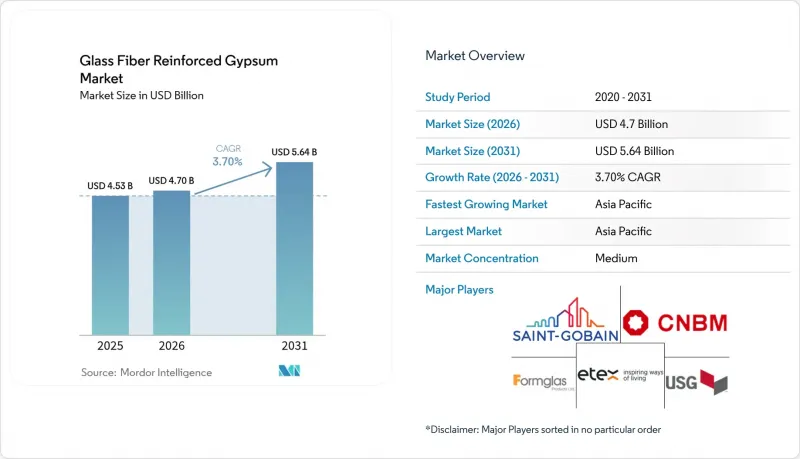
Mordor Intelligence에 의하면, 유리섬유 강화 석고 시장 규모는 2025년에 45억 3,000만 달러로 평가되었고, 2026년 47억 달러에서 2031년까지 56억 4,000만 달러에 이를 것으로 예측되며, 예측 기간(2026-2031년) CAGR은 3.70%를 나타낼 전망입니다.
본 보고서는 최종 사용자 산업별(주택, 비주택), 용도별(내장, 외장), 제품 유형별(표준, 내화, 고강도, 초경량/특수, 맞춤형 건축자재 및 키트), 그리고 지역별(아시아태평양, 북미, 유럽, 남미, 중동 및 아프리카)로 분류되어 있습니다. 시장 예측은 금액(달러) 기준으로 제시되어 있습니다.
세계의 유리섬유 강화 석고 시장 동향 및 인사이트
설치 비용 및 수명 주기 비용 절감이라는 장점
유리섬유 강화 석고는 기존 석고보드보다 가볍기 때문에 구조 하중을 줄이고 시공 속도를 높여 인건비와 프로젝트 기간을 단축합니다. 경량 패널은 대규모 보강 공사 없이 기존 기판에 직접 부착할 수 있어, 리모델링 프로젝트에서 특히 큰 이점을 제공합니다. 또한, 이 보드는 충격, 마모, 곰팡이 발생에 강하여 유지보수 빈도를 줄이고 보수 주기를 연장합니다. 인건비가 상승하고 있는 아시아태평양에서는 개발업자들이 총소유비용(TCO)을 중시하고 있어 이 소재에 대한 관심이 높아지고 있습니다. 각 제조업체는 탄소 배출량 감축에 따른 추가적인 비용 절감 효과를 강조하고 있으며, 이는 건물 소유주가 친환경 건축물 인증 기준을 충족하는 데 도움이 됩니다. 이러한 장점들이 결합되어 신축 시장과 리모델링 시장 모두에서 이 소재의 채택률이 상승하고 있습니다.
고급 인테리어 미학에 대한 수요 증가
고급 주거 타워, 호텔 및 레저 시설, 기업 사무실에서는 기존 석고로는 경제적으로 실현할 수 없는 정교한 천장 코퍼, 곡면 벽, 일체형 기둥 덮개 등이 점점 더 많이 지정되고 있습니다. GFRG는 직접 장식에 적합한 매끄러운 마감을 유지하면서 이러한 복잡한 형태를 구현합니다. 또한, 이 보드는 포름알데히드 및 VOC 배출량이 낮아, 의료 및 교육 시설에서 우선순위로 여겨지는 WELL 및 LEED의 실내 공기질 크레딧 요건을 충족합니다. 암스트롱 월드 인더스트리즈(Armstrong World Industries)는 2024년 건축용 특수 제품 부문 매출이 전년 대비 40.8% 증가했다고 보고했는데, 이는 고품질 석고 솔루션이 급속히 보급되고 있음을 보여줍니다. 뉴욕, 런던, 상하이, 두바이와 같은 디자인을 중시하는 도시 시장이 이러한 추세를 주도하고 있으며, 디지털 제조 기술을 통해 맞춤형 금형 비용이 절감됨에 따라 미적 가치의 확산이 가속화되고 있습니다.
신흥 지역의 소비자 및 시공업체 인식 부족
중국의 지방 도시, 인도의 농촌 지역, 사하라 이남 아프리카의 목수나 건식 벽체 시공 팀은 GFRG(유리 섬유 강화 석고 보드)에 관한 교육 자료가 부족하기 때문에 종종 목재나 석조와 같은 기존 자재에 의존하는 경향이 있습니다. 패널 접합부에 실란트 도포를 생략하는 등 부적절한 시공은 균열을 유발할 가능성이 있으며, 이는 부정적인 인식을 더욱 강화하는 결과를 낳고 있습니다. 각 제조업체는 기술 격차를 해소하기 위해 현장 강습회나 디지털 학습 모듈을 제공하고 있지만, 수도권 이외 지역에서의 보급 속도는 여전히 더딘 상태입니다. 이러한 지식 부족으로 인해 신흥 시장의 건설 시장을 장악하고 있는 소규모 주택 프로젝트에서의 수주량이 제한되고 있으며, 비용 및 성능 면에서 우위를 점하고 있음에도 불구하고 성장이 둔화되고 있습니다.
부문 분석
2025년에는 비주거용 프로젝트가 유리섬유 강화 석고(GFRG) 시장의 60.42%를 차지한 것으로 평가되었으며, 이 부문은 2031년까지 연평균 성장률(CAGR) 4.26%로 확대될 것으로 전망됩니다. 상업용 고층 빌딩, 병원, 공항, 학교에서는 내화 성능 기준 준수 및 설계의 자유도가 높다는 점 때문에 GFRG의 채택이 점점 늘어나고 있어, 이 부문의 우위를 강화하고 있습니다. 북미 의료시설의 리모델링 계획에서는 저휘발성 내장재가 중시되고 있어, GREENGUARD Gold 인증을 획득한 보드가 선호되고 있습니다. 또한, 공공 기관 수요는 견고한 인프라 구축에 초점을 맞춘 정부의 경기 부양책 배분으로부터도 혜택을 받고 있습니다. 주택 분야의 점유율은 여전히 작지만, 인도와 말레이시아의 저렴한 주택 공급 기관들이 하중을 견딜 수 있는 GFRG 벽 패널의 시범 도입을 추진함에 따라, 비용 측면에서의 우위가 주목받으면서 그 기세가 커지고 있습니다. 미국에서는 대형 소매점이 리프팅 장비를 사용하지 않고 작업자 2명만으로도 취급할 수 있는 경량 패널을 재고로 확보하게 되면서, DIY 분야에서의 채택이 증가하고 있습니다. 산업용도는 여전히 틈새 분야에 그치고 있지만, 주로 화재나 화학 물질에 대한 안정성이 최우선으로 요구되는 화학 플랜트나 데이터센터 등에서 이용되고 있으며, 이는 이 소재의 기술적 한계를 보여주는 실증 사례가 되고 있습니다. 전반적으로 전 세계 인프라 프로젝트의 수주 잔고와 건축 성능에 관한 규제의 엄격화를 고려할 때, 비주거 분야에서의 주도적 지위는 앞으로도 지속될 것으로 보입니다.
특히 상업시설의 인테리어는 구조 부재에 비해 칸막이 벽이나 천장의 재구성이 빈번하게 이루어지기 때문에 재구매 수요를 창출하며, 고품질 제품에 지속적인 비즈니스 기회를 제공합니다. 교육 시설에서는 사람의 왕래가 잦은 환경을 견딜 수 있도록 내충격성 표면재가 지정되어 있어, 제품 라인업의 가치를 더욱 넓히고 있습니다. 대조적으로, 주택 분야에서는 비용이 우선시되지만, 중국과 베트남의 중산층 소득 증가에 따라 GFRG로 제작된 장식용 천장 로즈와 이식형 조명용 니치에 대한 수요가 확대되고 있습니다. 기존의 회반죽 장식에 익숙했던 시공업체들이 공장 마감 처리된 GFRG로 전환하고, 현장 공사 기간을 단축함에 따라 교차 판매 기회도 생겨나고 있습니다. 이러한 부문별 차이는 다양한 성능 기준과 예산 제약에 걸쳐 이 소재가 지닌 범용성을 부각시키고 있습니다.
지역별 분석
아시아태평양의 주도적 지위는 정부의 인프라 정비 계획, 급속한 도시 지역으로의 인구 유입, 그리고 경량이며 고성능인 소재에 대한 선호 변화로 뒷받침되고 있습니다. 중국에서는 경기 부양책에 힘입은 철도, 공항, 사회주택 프로젝트 덕분에 부동산 시장의 침체에도 불구하고 벽판 생산 라인은 계속해서 풀가동되고 있습니다. 한편, 인도의 스마트 시티 구상에서는 GFRG가 복합 교통 허브에 통합되고 있습니다. 동남아시아 국가들, 특히 태국과 필리핀에서는 항만 및 물류 단지 건설이 활발해지고 있어, NFPA(미국 화재방지협회) 기준에 부합하는 방화 규정을 충족하기 위한 고품질 보드에 대한 수요가 국지적으로 발생하고 있습니다. 각 제조업체는 시공업체의 기술 향상을 도모하기 위해 이동식 연수 유닛을 운영하고 있으며, 이를 통해 해당 지역에서 도입의 주요 장벽 중 하나가 해소되고 있습니다. 환율의 안정과 경쟁력 있는 인건비 덕분에 수입 시멘트 패널보다 저렴한 가격을 책정하는 적극적인 가격 전략이 가능해져 시장 점유율 확대를 유지하고 있습니다.
북미에서는 개보수 공사 지출, 데이터센터의 급증, 그리고 저탄소 자재에 대한 연방 정부의 장려책에 기반한 견고한 기초 여건이 나타나고 있습니다. 미국 연방조달청(GSA)의 ‘저탄소 내장형’ 조달 프로그램을 통해 첨단 GFRG 배합재에 대한 연방 프로젝트 수요가 촉진되는 한편, 환경보호청(EPA)이 제공하는 1,800만 달러 규모의 청정 제조 보조금은 Scope 1 배출량을 감축하기 위한 공장 개조를 촉진하고 있습니다. 국경 관세로 인해 공급망이 재편되면서 유통업체들은 중서부 및 애팔래치아 지역 내에서 대체 조달처를 확보해야 하는 상황에 직면해 있습니다. 캐나다의 각 주에서는 더 높은 목조 건축물을 허용하도록 건축 기준이 개정되어, 간접적으로 유형 X GFRG와 같은 방화층에 대한 수요를 증가시키고 있습니다.
유럽은 탈탄소화를 전략의 중심에 두고 있습니다. 개발업자들은 일상적으로 환경 제품 선언서(EPD)를 요구하며, 내재 에너지가 낮음을 입증할 수 있는 공급업체를 우대하고 있습니다. 독일과 프랑스의 에너지 절약 개보수 보조금으로 인해 공간을 희생하지 않고도 단열성을 향상시키는 실내용 보드 오버레이에 대한 수요가 증가하고 있으며, 이는 초경량 GFRG에 가장 적합합니다. 폴란드와 루마니아와 같은 유럽의 신흥 경제국에서도 니어쇼어링의 확대에 따라 창고와 경공업 시설이 증가하고 있으며, 이들 시설은 각각 건축 기준을 준수하는 방화 칸막이가 필요하기 때문에 수요가 증가하고 있습니다. 남미에서는 브라질의 공공 주택 프로그램인 ‘Minha Casa Minha Vida’가 GFRG 샌드위치 벽 패널을 석조 자재의 대체재로 인정하기 시작했으며, 칠레의 해안 휴양지에서는 염분이 포함된 공기에 견디는 내후성 보드가 채택되고 있습니다. 중동에서는 국제 행사를 앞두고 엄격한 프로젝트 일정을 준수하면서도 장인의 수작업을 줄이고, 전통적인 이슬람 모티프를 신속하게 재현하기 위해 GFRG를 활용한 장식이 활용되고 있습니다. 이러한 세부적인 동향은 지역별 역학 관계가 정책, 거시경제의 변화, 그리고 지역 고유의 기후적 요건과 밀접하게 얽혀 있음을 보여줍니다.
기타 혜택 :
- 엑셀 형식 시장 전망(ME) 시트
- 3개월간의 애널리스트 지원
자주 묻는 질문
목차
제1장 서론
제2장 조사 방법
제3장 주요 요약
제4장 시장 구도
제5장 시장 규모 및 성장 예측
제6장 경쟁 구도
제7장 시장 기회 및 향후 전망
AJY 26.08.26According to Mordor Intelligence, the glass fiber reinforced gypsum market size was valued at USD 4.53 billion in 2025 and estimated to grow from USD 4.70 billion in 2026 to reach USD 5.64 billion by 2031, at a CAGR of 3.70% during the forecast period (2026-2031).
This report is Segmented by End-User Industry (Residential, Non-Residential), Application (Interior, Exterior), Product Type (Standard, Fire-Rated, High-Strength, Ultra-Lightweight/Specialty, Custom Architectural Elements & Kits), and Geography (Asia-Pacific, North America, Europe, South America, Middle East and Africa). The Market Forecasts are Provided in Terms of Value (USD).
Global Glass Fiber Reinforced Gypsum Market Trends and Insights
Lower Installation & Life-Cycle Cost Advantage
Glass fiber reinforced gypsum weighs less than traditional gypsum board, trims structural loads, and accelerates installation, thereby cutting labor outlays and project schedules. Retrofit projects benefit most because lighter panels allow direct attachment over existing substrates without extensive reinforcement. The boards also resist impact, abrasion, and mold growth, reducing maintenance frequency and extending refurbishment cycles. Developer focus on total cost of ownership in Asia-Pacific, where labor costs are rising, is intensifying interest in the material. Manufacturers highlight additional savings tied to lower embodied carbon, which can help building owners meet green-building certification thresholds. These combined advantages lift specification rates in both new-build and renovation markets.
Rising Demand for Premium Interior Aesthetics
High-end residential towers, hospitality venues, and corporate offices increasingly specify intricate ceiling coffers, curved walls, and monolithic column enclosures that conventional gypsum cannot deliver economically. GFRG enables such complex geometries while maintaining a smooth finish suitable for direct decoration. The boards achieve low formaldehyde and VOC emissions, aligning with WELL and LEED interior air-quality credits, a priority in healthcare and education facilities. Armstrong World Industries reported a 40.8% year-on-year jump in architectural specialties revenue in 2024, illustrating fast adoption of premium gypsum solutions. Design-laden urban markets such as New York, London, Shanghai, and Dubai are fueling the trend, and the aesthetic pull-through accelerates as digital fabrication techniques make custom molds more economical.
Low Consumer & Installer Awareness in Emerging Regions
Carpenters and drywall crews in secondary Chinese cities, rural India, and sub-Saharan Africa often default to wood or masonry because training materials for GFRG are scarce. Misapplication-such as omitting sealant on panel joints-can lead to cracking, reinforcing negative perceptions. Manufacturers sponsor on-site clinics and digital modules to bridge the skills gap, yet uptake outside capital cities is gradual. The knowledge deficit limits order volumes in small-scale residential projects that dominate emerging-market construction, tempering growth despite favorable cost and performance metrics.
Other drivers and restraints analyzed in the detailed report include:
- Valorization of Flue-Gas-Desulfurization (FGD) Gypsum Waste
- Government-Led Affordable-Housing Pilots Adopting GFRG
- Moisture-Susceptibility Concerns in High-Humidity Climates
For complete list of drivers and restraints, kindly check the Table Of Contents.
Segment Analysis
Non-residential projects captured 60.42% of the glass fiber reinforced gypsum market share in 2025, and the segment is forecast to advance at 4.26% CAGR through 2031. Commercial towers, hospitals, airports, and schools increasingly specify GFRG for its fire-rating compliance and design freedom, strengthening the segment's lead. Renovation programs across North American healthcare facilities emphasize low-emission interiors, favoring GREENGUARD Gold-certified boards. Institutional demand also benefits from government stimulus allocations focused on resilient infrastructure. The residential slice remains smaller but is gathering pace as affordable-housing agencies in India and Malaysia pilot load-bearing GFRG wall panels, highlighting cost advantages. DIY adoption in the United States is rising as big-box retailers stock lightweight panels that can be handled by two workers without lifting equipment. Industrial applications remain niche-predominantly chemical plants and data centers where fire and chemical stability are paramount-but serve as proof points for the material's technical ceiling. Overall, non-residential leadership is likely to persist given the backlog of global infrastructure projects and stricter building-performance mandates.
Commercial interiors in particular drive repeat volume because partition walls and ceilings undergo more frequent reconfiguration than structural elements, opening recurring opportunities for premium products. Educational facilities specify impact-resistant faces to withstand high foot traffic, expanding the value mix. In contrast, the residential segment prioritizes cost, but rising middle-class incomes in China and Vietnam are unlocking demand for decorative ceiling roses and recessed lighting niches made from GFRG. Cross-selling opportunities emerge as contractors accustomed to classical plaster ornaments pivot toward factory-finished GFRG, shortening on-site schedules. The segment split underscores the versatility of the material across divergent performance thresholds and budget constraints.
Complete Report Scope:
- By End-user Industry
- Residential
- Non-Residential
- Commercial
- Institutional
- Industrial
- By Application
- Interior
- Exterior
- By Product Type
- Standard (Type S)
- Fire-Rated (Type X)
- High-Strength (Type C)
- Ultra-Lightweight/Specialty
- Custom Architectural Elements and Kits
- By Geography
- Asia-Pacific
- China
- Japan
- India
- South Korea
- ASEAN Countries
- Rest of Asia-Pacific
- North America
- United States
- Canada
- Mexico
- Europe
- Germany
- United Kingdom
- France
- Italy
- Spain
- Russia
- NORDIC Countries
- Rest of Europe
- South America
- Brazil
- Argentina
- Rest of South America
- Middle East and Africa
- Saudi Arabia
- South Africa
- Rest of Middle East and Africa
- Asia-Pacific
Geography Analysis
Asia-Pacific's leadership rests on government infrastructure pipelines, rapid urban migration, and an evolving preference for lightweight, high-performance materials. China's stimulus-backed rail, airport, and social-housing projects keep wallboard lines busy despite real-estate softness, while India's smart-city initiatives integrate GFRG into multi-modal transit hubs. Southeast Asian nations, notably Thailand and the Philippines, intensify port and logistics-park construction, creating pockets of premium board demand to satisfy NFPA-aligned fire codes. Manufacturers deploy mobile training units to raise installer proficiency, thereby easing one of the region's principal adoption constraints. Exchange-rate stability and competitive labor costs permit aggressive pricing strategies that undercut imported cement panels, preserving share gains.
North America follows with strong fundamentals rooted in renovation spending, data-center proliferation, and federal incentives for low-carbon materials. The U.S. General Services Administration's low embodied-carbon procurement program unlocks federal project demand for advanced GFRG formulations, while the EPA's USD 18 million clean-manufacturing grants catalyze factory upgrades to lower Scope 1 emissions. Border tariffs reshape supply chains, prompting distributors to secure alternate sources within the Midwest and Appalachia. Canadian provinces update building codes to allow taller wood-frame structures, indirectly increasing demand for fire-barrier layers such as Type X GFRG.
Europe centers its strategy on decarbonization. Developers routinely request Environmental Product Declarations, rewarding suppliers that can document lower embodied energy. Energy-retrofit subsidies in Germany and France push demand for interior board overlays that improve thermal resistance without sacrificing space, an ideal fit for ultra-lightweight GFRG. Emerging European economies-Poland, Romania-also climb as nearshoring expands warehousing and light-industrial stock, each requiring code-compliant fire partitions. In South America, Brazil's Minha Casa Minha Vida subsidized-housing program begins to accept GFRG sandwich wall panels as a substitute for masonry, and Chilean coastal resorts use weather-resistant boards to withstand saline air. The Middle East leans on GFRG ornamentation to replicate traditional Islamic motifs quickly, trimming artisan labor while hitting tight project timelines ahead of international events. Collectively, these nuances illustrate that regional dynamics intertwine policy, macroeconomic shifts, and localized climatic demands.
- AWI Licensing LLC
- China National Building Material Group Corporation
- CHIYODA UTE CO.,LTD.
- Etex Group
- Formglas Products Ltd.
- GC Products LLC
- GP Industrial Plasters LLC
- Hyde Park Mouldings, Inc.
- Saint-Gobain
- Stromberg Architectural
- USG Corporation
Additional Benefits:
- The market estimate (ME) sheet in Excel format
- 3 months of analyst support
TABLE OF CONTENTS
1 Introduction
- 1.1 Study Assumptions and Market Definition
- 1.2 Scope of the Study
2 Research Methodology
3 Executive Summary
4 Market Landscape
- 4.1 Market Overview
- 4.2 Market Drivers
- 4.2.1 Lower installation and life-cycle cost advantage
- 4.2.2 Rising demand for premium interior aesthetics
- 4.2.3 Stringent fire-safety building codes
- 4.2.4 Valorization of flue-gas-desulfurization (FGD) gypsum waste
- 4.2.5 Government-led affordable-housing pilots adopting glass fiber reinforced gypsum
- 4.3 Market Restraints
- 4.3.1 Low consumer and installer awareness in emerging regions
- 4.3.2 Moisture-susceptibility concerns in high-humidity climates
- 4.3.3 Shortage of skilled labour for complex GFRG mouldings
- 4.4 Value Chain Analysis
- 4.5 Porter's Five Forces Analysis
- 4.5.1 Threat of New Entrants
- 4.5.2 Bargaining Power of Buyers
- 4.5.3 Bargaining Power of Suppliers
- 4.5.4 Threat of Substitute Products
- 4.5.5 Degree of Competition
5 Market Size and Growth Forecasts (Value)
- 5.1 By End-user Industry
- 5.1.1 Residential
- 5.1.2 Non-Residential
- 5.1.2.1 Commercial
- 5.1.2.2 Institutional
- 5.1.2.3 Industrial
- 5.2 By Application
- 5.2.1 Interior
- 5.2.2 Exterior
- 5.3 By Product Type
- 5.3.1 Standard (Type S)
- 5.3.2 Fire-Rated (Type X)
- 5.3.3 High-Strength (Type C)
- 5.3.4 Ultra-Lightweight/Specialty
- 5.3.5 Custom Architectural Elements and Kits
- 5.4 By Geography
- 5.4.1 Asia-Pacific
- 5.4.1.1 China
- 5.4.1.2 Japan
- 5.4.1.3 India
- 5.4.1.4 South Korea
- 5.4.1.5 ASEAN Countries
- 5.4.1.6 Rest of Asia-Pacific
- 5.4.2 North America
- 5.4.2.1 United States
- 5.4.2.2 Canada
- 5.4.2.3 Mexico
- 5.4.3 Europe
- 5.4.3.1 Germany
- 5.4.3.2 United Kingdom
- 5.4.3.3 France
- 5.4.3.4 Italy
- 5.4.3.5 Spain
- 5.4.3.6 Russia
- 5.4.3.7 NORDIC Countries
- 5.4.3.8 Rest of Europe
- 5.4.4 South America
- 5.4.4.1 Brazil
- 5.4.4.2 Argentina
- 5.4.4.3 Rest of South America
- 5.4.5 Middle East and Africa
- 5.4.5.1 Saudi Arabia
- 5.4.5.2 South Africa
- 5.4.5.3 Rest of Middle East and Africa
- 5.4.1 Asia-Pacific
6 Competitive Landscape
- 6.1 Market Concentration
- 6.2 Strategic Moves
- 6.3 Market Share(%)/Ranking Analysis
- 6.4 Company Profiles (includes Global level Overview, Market level overview, Core Segments, Financials as available, Strategic Information, Market Rank/Share for key companies, Products and Services, and Recent Developments)
- 6.4.1 AWI Licensing LLC
- 6.4.2 China National Building Material Group Corporation
- 6.4.3 CHIYODA UTE CO.,LTD.
- 6.4.4 Etex Group
- 6.4.5 Formglas Products Ltd.
- 6.4.6 GC Products LLC
- 6.4.7 GP Industrial Plasters LLC
- 6.4.8 Hyde Park Mouldings, Inc.
- 6.4.9 Saint-Gobain
- 6.4.10 Stromberg Architectural
- 6.4.11 USG Corporation
7 Market Opportunities and Future Outlook
- 7.1 White-space and Unmet-need Assessment


