|
시장보고서
상품코드
2114660
지오그리드 시장 : 시장 점유율 분석, 업계 동향 및 통계, 성장 예측(2026-2031년)Geogrids - Market Share Analysis, Industry Trends & Statistics, Growth Forecasts (2026 - 2031) |
||||||
 Mordor Intelligence
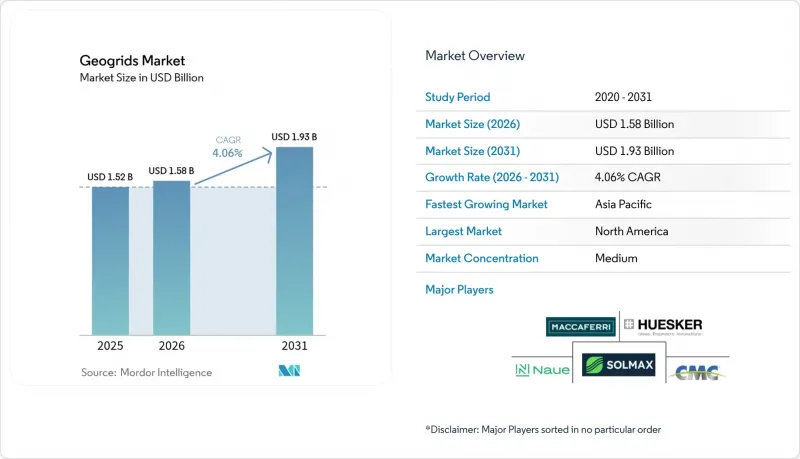
Mordor Intelligence에 의하면, 지오그리드 시장 규모는 2025년에 15억 2,000만 달러로 평가되었고, 2026년 15억 8,000만 달러에서 2031년까지 19억 3,000만 달러에 이를 것으로 추정되며, 예측 기간(2026-2031년) CAGR은 4.06%를 나타낼 전망입니다.
본 보고서는 소재별(폴리프로필렌, 폴리에틸렌, 폴리에스터, 기타), 구조 유형별(단축, 이축, 삼축), 제조 방법별(압출 성형, 편직/직조, 접착/용접), 용도별(도로 건설, 지반 보강, 철도 안정화, 기타), 지역별(아시아태평양, 북미, 유럽, 남미, 중동 및 아프리카)로 분류되어 있습니다.
세계의 지오그리드 시장 동향 및 인사이트
포장 수명 연장 목표의 급증
교통 기관은 두께에 기반한 경험칙에 의한 설계에서 40-100년의 내구 연수에 걸쳐 지오그리드를 통합함으로써 얻는 증분적 이점을 정량화하는 역학 및 경험칙에 기반한 접근 방식으로 전환하고 있습니다. 층 계수 비율 계산을 통해 더 얇은 보강 포장에서도 동등한 피로 성능을 발휘할 수 있음이 입증되었으며, 이는 예산 제약이 있는 관할 구역에 직접적인 도움이 됩니다. 미국 각 주 당국은 지반이 취약한 구간의 표준 시방서에 지오그리드를 포함하기 시작했으며, 이러한 움직임은 EU 회원국 몇 곳에서도 유사하게 나타나고 있습니다. 이러한 행동의 변화로 인해 초기 비용보다 수명 주기 비용이 더욱 중요시되면서, 현장에서 검증된 성능 데이터를 보유한 제품에 대한 관심이 높아지고 있습니다. 그 결과 발생한 수요 증가는 신속한 시공과 차선 통제 기간의 최소화가 요구되는 개보수 공사 계약에서 가장 두드러집니다. 그 결과, 지오그리드 시장에서는 포장 유지보수 예산과 미뤄졌던 유지관리에 배정된 경기 부양책에 따른 수요 견인력이 강화되고 있습니다.
경량 지오솔루션을 뒷받침하는 탄소 감축 의무
현재 일부 관할 구역에서는 입찰 평가의 일환으로 ‘총 내재 탄소량’이 고려되고 있으며, 이에 따라 시공사들은 골재 운반 및 아스팔트 생산에 따른 배출량을 정량화해야 합니다. 독립적인 조사에 따르면, 지오그리드로 보강된 노반층은 자재 운송량을 28-45% 줄일 수 있으며, 2차선 도로의 경우 58-85 tCO2e/km의 감축으로 이어지는 것으로 나타났습니다. 도로 건설로 인한 배출량의 95% 이상이 자재 생산에서 비롯된다는 점을 고려할 때, 이러한 이점은 결정적인 비중을 차지합니다. 프랑스와 북유럽 국가들에서는 선구적인 노력의 일환으로, 탄소 감축을 가격 이외의 평가 기준으로 다루는 조달 템플릿이 작성되었으며, 이 모델은 현재 미국 각 주 교통국(DOT)으로도 확산되고 있습니다. 제3자 기관의 검증 데이터를 통해 탄소 감축 효과를 입증할 수 있는 공급업체는 저탄소 시범 프로그램에서 우선적인 지위를 얻을 수 있습니다. 장기적으로는 공공 자금을 활용한 교통 프로젝트에서 수명 주기 인벤토리 공개가 의무화될 것으로 예상되며, 지오그리드는 설계의 주류로 더욱 깊게 자리 잡을 것입니다.
폴리프로필렌 및 HDPE의 가격 변동
폴리프로필렌 현물 가격의 급등은 고정 가격의 공공 계약에 묶여 있는 제조업체의 이익률을 압박하고 있습니다. 위험을 완화하기 위해 생산자들은 원자재 가격 변동 위험을 헤지하고 폴리에스테르로 다각화를 꾀하고 있지만, 대량으로 사용되는 도로 분야에서는 폴리프로필렌이 주류를 이루고 있어 대체는 부분적인 수준에 그치고 있습니다. 가격의 불확실성은 프로젝트 예산 편성도 복잡하게 만들고 있으며, 일부 기관에서는 지오그리드 입찰을 연기하거나 가격 조정 조항을 포함할 것을 요구하는 움직임이 나타나고 있습니다. 단기적으로는 이러한 가격 변동이 비용에 민감한 지방 도로 사업에서 지오그리드의 채택을 저해하여, 지오그리드 시장에 강력한 구조적 촉진요인이 있음에도 불구하고 신흥국에서의 추가 수요를 억제할 가능성이 있습니다.
부문 분석
2025년 지오그리드 시장에서 폴리프로필렌의 기여율은 43.78%를 기록하며 전 세계 매출에서 가장 큰 점유율을 차지했습니다. 절대값으로 보아도 폴리프로필렌 부문은 다른 어떤 소재보다 지오그리드 시장 규모에서 점유율이 컸습니다. 이는 인장 효율, 화학적 비활성, 가격 경쟁력 덕분에 추가적인 수지 개질제를 사용하지 않고도 대부분의 고속도로 사양을 충족할 수 있기 때문입니다.
그러나 같은 데이터에 따르면, 폴리에스테르 부문은 연평균 성장률(CAGR) 5.32%로 확대되고 있으며, 이는 각 소재 중 가장 급격한 성장 궤적을 보이고 있습니다. 이는 엔지니어들이 장기간 하중을 지탱하는 구조물에서 크리프 저항성을 우선시하기 때문입니다. 폴리에스테르는 지속적인 응력 하에서도 산화 열화가 잘 일어나지 않는 특성 덕분에, 수십 년에 걸쳐 끊임없는 중력의 인력을 견뎌야 하는 높은 성토나 보강된 급경사지에서 선호되는 선택지가 되고 있습니다. 설계 컨설팅 회사들은 높이 10미터를 초과하는 구조물에 대해 폴리에스터 채택을 점점 더 권장하고 있으며, 도시의 무질서한 확장으로 인해 교통 회랑이 외곽 지역으로 밀려나면서 이 사양의 틈새 시장은 확대되고 있습니다.
2025년에는 이축 지오그리드가 전 세계 매출의 45.21%를 차지했으며, 지오그리드 시장의 구조적 계층 구조를 확립했습니다. 이러한 우위는 수십 년에 걸친 설계 지침, 풍부한 현장 데이터, 그리고 단위 비용을 낮추는 제조상의 규모의 경제에서 비롯됩니다. 표준 연포장 보수를 수행하는 엔지니어들은 지침 문서에 해당 강성 프로파일에 맞추어 조정된 교통 상당 두께 계수가 기재되어 있기 때문에 많은 경우 2축 지오그리드를 기본 옵션으로 채택하고 있습니다.
그럼에도 불구하고, 3축 그리드는 연평균 성장률(CAGR) 5.05%로 시장을 확대하고 있으며, 전 방향에서 발생하는 교통 패턴으로 인해 골재 계면에서 높은 전단력이 발생하는 고하중 조건에서 채택이 점점 더 늘어나고 있습니다. 독립 시험 기관의 시험 결과, 3축 그리드는 모든 방향으로의 상호 잠금을 가능하게 하는 방사형 리브 배열 덕분에, 반복적인 차륜 하중 하에서 2축 그리드보다 30-40% 더 효과적으로 영구 변형을 저감할 수 있는 것으로 밝혀졌습니다.
지역별 분석
북미는 인프라 투자 및 고용법에 의해 승인된 3,500억 달러 규모의 연방 고속도로 자금을 바탕으로 2025년 매출의 39.01%를 차지했습니다. 각 주 교통국(DOT)의 사양서에서는 지오그리드 인증과 관련하여 AASHTO R50 절차가 일상적으로 인용되고 있어, 수요가 사실상 제도화되어 있습니다. 캘리포니아주, 텍사스주, 뉴욕주의 포장 유지 관리 방식은 두께 추가에서 기계적 안정화로 전환되고 있으며, 차선 킬로미터 증가세가 둔화되고 있음에도 불구하고 단위당 채택량은 증가하고 있습니다.
아시아태평양은 중국, 인도, 인도네시아, 베트남의 고속도로 및 철도 메가 프로젝트에 힘입어 2031년까지 연평균 성장률(CAGR)이 4.74%로 가장 빠르게 성장하는 지역이 되고 있습니다. 중국의 각 성에서는 하얼빈-이춘 회랑 등의 고속도로 노선에서 동결이 발생하기 쉬운 성토에 지오그리드를 채택하고 있는 반면,인도의 국가고속도로청은 바라트마라 파리요자나 계획에서 팽창성 점토 노반에 인장 강도 등급의 PET 지오그리드 사용을 의무화하고 있습니다. 풍부한 인프라 건설 계획과 지반 조건의 과제가 맞물리면서, 아시아태평양의 지오그리드 시장은 세계 평균을 상회하는 성장 궤도를 유지하고 있습니다.
유럽에서는 기존 네트워크의 개보수 및 자재 효율이 높은 보강을 권장하는 엄격한 탄소 감축 규제가 시장의 원동력이 되고 있습니다. 프랑스 인프라 총국은 전층 포장 재활용 시 지오그리드 사용을 규정하고 있으며, 영국의 인프라 전략에서는 제품 선정을 넷제로 목표와 연계하고 있습니다.
이 3개 지역 외에도 남미에서는 민관 협력(PPP) 모델이 활용되고 있으며, 걸프협력회의(GCC) 회원국에서는 사막 지대를 횡단하는 신규 건설 회랑에 자금이 투입되고 있습니다. 어떤 상황에서도 지오그리드는 노반의 강성 부족이나 모래로 인한 차선 흔적 발생을 억제하여, 전 세계 지오그리드 시장의 확대에 기여하고 있습니다.
기타 혜택 :
- 엑셀 형식 시장 예측(ME) 시트
- 3개월간의 애널리스트 지원
자주 묻는 질문
목차
제1장 서론
제2장 조사 방법
제3장 주요 요약
제4장 시장 구도
제5장 시장 규모 및 성장 예측
제6장 경쟁 구도
제7장 시장 기회 및 향후 전망
AJY 26.08.26According to Mordor Intelligence, the geogrids market size was valued at USD 1.52 billion in 2025 and estimated to grow from USD 1.58 billion in 2026 to reach USD 1.93 billion by 2031, at a CAGR of 4.06% during the forecast period (2026-2031).
This report is Segmented by Material (Polypropylene, Polyethylene, Polyester, and Others), Structural Type (Uniaxial, Biaxial, and Triaxial), Manufacturing Method (Extrusion, Knitted/Woven, and Bonded/Welded), Application (Road Construction, Soil Reinforcement, Railroad Stabilisation, and Others), and Geography (Asia-Pacific, North America, Europe, South America, and Middle-East and Africa).
Global Geogrids Market Trends and Insights
Surge in Pavement Life-Cycle Extension Targets
Transport agencies are shifting from thickness-based empirical design toward mechanistic-empirical approaches that quantify the incremental benefit of geogrid inclusion over a 40- to 100-year life. Layer Coefficient Ratio calculations prove that thinner reinforced pavements can deliver identical fatigue performance, directly supporting budget-constrained jurisdictions. United States state departments have begun embedding geogrids in standard specifications for weak-subgrade corridors, a practice mirrored in several EU member states. This behavioural change elevates lifecycle cost over first cost, heightening interest in products with robust field performance data. The resulting demand uptick is most visible in rehabilitation contracts, where agencies seek rapid construction and minimal lane closure times. Consequently, the geogrids market registers increased pull-through from pavement preservation budgets and stimulus allocations earmarked for deferred maintenance.
Carbon-Reduction Mandates Favouring Lightweight Geo-Solutions
Several jurisdictions now score bids partly on total embodied carbon, prompting contractors to quantify emissions from aggregate haulage and asphalt production. Independent studies show geogrid-reinforced base layers can shrink material haulage volumes by 28 to 45%, translating into 58 to 85 tCO2e/km savings on two-lane highways. With material production accounting for more than 95% of road-building emissions, this benefit carries decisive weight. Early movers in France and the Nordics have created procurement templates that treat carbon reduction as a non-price criterion, a model now spreading to US state DOTs. Suppliers able to substantiate carbon savings with third-party verified data gain preferred status on low-carbon pilot programs. Over the long term, lifecycle inventory disclosure is expected to become mandatory on publicly funded transportation projects, embedding geogrids deeper into mainstream design.
Price Volatility of Polypropylene and HDPE
Spikes in polypropylene spot values compress margins for manufacturers locked into fixed-price public contracts. To buffer risk, producers hedge feedstock exposure and diversify toward polyester, yet substitution remains partial because polypropylene dominates high-volume roads. Price uncertainty also complicates project budgeting, leading some agencies to postpone geogrid tenders or seek escalation clauses. Over the near term, volatility is likely to deter adoption in cost-sensitive rural road programs, trimming incremental demand in emerging economies despite strong structural drivers for the geogrids market.
Other drivers and restraints analyzed in the detailed report include:
- Rapid Expansion of Expressway Networks in Developing Economies
- Mining Haul-Road Reinforcement Demand
- Fragmented Certification Standards Across Regions
For complete list of drivers and restraints, kindly check the Table Of Contents.
Segment Analysis
The geogrids market registered a polypropylene contribution of 43.78% in 2025, translating into the single-largest slice of global revenues. In absolute terms, the polypropylene segment commanded a larger share of the geogrids market size than any other material because its tensile efficiency, chemical inertness, and price competitiveness meet most highway specifications without additional resin modifiers.
Yet the same data show polyester advancing at a 5.32% CAGR, the sharpest trajectory among materials, as engineers prioritise creep resistance for long-term load-bearing structures. Polyester's lower susceptibility to oxidative degradation under sustained stress makes it the preferred choice for high embankments and reinforced steep slopes that must resist constant gravitational pull over decades. Design consultancies increasingly prescribe polyester for structures exceeding 10 m in height, a specification niche widening as urban sprawl pushes transport corridors onto marginal terrain.
Biaxial designs delivered 45.21% of global revenue in 2025, thereby anchoring the structural hierarchy of the geogrids market. Their dominance stems from multi-decade design guidance, abundant field data, and manufacturing economies of scale that drive down unit costs. Engineers deploying standard flexible pavement rehabilitation often default to biaxial because guidance documents contain traffic-equivalent thickness factors calibrated for its stiffness profile.
Nevertheless, triaxial units are expanding at a 5.05% CAGR and are increasingly specified for heavy-loading conditions where omnidirectional traffic patterns create high shear at aggregate interfaces. Independent laboratory tests reveal that triaxial grids can reduce permanent deformation 30-40% more effectively than biaxial under cyclic wheel loads, owing to their radial rib distribution that mobilises interlock in every direction.
Complete Report Scope:
- By Material
- Polypropylene (PP)
- Polyethylene (HDPE/LDPE)
- Polyester (PET)
- Others Materials (Fiberglass, Composite, etc.)
- By Structural Type
- Uniaxial
- Biaxial
- Triaxial
- By Manufacturing Method
- Extrusion
- Knitted/Woven
- Bonded/Welded
- By Application
- Road Construction
- Soil Reinforcement
- Railroad Stabilisation
- Other Applications (Mining and Tunnel Support, Ports, etc.)
- By Geography
- Asia-Pacific
- China
- Japan
- India
- South Korea
- ASEAN Countries
- Rest of Asia-Pacific
- North America
- United States
- Canada
- Mexico
- Europe
- Germany
- United Kingdom
- France
- Italy
- Spain
- Russia
- NORDIC Countries
- Rest of Europe
- South America
- Brazil
- Argentina
- Rest of South America
- Middle-East and Africa
- Saudi Arabia
- South Africa
- Rest of Middle-East and Africa
- Asia-Pacific
Geography Analysis
North America delivered 39.01% of 2025 revenues, underpinned by USD 350 billion of federal highway funding authorised by the Infrastructure Investment and Jobs Act. State DOT specifications routinely cite AASHTO R50 procedures for geogrid qualification, effectively institutionalising demand. Pavement preservation philosophies in California, Texas, and New York have moved from thickness-addition toward mechanical stabilisation, translating into higher unit uptake even as lane-kilometre growth slows.
Asia-Pacific ranks as the fastest-growing territory with a 4.74% CAGR through 2031, buoyed by expressway and rail megaprojects across China, India, Indonesia, and Vietnam. Chinese provinces allocate grids for frost-susceptible embankments on high-speed routes such as the Harbin-Yichun corridor, while India's National Highways Authority mandates tensile-grade PET geogrids on expansive-clay subgrades within the Bharatmala Pariyojana. Abundant infrastructure pipelines and soil-condition challenges synergize to keep the Asia-Pacific geogrids market on a higher-than-global trajectory.
Europe is driven by the rehabilitation of legacy networks and stringent carbon-reduction rules that favour material-efficient reinforcement. France's Directorate-General for Infrastructure specifies geogrids in full-depth pavement recycling, while the UK Infrastructure Strategy aligns product selection with net-zero goals.
Beyond the triad, South America leans on public-private concession models, and Gulf Cooperation Council states fund new-build corridors across desert terrain, both contexts where geogrids counteract weak subgrade stiffness and sand-induced rutting, broadening the global footprint of the geogrids market.
- ABG Limited
- ACE Geosynthetics
- Commercial Metals Company
- CTM Technical Textiles Ltd.
- Geofabrics Australasia Pty Ltd.
- HUESKER International
- Maccaferri Spa
- Naue GmbH & Co. KG
- Pietrucha International Sp. z o. o.
- Singhal Industries Pvt. Ltd.
- Solmax
- Strata Systems, Inc.
- Taian Road Engineering Materials
- TECHFABINDIA
- TENAX SpA
- Thrace Group
- Titan Environmental
Additional Benefits:
- The market estimate (ME) sheet in Excel format
- 3 months of analyst support
TABLE OF CONTENTS
1 Introduction
- 1.1 Study Assumptions and Market Definition
- 1.2 Scope of the Study
2 Research Methodology
3 Executive Summary
4 Market Landscape
- 4.1 Market Overview
- 4.2 Market Drivers
- 4.2.1 Surge in Pavement Life-Cycle Extension Targets
- 4.2.2 Carbon-Reduction Mandates Favouring Lightweight Geo-Solutions
- 4.2.3 Rapid Expansion of Expressway Network in Developing Economies
- 4.2.4 Mining Haul-Road Reinforcement Demand
- 4.2.5 Digital Twin Adoption Enabling Design-Optimised Geogrids
- 4.3 Market Restraints
- 4.3.1 Price Volatility of Polypropylene and HDPE
- 4.3.2 Fragmented Certification Standards Across Regions
- 4.3.3 Limited Installer Skillsets in Emerging Markets
- 4.4 Value Chain Analysis
- 4.5 Porter's Five Forces
- 4.5.1 Bargaining Power of Suppliers
- 4.5.2 Bargaining Power of Buyers
- 4.5.3 Threat of New Entrants
- 4.5.4 Threat of Substitute Products
- 4.5.5 Degree of Competition
5 Market Size and Growth Forecasts (Value)
- 5.1 By Material
- 5.1.1 Polypropylene (PP)
- 5.1.2 Polyethylene (HDPE/LDPE)
- 5.1.3 Polyester (PET)
- 5.1.4 Others Materials (Fiberglass, Composite, etc.)
- 5.2 By Structural Type
- 5.2.1 Uniaxial
- 5.2.2 Biaxial
- 5.2.3 Triaxial
- 5.3 By Manufacturing Method
- 5.3.1 Extrusion
- 5.3.2 Knitted/Woven
- 5.3.3 Bonded/Welded
- 5.4 By Application
- 5.4.1 Road Construction
- 5.4.2 Soil Reinforcement
- 5.4.3 Railroad Stabilisation
- 5.4.4 Other Applications (Mining and Tunnel Support, Ports, etc.)
- 5.5 By Geography
- 5.5.1 Asia-Pacific
- 5.5.1.1 China
- 5.5.1.2 Japan
- 5.5.1.3 India
- 5.5.1.4 South Korea
- 5.5.1.5 ASEAN Countries
- 5.5.1.6 Rest of Asia-Pacific
- 5.5.2 North America
- 5.5.2.1 United States
- 5.5.2.2 Canada
- 5.5.2.3 Mexico
- 5.5.3 Europe
- 5.5.3.1 Germany
- 5.5.3.2 United Kingdom
- 5.5.3.3 France
- 5.5.3.4 Italy
- 5.5.3.5 Spain
- 5.5.3.6 Russia
- 5.5.3.7 NORDIC Countries
- 5.5.3.8 Rest of Europe
- 5.5.4 South America
- 5.5.4.1 Brazil
- 5.5.4.2 Argentina
- 5.5.4.3 Rest of South America
- 5.5.5 Middle-East and Africa
- 5.5.5.1 Saudi Arabia
- 5.5.5.2 South Africa
- 5.5.5.3 Rest of Middle-East and Africa
- 5.5.1 Asia-Pacific
6 Competitive Landscape
- 6.1 Market Concentration
- 6.2 Strategic Moves
- 6.3 Market Share(%)/Ranking Analysis
- 6.4 Company Profiles (includes Global level Overview, Market level overview, Core Segments, Financials as available, Strategic Information, Market Rank/Share for key companies, Products and Services, and Recent Developments)
- 6.4.1 ABG Limited
- 6.4.2 ACE Geosynthetics
- 6.4.3 Commercial Metals Company
- 6.4.4 CTM Technical Textiles Ltd.
- 6.4.5 Geofabrics Australasia Pty Ltd.
- 6.4.6 HUESKER International
- 6.4.7 Maccaferri Spa
- 6.4.8 Naue GmbH & Co. KG
- 6.4.9 Pietrucha International Sp. z o. o.
- 6.4.10 Singhal Industries Pvt. Ltd.
- 6.4.11 Solmax
- 6.4.12 Strata Systems, Inc.
- 6.4.13 Taian Road Engineering Materials
- 6.4.14 TECHFABINDIA
- 6.4.15 TENAX SpA
- 6.4.16 Thrace Group
- 6.4.17 Titan Environmental
7 Market Opportunities and Future Outlook
- 7.1 White-space and Unmet-Need Assessment
- 7.2 Application of Geogrids in Mining Industry