

|
시장보고서
상품코드
2114661
접착 필름 : 시장 점유율 분석, 업계 동향 및 통계, 성장 예측(2026-2031년)Adhesive Films - Market Share Analysis, Industry Trends & Statistics, Growth Forecasts (2026 - 2031) |
||||||
 Mordor Intelligence
접착 필름 시장 규모는 2025년 380억 4,000만 달러에서 2026년에는 399억 2,000만 달러에 이르고, 2026-2031년 CAGR 4.93%로 성장을 지속하여 2031년에는 507억 8,000만 달러에 달할 것으로 예측됩니다.
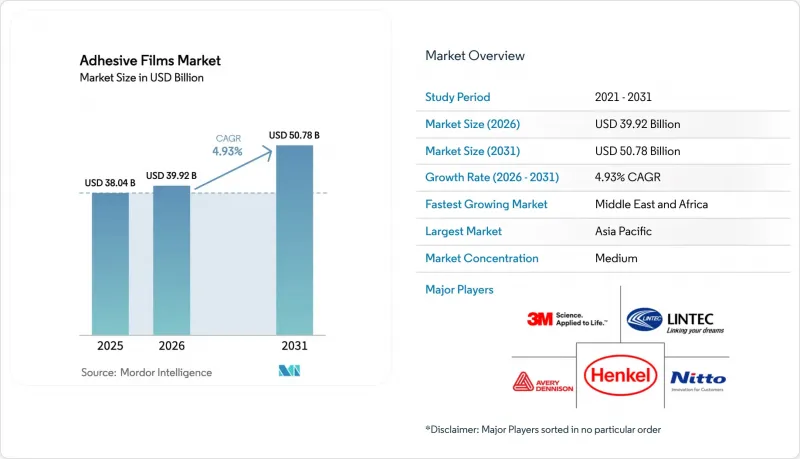
본 보고서는 소재(폴리에틸렌, 폴리프로필렌 등), 접착 기술(감압 접착제, 핫멜트 등), 용도(보호 필름, 그래픽 등), 최종 사용자 산업(포장, 자동차 및 운송 등), 지역(아시아태평양, 북미, 유럽, 남미, 중동 및 아프리카)별로 세분화되어 있습니다. 시장 예측은 금액(달러) 기준으로 제시되어 있습니다.
세계 접착 필름 시장 동향 및 인사이트
EV/ 배터리 열 관리에 대한 수요
모듈-투-팩(Module-to-Pack) 방식에서 셀-투-팩(Cell-to-Pack) 방식으로 전환하는 자동차 제조업체에게는 전기적 절연성과 3 W/m-K를 초과하는 열전도율을 모두 갖춘 필름이 요구되고 있습니다. 헨켈은 갭 패드를 대체하는 솔루션과 조립 공정의 3분의 1을 단축하는 솔루션을 바탕으로 2024년 열전도성 접착 필름 매출이 18% 증가했습니다. H.B. 풀러가 2024년에 출시한 ‘EV THERM’ 시리즈는 단일 공정으로 라미네이션이 가능하며, 70 wt%를 초과하는 세라믹 필러를 함유하고 있습니다. 2024년에는 접착제 기반의 런어웨이 배리어에 관한 특허 출원이 전년 대비 22% 증가하여, 화재 억제용 필름의 전략적 중요성이 부각되고 있습니다. 인산철 리튬 배터리 팩의 경우, 1대당 셀 수가 증가함에 따라 1대당 필름 소비량이 약 25-35% 증가합니다. UL 2580과 같은 새로운 규격에서는 85°C에서 1,000시간의 열노화 시험이 의무화되어 있어, 아크릴 계열에서 실리콘 계열 또는 폴리우레탄 계열로의 전환이 가속화되고 있습니다.
전자상거래 포장 시장의 급성장
1제곱미터당 소포 처리량은 2024년 대비 15% 급증했으며, 풀필먼트 사업자들은 1.2미터 낙하 시험을 통과하면서도 더 얇은 두께(기존 50미크론에서 35미크론)의 필름을 지정할 수밖에 없는 상황입니다. EU의 ‘포장 및 포장 폐기물 규정’에서는 2030년까지 70%의 재활용률을 달성할 것을 요구하고 있으며, 수성 접착제로 접합된 단일 소재 폴리에틸렌 구조가 권장되고 있습니다. H.B. 풀러(H.B. Fuller)사는 브랜드 소유주들이 휘발성 유기 화합물(VOC) 함량을 250 g/L 미만으로 억제하기 위해 노력한 결과, 2024년에 수성 포장용 접착제 매출이 두 자릿수 성장을 기록했다고 보고했습니다. 제품 반품률의 상승으로 인해, 여러 번 개봉해도 접착력을 유지하는 재밀봉 가능한 접착 필름에 대한 수요가 뒷받침되고 있습니다. 한편, 소포의 평균 중량은 2020년 2.8 kg에서 2025년 2.3 kg으로 감소하고 있어, 경량 필름을 통한 비용 절감 효과가 더욱 커지고 있습니다.
원자재 가격 변동
2025년 첫 2개월 동안 폴리에틸렌 수지는 파운드당 8센트, 폴리프로필렌은 파운드당 4센트 상승함에 따라, 가공업체의 이익률은 200-300 베이시스 포인트 축소되었습니다. 2025년 3월 미국 플라스틱 수지 생산자 물가 지수는 275.323을 기록하여 전 분기 대비 2.5% 상승했습니다. 헤지 수단이 없는 중소규모의 가공업체는 비용을 고객에게 전가하는 데 6-9개월의 시차가 발생하기 때문에 매출액 5,000만 달러 미만의 기업 중 상당수가 통합으로 내몰리고 있습니다. 구조적인 공급 과잉으로 인해 전 세계 크래커 가동률은 80% 전후로 유지되고 있지만, 예기치 못한 가동 중단이나 지정학적 충격이 여전히 현물 가격에 큰 변동을 초래하고 있습니다.
부문별 분석
폴리에틸렌은 1kg당 1.20-1.40달러라는 비용 경쟁력과 널리 보급된 인플레이션 필름 제조 설비와의 호환성 덕분에 2025년 매출의 34.47%를 차지했습니다. 특수 폴리머 및 바이오 폴리머는 연평균 성장률(CAGR) 6.31%를 나타낼 것으로 예측되며, 자동차 및 전자 산업 분야의 구매자들이 공급업체 계약에 탄소 감축 목표를 포함시키고 있는 만큼, 접착 필름 시장 전체보다 140 베이시스 포인트 높은 성장률을 보일 전망입니다. 폴리프로필렌은 투명성과 방습성이 강점으로, 출하량 기준 2위를 차지하고 있지만, 4.5%의 성장률은 더 뛰어난 내열성을 보장하는 특수 블렌드에 미치지 못하는 상황입니다.
틈새 시장에서는 열가소성 폴리우레탄이 1kg당 8-12달러의 가격대를 차지하고 있으며, 이는 도료 보호 필름 및 상처 관리 필름에서 중요하게 여겨지는 탄력성과 내마모성에 의해 정당화됩니다. 폴리비닐부티랄은 앞유리의 중간막에서 스마트 글라스 파사드에 이르기까지 용도가 확대되고 있으며, 이 부문은 2030년까지 연간 2,000만 m²에 달할 가능성이 있습니다. 폴리젖산(PLA)과 같은 퇴비화 가능한 제품은 열변형 온도가 60°C 미만이어서 대부분의 핫멜트 및 열 라미네이션 라인에서 사용할 수 없기 때문에 시장 점유율은 2% 미만에 그치고 있습니다.
방사선 및 자외선 경화형 제품은 핫멜트에 전형적인 10-15초의 유지 시간을 허용할 수 없는 전자기기 조립 제조업체 수요에 힘입어, 접착 필름 시장 내에서 가장 높은 연평균 성장률(CAGR) 6.42%를 기록하며 성장할 것으로 예측됩니다. 감압 접착제는 고속 라벨링 기계에 ‘플러그 앤 플레이’ 방식으로 통합이 가능하기 때문에 2025년에도 46.38%의 시장 점유율을 유지했습니다. 그러나 수성 유형은 더 긴 오븐 구역이 필요하기 때문에 분당 300m로 가동하는 컨버터 업체에게는 장벽이 되고 있습니다.
핫멜트 계열은 VOC를 전혀 배출하지 않아 포장 분야에서 점유율을 서서히 확대하고 있지만, 작업 가능 시간이 짧아 복잡한 파우치 조립을 제한하고 있습니다. 용제 계열은 EPA의 250 g/L 상한 규제로 인해 수성 제제로의 전환이 진행되고 있어 3% 미만의 성장에 그치고 있습니다. 자외선 경화형 감압 접착제는 즉각적인 접착력과 경화 후 24시간 만에 강도를 확보하지만, 20만 달러를 초과하는 램프 라인 비용이 소규모 공장에게는 장벽이 되고 있습니다.
지역별 분석
아시아태평양은 2025년에 전 세계 매출의 48.36%를 차지하고, 반도체 패키징 생산 능력의 60%를 차지하며, 스마트폰 조립 시장에서 압도적인 입지를 확립하고 있는 것을 배경으로, 2031년까지 연평균 성장률(CAGR) 5.1%로 확대될 것으로 전망됩니다. 중국은 2023년에 17억 5,000만 달러 상당의 접착 테이프를 수출하며 가격 결정자로서의 입지를 공고히 했습니다. 일본과 한국은 접이식 OLED용 본딩 필름 혁신의 최전선에 계속 서 있는 반면, 동남아시아에서는 공급망 다각화에 따라 새로운 생산 라인이 잇달아 도입되고 있습니다.
북미와 유럽은 합쳐서 큰 매출 점유율을 차지하고 있지만, 연평균 성장률(CAGR) 면에서는 아시아태평양에 1% 가까이 뒤처질 것으로 전망됩니다. 2025년 초 수지 가격이 파운드당 5-8센트 변동함에 따라 이익률이 압박을 받아 중견 압출 성형 제조업체들 간에 통합이 불가피하게 되었습니다. EU의 재활용 가능성 관련 규제로 인해, 헨켈사의 1억 5,000만 유로 규모의 수성 수지 생산 라인 확장을 포함해 단일 소재 생산 라인에 대한 새로운 자본 투자가 촉진되고 있습니다. 미국은 2024년 전자상거래 소포 처리량이 12% 증가하고, 연간 약 2억 2,500만 m²에 달하는 자동차 수요의 지속에 힘입어 계속해서 최대 국가별 시장으로 자리매김하고 있습니다.
중동 및 아프리카은 규모는 작지만, 사우디아라비아의 1조 1,000억 달러 규모의 ‘비전 2030’ 건설 계획에 힘입어 연평균 성장률(CAGR) 5.93%로 가장 빠른 성장이 예상됩니다. 이집트의 연포장 공장은 북아프리카의 식품 브랜드에 제품을 공급하고 있는 반면, 아랍에미리트(UAE)의 건설 프로젝트는 외장 및 인테리어용 라미네이트 필름 수요를 끌어올리고 있습니다. 남미는 출발이 늦은 편이며, 브라질과 아르헨티나는 수입 관세 및 고성능 기판의 국내 생산 능력 제한에 직면해 있어, 이 지역에서는 범용 테이프 및 라벨에 중점을 두고 있습니다.
기타 혜택:
- 엑셀 형식 시장 예측(ME) 시트
- 3개월간의 애널리스트 지원
자주 묻는 질문
목차
제1장 서론
제2장 조사 방법
제3장 주요 요약
제4장 시장 구도
제5장 시장 규모와 성장 예측
제6장 경쟁 구도
제7장 시장 기회와 향후 전망
LSH 26.08.26According to Mordor Intelligence, the adhesive films market size is expected to grow from USD 38.04 billion in 2025 to USD 39.92 billion in 2026 and is forecast to reach USD 50.78 billion by 2031 at 4.93% CAGR over 2026-2031.
This report is Segmented by Material (Polyethylene, Polypropylene, and More), Adhesive Technology (Pressure-Sensitive, Hot-Melt, and More), Application (Protective Films, Graphics, and More), End-User Industry (Packaging, Automotive and Transportation, and More), and Geography (Asia-Pacific, North America, Europe, South America, Middle-East and Africa). The Market Forecasts are Provided in Terms of Value (USD).
Global Adhesive Films Market Trends and Insights
EV/Battery Thermal-Management Demand
Vehicle manufacturers moving from module-to-pack to cell-to-pack architectures need films that deliver both electrical isolation and thermal conductivity above 3 W/m-K. Henkel posted an 18% jump in revenue from thermally conductive adhesive films during 2024, aided by solutions that replace gap pads and eliminate one-third of assembly steps. H.B. Fuller's EV THERM series, launched in 2024, laminates in a single pass and carries ceramic filler loadings above 70 wt%. Patent applications for adhesive-based runaway barriers rose 22% year on year in 2024, underscoring the strategic importance of fire-mitigation films. Lithium-iron-phosphate packs require more cells per vehicle, lifting film consumption by roughly 25-35% per car. New standards such as UL 2580 now call for 1,000-hour thermal-aging tests at 85 °C, accelerating the shift from acrylic to silicone or polyurethane chemistries.
E-commerce Packaging Boom
Parcel throughput per square meter jumped 15% versus 2024, compelling fulfillment operators to specify thinner gauges-now 35 microns instead of 50 microns-while still passing 1.2-meter drop tests. The EU Packaging and Packaging Waste Regulation demands 70% recyclability by 2030, encouraging mono-material polyethylene constructions bonded with water-based adhesives. H.B. Fuller reported double-digit growth in water-based packaging adhesives in 2024 as brand owners chased volatile-organic-compound limits below 250 g/L. Rising product return rates sustain demand for re-sealable adhesive films that maintain tack after multiple openings. Meanwhile, the average parcel weight fell from 2.8 kg in 2020 to 2.3 kg in 2025, magnifying cost savings from lightweight films.
Raw-Material Price Volatility
Polyethylene resin added 8 cents/lb during the first two months of 2025, while polypropylene climbed 4 cents/lb, slicing 200-300 basis points off converter margin. The U.S. Producer Price Index for plastic resins hit 275.323 in March 2025, up 2.5% quarter on quarter. Smaller converters lacking hedging tools face a 6-9-month delay before passing costs to customers, pushing many sub-USD 50 million firms toward consolidation. Structural oversupply keeps global cracker utilization near 80%, yet unplanned outages and geopolitical shocks still jolt spot prices.
Other drivers and restraints analyzed in the detailed report include:
- Miniaturization in Flexible and Wearable Electronics
- Shift to Water-based/Solvent-free Chemistries
- Stricter PFAS and VOC Regulations
For complete list of drivers and restraints, kindly check the Table Of Contents.
Segment Analysis
Polyethylene delivered 34.47% of 2025 revenue thanks to its cost advantage at USD 1.20-1.40 per kg and compatibility with widespread blown-film assets. Specialty and bio-based polymers are forecast to post a 6.31% CAGR, topping the overall adhesive films market by 140 basis points as automotive and electronics buyers embed carbon-reduction targets in supplier contracts. Polypropylene ranks second by volume on the strength of its clarity and moisture barrier, but its 4.5% growth trails specialty blends that promise better heat stability.
In niche arenas, thermoplastic polyurethane commands USD 8-12 per kg, justified by elasticity and abrasion resistance valued in paint-protection and wound-care films. Polyvinyl butyral is spreading from windshield interlayers to smart-glass facades, a segment that could reach 20 million m2 annually by 2030. Compostable options such as polylactic acid remain under 2% share because heat-deflection temperatures below 60 °C prevent use in most hot-melt or thermal-lamination lines.
Radiation and ultraviolet-cured products are projected to grow at 6.42% CAGR, the fastest within the adhesive films market, spurred by electronics assemblers that cannot afford 10-15 second dwell times typical of hot-melts. Pressure-sensitives retained 46.38% share in 2025 owing to their plug-and-play integration on high-speed labelers. However, water-based versions require longer oven zones, posing a hurdle for converters running at 300 m/min.
Hot-melts have won incremental packaging share because they emit zero VOCs, yet their short open window restricts intricate pouch assembly. Solvent systems are tethered to sub-3% growth as EPA's 250 g/L cap sparks migration to water-based formulations. Ultraviolet-cured pressure-sensitives now offer instant tack and 24-hour post-cure strength, but USD 200,000-plus lamp lines deter smaller shops.
Complete Report Scope:
- By Material
- Polyethylene
- Polypropylene
- Polyvinyl Chloride
- Others (EVA, PET, TPU, PVB, Bio-based)
- By Adhesive Technology
- Pressure-Sensitive (PSA)
- Hot-Melt
- Water-based
- Solvent-based
- Radiation/UV-cured
- By Application
- Protective Films
- Graphics
- Labels
- Tapes
- Others (Optically Clear, Conductive, EMI)
- By End-User Industry
- Packaging
- Automotive and Transportation
- Electrical and Electronics
- Others
- By Geography
- Asia-Pacific
- China
- India
- Japan
- South Korea
- Malaysia
- Thailand
- Indonesia
- Vietnam
- Rest of Asia-Pacific
- North America
- United States
- Canada
- Mexico
- Europe
- Germany
- United Kingdom
- France
- Italy
- Spain
- NORDIC Countries
- Turkey
- Russia
- Rest of Europe
- South America
- Brazil
- Argentina
- Rest of South America
- Middle-East and Africa
- Saudi Arabia
- Qatar
- United Arab Emirates
- Nigeria
- Egypt
- South Africa
- Rest of Middle-East and Africa
- Asia-Pacific
Geography Analysis
Asia-Pacific generated 48.36% of global revenue in 2025 and should extend at a 5.1% CAGR through 2031, propelled by its 60% share of semiconductor packaging capacity and dominance in smartphone assembly. China exported USD 1.75 billion of self-adhesive tape in 2023, confirming its price-setting status. Japan and South Korea stay at the innovation frontier for foldable OLED bonding films, while Southeast Asia attracts incremental lines as supply chains diversify.
North America and Europe together controlled a significant revenue share but will trail the Asia-Pacific by nearly 1 percentage point in CAGR. Resin price oscillations of 5-8 cents/lb in early 2025 squeezed margins and forced consolidation among mid-tier extruders. The EU's recyclability mandate is triggering fresh capital for mono-material lines, including Henkel's EUR 150 million water-based expansion. The United States remains the largest country market, supported by e-commerce parcel growth of 12% in 2024 and persistent automotive demand of roughly 225 million m2 annually.
Middle East and Africa, though smaller, is forecast to grow fastest at 5.93% CAGR, helped by Saudi Arabia's USD 1.1 trillion Vision 2030 build-out. Egypt's flexible-packaging plants feed North African food brands, while United Arab Emirates construction projects lift demand for facade and interior laminate films. South America lags, with Brazil and Argentina constrained by import tariffs and limited domestic capacity for high-performance bases, keeping the region focused on commodity tapes and labels.
- 3M
- Adhesive Films, Inc.
- Arkema
- Avery Dennison Corporation
- Berry Global Inc.
- DuPont
- Eastman Chemical Company
- Grafix Plastics
- H.B. Fuller Company
- Henkel AG & Co. KGaA
- Huntsman International LLC
- LINTEC Corporation
- L&L Products
- Nitto Denko Corporation
- Scapa
- Sika AG
- tesa Tapes (India) Private Limited
- Toray Advanced Composites
- XPEL
Additional Benefits:
- The market estimate (ME) sheet in Excel format
- 3 months of analyst support
TABLE OF CONTENTS
1 Introduction
- 1.1 Study Assumptions and Market Definition
- 1.2 Scope of the Study
2 Research Methodology
3 Executive Summary
4 Market Landscape
- 4.1 Market Overview
- 4.2 Market Drivers
- 4.2.1 EV/ Battery Thermal-Management Demand
- 4.2.2 E-commerce Packaging Boom
- 4.2.3 Miniaturisation in Flexible and Wearable Electronics
- 4.2.4 Shift to Water-based / Solvent-free Chemistries
- 4.2.5 Infrastructure Spend on Smart Construction Facades
- 4.3 Market Restraints
- 4.3.1 Raw-Material Price Volatility
- 4.3.2 Complex End-of-life Recycling of Multi-layer Films
- 4.3.3 Stricter PFAS and VOC Regulations
- 4.4 Value Chain Analysis
- 4.5 Porter's Five Forces
- 4.5.1 Threat of New Entrants
- 4.5.2 Bargaining Power of Buyers
- 4.5.3 Bargaining Power of Suppliers
- 4.5.4 Threat of Substitute Products
- 4.5.5 Degree of Competition
5 Market Size and Growth Forecasts (Value)
- 5.1 By Material
- 5.1.1 Polyethylene
- 5.1.2 Polypropylene
- 5.1.3 Polyvinyl Chloride
- 5.1.4 Others (EVA, PET, TPU, PVB, Bio-based)
- 5.2 By Adhesive Technology
- 5.2.1 Pressure-Sensitive (PSA)
- 5.2.2 Hot-Melt
- 5.2.3 Water-based
- 5.2.4 Solvent-based
- 5.2.5 Radiation/UV-cured
- 5.3 By Application
- 5.3.1 Protective Films
- 5.3.2 Graphics
- 5.3.3 Labels
- 5.3.4 Tapes
- 5.3.5 Others (Optically Clear, Conductive, EMI)
- 5.4 By End-User Industry
- 5.4.1 Packaging
- 5.4.2 Automotive and Transportation
- 5.4.3 Electrical and Electronics
- 5.4.4 Others
- 5.5 By Geography
- 5.5.1 Asia-Pacific
- 5.5.1.1 China
- 5.5.1.2 India
- 5.5.1.3 Japan
- 5.5.1.4 South Korea
- 5.5.1.5 Malaysia
- 5.5.1.6 Thailand
- 5.5.1.7 Indonesia
- 5.5.1.8 Vietnam
- 5.5.1.9 Rest of Asia-Pacific
- 5.5.2 North America
- 5.5.2.1 United States
- 5.5.2.2 Canada
- 5.5.2.3 Mexico
- 5.5.3 Europe
- 5.5.3.1 Germany
- 5.5.3.2 United Kingdom
- 5.5.3.3 France
- 5.5.3.4 Italy
- 5.5.3.5 Spain
- 5.5.3.6 NORDIC Countries
- 5.5.3.7 Turkey
- 5.5.3.8 Russia
- 5.5.3.9 Rest of Europe
- 5.5.4 South America
- 5.5.4.1 Brazil
- 5.5.4.2 Argentina
- 5.5.4.3 Rest of South America
- 5.5.5 Middle-East and Africa
- 5.5.5.1 Saudi Arabia
- 5.5.5.2 Qatar
- 5.5.5.3 United Arab Emirates
- 5.5.5.4 Nigeria
- 5.5.5.5 Egypt
- 5.5.5.6 South Africa
- 5.5.5.7 Rest of Middle-East and Africa
- 5.5.1 Asia-Pacific
6 Competitive Landscape
- 6.1 Market Concentration Analysis
- 6.2 Strategic Moves
- 6.3 Market Share/Ranking Analysis
- 6.4 Company Profiles (includes Global level Overview, Market level overview, Core Segments, Financials as available, Strategic Information, Market Rank/Share, Products and Services, Recent Developments)
- 6.4.1 3M
- 6.4.2 Adhesive Films, Inc.
- 6.4.3 Arkema
- 6.4.4 Avery Dennison Corporation
- 6.4.5 Berry Global Inc.
- 6.4.6 DuPont
- 6.4.7 Eastman Chemical Company
- 6.4.8 Grafix Plastics
- 6.4.9 H.B. Fuller Company
- 6.4.10 Henkel AG & Co. KGaA
- 6.4.11 Huntsman International LLC
- 6.4.12 LINTEC Corporation
- 6.4.13 L&L Products
- 6.4.14 Nitto Denko Corporation
- 6.4.15 Scapa
- 6.4.16 Sika AG
- 6.4.17 tesa Tapes (India) Private Limited
- 6.4.18 Toray Advanced Composites
- 6.4.19 XPEL
7 Market Opportunities and Future Outlook
- 7.1 White-space and Unmet-need Assessment


