

|
시장보고서
상품코드
2114664
우주 로봇 시장 : 시장 점유율 분석, 업계 동향 및 통계, 성장 예측(2026-2031년)Space Robots - Market Share Analysis, Industry Trends & Statistics, Growth Forecasts (2026 - 2031) |
||||||
 Mordor Intelligence
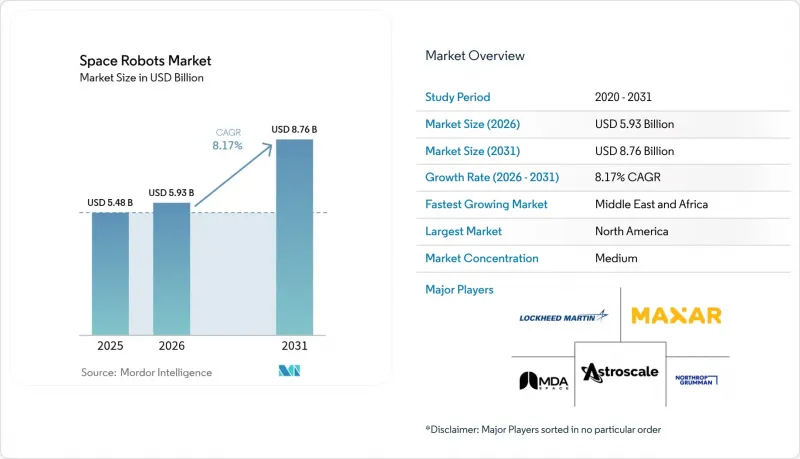
Mordor Intelligence에 의하면, 우주 로봇 시장 규모는 2025년 54억 8,000만 달러로 평가되었고, 2026년에는 59억 3,000만 달러로 추정되고, 2026-2031년 CAGR 8.17%로 성장을 지속할 전망이며, 2031년에는 87억 6,000만 달러에 이를 것으로 예측됩니다.
본 보고서는 제품별(로버/우주선 착륙선, 로봇 암/조작 시스템, 우주 탐사선 등), 임무 유형별(심우주 및 근우주), 용도별(위성 유지보수·수명 연장 등), 최종 사용자별(민간 및 정부), 구성 요소별(하드웨어 및 소프트웨어), 지역별(북미, 유럽 등)로 분류되어 있습니다. 시장 예측은 금액(달러) 기준으로 제시되어 있습니다.
세계의 우주 로봇 시장 동향 및 인사이트
궤도상 위성 유지보수 수요의 급증
정지 궤도 위성의 교체 비용은 4억 달러를 초과하는 경우가 많아, 이에 따라 수명 연장 임무는 경제적으로 매력적인 선택지가 되었습니다. 인텔샛(Intelsat)이 2024년에 스타피시 스페이스(Starfish Space)와 체결한 계약은 로봇을 활용한 유지보수의 상업적 선례가 되었으며, 첫 번째 임무는 2026년에 예정되어 있습니다. 노스롭 그루먼(Northrop Grumman)은 2026년 로봇 팔이 장착된 ‘미션 익스텐션 포드(Mission Extension Pod)’의 발사를 향해 진전을 보이고 있으며, 이는 단기적인 수익에 대한 신뢰를 뒷받침하고 있습니다. 유럽우주국(ESA)에서도 병행하여 활동이 진행되고 있으며, 동 기관의 ‘정지궤도 정비선(Geostationary Servicing Vehicle)’이 2028년 첫 비행을 목표로 개발이 진행 중이며, 기관 차원의 지지가 표명되었습니다. 이러한 이정표들은 전반적으로 연료 보급, 위치 변경, 점검 서비스에 대한 지속적인 수요를 뒷받침하며, 궤도상 로봇 서비스 제공업체들에게 예측 가능한 현금 흐름을 조성했습니다.
정부 자금 지원에 의한 달 및 화성 탐사 프로그램
NASA의 ‘아르테미스’ 계획에서는 로봇 시스템에 대한 다년간의 자금 배분이 지속되고 있으며, 2025년 3월 통합 시험을 통과한 CADRE 로버 네트워크가 그 증거입니다. ESA의 2031년 달 착륙선 ‘아르고나우트’는 1,500kg의 적재 능력을 갖추고 있어 대규모 달 표면 물류를 뒷받침할 것입니다. 중국은 2035년을 목표로 하는 로봇 달 연구 거점의 일정을 앞당겨 기술 경쟁을 격화시켰습니다. 이러한 병행 프로그램들은 혹독한 달 및 화성 환경에 맞추어 설계된 견고한 매니퓰레이터, 자율 항행 소프트웨어, 그리고 모듈형 이동 플랫폼에 대한 수요를 촉진했습니다.
높은 개발 및 인증 비용
우주용 인증 부품에는 철저한 방사선 시험, 내결함성 설계 및 틈새 제조가 요구되어 비반복적인 엔지니어링 비용을 부풀렸습니다. 소규모 신규 진출기업들은 첫 수익을 창출하기 전에 5,000만 달러가 넘는 자금 조달의 장벽에 직면하여, 새로운 경쟁사의 진입이 제한되었습니다. 정부의 비용 분담 보조금으로 부담이 일부 완화되었지만, 설계 주기가 길어 단기적인 시장 성장은 여전히 제약을 받았습니다.
부문 분석
2025년 매출은 로봇 암이 주도하여, 중요한 우주 정거장 유지보수 및 위성 포획 자산에서 총 매출의 41.72%를 창출했습니다. 조작 시스템 분야의 우주 로봇 시장 규모는 캐나다암 3(Canadarm3) 프로그램을 배경으로 2031년까지 꾸준히 확대될 것으로 예측됩니다. 복잡한 관절, 멀티 센서식 엔드 이펙터, 그리고 방사선 내성 전자 기기가 높은 가격 책정을 뒷받침했습니다. 또한, 레골리스 채취 및 계측 장비 전개에 경량 암의 다양한 변형을 채택한 행성 탐사 로버도 성장 요인이 되었습니다.
궤도상 서비스 기체는 로봇 암이나 연료 보급 포드를 탑재한 모듈형 우주선에 대한 운영 사업자의 관심을 반영하여, 9.33%라는 가장 높은 연평균 성장률(CAGR)을 보일 것으로 전망됩니다. 서비스 제공업체들은 수년에 걸친 성과 기반 계약을 통해 주요 고객을 확보하고 있으며, 이는 ‘추력 단위 과금형’ 비즈니스 모델에 대한 신뢰를 보여줍니다. 각 기관이 표준 인터페이스 채택에 합의함에 따라, 그립 및 도킹 장치가 보급되고 있는 한편, 국제우주정거장(ISS)에 탑재되는 외과용 로봇 등 신흥 개념이 틈새 연구개발 예산을 확보했습니다.
지구 중력권 내에서 이루어지는 근우주 활동은 높은 위성 밀도와 즉각적인 수익 기회로 인해 2025년에 65.12%의 시장 점유율을 차지했습니다. 점검, 이전 및 우주정거장 유지 관리에 대한 견조한 수요로 인해 함대 운영 사업자들은 신뢰성 높은 로봇 자산에 계속 집중했습니다. 각국 정부가 궤도상의 안전성을 우선시하는 가운데, 근우주 플랫폼용 우주 로봇 시장 점유율은 2020년대 중반까지 높은 수준을 유지할 전망입니다.
심우주 임무는 규모는 작지만, 9.86%라는 업계 최고 수준의 연평균 성장률(CAGR)을 보일 것으로 전망됩니다. 자율 내비게이션, 내방사선 액추에이터, 적응형 AI에 대한 투자로 인해 통신 지연이 긴 환경에서도 우주선 운용이 가능해졌습니다. NASA의 ‘화성 상승체(Mars Ascent Vehicle)’ 프로그램에서는 지구 밖에서의 상승 유도를 위한 강화 학습 알고리즘 개발이 진행되었습니다. ESA의 2028년 ‘엑소마스 로잘린드 프랭클린(ExoMars Rosalind Franklin)’ 로버와 중국의 시료 회수 계획은 첨단 로봇 탐사선에 대한 지속적인 수요를 명확히 보여주었습니다.
지역별 분석
북미는 NASA의 ‘아르테미스’ 계획에 따른 계약 파이프라인과 활기찬 상업 발사 생태계의 지원에 힘입어 2025년에도 55.97%의 시장 점유율을 유지했습니다. 2025년 6월, 스페이스X는 국제우주정거장(ISS)의 궤도 이탈용 기체 제조와 관련하여 8억 4,300만 달러 규모의 계약을 수주했습니다. MDA Space사의 ‘캐나다 룸’ 전통에 기반한 로봇 매니퓰레이터 분야의 캐나다 전문 지식이 이 지역의 리더십을 더욱 공고히 했습니다.
아시아태평양은 중국이 지상 희귀 금속에 대한 의존도를 낮추기 위해 6족 소행성 채굴 로봇에 자금을 지원함에 따라 두 자릿수의 견조한 성장을 유지했습니다. 일본의 JAXA는 2025년 4월, GITAI에 달 탐사차용 암의 개념 검증 연구를 의뢰했습니다. 인도는 차세대 자율형 달 탐사차 개발을 추진했고, 호주의 스타트업 기업은 로봇을 활용한 레골리스 처리 연구를 진행했으며, 이 모든 노력이 합쳐져 해당 지역 공급업체 기반을 확대했습니다.
중동 및 아프리카는 11.78%라는 가장 높은 연평균 성장률(CAGR) 전망치를 달성했습니다. UAE는 51억 달러 상당의 보안 통신 계약을 포함한 국가 지원 프로그램을 통해 AI가 탑재된 자체 개발 우주선 개발을 추진했습니다. 2025년 5월 카이로에서 출범한 아프리카 우주 기구는 위성 제조 및 궤도 상의 우주 쓰레기 관리에 관한 대륙 전체의 연구개발 목표를 조정했습니다.
유럽은 모듈식 서비스 차량 및 고정밀 매니퓰레이터를 위한 EU 자금을 통합한 ESA의 ‘PERASPERA’ 이니셔티브에 힘입어 안정적인 성장을 유지했습니다. EU 우주법 제안에 따른 규제 명확화는 국경을 초월한 로봇 공학 프로젝트에 대한 투자자들의 신뢰를 뒷받침했습니다. 로봇 탐사선을 이용한 소행성 궤도 변경 예행 연습을 목적으로 한 ‘헤라(Hera)’와 같은 공동 임무는 이 지역이 행성 방어를 중시하고 있음을 여실히 보여주었습니다.
남미는 초기 단계의 기회를 제시했습니다. 브라질은 알칸타라 발사장에 자율형 로봇 시험 베드를 설치하는 문제에 대해 ESA와 협의를 재개했으나, 자금 제약으로 인해 단기적인 실현은 어려웠습니다. 신생 민관 컨소시엄은 발사 비용이 하락하는 대로 참여할 의사를 밝혔습니다.
기타 혜택 :
- 엑셀 형식 시장 예측(ME) 시트
- 3개월간의 애널리스트 지원
자주 묻는 질문
목차
제1장 서론
제2장 조사 방법
제3장 주요 요약
제4장 시장 구도
제5장 시장 규모 및 성장 예측
제6장 경쟁 구도
제7장 시장 기회 및 향후 전망
AJY 26.08.26According to Mordor Intelligence, the space robots market size is expected to grow from USD 5.48 billion in 2025 to USD 5.93 billion in 2026 and is forecast to reach USD 8.76 billion by 2031 at 8.17% CAGR over 2026-2031.
This report is Segmented by Product (Rovers/Spacecraft Landers, Robotic Arms/Manipulator Systems, Space Probes, and More), Mission Type (Deep Space and Near Space), Application (Satellite Servicing and Life Extension, and More), End-User (Commercial and Government), Component (Hardware and Software), and Geography (North America, Europe, and More). The Market Forecasts are Provided in Terms of Value (USD).
Global Space Robots Market Trends and Insights
Surge in On-Orbit Satellite-Servicing Demand
High replacement costs for geostationary satellites, often surpassing USD 400 million, made life-extension missions economically compelling. Intelsat's 2024 agreement with Starfish Space set a commercial precedent for robotic servicing, with the first mission slated for 2026. Northrop Grumman progressed toward a 2026 robot-armed Mission Extension Pod launch, validating confidence in near-term revenue. Parallel activity at the European Space Agency, which advanced its Geostationary Servicing Vehicle toward a 2028 debut, signaled agency-wide endorsement. Collectively, these milestones underpinned recurring demand for refueling, relocation, and inspection services, boosting predictable cash flows for in-orbit robotics providers.
Government-Funded Lunar and Mars Exploration Programs
NASA's Artemis framework continued to allocate multi-year funding to robotic systems, evidenced by the CADRE rover network that passed integrated testing in March 2025. ESA's Argonaut lunar lander target for 2031 introduced a 1,500 kg cargo capacity, supporting large-scale surface logistics. China accelerated its robotic lunar research outpost timeline by 2035, intensifying technology competition. These parallel programs stimulated demand for rugged manipulators, autonomous navigation software, and modular mobility platforms tailored to harsh lunar and Martian environments.
High Development and Qualification Costs
Space-qualified components required extensive radiation testing, fault-tolerant design, and niche manufacturing, inflating non-recurring engineering expenses. Smaller entrants faced capital hurdles exceeding USD 50 million before first revenue, limiting new competition. Government cost-sharing grants alleviated some burden, yet long design cycles still restrained near-term market acceleration.
Other drivers and restraints analyzed in the detailed report include:
- Falling Launch Costs from Reusable Launchers
- Expansion of Commercial Lunar Logistics Corridors
- Export-Control Complexities
For complete list of drivers and restraints, kindly check the Table Of Contents.
Segment Analysis
Robotic arms dominated 2025 revenue, generating 41.72% of total sales from critical station maintenance and satellite capture assets. The space robots market size for manipulator systems is forecast to expand steadily through 2031 on the back of the Canadarm3 program. Complex joints, multi-sensor end-effectors, and radiation-hardened electronics supported premium pricing. Growth also stemmed from planetary rovers using lightweight arm variants to collect regolith and deploy instruments.
On-orbit servicing vehicles posted the quickest 9.33% CAGR outlook, reflecting operator interest in modular spacecraft hosting robotic arms and refueling pods. Service providers secured anchor customers through multi-year performance-based contracts, signaling confidence in pay-per-thrust business models. Gripping and docking mechanisms gained traction as agencies converged on standard interfaces, while emerging concepts such as surgical robots aboard the ISS captured niche R&D budgets.
Near-space activities within Earth's gravitational sphere attained a 65.12% market share in 2025 thanks to high satellite density and immediate revenue opportunities. Robust demand for inspection, relocation, and station upkeep kept fleet operators focused on reliable robotic assets. As governments prioritize orbital safety, the market share for space robots for near-space platforms will remain elevated through mid-decade.
Deep-space missions recorded a smaller base but posted a leading 9.86% CAGR forecast. Investments in autonomous navigation, radiation-tolerant actuators, and adaptive AI allowed spacecraft to operate with longer communication delays. NASA's Mars Ascent Vehicle program advanced reinforcement-learning algorithms for off-world ascent guidance. ESA's 2028 ExoMars Rosalind Franklin rover and China's sample-return initiatives defined sustained demand for sophisticated robotic explorers.
Complete Report Scope:
- By Product
- Rovers/Spacecraft Landers
- Robotic Arms/Manipulator Systems
- Space Probes
- Gripping and Docking Systems
- On-Orbit Servicing Vehicles
- Others Products
- By Mission Type
- Deep Space
- Near Space
- By Application
- Satellite Servicing and Life Extension
- Active Debris Removal
- On-Orbit Assembly and Manufacturing
- Exploration and Scientific Research
- Cargo and Logistics
- By End-User
- Commercial
- Commercial Satellite Operators
- Research Institutes
- NewSpace Start-ups
- Government
- Space Agencies
- Defence and Intelligence
- Commercial
- By Component
- Hardware
- Manipulators
- Structural and Mobility Platform
- Sensor and Vision Systems
- Power Subsystems
- Commuincation System
- Software
- Autonomy and Navigation Software
- Sensor Fusion and Data Processing
- Commuincation and Data Management Software
- Others
- Hardware
- By Geography
- North America
- United States
- Canada
- Mexico
- South America
- Brazil
- Rest of South America
- Europe
- United Kingdom
- Germany
- France
- Russia
- Rest of Europe
- Asia-Pacific
- China
- Japan
- India
- South Korea
- Australia
- Rest of Asia-Pacific
- Middle East and Africa
- Middle East
- Saudi Arabia
- Israel
- United Arab Emirates
- Rest of Middle East
- Africa
- South Africa
- Rest of Africa
- Middle East
- North America
Geography Analysis
North America retained a 55.97% market share in 2025, supported by NASA's Artemis contracting pipeline and a vibrant commercial launch ecosystem. In June 2025, SpaceX secured a USD 843 million contract to build an ISS deorbit vehicle. Canadian expertise in robotic manipulators, anchored by MDA Space's Canadarm heritage, further reinforced regional leadership.
Asia-Pacific sustained strong double-digit growth as China funded six-legged asteroid-mining robots to cut reliance on terrestrial rare metals. Japan's JAXA awarded GITAI a concept study for a lunar rover arm in April 2025. India prepared its next generation of autonomous lunar rovers, while Australian startups explored robotic regolith processing, collectively widening the regional supplier base.
The Middle East and Africa region achieved the fastest 11.78% CAGR outlook. The UAE advanced sovereign AI-enabled spacecraft through state-backed programs, including secure communication contracts worth USD 5.1 billion. The African Space Agency, inaugurated in Cairo in May 2025, coordinated continental R&D objectives for satellite production and orbital debris management.
Europe maintained stable expansion, supported by ESA's PERASPERA initiative, which pooled EU funding for modular servicing vehicles and dexterous manipulators. Regulatory clarity under the EU Space Law proposal bolstered investor confidence in cross-border robotics projects. Cooperative missions such as Hera, targeting asteroid-deflection rehearsals with robotic probes, underscored the region's emphasis on planetary defense.
South America represented an early-stage opportunity. Brazil renewed discussions with ESA on hosting autonomous robotic testbeds at the Alcantara launch site, yet funding constraints limited near-term deliveries. Emerging public-private consortia signaled intent to participate once launch prices ease.
- Northrop Grumman Corporation
- Maxar Technologies Holdings Inc.
- Lockheed Martin Corporation
- MDA Space Ltd.
- Astroscale Holdings Inc.
- Blue Origin Enterprises, L.P.
- Redwire Corporation
- ASTROBOTIC TECHNOLOGY, INC.
- GITAI USA Inc.
- Starfish Space Inc.
- D-Orbit S.p.A
- ClearSpace SA
- Metecs, LLC.
- Motiv Space Systems, Inc.
- Space Applications Services NV/SA
- Oceaneering International, Inc.
- iSpace, Inc.
Additional Benefits:
- The market estimate (ME) sheet in Excel format
- 3 months of analyst support
TABLE OF CONTENTS
1 INTRODUCTION
- 1.1 Study Assumptions and Market Definition
- 1.2 Scope of the Study
2 RESEARCH METHODOLOGY
3 EXECUTIVE SUMMARY
4 MARKET LANDSCAPE
- 4.1 Market Overview
- 4.2 Market Drivers
- 4.2.1 Surge in on-orbit satellite-servicing demand
- 4.2.2 Government-funded lunar and Mars exploration programs
- 4.2.3 Falling launch costs from reusable launchers
- 4.2.4 Expansion of commercial lunar logistics corridors
- 4.2.5 Growth in in-space manufacturing and 3-D printing needs
- 4.2.6 Defense-led demand for autonomous ISR rendezvous
- 4.3 Market Restraints
- 4.3.1 High development and qualification costs
- 4.3.2 Export-control (ITAR/EAR) complexities
- 4.3.3 Legal liability over active-debris-removal missions
- 4.3.4 Lack of open interface standards for servicing ports
- 4.4 Value Chain Analysis
- 4.5 Regulatory Landscape
- 4.6 Technological Outlook
- 4.7 Porter's Five Forces Analysis
- 4.7.1 Threat of New Entrants
- 4.7.2 Bargaining Power of Buyers
- 4.7.3 Bargaining Power of Suppliers
- 4.7.4 Threat of Substitutes
- 4.7.5 Intensity of Competitive Rivalry
5 MARKET SIZE AND GROWTH FORECASTS (VALUE)
- 5.1 By Product
- 5.1.1 Rovers/Spacecraft Landers
- 5.1.2 Robotic Arms/Manipulator Systems
- 5.1.3 Space Probes
- 5.1.4 Gripping and Docking Systems
- 5.1.5 On-Orbit Servicing Vehicles
- 5.1.6 Others Products
- 5.2 By Mission Type
- 5.2.1 Deep Space
- 5.2.2 Near Space
- 5.3 By Application
- 5.3.1 Satellite Servicing and Life Extension
- 5.3.2 Active Debris Removal
- 5.3.3 On-Orbit Assembly and Manufacturing
- 5.3.4 Exploration and Scientific Research
- 5.3.5 Cargo and Logistics
- 5.4 By End-User
- 5.4.1 Commercial
- 5.4.1.1 Commercial Satellite Operators
- 5.4.1.2 Research Institutes
- 5.4.1.3 NewSpace Start-ups
- 5.4.2 Government
- 5.4.2.1 Space Agencies
- 5.4.2.2 Defence and Intelligence
- 5.4.1 Commercial
- 5.5 By Component
- 5.5.1 Hardware
- 5.5.1.1 Manipulators
- 5.5.1.2 Structural and Mobility Platform
- 5.5.1.3 Sensor and Vision Systems
- 5.5.1.4 Power Subsystems
- 5.5.1.5 Commuincation System
- 5.5.2 Software
- 5.5.2.1 Autonomy and Navigation Software
- 5.5.2.2 Sensor Fusion and Data Processing
- 5.5.2.3 Commuincation and Data Management Software
- 5.5.2.4 Others
- 5.5.1 Hardware
- 5.6 By Geography
- 5.6.1 North America
- 5.6.1.1 United States
- 5.6.1.2 Canada
- 5.6.1.3 Mexico
- 5.6.2 South America
- 5.6.2.1 Brazil
- 5.6.2.2 Rest of South America
- 5.6.3 Europe
- 5.6.3.1 United Kingdom
- 5.6.3.2 Germany
- 5.6.3.3 France
- 5.6.3.4 Russia
- 5.6.3.5 Rest of Europe
- 5.6.4 Asia-Pacific
- 5.6.4.1 China
- 5.6.4.2 Japan
- 5.6.4.3 India
- 5.6.4.4 South Korea
- 5.6.4.5 Australia
- 5.6.4.6 Rest of Asia-Pacific
- 5.6.5 Middle East and Africa
- 5.6.5.1 Middle East
- 5.6.5.1.1 Saudi Arabia
- 5.6.5.1.2 Israel
- 5.6.5.1.3 United Arab Emirates
- 5.6.5.1.4 Rest of Middle East
- 5.6.5.2 Africa
- 5.6.5.2.1 South Africa
- 5.6.5.2.2 Rest of Africa
- 5.6.5.1 Middle East
- 5.6.1 North America
6 COMPETITIVE LANDSCAPE
- 6.1 Market Concentration
- 6.2 Strategic Moves
- 6.3 Market Share Analysis
- 6.4 Company Profiles (includes Global level Overview, Market level overview, Core Segments, Financials as available, Strategic Information, Market Rank/Share for key companies, Products and Services, and Recent Developments)
- 6.4.1 Northrop Grumman Corporation
- 6.4.2 Maxar Technologies Holdings Inc.
- 6.4.3 Lockheed Martin Corporation
- 6.4.4 MDA Space Ltd.
- 6.4.5 Astroscale Holdings Inc.
- 6.4.6 Blue Origin Enterprises, L.P.
- 6.4.7 Redwire Corporation
- 6.4.8 ASTROBOTIC TECHNOLOGY, INC.
- 6.4.9 GITAI USA Inc.
- 6.4.10 Starfish Space Inc.
- 6.4.11 D-Orbit S.p.A
- 6.4.12 ClearSpace SA
- 6.4.13 Metecs, LLC.
- 6.4.14 Motiv Space Systems, Inc.
- 6.4.15 Space Applications Services NV/SA
- 6.4.16 Oceaneering International, Inc.
- 6.4.17 iSpace, Inc.
7 MARKET OPPORTUNITIES AND FUTURE OUTLOOK
- 7.1 White-Space and Unmet-Need Assessment


