

|
시장보고서
상품코드
2114669
재택 의료 시장 : 시장 점유율 분석, 업계 동향 및 통계, 성장 예측(2026-2031년)Home Healthcare - Market Share Analysis, Industry Trends & Statistics, Growth Forecasts (2026 - 2031) |
||||||
 Mordor Intelligence
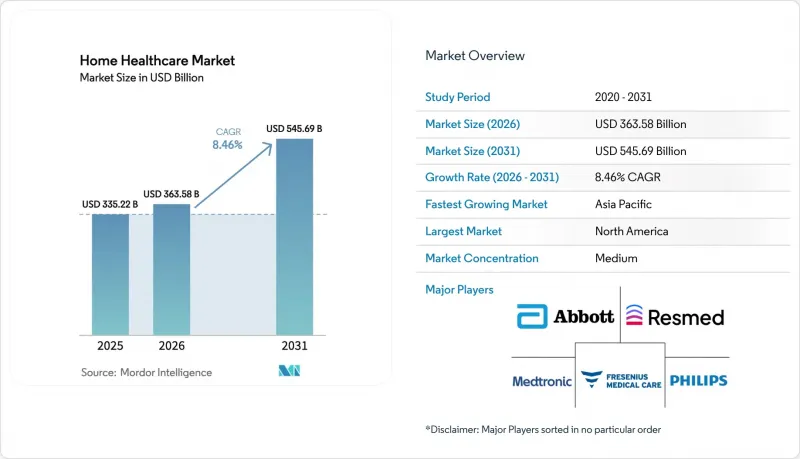
Mordor Intelligence에 의하면, 재택 의료 시장 규모는 2025년에 3,352억 2,000만 달러로 평가되었고, 2026년 3,635억 8,000만 달러에서 2031년까지 5,456억 9,000만 달러에 이를 것으로 추정되며, 예측 기간(2026-2031년) CAGR은 8.46%를 나타낼 전망입니다.
본 보고서는 의료 유형별(기기(치료용 기기(인슐린 투여 장치 등), 진단·모니터링 기기 등), 서비스(전문 간호 등), 소프트웨어(기관 관리 등)), 적응증별(심혈관 질환, 당뇨병 등) 및 지역별(북미, 유럽 등)로 분류되어 있습니다. 시장 예측은 금액(달러) 기준으로 제시되어 있습니다.
세계의 재택 의료 시장 동향 및 인사이트
고령화가 진행되며 만성 질환 관리 수요가 확대
세계보건기구(WHO)의 추계에 따르면, 2030년까지 60세 이상 고령자는 14억 명에 달할 것이며, 그 중 80%는 시설을 통한 장기 요양이 여전히 제한적인 저·중소득 국가에 거주하게 될 것입니다. 평균 수명이 75세를 넘어 1년 늘어날 때마다 만성 질환 관리 기간이 3-5년 연장되지만, 재택 간호는 전문 요양 시설에서의 간호에 비해 비용을 절감할 수 있습니다. 일본은 이미 요양보험 제도 하에서 지역 밀착형 통합 간호에 막대한 지출을 하고 있으며, 다른 초고령 사회를 위한 모델이 되고 있습니다. 중국에서는 ‘제14차 5개년 계획’을 통해 도시 지역의 고령자 대상 지역 서비스 제공 범위를 반경 15분 이내로 의무화하고 있으며, 이에 따라 읍·면 진료소와 3차 의료기관을 연결하는 휴대용 진단 기기 및 원격 의료에 대한 지역 내 수요가 증가하고 있습니다. 유럽과 북미에서도 유사한 인구 동향의 변화가 진행되는 가운데, 재택 의료 시장은 정책에 뒷받침된 대규모 환자들의 급성기 의료시설 이탈로부터 직접적인 혜택을 받고 있습니다.
원격 모니터링에 대한 보험 적용 범위 확대
메디케어·메디케이드 서비스 센터(CMS)는 CPT 코드 99453, 99454, 99457,및 99458을 영구적으로 추가하고, 기기 설치, 데이터 전송 및 월별 생리학적 평가에 대해 의료 제공업체에게 보상을 지급함으로써 도시와 농촌을 불문하고 원격 환자 모니터링을 표준화했습니다. 유나이티드헬스케어(UnitedHealthcare)나 휴마나(Humana)와 같은 민간 보험사들은 현재 유사한 서비스에 대해 진료소 요금의 85-90%를 지급하고 있으며, 과거 의사의 도입을 방해했던 보상 격차가 해소되었습니다. 이러한 변화로 인해 하드웨어는 지속적인 수익 모델로 전환되었으며, 제조업체는 기기를 지원하면서 구독료를 징수하는 구조가 되었습니다. 이는 소비자용 웨어러블 기기의 비즈니스 모델을 반영하면서도 임상 수준의 정확성과 FDA의 감독에 의해 뒷받침되고 있습니다.
숙련된 재택 간병 인력 부족
미국에서는 2026년까지 7만 8,000명의 간호사 부족이 예상되며, 일부 주에서는 재택 간병 보조원의 이직률이 65%를 초과하고 있어 수요가 증가하고 있음에도 불구하고, 간병 사업자가 신규 환자를 수용할 여력이 제한되고 있습니다. 간병 보조원의 시간당 임금 중앙값은 13.50달러로 다른 서비스업에 비해 낮은 수준이기 때문에 각 기관은 2024년 이후 임금을 12-18% 인상할 수밖에 없어, 팬데믹 이전 평균 3-5%였던 이익률이 압박받고 있습니다.
부문 분석
2025년에는 재택 의료 시장의 48.56%를 의료기기가 차지했으며, 인공호흡기, 투석 장치, 인슐린 펌프 등의 치료용 기기의 자본 집약성이 두드러지고 있습니다. 메디케어가 재택 투석 비용을 시설 내 투석 비용의 80-90% 수준으로 보상하는 정책에 따라 치료용 기기의 매출이 증가하고 있습니다. 이에 따라 중증도의 높은 시술이 재택 환경에서 이루어지게 되면서 신장 관리 기술의 재택 의료 시장 규모가 확대되고 있습니다. 진단·모니터링 기기는 점점 더 저렴한 가격으로 제공되고 있습니다. 손가락 채혈식 혈당 측정기의 평균 판매 가격은 2023-2025년 25% 하락했습니다. 이는 지속 혈당 모니터가 시장 점유율을 빼앗아 기존 제품의 이익률을 압박했기 때문입니다. 이동 지원 기기는 소비자에게 직접 판매해야 한다는 압박에 직면해 있으며, 이로 인해 지리적 도달 범위는 넓어지지만 유통업체의 이익은 줄어들고 있습니다.
서비스 부문은 2025년 시장 규모에서 2위의 점유율을 차지했으며, 인력 부족으로 인해 각 기관은 중증도가 높은 사례에 우선순위를 두지 않을 수 없는 상황입니다. 한편, 원격 생체 징후 모니터링이나 원격 치료와 같은 기술이 인력 부족을 부분적으로 보완하고 있습니다. 메디케어의 호스피스 급여로 인해 경제적 장벽이 낮아지면서 호스피스 및 완화 의료는 꾸준히 확대되고 있으며, 영구 청구 코드의 도입으로 원격 재택 간호 실시 건수는 높은 수준을 유지하고 있습니다. 소프트웨어 플랫폼은 기반 규모는 작지만, 전자 방문 확인 및 개방형 FHIR API가 보험사와의 계약 필수 조건이 됨에 따라 2031년까지 연평균 성장률(CAGR) 12.25%를 나타낼 것으로 예측됩니다. FDA의 ‘의료기기로서의 소프트웨어(Software as a Medical Device)’ 프레임워크는 규제상의 장벽을 추가하는 한편, 임상적 신뢰성을 부여함으로써 시장 보급을 가속화하고 있습니다.
지역별 분석
북미는 2025년 매출의 42.13%를 차지했으며, 이는 메디케어 어드밴티지(Medicare Advantage)의 보급률 52%와, 재택에서 제공되는 입원 수준 서비스를 보상하는 CMS(미국 의료보험 및 의료서비스 센터)의 면제 조치에 힘입은 것입니다. 그러나 의료 인력 부족이 서비스 제공 능력을 제약하고 있습니다. 자격을 갖춘 간병인의 이직률은 65%를 초과하며, 간병 서비스 제공업체들은 소개 건수에 상한선을 두는 경우가 많아 보험사 측 수요가 있음에도 불구하고 잠재적인 시장 확대가 둔화되고 있습니다. 캐나다의 재택 간호에 대한 자금 배분은 의료비 총액의 4% 미만에 그치고 있으며, 멕시코에서는 원격의료 시범 사업이 농촌 지역으로 적용 범위가 확대됨에 따라 의료기기에 대한 수요가 서서히 발생하고 있습니다.
아시아태평양은 일본의 초고령화 사회라는 인구 구조와 종합적인 재택 서비스에 자금을 지원하는 요양보험 제도 개혁에 힘입어, 2031년까지 연평균 성장률(CAGR) 9.51%로 성장을 주도할 것으로 예측됩니다. 중국에서는 지역 밀착형 돌봄이 의무화되어 있는 반면, 인도의 ‘생산 연계형 인센티브(PLI)’ 제도는 국내 의료기기 제조에 보조금을 지급함으로써 기본 모니터의 소매 가격을 최대 30%까지 인하하고 있습니다. 한국과 호주에서는 방문 횟수를 극대화하는 것이 아니라 재입원을 방지하는 데 대해 요양 사업자에게 보상을 지급하는 성과 연계형 지불 모델이 시범적으로 도입되고 있습니다.
유럽은 여전히 큰 점유율을 유지하고 있으며, 영국의 ‘가상 병동’과 독일의 디지털 치료제에 대한 신속한 보험 적용 제도로 인해 접근성이 확대되고 있습니다. 프랑스의 ‘재택 입원(hospitalisation a domicile)’은 2024년에 12만 명의 환자를 수용했으며, 그 대부분이 항생제 정맥 주사나 화학요법을 받고 있어 이 지역의 선진적인 정책 지원을 뒷받침하고 있습니다. 이탈리아와 스페인에서는 공적 보험 적용이 제한적이어서, 부유층은 민간 간병 비용을 부담하는 반면, 기타 가구는 비공식 간병인에게 의지할 수밖에 없는 양극화된 상황이 발생하고 있습니다.
규모는 작지만 성장이 가속화되고 있는 시장으로는 스마트 홈 모니터링에 국가 자금을 투입하고 있는 걸프협력회의(GCC) 회원국, 민간 보험사가 HIV 치료의 복약 순응도를 원격으로 모니터링하는 시범 사업을 실시하고 있는 남아프리카공화국 등을 들 수 있습니다. 브라질의 ‘Programa Melhor em Casa’는 2024년에 20만 명의 환자를 치료했으나, 이용 현황은 지역에 따라 편차가 있어 의료 서비스가 충분히 제공되지 않는 북부 지역에서 의료기기 및 소프트웨어에 대한 잠재적 수요가 있음을 시사합니다.
기타 혜택 :
- 엑셀 형식 시장 예측(ME) 시트
- 3개월간의 애널리스트 지원
자주 묻는 질문
목차
제1장 서론
제2장 조사 방법
제3장 주요 요약
제4장 시장 구도
제5장 시장 규모 및 성장 예측
제6장 경쟁 구도
제7장 시장 기회 및 향후 전망
AJY 26.08.26According to Mordor Intelligence, the home healthcare market size was valued at USD 335.22 billion in 2025 and is estimated to grow from USD 363.58 billion in 2026 to reach USD 545.69 billion by 2031, at a CAGR of 8.46% during the forecast period (2026-2031).
This report is Segmented by Healthcare Type (Equipment [Therapeutic Equipment {Insulin Delivery Devices, and More}, Diagnostic & Monitoring Equipment, and More], Services [Skilled Nursing, and More], and Software [Agency Administration, and More]), Indication (Cardiovascular, Diabetes and More) and Geography (North America, Europe, and More). The Market Forecasts are Provided in Terms of Value (USD).
Global Home Healthcare Market Trends and Insights
Aging Populations Driving Chronic-Care Demand
The World Health Organization estimates that 1.4 billion people will be aged 60 plus by 2030, with 80% residing in low- and middle-income nations where institutional long-term care remains limited. Each added year of life expectancy beyond 75 correlates with three to five additional years of chronic-disease management that is less costly when delivered at home than in skilled-nursing facilities. Japan already spends heavily on community-based integrated care under its long-term care insurance scheme, providing a template for other super-aged societies. In China, the 14th Five-Year Plan mandates a 15-minute radius for elderly community services in urban areas, driving local demand for portable diagnostics and telemedicine that link township clinics to tertiary centers. As similar demographic pivots unfold across Europe and North America, the home healthcare market benefits directly from scaled, policy-backed patient migration out of acute settings.
Reimbursement Expansion for Remote Monitoring
The Centers for Medicare & Medicaid Services permanently added CPT codes 99453, 99454, 99457, and 99458, reimbursing providers for device setup, data transmission, and monthly physiologic review, thus normalizing remote-patient monitoring across urban and rural settings alike. Commercial insurers such as UnitedHealthcare and Humana now pay 85-90% of in-office rates for similar services, closing the margin gap that once hindered physician adoption. The shift converts hardware into a recurring revenue model whereby manufacturers subsidize devices and earn subscription fees, mirroring consumer-wearable economics yet underpinned by clinical-grade accuracy and FDA oversight.
Shortage of Skilled Home-Care Clinicians
The United States faces a projected 78,000-nurse deficit by 2026, and home-health-aide turnover tops 65% in several states, limiting agencies' capacity to accept new patients even as demand rises. Median aide pay of USD 13.50 per hour lags other service sectors, forcing agencies to raise wages 12-18% since 2024, compressing margins that averaged 3-5% pre-pandemic.
Other drivers and restraints analyzed in the detailed report include:
- AI-Enabled Devices Boost Proactive Home Care
- Shift to Hospital-at-Home Models
- Cyber-Security & Privacy Threats to Medical IoT
For complete list of drivers and restraints, kindly check the Table Of Contents.
Segment Analysis
Equipment represented 48.56% of the home healthcare market in 2025, spotlighting the capital intensity of therapeutic gear such as ventilators, dialysis systems, and insulin pumps. Therapeutic equipment revenues gain from Medicare's policy that reimburses home dialysis at 80-90% of in-center rates, enlarging the home healthcare market size for renal-care technology by routing high-acuity procedures into domestic environments. Diagnostic and monitoring devices become more affordable; fingerstick glucometer average selling prices fell 25% between 2023 and 2025 as continuous glucose monitors captured share, compressing margins for legacy products. Mobility assist equipment faces direct-to-consumer pressure that widens geographic reach but thins distributor profits.
Services constitute the second-largest 2025 slice, yet staffing deficits force agencies to triage high-acuity cases while technology offsets some labor gaps through remote vitals monitoring and tele-therapy. Hospice and palliative care expand steadily as Medicare's hospice benefit lowers financial barriers, and tele-homecare volumes stay elevated under permanent billing codes. Software platforms, though starting from a smaller base, are forecast to post a 12.25% CAGR through 2031 as electronic visit verification and open FHIR APIs become prerequisites for payer contracts. The FDA's Software as a Medical Device framework adds regulatory hurdles yet confers clinical credibility that hastens commercial adoption.
Complete Report Scope:
- By Healthcare Type
- Equipment
- Therapeutic Equipment
- Insulin Delivery Devices
- Home IV Equipment
- Home Dialysis Equipment
- Ventilators & Nebulizers
- CPAP & BiPAP Devices
- Diagnostic & Monitoring Equipment
- Blood-glucose Monitors
- BP Monitors
- Pulse-oximeters
- ECG & Holter Monitors
- Digital Thermometers
- Mobility Assist Equipment
- Wheelchairs
- Walkers & Rollators
- Mobility Scooters
- Therapeutic Equipment
- Services
- Skilled Nursing
- Physical Therapy
- Occupational Therapy
- Speech Therapy
- Hospice & Palliative
- Personal (Unskilled) Care
- Respiratory Therapy
- Tele-homecare & Telehealth
- Software Platforms
- Agency Administration
- Clinical/EHR Platforms
- Remote-patient Monitoring SaaS
- Equipment
- By Indication
- Cardiovascular
- Diabetes
- Respiratory
- Cancer
- Wound-care
- Neurological Disorders
- By Geography
- North America
- United States
- Canada
- Mexico
- Europe
- Germany
- United Kingdom
- France
- Italy
- Spain
- Rest of Europe
- Asia-Pacific
- China
- Japan
- India
- South Korea
- Australia
- Rest of Asia-Pacific
- Middle East & Africa
- GCC
- South Africa
- Rest of Middle East & Africa
- South America
- Brazil
- Argentina
- Rest of South America
- North America
Geography Analysis
North America commanded 42.13% of 2025 revenue, powered by 52% Medicare Advantage penetration and CMS waivers that reimburse inpatient-level services rendered at home. Yet clinician shortages constrain capacity: certified-aide turnover exceeds 65%, and agencies often cap referrals, slowing potential expansion despite payer demand. Canada's funding for home care remains under 4% of total health expenditure, and Mexico's telemedicine pilots are creating incremental device demand as coverage extends into rural states.
Asia-Pacific is forecast to lead growth at 9.51% CAGR through 2031, propelled by Japan's super-aged demographic profile and Kaigo Hoken reforms that fund comprehensive in-home services. China mandates proximal community care, while India's Production Linked Incentive scheme subsidizes local device manufacturing, slicing retail prices for basic monitors by up to 30%. South Korea and Australia experiment with outcome-tied payment models that reward agencies for avoiding readmissions rather than maximizing visit counts.
Europe sustains meaningful share, with the United Kingdom's virtual wards and Germany's fast-track reimbursements for digital therapeutics broadening access. France's hospitalisation a domicile handled 120,000 patients in 2024, predominantly for intravenous antibiotics and chemotherapy, underscoring the region's advanced policy backing. Italy and Spain offer limited public reimbursement, producing a two-tier landscape in which affluent households fund private care while others rely on informal caregivers.
Smaller yet accelerating markets include the Gulf Cooperation Council states, which invest sovereign capital into smart-home monitoring, and South Africa, where private insurers pilot remote monitoring for HIV adherence. Brazil's Programa Melhor em Casa treated 200,000 patients in 2024 but remains unevenly distributed, indicating latent demand for devices and software in underserved northern regions.
- Abbott Laboratories
- Amedisys Inc.
- Bayada Home Health Care
- Beijing Jiuzhou Tongbang
- Cardinal Health
- CareCentrix Inc.
- Coloplast
- Drive DeVilbiss Healthcare
- Fresenius
- GE HealthCare Technologies Inc.
- Homage Pte Ltd.
- Home Instead Inc.
- Honor Technology
- Invacare
- Kindred at Home (Humana)
- Koninklijke Philips
- LHC Group Inc.
- Linde plc
- Mckesson
- Medtronic
- Omron Healthcare Co., Ltd.
- Resmed
- Sunrise Medical
Additional Benefits:
- The market estimate (ME) sheet in Excel format
- 3 months of analyst support
TABLE OF CONTENTS
1 Introduction
- 1.1 Study Assumptions & Market Definition
- 1.2 Scope of the Study
2 Research Methodology
3 Executive Summary
4 Market Landscape
- 4.1 Market Overview
- 4.2 Market Drivers
- 4.2.1 Aging populations driving chronic-care demand
- 4.2.2 Reimbursement expansion for remote monitoring
- 4.2.3 AI-enabled devices boost proactive home care
- 4.2.4 Shift to hospital-at-home models
- 4.2.5 Edge-computing IoT lowers in-home device costs
- 4.2.6 Miniaturised lab-on-chip diagnostics enter home
- 4.3 Market Restraints
- 4.3.1 Shortage of skilled home-care clinicians
- 4.3.2 Cyber-security & privacy threats to medical IoT
- 4.3.3 Reimbursement rate uncertainty for agencies
- 4.3.4 Lithium-battery supply risk for critical devices
- 4.4 Regulatory Landscape
- 4.5 Technological Outlook
- 4.6 Porter's Five Forces
- 4.6.1 Bargaining Power of Buyers
- 4.6.2 Bargaining Power of Suppliers
- 4.6.3 Threat of New Entrants
- 4.6.4 Threat of Substitutes
- 4.6.5 Competitive Rivalry
5 Market Size & Growth Forecasts (Value, USD)
- 5.1 By Healthcare Type
- 5.1.1 Equipment
- 5.1.1.1 Therapeutic Equipment
- 5.1.1.1.1 Insulin Delivery Devices
- 5.1.1.1.2 Home IV Equipment
- 5.1.1.1.3 Home Dialysis Equipment
- 5.1.1.1.4 Ventilators & Nebulizers
- 5.1.1.1.5 CPAP & BiPAP Devices
- 5.1.1.2 Diagnostic & Monitoring Equipment
- 5.1.1.2.1 Blood-glucose Monitors
- 5.1.1.2.2 BP Monitors
- 5.1.1.2.3 Pulse-oximeters
- 5.1.1.2.4 ECG & Holter Monitors
- 5.1.1.2.5 Digital Thermometers
- 5.1.1.3 Mobility Assist Equipment
- 5.1.1.3.1 Wheelchairs
- 5.1.1.3.2 Walkers & Rollators
- 5.1.1.3.3 Mobility Scooters
- 5.1.1.1 Therapeutic Equipment
- 5.1.2 Services
- 5.1.2.1 Skilled Nursing
- 5.1.2.2 Physical Therapy
- 5.1.2.3 Occupational Therapy
- 5.1.2.4 Speech Therapy
- 5.1.2.5 Hospice & Palliative
- 5.1.2.6 Personal (Unskilled) Care
- 5.1.2.7 Respiratory Therapy
- 5.1.2.8 Tele-homecare & Telehealth
- 5.1.3 Software Platforms
- 5.1.3.1 Agency Administration
- 5.1.3.2 Clinical/EHR Platforms
- 5.1.3.3 Remote-patient Monitoring SaaS
- 5.1.1 Equipment
- 5.2 By Indication
- 5.2.1 Cardiovascular
- 5.2.2 Diabetes
- 5.2.3 Respiratory
- 5.2.4 Cancer
- 5.2.5 Wound-care
- 5.2.6 Neurological Disorders
- 5.3 By Geography
- 5.3.1 North America
- 5.3.1.1 United States
- 5.3.1.2 Canada
- 5.3.1.3 Mexico
- 5.3.2 Europe
- 5.3.2.1 Germany
- 5.3.2.2 United Kingdom
- 5.3.2.3 France
- 5.3.2.4 Italy
- 5.3.2.5 Spain
- 5.3.2.6 Rest of Europe
- 5.3.3 Asia-Pacific
- 5.3.3.1 China
- 5.3.3.2 Japan
- 5.3.3.3 India
- 5.3.3.4 South Korea
- 5.3.3.5 Australia
- 5.3.3.6 Rest of Asia-Pacific
- 5.3.4 Middle East & Africa
- 5.3.4.1 GCC
- 5.3.4.2 South Africa
- 5.3.4.3 Rest of Middle East & Africa
- 5.3.5 South America
- 5.3.5.1 Brazil
- 5.3.5.2 Argentina
- 5.3.5.3 Rest of South America
- 5.3.1 North America
6 Competitive Landscape
- 6.1 Market Concentration
- 6.2 Market Share Analysis
- 6.3 Company Profiles (includes Global level Overview, Market level overview, Core Segments, Financials as available, Strategic Information, Market Rank/Share, Products & Services, Recent Developments)
- 6.3.1 Abbott Laboratories
- 6.3.2 Amedisys Inc.
- 6.3.3 Bayada Home Health Care
- 6.3.4 Beijing Jiuzhou Tongbang
- 6.3.5 Cardinal Health Inc.
- 6.3.6 CareCentrix Inc.
- 6.3.7 Coloplast A/S
- 6.3.8 Drive DeVilbiss Healthcare
- 6.3.9 Fresenius Medical Care AG & Co. KGaA
- 6.3.10 GE HealthCare Technologies Inc.
- 6.3.11 Homage Pte Ltd.
- 6.3.12 Home Instead Inc.
- 6.3.13 Honor Technology Inc.
- 6.3.14 Invacare Corporation
- 6.3.15 Kindred at Home (Humana)
- 6.3.16 Koninklijke Philips N.V.
- 6.3.17 LHC Group Inc.
- 6.3.18 Linde plc
- 6.3.19 McKesson Corporation
- 6.3.20 Medtronic plc
- 6.3.21 Omron Healthcare Co., Ltd.
- 6.3.22 ResMed Inc.
- 6.3.23 Sunrise Medical LLC
7 Market Opportunities & Future Outlook
- 7.1 White-space & Unmet-need Assessment


