|
시장보고서
상품코드
2114674
LFA(Lateral Flow Assays) : 시장 점유율 분석, 산업 동향 및 통계 데이터, 성장 예측(2026-2031년)Lateral Flow Assays - Market Share Analysis, Industry Trends & Statistics, Growth Forecasts (2026 - 2031) |
||||||
 Mordor Intelligence
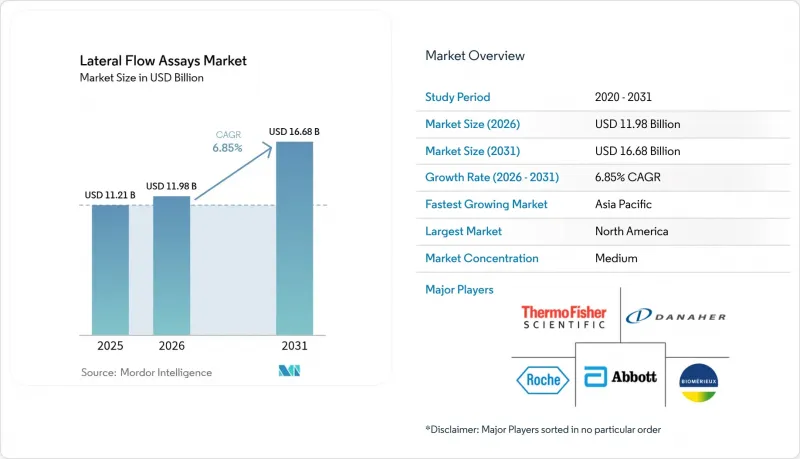
Mordor Intelligence에 의하면, LFA(Lateral Flow Assays) 시장 규모는 2025년에 112억 1,000만 달러, 2026년 119억 8,000만 달러에서 2031년까지 166억 8,000만 달러에 이를 것으로 예측되며, 예측 기간(2026년-2031년) CAGR은 6.85%를 기록할 전망입니다.
본 보고서는 용도(임상 검사, 약물 남용 검사 등), 분석법(샌드위치 분석법, 경쟁 분석법 등), 제품(키트 및 시약, 래터럴 플로우 리더),최종 사용자(재택치료, 병원 및 진료소 등), 지역(북미, 유럽, 아시아태평양, 중동 및 아프리카, 남미)별로 분류되어 있습니다. 시장 예측은 금액(달러) 기준으로 제시되어 있습니다.
세계 래터럴 플로우 분석 시장 동향 및 인사이트
POC(Point-of-Care) 진단 수요 증가
의료 제공업체들은 치료 주기를 단축하고 환자 처리 능력을 향상시키기 위해 신속 검사 도입을 가속화하고 있습니다. 17분 만에 결과를 얻을 수 있는 고감도 심근 트로포닌 I 분석법이 FDA 승인을 받은 것은 첨단 래터럴 플로우 방식의 임상적 유용성을 입증하는 것입니다. 소매 클리닉, 응급 치료 센터 및 직장 프로그램에서는 현재 SARS-CoV-2, A형 및 B형 인플루엔자, RSV를 동시에 식별하는 다항목 호흡기 패널이 도입되어, 한 번의 내원으로 삼분류가 가능해졌습니다. 소형화된 검출 모듈과 무선 연결에 대한 투자를 통해, 래터럴 플로우 플랫폼은 지속적인 모니터링 생태계 및 원격 환자 관리 모델의 핵심 요소로서 입지를 확고히 하고 있습니다.
가정용 검사 확산
코로나19로 인해 자가 검사가 보편화됨에 따라 규제 당국은 일반의약품(OTC)으로의 전환을 확대되고 있습니다. FDA는 2024년, 표준 510(k) 절차에 따라 코로나19와 인플루엔자 항원 병용 검사를 승인하여, 유사한 다항목 가정용 검사의 진입 장벽을 낮췄습니다. 소비자에게 직접 판매하는 방식은 제조업체에 지속적인 수익원과 더 풍부한 실제 데이터를 제공합니다. 소비자들은 ‘First To Know’ 매독 검사 키트의 사례에서 볼 수 있듯이, 손가락 끝에서 혈액 한 방울을 채취하기만 하면 15분 만에 결과를 확인할 수 있는 편의성을 선호합니다. 자가 진단은 의료기관 방문 횟수를 줄이고, 보험사의 비용을 절감하며, 조기 치료 개입을 지원함으로써 시장 확대를 뒷받침하고 있습니다.
분산되고 끊임없이 변화하는 규제 체계
미국, 중국, 유럽연합(EU) 간 규정이 서로 다르기 때문에 전 세계적인 승인 전략은 복잡해지고 있습니다. FDA가 실험실 개발 검사(LDT)에 대한 집행 재량권을 4년에 걸쳐 단계적으로 폐지할 방침에 따라, 이 분야에서는 규정 준수 비용으로 5억 6,600만 달러에서 35억 6,000만 달러의 지출이 발생할 가능성이 있습니다. 중국의 국가약품감독관리국(NMPA)은 24개 항목의 개혁 프로그램을 동시에 전개하고 있으며, EU도 체외진단용 의료기기에 관한 규제를 세분화하고 있습니다. 중소규모 기업들은 불균형적인 부담에 직면하고 있으며, 품질 기준의 전반적인 향상이라는 장기적인 이점이 있음에도 불구하고 혁신 속도가 둔화되고 있습니다.
부문 분석
임상 검사는 2025년 래터럴 플로우 분석(lateral flow assay) 시장에서 51.02%를 차지하며, 병원, 진료소, 검사실에서의 일상적인 검사를 뒷받침하고 있습니다. 이 부문은 한 번의 진료로 SARS-CoV-2, A형 및 B형 인플루엔자, RSV를 진단하는 멀티플렉스 호흡기 패널이 다시 성장하고 있는 데서 혜택을 보고 있습니다. 임신 검사는 모든 의료 현장에서 여전히 주류를 이루고 있는 반면, 결핵 검사는 전 세계적인 근절 이니셔티브 덕분에 탄력을 받고 있습니다. 약물 남용 검사는 현재 절대액 기준으로 규모가 작지만, 대마초 합법화 및 안전 규제 동향에 대응하는 고용주 수요로 인해 2031년까지 연평균 성장률(CAGR) 10.24%로 확대되고 있습니다. 환경 모니터링 및 수의학 검사는 현재 전체에서 미미한 점유율에 불과하지만, 규제 당국의 감시 요건이 강화됨에 따라 큰 성장 여지를 보이고 있습니다.
임상 검사의 지속적인 우위는 환급 절차의 개선과 15분 만에 결과를 얻을 수 있는 샌드위치 방식에 대한 임상의들의 신뢰로 인해 더욱 공고해지고 있습니다. 한편, 가장 빠르게 성장하고 있는 약물 남용 검사 부문은 속도를 희생하지 않고도 합성 카나비노이드와 오피오이드를 검출할 수 있는 멀티플렉스 패널의 발전으로 혜택을 보고 있습니다. 이러한 발전으로 인해 수익원의 다각화가 확고해졌으며, 기존의 임신 검사에 대한 의존도가 낮아지고 있습니다.
샌드위치 방식의 분석법은 확립된 제조 기술과 높은 특이성 덕분에 2025년 래터럴 플로우 분석법 시장 점유율의 66.02%를 차지하고 있습니다. 그러나 의료 시스템이 여러 병원체와 바이오마커의 동시 검출을 요구하는 가운데, 멀티플렉스 형식은 연평균 성장률(CAGR) 11.32%로 확대될 것으로 예측됩니다. CRISPR-Cas13a 스트립은 다중 바이러스 패널에서 RT-qPCR과 완벽한 일치를 보여줌으로써 새로운 성능 기준을 제시하고 있습니다. 경쟁 분석법 및 리버스 플로우 분석법은 저분자 의약품 스크리닝이나 고감도 호르몬 검사 등 틈새 용도에서 계속해서 활용되고 있습니다.
멀티플렉스 기술의 혁신은 10분 이내에 여러 유전자 표적을 식별하고, 스마트폰 리더기와 원활하게 연동되는 방사형으로 구획화된 페이퍼 칩에 의해 주도되고 있습니다. 페닐보론산으로 개질된 자성 양자점은 감도의 한계를 한층 더 높이며, 저비용 기판에 분자 수준의 성능을 제공합니다. 이러한 기술적 모멘텀은 감염증, 종양학, 동반 진단 각 워크플로우에서 멀티플렉스 플랫폼의 채택이 확대될 것임을 시사합니다.
지역별 분석
2025년, 북미는 37.70%의 점유율을 유지하며 최대 시장이 되었습니다. 견고한 의료 인프라, 보험사의 보상, 그리고 FDA의 명확한 LDT(실험실 개발 검사) 프레임워크가 안정적인 수요를 뒷받침하고 있습니다. 미국의 소매 클리닉 및 약국 체인에서는 멀티플렉스 호흡기 패널 도입이 확대되고 있는 반면, 캐나다와 멕시코는 USMCA(미국·멕시코·캐나다 협정)에 따른 공급망의 시너지 효과를 활용하여 접근성 확대를 도모하고 있습니다.
아시아태평양은 연평균 성장률(CAGR) 10.63%로 가장 빠르게 성장하고 있는 지역입니다. 중국의 ‘의료기기 개혁 24개 항목’ 및 ‘건강 중국 2030’ 의제에 따라 국내 혁신이 촉진되고 승인 절차가 신속화되고 있습니다. 또한, 이 지역은 비용 경쟁력이 있는 제조 체계의 혜택을 받아 시장 출시 기간을 단축하고, 인도나 인도네시아 등 인구가 많은 국가에서의 접근성을 확대되고 있습니다. 일본의 고령화는 신속하고 사용하기 쉬운 진단법에 대한 수요를 더욱 부추기고 있습니다.
유럽에서는 엄격한 성능 요건 및 환경 지속가능성에 관한 규제에 따라 생분해성 기질의 채택이 촉진되어 꾸준한 성장이 나타나고 있습니다. 유럽연합(EU)의 조율된 조달 체계가 지역 간 제품 출시를 뒷받침하는 한편, 각국의 의료 제도에서는 병원의 부담을 줄이기 위해 포인트 오브 케어(PoC) 플랫폼이 도입되고 있습니다. 중동 및 아프리카 및 남미에서는 공중보건 프로그램과 국제적인 자금 지원에 힘입어 이용이 확대되고 있지만, 공급망의 변동과 수입 관세가 때때로 성장을 둔화시키는 요인이 되고 있습니다. 지역적 분산화로 인해 래터럴 플로우 분석 시장은 국지적인 경기 침체에도 탄력성을 유지하고 있습니다.
기타 혜택:
- Excel 형식 시장 예측(ME) 시트
- 3개월간의 애널리스트 지원
자주 묻는 질문
목차
제1장 서론
제2장 분석 방법
제3장 주요 요약
제4장 시장 구도
제5장 시장 규모·성장률 예측
제6장 경쟁 구도
제7장 시장 기회와 향후 전망
LSH 26.08.26According to Mordor Intelligence, the lateral flow assay market size was valued at USD 11.21 billion in 2025 and estimated to grow from USD 11.98 billion in 2026 to reach USD 16.68 billion by 2031, at a CAGR of 6.85% during the forecast period (2026-2031).
This report is Segmented by Application (Clinical Testing, Drug-Abuse Testing, and More), Technique (Sandwich Assay, Competitive Assay, and More), Product (Kits & Reagents, Lateral-Flow Readers), End User (Home Care Settings, Hospitals & Clinics, and More), and Geography (North America, Europe, Asia-Pacific, Middle East & Africa, South America). The Market Forecasts are Provided in Terms of Value (USD).
Global Lateral Flow Assays Market Trends and Insights
Accelerating Demand for Point-of-Care Diagnostics
Healthcare providers intensify adoption of rapid testing to shorten treatment cycles and improve patient throughput. The FDA's clearance of a high-sensitivity cardiac troponin I assay that delivers results in 17 minutes validates the clinical utility of advanced lateral flow formats. Retail clinics, urgent-care centers, and workplace programs now deploy multiplex respiratory panels that simultaneously identify SARS-CoV-2, influenza A/B, and RSV, enabling single-visit triage. Investments in miniaturized detection modules and wireless connectivity position lateral flow platforms as core elements of continuous monitoring ecosystems and remote patient-management models.
Surge in Home-Based Testing Adoption
COVID-19 normalized self-testing, and regulators are widening the over-the-counter pathway. The FDA authorized an antigen combination test for COVID-19 and influenza under a standard 510(k) in 2024, lowering barriers for similar multiplex home tests. Direct-to-consumer distribution provides manufacturers with recurring revenue streams and richer real-world data. Consumers favor the convenience of 15-minute results from single finger-stick blood drops, as exemplified by the First To Know Syphilis Test. Home-based diagnostics reduce clinical visits, cut payer costs, and support earlier therapeutic intervention, reinforcing market expansion.
Fragmented and Evolving Regulatory Frameworks
Divergent rules across the United States, China, and the European Union complicate global submission strategies. The FDA's four-year phase-out of enforcement discretion on laboratory-developed tests could cost the sector between USD 566 million and USD 3.56 billion in compliance spending. China's National Medical Products Administration (NMPA) is simultaneously rolling out a 24-measure reform program, and the EU continues to refine in-vitro diagnostic regulations. Smaller firms face disproportionate burden, curbing innovation velocity despite the long-term benefit of universally higher quality standards.
Other drivers and restraints analyzed in the detailed report include:
- Expansion into Veterinary Diagnostics and Food Safety Applications
- Increased Preparedness for Biothreats and Public Health Emergencies
- Higher False-Negative Risk Compared to Molecular Diagnostics
For complete list of drivers and restraints, kindly check the Table Of Contents.
Segment Analysis
Clinical testing captured 51.02% of the 2025 lateral flow assays market, underpinning routine workups in hospitals, clinics, and laboratories. The segment benefits from renewed growth in multiplex respiratory panels that diagnose SARS-CoV-2, influenza A/B, and RSV in a single visit. Pregnancy testing remains a mainstay across all care settings, while tuberculosis assays gain traction thanks to global elimination initiatives. Drug-abuse testing, currently smaller in absolute dollars, accelerates at a 10.24% CAGR through 2031 as employers respond to evolving marijuana legalization and safety mandates. Environmental monitoring and veterinary testing collectively account for a modest share today but show strong upside as regulators tighten surveillance requirements.
Clinical testing's continued dominance is reinforced by improved reimbursement pathways and clinician trust in sandwich formats that deliver 15-minute results. Meanwhile, the fastest-growing drug-abuse segment benefits from advancements in multiplex panels capable of detecting synthetic cannabinoids and opioids without sacrificing speed. These developments solidify diversified revenue streams and mitigate reliance on legacy pregnancy testing.
Sandwich assays anchored 66.02% of the 2025 lateral flow assays market share owing to established manufacturing and high specificity. Yet, multiplex formats are projected to expand at 11.32% CAGR as health systems demand concurrent detection of multiple pathogens or biomarkers. CRISPR-Cas13a strips have already shown perfect concordance with RT-qPCR for multivirus panels, signaling a new performance benchmark. Competitive and reverse-flow assays continue serving niche applications such as small-molecule drug screening and enhanced-sensitivity hormone testing.
Multiplex innovation is propelled by radially compartmentalized paper chips that identify multiple gene targets within 10 minutes and integrate seamlessly with smartphone readers. Phenylboronic acid-modified magnetic quantum dots further raise the sensitivity ceiling, bringing molecular-class performance to low-cost substrates. This technical momentum suggests escalating adoption of multiplex platforms across infectious disease, oncology, and companion-diagnostic workflows.
Complete Report Scope:
- By Application
- Clinical Testing
- Pregnancy Testing
- Influenza Testing
- Tuberculosis Testing
- D-dimer Testing
- Other Clinical Testing
- Drug-Abuse Testing
- Environmental Monitoring
- Other Applications
- Clinical Testing
- By Technique
- Sandwich Assay
- Competitive Assay
- Multiplex Assay
- Reverse Flow Assay
- By Product
- Kits & Reagents
- Lateral-Flow Readers
- Digital / Mobile Readers
- Benchtop Readers
- By End User
- Home Care Settings
- Hospitals & Clinics
- Diagnostic Laboratories
- Veterinary & Food Testing Labs
- By Geography
- North America
- United States
- Canada
- Mexico
- Europe
- Germany
- United Kingdom
- France
- Italy
- Spain
- Rest of Europe
- Asia-Pacific
- China
- Japan
- India
- Australia
- South Korea
- Rest of Asia-Pacific
- Middle East & Africa
- GCC
- South Africa
- Rest of Middle East & Africa
- South America
- Brazil
- Argentina
- Rest of South America
- North America
Geography Analysis
North America maintained the largest share at 37.70% in 2025. Robust healthcare infrastructure, payer reimbursement, and the FDA's clear LDT framework underpin consistent demand. U.S. retail clinics and pharmacy chains increasingly deploy multiplex respiratory panels, while Canada and Mexico leverage USMCA supply-chain synergies to broaden access.
Asia-Pacific is the fastest-growing region at 10.63% CAGR. China's 24-measure medical-device reform and the Healthy China 2030 agenda elevate domestic innovation and expedite approvals. The region also benefits from cost-competitive manufacturing that shortens time-to-market and expands availability in populous nations such as India and Indonesia. Japan's aging demographics further fuel demand for rapid, user-friendly diagnostics.
Europe posts steady growth based on stringent performance requirements and environmental sustainability mandates that drive adoption of biodegradable substrates. Coordinated procurement in the European Union supports pan-regional launches, while national health systems adopt point-of-care platforms to lower hospital burden. The Middle East & Africa and South America record rising uptake aided by public-health programs and international funding, although supply-chain volatility and import duties occasionally temper growth. Geographic diversification ensures the lateral flow assays market remains resilient to localized downturns.
- Abbott Laboratories
- Thermo Fisher Scientific
- Roche
- Danaher
- Siemens Healthineers
- QuidelOrtho
- Merck
- Revvity
- QIAGEN
- bioMerieux
- Hologic
- Beckton Dickinson
- Bio-Rad Laboratories
- Sysmex
- Chembio Diagnostics Inc.
- Zhejiang Orient Gene Biotech
- Hangzhou AllTest Biotech
- Shenzhen Mindray Bio-Medical
- Sugentech Inc.
- Baja Medica LLC
Additional Benefits:
- The market estimate (ME) sheet in Excel format
- 3 months of analyst support
TABLE OF CONTENTS
1 Introduction
- 1.1 Study Assumptions & Market Definition
- 1.2 Scope of the Study
2 Research Methodology
3 Executive Summary
4 Market Landscape
- 4.1 Market Overview
- 4.2 Market Drivers
- 4.2.1 Accelerating Demand for Point-of-Care Diagnostics
- 4.2.2 Surge in Home-Based Testing Adoption
- 4.2.3 Expansion into Veterinary Diagnostics and Food Safety Applications,
- 4.2.4 Increased Preparedness for Biothreats and Public Health Emergencies
- 4.2.5 Integration with Smartphone Apps and Digital Readers
- 4.2.6 Cost-Effectiveness and Scalability of LFAs
- 4.3 Market Restraints
- 4.3.1 Fragmented and Evolving Regulatory Frameworks
- 4.3.2 Higher False-Negative Risk Compared to Molecular (PCR) Diagnostics
- 4.3.3 Volatility in Supply of Key Raw Materials
- 4.3.4 Mounting Environmental Concerns Around the Use of Single-Use Plastic-Based Test
- 4.4 Porter's Five Forces Analysis
- 4.4.1 Threat of New Entrants
- 4.4.2 Bargaining Power of Buyers
- 4.4.3 Bargaining Power of Suppliers
- 4.4.4 Threat of Substitute Products
- 4.4.5 Intensity of Competitive Rivalry
5 Market Size & Growth Forecasts (Value in USD)
- 5.1 By Application
- 5.1.1 Clinical Testing
- 5.1.1.1 Pregnancy Testing
- 5.1.1.2 Influenza Testing
- 5.1.1.3 Tuberculosis Testing
- 5.1.1.4 D-dimer Testing
- 5.1.1.5 Other Clinical Testing
- 5.1.2 Drug-Abuse Testing
- 5.1.3 Environmental Monitoring
- 5.1.4 Other Applications
- 5.1.1 Clinical Testing
- 5.2 By Technique
- 5.2.1 Sandwich Assay
- 5.2.2 Competitive Assay
- 5.2.3 Multiplex Assay
- 5.2.4 Reverse Flow Assay
- 5.3 By Product
- 5.3.1 Kits & Reagents
- 5.3.2 Lateral-Flow Readers
- 5.3.2.1 Digital / Mobile Readers
- 5.3.2.2 Benchtop Readers
- 5.4 By End User
- 5.4.1 Home Care Settings
- 5.4.2 Hospitals & Clinics
- 5.4.3 Diagnostic Laboratories
- 5.4.4 Veterinary & Food Testing Labs
- 5.5 By Geography
- 5.5.1 North America
- 5.5.1.1 United States
- 5.5.1.2 Canada
- 5.5.1.3 Mexico
- 5.5.2 Europe
- 5.5.2.1 Germany
- 5.5.2.2 United Kingdom
- 5.5.2.3 France
- 5.5.2.4 Italy
- 5.5.2.5 Spain
- 5.5.2.6 Rest of Europe
- 5.5.3 Asia-Pacific
- 5.5.3.1 China
- 5.5.3.2 Japan
- 5.5.3.3 India
- 5.5.3.4 Australia
- 5.5.3.5 South Korea
- 5.5.3.6 Rest of Asia-Pacific
- 5.5.4 Middle East & Africa
- 5.5.4.1 GCC
- 5.5.4.2 South Africa
- 5.5.4.3 Rest of Middle East & Africa
- 5.5.5 South America
- 5.5.5.1 Brazil
- 5.5.5.2 Argentina
- 5.5.5.3 Rest of South America
- 5.5.1 North America
6 Competitive Landscape
- 6.1 Market Concentration
- 6.2 Market Share Analysis
- 6.3 Company Profiles (includes Global level Overview, Market level overview, Core Segments, Financials as available, Strategic Information, Market Rank/Share for key companies, Products & Services, and Recent Developments)
- 6.3.1 Abbott Laboratories
- 6.3.2 Thermo Fisher Scientific Inc.
- 6.3.3 F. Hoffmann-La Roche AG
- 6.3.4 Danaher Corporation
- 6.3.5 Siemens Healthineers AG
- 6.3.6 QuidelOrtho Corporation
- 6.3.7 Merck KGaA
- 6.3.8 Revvity
- 6.3.9 QIAGEN N.V.
- 6.3.10 bioMerieux SA
- 6.3.11 Hologic Inc.
- 6.3.12 Becton, Dickinson and Company
- 6.3.13 Bio-Rad Laboratories Inc.
- 6.3.14 Sysmex Corporation
- 6.3.15 Chembio Diagnostics Inc.
- 6.3.16 Zhejiang Orient Gene Biotech
- 6.3.17 Hangzhou AllTest Biotech
- 6.3.18 Shenzhen Mindray Bio-Medical
- 6.3.19 Sugentech Inc.
- 6.3.20 Baja Medica LLC
7 Market Opportunities & Future Outlook
- 7.1 White-space & Unmet-need Assessment