

|
시장보고서
상품코드
2114677
남성 성선 기능 저하증 시장 : 시장 점유율 분석, 업계 동향 및 통계, 성장 예측(2026-2031년)Male Hypogonadism - Market Share Analysis, Industry Trends & Statistics, Growth Forecasts (2026 - 2031) |
||||||
 Mordor Intelligence
Mordor Intelligence에 의하면, 2026년 남성 성선 기능 저하증 시장 규모는 35억 8,000만 달러로 추정되고, 2025년 34억 1,000만 달러에서 확대해, 2031년에는 45억 4,000만 달러에 이를 것으로 예측됩니다.
2026-2031년 연평균 성장률(CAGR) 4.86%로 성장할 것으로 전망됩니다.
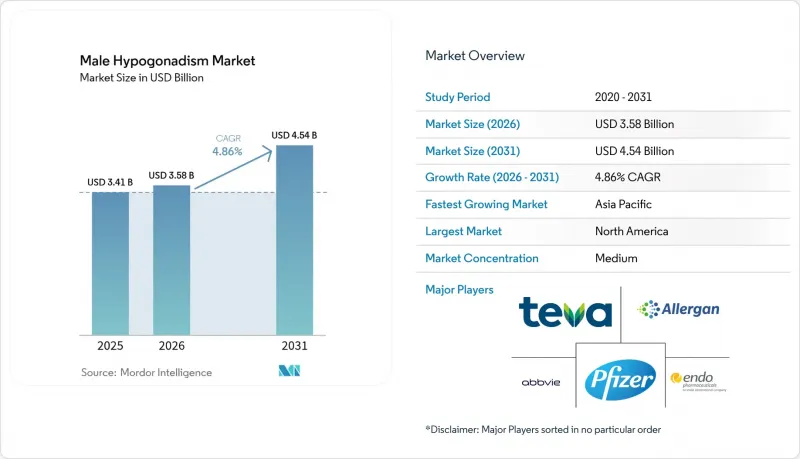
본 보고서는 치료법별(테스토스테론 보충 요법, 고나도트로핀 방출 호르몬 요법), 투여 경로별(주사제, 경구제, 기타), 적응증별(칼만 증후군, 클라인펠터 증후군, 뇌하수체 질환, 기타 적응증), 지역별(북미, 유럽, 아시아태평양, 기타)로 분류되어 있습니다. 시장 예측은 금액(달러) 기준으로 제시되어 있습니다.
세계의 남성 성선 기능 저하증 시장 동향 및 인사이트
전 세계적으로 증가하는 테스토스테론 결핍증 진단 건수
2025년에 승인된 자동 유리 테스토스테론 측정법은 48분 만에 결과를 보고하며, 성호르몬 결합 글로불린(SHBG) 수치가 낮은 비만 환자의 검출 정확도를 향상시킵니다. 명확한 진단 알고리즘과 의사를 대상으로 한 광범위한 교육을 통해, 기존에는 간과되기 쉬웠던 사례가 감소하고 있으며, 확정 진단 사례가 증가하고 있습니다. 치료되지 않은 성선 기능 저하증은 대사성 및 심혈관계 동반 질환을 유발하기 때문에 보험사들은 현재 조기 치료를 비용 대비 효과가 높은 것으로 간주하고 있습니다. 40세 이상 남성을 대상으로 한 선별 검사가 일상화됨에 따라, 남성 성선 기능 저하증 시장에 유입되는 진단받은 환자층은 계속해서 확대되고 있습니다.
장시간 작용형 주사제 및 경구용 테스토스테론 제제의 급속한 보급
경구용 테스토스테론 운데카노에이트는 용량 조정을 하지 않아도 환자의 87.8%에서 호르몬 수치를 정상화시킵니다. Xyosted와 같은 피하 자가 주사기는 자가 투여를 간소화하고, 병원 방문 횟수를 줄이며, 주사 부위의 반응을 완화합니다. 10-14주마다 투여되는 지속형 근육 내 주사제는 혈중 농도 곡선을 안정화시키고, 복약 순응도를 향상시킵니다. 첨단 투여 기술에 대한 특허를 보유한 기업(Antares Pharma사만 해도 2038년까지 유효한 미국의 자동 주사기 관련 특허 26건을 보유하고 있습니다)은 가격 결정력을 유지하며 시장 확대를 지속하고 있습니다. 이러한 혁신 기술이 남성 성선 기능 저하증 시장의 모든 성숙 지역에서 판매량 증가를 뒷받침하고 있습니다.
심혈관 및 전립선암에 관한 안전성 우려
TRAVERSE 임상시험에서는 주요 심혈관 사건에 대한 비열등성이 확인되어 2025년 2월 FDA의 첨부문서 갱신으로 이어졌으나, 폐색전증 및 심방세동의 발생률이 높다는 징후가 나타나고 있으므로 지속적인 혈압 모니터링이 필요합니다. 유럽 규제 당국은 더 장기적인 결과가 명확해질 때까지 계속해서 신중한 사용을 권장하고 있습니다. 전립선암 정기 검진의 의무화는 환자의 비용 부담과 위험에 대한 인식을 높여, 본래 치료 대상인 집단에서의 치료 도입을 억제하고, 단기적인 남성 성기능 저하증 시장의 성장을 둔화시키고 있습니다.
부문 분석
테스토스테론 대체 요법(TRT)은 2025년 매출의 80.57%를 차지했으며, 대부분의 병인에서 1차 치료법으로서의 입지를 공고히 했습니다. 주사제, 패치, 젤 및 새로 승인된 경구 캡슐은 임상 현장에서 폭넓은 인지도를 확보하여 남성 성선 기능 저하증 시장에서 TRT의 규모 우위를 가져다주고 있습니다. 한편, 성선자극호르몬 방출 호르몬(GnRH) 요법은 젊은 남성의 생식 능력 보존이라는 매력 덕분에 연평균 성장률(CAGR) 5.42%로 확대되고 있습니다.
TRT와 hCG 또는 GnRH를 병용하는 병용 요법은 정자 형성 최적화와 증상 완화 측면에서 학계의 관심을 모으고 있습니다. 극심한 스트레스 환경 하에서 테스토스테론 운데카노에이트의 유효성을 입증한 군사 연구는 성능 유지 적응증 분야로의 길을 열어주고 있습니다. 마이크로캡슐화 및 림프관 흡수 촉진제에 관한 특허 활동이 지속됨에 따라, 남성 성선 기능 저하증 시장에서 두 범주의 경쟁적 입지가 형성되어 중기적인 성장이 유지될 것으로 전망됩니다.
지역별 분석
북미에서는 종합적인 보험 적용, 원격 의료의 보급, 그리고 적응증 확대 이후 테스토스테론 처방 건수의 회복을 배경으로, 2025년에는 전 세계 매출의 40.79%를 차지했습니다. 미국만 보더라도 처방량은 2014년 기준치에 비해 3배 증가했으며, 이는 규제 명확화와 디지털 헬스 인프라가 치료법의 보급을 얼마나 가속화하고 있는지를 보여줍니다. 기존의 외용제가 자동 주사기나 경구용 약물로 대체되는 현상이 진행 중이지만, 이는 총 매출에 긍정적인 영향을 미치며 남성 성선 기능 저하증 시장의 꾸준한 성장을 뒷받침하고 있습니다.
유럽에서는 지침의 조화와 삶의 질(QOL) 향상 요법에 대한 지불 기관의 자금 지원 의지가 심혈관계 안전성에 대한 보다 보수적인 태도를 상쇄하고 있어, 균형 잡힌 성장세가 나타나고 있습니다. 유럽의약품청(EMA)의 모니터링 체계는 치료 시작 전에 생화학적 결핍이 확인되었는지를 중시하고 있으며, 이로 인해 처방량은 인증된 전문 클리닉으로 유도되고 있습니다. 일부 EU 회원국에서 발생한 공급 부족은 국경을 넘는 약국 거래를 유발했으나, 이는 일시적인 현상이었음에도 불구하고 남성 성선 기능 저하증 시장 규모에서 잠재적 수요의 탄력성을 부각시켰습니다.
아시아태평양은 2031년까지 연평균 성장률(CAGR)이 5.55%로 가장 빠르게 성장하는 지역입니다. 일본, 한국 및 중국의 도시 지역에서 고령화와 비만 유병률의 확대가 맞물려 상당한 규모의 잠재적 대상 집단이 형성되고 있습니다. 경구용 운데카노에이트 제제의 현지 출시로 주사에 따른 사회적 편견을 피할 수 있는 한편, 국가 차원의 군 체력 단련 프로그램을 통해 검진이 촉진되고 있습니다. 2급 도시 시장 침투율은 여전히 낮은 수준이므로, 남성 성선 기능 저하증 시장의 향후 확장을 위한 충분한 여지가 남아 있습니다.
기타 혜택 :
- 엑셀 형식 시장 예측(ME) 시트
- 3개월간의 애널리스트 지원
자주 묻는 질문
목차
제1장 서론
제2장 조사 방법
제3장 주요 요약
제4장 시장 구도
제5장 시장 규모 및 성장 예측
제6장 경쟁 구도
제7장 시장 기회 및 향후 전망
AJY 26.08.26According to Mordor Intelligence, male hypogonadism market size in 2026 is estimated at USD 3.58 billion, growing from 2025 value of USD 3.41 billion with 2031 projections showing USD 4.54 billion, growing at 4.86% CAGR over 2026-2031.
This report is Segmented by Therapy Type (Testosterone Replacement Therapy, Gonadotropin-Releasing Hormone Therapy), Route of Administration (Injectable, Oral, Others), Application (Kallmann Syndrome, Klinefelter's Syndrome, Pituitary Disorders, Other Applications), and Geography (North America, Europe, Asia-Pacific, and More). The Market Forecasts are Provided in Terms of Value (USD).
Global Male Hypogonadism Market Trends and Insights
Rising Global Prevalence of Testosterone-Deficiency Diagnoses
Automated free-testosterone assays cleared in 2025 report results in 48 minutes and improve detection accuracy in obese patients with low sex-hormone-binding globulin . Clear diagnostic algorithms and wider physician training reduce historical under-screening, raising the number of confirmed cases. Payers now view early therapy as cost-effective because untreated hypogonadism drives metabolic and cardiovascular comorbidities. As screening becomes routine for men over 40, the diagnosed population feeding into the male hypogonadism market keeps enlarging.
Rapid Uptake of Long-Acting Injectable & Oral Testosterone Formulations
Oral testosterone undecanoate normalizes hormone levels in 87.8% of patients without dose titration. Subcutaneous autoinjectors such as Xyosted simplify self-administration, cut clinic visits, and reduce injection-site reactions. Long-acting intramuscular products given every 10-14 weeks stabilize serum curves and improve adherence. Firms owning advanced delivery patents-Antares Pharma alone holds 26 U.S. autoinjector patents valid through 2038-protect pricing power and sustain expansion. These innovations underpin volume growth across all mature regions of the male hypogonadism market.
Cardio-vascular & Prostate-Cancer Safety Concerns
The TRAVERSE trial met non-inferiority on major cardiac events, leading to February 2025 FDA label updates, yet higher pulmonary embolism and atrial-fibrillation signals require continued blood-pressure surveillance . European regulators still recommend conservative use until more long-term outcomes surface . Mandatory prostate screening raises patient costs and perceptions of risk, tempering uptake in otherwise eligible populations and dampening near-term male hypogonadism market growth.
Other drivers and restraints analyzed in the detailed report include:
- Growing Use of Tele-Endocrinology & Direct-to-Consumer Online Pharmacies
- Ageing/Obesity Co-Morbidity Funnel Enlarging the Treatable Pool
- Stringent US & EU REMS / Controlled-Substance Regulations
For complete list of drivers and restraints, kindly check the Table Of Contents.
Segment Analysis
Testosterone replacement therapy commanded 80.57% of 2025 revenue, reinforcing its status as the first-line option for most etiologies. Injectables, patches, gels, and newly approved oral capsules anchor broad clinical familiarity, giving TRT a scale advantage within the male hypogonadism market. Gonadotropin-releasing hormone (GnRH) therapy, however, is advancing at a 5.42% CAGR on the appeal of fertility preservation in younger men.
Combination regimens that pair TRT with hCG or GnRH are gaining academic interest for optimizing spermatogenesis and symptom relief. Military research showing testosterone undecanoate's efficacy in extreme-stress environments opens a path for performance maintenance indications. Continued patent activity around micro-encapsulation and lymphatic-absorption enhancers is likely to shape competitive positioning and sustain mid-term growth across both categories in the male hypogonadism market.
Complete Report Scope:
- By Therapy Type
- Testosterone Replacement Therapy
- Gonadotropin-Releasing Hormone Therapy
- Human Chorionic Gonadotropin (hCG)
- Follicle-Stimulating Hormone (FSH)
- Gonadotropin-Releasing Hormone (GnRH)
- Other Gonadotropin Therapies
- By Route of Administration
- Injectable
- Oral
- Others
- By Application
- Kallmann Syndrome
- Klinefelter's Syndrome
- Pituitary Disorders
- Other Applications
- By Geography
- North America
- United States
- Canada
- Mexico
- Europe
- Germany
- United Kingdom
- France
- Italy
- Spain
- Rest of Europe
- Asia-Pacific
- China
- Japan
- India
- Australia
- South Korea
- Rest of Asia-Pacific
- Middle East and Africa
- GCC
- South Africa
- Rest of Middle East and Africa
- South America
- Brazil
- Argentina
- Rest of South America
- North America
Geography Analysis
North America generated 40.79% of global sales in 2025 on the back of generous insurance coverage, telehealth penetration, and the post-label-change rebound in testosterone prescribing. The United States alone saw prescription volumes triple versus 2014 baselines, illustrating how regulatory clarity and digital health infrastructure accelerate therapy uptake. Cannibalization of older topical formulations by autoinjectors and orals is underway yet additive to total dollars, supporting steady male hypogonadism market growth.
Europe displays balanced forward momentum as guideline harmonization and payer willingness to fund quality-of-life therapies offset more conservative cardiovascular safety positions. EMA monitoring frameworks emphasize confirmed biochemical deficiency before initiation, channeling volumes toward certified specialty clinics. Supply scarcities in select EU states sparked cross-border pharmacy transactions that, while temporary, showcased latent demand elasticity within the male hypogonadism market size.
Asia-Pacific is the fastest-rising region at a 5.55% CAGR through 2031. Aging populations in Japan, South Korea, and urban China, coupled with expanding obesity prevalence, create sizable addressable cohorts. Local launches of oral undecanoate products sidestep injection-related stigma, while national military-fitness programs amplify screening. Market penetration remains low in tier-2 cities, leaving ample runway for future expansion of the male hypogonadism market.
- Abbvie
- Bayer
- Endo International
- Pfizer
- Teva Pharmaceutical Industries
- Eli Lilly and Company
- Ferring Pharmaceuticals
- Sun Pharmaceuticals Industries
- Merck
- Abbvie
- Clarus Therapeutics
- Antares Pharma
- Lupin
- Sandoz ( Novartis AG )
- Mylan N.V. (Viatris)
- Acerus Pharmaceuticals
- Upsher-Smith Laboratories
- Besins Healthcare
- Aspen Pharmacare
- Endocrine Technologies, Inc.
- Theramex
Additional Benefits:
- The market estimate (ME) sheet in Excel format
- 3 months of analyst support
TABLE OF CONTENTS
1 Introduction
- 1.1 Study Assumptions & Market Definition
- 1.2 Scope of the Study
2 Research Methodology
3 Executive Summary
4 Market Landscape
- 4.1 Market Overview
- 4.2 Market Drivers
- 4.2.1 Rising Global Prevalence Of Testosterone-Deficiency Diagnoses
- 4.2.2 Rapid Uptake Of Long-Acting Injectable & Oral Testosterone Formulations
- 4.2.3 Growing Use Of Tele-Endocrinology & Direct-To-Consumer (DTC) Online Pharmacies
- 4.2.4 Ageing/Obesity Co-Morbidity Funnel Enlarging The Treatable Pool
- 4.2.5 Payer Shift Toward Covering Hypogonadism As A Quality-Of-Life Disorder
- 4.2.6 Military & Sports-Medicine Screening Programmes In Emerging Markets
- 4.3 Market Restraints
- 4.3.1 Cardio-Vascular & Prostate-Cancer Safety Concerns
- 4.3.2 Stringent US & EU REMS / Controlled-Substance Regulations
- 4.3.3 Supply Instability Of API Testosterone & Compounded Products
- 4.3.4 Social-Media-Driven OTC Misuse Prompting Tighter Oversight
- 4.4 Regulatory Landscape
- 4.5 Porter's Five Forces Analysis
- 4.5.1 Threat of New Entrants
- 4.5.2 Bargaining Power of Buyers
- 4.5.3 Bargaining Power of Suppliers
- 4.5.4 Threat of Substitutes
- 4.5.5 Intensity of Competitive Rivalry
5 Market Size & Growth Forecasts (Value, USD)
- 5.1 By Therapy Type
- 5.1.1 Testosterone Replacement Therapy
- 5.1.2 Gonadotropin-Releasing Hormone Therapy
- 5.1.2.1 Human Chorionic Gonadotropin (hCG)
- 5.1.2.2 Follicle-Stimulating Hormone (FSH)
- 5.1.2.3 Gonadotropin-Releasing Hormone (GnRH)
- 5.1.2.4 Other Gonadotropin Therapies
- 5.2 By Route of Administration
- 5.2.1 Injectable
- 5.2.2 Oral
- 5.2.3 Others
- 5.3 By Application
- 5.3.1 Kallmann Syndrome
- 5.3.2 Klinefelter's Syndrome
- 5.3.3 Pituitary Disorders
- 5.3.4 Other Applications
- 5.4 By Geography
- 5.4.1 North America
- 5.4.1.1 United States
- 5.4.1.2 Canada
- 5.4.1.3 Mexico
- 5.4.2 Europe
- 5.4.2.1 Germany
- 5.4.2.2 United Kingdom
- 5.4.2.3 France
- 5.4.2.4 Italy
- 5.4.2.5 Spain
- 5.4.2.6 Rest of Europe
- 5.4.3 Asia-Pacific
- 5.4.3.1 China
- 5.4.3.2 Japan
- 5.4.3.3 India
- 5.4.3.4 Australia
- 5.4.3.5 South Korea
- 5.4.3.6 Rest of Asia-Pacific
- 5.4.4 Middle East and Africa
- 5.4.4.1 GCC
- 5.4.4.2 South Africa
- 5.4.4.3 Rest of Middle East and Africa
- 5.4.5 South America
- 5.4.5.1 Brazil
- 5.4.5.2 Argentina
- 5.4.5.3 Rest of South America
- 5.4.1 North America
6 Competitive Landscape
- 6.1 Market Concentration
- 6.2 Market Share Analysis
- 6.3 Company Profiles (includes Global-level Overview, Market-level Overview, Core Segments, Financials, Strategic Info, Market Rank/Share, Products & Services, Recent Developments)
- 6.3.1 AbbVie Inc.
- 6.3.2 Bayer AG
- 6.3.3 Endo International plc
- 6.3.4 Pfizer Inc.
- 6.3.5 Teva Pharmaceutical Industries Ltd.
- 6.3.6 Eli Lilly and Company
- 6.3.7 Ferring Holding SA
- 6.3.8 Sun Pharmaceutical Industries Ltd.
- 6.3.9 Merck & Co., Inc.
- 6.3.10 Allergan plc
- 6.3.11 Clarus Therapeutics
- 6.3.12 Antares Pharma
- 6.3.13 Lupin Ltd.
- 6.3.14 Sandoz ( Novartis AG )
- 6.3.15 Mylan N.V. (Viatris)
- 6.3.16 Acerus Pharmaceuticals
- 6.3.17 Upsher-Smith Laboratories
- 6.3.18 Besins Healthcare
- 6.3.19 Aspen Pharmacare
- 6.3.20 Endocrine Technologies, Inc.
- 6.3.21 Theramex
7 Market Opportunities & Future Outlook
- 7.1 White-space & Unmet-Need Assessment


