

|
시장보고서
상품코드
2114682
유전성 혈관부종 치료제 : 시장 점유율 분석, 산업 동향 및 통계 데이터, 성장 예측(2026-2031년)Hereditary Angioedema Therapeutics - Market Share Analysis, Industry Trends & Statistics, Growth Forecasts (2026 - 2031) |
||||||
 Mordor Intelligence
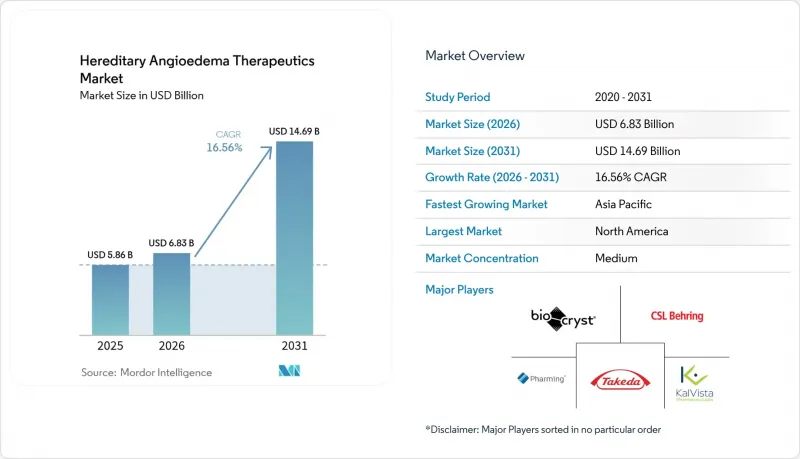
Mordor Intelligence에 의하면, 2026년 유전성 혈관부종 치료제 시장 규모는 68억 3,000만 달러로 추정되고 2025년 58억 6,000만 달러에서 확대해, 2031년에는 146억 9,000만 달러에 이를 것으로 예측됩니다.
2026년부터 2031년까지의 연평균 성장률(CAGR)은 16.56%를 나타낼 것으로 전망됩니다.
본 보고서는 약물 분류별(C1 에스테라제 억제제 등), 투여 경로별(정맥 내 등), 환자 유형별(제1형 등), 치료 유형별(급성기/온디맨드 치료, 장기 예방 요법), 유통 채널별(병원 약국 등), 지역별(북미, 유럽,아시아태평양 등)별로 분류되어 있습니다. 시장 예측은 금액(달러) 기준으로 제시되어 있습니다.
세계의 유전성 혈관부종 치료제 시장 동향 및 인사이트
최초의 경구용 칼리크레인 억제제의 상업화
BioCryst사의 베오트랄스타트(Orladeyo)는 1일 1회 경구 예방 요법을 표준화하여, 2024년에는 4억 3,700만 달러의 매출을 올리고, 2025년 1분기에는 전년 동기 대비 51%의 추가 성장을 기록했습니다. 젊은 층과 근로 연령층의 환자들은 정제를 선호하는 경향이 있어, 이에 따라 주사제에서 경구제로의 전환이 가속화되고 있습니다. 현재 미국 유전성 혈관부종 환자의 70%가 경구 예방 요법을 선택하고 있습니다. 칼비스타(Calvista)사의 세베트랄스타트에 대해서는 FDA의 승인 결정이 보류 중이지만, 이 약이 승인되면 최초의 경구 온디맨드 치료제로 등장하게 됩니다. 3상 임상시험 데이터에 따르면, 증상 완화까지 걸리는 시간은 위약군의 6.72시간에 비해 1.61시간인 것으로 나타났습니다. 이러한 추세에 따라, 그동안 치료가 미흡했던 환자층을 포용하고 지리적 보급 범위를 확대함으로써 유전성 혈관부종 치료제 시장은 성장하고 있습니다.
피하 투여형 C1-INH의 자가 투여 확대
CSL 베링사의 ‘헤가르다(Haegarda)’는 주요 임상시험에서 발작 빈도를 95% 감소시켰으며, 정맥 내 보충 요법에서 환자 스스로의 피하 투여로 전 세계적으로 전환되는 것을 뒷받침했습니다. 재택 치료 프로그램을 통해 환자 1인당 연간 비용은 11.3% 절감되었으며, 기술적 실패율은 2% 미만으로 억제되고 있습니다. 전문 약국은 24시간 운영되는 헬프라인과 간호사의 지도를 제공하여 복약 순응도를 높이는 동시에, 정맥 주사 센터의 부담을 경감시키고 있습니다. 8세라는 어린 소아 환자군에서도 병원 밖에서 지속적인 예방 치료가 가능해져, 삶의 질 향상이 더욱 촉진되고 있습니다.
고액의 연간 치료비로 인한 의료 예산 압박
높은 임상적 가치에도 불구하고, 증분 비용 대비 효과 비율은 QALY당 15만 달러를 초과하는 경우가 있어 기존의 기준치에 문제를 제기하고 있습니다. 실제 데이터에 따르면, 환자 1인당 연간 직접 의료비는 약 36만 4,000달러, 간접적 손실은 5만 2,500달러에 달하여 공적 보험자의 부담이 되고 있으며, 저소득 시장에서의 보험 적용 범위를 제한하고 있습니다. 바이오시밀러의 잠재력은 혈장 공급 제약과 복잡한 생물학적 제제 제조 공정에 의해 제한받고 있습니다.
부문별 분석
C1 에스테라제 억제제는 2025년 매출의 60.92%를 차지하며, 유전성 혈관부종 치료제 시장 규모를 35억 7,000만 달러로 뒷받침했습니다. CSL Behring사의 ‘Berinert’와 ‘Haegarda’는 확실한 효능과 풍부한 실제 임상 데이터를 바탕으로 이러한 입지를 공고히 하고 있습니다. 한편, 칼리크레인 억제제는 19.12%의 연평균 성장률(CAGR)로 더 빠르게 성장하고 있으며, 2024년에 4억 3,700만 달러의 매출을 기록한 BioCryst사의 경구용 제제 ‘베오트랄스타트’가 이를 주도하고 있습니다. 후기 임상 개발 단계에 있는 경구제, 피하 투여제, 그리고 장기 작용형 단일클론 항체와 같은 다양한 제형을 파이프라인에 보유한 칼리크레인 억제제는 예측 기간 동안 유전성 혈관부종 치료제 시장에서 점유율을 더욱 확대될 전망입니다.
환자들의 선호에 따라 자본 배분은 경구제나 투여 간격이 긴 주사제로 이동하고 있으며, 이는 기존의 혈장 유래 부문에 압박을 가하고 있습니다. 그럼에도 불구하고, 혈장을 사용하지 않는 재조합 C1-INH(루코네스트)와 공급 다각화 전략을 통해 기존 기업들은 조달상의 제약과 감염병 위험으로부터 보호받고 있으며, 2030년까지 이 두 축을 기반으로 한 시장 구조가 유지될 전망입니다.
2025년, 피하 투여 제제는 유전성 혈관부종 치료제 시장의 51.48%를 차지하여 30억 2,000만 달러에 달하며, 지난 10년 동안 지속된 재택 투여로의 전환 추세를 여실히 보여주었습니다. 98% 이상의 교육 수료율은 이 모델의 유효성을 입증하고 있으며, 의료경제학 연구에 따르면 병원에서의 정맥 내 투여에 비해 연간 11.30%의 비용 절감이 확인되었습니다. 동시에 경구 투여 시장은 연평균 성장률(CAGR) 19.7%로 확대되고 있으며, 벨로트랄스타트 및 세베트랄스타트의 승인 전망에 힘입어 2031년까지 47억 2,000만 달러를 넘어설 것으로 예측됩니다.
정맥 내 치료는 감소 추세를 보이고 있지만, 응급실이나 즉각적인 고용량 치료가 필요한 환자에게는 여전히 필수적입니다. 2-11세 소아를 대상으로 한 과립 제제를 목표로 하는 향후 파이프라인 자산은 경구 치료의 적용 범위를 더욱 넓히고, 환자 중심 치료의 발전을 뒷받침할 것입니다.
지역별 분석
북미는 2025년 매출의 79.55%를 차지했으며, 이는 견실한 보험 환급, 신속 심사 지정, 그리고 잘 갖춰진 전문 약국 인프라를 반영합니다. 미국에서는 1,200명 이상의 의사가 베오트랄스타트를 채택하고 있으며, 성과 연계형 계약에 관한 보험사와의 협력이 높은 복약 순응도를 뒷받침하고 있습니다. 캐나다에서는 주(州)의 처방약 목록을 활용한 보험 적용이 이루어지고 있는 반면, 멕시코의 의료 관광 회랑은 선진적인 치료법을 찾는 지역 HAE 환자들을 끌어모으고 있습니다.
유럽에서는 시장 침투가 성숙 단계에 접어든 가운데, 지속적인 제품 주기를 통해 가치 성장이 유지되고 있습니다. EMA(유럽의약품청)의 갈라다시맙에 대한 긍정적 견해와 MHRA(영국 의약품규제청)의 라나델맙 소아 적응증 승인은 규제 측면에서의 모멘텀을 보여주고 있습니다. 프랑스의 조기 접근 프로그램에서는 6개월 시점에서 임상적으로 유의미한 QOL(삶의 질) 개선이 65% 보고되어, 보험사 측의 신뢰를 강화하고 있습니다.
아시아태평양은 연평균 성장률(CAGR) 17.44%로 가장 빠르게 성장하고 있으며, 일본의 규제 명확화, 중국의 희귀질환 목록 확대, 그리고 환자 지원 단체 주도의 인지도 제고가 그 원동력이 되고 있습니다. 2024년 마닐라에서 개최된 HAEi 서밋에서는 25개국에 걸친 협력 노력이 소개되었으나, 진단법과 보험 지급 제도의 불일치가 여전히 과제로 남아 있습니다. 지역 내 혈장 분획 시설 및 원격 교육 플랫폼에 대한 투자를 통해, 향후 공급 및 전문 지식 부족 문제가 완화될 것으로 기대됩니다.
기타 혜택 :
- 엑셀 형식 시장 예측(ME) 시트
- 3개월간의 애널리스트 지원
자주 묻는 질문
목차
제1장 서론
제2장 분석 방법
제3장 주요 요약
제4장 시장 구도
제5장 시장 규모 및 성장률 예측
제6장 경쟁 구도
제7장 시장 기회 및 향후 전망
KTH 26.08.28According to Mordor Intelligence, the hereditary angioedema therapeutics market size in 2026 is estimated at USD 6.83 billion, growing from 2025 value of USD 5.86 billion with 2031 projections showing USD 14.69 billion, growing at 16.56% CAGR over 2026-2031.
This report is Segmented by Drug Class (C1 Esterase Inhibitor, and More), Route of Administration (Intravenous, and More), Patient Type (Type I, and More), Treatment Type (Acute/On-Demand and Long-Term Prophylaxis), Distribution Channel (Hospital Pharmacies, and More), and Geography (North America, Europe, Asia-Pacific, and More). The Market Forecasts are Provided in Terms of Value (USD).
Global Hereditary Angioedema Therapeutics Market Trends and Insights
Commercial Roll-Out of First-In-Class Oral Kallikrein Inhibitors
BioCryst's berotralstat (Orladeyo) has normalized once-daily oral prophylaxis, driving USD 437 million in 2024 sales and a further 51% year-over-year uplift in Q1 2025. Young, working-age patients favor the pill format, accelerating switches from injectables; 70% of U.S. hereditary angioedema patients now choose oral prophylaxis. A pending FDA decision on KalVista's sebetralstat could inaugurate the first oral on-demand option, with Phase 3 data showing symptom relief within 1.61 hours versus 6.72 hours for placebo. These dynamics are enlarging the hereditary angioedema therapeutics market by capturing previously undertreated segments and broadening geographic reach.
Escalating Use of Subcutaneous C1-INH Self-Administration
CSL Behring's Haegarda cut attack frequency by 95% in pivotal trials and underpinned a global migration from intravenous replacement to patient-controlled subcutaneous dosing. Home programs reduce annual per-patient costs by 11.3% and maintain technical failure rates below 2%. Specialty pharmacies supply 24-hour helplines and nurse coaching, reinforcing adherence and freeing infusion-center capacity. Pediatric cohorts as young as eight years now achieve durable prophylaxis outside hospital settings, reinforcing quality-of-life gains.
High Annual Therapy Cost Pressures Healthcare Budgets
Despite strong clinical value, incremental cost-effectiveness ratios can breach USD 150,000 per QALY, challenging conventional thresholds. Real-world evidence places direct medical costs near USD 364,000 and indirect losses at USD 52,500 per patient yearly, straining public payers and limiting coverage in low-income markets. Biosimilar potential is restricted by plasma supply constraints and complex biologics manufacturing.
Other drivers and restraints analyzed in the detailed report include:
- Momentum Behind Gene-Silencing & CRISPR One-Shot Cures
- Rising Orphan-Drug Pricing Power & Payer Acceptance
- Limited HAE Expertise Outside Tier-1 Academic Centers
For complete list of drivers and restraints, kindly check the Table Of Contents.
Segment Analysis
C1 esterase inhibitors generated 60.92% of 2025 revenue, anchoring the hereditary angioedema therapeutics market size at USD 3.57 billion. CSL Behring's Berinert and Haegarda safeguard this position through reliable efficacy and extensive real-world data. Yet kallikrein inhibitors are scaling faster at a 19.12% CAGR, led by BioCryst's oral berotralstat, which delivered USD 437 million in 2024 sales. With modular oral, subcutaneous, and long-acting monoclonal formats in late-stage pipelines, kallikrein agents are positioned to capture incremental hereditary angioedema therapeutics market share over the forecast window.
Patient preference is steering capital allocation toward oral compounds and long-interval injectables, pressuring conventional plasma-derived segments. Nonetheless, plasma-free recombinant C1-INH (Ruconest) and supply-diversification strategies protect incumbents against sourcing constraints and infectious-disease risk, sustaining a two-pillar class dynamic through 2030.
Subcutaneous products contributed 51.48% of hereditary angioedema therapeutics market share in 2025, equal to USD 3.02 billion, and underscore a decade-long shift toward home dosing. Training completion rates above 98% validate the model, while health-economic studies confirm 11.30% annual savings versus hospital-based intravenous care. Concurrently, oral delivery is expanding at 19.7% CAGR, on track to exceed USD 4.72 billion by 2031, driven by berotralstat and the anticipated approval of sebetralstat.
Intravenous treatments, though declining, remain critical for emergency departments and for patients requiring immediate high-dose intervention. Future pipeline assets targeting granule formulations for children aged 2-11 years will further broaden oral reach, reinforcing patient-centric care trajectories.
Complete Report Scope:
- By Drug Class
- C1 Esterase Inhibitor
- Selective Bradykinin B2 Receptor Antagonist
- Kallikrein Inhibitor
- Other Drug Classes
- By Route of Administration
- Intravenous
- Sub-cutaneous Injection
- Oral
- By Treatment Type
- Acute / On-Demand
- Long-term Prophylaxis
- By Patient Type
- Type I (C1-INH deficiency)
- Type II (C1-INH dysfunction)
- nC1-INH (Type III & others)
- By Distribution Channel
- Hospital Pharmacies
- Specialty & Home-infusion Pharmacies
- Online Pharmacies
- Geography
- North America
- United States
- Canada
- Mexico
- Europe
- Germany
- United Kingdom
- France
- Italy
- Spain
- Rest of Europe
- Asia-Pacific
- China
- Japan
- India
- Australia
- South Korea
- Rest of Asia-Pacific
- Middle East & Africa
- GCC
- South Africa
- Rest of Middle East & Africa
- South America
- Brazil
- Argentina
- Rest of South America
- North America
Geography Analysis
North America held 79.55% of 2025 revenue, reflecting robust reimbursement, fast-track regulatory designations, and dense specialty-pharmacy infrastructure. More than 1,200 U.S. physicians have adopted berotralstat, and payer alignment on outcomes contracts sustains high adherence. Canada leverages provincial formularies for coverage, while Mexico's medical-tourism corridors attract regional HAE patients seeking advanced regimens.
Europe displays mature penetration, yet continued product cycling sustains value growth. EMA's positive opinion on garadacimab and MHRA's lanadelumab pediatric nod highlight regulatory momentum. France's early-access program reported 65% clinically meaningful quality-of-life gains at six months, reinforcing payer confidence.
Asia-Pacific is the fastest-growing region at 17.44% CAGR, propelled by Japan's regulatory clarity, China's expanding rare-disease catalog, and advocacy-driven awareness. The 2024 Manila HAEi summit showcased collaborative efforts across 25 nations, though diagnostic and reimbursement heterogeneity remain hurdles. Investments in regional plasma fractionation and tele-education platforms are expected to mitigate supply and expertise gaps over time.
- CSL Behring
- Takeda Pharmaceutical Co Ltd
- Sanofi
- Pharming Healthcare
- BioCryst Pharmaceuticals
- Attune Pharmaceuticals
- Ionis Pharmaceuticals
- KalVista Pharmaceuticals
- Adverum Biotechnologies
- Cipla
- Arrowhead Pharmaceuticals
- Astria Therapeutics Inc.
- Grifols
- Swedish Orphan Biovitrum (SOBI)
- Regeneron Pharmaceuticals
- CSL Vifor
- Bayer
- Novartis
- Merck
- Roche
Additional Benefits:
- The market estimate (ME) sheet in Excel format
- 3 months of analyst support
TABLE OF CONTENTS
1 Introduction
- 1.1 Study Assumptions & Market Definition
- 1.2 Scope of the Study
2 Research Methodology
3 Executive Summary
4 Market Landscape
- 4.1 Market Overview
- 4.2 Market Drivers
- 4.2.1 Escalating Use of Sub-Cutaneous C1-INH Self-Administration
- 4.2.2 Commercial Roll-Out of First-In-Class Oral Kallikrein Inhibitors
- 4.2.3 Rising Orphan-Drug Pricing Power & Payer Acceptance
- 4.2.4 Precision-Medicine Push for Nc1-INH HAE Genotyping
- 4.2.5 Home-Infusion & Tele-Pharmacy Infrastructure Expansion
- 4.2.6 Momentum Behind Gene-Silencing & CRISPR One-Shot Cures
- 4.3 Market Restraints
- 4.3.1 High Annual Therapy Cost (> US $500k/Patient) Pressures Budgets
- 4.3.2 Limited HAE Expertise Outside Tier-1 Academic Centers
- 4.3.3 Cold-Chain & Plasma-Supply Bottlenecks for C1-INH
- 4.3.4 Regulatory Uncertainty for Long-Acting Monoclonal in Pediatrics
- 4.4 Regulatory Landscape
- 4.5 Porter's Five Forces Analysis
- 4.5.1 Threat of New Entrants
- 4.5.2 Bargaining Power of Buyers
- 4.5.3 Bargaining Power of Suppliers
- 4.5.4 Threat of Substitutes
- 4.5.5 Intensity of Rivalry
5 Market Size & Growth Forecasts (Value, USD)
- 5.1 By Drug Class
- 5.1.1 C1 Esterase Inhibitor
- 5.1.2 Selective Bradykinin B2 Receptor Antagonist
- 5.1.3 Kallikrein Inhibitor
- 5.1.4 Other Drug Classes
- 5.2 By Route of Administration
- 5.2.1 Intravenous
- 5.2.2 Sub-cutaneous Injection
- 5.2.3 Oral
- 5.3 By Treatment Type
- 5.3.1 Acute / On-Demand
- 5.3.2 Long-term Prophylaxis
- 5.4 By Patient Type
- 5.4.1 Type I (C1-INH deficiency)
- 5.4.2 Type II (C1-INH dysfunction)
- 5.4.3 nC1-INH (Type III & others)
- 5.5 By Distribution Channel
- 5.5.1 Hospital Pharmacies
- 5.5.2 Specialty & Home-infusion Pharmacies
- 5.5.3 Online Pharmacies
- 5.6 Geography
- 5.6.1 North America
- 5.6.1.1 United States
- 5.6.1.2 Canada
- 5.6.1.3 Mexico
- 5.6.2 Europe
- 5.6.2.1 Germany
- 5.6.2.2 United Kingdom
- 5.6.2.3 France
- 5.6.2.4 Italy
- 5.6.2.5 Spain
- 5.6.2.6 Rest of Europe
- 5.6.3 Asia-Pacific
- 5.6.3.1 China
- 5.6.3.2 Japan
- 5.6.3.3 India
- 5.6.3.4 Australia
- 5.6.3.5 South Korea
- 5.6.3.6 Rest of Asia-Pacific
- 5.6.4 Middle East & Africa
- 5.6.4.1 GCC
- 5.6.4.2 South Africa
- 5.6.4.3 Rest of Middle East & Africa
- 5.6.5 South America
- 5.6.5.1 Brazil
- 5.6.5.2 Argentina
- 5.6.5.3 Rest of South America
- 5.6.1 North America
6 Competitive Landscape
- 6.1 Market Concentration
- 6.2 Market Share Analysis
- 6.3 Company Profiles (includes Global-level Overview, Market-level Overview, Core Segments, Financials, Strategic Information, Market Rank/Share, Products & Services, Recent Developments)
- 6.3.1 CSL Behring
- 6.3.2 Takeda Pharmaceutical Co Ltd
- 6.3.3 Sanofi
- 6.3.4 Pharming Healthcare Inc.
- 6.3.5 BioCryst Pharmaceuticals Inc.
- 6.3.6 Attune Pharmaceuticals Inc.
- 6.3.7 Ionis Pharmaceuticals
- 6.3.8 KalVista Pharmaceuticals Inc.
- 6.3.9 Adverum Biotechnologies Inc.
- 6.3.10 Cipla Inc.
- 6.3.11 Arrowhead Pharmaceuticals Inc.
- 6.3.12 Astria Therapeutics Inc.
- 6.3.13 Grifols S.A.
- 6.3.14 Swedish Orphan Biovitrum (SOBI)
- 6.3.15 Regeneron Pharmaceuticals Inc.
- 6.3.16 CSL Vifor
- 6.3.17 Bayer AG
- 6.3.18 Novartis AG
- 6.3.19 Merck & Co. Inc.
- 6.3.20 F. Hoffmann-La Roche Ltd
7 Market Opportunities & Future Outlook
- 7.1 White-space & Unmet-need Assessment


