|
시장보고서
상품코드
2114684
리소좀 축적 질환 치료제 : 시장 점유율 분석, 산업 동향 및 통계 데이터, 성장 예측(2026-2031년)Lysosomal Storage Disease Treatment - Market Share Analysis, Industry Trends & Statistics, Growth Forecasts (2026 - 2031) |
||||||
 Mordor Intelligence
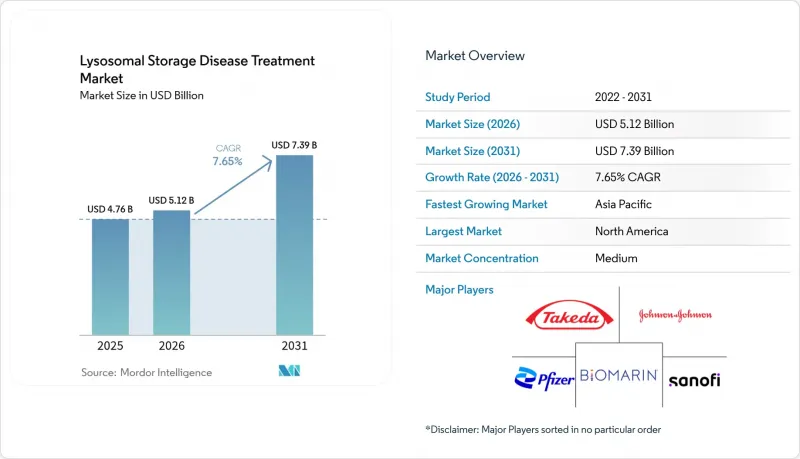
Mordor Intelligence에 의하면, 리소좀 축적 질환 치료제 시장 규모는 2025년에 47억 6,000만 달러로 평가되었습니다. 2026년 51억 2,000만 달러에서 2031년까지 73억 9,000만 달러에 이를 것으로 예상되며, 예측 기간(2026-2031년) CAGR은 7.65%를 나타낼 전망입니다.
본 보고서는 치료법 유형(효소 보충 요법 등), 투여 방식(생물학적 제제의 정맥 내 투여 등), 질환 유형(고셰병 등), 투여 경로(병원 내 정맥 내 점적 주사 등), 최종 사용자(3차 의료 기관 등) 및 지역(북미, 유럽 등)별로 분류되어 있습니다. 시장 전망은 금액(달러) 기준으로 제시되어 있습니다.
세계의 리소좀 축적 질환 치료제 시장 동향 및 인사이트
전 세계 리소좀 축적 질환 유병률 증가
상하이에서 실시된 신생아 유전체 선별 검사 결과, 신생아 1,856명당 1명의 비율로 리소좀 축적 질환(LSD : 리소좀 질환)의 발생이 확인되었습니다. 이는 기존의 추정치를 크게 상회하는 수치로, 예방적 검사의 중요성을 뒷받침하는 결과입니다. 중국 국가의약품감독관리국의 CARE 프로그램은 희귀질환용 의약품 신청을 장려하고 있으며, 2024년 이후 임상시험용 의약품 신청 건수가 32% 증가했습니다. 한국의 전국 등록 데이터에서도 유사한 유병률 상승이 관찰되어, 개별 사례 진단에서 전체 인구를 대상으로 한 선별 검사로의 전환이 부각되고 있습니다. 등록 데이터의 확대에 따라 조기 개입에 대한 수요가 증가하고 있으며, 주요 3차 의료기관에서는 진단까지의 지연 기간이 6년에서 6주 미만으로 단축되었습니다. 이에 따라 치료 파이프라인은 임상적 효과가 가장 뚜렷한 영아 발병 적응증을 중심으로 재조정되고 있습니다.
진단 기술과 조기 선별 검사의 발전
2세대 탠덤 질량 분석법으로는 현재 1회의 검사로 최대 8유형의 LSD를 선별할 수 있으며, 위양성률은 0.5% 미만으로, 효소 활성 패널을 능가하는 성능을 보이고 있습니다. 차세대 염기서열 분석(NGS)의 통합을 통해 병인성 변이가 확인되어 치료 지침이 됩니다. 예를 들어, 적응증이 되는 변이를 가진 파브리병 환자에게 미갈라스타트 선택 등이 가능해집니다. 확정적인 유전자형 판정에 소요되는 시간은 7일 미만으로 단축되어, 신생아 집중치료실(NICU) 입원 중에 치료를 시작할 수 있게 되었습니다. 의료 제도에 도입이 가장 많이 진행된 곳은 캐나다와 독일이며, 이들 국가에서는 정부의 보험 급여 제도가 생화학적 검사와 유전체 검사를 모두 대상으로 하고 있습니다. 조기 진단을 통해 장애 예방에 따른 장기적인 비용 절감 효과가 입증됨에 따라, 고부가가치 유전자 치료에 대한 보험사 측의 수용이 촉진되고 있습니다.
고액의 치료비와 보험 급여상의 과제
렌멜디의 가격은 425만 달러로, 세계에서 가장 비싼 치료법으로 자리매김하고 있으며, 지급 기관은 보상을 운동 기능의 평가 지표와 연계하는 성과 연계형 계약의 채택을 피할 수 없게 되었습니다. 독일에서는 파브리병에 대한 효소 보충 요법의 연간 평균 비용이 환자 1인당 36만 9,047유로(40만 5,952달러)이며, 그중 94%가 약제 조달비를 차지하고 있습니다. 메디케이드 프로그램에서는 일시적인 재정적 충격을 완화하기 위해 정액 지급에서 유전자 치료 번들을 분리하고 있습니다. 민간 보험사는 유전적으로 확인된 사례로만 적용 범위를 제한하고, 경과에 따른 바이오마커 데이터 제출을 의무화하고 있어, 이로 인해 미국 17개 주에서 치료 접근이 지연되고 있습니다. 또한, 다년에 걸친 상각에 관한 규제 지침이 미해결 상태이기 때문에 혁신적인 연금형 지불 모델의 도입은 더디게 진행되고 있습니다.
부문별 분석
리소좀 축적 질환 치료제 시장에서 효소 보충 요법 시장 규모는 2025년에 31억 달러에 달하고, 총 매출의 65.10%를 차지하며, 고셰병, 파브리병, 폼페병 치료에서 여전히 매우 중요한 위치를 차지했습니다. 경쟁 우위는 이전 세대의 알글루코시다제에 비해 근육 흡수율이 높은 아바르글루코시다제 알파와 같은 2세대 효소에 집중되어 있습니다. 그러나 유전자 치료의 연평균 성장률(CAGR) 10.22%는 단 한 번의 투여로 충분하다는 가치 제안을 반영하고 있습니다. 렘멜디의 승인은 지속적인 신경학적 효과를 입증한 반면, 울트라제닉스의 UX111은 산필리포 증후군에 대한 2025년 FDA 심사 대기 목록의 최상위에 위치했습니다. 기질 감소 요법 및 약리학적 샤페론은 특정 돌연변이를 가진 환자군에게 점진적인 개선을 가져다주며, 리소좀 축적 질환 치료제 시장에서 정밀 의학의 발전을 뒷받침하고 있습니다. 퐁빌리치와 옵폴다의 병용 요법 등 병용 요법에 대한 파이프라인의 집중은 세포 내 수송을 촉진하고 치료 간격을 연장하는 것을 목표로 하고 있습니다.
2025년에는 이미글루세라제, 아갈시다제 β, 알글루코시다제 α의 주 1회 정맥 주사 투여에 힘입어, 정맥 내 투여 생물학적 제제가 매출의 55.20%를 차지했습니다. 경구용 저분자 기질 환원제(벤글루스타트, 루셀루스타트 및 승인된 셀델가)는 복약 순응도 향상과 주사 반응이 없습니다는 장점에 힘입어 연평균 성장률(CAGR) 10.12%라는 가장 높은 성장률을 기록하고 있습니다. 경구용 샤페론인 미갈라스타트가 파브리병의 추가 유전자형으로 적용 범위를 확대함에 따라, 치료법의 구성 비율은 더욱 변화하고 있습니다. 척수강내 및 뇌실내 투여법은 신경병증성 증후군으로 제한되어 있습니다. SmartFlow Neuro와 같은 기기는 케빌리디의 유전자 도입을 위한 캐뉼라의 정확한 삽입을 가능하게 합니다. PEG화 및 Fc 융합 기술을 통해 ELFABRIO와 같은 ERT의 반감기가 연장되어, 정맥 주사 투여 빈도가월1회로 줄었습니다. 환자 중심의 투여량은 재택 점적 요법의 확대와 조화를 이루고 있으며, 리소좀 축적 질환 치료제 시장에서 지불 주체가 치료 총비용 절감에 중점을 두고 있음을 여실히 보여줍니다.
지역별 분석
북미는 FDA의 ‘희귀 소아 질환 우선 심사 바우처’ 프로그램과 광범위한 민간 보험 적용에 힘입어 2025년 매출의 42.10%를 차지했습니다. 미국에서는 20건 이상의 유전자 치료 임상시험이 피험자를 모집 중이며, 이는 이 지역의 혁신적 우위를 확고히 하고 있습니다. 주별 격차는 여전히 존재합니다. 캘리포니아주는 타주에서 레멜디(Remeldy)를 투여받는 환자의 교통비와 숙박비를 지원하고 있는 반면, 중서부 6개 주에서는 유전자 치료를 메디케이드(Medicaid) 적용 제외 대상으로 제한하고 있어 치료 접근에 걸리는 기간이 길어지고 있습니다. 캐나다의 국민건강보험 제도에서는 지정된 희귀질환 의약품 목록에 등재된 5가지 ERT(효소 보충 요법)에 대해 보험 급여가 이루어지고 있으나, 승인부터 자금 지원까지의 기간은 평균 14개월 지연되고 있습니다.
아시아태평양은 연평균 성장률(CAGR) 9.15%로 가장 빠르게 성장하고 있는 지역입니다. 중국에서는 207가지 질환을 포괄하는 개정판 ‘희귀질환 목록’에 따라, 수입 의약품의 규제 심사 기간이 2023년 이전의 24개월에서 9개월로 단축되었습니다. 상하이에서 실시된 유전체 스크리닝 시범 사업에서는 LSD 발생률이 세계 평균을 크게 상회하는 것으로 밝혀졌으며, 이에 따라 전국 규모로 사업을 확대하기 위한 보조금이 지급되었습니다. 일본은 ‘사키가케’ 제도라는 신속 승인 제도를 활용하여 해외 생명공학 기업의 신청을 유치하고 있는 반면, 한국의 국민건강보험은 파브리병 치료비의 90% 이상을 부담하고 있어 지불 측의 준비가 되어 있음을 보여줍니다. 인도의 희귀질환 정책에서는 유전자 치료에 대해 환자 1인당 최대 200만 루피(220만 달러)의 보조금이 지급되지만, 실제 지급은 여전히 산발적입니다.
유럽에서는 국경을 초월한 의료를 조정하는 ‘유전성 대사질환 유럽 참조 네트워크(EMRD-EN)’의 주도 하에 안정적인 시장 점유율을 유지하고 있습니다. 독일에서는 재택 정맥주사 요법의 비용 균등화를 인정하고, 내원 횟수를 최소화하기 위해 매월 처방전 갱신을 지원하고 있습니다. 이탈리아 롬바르디아 주에서는 LSD 신생아 선별검사가 의무화되어 조기 진단이 확산되고 있습니다. 프랑스에서는 고가의 유전자 치료에 대해 치료 성과 연동형 상환 모델을 권장하고 있으며, 5년간의 보증 조항을 시범적으로 도입하고 있습니다. 영국의 NHS(국민보건서비스)는 항생제 ‘넷플릭스’ 계약을 모델로 한 정액 지불에 대해 협상을 진행 중이며, LSD 치료의 연간 지출에 상한선을 설정하는 동시에 공급업체에 안정적인 발주량을 보장하는 것을 목표로 하고 있습니다.
기타 혜택 :
- 엑셀 형식 시장 예측(ME) 시트
- 3개월간의 애널리스트 지원
자주 묻는 질문
목차
제1장 서론
제2장 분석 방법
제3장 주요 요약
제4장 시장 구도
제5장 시장 규모 및 성장률 예측
제6장 경쟁 구도
제7장 시장 기회 및 향후 전망
KTHAccording to Mordor Intelligence, the lysosomal storage disease treatment market size was valued at USD 4.76 billion in 2025 and estimated to grow from USD 5.12 billion in 2026 to reach USD 7.39 billion by 2031, at a CAGR of 7.65% during the forecast period (2026-2031).
This report is Segmented by Therapy Type (Enzyme Replacement Therapy, and More), Modality (Intravenous Biologics, and More), Disease Type (Gaucher Disease, and More), Route of Administration (Hospital-Based IV Infusion, and More), End User (Tertiary Hospitals, and More), and Geography (North America, Europe, and More). The Market Forecasts are Provided in Terms of Value (USD).
Global Lysosomal Storage Disease Treatment Market Trends and Insights
Rising Global Prevalence of Lysosomal Storage Disorders
Newborn genomic screening in Shanghai identified LSD incidence of 1 in 1,856 live births, materially above historical estimates and confirming the value of proactive testing. The Chinese National Medical Products Administration's CARE program encourages orphan-drug filings and has increased investigational new drug submissions by 32% since 2024. Similar prevalence up-ticks are appearing in South Korea's national registry, underscoring the shift from anecdotal diagnosis to population-wide screening. As registries expand, demand for early-stage intervention grows, shortening diagnostic delay from six years to fewer than six weeks in leading tertiary centers. Therapeutic pipelines are therefore recalibrated toward infant-onset indications where clinical benefit is most pronounced.
Advancements in Diagnostic Technologies and Early Screening
Second-generation tandem mass spectrometry now screens for up to eight LSDs in a single assay with under 0.5% false positives, outperforming enzyme-activity panels. Integration of next-generation sequencing confirms pathogenic variants and guides precision therapy, such as selecting migalastat for Fabry patients with amenable mutations. Turn-around times for confirmatory genotyping have fallen below seven days, enabling treatment initiation during neonatal intensive-care stays. Health-system adoption is fastest in Canada and Germany where government reimbursement covers both biochemical and genomic assays. Early diagnosis is catalyzing payer acceptance of high-value gene therapies by evidencing long-term cost offsets from avoided disability.
High Treatment Costs and Reimbursement Challenges
Lenmeldy lists at USD 4.25 million, positioning it as the world's most expensive therapy and forcing payers to adopt outcomes-based contracts tying reimbursement to motor-function end-points. In Germany, mean annual enzyme-replacement expenditure for Fabry disease is EUR 369,047 (USD 405,952) per patient, 94% of which is drug acquisition cost. Medicaid programs are carving out gene-therapy bundles from capitation payments to mitigate one-time financial shocks. Private insurers restrict coverage to genetically confirmed cases and require longitudinal biomarker data, prolonging access in 17 U.S. states. Innovative annuity-style payment models are progressing slowly due to unresolved regulatory guidance on multi-year amortization.
Other drivers and restraints analyzed in the detailed report include:
- Emerging Gene and Cell Therapies for Neuropathic LSDs
- Strategic Collaborations and Rare-Disease Investment Surge
- Limited Blood-Brain Barrier Penetration of Current Therapies
For complete list of drivers and restraints, kindly check the Table Of Contents.
Segment Analysis
The lysosomal storage disease treatment market size for enzyme replacement therapy stood at USD 3.1 billion in 2025, equal to 65.10% of total revenue, and remains pivotal for Gaucher, Fabry, and Pompe care. Competitive positioning centers on second-generation enzymes such as avalglucosidase alfa, which offers higher muscle uptake versus predecessor alglucosidase. However, gene therapy's 10.22% CAGR reflects its one-time-dose value proposition. Lenmeldy's approval showcases durable neurologic benefit, while Ultragenyx's UX111 heads the 2025 FDA review queue for Sanfilippo syndrome. Substrate reduction and pharmacological chaperones deliver incremental gains for mutation-specific cohorts, reinforcing precision-medicine trajectories within the lysosomal storage disease treatment market. Pipeline convergence toward combination regimens, such as Pombiliti plus Opfolda, aims to amplify intracellular trafficking and prolong treatment intervals.
Intravenous biologics retained 55.20% revenue in 2025, anchored by weekly infusions of imiglucerase, agalsidase beta, and alglucosidase alfa. Oral small-molecule substrate reducers-venglustat, lucerastat, and the approved Cerdelga-record the highest growth at 10.12% CAGR, driven by adherence benefits and absence of infusion reactions. The modality mix is tilting further as oral chaperone migalastat expands into additional Fabry genotypes. Intrathecal and intracerebroventricular deliveries are reserved for neuronopathic syndromes; devices such as SmartFlow Neuro enable precise cannula placement for Kebilidi gene transfer. PEGylation and Fc-fusion technologies extend half-life of ERTs like ELFABRIO, trimming infusion frequency to monthly. Patient-centric dosing aligns with home-infusion expansion and underscores payers' focus on total-cost-of-care reduction within the lysosomal storage disease treatment market.
Complete Report Scope:
- By Therapy Type
- Enzyme Replacement Therapy (ERT)
- Substrate Reduction Therapy (SRT)
- Gene Therapy
- Pharmacological Chaperone Therapy
- Hematopoietic Stem-Cell Transplantation
- By Modality
- Intravenous Biologics
- Oral Small-molecule
- Intrathecal/ICV Delivery
- By Disease Type
- Gaucher Disease (Type I-III)
- Fabry Disease
- Pompe Disease
- Mucopolysaccharidoses (I, II, III, IV, VI, VII)
- Niemann-Pick Disease (Type A/B & C)
- Other Disease Types
- By Route of Administration
- Hospital-based IV Infusion
- Home-infusion IV
- Oral
- Intrathecal/ICV
- By End-user
- Tertiary Hospitals
- Specialty/Rare-disease Clinics
- Home-care Settings
- Geography
- North America
- United States
- Canada
- Mexico
- Europe
- Germany
- United Kingdom
- France
- Italy
- Spain
- Rest of Europe
- Asia-Pacific
- China
- Japan
- India
- Australia
- South Korea
- Rest of Asia-Pacific
- Middle East & Africa
- GCC
- South Africa
- Rest of Middle East & Africa
- South America
- Brazil
- Argentina
- Rest of South America
- North America
Geography Analysis
North America delivered 42.10% of 2025 revenue, guided by the FDA's Rare Pediatric Disease Priority Review Voucher program and expansive commercial insurance coverage. More than 20 active gene-therapy trials are recruiting across the United States, cementing the region's innovation dominance. State-level disparity persists: California covers travel and lodging for out-of-state Lenmeldy recipients, whereas six Midwestern states limit gene therapies to Medicaid carve-outs, elongating access timelines. Canada's universal system reimburses five ERTs on a designated orphan-drug list, although approval-to-funding lags average 14 months.
Asia-Pacific is the fastest-growing territory at 9.15% CAGR. China's updated Rare Disease List, now 207 conditions, has cut regulatory review time for imported agents to 9 months, down from 24 months pre-2023. Shanghai's genomic screening pilot uncovered LSD incidence far above global averages, prompting national scale-up grants. Japan leverages its Sakigake fast-track to draw foreign biotech filings, while South Korea's National Health Insurance captures over 90% Fabry treatment coverage, demonstrating advanced payer readiness. India's rare-disease policy subsidizes up to INR 2 million (USD 2.2 million) per patient for gene therapy, though disbursement remains sporadic.
Europe holds a stable share driven by the European Reference Network for Hereditary Metabolic Disorders that coordinates cross-border care. Germany validates home-infusion cost parity and supports monthly prescription refills to minimize clinic visits. Italy's Lombardy region mandates LSD newborn screening, expanding early-diagnosis uptake. France favors outcome-linked reimbursement models for high-cost gene therapies, piloting five-year warranty clauses. The U.K.'s NHS is negotiating subscription payments modeled on its antimicrobial "Netflix" contract, aiming to cap annual LSD therapy spend while guaranteeing supplier volume.
- Sanofi
- Takeda Pharmaceuticals
- Pfizer
- BioMarin
- Johnson & Johnson
- Amicus Therapeutics
- Alexion Pharmaceuticals
- Sigilon Therapeutics
- GC Biopharma
- Orchard Therapeutics
- Cyclo Therapeutics
- IntraBio
- Chiesi Farmaceutici
- Freeline Therapeutics
- Rocket Pharmaceuticals
- Forge Biologics
- Polaryx Therapeutics
- M6P Therapeutics
- Sarepta Therapeutics
- Krystal Biotech
Additional Benefits:
- The market estimate (ME) sheet in Excel format
- 3 months of analyst support
TABLE OF CONTENTS
1 Introduction
- 1.1 Study Assumptions & Market Definition
- 1.2 Scope of the Study
2 Research Methodology
3 Executive Summary
4 Market Landscape
- 4.1 Market Overview
- 4.2 Market Drivers
- 4.2.1 Rising Global Prevalence of Lysosomal Storage Disorders
- 4.2.2 Increasing Orphan Drug Designations and Incentives
- 4.2.3 Advancements in Diagnostic Technologies and Early Screening
- 4.2.4 Expansion of Enzyme Replacement Therapy Product Approvals
- 4.2.5 Emerging Gene and Cell Therapies for Neuropathic LSDs
- 4.2.6 Strategic Collaborations and Rare-Disease Investment Surge
- 4.3 Market Restraints
- 4.3.1 High Treatment Costs and Reimbursement Challenges
- 4.3.2 Limited Blood-Brain Barrier Penetration of Current Therapies
- 4.3.3 Manufacturing Scalability and Supply Constraints
- 4.3.4 Long-Term Safety and Immunogenicity Concerns
- 4.4 Regulatory Landscape
- 4.5 Porter's Five Forces Analysis
- 4.5.1 Threat of New Entrants
- 4.5.2 Bargaining Power of Buyers/Consumers
- 4.5.3 Bargaining Power of Suppliers
- 4.5.4 Threat of Substitute Products
- 4.5.5 Intensity of Competitive Rivalry
5 Market Size & Growth Forecasts (Value, USD)
- 5.1 By Therapy Type
- 5.1.1 Enzyme Replacement Therapy (ERT)
- 5.1.2 Substrate Reduction Therapy (SRT)
- 5.1.3 Gene Therapy
- 5.1.4 Pharmacological Chaperone Therapy
- 5.1.5 Hematopoietic Stem-Cell Transplantation
- 5.2 By Modality
- 5.2.1 Intravenous Biologics
- 5.2.2 Oral Small-molecule
- 5.2.3 Intrathecal/ICV Delivery
- 5.3 By Disease Type
- 5.3.1 Gaucher Disease (Type I-III)
- 5.3.2 Fabry Disease
- 5.3.3 Pompe Disease
- 5.3.4 Mucopolysaccharidoses (I, II, III, IV, VI, VII)
- 5.3.5 Niemann-Pick Disease (Type A/B & C)
- 5.3.6 Other Disease Types
- 5.4 By Route of Administration
- 5.4.1 Hospital-based IV Infusion
- 5.4.2 Home-infusion IV
- 5.4.3 Oral
- 5.4.4 Intrathecal/ICV
- 5.5 By End-user
- 5.5.1 Tertiary Hospitals
- 5.5.2 Specialty/Rare-disease Clinics
- 5.5.3 Home-care Settings
- 5.6 Geography
- 5.6.1 North America
- 5.6.1.1 United States
- 5.6.1.2 Canada
- 5.6.1.3 Mexico
- 5.6.2 Europe
- 5.6.2.1 Germany
- 5.6.2.2 United Kingdom
- 5.6.2.3 France
- 5.6.2.4 Italy
- 5.6.2.5 Spain
- 5.6.2.6 Rest of Europe
- 5.6.3 Asia-Pacific
- 5.6.3.1 China
- 5.6.3.2 Japan
- 5.6.3.3 India
- 5.6.3.4 Australia
- 5.6.3.5 South Korea
- 5.6.3.6 Rest of Asia-Pacific
- 5.6.4 Middle East & Africa
- 5.6.4.1 GCC
- 5.6.4.2 South Africa
- 5.6.4.3 Rest of Middle East & Africa
- 5.6.5 South America
- 5.6.5.1 Brazil
- 5.6.5.2 Argentina
- 5.6.5.3 Rest of South America
- 5.6.1 North America
6 Competitive Landscape
- 6.1 Market Concentration
- 6.2 Market Share Analysis
- 6.3 Company Profiles (includes Global level Overview, Market level overview, Core Business Segments, Financials, Headcount, Key Information, Market Rank, Market Share, Products and Services, and analysis of Recent Developments)
- 6.3.1 Sanofi (Genzyme Corporation)
- 6.3.2 Takeda Pharmaceutical Company Limited (Shire Plc)
- 6.3.3 Pfizer, Inc.
- 6.3.4 BioMarin
- 6.3.5 Johnson & Johnson (Actelion Pharmaceuticals Ltd)
- 6.3.6 Amicus Therapeutics
- 6.3.7 Alexion Pharmaceuticals
- 6.3.8 Sigilon Therapeutics
- 6.3.9 GC Biopharma
- 6.3.10 Orchard Therapeutics
- 6.3.11 Cyclo Therapeutics
- 6.3.12 IntraBio
- 6.3.13 Chiesi Farmaceutici
- 6.3.14 Freeline Therapeutics
- 6.3.15 Rocket Pharmaceuticals
- 6.3.16 Forge Biologics
- 6.3.17 Polaryx Therapeutics
- 6.3.18 M6P Therapeutics
- 6.3.19 Sarepta Therapeutics
- 6.3.20 Krystal Biotech
7 Market Opportunities & Future Outlook
- 7.1 White-space & Unmet-need Assessment