|
시장보고서
상품코드
2114692
분획 혈류 예비력(FFR) : 시장 점유율 분석, 산업 동향 및 통계 데이터, 성장 예측(2026-2031년)Fractional Flow Reserve - Market Share Analysis, Industry Trends & Statistics, Growth Forecasts (2026 - 2031) |
||||||
 Mordor Intelligence
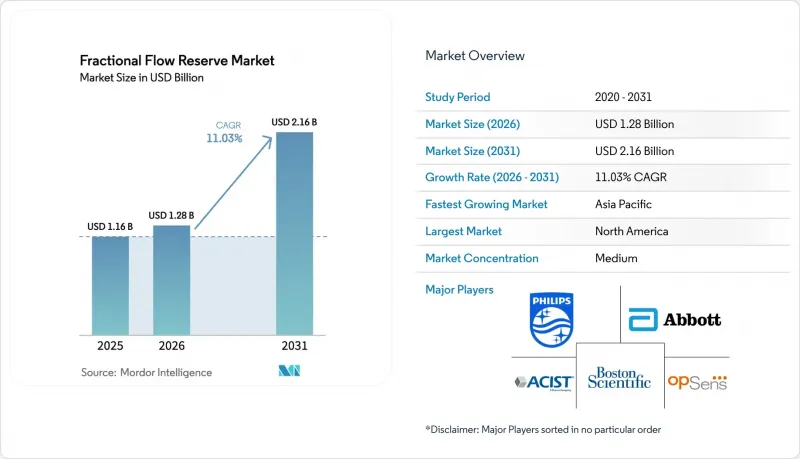
Mordor Intelligence에 의하면, 분획 혈류 예비력(FFR) 시장 규모는 2025년에 11억 6,000만 달러, 2026년에 12억 8,000만 달러에 달하고, 2031년까지 21억 6,000만 달러에 이를 것으로 예측되며, 2026년부터 2031년에 걸쳐 CAGR 11.03%로 성장할 전망입니다.
본 보고서는 제품 유형(압력 와이어식 FFR 시스템, 마이크로카테터식 FFR 시스템 등), 센서 기술(광섬유 등), 시술 유형(진단용 관상동맥 조영술 등), 모달리티(침습적 FFR 등),최종 사용자(병원 등), 지역(북미 등)별로 분류되어 있습니다. 시장 전망은 금액(달러) 기준으로 제시되어 있습니다.
세계의 분획 혈류 예비력(FFR) 시장 동향 및 인사이트
관상동맥질환(CAD) 유병률 증가
2022년, 관상동맥질환으로 인한 사망자 수는 1,980만 명에 달했으며, 그중 4분의 3은 저·중소득 국가에서 발생했습니다. 급속한 도시화와 2000년 이후 아시아태평양의 당뇨병 유병률이 두 배로 증가함에 따라, 생리학적 소견에 기반한 분류가 필요한 확산성 병변을 가진 젊은 환자군이 증가하고 있습니다. 일본에서는 2024년에 65세 이상 인구의 비율이 29%에 달하며, 안정형 협심증 환자 수가 증가하고 있습니다. 인도에서는 2020년부터 2024년에 걸쳐 카테터 검사 건수가 34% 증가했으나, 생리학적 지침이 적용된 경우는 고작 15%에 그쳐, 관상동맥 혈류 예비비(FFR) 시장의 확산 여지가 크다는 점이 시사되고 있습니다. 의료기관에서는 중재적 치료의 규모를 비례적으로 확대하지 않고도 의뢰 환자를 관리하기 위해, 침습적인 압력 와이어와 외래 FFR-CT 모두에 관심이 집중되고 있습니다.
가이드라인에서 의무화된 FFR 유도 하 PCI
2024년 ESC 만성 관상동맥 증후군 가이드라인 및 2025년 ACC/AHA 급성 관상동맥 증후군 가이드라인 개정판은 모두 중등도 병변에 대한 와이어 기반 FFR에 클래스 I 권고를 부여하여, 보험사의 판단 기준을 ‘생리학적 평가를 우선시하는’ 방향으로 전환시켰습니다. FLOWER-MI 연구에서는 FFR에 기반한 완전 혈행 재건술이 혈관조영술 단독에 비해 주요 유해 사건을 22% 감소시키는 것으로 나타났습니다. 혈관조영술만 시행하는 PCI에 대한 보험 지급 거절로 인해, 병원들은 현재 압력 와이어 비축 및 시술자 교육을 진행하고 있으나, AI를 활용한 혈관조영술-FFR은 이러한 요건을 충족하기 위한 저비용 수단을 제공합니다.
디바이스 및 소프트웨어의 높은 비용
일회용 압력 와이어의 가격은 600-1,200달러,FFR-CT 라이선스 비용은 50,000-15만 달러에 더해 스캔 1회당 300-500달러가 소요되므로, 1인당 연간 의료비가 200달러 미만인 지역에서는 예산 면에서 큰 과제가 되고 있습니다. 경험이 부족한 팀이 시술 시간을 60분을 초과하게 되면, 미국의 병원조차도 이익률 압박에 직면하게 됩니다.
부문별 분석
2025년, 압력 와이어식 시스템은 관상동맥 혈류 예비량 비율(FFR) 시장의 55.22% 점유율을 차지하며, 실시간 의사 결정에서 일회용 센서 와이어가 확고한 역할을 하고 있음을 입증했습니다. 도입이 가장 활발한 곳은 가이드라인 요건이나 시술자의 숙련도에 따라 시술 건수가 유지되고 있는 대학병원, 사례 수가 많은 지역 병원입니다. 교체 주기나 연수 프로그램을 통해 이러한 와이어를 이용한 시술의 위상이 강화됨에 따라, 관상동맥 혈류 예비량 비율(FFR) 시장 규모는 꾸준히 확대될 것으로 예측됩니다. FFR-CT 소프트웨어는 규모가 작은 외래 영상 진단센터가 현재 생리학적 검사 비용을 메디케어에 직접 청구할 수 있게 됨에 따라, 2031년까지 연평균 성장률(CAGR) 15.24%로 확대될 것으로 예측됩니다.
방사선과에서는 침습적 검사를 미루고 전체 치료 과정의 비용을 절감할 수 있다는 장점 때문에 이 소프트웨어를 선호하고 있으며, 이러한 이점은 가치 기반 구매(VBP) 개념과도 부합합니다. 미국에서 이 기술을 조기에 도입한 기관에 따르면, FFR-CT를 흉통 진료 워크플로우에 통합한 결과 불필요한 카테터 검사가 30% 감소했다고 보고되고 있으며, 이러한 추세는 서유럽에서도 마찬가지로 나타나고 있습니다. 각 벤더사는 기존 CT 스캐너에 원활하게 통합될 수 있도록 플랫폼을 최적화하여, 중규모 의료기관의 설비 투자 장벽을 낮추고 있습니다. 이러한 양극화로 인해 와이어 기반 시스템은 계속해서 수술대에서 복잡한 판단을 지원하는 역할을 맡게 되는 반면, 소프트웨어 플랫폼은 기존 시장을 잠식하지 않으면서 외래 진단 분야에서 새로운 수익원을 개척하게 될 것입니다.
광섬유식 압력 센서는 카테터 검사실에서 중요하게 여겨지는 전자기 내성과 장기 안정성 덕분에 2025년 매출의 46.52%를 차지했습니다. 이러한 특징들은 얇은 프로파일과 신속한 신호 충실도를 겸비한 애보트의 ‘PressureWire X’나 옵센의 ‘OptoWire’와 같은 프리미엄 제품의 핵심을 이루고 있습니다. 병원 측은 재보정 빈도를 줄이고 시술 시간을 단축하는 드리프트 감소를 높이 평가하고 있으며, 이는 고정된 상환 일정 하에서도 처리 능력을 유지하는 데 도움이 되고 있습니다.
반도체 제조 기술의 발전으로 개당 단가가 400달러까지 하락하고, 신흥 시장으로공급이 확대됨에 따라 MEMS 센서는 2031년까지 연평균 14.55%의 성장률을 보일 것으로 전망됩니다. 보스턴 사이언티픽(Boston Scientific)의 최신 MEMS 기반 ‘Comet’ 와이어는 응답 시간을 10밀리초 미만으로 단축하여 시술자에게 거의 즉각적인 압력 피드백을 제공합니다. 이러한 확장성이 뛰어나고 비용 효율적인 특성은 예산 상한선이 있는 반면 관상동맥 질환 환자 수가 증가하고 있는 아시아태평양 및 라틴아메리카의 의료 시스템에 매력적입니다. MEMS 기술의 성숙에 따라 성능 격차가 좁혀지는 가운데, 기존 광섬유 제조업체들은 생태계 서비스를 통해 시장 점유율을 지키려할 것이며, 중견 구매자들은 더 저렴한 MEMS 대체 제품으로 전환해 나갈 것입니다.
기타 혜택 :
- 엑셀 형식 시장 예측(ME) 시트
- 3개월간의 애널리스트 지원
자주 묻는 질문
목차
제1장 서론
제2장 분석 방법
제3장 주요 요약
제4장 시장 구도
제5장 시장 규모 및 성장률 예측
제6장 경쟁 구도
제7장 시장 기회 및 향후 전망
KTH 26.08.28According to Mordor Intelligence, the fractional flow reserve market size is projected to be USD 1.16 billion in 2025, USD 1.28 billion in 2026, and reach USD 2.16 billion by 2031, growing at a CAGR of 11.03% from 2026 to 2031.
This report is Segmented by Product Type (Pressure-Wire FFR Systems, Micro-Catheter FFR Systems, and More), Sensor Technology (Optical Fiber, and More), Procedure Type (Diagnostic Coronary Angiography, and More), Modality (Invasive FFR, and More), End-User (Hospitals, and More), and Geography (North America, and More). Market Forecasts are Provided in Terms of Value (USD).
Global Fractional Flow Reserve Market Trends and Insights
Growing Prevalence of CAD
Coronary artery disease caused 19.8 million deaths in 2022, with three-quarters in low- and middle-income nations. Rapid urbanization and a doubling of diabetes prevalence across Asia-Pacific since 2000 are producing younger cohorts with diffuse disease that require physiology-based triage. Japan's share of citizens aged>= 65 reached 29% in 2024, pushing stable angina volumes higher.India's catheterization procedures jumped 34% between 2020 and 2024, yet only 15% used physiologic guidance, signaling sizable headroom for fractional flow reserve market penetration.Health systems are turning to both invasive pressure wires and outpatient FFR-CT to manage referrals without proportionate interventional expansion.
Guideline-Mandated FFR-Guided PCI
The 2024 ESC chronic coronary syndromes guideline and the 2025 ACC/AHA acute coronary syndromes update each granted Class I status to wire-based FFR for intermediate lesions, shifting payer logic toward physiology first. FLOWER-MI showed a 22% drop in major adverse events with FFR-guided complete revascularization versus angiography alone. Reimbursement denials for angiography-only PCI now prompt hospitals to stock pressure wires and train operators, while AI-driven angio-FFR offers a lower-cost path to meeting the mandate.
High Device and Software Cost
Single-use pressure wires cost USD 600-1,200, while FFR-CT licenses run USD 50,000-150,000 plus USD 300-500 per scan, challenging budgets where annual health spend per capita is under USD 200. Even U.S. hospitals face margin squeeze when inexperienced teams extend procedures beyond 60 minutes.
Other drivers and restraints analyzed in the detailed report include:
- Rapid Adoption of Non-Invasive FFR-CT
- Cost-Effectiveness vs Angiography-Only PCI
- Limited Operator Skillset & Training
For complete list of drivers and restraints, kindly check the Table Of Contents.
Segment Analysis
Pressure-wire systems commanded 55.22% of fractional flow reserve market share in 2025, underscoring the entrenched role of disposable sensor wires in real-time decision making. Adoption remains strongest in academic and high-volume community hospitals where guideline mandates and operator familiarity sustain procedure volumes. The fractional flow reserve market size generated by these wires is expected to rise steadily as replacement cycles and training programs reinforce their procedural status. FFR-CT software, though starting from a smaller base, is projected to expand at a 15.24% CAGR through 2031 because outpatient imaging centers can now bill Medicare directly for physiology studies.
Radiology departments favor software because it defers invasive work-ups and cuts total episode costs, benefits that resonate with value-based purchasing. Early U.S. adopters report a 30% fall in unnecessary catheterizations after integrating FFR-CT into chest-pain workflows, a trend mirrored in Western Europe. Vendors are tailoring platforms for seamless plug-ins to existing CT scanners, reducing capital barriers for mid-sized centers. This bifurcation means wire-based systems will keep servicing complex, on-table decisions, while software platforms open new revenues in outpatient diagnostics rather than cannibalizing established volumes.
Optical-fiber pressure sensors delivered 46.52% of 2025 revenue thanks to electromagnetic immunity and long-term stability, qualities prized in catheterization laboratories. They anchor premium offerings such as Abbott's PressureWire X and Opsens' OptoWire, which combine thin profiles with quick signal fidelity. Hospitals value the reduced drift that limits recalibration and shortens procedure time, helping maintain throughput under fixed reimbursement schedules.
Micro-electromechanical-systems sensors are forecast to grow at 14.55% annually through 2031 as semiconductor manufacturing lowers unit cost toward USD 400 per wire and boosts supply for emerging markets. Boston Scientific's latest MEMS-based Comet wire cuts response time below 10 milliseconds, giving operators near-instant pressure feedback. The scalable economics appeal to health systems in Asia-Pacific and Latin America that face budget ceilings yet rising coronary-disease caseloads. As MEMS maturity narrows performance gaps, optical-fiber incumbents will defend share through ecosystem services, while mid-tier buyers migrate to lower-priced MEMS alternatives.
Complete Report Scope:
- By Product Type
- Pressure-Wire FFR Systems
- Micro-catheter FFR Systems
- FFR-CT Software Platforms
- Disposable Sensor Wires & Accessories
- By Sensor Technology
- Optical Fiber Pressure Sensors
- Piezoelectric / Strain-Gauge Sensors
- MEMS-based Sensors
- Other Emerging Sensors
- By Procedure Type
- Diagnostic Coronary Angiography
- Percutaneous Coronary Intervention (PCI)
- By Modality
- Invasive FFR
- Non-Invasive FFR-CT
- By End-User
- Hospitals
- Ambulatory Surgical Centers
- Diagnostic Imaging Centers
- By Geography
- North America
- United States
- Canada
- Mexico
- Europe
- Germany
- France
- United Kingdom
- Italy
- Spain
- Rest of Europe
- Asia-Pacific
- China
- Japan
- India
- South Korea
- Australia
- Rest of Asia-Pacific
- Middle East & Africa
- GCC
- South Africa
- Rest of Middle East & Africa
- South America
- Brazil
- Argentina
- Rest of South America
- North America
List of Companies Covered in this Report:
- Abbott Laboratories
- ACIST Medical Systems
- Asahi Intecc Co., Ltd.
- Boston Scientific
- Bracco Imaging S.p.A.
- CathWorks Ltd.
- GE Healthcare
- HeartFlow, Inc.
- Koninklijke Philips
- Medtronic
- MicroPort
- Opsens Inc.
- Pie Medical Imaging
- PiezoWave Medical
- Pulse Medical Imaging Technology
- Shenzhen Rainmed Medical Technology
- Siemens Healthineers
- Terumo
Additional Benefits:
- The market estimate (ME) sheet in Excel format
- 3 months of analyst support
TABLE OF CONTENTS
1 Introduction
- 1.1 Study Assumptions & Market Definition
- 1.2 Scope of the Study
2 Research Methodology
3 Executive Summary
4 Market Landscape
- 4.1 Market Overview
- 4.2 Market Drivers
- 4.2.1 Growing Prevalence of CAD
- 4.2.2 Guideline-Mandated FFR-Guided PCI
- 4.2.3 Rapid Adoption of Non-Invasive FFR-CT
- 4.2.4 Cost-Effectiveness Vs. Angiography-Only PCI
- 4.2.5 AI-Driven Real-Time Angio-FFR Analytics
- 4.2.6 Emerging Reimbursement in Emerging Markets
- 4.3 Market Restraints
- 4.3.1 High Device and Software Cost
- 4.3.2 Limited Operator Skillset & Training
- 4.3.3 Diagnostic Uncertainty in Micro-Vascular Disease
- 4.3.4 Competitive Pressure From iFR/OFR Modalities
- 4.4 Value / Supply-Chain Analysis
- 4.5 Regulatory Landscape
- 4.6 Technological Outlook
- 4.7 Porter's Five Forces Analysis
- 4.7.1 Threat of New Entrants
- 4.7.2 Bargaining Power of Suppliers
- 4.7.3 Bargaining Power of Buyers
- 4.7.4 Threat of Substitutes
- 4.7.5 Intensity of Competitive Rivalry
5 Market Size & Growth Forecasts (Value in USD)
- 5.1 By Product Type
- 5.1.1 Pressure-Wire FFR Systems
- 5.1.2 Micro-catheter FFR Systems
- 5.1.3 FFR-CT Software Platforms
- 5.1.4 Disposable Sensor Wires & Accessories
- 5.2 By Sensor Technology
- 5.2.1 Optical Fiber Pressure Sensors
- 5.2.2 Piezoelectric / Strain-Gauge Sensors
- 5.2.3 MEMS-based Sensors
- 5.2.4 Other Emerging Sensors
- 5.3 By Procedure Type
- 5.3.1 Diagnostic Coronary Angiography
- 5.3.2 Percutaneous Coronary Intervention (PCI)
- 5.4 By Modality
- 5.4.1 Invasive FFR
- 5.4.2 Non-Invasive FFR-CT
- 5.5 By End-User
- 5.5.1 Hospitals
- 5.5.2 Ambulatory Surgical Centers
- 5.5.3 Diagnostic Imaging Centers
- 5.6 By Geography
- 5.6.1 North America
- 5.6.1.1 United States
- 5.6.1.2 Canada
- 5.6.1.3 Mexico
- 5.6.2 Europe
- 5.6.2.1 Germany
- 5.6.2.2 France
- 5.6.2.3 United Kingdom
- 5.6.2.4 Italy
- 5.6.2.5 Spain
- 5.6.2.6 Rest of Europe
- 5.6.3 Asia-Pacific
- 5.6.3.1 China
- 5.6.3.2 Japan
- 5.6.3.3 India
- 5.6.3.4 South Korea
- 5.6.3.5 Australia
- 5.6.3.6 Rest of Asia-Pacific
- 5.6.4 Middle East & Africa
- 5.6.4.1 GCC
- 5.6.4.2 South Africa
- 5.6.4.3 Rest of Middle East & Africa
- 5.6.5 South America
- 5.6.5.1 Brazil
- 5.6.5.2 Argentina
- 5.6.5.3 Rest of South America
- 5.6.1 North America
6 Competitive Landscape
- 6.1 Market Concentration
- 6.2 Market Share Analysis
- 6.3 Company Profiles (includes Global level Overview, Market level overview, Core Segments, Financials as available, Strategic Information, Market Rank/Share for key companies, Products and Services, and Recent Developments)
- 6.3.1 Abbott Laboratories
- 6.3.2 ACIST Medical Systems
- 6.3.3 Asahi Intecc Co., Ltd.
- 6.3.4 Boston Scientific Corporation
- 6.3.5 Bracco Imaging S.p.A.
- 6.3.6 CathWorks Ltd.
- 6.3.7 GE Healthcare
- 6.3.8 HeartFlow, Inc.
- 6.3.9 Koninklijke Philips N.V.
- 6.3.10 Medtronic plc
- 6.3.11 MicroPort Scientific
- 6.3.12 Opsens Inc.
- 6.3.13 Pie Medical Imaging
- 6.3.14 PiezoWave Medical
- 6.3.15 Pulse Medical Imaging Technology
- 6.3.16 Shenzhen Rainmed Medical Technology
- 6.3.17 Siemens Healthineers AG
- 6.3.18 Terumo Corporation
7 Market Opportunities & Future Outlook
- 7.1 White-space & Unmet-Need Assessment