

|
시장보고서
상품코드
2114693
자궁 내막 절제 장치 시장 : 시장 점유율 분석, 업계 동향 및 통계, 성장 예측(2026-2031년)Endometrial Ablation Devices - Market Share Analysis, Industry Trends & Statistics, Growth Forecasts (2026 - 2031) |
||||||
 Mordor Intelligence
Mordor Intelligence에 의하면, 자궁 내막 절제 장치 시장 규모는 2025년에 12억 달러로 평가되었고, 2026년 12억 6,000만 달러에서 2031년까지 16억 2,000만 달러에 이를 것으로 예측되며, 예측 기간(2026-2031년) CAGR은 5.14%를 나타낼 전망입니다.
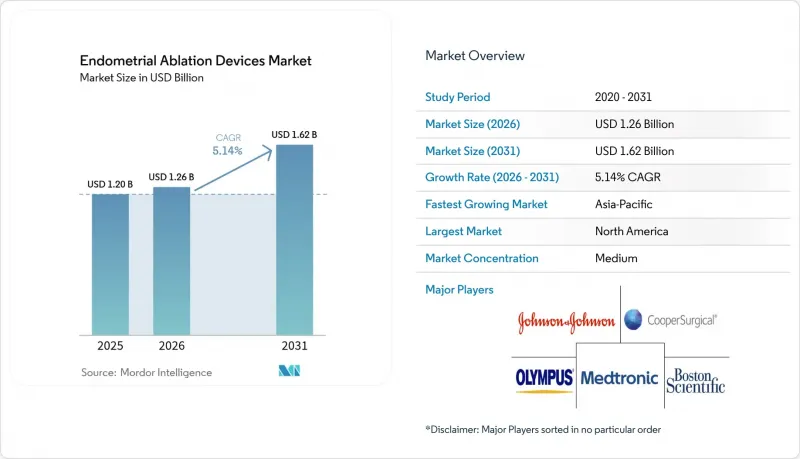
본 보고서는 기기 기술별(열 절제 및 비열 절제), 기기 유형별(자궁경용 기기, 고주파 자궁내막 절제 기기 등), 접근 방법별(자궁경 시스템 등), 최종 사용자별(외래수술센터(ASC), 병원 등) 및 지역별(북미, 유럽 등)로 분류되어 있습니다. 시장 전망은 금액(달러) 기준으로 제시되어 있습니다.
세계의 자궁내막 절제 기기 시장 동향 및 인사이트
비정상 자궁 출혈(AUB) 유병률 증가
AUB는 가임기 여성의 14-25%에 영향을 미치며, 40-50대에서는 그 발생률이 증가하고 있습니다. 최근 연구 결과에 따르면, 과다월경은 독립적인 심혈관 질환의 위험 요인인 것으로 지적되고 있으며, 이로 인해 임상의들은 치료 초기 단계에서 근치적 치료를 실시하도록 권장받고 있습니다. 인식이 높아짐에 따라 치료 가능한 환자층이 확대되고, 절제술에 대한 수요가 지속되면서 자궁내막 절제 기기 시장이 확대되고 있습니다.
저침습 부인과 수술에 대한 수요 증가
인디시안 그린 형광과 같은 영상 진단 기술의 향상으로 합병증 발생률이 감소하는 한편, 새로운 시술 기법으로 수술 시간이 25% 단축되었습니다. 진료소에서의 절제술은 환자 1인당 비용을 1,498달러 절감하므로, 최소 침습 치료는 보험사 및 의료 제공업체 모두에게 매력적인 선택지가 되고 있습니다.
불리하거나 일관성 없는 규제 절차
규제의 불균일성으로 인해 승인까지의 기간이 길어지고, 규정 준수 비용이 증가하고 있습니다. FDA의 열 영향에 관한 지침 초안은 시판 전 데이터에 대한 부담을 가중시키고 있으며, 인도의 규제 체계 변동은 해외 진출 기업들에게 불확실성을 야기하고 있습니다.
부문 분석
2025년 매출의 55.10%를 열식 플랫폼이 차지했으며, 자궁내막 절제 기기 시장에서 임상적 주력 제품으로서의 역할이 입증되었습니다. 검증된 안전성과 외과의사의 숙련도가 이러한 우위를 뒷받침하고 있습니다. 한편, 비열식 치료법은 연평균 성장률(CAGR) 9.12%를 나타낼 것으로 예측됩니다. 냉동 절제술은 유럽에서의 채택 확대에 힘입어 시장 점유율을 늘리고 있으며, MRI 유도 집속 초음파는 2024년에 5가지 새로운 치료 적응증을 획득했습니다.
현재 경쟁 구도는 열 치료의 한계가 나타나는 특수한 적응증, 예를 들어 극도로 정밀한 조직 보존이 요구되는 사례 등에 따라 좌우되고 있습니다. 이러한 변화로 인해 열 치료의 수익원을 즉시 훼손하지 않으면서도 비열 치료 솔루션의 임상적 적용 범위가 확대되고 있습니다.
고주파(RF) 시스템은 2025년에 매출의 44.10%를 차지했으며, 그 폭넓은 유용성 덕분에 시술 건수 측면에서 여전히 중심적인 위치를 차지하고 있습니다. 한편, 풍선 절제기는 간소화된 일회용 모델이 감염 위험과 사용 난이도를 낮추기 때문에 2031년까지 연평균 성장률(CAGR) 8.05%로 성장할 것으로 전망됩니다. 홀로직(Hologic)사의 ‘스마트 뎁스(Smart Depth)’ 기술과 자궁강 완전성 평가 기능은 계속해서 RF(고주파)의 인기를 뒷받침하고 있지만, 미네르바(Minerva)사의 실리콘 메쉬 어레이는 설계상의 차별화가 풍선 방식의 보급을 어떻게 촉진하는지 보여주고 있습니다.
풍선 기술을 활용한 자궁내막 절제 장치 시장 규모는 장치 유형 중 가장 빠른 속도로 확대될 것으로 예측되며, 업계 전체가 외래 진료에 적합한 기기로 전환되고 있음을 여실히 보여주고 있습니다.
지역별 분석
북미는 종합적인 보험 환급, 밀집된 전문의 네트워크, 그리고 높은 환자 인지도에 힘입어 2025년 매출의 41.35%를 차지했습니다. 이 지역의 자궁내막 절제 기기 시장 규모는 AI 안내 시스템 및 일회용 내시경의 보급이 확대됨에 따라 한 자릿수 중반대의 성장률을 기록하며 확대될 전망입니다.
유럽은 증거 기반의 도입을 중시하는 혁신의 중심지로 자리매김하고 있습니다. 체계적인 조달 프로세스는 검증된 기술을 우선시하지만, 영국, 프랑스, 독일의 외래수술센터(ASC)로의 전환이 성장을 가속화할 전망입니다.
연평균 성장률(CAGR) 8.10%로 성장하고 있는 아시아태평양은 보험 적용 범위 확대, 도시 중산층의 확대, 그리고 여성 건강에 대한 정부의 지원 정책의 혜택을 받고 있습니다. 인도의 현지 제조 파트너십과 수출 지향적인 중국 기업들 덕분에 기기의 접근성이 확대되고 있습니다.
남미, 중동 및 아프리카의 신흥 시장에서는 수요가 초기 단계에 있습니다. 3차 의료기관 및 전문 의료 센터에 대한 투자로 수술 수행 능력은 점차 확대되고 있으나, 경제의 변동성으로 인해 단기적인 수술 건수는 제한될 전망입니다.
기타 혜택 :
- 엑셀 형식 시장 예측(ME) 시트
- 3개월간의 애널리스트 지원
자주 묻는 질문
목차
제1장 서론
제2장 조사 방법
제3장 주요 요약
제4장 시장 구도
제5장 시장 규모 및 성장 예측
제6장 경쟁 구도
제7장 시장 기회 및 향후 전망
AJY 26.08.26According to Mordor Intelligence, the endometrial ablation devices market size was valued at USD 1.20 billion in 2025 and estimated to grow from USD 1.26 billion in 2026 to reach USD 1.62 billion by 2031, at a CAGR of 5.14% during the forecast period (2026-2031).
This report is Segmented by Device Technology (Thermal Ablation and Non-Thermal Ablation), Device Type (Hysteroscopy Devices, Radiofrequency Endometrial Ablation Devices and More), Access Approach (Hysteroscopic Systems, and More), End-User (Ambulatory Surgical Centers, Hospitals, and More), and Geography (North America, Europe, and More). The Market Forecasts are Provided in Terms of Value (USD).
Global Endometrial Ablation Devices Market Trends and Insights
Rising Prevalence of Abnormal Uterine Bleeding (AUB)
AUB affects 14-25% of reproductive-age women, and incidence climbs in the 40-50 age group. Recent findings flag heavy menstrual bleeding as an independent cardiovascular risk factor, pushing clinicians toward definitive therapy earlier in the care pathway. Greater awareness widens the treatable population and sustains demand for ablation, enlarging the endometrial ablation devices market.
Growing Demand for Minimally-Invasive Gynecologic Procedures
Enhanced imaging, such as indocyanine-green fluorescence, lowers complication rates, while novel manipulation methods shorten operating time by 25%. Office-based ablation cuts per-patient costs by USD 1,498, making minimally invasive care compelling for payers and providers alike.
Unfavorable or Heterogeneous Regulatory Pathways
Divergent rules extend approval timelines and inflate compliance costs. The FDA's draft guidance on thermal effects adds premarket data burdens, and India's evolving framework creates uncertainty for foreign entrants.
Other drivers and restraints analyzed in the detailed report include:
- Rapid Outpatient Migration to ASCs
- AI-Guided Imaging Improving Procedural Accuracy
- High Capital Cost of Advanced RF & HIFU Platforms
For complete list of drivers and restraints, kindly check the Table Of Contents.
Segment Analysis
Thermal platforms generated 55.10% of 2025 revenue, confirming their role as the clinical mainstay of the endometrial ablation devices market. Proven safety and surgeon familiarity underpin this lead. Meanwhile, non-thermal modalities are forecast to grow at 9.12% CAGR. Cryoablation is gaining share through expanded European adoption, and MRI-guided focused ultrasound secured five new therapeutic indications in 2024.
Competitive dynamics now hinge on specialty applications where thermal limits arise-for instance, cases requiring ultra-precise tissue sparing. That shift widens the clinical footprint of non-thermal solutions without immediately eroding thermal revenue streams.
Radiofrequency systems represented 44.10% revenue in 2025, and their broad utility keeps them central to procedure volumes. Balloon ablators, however, are set for an 8.05% CAGR to 2031 as simplified, single-use models reduce infection risk and learning curve. Hologic's smart-depth technology and cavity-integrity assessment continue to anchor RF's popularity, whereas Minerva's silicone-mesh array illustrates how design differentiation propels balloon adoption.
The endometrial ablation devices market size for balloon technologies is projected to expand at the fastest clip within the device-type hierarchy, emphasising an industry-wide pivot to outpatient-friendly tools.
Complete Report Scope:
- By Device Technology
- Thermal Ablation
- Non-Thermal Ablation
- By Device Type
- Hysteroscopy Devices
- Thermal Balloon Ablators
- Radiofrequency Endometrial Ablation Devices
- Hydrothermal Ablators
- Electrical Ablators
- Cryoablation Systems
- Microwave Ablation Probes
- By Access Approach
- Hysteroscopic Systems
- Transcervical Non-hysteroscopic (RF, Balloons)
- Image-Guided Extra-uterine (MRI-/US-guided HIFU)
- By End-User
- Hospitals
- Ambulatory Surgical Centers
- Specialty Clinics
- Office-based Gynecology Practices
- Geography
- North America
- United States
- Canada
- Mexico
- Europe
- Germany
- United Kingdom
- France
- Italy
- Spain
- Rest of Europe
- Asia-Pacific
- China
- Japan
- India
- South Korea
- Australia
- Rest of Asia-Pacific
- Middle East and Africa
- GCC
- South Africa
- Rest of Middle East and Africa
- South America
- Brazil
- Argentina
- Rest of South America
- North America
Geography Analysis
North America commanded 41.35% of 2025 revenue, underwritten by comprehensive reimbursement, dense specialist networks, and patient awareness. The endometrial ablation devices market size in the region will advance at mid-single-digit rates as AI guidance and disposable scopes deepen penetration.
Europe remains an innovation center that values evidence-based adoption. Structured procurement favors proven technologies, yet ASC migration in the United Kingdom, France, and Germany should accelerate growth.
Asia-Pacific, advancing at an 8.10% CAGR, benefits from widening insurance coverage, urban middle-class expansion, and government incentives for women's health. Local manufacturing partnerships in India and export-oriented Chinese players broaden device availability.
Emerging markets in South America, the Middle East, and Africa exhibit early-stage demand. Investments in tertiary hospitals and specialty centers gradually unlock procedure capacity, though economic volatility tempers near-term volume.
- Hologic
- Boston Scientific
- Medtronic
- The Cooper Companies
- Johnson & Johnson
- Olympus
- Minerva Surgical
- AngioDynamics
- Richard Wolf
- AEGEA Medical, Inc.
- Veldana Medical
- LiNA Medical ApS
- Stryker
- Besmed Health Business
- Idoman Teoranta
- Shenzhen Huikang Medical
- Wallach Surgical Devices
- Karl Storz
- Jiomax Medical
Additional Benefits:
- The market estimate (ME) sheet in Excel format
- 3 months of analyst support
TABLE OF CONTENTS
1 Introduction
- 1.1 Study Assumptions & Market Definition
- 1.2 Scope of the Study
2 Research Methodology
3 Executive Summary
4 Market Landscape
- 4.1 Market Overview
- 4.2 Market Drivers
- 4.2.1 Rising Prevalence Of Abnormal Uterine Bleeding (AUB)
- 4.2.2 Growing Demand For Minimally-Invasive Gynecologic Procedures
- 4.2.3 Rapid Outpatient Migration To Ambulatory Surgery Centers
- 4.2.4 Increasing Reimbursement Coverage For Office-Based Ablation
- 4.2.5 AI-Guided Imaging Improving Procedural Accuracy
- 4.2.6 Emergence Of Single-Use Hysteroscopic Systems Lowering Infection Risk
- 4.3 Market Restraints
- 4.3.1 Unfavorable Or Heterogeneous Regulatory Pathways
- 4.3.2 High Capital Cost Of Advanced RF & HIFU Platforms
- 4.3.3 Shortage Of Trained Hysteroscopists In Emerging Markets
- 4.3.4 Slow Procedural Adoption Due To Fertility-Preservation Concerns
- 4.4 Technological Outlook
- 4.5 Porter's Five Forces Analysis
- 4.5.1 Threat of New Entrants
- 4.5.2 Bargaining Power of Buyers
- 4.5.3 Bargaining Power of Suppliers
- 4.5.4 Threat of Substitutes
- 4.5.5 Intensity of Competitive Rivalry
5 Market Size & Growth Forecasts (Value, USD)
- 5.1 By Device Technology
- 5.1.1 Thermal Ablation
- 5.1.2 Non-Thermal Ablation
- 5.2 By Device Type
- 5.2.1 Hysteroscopy Devices
- 5.2.2 Thermal Balloon Ablators
- 5.2.3 Radiofrequency Endometrial Ablation Devices
- 5.2.4 Hydrothermal Ablators
- 5.2.5 Electrical Ablators
- 5.2.6 Cryoablation Systems
- 5.2.7 Microwave Ablation Probes
- 5.3 By Access Approach
- 5.3.1 Hysteroscopic Systems
- 5.3.2 Transcervical Non-hysteroscopic (RF, Balloons)
- 5.3.3 Image-Guided Extra-uterine (MRI-/US-guided HIFU)
- 5.4 By End-User
- 5.4.1 Hospitals
- 5.4.2 Ambulatory Surgical Centers
- 5.4.3 Specialty Clinics
- 5.4.4 Office-based Gynecology Practices
- 5.5 Geography
- 5.5.1 North America
- 5.5.1.1 United States
- 5.5.1.2 Canada
- 5.5.1.3 Mexico
- 5.5.2 Europe
- 5.5.2.1 Germany
- 5.5.2.2 United Kingdom
- 5.5.2.3 France
- 5.5.2.4 Italy
- 5.5.2.5 Spain
- 5.5.2.6 Rest of Europe
- 5.5.3 Asia-Pacific
- 5.5.3.1 China
- 5.5.3.2 Japan
- 5.5.3.3 India
- 5.5.3.4 South Korea
- 5.5.3.5 Australia
- 5.5.3.6 Rest of Asia-Pacific
- 5.5.4 Middle East and Africa
- 5.5.4.1 GCC
- 5.5.4.2 South Africa
- 5.5.4.3 Rest of Middle East and Africa
- 5.5.5 South America
- 5.5.5.1 Brazil
- 5.5.5.2 Argentina
- 5.5.5.3 Rest of South America
- 5.5.1 North America
6 Competitive Landscape
- 6.1 Market Concentration
- 6.2 Market Share Analysis
- 6.3 Company Profiles (includes Global level Overview, Market level overview, Core Segments, Financials as available, Strategic Information, Market Rank/Share for key companies, Products & Services, and Recent Developments)
- 6.3.1 Hologic, Inc.
- 6.3.2 Boston Scientific Corporation
- 6.3.3 Medtronic plc
- 6.3.4 CooperSurgical, Inc.
- 6.3.5 Johnson & Johnson (Ethicon)
- 6.3.6 Olympus Corporation
- 6.3.7 Minerva Surgical, Inc.
- 6.3.8 AngioDynamics, Inc.
- 6.3.9 Richard Wolf GmbH
- 6.3.10 AEGEA Medical, Inc.
- 6.3.11 Veldana Medical SA
- 6.3.12 LiNA Medical ApS
- 6.3.13 Stryker Corporation
- 6.3.14 Besmed Health Business Corp.
- 6.3.15 Idoman Teoranta
- 6.3.16 Shenzhen Huikang Medical
- 6.3.17 Wallach Surgical Devices
- 6.3.18 Karl Storz SE & Co. KG
- 6.3.19 Jiomax Medical
7 Market Opportunities & Future Outlook
- 7.1 White-Space & Unmet-Need Assessment


