
|
시장보고서
상품코드
2114697
메디컬 라이팅 : 시장 점유율 분석, 산업 동향 및 통계 데이터, 성장 예측(2026-2031년)Medical Writing - Market Share Analysis, Industry Trends & Statistics, Growth Forecasts (2026 - 2031) |
||||||
 Mordor Intelligence
Mordor Intelligence에 의하면, 메디컬 라이팅 시장 규모는 2025년 39억 4,000만 달러로 평가되었습니다. 2026년에는 43억 3,000만 달러로 확대되어 2026년부터 2031년에 걸쳐 CAGR 9.98%로 성장을 지속하여, 2031년에는 69억 7,000만 달러에 이를 것으로 예측됩니다.
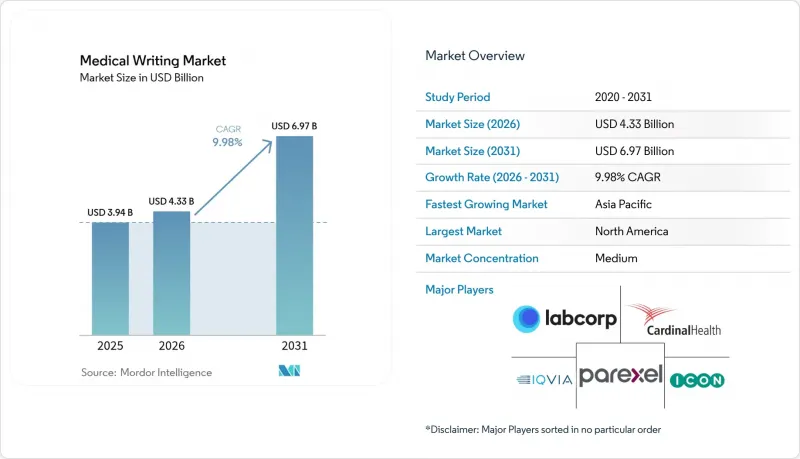
본 보고서는 유형(규제 관련 메디컬 라이팅, 임상 라이팅 등), 최종 사용자(제약 회사, 생명공학 기업 등), 치료 분야(종양학, 순환기학, 중추신경계·신경학,면역학, 희귀질환, 기타) 및 지역(북미, 유럽, 아시아태평양, 중동 및 아프리카, 남미)별로 분류되어 있습니다. 시장 예측은 금액(달러) 기준으로 제시되어 있습니다.
세계의 메디컬 라이팅 시장 동향 및 인사이트
연구개발비 증가와 신규 치료제 개발
2024년, 전 세계 생명과학 분야의 매출액은 약 1조 9,000억 달러에 달했으며, 그중 제약 부문이 매출의 70% 가까이 차지했습니다. 이에 따라 세심한 문서화가 필요한 임상시험 파이프라인이 확대되고 있습니다. FDA는 2024년에 50건의 신약을 승인했으며, 2025년에는 최대 70건의 승인을 예상하고 있습니다. 이러한 추세로 인해 라이팅의 납기 기간은 단축되는 반면, 신청 서류의 범위는 확대되고 있습니다. 세포 치료나 유전자 치료와 같은 첨단 치료법에서는 보다 상세한 화학·제조·품질 관리(CMC) 섹션과 설득력 있는 위험-이익 설명이 요구됩니다. 투자 확대는 승인 후 증거 프로그램에도 미치고 있어, 문서 작성 업무 기간은 초기 승인 획득을 훨씬 넘어 장기화되고 있습니다. 개발 비용의 급등 속에서 각 스폰서사가 승인 주기의 최적화를 경쟁하는 가운데, 이러한 요인들이 맞물려 메디컬 라이팅 시장에 더욱 큰 활력을 불어넣고 있습니다.
CRO 아웃소싱 모델의 확대
세계 CRO(의약품 개발 수탁 기관) 시장은 2024년에 약 820억 달러에 달했습니다. 이는 비용 효율성과 업무 관리의 균형을 맞추기 위해 기능형 서비스 제공업체(FSP)와의 계약을 선호하는 스폰서들에 의해 주도된 결과입니다. 2024년 3월 Indegene가 Trilogy Writing & Consulting을 인수한 사례를 비롯한 대규모 거래는 일관된 문서 작성 지원이 필요한 세계 프로그램을 유치하기 위해 각 플랫폼이 통합 역량을 강화하고 있음을 보여줍니다. 아웃소싱이 가장 빠르게 확산되고 있는 지역은 아시아태평양으로, 규제 체제의 발전과 비용 측면의 우위가 외부 파트너 채택을 뒷받침하고 있습니다. 유연한 기능형 서비스 제공업체(FSP) 계약을 도입하는 스폰서는 파이프라인의 변동에 따라 작가 수를 조정할 수 있어 예산의 예측 가능성을 높일 수 있습니다. 분산형 요소를 도입하는 임상시험이 늘어나는 가운데, 규제, 임상, 라이팅 각 서비스를 패키지화한 CRO는 전략적 우위를 점하며 메디컬 라이팅 시장의 성장을 뒷받침하고 있습니다.
숙련된 메디컬 라이팅 전문가 부족
2024년, 생명과학 기업의 83%가 메디컬 라이팅 직군 채용에 어려움을 겪고 있다고 보고했으며, 2030년까지 35%의 인력 부족이 발생할 것으로 예측됩니다. 각 스폰서사가 복잡한 제품을 관리할 수 있는 시니어 라이터를 확보하기 위해 경쟁하는 가운데, 임금 상승과 프로젝트 지연이 빈번하게 발생하고 있습니다. 2024년 시카고 대학교 등 교육 기관들이 규제 관련 라이팅 분야로 진로를 희망하는 과학자들의 역량 강화를 목적으로 새로운 인증 프로그램을 출범시켰음에도 불구하고, 학술 분야의 인재 양성은 시장 수요를 따라가지 못하고 있습니다. 아시아태평양에서는 바이오의약품 업계의 급속한 확장이 현지 인재 양성 능력을 상회하고 있어 인력 부족이 더욱 심화되고 있으며, 그 결과 외국인 주재원의 비용 증가와 프로젝트 기간의 장기화로 이어지고 있습니다. 인력 부족은 프로젝트 처리 속도를 늦추고, 메디컬 라이팅 시장의 성장을 저해하고 있습니다.
부문별 분석
2025년에는 규제 관련 메디컬 라이팅이 메디컬 라이팅 시장의 41.88% 점유율을 차지하며 시장을 주도했습니다. 이는 지침 문서가 급증하는 가운데, 규정 준수를 중시하는 결과물에 대한 수요가 높아지고 있음을 보여줍니다. 과학 논문 및 HEOR(의료 경제학 및 결과 연구) 라이팅은 지불자가 규제 당국에 제출하는 신청 서류 외에도 RWD(실세계 데이터) 및 의료 경제학적 근거를 요구하게 됨에 따라, 2031년까지 10.74%라는 가장 높은 연평균 성장률(CAGR)을 나타낼 전망입니다.
의료 글라이팅 시장의 성장은 지역 언어 및 개인정보 보호 관련 법규를 준수해야 하는 분산형 프로토콜을 지원하는 임상 글라이팅에 대한 꾸준한 수요에 의해 더욱 가속화되고 있습니다. 신흥 카테고리에는 디지털 헬스 기술을 위한 AI 기반 집필 지원이 포함되어 있으며, 이는 제공업체들이 진화하는 고객의 요구에 대응하기 위해 포트폴리오를 다각화하고 있음을 보여줍니다. 규제 분야 전문가들은 더 높은 청구 단가를 받고 있지만, HEOR 및 디지털 분야로 교차 교육을 받음으로써 수익원을 확대하고 프로젝트 파이프라인의 변동 위험을 줄일 수 있습니다.
지역별 분석
북미는 2025년 매출의 39.75%를 차지했으며, 그 중심은 미국입니다. 미국에서는 2024년에 25건 이상의 새로운 지침 문서가 발행되어 신청 서류의 분량이 증가하는 동시에, 규정 준수를 위한 신속한 업데이트가 요구되었습니다. 캐나다와 멕시코는 신청 절차를 효율화하는 조화 이니셔티브를 통해 참여하고 있지만, 여전히 미국의 선례에 의존하고 있어, 이로 인해 의료 문서 작성 시장에서 해당 지역의 주도적 지위가 공고해지고 있습니다.
아시아태평양은 연평균 성장률(CAGR) 10.82%를 나타낼 전망입니다. 이는 중국이 24가지 개혁 조치를 도입하고, 2027년까지 현지 언어로 된 템플릿 사용을 의무화하는 등 수년에 걸친 근본적인 재검토를 반영한 결과입니다. 일본이 자국의 임상 데이터를 중시하는 태도와 인도의 신속 심사 규정은 모두 세계 섹션과 각국 고유의 기준을 조화시킬 수 있는 전문 라이터에 대한 지속적인 수요를 창출하고 있습니다. 호주에서 우선 의약품 대상으로 시행되는 2025년 ‘롤링 서브미션(단계적 제출)’ 제도는 경험이 풍부한 서비스 제공업체에 대한 수요를 더욱 부추기고 있습니다.
유럽은 여전히 중요한 시장이며, EMA(유럽의약품청)의 임상시험 정보 시스템에 따라 스폰서는 새로운 공개 투명성 기준을 충족하는 조화된 문서를 제출해야 합니다. 독일, 프랑스, 영국에서는 세계 섹션을 현지 표시 규정에 세밀하게 부합시켜야 하므로 작성 주기가 길어지고 있습니다. 라틴아메리카 및 중동 및 아프리카에서는 ICH 지침의 도입이 꾸준히 진행되고 있으며, 서비스 제공업체들이 지역 허브를 통해 목표로 삼고 있는 미래 성장 거점이 될 조짐이 보이고 있습니다.
기타 혜택 :
- 엑셀 형식 시장 예측(ME) 시트
- 3개월간의 애널리스트 지원
자주 묻는 질문
목차
제1장 서론
제2장 분석 방법
제3장 주요 요약
제4장 시장 구도
제5장 시장 규모 및 성장률 예측
제6장 경쟁 구도
제7장 시장 기회 및 향후 전망
KTH 26.08.28According to Mordor Intelligence, the medical writing market size is expected to grow from USD 3.94 billion in 2025 to USD 4.33 billion in 2026 and is forecast to reach USD 6.97 billion by 2031 at 9.98% CAGR over 2026-2031.
This report is Segmented by Type (Regulatory Medical Writing, Clinical Writing, and More), End User (Pharmaceutical Companies, Biotechnology Companies, and More), Therapeutic Area (Oncology, Cardiology, CNS & Neurology, Immunology, Rare Diseases, Others), and Geography (North America, Europe, Asia-Pacific, Middle East and Africa, South America). The Market Forecasts are Provided in Terms of Value (USD).
Global Medical Writing Market Trends and Insights
Growing R&D Expenditure and Development of New Therapeutics
Global life-sciences revenue climbed to about USD 1.9 trillion in 2024, with pharmaceuticals representing nearly 70% of sales, which translates into larger study pipelines that require meticulous documentation. The FDA cleared 50 new drugs in 2024 and anticipates up to 70 approvals in 2025, a trend that compresses writing timelines while widening the scope of submission dossiers. Advanced modalities such as cell and gene therapies demand more extensive chemistry, manufacturing, and controls (CMC) sections and robust risk-benefit narratives. Heightened investment also extends to post-approval evidence programs, expanding the lifespan of writing assignments well beyond initial licensure. These factors collectively add momentum to the medical writing market as sponsors vie to optimize approval cycles amid rising development costs .
Expansion of CRO Outsourcing Models
The worldwide CRO sector reached roughly USD 82 billion in 2024, driven by sponsors that favor functional service provider arrangements to balance cost efficiency with operational control. Large deals, including Indegene's acquisition of Trilogy Writing & Consulting in March 2024, illustrate how platforms are enhancing integrated capabilities to attract global programs that require cohesive documentation support. Outsourcing penetration is advancing fastest in Asia-Pacific where evolving regulatory systems and cost advantages spur adoption of external partners. Sponsors that deploy flexible FSP contracts can scale writer pools in line with pipeline fluctuations, improving budget predictability. As more trials incorporate decentralized components, CROs that bundle regulatory, clinical, and writing services hold a strategic edge, boosting the medical writing market.
Shortage of Skilled Medical-Writing Professionals
Eighty-three percent of life-sciences companies reported difficulty filling medical writing roles in 2024, and forecasts predict a 35% talent deficit by 2030. Wage inflation and project delays are common as sponsors compete for senior writers who can manage complex products. Academic pipelines lag market needs despite new certificate programs launched by institutions such as the University of Chicago in 2024 aimed at upskilling scientists for regulatory writing careers. Asia-Pacific faces sharper deficits because rapid biopharma expansion outpaces local training capacity, leading to higher expatriate costs or longer timelines. The squeeze on talent slows project throughput and tempers growth in the medical writing market.
Other drivers and restraints analyzed in the detailed report include:
- Increasing Regulatory Complexity & Documentation Volume
- Rising Adoption of Biologics & Personalized Medicine
- Pricing Pressure from Procurement Consolidation
For complete list of drivers and restraints, kindly check the Table Of Contents.
Segment Analysis
Regulatory Medical Writing led the segment with 41.88% of the medical writing market share in 2025, underscoring the premium placed on compliance-centric deliverables amid proliferating guidance documents. Scientific and HEOR Writing is projected to record the fastest 10.74% CAGR to 2031 as payers request real-world evidence and health-economic justifications alongside regulatory submissions.
Growth in the medical writing market is further buoyed by steady demand for Clinical Writing, which supports decentralized protocols that must satisfy regional language and privacy statutes. Emerging categories now include AI-assisted authoring support for digital health technologies, signalling how providers diversify portfolios to address evolving client needs. Regulatory specialists command higher billing rates, but cross-training into HEOR and digital modalities widens revenue streams and mitigates project-pipeline volatility.
Complete Report Scope:
- By Type
- Regulatory Medical Writing
- Clinical Writing
- Scientific and HEOR Writing
- Others
- By End User
- Pharmaceutical Companies
- Biotechnology Companies
- Contract Research Organizations
- Medical Device Manufacturers
- Academic & Research Institutes
- thers
- By Therapeutic Area
- Oncology
- Cardiology
- CNS & Neurology
- Immunology
- Rare Diseases
- Others
- By Geography
- North America
- United States
- Canada
- Mexico
- Europe
- Germany
- United Kingdom
- France
- Italy
- Spain
- Rest of Europe
- Asia-Pacific
- China
- Japan
- India
- Australia
- South Korea
- Rest of Asia-Pacific
- Middle East and Africa
- GCC
- South Africa
- Rest of Middle East and Africa
- South America
- Brazil
- Argentina
- Rest of South America
- North America
Geography Analysis
North America generated 39.75% of 2025 revenue, anchored by the United States, which issued over 25 new guidance documents in 2024 that expanded dossier length and demanded rapid compliance updates. Canada and Mexico participate through harmonized initiatives that streamline submissions but still rely on U.S. precedents, which reinforces the region's leadership in the medical writing market.
Asia-Pacific is set to record an 10.82% CAGR, reflecting China's multi-year overhaul that adds 24 reform measures and mandates localized templates by 2027. Japan's preference for indigenous clinical data and India's fast-tracking rules both create sustained demand for specialized writers who can reconcile global sections with country-specific standards. Australia's 2025 rolling submission pathway for priority medicines further drives engagement with experienced providers.
Europe remains pivotal as the EMA's Clinical Trial Information System obliges sponsors to submit harmonized dossiers that meet new public transparency thresholds. Germany, France, and the United Kingdom require meticulous adaptation of global sections to local labelling statutes, extending writing cycles. Latin America and the Middle East & Africa show steady adoption of ICH guidelines, signalling future growth nodes that providers are targeting through regional hubs.
- IQVIA
- ICON
- LabCorp (including Covance)
- Parexel International
- Cardinal Health
- Certara USA
- Freyr Solutions
- InClin
- Quanticate
- Synchrogenix (a Certara Company)
- Trilogy Writing & Consulting
- SIRO Clinpharm Pvt Ltd
- OMICS International
- MedPace
- PPD Inc. (Thermo Fisher Scientific)
- ProPharma Group
- Cactus Communications
- BioClinica (Clario)
- ClinTec International
- Kainos
Additional Benefits:
- The market estimate (ME) sheet in Excel format
- 3 months of analyst support
TABLE OF CONTENTS
1 Introduction
- 1.1 Study Assumptions & Market Definition
- 1.2 Scope of the Study
2 Research Methodology
3 Executive Summary
4 Market Landscape
- 4.1 Market Overview
- 4.2 Market Drivers
- 4.2.1 Growing R&D expenditure and development of new therapeutics
- 4.2.2 Expansion of CRO outsourcing models
- 4.2.3 Increasing regulatory complexity & documentation volume
- 4.2.4 Rising adoption of biologics & personalized medicine
- 4.2.5 AI-enabled content automation requiring expert oversight
- 4.2.6 Decentralised / virtual trials driving adaptive multilingual protocols
- 4.3 Market Restraints
- 4.3.1 Shortage of skilled medical-writing professionals
- 4.3.2 Pricing pressure from procurement consolidation
- 4.3.3 Regulatory scrutiny on ghost-writing & author transparency
- 4.3.4 High compliance cost for region-specific submission templates
- 4.4 Regulatory Landscape
- 4.5 Porters Five Forces Analysis
- 4.5.1 Threat of New Entrants
- 4.5.2 Bargaining Power of Buyers
- 4.5.3 Bargaining Power of Suppliers
- 4.5.4 Threat of Substitutes
- 4.5.5 Intensity of Competitive Rivalry
5 Market Size & Growth Forecasts (Value, USD)
- 5.1 By Type
- 5.1.1 Regulatory Medical Writing
- 5.1.2 Clinical Writing
- 5.1.3 Scientific and HEOR Writing
- 5.1.4 Others
- 5.2 By End User
- 5.2.1 Pharmaceutical Companies
- 5.2.2 Biotechnology Companies
- 5.2.3 Contract Research Organizations
- 5.2.4 Medical Device Manufacturers
- 5.2.5 Academic & Research Institutes
- 5.2.6 thers
- 5.3 By Therapeutic Area
- 5.3.1 Oncology
- 5.3.2 Cardiology
- 5.3.3 CNS & Neurology
- 5.3.4 Immunology
- 5.3.5 Rare Diseases
- 5.3.6 Others
- 5.4 By Geography
- 5.4.1 North America
- 5.4.1.1 United States
- 5.4.1.2 Canada
- 5.4.1.3 Mexico
- 5.4.2 Europe
- 5.4.2.1 Germany
- 5.4.2.2 United Kingdom
- 5.4.2.3 France
- 5.4.2.4 Italy
- 5.4.2.5 Spain
- 5.4.2.6 Rest of Europe
- 5.4.3 Asia-Pacific
- 5.4.3.1 China
- 5.4.3.2 Japan
- 5.4.3.3 India
- 5.4.3.4 Australia
- 5.4.3.5 South Korea
- 5.4.3.6 Rest of Asia-Pacific
- 5.4.4 Middle East and Africa
- 5.4.4.1 GCC
- 5.4.4.2 South Africa
- 5.4.4.3 Rest of Middle East and Africa
- 5.4.5 South America
- 5.4.5.1 Brazil
- 5.4.5.2 Argentina
- 5.4.5.3 Rest of South America
- 5.4.1 North America
6 Competitive Landscape
- 6.1 Market Concentration
- 6.2 Market Share Analysis
- 6.3 Company Profiles (includes Global level Overview, Market level overview, Core Segments, Financials as available, Strategic Information, Market Rank/Share for key companies, Products & Services, and Recent Developments)
- 6.3.1 IQVIA Inc.
- 6.3.2 ICON plc
- 6.3.3 LabCorp (including Covance)
- 6.3.4 Parexel International
- 6.3.5 Cardinal Health
- 6.3.6 Certara USA Inc.
- 6.3.7 Freyr Solutions
- 6.3.8 InClin Inc.
- 6.3.9 Quanticate
- 6.3.10 Synchrogenix (a Certara Company)
- 6.3.11 Trilogy Writing & Consulting GmbH
- 6.3.12 SIRO Clinpharm Pvt Ltd
- 6.3.13 OMICS International
- 6.3.14 Medpace Holdings Inc.
- 6.3.15 PPD Inc. (Thermo Fisher Scientific)
- 6.3.16 ProPharma Group
- 6.3.17 Cactus Communications
- 6.3.18 BioClinica (Clario)
- 6.3.19 ClinTec International
- 6.3.20 Kainos
7 Market Opportunities & Future Outlook
- 7.1 White-space & Unmet-need Assessment