

|
시장보고서
상품코드
2114698
군용 센서 : 시장 점유율 분석, 산업 동향 및 통계 데이터, 성장 예측(2026-2031년)Military Sensors - Market Share Analysis, Industry Trends & Statistics, Growth Forecasts (2026 - 2031) |
||||||
 Mordor Intelligence
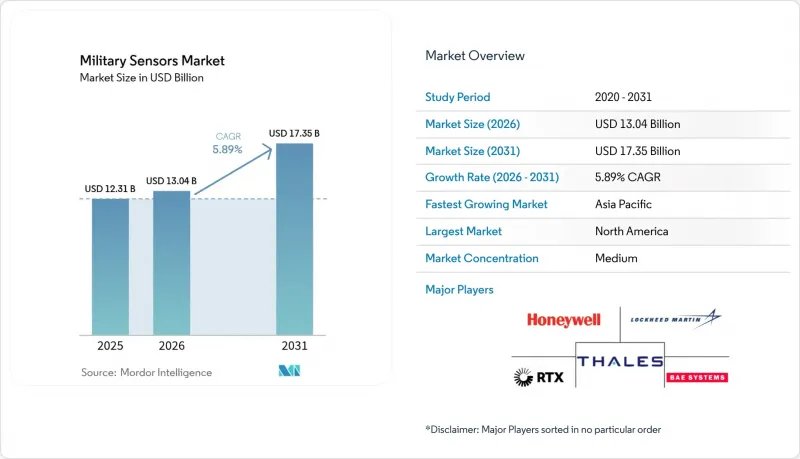
Mordor Intelligence에 의하면, 군용 센서 시장 규모는 2025년 123억 1,000만 달러로 평가되었습니다. 2026년에는 130억 4,000만 달러로 확대되어 2026년부터 2031년에 걸쳐 CAGR 5.89%로 성장을 지속하여, 2031년에는 173억 5,000만 달러에 이를 것으로 예측됩니다.
본 보고서는 센서 유형(레이더 센서, 라이다(LiDAR) 센서, 음향 센서 등), 플랫폼(항공, 육상, 해상, 우주), 용도(표적 인식·사격 통제, 통신·항법 등), 기술(포토닉 센서, AESA 센서 등) 및 지역(북미, 유럽 등)별로 분류되어 있습니다. 시장 전망은 금액(달러) 기준으로 제시되어 있습니다.
세계의 군용 센서 시장 동향 및 인사이트
ISR(정보·감시·정찰)에 중점을 둔 국방 예산의 급증
연간 예산 배분은 지속적인 세계 감시로 결정적으로 전환되고 있습니다. 미국 국방부의 2025 회계연도 계획에서는 광시야 추적 위성에 1억 870만 달러, 초음속·탄도 추적용 우주 센서에 7,600만 달러가 배정되었습니다. 이는 궤도상의 아키텍처가 현재 조기 경보 교리를 뒷받침하고 있음을 입증합니다. 유럽 각국 정부도 이러한 추세를 따르고 있으며, 스웨덴의 TPY-4 레이더 도입은 NATO가 광역 방공망 구축을 추진하고 있음을 여실히 보여줍니다. ISR에 대한 예산 배분에는 AI 엣지 처리 모듈이 점점 더 많이 통합되고 있으며, 이를 통해 센서는 지휘 센터에 대량의 데이터를 전송하지 않고도 수집 지점에서 불필요한 정보를 필터링할 수 있게 됩니다. 또한, 예산 재분배를 통해 급속한 위협의 진화와 소프트웨어 정의 파형 업데이트에 대응하며, 장래에 걸쳐 플랫폼의 기능성을 유지할 수 있는 개방형 시스템 아키텍처가 중시되고 있습니다.
UAV 탑재 소형 센서의 급속한 보급
무인 항공기는 이제 첨단 페이로드를 운반하는 주요 수단이 되었습니다. 제너럴 아토믹스(General Atomics)와 사브(Saab)는 기존의 E-2급 자산을 대체할 저비용 MQ-9B 공중 조기 경보형을 입증했습니다. 소형화를 통해 AESA 레이더, 전자전 포드, 하이퍼스펙트럼 이미저를 그룹 3 드론에 탑재할 수 있게 되어, 유인 플랫폼을 위험에 빠뜨리지 않고도 전방 지역의 감시 범위를 확대되고 있습니다. 프랑스 최전선에 위치한 마이크로 팩토리에서는 센서가 내장된 FPV 드론을 3시간 주기로 생산하고 있으며, 적층 가공가 병참 지연을 얼마나 단축할 수 있는지 보여주고 있습니다. 이러한 동향은 군집이 통합된 데이터를 지휘관에게 중계하는 분산형 감지 모델을 촉진하여, 센서에서 사격까지의 시간을 단축하고 있습니다.
차세대 센서 스위트의 높은 도입 비용과 수명 주기 비용
최첨단 센서 어레이는 조달 예산을 압박하고 있습니다. 레이시온(Raytheon)이 수주한 6억 4,700만 달러 규모의 SPY-6 양산 계약은 하드웨어 가격이 어디까지나 ‘진입 비용’에 불과하며, 전체 수명 주기 동안 지원 비용이 200-300%나 상승할 가능성이 있음을 보여줍니다. 소국들은 도입을 주저하고 있으며, 그 결과 자금력이 있는 군에 유리한 단계적 도입 곡선이 형성되고 있습니다. 현재 병사용 광학 장비에는 증강현실(AR) 오버레이와 비냉각형 열화상 코어가 탑재되어 있으며, 엘빗사의 1억 3,900만 달러 규모 쌍안경 수주 사례가 보여주듯이 단가는 기존의 야간 투시경(NVG)을 훨씬 상회하고 있습니다. 예산 압박으로 인해 전면적인 교체를 하지 않고도 노후화를 미룰 수 있는 개방형 아키텍처 설계와 모듈식 업그레이드 키트의 도입이 확대되고 있습니다.
부문별 분석
레이더 어레이는 2025년에 48억 1,000만 달러의 매출을 창출했으며, 이는 군용 센서 시장의 39.10%에 해당합니다. 이러한 우위는 모든 기상 조건에서의 감지 범위와 방공 및 미사일 방어 구역 전반에 걸친 표적 등급 식별 능력에서 비롯됩니다. 이 부문은 사거리를 확대하면서도 크기와 냉각 부하를 줄여주는 갈륨 질화물(GaN) 전력 증폭기의 혜택을 받고 있습니다. 그러나 군이 수동적이고 감지 확률이 낮은 추적을 요구함에 따라, EO/IR 모듈이 연평균 성장률(CAGR) 6.37%로 가장 빠르게 성장하고 있습니다. F-22의 파노라마형 IR 방어 시스템은 열화상 카메라가 현재 위협 경보 장치로도 기능하며, 레이더에 감지되지 않는 생존성을 높이는 전형적인 사례입니다.
정밀 타격 작전 이념에 따라 무인항공기(UAV), 회전익 항공기 및 병사의 헬멧에 EO/IR 탑재가 확대되고 있습니다. 다중 스펙트럼 짐벌은 암호화된 데이터 링크를 통해 주야를 가리지 않고 영상을 전송하며, 냉각식 중파장 검출기는 장거리 식별을 가능하게 합니다. 저주파 능동 소나와 머신러닝을 활용한 자동 분류 시스템이 결합됨에 따라, 잠수함 수색을 위한 음향 센서에 대한 지출이 증가하고 있습니다. 2024년 사건으로 인해 비동력 공격의 위험이 부각됨에 따라, 화학·생물·방사선(CBR) 센서가 다시 주목받고 있습니다. 자동차 업계공급망 비용 곡선을 활용하여, 자율 주행 차량의 항행 및 지형 매핑을 위한 라이다(LiDAR) 도입이 가속화되고 있습니다. MEMS 관성 유닛은 1°/h 미만의 바이어스 드리프트를 실현하여, GPS를 사용할 수 없는 지역에서도 정밀 사격을 가능하게 합니다. 콜로라도 대학교 실험실에서 이루어진 획기적인 성과로 인해, 양자 원자 간섭계 방식의 나침반이 자이로스코프를 대체할 가능성이 시사되고 있으며, 이러한 변화로 인해 장기적인 조달 우선순위가 재편될 가능성이 있습니다.
2025년 매출액 중 지상 플랫폼이 42.10%를 차지했으며, 이는 대포병 레이더, 연안 감시 어레이, 국경 울타리용 센서 네트워크에 대한 막대한 투자를 반영한 것입니다. 군용 센서 시장에서는 수분 이내에 재배치가 가능하며 정밀 사격을 유도하는 트럭 탑재형 AESA 레이더에 대한 수주가 견조한 추세를 보이고 있습니다. 그러나 항공기 탑재형 페이로드는 7.05%라는 가장 높은 연평균 성장률(CAGR)을 기록하고 있습니다. MQ-9B AEW형은 대형 터보프롭기와 비교해 공중 조기 경보 비용을 대폭 절감하고 있으며, 이에 따라 동맹국 공군은 감시 예산의 재분배를 추진하고 있습니다.
회전익기 부대에는 장거리 해상 수색용으로 소형 AESA가 탑재되어 있는 반면, 고고도·장항속형 드론에는 위장 처리된 장갑차를 감지하는 하이퍼스펙트럼 키트가 탑재되어 있습니다. 해군의 현대화에 따라 마스트 상부에는 파노라마형 적외선 카메라가, 선체 하부에는 가변 수심 소나가 추가되어 다층적인 대잠 방어망이 구축되고 있습니다. 노스롭 그루먼사의 추적 위성이 연구 개발 단계에서 양산 단계로 전환됨에 따라, 우주 플랫폼용 군용 센서 시장 규모는 대폭 확대될 전망입니다. 알토 대학교가 개발한 획기적인 적외선 포토다이오드는 통신 파장 영역에서의 응답성을 35% 향상시켜, 위성 페이로드의 경량화와 냉각 부하 감소가 기대됩니다.
지역별 분석
북미는 2025년 군용 센서 시장 매출의 37.20%를 차지했습니다. 이는 우주개발청(SDA)의 저궤도(LEO) 콘스텔레이션 확대와 센서, 프로세서, 이펙터를 수직 통합하는 5대 주요 제조업체에 의해 뒷받침되고 있습니다. SPY-6 레이더 생산 라인은 수년에 걸친 생산 확대에 자금을 지원하며, 질화갈륨 파워 모듈 분야에서 이 지역의 우위를 뒷받침하고 있습니다. 캐나다는 북극권의 상황 인식을 위해 능동형 전자 스캔 소나를 제공하고, 멕시코는 주요 회랑을 따라 모듈식 대UAS 타워를 배치함으로써 지역 내 수요를 확대되고 있습니다. 대학과 산업계로 구성된 컨소시엄은 연구실에서 현장 시험장으로의 주기를 가속화하여 북미를 양자 나침반 및 포토닉 RF 어퍼처의 최초 도입 지역으로 만들고 있습니다.
아시아태평양은 2031년까지 5.41%라는 가장 높은 연평균 성장률(CAGR)을 나타낼 전망입니다. 그 원동력은 중국의 마이크로파 및 포토닉 레이더 분야의 획기적인 기술 혁신이며, 이는 인도, 일본, 호주의 대응 투자를 촉진하고 있습니다. 인도의 국경 감시 네트워크는 실효 지배선(LAC)을 따라 10km 간격으로 멀티센서 마스트를 도입하여 AESA, EO/IR 및 수동형 RF 파인더를 결합하고 있습니다. 일본은 초음속 활공체를 추적하기 위해 이지스 구축함을 솔리드 스테이트 S-밴드 어레이로 업그레이드하는 한편, 한국은 국산 MALE 드론에 고해상도 EO 카메라를 통합하고 있습니다. 호주의 잠수함 계획은 심해 음향 센서 수요를 견인하는 동시에, AUKUS 체제 하에서 양자 자력계 연구에 자금을 지원하고 있습니다. 유럽은 성숙한 기술을 바탕으로 시장 점유율을 지속적으로 확대되고 있습니다. 스웨덴의 TPY-4 구매는 북부 전선의 항공 감시 체제를 강화하는 동시에, 다른 중규모 NATO 회원국들에게 조달 모델이 되고 있습니다. 핀란드의 노키아 비티움(Nokia Vitium)사가 개발한 하이브리드 네트워크는 상용 5G 기술을 활용함으로써 수출 통제의 레드라인을 넘지 않으면서도 전장의 통신 링크를 견고하게 할 수 있음을 입증하고 있습니다. 독일의 FCAS 전투기 연구에서는 복합재 기체 외피에 내장된 컨포멀 포토닉 어퍼처가 평가받고 있으며, 이는 저가시성 센서 통합에 대한 유럽 대륙 전체의 관심을 반영하고 있습니다. 중동 및 아프리카에서는 국지적인 성장이 관찰되고 있으며, GCC 국가들은 중요 인프라를 보호하기 위해 대드론 레이더를 조달하고 있고, 아프리카 평화유지군은 순찰용으로 저렴한 주야간 겸용 카메라를 장착하고 있습니다.
기타 혜택 :
- 엑셀 형식 시장 예측(ME) 시트
- 3개월간의 애널리스트 지원
자주 묻는 질문
목차
제1장 서론
제2장 분석 방법
제3장 주요 요약
제4장 시장 구도
제5장 시장 규모 및 성장률 예측
제6장 경쟁 구도
제7장 시장 기회 및 향후 전망
KTH 26.08.28According to Mordor Intelligence, the military sensors market size is expected to grow from USD 12.31 billion in 2025 to USD 13.04 billion in 2026 and is forecast to reach USD 17.35 billion by 2031 at 5.89% CAGR over 2026-2031.
This report is Segmented by Sensor Type (Radar Sensors, Lidar Sensors, Acoustic Sensors and More), Platform (Airborne, Land, Naval, and Space-Based), Application (Target Recognition and Fire Control, Communication and Navigation, and More), Technology (Photonic and AESA Sensors, and More), and Geography (North America, Europe, and More). The Market Forecasts are Provided in Terms of Value (USD).
Global Military Sensors Market Trends and Insights
Surge in ISR-focused defense budgets
Annual appropriations are shifting decisively toward persistent global surveillance. The Pentagon's FY 2025 plan allocates USD 108.7 million for Wide-Field-of-View tracking satellites and USD 76 million for Hypersonic and Ballistic Tracking Space Sensors. This confirms that orbital architectures now underpin early-warning doctrine. European governments are mirroring the trend; Sweden's acquisition of the TPY-4 radar underscores NATO's push for wide-area air-defense coverage. ISR allocations increasingly bundle AI edge-processing modules, enabling sensors to filter clutter at the collection point instead of flooding command centers. Budget realignment also favors open-system architectures that future-proof platforms against rapid threat evolution and software-defined waveform updates.
Rapid uptake of UAV-borne miniaturized sensors
Unmanned aircraft are now primary carriers of advanced payloads. General Atomics and Saab have demonstrated an airborne early-warning variant of the MQ-9B that displaces traditional E-2-class assets at lower cost. Miniaturization allows AESA radars, EW pods, and hyperspectral imagers to fit onto Group-3 drones, expanding coverage of forward areas without risking crewed platforms. France's frontline micro-factories produce FPV drones with embedded sensors in three-hour cycles, showing how additive manufacturing reduces logistics tails. The trend drives a distributed detection model where swarms relay fused data to commanders, shrinking sensor-to-shooter timelines.
High acquisition and lifecycle costs of next-gen sensor suites
Cutting-edge sensor arrays are stretching procurement budgets. Raytheon's USD 647 million SPY-6 production award illustrates that hardware price is only the entry fee; support costs can rise 200-300% over the life-of-type. Smaller nations hesitate to commit, creating a tiered adoption curve that advantages well-funded militaries. Soldier-level optics now feature augmented reality overlays and uncooled thermal cores, pushing unit prices far above legacy NVGs, as Elbit's USD 139 million binocular order shows. Budget pressure incentivizes open-architecture designs and modular upgrade kits that defer obsolescence without full recapitalization.
Other drivers and restraints analyzed in the detailed report include:
- Escalating radar deployments along contested borders
- AI-enabled multi-sensor fusion for real-time battlespace awareness
- Stringent ITAR/export-control regimes
For complete list of drivers and restraints, kindly check the Table Of Contents.
Segment Analysis
Radar arrays generated USD 4.81 billion in 2025, equal to 39.10% of the military sensors market. Their dominance stems from all-weather reach and target-class discrimination across air-and-missile defense corridors. The segment benefits from gallium-nitride power amplifiers that lift range while shrinking size and cooling loads. Yet EO/IR modules grow fastest at 6.37% CAGR as forces demand passive, low-probability-of-intercept tracking. The F-22's panoramic IR defensive system typifies how thermal cameras now double as threat-warning gear, extending radar-silent survivability.
Precision strike doctrine drives EO/IR proliferation aboard UAVs, rotorcraft, and soldier helmets. Multispectral gimbals deliver day-night imagery streamed through encrypted datalinks, while cooled mid-wave detectors provide long-range identification. Acoustic-sensor spending rises in submarine hunting as low-frequency active sonars pair with machine-learning auto-classifiers. Chemical-biological-radiological (CBR) sensors are regaining prominence after the 2024 incidents underscored the risk of non-kinetic attacks. LiDAR adoption accelerates for autonomous convoy navigation and terrain mapping, leveraging automotive supply-chain cost curves. MEMS inertial units achieve less than 1°/h bias drift, enabling precision fires in GPS-denied zones. Laboratory breakthroughs at the University of Colorado suggest quantum atom-interferometer compasses could displace gyros, a shift that may reorder long-term procurement priorities.
Land platforms accounted for 42.10% of 2025 revenue, reflecting heavy investment in counter-battery radars, coastal surveillance arrays, and border-fence sensor networks. The military sensors market sees steady contract flow for truck-mounted, AESA-equipped radars that relocate within minutes and cue precision fires. However, airborne payloads exhibit the briskest 7.05% CAGR. The MQ-9B AEW variant compresses airborne-warning costs by magnitude versus large turboprop aircraft, spurring allied air forces to reallocate surveillance budgets.
Rotorcraft fleets integrate compact AESAs for long-range maritime search, while High-Altitude, Long-Endurance drones carry hyperspectral kits that detect camouflaged armor. Naval modernization adds panoramic IR cameras atop masts and variable-depth sonars below hulls, creating a layered anti-submarine bubble. The military sensors market size for space-based platforms will expand strongly as Northrop Grumman's tracking satellites transition from R&D to production funding. Breakthrough infrared photodiodes from Aalto University improve responsiveness 35% at telecommunication wavelengths, promising lighter satellite payloads and reduced cooling loads.
Complete Report Scope:
- By Sensor Type
- Radar Sensors
- Electro-Optical/Infra-Red (EO/IR) Sensors
- Acoustic (Sonar) Sensors
- Magnetic and Seismic Sensors
- Chemical, Biological and Radiological Sensors
- LiDAR Sensors
- MEMS Inertial and Environmental Sensors
- By Platform
- Airborne
- Land
- Naval
- Space-based
- By Application
- Intelligence, Surveillance, and Reconnaissance (ISR)
- Communication and Navigation
- Target Recognition and Fire Control
- Electronic Warfare (EW) and Counter-Measures
- Command, Control, and Situation Awareness
- Integrated Soldier Systems
- By Technology
- MEMS and Nano-technology Sensors
- Photonic and AESA Sensors
- AI/Edge-computing-enabled Sensors
- Quantum and Cold-atom Sensors
- By Geography
- North America
- United States
- Canada
- Mexico
- Europe
- United Kingdom
- France
- Germany
- Italy
- Russia
- Rest of Europe
- Asia-Pacific
- China
- Japan
- India
- South Korea
- Rest of Asia-Pacific
- South America
- Brazil
- Rest of South America
- Middle East and Africa
- Middle East
- Saudi Arabia
- UAE
- Rest of Middle East
- Africa
- South Africa
- Rest of Africa
- Middle East
- North America
Geography Analysis
North America generated 37.20% of 2025 revenue in the military sensors market, sustained by the Space Development Agency's proliferated-LEO constellations and Big-Five primes that vertically integrate sensors, processors, and effectors. The SPY-6 radar line funds a multi-year production ramp and underpins the region's edge in gallium-nitride power modules. Canada contributes active electronically steered sonar for Arctic domain awareness, while Mexico fields modular counter-UAS towers along critical corridors, broadening regional demand. University-industry consortia accelerate lab-to-range cycles, making North America a first adopter of quantum compasses and photonic RF apertures.
Asia-Pacific posts the fastest 5.41% CAGR through 2031, anchored by China's microwave-photonic radar breakthroughs that spur counter-investments across India, Japan, and Australia. India's border surveillance network orders multisensor masts every 10 km along the LAC, combining AESA, EO/IR, and passive RF finders. Japan upgrades Aegis destroyers with solid-state S-band arrays to track hypersonic glide vehicles, while South Korea integrates high-pixel-count EO cameras on indigenous MALE drones. Australia's submarine program drives deep-ocean acoustic sensor demand and funds quantum magnetometer research under the AUKUS umbrella. Europe maintains a mature but growing share. Sweden's TPY-4 buy strengthens northern-flank air coverage and sets a procurement template for other mid-sized NATO members. Finland's Nokia-Bittium hybrid network proves commercial-off-the-shelf 5G can harden battlefield links without breaching export-control red lines. Germany's FCAS fighter studies evaluate conformal photonic apertures embedded in composite skins, reflecting continental interest in low-observable sensor integration. The Middle East and Africa show pocket growth, with GCC states procuring counter-drone radars to protect critical infrastructure and African peacekeeping forces equipping patrols with inexpensive day-night cameras.
- Honeywell International Inc.
- RTX Corporation
- Lockheed Martin Corporation
- THALES Group
- BAE Systems plc
- Northrop Grumman Corporation
- L3Harris Technologies, Inc.
- Leonardo S.p.A
- Saab AB
- HENSOLDT AG
- Elbit Systems Ltd.
- Kongsberg Gruppen ASA
- Teledyne Technologies Incorporated
- Rohde & Schwarz GmbH & Co. KG
- TE Connectivity Corporation
- Headwall Photonics, Inc.
- Safran SA
- Crane Aerospace & Electronics (Crane Company)
Additional Benefits:
- The market estimate (ME) sheet in Excel format
- 3 months of analyst support
TABLE OF CONTENTS
1 INTRODUCTION
- 1.1 Study Assumptions and Market Definition
- 1.2 Scope of the Study
2 RESEARCH METHODOLOGY
3 EXECUTIVE SUMMARY
4 MARKET LANDSCAPE
- 4.1 Market Overview
- 4.2 Market Drivers
- 4.2.1 Surge in ISR-focused defense budgets
- 4.2.2 Rapid uptake of UAV-borne miniaturized sensors
- 4.2.3 Escalating radar deployments along contested borders
- 4.2.4 AI-enabled multi-sensor fusion for real-time battlespace awareness
- 4.2.5 Proliferation of near-space platforms demanding space-based sensors
- 4.2.6 Breakthroughs in quantum sensing unlocking low-observable target detection
- 4.3 Market Restraints
- 4.3.1 High acquisition and lifecycle costs of next-gen sensor suites
- 4.3.2 Stringent ITAR/export-control regimes
- 4.3.3 Rare-earth-dependent RF/EO component supply-chain fragility
- 4.3.4 RF spectrum congestion limiting sensor architecture scalability
- 4.4 Value Chain Analysis
- 4.5 Regulatory Landscape
- 4.6 Technological Outlook
- 4.7 Porter's Five Forces Analysis
- 4.7.1 Bargaining Power of Suppliers
- 4.7.2 Bargaining Power of Buyers
- 4.7.3 Threat of New Entrants
- 4.7.4 Threat of Substitutes
- 4.7.5 Intensity of Competitive Rivalry
5 MARKET SIZE AND GROWTH FORECASTS (VALUE)
- 5.1 By Sensor Type
- 5.1.1 Radar Sensors
- 5.1.2 Electro-Optical/Infra-Red (EO/IR) Sensors
- 5.1.3 Acoustic (Sonar) Sensors
- 5.1.4 Magnetic and Seismic Sensors
- 5.1.5 Chemical, Biological and Radiological Sensors
- 5.1.6 LiDAR Sensors
- 5.1.7 MEMS Inertial and Environmental Sensors
- 5.2 By Platform
- 5.2.1 Airborne
- 5.2.2 Land
- 5.2.3 Naval
- 5.2.4 Space-based
- 5.3 By Application
- 5.3.1 Intelligence, Surveillance, and Reconnaissance (ISR)
- 5.3.2 Communication and Navigation
- 5.3.3 Target Recognition and Fire Control
- 5.3.4 Electronic Warfare (EW) and Counter-Measures
- 5.3.5 Command, Control, and Situation Awareness
- 5.3.6 Integrated Soldier Systems
- 5.4 By Technology
- 5.4.1 MEMS and Nano-technology Sensors
- 5.4.2 Photonic and AESA Sensors
- 5.4.3 AI/Edge-computing-enabled Sensors
- 5.4.4 Quantum and Cold-atom Sensors
- 5.5 By Geography
- 5.5.1 North America
- 5.5.1.1 United States
- 5.5.1.2 Canada
- 5.5.1.3 Mexico
- 5.5.2 Europe
- 5.5.2.1 United Kingdom
- 5.5.2.2 France
- 5.5.2.3 Germany
- 5.5.2.4 Italy
- 5.5.2.5 Russia
- 5.5.2.6 Rest of Europe
- 5.5.3 Asia-Pacific
- 5.5.3.1 China
- 5.5.3.2 Japan
- 5.5.3.3 India
- 5.5.3.4 South Korea
- 5.5.3.5 Rest of Asia-Pacific
- 5.5.4 South America
- 5.5.4.1 Brazil
- 5.5.4.2 Rest of South America
- 5.5.5 Middle East and Africa
- 5.5.5.1 Middle East
- 5.5.5.1.1 Saudi Arabia
- 5.5.5.1.2 UAE
- 5.5.5.1.3 Rest of Middle East
- 5.5.5.2 Africa
- 5.5.5.2.1 South Africa
- 5.5.5.2.2 Rest of Africa
- 5.5.5.1 Middle East
- 5.5.1 North America
6 COMPETITIVE LANDSCAPE
- 6.1 Market Concentration
- 6.2 Strategic Moves
- 6.3 Market Share Analysis
- 6.4 Company Profiles (includes Global level Overview, Market level overview, Core Segments, Financials as available, Strategic Information, Market Rank/Share for key companies, Products and Services, and Recent Developments)
- 6.4.1 Honeywell International Inc.
- 6.4.2 RTX Corporation
- 6.4.3 Lockheed Martin Corporation
- 6.4.4 THALES Group
- 6.4.5 BAE Systems plc
- 6.4.6 Northrop Grumman Corporation
- 6.4.7 L3Harris Technologies, Inc.
- 6.4.8 Leonardo S.p.A
- 6.4.9 Saab AB
- 6.4.10 HENSOLDT AG
- 6.4.11 Elbit Systems Ltd.
- 6.4.12 Kongsberg Gruppen ASA
- 6.4.13 Teledyne Technologies Incorporated
- 6.4.14 Rohde & Schwarz GmbH & Co. KG
- 6.4.15 TE Connectivity Corporation
- 6.4.16 Headwall Photonics, Inc.
- 6.4.17 Safran SA
- 6.4.18 Crane Aerospace & Electronics (Crane Company)
7 MARKET OPPORTUNITIES AND FUTURE OUTLOOK
- 7.1 White-space and Unmet-need Assessment


