|
시장보고서
상품코드
2114703
지혈 진단 시장 : 시장 점유율 분석, 업계 동향 및 통계, 성장 예측(2026-2031년)Hemostasis Diagnostics - Market Share Analysis, Industry Trends & Statistics, Growth Forecasts (2026 - 2031) |
||||||
 Mordor Intelligence
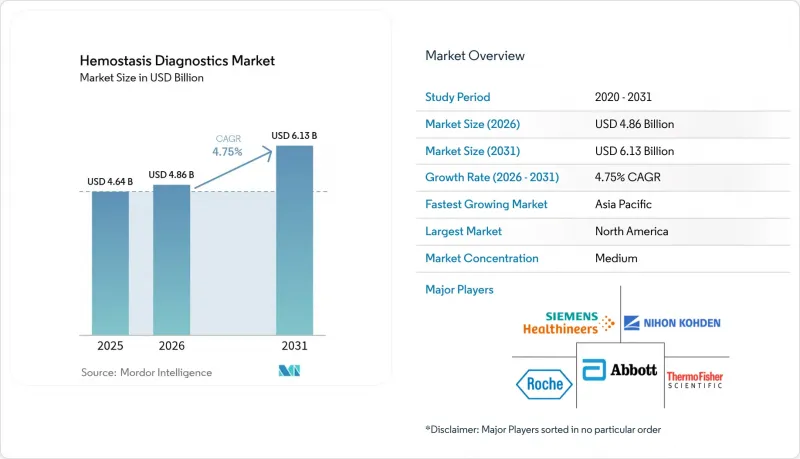
Mordor Intelligence에 의하면, 지혈 진단 시장 규모는 2025년에 46억 4,000만 달러로 평가되었고, 2026년 48억 6,000만 달러에서 2031년까지 61억 3,000만 달러에 이를 것으로 예측되며, 예측 기간(2026-2031년) CAGR은 4.75%를 나타낼 전망입니다.
본 보고서는 제품별(임상 검사 장비(자동 시스템 등), 현장 진단(Point-of-Care) 검사 시스템 등), 검사 항목별(활성화 부분 트롬보플라스틴 시간 등), 기술별(광학 검출 등), 최종 사용자별(병원, 진단실험실 등), 지역별(북미, 유럽, 아시아태평양 등)로 분류되어 있습니다. 시장 예측은 금액(달러) 기준으로 제시되어 있습니다.
세계의 지혈 진단 시장 동향 및 인사이트
출혈성 질환 발생률 증가
세계 혈우병 유병률은 이전 추정치의 약 3배에 달할 것으로 추정되며, 병원이 시급히 해소해야 할 큰 진단 격차가 발생하고 있습니다. 세계 혈우병연맹(WFH)의 기록에 따르면 매년 2만 건의 신규 사례가 보고되고 있지만, 전 세계적으로 50만 명 이상이 미진단 상태로 남아 있어, 이는 조기 선별 검사에 대한 지속적인 수요를 뒷받침하고 있습니다. 예방적 치료는 두개내 출혈의 위험을 대폭 낮추고, 현재 환자 1인당 21만 3,874달러에서 86만 9,940달러에 이르는 연간 치료비를 절감할 수 있으므로, 정확한 응고 인자 모니터링은 필수적입니다. 따라서 각국 정부와 보험사는 3차 의료기관 이외의 곳에서도 일상적인 모니터링을 용이하게 하는 응고 패널 및 현장 진단 기기에 대한 접근성 확대를 추진하고 있습니다. 인구 고령화와 수술 건수 증가에 따라 병원에서는 지혈 진단 시장을 ‘선택적’이 아닌 ‘필수적’인 것으로 인식하기 시작했습니다.
응고 검사 분야의 기술적 진보
헤모네틱스(Hemnetics)사의 FDA 승인 TEG 6s 카트리지와 같은 점탄성 플랫폼은 일반적인 PT나 aPTT로는 파악할 수 없는 전혈의 응고 동태를 실시간으로 제공합니다. 임상 연구에 따르면, 프로토콜에 기반한 수혈을 통해 출혈 위험을 높이지 않으면서 혈액 제제의 사용량을 최대 79%까지 줄일 수 있어, 외상 센터나 이식 센터에 상당한 비용 절감으로 이어진다는 것이 입증되었습니다. 또한, Nova Biomedical사의 ‘Stat Profile Prime Plus’가 보여주듯이, 불과 90μL의 모세혈관 혈액으로 측정이 가능한 마이크로플루이딕스 기술의 병행된 발전으로 인해, 검사실 검사와 병상 검사 간의 경계가 모호해지고 있습니다. 도쿄대학이 개발한 인공지능을 활용한 혈소판 이미징 기술은 자동 패턴 인식으로의 광범위한 전환을 부각시키고 있으며, 가까운 미래에 항혈소판 요법의 개인화가 가능해질 가능성이 있습니다. 이러한 획기적인 발전은 지혈 진단 시장에서 처리 능력 향상, 검체량 감소, 그리고 임상적 의사 결정의 신속화를 종합적으로 가져오고 있습니다.
개발도상국에서의 인식 부족
많은 저소득 지역에서는 출혈성 질환에 대한 인식이 부족하여 수술 건수가 증가하고 있음에도 불구하고 진단 건수는 낮은 수준에 머물러 있습니다. 세계 혈우병연맹은 환자 등록 제도에 큰 격차가 있음을 지적하고 있으며, 이는 자원 배분을 복잡하게 만들고 있습니다. 지방 병원에서는 첨단 응고 검사 패널을 이용할 수 없거나 비용이 너무 비싸서 감당할 수 없기 때문에 많은 임상의들은 여전히 PT/INR에만 의존하고 있습니다. 제한된 공중보건 예산은 주목도가 높은 다른 질환에 대한 우선 배분과 경쟁하고 있어, 분석 장비 플랫폼에 대한 투자가 지연되고 있습니다. 전통적인 치료법에 대한 문화적 의존도 현대적인 진단법의 보급을 더욱 지연시키고 있습니다. 그럼에도 불구하고, 국제 품질 기준을 충족하는 인도의 제조 시설과 같은 현지 생산은 접근성을 확대하고 장기적으로 지혈 진단 시장을 활성화하기 위한 현실적인 길을 제시하고 있습니다.
부문 분석
검사용 분석 장비는 2025년 매출의 51.10%를 차지했으며, 높은 처리 능력과 폭넓은 검사 메뉴를 통해 지혈 진단 시장의 기반을 형성하고 있습니다. 자동화, 시약 안정성 향상, 미들웨어를 통한 연결성 덕분에 대규모 핵심 검사실은 더욱 엄격한 품질 관리 목표를 달성하면서도 인력 배치의 병목 현상을 해소할 수 있게 되었습니다. 포인트 오브 케어(POC) 시스템은 시장 규모는 작지만, 응급실, 카테터실 및 외래수술센터(ASC)에서 병상 옆에서 신속한 응고 프로파일 측정을 요구함에 따라 연평균 성장률(CAGR) 7.95%로 확대되고 있습니다. 이러한 추세는 분산형 의료 및 가치 기반 환급으로의 더 깊은 구조적 전환을 반영하며, 이를 통해 입원 일수 단축 및 수혈 비용 절감이 평가받고 있습니다. 검사 장비와 관련된 시약 및 소모품 분야는 장비를 IVDR 및 CLIA 기준에 부합하는 상태로 유지하기 위해 키트를 지속적으로 교체해야 하므로 여전히 견실한 수익원입니다. 소형화로 인해 카테고리 간의 경계가 모호해지고 있으며, 손가락 끝에서 소량의 혈액을 채취하거나 카트리지 방식의 분석을 통해 처리 능력을 희생하지 않고도 분석 장비를 환자 근처에 배치할 수 있게 되었습니다.
이와 동시에, 지혈 진단 업계에서는 수술실의 피크 시간대에 대량 처리가 가능한 중앙 검사실 모드와 긴급 검사 모드를 전환할 수 있는 하이브리드 워크스테이션에 대한 수요가 급증하고 있습니다. 각 공급업체는 다년간의 계약을 확보하기 위해, 기기와 함께 폐쇄형 시약 계약, 검사 정보 시스템(LIS) 연동 기능, 그리고 현장 교육을 세트로 제공합니다. 숙련된 검사 기사의 인력 부족으로 어려움을 겪는 병원에서는 자동 교정, 실시간 품질 관리(QC),예측 유지보수 알림을 제공하는 플랫폼에 대한 의존도가 높아지고 있습니다. 이러한 통합형 솔루션은 POC(Point-of-Care) 시스템의 보급이 확대되는 상황에서도 벤더 종속성을 강화하고, 검사 장비의 수명 주기를 연장하고 있습니다.
2025년에도 PT/INR은 지혈 진단 시장에서 26.20%의 점유율을 유지했습니다. 이는 와파린 모니터링과 수술 전 선별 검사가 여전히 거의 보편적으로 이루어지고 있기 때문입니다. 쿠마딘 클리닉이나 수술 전 프로토콜에서는 항응고제 투여량을 조정하고 시술 준비가 완료되었는지 확인하기 위해 신속한 PT/INR 측정 결과에 의존하고 있습니다. 그러나 점탄성 측정법은 연평균 성장률(CAGR) 9.85%로 급속히 확대되고 있습니다. 외과 의사와 중환자 의사는 표적 수혈을 위해 전혈 응고 역학을 중시하고 있으며, 이는 기존의 혈장 기반 검사에서는 제공할 수 없는 이점입니다. D-다이머는 폐색전증 및 심부정맥 혈전증 검사에서 여전히 중요한 위치를 차지하고 있지만, 피브리노겐 검사는 산과적 출혈 및 외상성 응고 장애의 위험 계층화에서 보급이 확대되고 있습니다.
뇌졸중 분류에서 GFAP과 D-다이머를 병용하는 등 새로운 검사 조합은 하나의 검체로 일련의 검사를 완료할 수 있는 다항목 검사 패널의 가능성을 시사하고 있습니다. 그럼에도 불구하고, 비분획 헤파린 모니터링에서는 기존의 aPTT가 필수적이며, 광범위한 검사 포트폴리오 내에서 그 위상을 유지하고 있습니다. 점탄성 검사를 기반으로 한 프로토콜이 혈액 제제 사용량을 줄이고 중환자실(ICU) 입원 기간을 단축한다는 증거가 축적됨에 따라, 3차 의료 기관에서는 이러한 검사를 현장 진단용 카트에 추가하고 있으며, 지혈 진단 시장의 검사 구성에 따른 수익 구조를 재편하고 있습니다.
지역별 분석
북미는 선진적인 병원 네트워크, 자동 분석기의 조기 도입, 그리고 첨단 진단에 대한 안정적인 보험 환급 덕분에 2025년 매출의 37.40%를 차지하며 1위를 차지했습니다. 미국에서는 외상 센터와 이식 프로그램이 밀집해 있어 점탄성 검사 수요가 안정적으로 발생하고 있으며, 한편 FDA의 2025년 클래스 II 인증으로 인해 신규 의료기기 도입이 용이해지고 있습니다. 캐나다는 미국의 동향과 유사하지만, 멀티 애널라이트 플랫폼을 우선시하는 주 정부의 일괄 구매 계약을 더 중시하고 있습니다. 멕시코에서는 진행 중인 의료 제도 개혁으로 인해 검사실의 중앙 집중화가 진행되고 있어, 중급 분석기에 대한 새로운 판매 채널이 열리고 있습니다.
아시아태평양은 가장 성장세가 두드러지는 지역으로, 연평균 성장률(CAGR)은 8.00%로 성장을 지속하고 있습니다. 중국에서는 수량 기준 조달로 인해 시약 가격에 압박이 가해지고 있지만, 방대한 검사 건수가 절대적인 성장을 뒷받침하고 있습니다. 일본에서는 고령화가 진행되는 인구 구조가 만성 항응고 요법의 모니터링 수요를 뒷받침하는 한편, 기술력이 뛰어난 병원에서는 AI를 활용한 혈소판 이미징이 급속히 도입되고 있습니다. 인도에서 국산 제조가 확대됨에 따라(시스멕스의 신규 시설에서 볼 수 있듯이) 공립 병원의 조달 비용이 절감되고, 자동 지혈 패널의 활용 기회가 확대되고 있습니다. 한국과 호주는 모두 외상 및 심장외과 프로그램이 잘 갖춰져 있어, 기존 검사 워크스테이션과 병행하여 점탄성 분석기 도입을 계속하고 있습니다. 이러한 요인들이 맞물려 아시아태평양의 지혈 진단 시장 점유율은 해마다 높아지고 있습니다.
유럽에서는 엄격한 IVDR(체외진단용 의료기기 규정) 준수가 진행되는 가운데, 한 자릿수 중반의 꾸준한 성장세를 유지하고 있습니다. 독일과 프랑스에서는 첨단 응급의료 센터에서 마이크로플루이딕스 카트리지가 신속하게 도입되고 있는 반면, 영국에서는 국민보건서비스(NHS)의 현대화 자금을 활용하여 현장 진단(Point-of-Care)에서의 도입을 가속화하고 있습니다. 남유럽 국가들은 혈액 제제 지출을 억제하기 위해 수혈을 줄이는 기술을 우선시하며 선택적으로 투자하고 있습니다. 중동 및 아프리카는 뒤처져 있지만, 걸프협력회의(GCC) 회원국에서는 새로 설립된 3차 의료기관이 개원 초기부터 집중형 응고 검사실을 구축하는 등 국지적인 성장세가 나타나고 있습니다. 라틴아메리카의 성장은 주로 브라질과 아르헨티나에 의해 지탱되고 있으며, 양국에서는 외상 치료 인프라 확충이 진행되고 있고, 민간 병원 그룹에서 점탄성 검사가 도입되고 있습니다. 이러한 지역별 동향을 종합해 보면, 다양하면서도 수렴해 가는 추세가 뚜렷하게 드러나며, 지혈 진단 시장은 전 세계적으로 견조한 성장 궤도를 유지하고 있습니다.
기타 혜택 :
- 엑셀 형식 시장 예측(ME) 시트
- 3개월간의 애널리스트 지원
자주 묻는 질문
목차
제1장 서론
제2장 조사 방법
제3장 주요 요약
제4장 시장 구도
제5장 시장 규모 및 성장 예측
제6장 경쟁 구도
제7장 시장 기회 및 향후 전망
AJY 26.08.26According to Mordor Intelligence, the hemostasis diagnostics market size was valued at USD 4.64 billion in 2025 and estimated to grow from USD 4.86 billion in 2026 to reach USD 6.13 billion by 2031, at a CAGR of 4.75% during the forecast period (2026-2031).
This report is Segmented by Product (Laboratory Analyzers [Automated Systems, and More], Point-Of-Care Testing Systems and More), Test (Activated Partial Thromboplastin Time, and More), Technology (Optical Detection, and More), End User (Hospitals, Diagnostic Laboratories, and More), and Geography (North America, Europe, Asia-Pacific, and More). The Market Forecasts are Provided in Terms of Value (USD).
Global Hemostasis Diagnostics Market Trends and Insights
Rising Incidences of Bleeding Disorders
Global hemophilia prevalence is now believed to be nearly triple earlier estimates, creating a substantial diagnostic gap that hospitals are eager to close. The World Federation of Hemophilia records 20,000 new cases each year, yet more than 500,000 people remain undiagnosed worldwide, driving sustained demand for early-screening assays. Precise factor monitoring is essential because prophylactic regimens cut intracranial hemorrhage risk sharply and can lower annual treatment costs that today range between USD 213,874 and USD 869,940 per patient. Governments and payers therefore push for broader access to coagulation panels and point-of-care devices that facilitate routine monitoring outside tertiary centers. As population aging and surgical volumes climb, hospitals increasingly regard the hemostasis diagnostics market as indispensable rather than discretionary.
Technological Advancements in Coagulation Testing
Viscoelastic platforms such as Haemonetics' FDA-cleared TEG 6s cartridge provide real-time, whole-blood clot dynamics that routine PT or aPTT cannot capture. Clinical studies show protocol-guided transfusions cut blood-product use by up to 79% without raising bleeding risk, translating to sizeable cost savings for trauma and transplant centers. Parallel advances in microfluidics, exemplified by Nova Biomedical's Stat Profile Prime Plus requiring only 90 μL of capillary blood, blur the line between laboratory and bedside testing. Artificial-intelligence-enabled platelet imaging from the University of Tokyo underscores a broader shift toward automated pattern recognition that could soon personalize antiplatelet regimens. These breakthroughs collectively raise throughput, lower sample-volume requirements, and improve clinical decision-making speed within the hemostasis diagnostics market.
Lack of Awareness in Developing Economies
Under-recognition of bleeding disorders in many low-income regions keeps diagnostic volumes low despite rising surgical rates. The World Federation of Hemophilia notes large gaps in patient registries, complicating resource allocation. Many clinicians still rely solely on PT/INR because advanced coagulation panels are unavailable or unaffordable at district hospitals. Limited public-health funding competes with higher-profile disease priorities, delaying investment in analyzer platforms. Cultural reliance on traditional therapies further slows uptake of modern diagnostics. Still, localized manufacturing-such as Indian-based facilities that meet international quality standards-demonstrates a viable path to broaden access and lift the hemostasis diagnostics market over the long term.
Other drivers and restraints analyzed in the detailed report include:
- Rising Adoption of Automated Hemostasis Equipment
- Adoption of Viscoelastic Testing (TEG/ROTEM) for Transfusion Management
- Stringent Regulatory Approval Processes
For complete list of drivers and restraints, kindly check the Table Of Contents.
Segment Analysis
Laboratory analyzers generated 51.10% of 2025 revenue, anchoring the hemostasis diagnostics market with high-throughput capabilities and broad test menus. Automation, advanced reagent stability, and middleware connectivity help large core labs clear staffing bottlenecks while meeting tighter quality-control targets. Point-of-care (POC) systems, although a smaller base, are advancing at an 7.95% CAGR as emergency departments, catheterization labs, and ambulatory surgery centers seek rapid clotting profiles at the bedside. This trend reflects a deeper structural pivot toward decentralized care and value-based reimbursement, which rewards shorter length of stay and lower transfusion cost. The reagents and consumables stream linked to laboratory analyzers remains a resilient profit pool because kits require continual replacement to keep instruments compliant with IVDR and CLIA standards. Miniaturization is blurring category lines, with fingertip micro-sampling and cartridge-based assays allowing analyzers to migrate closer to patients without sacrificing throughput.
In parallel, the hemostasis diagnostics industry is witnessing a surge in hybrid workstations able to toggle between high-volume central-lab mode and stat-testing mode during peak OR hours. Suppliers are bundling instruments with closed-loop reagent contracts, laboratory information system connectivity, and on-site training to secure multiyear deals. Hospitals struggling with skilled-technologist vacancies lean heavily toward platforms that deliver automated calibration, real-time QC, and predictive maintenance alerts. These integrated offerings solidify vendor lock-in and extend the lifecycle of laboratory analyzers, even as POC systems rise.
PT/INR retained 26.20% share of the hemostasis diagnostics market in 2025 because warfarin monitoring and surgical screening remain near-universal. Coumadin clinics and pre-op pathways rely on quick PT/INR readouts to adjust anticoagulant dosing and verify readiness for procedures. However, viscoelastic assays are sprinting ahead with a 9.85% CAGR. Surgeons and intensivists value whole-blood clot kinetics for targeted transfusion, a benefit conventional plasma-based tests cannot provide. D-dimer keeps its foothold in pulmonary embolism and deep-vein thrombosis workups, while fibrinogen tests gain traction for obstetric hemorrhage and trauma-induced coagulopathy risk stratification.
New test combinations, such as GFAP plus D-dimer for stroke triage, hint at multiplexed assay panels that could compress workups into a single sample. Even so, traditional aPTT remains indispensable for unfractionated heparin monitoring, preserving its place in the broader portfolio. As evidence mounts that viscoelastic-guided protocols save blood products and reduce ICU stays, tertiary centers add these assays to point-of-care carts, reshaping test-mix revenue within the hemostasis diagnostics market.
Complete Report Scope:
- By Product
- Laboratory Analyzers
- Automated Systems
- Semi-automated Systems
- Manual Systems
- Point-of-Care Testing Systems
- Reagents & Consumables
- Laboratory Analyzers
- By Test
- Activated Partial Thromboplastin Time (aPTT)
- Prothrombin Time (PT/INR)
- D-Dimer
- Fibrinogen
- Thrombin Time & Clotting-Factor Assays
- Viscoelastic Tests (TEG, ROTEM)
- By Technology
- Optical Detection
- Mechanical Detection
- Electrochemical & Magnetic Detection
- Microfluidics & Lab-on-Chip
- By End User
- Hospitals
- Diagnostic Laboratories
- Outpatient Clinics & Ambulatory Surgery Centers
- Blood Banks
- Geography
- North America
- United States
- Canada
- Mexico
- Europe
- Germany
- United Kingdom
- France
- Italy
- Spain
- Rest of Europe
- Asia-Pacific
- China
- Japan
- India
- South Korea
- Australia
- Rest of Asia-Pacific
- Middle East and Africa
- GCC
- South Africa
- Rest of Middle East and Africa
- South America
- Brazil
- Argentina
- Rest of South America
- North America
Geography Analysis
North America led with 37.40% of 2025 revenue thanks to sophisticated hospital networks, early adoption of automated analyzers, and stable reimbursement for advanced diagnostics. The United States' dense trauma centers and transplant programs generate a steady stream of viscoelastic test demand, while the FDA's 2025 Class II ruling eases new-device onboarding. Canada mirrors U.S. trends but places greater emphasis on provincial bulk-purchase contracts that favor multi-analyte platforms. Mexico's ongoing health-system reform drives centralized laboratory buildouts, opening incremental sales channels for mid-tier analyzers.
Asia-Pacific is the fastest-growing geography, advancing at an 8.00% CAGR. China's volume-based procurement pressures pricing for reagents, yet massive procedure volumes sustain absolute growth. Japan's aging demographic fuels demand for chronic anticoagulation monitoring, while its technologically adept hospitals rapidly integrate AI-enabled platelet imaging. India's expansion of indigenous manufacturing-seen in Sysmex's new facilities-lowers acquisition costs for public hospitals, broadening access to automated hemostasis panels. South Korea and Australia, each with robust trauma and cardiac-surgery programs, continue to install viscoelastic analyzers alongside existing laboratory workstations. These combined forces elevate Asia-Pacific's share of the hemostasis diagnostics market year by year.
Europe maintains steady mid-single-digit gains amid stringent IVDR compliance. Germany and France adopt microfluidic cartridges swiftly in high-acuity centers, whereas the United Kingdom accelerates point-of-care deployment through National Health Service modernization funds. Southern European nations invest selectively, prioritizing transfusion-sparing technologies to curb blood-product expenditures. The Middle East and Africa trail but show pockets of momentum in Gulf Cooperation Council states where new tertiary hospitals specify centralized coagulation labs from day one. Latin America's growth rests largely on Brazil and Argentina, which are expanding trauma-care infrastructure and adopting viscoelastic testing in private hospital groups. Collectively, these regional narratives underscore varied but converging trajectories that keep the hemostasis diagnostics market on a positive global slope.
- Abbott Laboratories
- Danaher Corp.
- Roche
- Grifols
- Werfen (Instrumentation Laboratory)
- Sysmex
- Siemens Healthineers
- Nihon Kohden
- HORIBA
- Bio-Rad Laboratories
- Thermo Fisher Scientific
- Diagnostica Stago
- Helena Laboratories
- Haemonetics (HemoSonics)
- CSL Behring
- Baxter
- Beckton Dickinson
- Medtronic (ViscoStat)
Additional Benefits:
- The market estimate (ME) sheet in Excel format
- 3 months of analyst support
TABLE OF CONTENTS
1 Introduction
- 1.1 Study Assumptions & Market Definition
- 1.2 Scope of the Study
2 Research Methodology
3 Executive Summary
4 Market Landscape
- 4.1 Market Overview
- 4.2 Market Drivers
- 4.2.1 Rising Incidences Of Bleeding Disorders
- 4.2.2 Technological Advancements In Coagulation Testing
- 4.2.3 Rising Adoption Of Automated Hemostasis Equipment
- 4.2.4 Adoption Of Viscoelastic Testing (TEG/ROTEM) For Transfusion Management
- 4.2.5 Microfluidic Point-Of-Care (POC) Assays Enabling Decentralized Testing
- 4.2.6 Low-Volume Monitoring Demand In ECMO & Critical Care
- 4.3 Market Restraints
- 4.3.1 Lack Of Awareness In Developing Economies
- 4.3.2 Stringent Regulatory Approval Processes
- 4.3.3 Reimbursement Gaps For Advanced POC Devices
- 4.3.4 Data-Interoperability Issues With LIS / HIS Integration
- 4.4 Technological Outlook
- 4.5 Porter's Five Forces
- 4.5.1 Threat of New Entrants
- 4.5.2 Bargaining Power of Buyers/Consumers
- 4.5.3 Bargaining Power of Suppliers
- 4.5.4 Threat of Substitute Products
- 4.5.5 Intensity of Competitive Rivalry
5 Market Size & Growth Forecasts (Value, USD)
- 5.1 By Product
- 5.1.1 Laboratory Analyzers
- 5.1.1.1 Automated Systems
- 5.1.1.2 Semi-automated Systems
- 5.1.1.3 Manual Systems
- 5.1.2 Point-of-Care Testing Systems
- 5.1.3 Reagents & Consumables
- 5.1.1 Laboratory Analyzers
- 5.2 By Test
- 5.2.1 Activated Partial Thromboplastin Time (aPTT)
- 5.2.2 Prothrombin Time (PT/INR)
- 5.2.3 D-Dimer
- 5.2.4 Fibrinogen
- 5.2.5 Thrombin Time & Clotting-Factor Assays
- 5.2.6 Viscoelastic Tests (TEG, ROTEM)
- 5.3 By Technology
- 5.3.1 Optical Detection
- 5.3.2 Mechanical Detection
- 5.3.3 Electrochemical & Magnetic Detection
- 5.3.4 Microfluidics & Lab-on-Chip
- 5.4 By End User
- 5.4.1 Hospitals
- 5.4.2 Diagnostic Laboratories
- 5.4.3 Outpatient Clinics & Ambulatory Surgery Centers
- 5.4.4 Blood Banks
- 5.5 Geography
- 5.5.1 North America
- 5.5.1.1 United States
- 5.5.1.2 Canada
- 5.5.1.3 Mexico
- 5.5.2 Europe
- 5.5.2.1 Germany
- 5.5.2.2 United Kingdom
- 5.5.2.3 France
- 5.5.2.4 Italy
- 5.5.2.5 Spain
- 5.5.2.6 Rest of Europe
- 5.5.3 Asia-Pacific
- 5.5.3.1 China
- 5.5.3.2 Japan
- 5.5.3.3 India
- 5.5.3.4 South Korea
- 5.5.3.5 Australia
- 5.5.3.6 Rest of Asia-Pacific
- 5.5.4 Middle East and Africa
- 5.5.4.1 GCC
- 5.5.4.2 South Africa
- 5.5.4.3 Rest of Middle East and Africa
- 5.5.5 South America
- 5.5.5.1 Brazil
- 5.5.5.2 Argentina
- 5.5.5.3 Rest of South America
- 5.5.1 North America
6 Competitive Landscape
- 6.1 Market Concentration
- 6.2 Market Share Analysis
- 6.3 Company Profiles (includes Global level Overview, Market level overview, Core Segments, Financials as available, Strategic Information, Market Rank/Share for key companies, Products & Services, and Recent Developments)
- 6.3.1 Abbott Laboratories
- 6.3.2 Danaher Corp.
- 6.3.3 F. Hoffmann-La Roche Ltd
- 6.3.4 Grifols
- 6.3.5 Werfen (Instrumentation Laboratory)
- 6.3.6 Sysmex Corporation
- 6.3.7 Siemens Healthineers
- 6.3.8 Nihon Kohden Corporation
- 6.3.9 HORIBA
- 6.3.10 Bio-Rad Laboratories
- 6.3.11 Thermo Fisher Scientific, Inc.
- 6.3.12 Diagnostica Stago
- 6.3.13 Helena Laboratories
- 6.3.14 Haemonetics (HemoSonics)
- 6.3.15 CSL Behring
- 6.3.16 Baxter International
- 6.3.17 Becton, Dickinson & Co.
- 6.3.18 Medtronic (ViscoStat)
7 Market Opportunities & Future Outlook
- 7.1 White-space & Unmet-need Assessment