

|
시장보고서
상품코드
2114711
HIV 예방 치료제 : 시장 점유율 분석, 업계 동향 및 통계, 성장 예측(2026-2031년)Prophylactic HIV Drugs - Market Share Analysis, Industry Trends & Statistics, Growth Forecasts (2026 - 2031) |
||||||
 Mordor Intelligence
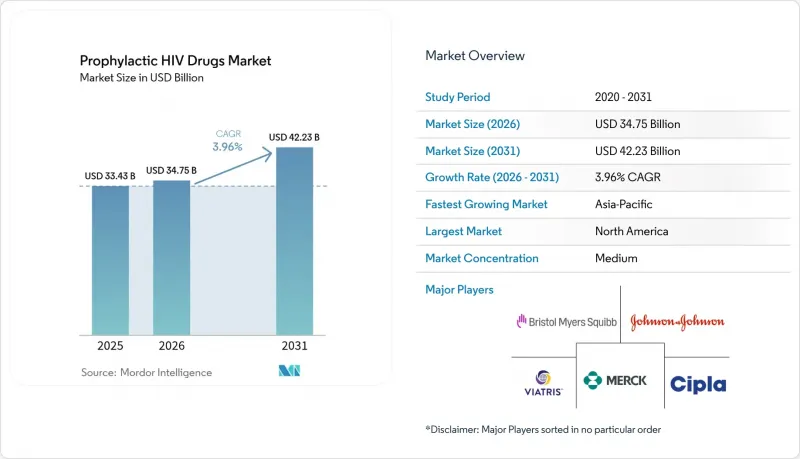
Mordor Intelligence에 의하면, HIV 예방 치료제 시장 규모는 2025년에 334억 3,000만 달러로 평가되었습니다. 2026년 347억 5,000만 달러에서 2031년까지 422억 3,000만 달러에 이를 것으로 예상되며, 예측 기간(2026-2031년) CAGR은 3.96%를 나타낼 전망입니다.
본 보고서는 제제별(테노포비르 디소프로실 푸마르산염, 테노포비르 알라페나미드, 엠트리시타빈 등),제형별(경구용 정제, 지속형 주사제 등), 유통 채널별(병원 약국, 소매 약국 등), 지역별(북미, 유럽, 아시아태평양, 중동 및 아프리카, 남미)로 분류되어 있습니다. 시장 예측은 금액(미 달러) 기준으로 제시되어 있습니다.
세계의 HIV 예방 치료제 시장 동향 및 인사이트
전 세계 HIV 신규 감염자 수 및 유병률 증가
2024년에는 전 세계적으로 약 130만 건의 신규 HIV 감염이 보고되었으며, 이 중 청소년 및 젊은 성인의 비율이 증가하고 있습니다. 이러한 역학적 긴급성은 예방 전략에 대한 근본적인 수요를 뒷받침하며, 감염 부담이 높은 지역에서 HIV 예방제 시장 수요 증가를 촉진하고 있습니다. PURPOSE-1 및 PURPOSE-2 임상시험에서는 시스젠더 여성을 대상으로 연 2회 레나카파빌 투여를 통해 100%의 예방 효과가 입증되었으며, 매일 복용 시 효능을 제한하던 복약 순응도 문제가 해소되었습니다. 공중보건 기관들은 고위험군에 대해 캡시드 억제제를 권장하는 경향이 강해지고 있으며, 이는 임상 지침에서 증거에 기반한 전환을 시사합니다. 약물 내성을 가진 HIV 균주 증가는 역전사효소 억제 이외의 작용기전에 대한 관심을 더욱 높이며, HIV 예방 치료제 시장의 다양화를 뒷받침하고 있습니다. 전반적으로, 질병 부담의 동향과 내성에 대한 우려가 예방적 약물 요법의 구조적 성장을 뒷받침하고 있습니다.
예방 프로그램에 대한 정부 및 기부 기관의 자금 지원 확대
기부 기관들은 HIV 발생률을 줄이기 위한 재정적으로 현명한 수단으로서 예방에 중점을 옮기고 있으며, 세계 펀드(Global Fund)가 2025년까지 아프리카에서 생산된 1차 치료제를 조달한 것은 지역 공급망에 있어 획기적인 사건이 되었습니다. PEPFAR가 2030년까지 200만 회분의 현지 생산 치료제 조달을 약속한 것은 산업 정책 목표가 현재 공중보건 목표와 어떻게 맞물려 있는지를 보여줍니다. 이러한 노력은 예측 가능한 공급량을 보장하고 라스트 마일 비용을 절감함으로써 HIV 예방 치료제 시장을 확대할 것입니다. 반면, 프로그램에 대한 자금 지원은 정치적 주기에 좌우되기 때문에 다년간의 수익 예측에 변동성을 초래하고 있습니다. 저비용 GMP 생산 체계를 확립하고, 기부 기관의 입찰 절차를 성공적으로 통과할 수 있는 제조업체는 이 새로운 접근 패러다임 하에서 지속적인 경쟁 우위를 확보하게 될 것입니다.
신규 장기 작용형 제제의 높은 비용
레나카파비르의 미국 내 연간 정가 4만 2,250달러는 추정 제조 비용의 1,000배에 달하여, 임상적 우위가 있음에도 불구하고 지불 기관의 수용을 제한하고 있습니다. 보험사는 사전 승인이나 단계적 치료를 의무화하고 있으며, 더 저렴한 제네릭 의약품이 우선시됨에 따라 지속형 제제의 보급이 지연되고 있습니다. 특허 보호와 단계적 가격 책정의 부재 사이에서 양쪽 모두의 압박을 받고 있는 중소득국 시장은 가장 심각한 경제적 장벽에 직면해 있으며, 이는 HIV 예방제 시장으로의 단기적인 침투를 방해하고 있습니다. 이러한 저항을 완화하기 위해 각 기업은 구독형 계약이나 가치 기반 계약을 검토하고 있지만, 이러한 모델은 아직 발전 단계에 있으며 적용 현황도 제각각입니다.
부문별 분석
2025년, 테노포비르 알라페나미드는 HIV 예방 치료제 시장 점유율의 54.78%를 차지했습니다. 이는 신장이나 뼈에 주는 부담이 적다는 안전성 프로파일과 처방 의사들 사이에서 높은 인지도를 반영한 결과입니다. 그러나 레나카파비르는 독자적인 캡시드 억제 경로를 개척하여 연평균 성장률(CAGR) 6.35%를 달성하고 있습니다. 이를 통해 복약 순응도 위험이 높은 환자층에서 기존 제품을 대체하고, 그동안 매일 약을 복용하는 것을 주저하거나 복용할 수 없었던 환자층을 포용함으로써 HIV 예방 치료제 시장 전체의 규모를 확대되고 있습니다. 엠트리시타빈은 여전히 병용 요법의 주력 제품으로 자리 잡고 있으며, 한편 카보테그라빌 서방형 제제는 공급 병목 현상이 있음에도 불구하고 틈새 시장을 유지하고 있습니다.
경쟁 동향은 내성 진화에 대응하기 위한 작용기전의 다양화에 점점 더 좌우되고 있으며, 레나카파비르는 HIV 예방 치료제 업계에서 차세대 예방 치료제의 선구자로서의 입지를 확고히 하고 있습니다. 제네릭 의약품 라이선싱을 통해 120개국에서 공급량이 증가하는 가운데, 혁신 기업들은 라이프사이클 관리와 새로운 복합 제제에 의존하여 프리미엄 부문에서 시장 점유율을 지켜내야 합니다.
지역별 분석
북미는 광범위한 보험 적용, 조기 규제 당국의 승인, 그리고 성숙한 임상시험 생태계에 힘입어 2025년 HIV 예방 치료제 시장 매출의 41.02%를 차지했습니다. 미국의 지불 기관들은 지속성 주사제에 대해 가치 기반 환급 제도를 점점 더 많이 채택하고 있는 반면, 캐나다의 단일 지불자 제도에서는 PrEP 급여가 전국적으로 표준화되어 있습니다. 멕시코는 무역 관계를 활용하여 기술 이전을 가속화하고, 국경을 초월한 제조 파트너십을 가능하게 함으로써 공급의 회복력을 높이고 있습니다.
아시아태평양은 5.28%라는 가장 높은 예측 연평균 성장률(CAGR)을 기록하고 있으며, 베트남, 태국, 인도 각국 정부가 HIV 예방을 보편적 의료 보장(UHC)의 정책 과제로 포함시키고 있어 2031년까지 전 세계 성장률을 상회할 것으로 전망됩니다. 스마트폰의 급속한 보급이 원격의료 제공을 뒷받침하고 있지만, 농촌 지역의 콜드체인 부족이 여전히 주사제 보급 확대를 제약하고 있습니다. 아세안 전역에 걸친 규제 조화를 통해 승인까지의 기간이 단축되어, 인구가 많은 경제권에서 HIV 예방 치료제 시장 규모가 확대될 가능성이 있습니다.
유럽에서는 보급이 성숙 단계에 이르렀으나 불균형한 양상이 관찰됩니다. 2024년까지 52개국 중 38개국에서 PrEP에 관한 국가 지침이 마련되었으나, 수혜자 데이터에 따르면 그 98%가 남성 간 성관계를 하는 사람들(MSM)에 집중되어 있어, 여성과 이민자층의 미충족 수요가 부각되고 있습니다. 독일의 보험 모델은 적응 대상자의 33%를 보장하고 있으며, 2030년까지 81%를 목표로 하고 있어, 보험 환급의 안정성이 보급을 촉진하는 사례로 꼽힙니다. 그러나 회원국마다 적용 기준이 다르기 때문에 해당 지역의 HIV 예방 치료제 시장 상황은 여전히 분열된 상태를 유지하고 있습니다.
기타 혜택 :
- 엑셀 형식 시장 예측(ME) 시트
- 3개월간 애널리스트 지원
자주 묻는 질문
목차
제1장 서론
제2장 조사 방법
제3장 주요 요약
제4장 시장 구도
제5장 시장 규모 및 성장 예측
제6장 경쟁 구도
제7장 시장 기회 및 향후 전망
KTH 26.08.28According to Mordor Intelligence, the prophylactic HIV drugs market size was valued at USD 33.43 billion in 2025 and estimated to grow from USD 34.75 billion in 2026 to reach USD 42.23 billion by 2031, at a CAGR of 3.96% during the forecast period (2026-2031).
This report is Segmented by Drug (Tenofovir Disoproxil Fumarate, Tenofovir Alafenamide, Emtricitabine, and More), Dosage Form (Oral Pill, Long-Acting Injectable, and More), Distribution Channel (Hospital Pharmacies, Retail Pharmacies, and More), and Geography (North America, Europe, Asia-Pacific, Middle East & Africa, South America). The Market Forecasts are Provided in Terms of Value (USD).
Global Prophylactic HIV Drugs Market Trends and Insights
Rising Global HIV Incidence and Prevalence
Roughly 1.3 million new HIV infections were reported worldwide in 2024, with adolescents and young adults accounting for a growing proportion of cases. The epidemiological urgency sustains baseline demand for prophylactic strategies and amplifies uptake of the prophylactic HIV drugs market across high-burden geographies. PURPOSE-1 and PURPOSE-2 trials documented 100% prevention efficacy for twice-yearly lenacapavir among cisgender women, eliminating adherence gaps that limited daily-pill effectiveness. Public-health agencies increasingly recommend capsid inhibitors for high-risk cohorts, signaling an evidence-driven shift in clinical guidelines. Rising drug-resistant HIV strains further heighten interest in mechanisms outside reverse transcriptase inhibition, reinforcing diversification within the prophylactic HIV drugs market. Collectively, disease-burden dynamics and resistance concerns underpin a structural growth floor for preventive pharmacotherapy.
Expanding Government and Donor Funding for Prevention Programs
Donor agencies are pivoting toward prevention as the fiscally prudent way to cut HIV incidence, with the Global Fund's 2025 procurement of African-manufactured first-line regimens marking a watershed for regional supply chains. PEPFAR's pledge to source 2 million locally produced treatments by 2030 illustrates how industrial-policy goals now overlap with public-health objectives. Such commitments enlarge the prophylactic HIV drugs market by guaranteeing predictable volumes and lowering last-mile costs. At the same time, program funding is tied to political cycles, injecting volatility into multiyear revenue forecasts. Manufacturers that master low-cost GMP production and navigate donor tender processes secure a durable competitive edge under the new access paradigm.
High Cost of Novel Long-Acting Formulations
Annual U.S. list pricing of USD 42,250 for lenacapavir stands a thousand-fold above estimated manufacturing costs, limiting payer acceptance despite clinical superiority. Insurers impose prior authorization and step therapy, delaying uptake of long-acting options in favor of cheaper generics. Middle-income markets caught between patent protection and absence of tiered pricing face the steepest affordability hurdles, curbing near-term penetration of the prophylactic HIV drugs market. To mitigate resistance, companies are exploring subscription-style agreements and value-based contracts, yet these models remain nascent and unevenly applied.
Other drivers and restraints analyzed in the detailed report include:
- Increasing Generic Drug Availability and Affordability
- Ongoing Innovation in Antiretroviral Drug-Delivery Technologies
- Persisting Socioeconomic Access Disparities in High-Burden Regions
For complete list of drivers and restraints, kindly check the Table Of Contents.
Segment Analysis
Tenofovir Alafenamide controlled 54.78% of the prophylactic HIV drugs market share in 2025, reflecting its renal- and bone-sparing safety profile and wide familiarity among prescribers. However, lenacapavir unlocks a differentiated capsid-inhibition pathway that secures a 6.35% CAGR, displacing incumbents in high-adherence-risk populations and expanding the overall prophylactic HIV drugs market size by capturing patients previously unwilling or unable to manage daily pills. Emtricitabine remains a staple backbone in combination regimens, while cabotegravir long-acting sustains niche demand despite supply bottlenecks.
Competitive dynamics increasingly hinge on mechanism-of-action diversification to counter resistance evolution, positioning lenacapavir as the vanguard of next-generation prophylaxis within the prophylactic HIV drugs industry. As generic licensing unlocks volume in 120 countries, innovators must rely on lifecycle management and novel co-formulations to defend share in premium tiers.
Complete Report Scope:
- By Drug
- Tenofovir Disoproxil Fumarate (TDF)
- Tenofovir Alafenamide (TAF)
- Emtricitabine (FTC)
- Cabotegravir Long-Acting (Apretude)
- Lenacapavir (Yeztugo/Sunlenca)
- Other Drugs
- By Dosage Form
- Oral Pill
- Long-Acting Injectable
- Sub-Dermal Implant (Pipeline)
- Topical Microbicide (Gel/Film)
- Vaginal Ring
- By Distribution Channel
- Hospital Pharmacies
- Retail Pharmacies
- Online Pharmacies & Tele-PrEP Platforms
- Community-Based Clinics & NGOs
- Geography
- North America
- United States
- Canada
- Mexico
- Europe
- Germany
- United Kingdom
- France
- Italy
- Spain
- Rest of Europe
- Asia-Pacific
- China
- Japan
- India
- Australia
- South Korea
- Rest of Asia-Pacific
- Middle East & Africa
- GCC
- South Africa
- Rest of Middle East & Africa
- South America
- Brazil
- Argentina
- Rest of South America
- North America
Geography Analysis
North America represented 41.02% of 2025 revenue for the prophylactic HIV drugs market, underpinned by broad insurance coverage, early regulatory approvals, and mature clinical trial ecosystems. United States payers increasingly adopt value-based reimbursement for long-acting injectables, while Canada's single-payer system standardizes PrEP benefits nationally. Mexico leverages trade ties to accelerate technology transfer, enabling cross-border manufacturing partnerships that widen supply resilience.
Asia-Pacific posts the highest forecast CAGR at 5.28% and is projected to outpace global growth through 2031 as governments in Vietnam, Thailand, and India merge HIV prevention into universal-health-coverage agendas. Rapid smartphone penetration backs telehealth delivery, although rural cold-chain gaps still constrain injectable scale-up. Regulatory harmonization across ASEAN could streamline approval timelines, expanding the prophylactic HIV drugs market size in populous economies.
Europe shows mature yet uneven penetration; 38 of 52 countries had national PrEP guidelines by 2024, but recipient data reveal concentration among men who have sex with men at 98%, highlighting unmet needs in women and migrants. Germany's insurance model has achieved 33% coverage of indicated users and targets 81% by 2030, illustrating how reimbursement stability lifts adoption. Divergent eligibility criteria across member states, however, continue to fragment the prophylactic HIV drugs market landscape within the region.
- Gilead Sciences
- ViiV Healthcare (GSK Plc)
- Johnson & Johnson
- Merck
- Abbvie
- Bristol-Myers Squibb
- Roche
- Boehringer Ingelheim Intl. GmbH
- Pfizer
- Cipla
- Viatris
- Teva Pharmaceutical Industries
- Sun Pharmaceuticals Industries
- Aurobindo Pharma Ltd.
- Hetero Labs Ltd.
- Lupin
- Macleods Pharmaceuticals Ltd.
- Apotex
- Glenmark Pharmaceuticals
- Dr. Reddy's Laboratories
Additional Benefits:
- The market estimate (ME) sheet in Excel format
- 3 months of analyst support
TABLE OF CONTENTS
1 Introduction
- 1.1 Study Assumptions & Market Definition
- 1.2 Scope of the Study
2 Research Methodology
3 Executive Summary
4 Market Landscape
- 4.1 Market Overview
- 4.2 Market Drivers
- 4.2.1 Rising Global HIV Incidence and Prevalence
- 4.2.2 Expanding Government and Donor Funding for Prevention Programs
- 4.2.3 Increasing Generic Drug Availability and Affordability
- 4.2.4 Ongoing Innovation in Antiretroviral Drug Delivery Technologies
- 4.2.5 Evolving Digital Health Channels Enabling Remote PrEP Access
- 4.2.6 Integration of PrEP Within Sexual and Reproductive Health Services
- 4.3 Market Restraints
- 4.3.1 High Cost of Novel Long-Acting Formulations
- 4.3.2 Persisting Socioeconomic access Disparities in High-Burden Regions
- 4.3.3 Regulatory and Reimbursement Uncertainties across Markets
- 4.3.4 Stigma and Misinformation Limiting PrEP Uptake
- 4.4 Regulatory Landscape
- 4.5 Porter's Five Forces Analysis
- 4.5.1 Threat Of New Entrants
- 4.5.2 Bargaining Power Of Buyers
- 4.5.3 Bargaining Power Of Suppliers
- 4.5.4 Threat Of Substitute Products
- 4.5.5 Intensity Of Competitive Rivalry
5 Market Size & Growth Forecasts (Value, USD)
- 5.1 By Drug
- 5.1.1 Tenofovir Disoproxil Fumarate (TDF)
- 5.1.2 Tenofovir Alafenamide (TAF)
- 5.1.3 Emtricitabine (FTC)
- 5.1.4 Cabotegravir Long-Acting (Apretude)
- 5.1.5 Lenacapavir (Yeztugo/Sunlenca)
- 5.1.6 Other Drugs
- 5.2 By Dosage Form
- 5.2.1 Oral Pill
- 5.2.2 Long-Acting Injectable
- 5.2.3 Sub-Dermal Implant (Pipeline)
- 5.2.4 Topical Microbicide (Gel/Film)
- 5.2.5 Vaginal Ring
- 5.3 By Distribution Channel
- 5.3.1 Hospital Pharmacies
- 5.3.2 Retail Pharmacies
- 5.3.3 Online Pharmacies & Tele-PrEP Platforms
- 5.3.4 Community-Based Clinics & NGOs
- 5.4 Geography
- 5.4.1 North America
- 5.4.1.1 United States
- 5.4.1.2 Canada
- 5.4.1.3 Mexico
- 5.4.2 Europe
- 5.4.2.1 Germany
- 5.4.2.2 United Kingdom
- 5.4.2.3 France
- 5.4.2.4 Italy
- 5.4.2.5 Spain
- 5.4.2.6 Rest of Europe
- 5.4.3 Asia-Pacific
- 5.4.3.1 China
- 5.4.3.2 Japan
- 5.4.3.3 India
- 5.4.3.4 Australia
- 5.4.3.5 South Korea
- 5.4.3.6 Rest of Asia-Pacific
- 5.4.4 Middle East & Africa
- 5.4.4.1 GCC
- 5.4.4.2 South Africa
- 5.4.4.3 Rest of Middle East & Africa
- 5.4.5 South America
- 5.4.5.1 Brazil
- 5.4.5.2 Argentina
- 5.4.5.3 Rest of South America
- 5.4.1 North America
6 Competitive Landscape
- 6.1 Market Concentration
- 6.2 Market Share Analysis
- 6.3 Company Profiles (includes Global level Overview, Market level overview, Core Business Segments, Financials, Headcount, Key Information, Market Rank, Market Share, Products and Services, and analysis of Recent Developments)
- 6.3.1 Gilead Sciences Inc.
- 6.3.2 ViiV Healthcare (GSK Plc)
- 6.3.3 Johnson & Johnson (Janssen Pharmaceuticals)
- 6.3.4 Merck & Co. Inc.
- 6.3.5 AbbVie Inc.
- 6.3.6 Bristol-Myers Squibb Company
- 6.3.7 F. Hoffmann-La Roche AG
- 6.3.8 Boehringer Ingelheim Intl. GmbH
- 6.3.9 Pfizer Inc.
- 6.3.10 Cipla Ltd.
- 6.3.11 Viatris Inc.
- 6.3.12 Teva Pharmaceutical Industries Ltd.
- 6.3.13 Sun Pharmaceutical Industries Ltd.
- 6.3.14 Aurobindo Pharma Ltd.
- 6.3.15 Hetero Labs Ltd.
- 6.3.16 Lupin Limited
- 6.3.17 Macleods Pharmaceuticals Ltd.
- 6.3.18 Apotex Inc.
- 6.3.19 Glenmark Pharmaceuticals Ltd.
- 6.3.20 Dr. Reddy's Laboratories Ltd.
7 Market Opportunities & Future Outlook
- 7.1 White-Space & Unmet-Need Assessment


