|
시장보고서
상품코드
2114715
막 분리 기술 시장 : 시장 점유율 분석, 업계 동향 및 통계, 성장 예측(2026-2031년)Membrane Separation Technology - Market Share Analysis, Industry Trends & Statistics, Growth Forecasts (2026 - 2031) |
||||||
 Mordor Intelligence
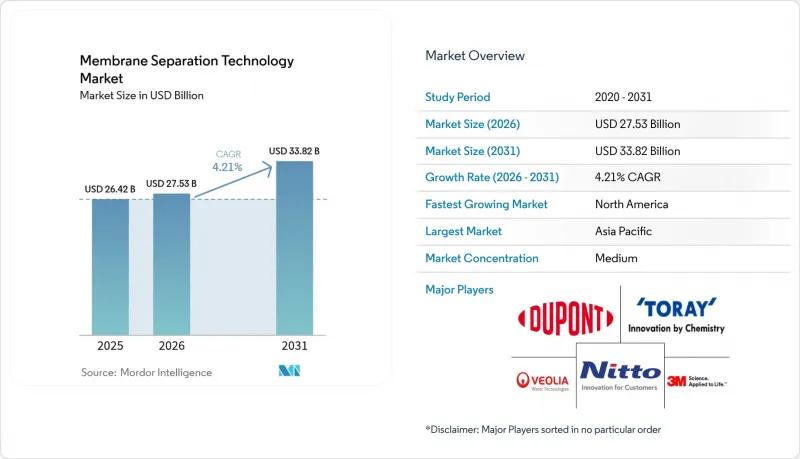
Mordor Intelligence에 의하면, 막 분리 기술 시장 규모는 2025년 264억 2,000만 달러로 평가되었고, 2026년에는 275억 3,000만 달러로 추정되고, 2026-2031년 CAGR 4.21%로 성장을 지속할 전망이며, 2031년에는 338억 2,000만 달러에 이를 것으로 예측됩니다.
본 보고서는 막 기술별(역삼투, 한외여과 등), 막 소재별(고분자, 세라믹,복합/하이브리드), 모듈 구성별(나선형, 중공사 등), 용도별(상하수도 처리, 식품 가공 등), 지역별(아시아태평양, 북미, 유럽, 남미, 중동 및 아프리카)로 분류되어 있습니다.
세계의 막 분리 기술 시장 동향 및 인사이트
물 및 폐수 처리에 대한 수요 증가
세계적으로 20억 명이 물 부족에 직면하고 있어, 지금까지는 이용이 불가능하다고 여겨졌던 오염된 수원을 처리할 수 있는 막식 정화 기술에 대한 전례 없는 수요가 발생하고 있습니다. 지자체 수처리 시설에서는 막 생물 반응기(MBR) 시스템의 도입이 확대되고 있으며, 중국에서만 300곳 이상의 MBR 플랜트가 가동 중이고, 그 연간 성장률은 세계 평균 10.9%에 비해 거의 100%에 달할 전망입니다. 이 기술은 직접 재사용에 적합한 고품질의 처리수를 생산할 수 있는 능력을 갖추고 있어, 기존 처리 방법으로는 엄격한 방류 기준을 충족하기 어려운 물 부족 지역에서의 도입을 촉진하고 있습니다. 첨단 막 구조를 통해 상수도 유틸리티자는 염분 농도가 높거나 유기 오염 수준이 높은 수원에서 음용수를 추출할 수 있게 되었습니다. 분산형 수처리 시스템으로의 전환은 특히 산업 지역에서 현장 처리를 통해 운송 비용과 규제 준수 위험을 줄일 수 있기 때문에 새로운 시장 부문을 창출하고 있습니다.
식품 및 음료·제약 가공 분야의 성장
각 유제품 제조업체들은 현재 열에 의한 손상을 주지 않고 유청 단백질을 농축하기 위해 크로스플로우 미세여과를 채택하고 있으며, 고수익의 영양 분리 단백질 제품으로 제품 라인을 확대되고 있습니다(DAIRYNETWORK.COM). 제약 공장에서는 주사용수 제조 과정에서 증류에서 한외여과로 전환이 진행되고 있습니다. 아사히카세이의 최신 스키드는 엔도톡신을 99.999% 제거하는 동시에 에너지 소비량을 30% 절감합니다. 저알코올 음료의 급증으로 인해 수요는 더욱 높아지고 있습니다. 이는 중공사 나노여과가 진공 증발법보다 섬세한 향기 성분을 더 잘 보존하면서 에탄올을 제거할 수 있기 때문입니다. 또한, 막 처리 공정에서는 상온에서 기능성 식품용 생리활성 성분을 분리할 수 있어, 열에 민감한 영양 보충제를 보호하고 운영 비용을 절감합니다.
높은 설비 투자 및 운영 비용
세라믹 막은 폴리머로 만든 경쟁 제품보다 수명이 길지만, 더 고가의 알루미나나 지르코니아 기판이 필요하기 때문에 저소득 지역에서는 도입 비용이 최대 50% 더 비쌉니다. 전기 요금이 0.12달러/kWh를 초과하는 지역에서는 에너지 관련 비용으로 인해 기존 정화 처리와 비교하여 수명 주기 비용이 20-30% 증가할 가능성이 있습니다. 투자자들은 투자 회수 기간에 대한 명확한 전망을 요구하고 있으며, 이미 예산 제약에 직면해 있는 유틸리티자의 조달 주기가 장기화되고 있습니다. 자금 조달의 장벽으로 인해 자본 위험을 공급업체로 이전하는 혁신적인 리스 모델이나 성과 연동형 계약이 촉진되고 있지만, 신용 접근성이 제한된 시장에서는 그 도입이 여전히 더딘 실정입니다.
부문별 분석
2025년, 해수 담수화 메가 프로젝트와 산업용 재이용 계획에 힘입어 역삼투(RO)는 막 분리 기술 시장에서 47.73%의 점유율을 차지했습니다. 유틸리티자들은 거의 만능에 가까운 화학적 장벽과 자본 비용을 완화해 주는 성숙한 공급 기반을 이유로 RO를 선택하고 있습니다. 정향삼투(Forward-osmosis)와 막 생물반응기(MBR)를 결합한 기술군은 현재 4.92%의 연평균 성장률(CAGR)로 가장 빠르게 확대되고 있으며, 이는 사업자들이 높은 TDS(총 용존 고형물)를 가진 원수에 대해 더 낮은 에너지 소비를 원하고 있음을 보여줍니다. 한외여과(Ultrafiltration)와 나노여과(Nanofiltration)는 특정 용질 범위를 처리하고 하류의 RO 어레이를 보호하는 견고한 전처리 공정으로서 기능함으로써 계속해서 시장 점유율을 확대되고 있습니다.
미세 여과, 나노 여과 및 고급 산화 처리를 하나의 콤팩트한 스키드에 통합한 하이브리드 처리 시스템이 유럽 전역에서 시범 운영 단계에 접어들었습니다. 이 모듈식 아키텍처를 통해 시운전 기간이 25% 단축되었으며, 맞춤형 토목 공사 없이도 목표 방류 수질을 달성할 수 있습니다. 따라서 막 분리 기술 업계에서는 각 통합 업체들이 단순히 폴리머 배합뿐만 아니라, 스마트한 공정 제어 및 상호 운용 가능한 엘리먼트 설계 분야에서 경쟁을 펼치고 있습니다.
2025년, 폴리머 막이 막 분리 기술 시장의 64.52%를 차지했습니다. 이는 확장성이 뛰어난 압출 라인과 충분히 연구된 화학 조성 덕분입니다. 폴리에테르설폰과 폴리비닐리덴플루오라이드(PVDF)는 기계적 내구성과 내염소성이 중시되는 음용수 용도에서 주류를 이루고 있습니다. 그러나 PFAS의 단계적 폐지가 임박함에 따라 공급업체들은 배합 조정 및 불소를 포함하지 않는 대체재 시험을 진행하고 있습니다.
복합 하이브리드 막은 폴리머 골격 내에 산화 그래핀, 제올라이트 또는 금속 유기 구조체를 삽입함으로써 투과성을 저해하지 않으면서 선택성을 높이기 때문에 2031년까지 연평균 성장률(CAGR) 5.11%를 기록할 전망입니다. 이미 실증 단계에 접어든 세라믹 지지체 복합막은 고온의 산 유동에서 기존 폴리머를 능가하는 성능을 발휘하며, 석유화학 및 광업 분야에서 입지를 다지고 있습니다. 이러한 소재의 다양화로 인해 특정 화학 원료에 대한 의존도가 낮아지고, 막 분리 기술 시장의 성장을 저해할 수 있는 규제 위험이 완화됩니다.
지역별 분석
아시아태평양은 중국, 인도, 베트남의 두 자릿수 산업 성장에 힘입어 2025년에는 전 세계 매출의 40.83%를 차지했습니다. 중국에서는 작년에 300건 이상의 막 생물반응기(MBR) 프로젝트가 진행되어, 기존의 폭기조를 거치지 않고 첨단 처리 기술로 직접 도약할 준비가 되어 있음을 보여주었습니다(CHINA-WATER.ORG). 이 지역의 전자 산업 클러스터에서는 분기마다 웨이퍼 등급 초순수 생산 능력이 확대되고 있어, 폴리머 제한외 여과 및 역삼투 스키드 공급업체에 안정적인 판매 채널을 제공합니다. 농촌 지역의 식수 공급을 위한 정부 보조금으로 인해 대상 시장 기반은 더욱 확대되고 있습니다.
북미는 음용수 내 PFAS 규제 기준이 강화됨에 따라 긴급 개조 주문이 잇따르고 있어, 2031년까지 연평균 성장률(CAGR) 4.86%라는 가장 빠른 성장이 예상됩니다. 미국의 일부 지자체는 장쇄 PFAS를 99% 제거하는 것이 보장된 나노여과 라인의 설계 및 시공 계약을 발주하고 있어, 저압·고선택성 막에 대한 수요를 높이고 있습니다(EPA.GOV). 다음으로 주목할 대상은 캐나다의 광업 관계자들입니다. 셀레늄 및 질산염의 방류 기준이 개정됨에 따라, 다단계 화학 처리를 대신해 막 농축 장치가 도입되고 있습니다.
유럽은 성숙해 가면서도 혁신적인 시장이며, 엄격한 산업 배출 상한선이 지속적인 설비 갱신을 뒷받침하고 있습니다. 독일과 네덜란드에서는 처리가 어려운 침출수나 정유시설 폐기물을 대상으로 세라믹 나노여과 기술이 개량되고 있으며, 이러한 이용 사례가 점차 인근 시장으로 확산되고 있습니다. 한편, 중동에서는 대규모 해수 담수화가 가속화되고 있으며, 일반적으로 에너지 회수 장치와 첨단 박막 복합막을 결합하고 있습니다. 아프리카의 유틸리티자들은 뒤처져 있지만, 배관 인프라 부족을 우회하는 컨테이너형 처리 장치에 대해 우대 금융을 지원받고 있어 장기적인 성장의 토대를 마련하고 있습니다.
기타 혜택 :
- 엑셀 형식 시장 예측(ME) 시트
- 3개월간의 애널리스트 지원
자주 묻는 질문
목차
제1장 서론
제2장 조사 방법
제3장 주요 요약
제4장 시장 구도
제5장 시장 규모 및 성장 예측
제6장 경쟁 구도
제7장 시장 기회 및 향후 전망
AJY 26.08.26According to Mordor Intelligence, the membrane separation technology market size market is expected to grow from USD 26.42 billion in 2025 to USD 27.53 billion in 2026 and is forecast to reach USD 33.82 billion by 2031 at 4.21% CAGR over 2026-2031.
This report is Segmented by Membrane Technology (Reverse Osmosis, Ultrafiltration, and More), Membrane Material (Polymeric, Ceramic, and Composite/Hybrid), Module Configuration (Spiral Wound, Hollow Fiber, and More), Application (Water and Waste-Water Treatment, Food Processing, and More), and Geography (Asia-Pacific, North America, Europe, South America, and Middle-East and Africa).
Global Membrane Separation Technology Market Trends and Insights
Rising Demand for Water and Waste-Water Treatment
Water scarcity affects 2 billion people globally, creating unprecedented demand for membrane-based purification technologies that can process contaminated water sources previously deemed unusable. Municipal water treatment facilities are increasingly adopting membrane bioreactor systems, with China alone implementing over 300 MBR plants achieving nearly 100% annual growth compared to the global rate of 10.9%. The technology's ability to produce high-quality effluent suitable for direct reuse is driving adoption in water-stressed regions, where traditional treatment methods prove inadequate for meeting stringent discharge standards. Advanced membrane configurations are enabling utilities to extract potable water from sources with high salinity and organic contamination levels. The shift toward decentralized water treatment systems is creating new market segments, particularly in industrial zones where on-site treatment reduces transportation costs and regulatory compliance risks.
Growth In Food, Beverage and Pharma Processing
Dairy groups now rely on cross-flow microfiltration to concentrate whey proteins without heat damage, extending product lines into high-margin nutritional isolates DAIRYNETWORK.COM. Pharmaceutical plants are shifting from distillation to ultrafiltration for water-for-injection; Asahi Kasei's latest skid removes 99.999% endotoxins while trimming energy draw by 30%. The surge in low-alcohol beverages further strengthens demand because hollow fiber nanofiltration strips ethanol while preserving delicate aroma compounds better than vacuum evaporation. Membrane steps also isolate bioactive ingredients for functional foods at ambient temperatures, protecting heat-sensitive nutraceuticals and lowering operating costs.
High Capital and Operating Costs
Ceramic membranes outlast polymeric rivals but require pricier alumina or zirconia substrates, elevating installed costs by up to 50% in low-income regions. Where power rates exceed USD 0.12 /kWh, energy line items can raise life-cycle ownership by 20-30% over conventional clarification. Investors demand clear visibility on payback, lengthening procurement cycles for public utilities that already face budget constraints. Financing hurdles spur innovative leasing models and outcome-based contracts that shift capital risk to suppliers, yet adoption remains slow in markets with limited credit access.
Other drivers and restraints analyzed in the detailed report include:
- Stricter Industrial Effluent Regulations
- Adoption of Forward-Osmosis and Electrically Responsive Membranes
- Membrane Fouling and Maintenance Complexity
For complete list of drivers and restraints, kindly check the Table Of Contents.
Segment Analysis
Reverse osmosis contributed 47.73% to the membrane separation technology market in 2025 on the back of seawater desalination megaprojects and industrial reuse schemes. Utilities pick RO for its near-universal chemistry barrier and mature supply base that cushions capital costs. Forward-osmosis together with membrane bioreactors is now the fastest-expanding cluster at a 4.92% CAGR, showing that operators want lower energy profiles for high-TDS feeds. Ultrafiltration and nanofiltration continue to carve space by handling specific solute ranges and acting as robust pretreatment steps that safeguard downstream RO arrays.
Hybrid trains that weld microfiltration, nanofiltration, and advanced oxidation in one compact skid are entering pilot stages across Europe. This modular architecture shortens commissioning by 25% and achieves target effluent quality without bespoke civil works. The membrane separation technology industry therefore sees integrators compete on smart process controls and interoperable element designs rather than on polymer recipes alone.
Polymeric membranes accounted for 64.52% of the membrane separation technology market size in 2025 owing to scalable extrusion lines and well-studied chemistries. Polyethersulfone and polyvinylidene fluoride dominate potable-water deployments where mechanical resilience and chlorine tolerance are prized. However, looming PFAS phase-outs are nudging suppliers to tweak formulations and test fluorine-free alternatives.
Composite-hybrid membranes will clock a 5.11% CAGR through 2031 by embedding graphene oxide, zeolites, or metal-organic frameworks inside polymer backbones that raise selectivity without hurting permeability. Pilot ceramic-supported composites already outperform legacy polymers in hot acid streams, granting them footholds in petrochemical and mining sectors. The resultant material diversification lowers reliance on any single chemical feedstock and mitigates regulatory risks that could otherwise slow the membrane separation technology market.
Complete Report Scope:
- By Membrane Technology
- Reverse Osmosis
- Ultrafiltration
- Nanofiltration
- Microfiltration
- Other Technologies (Forward Osmosis, Membrane Bioreactor (MBR), etc.)
- By Membrane Material
- Polymeric
- Ceramic
- Composite / Hybrid (Graphene, MOF, Zeolite)
- By Module Configuration
- Spiral Wound
- Hollow Fiber
- Plate and Frame
- Tubular
- By Application
- Water and Waste-water Treatment
- Food Processing
- Chemical and Pharmaceutical
- Other Applications (Gas Separation, Electronics etc.)
- By Geography
- Asia-Pacific
- China
- Japan
- India
- South Korea
- ASEAN Countries
- Rest of Asia-Pacific
- North America
- United States
- Canada
- Mexico
- Europe
- Germany
- United Kingdom
- France
- Italy
- Spain
- Russia
- NORDIC Countries
- Rest of Europe
- South America
- Brazil
- Argentina
- Rest of South America
- Middle-East and Africa
- Saudi Arabia
- South Africa
- Rest of Middle-East and Africa
- Asia-Pacific
Geography Analysis
Asia-Pacific generated 40.83% of global sales in 2025, underpinned by double-digit industrial growth across China, India, and Vietnam. China rolled out more than 300 membrane bioreactor projects last year, showcasing readiness to leapfrog directly to advanced treatment technologies without legacy aeration lagoons CHINA-WATER.ORG. Regional electronics clusters add wafer-grade ultrapure water capacity every quarter, giving polymeric ultrafiltration and reverse-osmosis skid suppliers a dependable sales funnel. Government subsidies for rural potabilization further widen the addressable base.
North America is on track for the swiftest 4.86% CAGR to 2031 because tightened PFAS caps in drinking water spur urgent retrofit orders. Several US municipalities have issued design-build contracts for nanofiltration lines guaranteed to strip 99% of long-chain PFAS, lifting demand for low-pressure high-selectivity membranes EPA.GOV. Canada's mining friends are next: revised effluent limits for selenium and nitrate mean membrane concentrators are replacing multi-step chemical treatments.
Europe constitutes a mature yet innovative arena where strict industrial emission ceilings nourish continuous upgrades. Germany and the Netherlands refine ceramic nanofiltration for hard-to-treat leachate and refinery waste, adding use cases that slowly migrate to neighboring markets. Meanwhile, the Middle East accelerates large-scale seawater desalination, typically pairing energy-recovery devices with advanced thin-film composite membranes. African utilities trail but receive concessional finance for containerized treatment units that bypass piped infrastructure deficits, planting seeds for long-run growth.
- 3M
- ALFA LAVAL
- Aquaporin A/S
- Asahi Kasei Corporation
- AXEON Water
- DuPont
- Kovalus Separation Solutions
- KUBOTA Corporation
- LG Chem
- Nitto Denko Corporation
- Pall Corporation
- Pentair
- Samco Technologies, Inc.
- Sartorius AG
- Thermo Fisher Scientific
- TORAY ENGINEERING Co.,Ltd.
- Veolia Water Technologies & Solutions
- Xylem
Additional Benefits:
- The market estimate (ME) sheet in Excel format
- 3 months of analyst support
TABLE OF CONTENTS
1 Introduction
- 1.1 Study Assumptions and Market Definition
- 1.2 Scope of the Study
2 Research Methodology
3 Executive Summary
4 Market Landscape
- 4.1 Market Overview
- 4.2 Market Drivers
- 4.2.1 Rising Demand for Water and Waste-Water Treatment
- 4.2.2 Growth In Food, Beverage and Pharma Processing
- 4.2.3 Stricter Industrial Effluent Regulations
- 4.2.4 Adoption of Forward-Osmosis and Electrically Responsive Membranes
- 4.2.5 Low-Alcohol Beverage Processing Demand
- 4.3 Market Restraints
- 4.3.1 High Capital and Operating Costs
- 4.3.2 Membrane Fouling and Maintenance Complexity
- 4.3.3 Impending PFAS Restrictions on Membrane Components
- 4.4 Value Chain Analysis
- 4.5 Porter's Five Forces
- 4.5.1 Threat of New Entrants
- 4.5.2 Bargaining Power of Buyers
- 4.5.3 Bargaining Power of Suppliers
- 4.5.4 Threat of Substitutes
- 4.5.5 Degree of Competition
5 Market Size and Growth Forecasts (Value)
- 5.1 By Membrane Technology
- 5.1.1 Reverse Osmosis
- 5.1.2 Ultrafiltration
- 5.1.3 Nanofiltration
- 5.1.4 Microfiltration
- 5.1.5 Other Technologies (Forward Osmosis, Membrane Bioreactor (MBR), etc.)
- 5.2 By Membrane Material
- 5.2.1 Polymeric
- 5.2.2 Ceramic
- 5.2.3 Composite / Hybrid (Graphene, MOF, Zeolite)
- 5.3 By Module Configuration
- 5.3.1 Spiral Wound
- 5.3.2 Hollow Fiber
- 5.3.3 Plate and Frame
- 5.3.4 Tubular
- 5.4 By Application
- 5.4.1 Water and Waste-water Treatment
- 5.4.2 Food Processing
- 5.4.3 Chemical and Pharmaceutical
- 5.4.4 Other Applications (Gas Separation, Electronics etc.)
- 5.5 By Geography
- 5.5.1 Asia-Pacific
- 5.5.1.1 China
- 5.5.1.2 Japan
- 5.5.1.3 India
- 5.5.1.4 South Korea
- 5.5.1.5 ASEAN Countries
- 5.5.1.6 Rest of Asia-Pacific
- 5.5.2 North America
- 5.5.2.1 United States
- 5.5.2.2 Canada
- 5.5.2.3 Mexico
- 5.5.3 Europe
- 5.5.3.1 Germany
- 5.5.3.2 United Kingdom
- 5.5.3.3 France
- 5.5.3.4 Italy
- 5.5.3.5 Spain
- 5.5.3.6 Russia
- 5.5.3.7 NORDIC Countries
- 5.5.3.8 Rest of Europe
- 5.5.4 South America
- 5.5.4.1 Brazil
- 5.5.4.2 Argentina
- 5.5.4.3 Rest of South America
- 5.5.5 Middle-East and Africa
- 5.5.5.1 Saudi Arabia
- 5.5.5.2 South Africa
- 5.5.5.3 Rest of Middle-East and Africa
- 5.5.1 Asia-Pacific
6 Competitive Landscape
- 6.1 Market Concentration
- 6.2 Strategic Moves
- 6.3 Market Share(%)/Ranking Analysis
- 6.4 Company Profiles (includes Global level Overview, Market level overview, Core Segments, Financials, Strategic Information, Market Rank/Share, Products and Services, Recent Developments)
- 6.4.1 3M
- 6.4.2 ALFA LAVAL
- 6.4.3 Aquaporin A/S
- 6.4.4 Asahi Kasei Corporation
- 6.4.5 AXEON Water
- 6.4.6 DuPont
- 6.4.7 Kovalus Separation Solutions
- 6.4.8 KUBOTA Corporation
- 6.4.9 LG Chem
- 6.4.10 Nitto Denko Corporation
- 6.4.11 Pall Corporation
- 6.4.12 Pentair
- 6.4.13 Samco Technologies, Inc.
- 6.4.14 Sartorius AG
- 6.4.15 Thermo Fisher Scientific
- 6.4.16 TORAY ENGINEERING Co.,Ltd.
- 6.4.17 Veolia Water Technologies & Solutions
- 6.4.18 Xylem
7 Market Opportunities and Future Outlook
- 7.1 White-space and Unmet-Need Assessment