

|
시장보고서
상품코드
2114719
역삼투막 시장 : 점유율 분석, 업계 동향과 통계, 성장 예측(2026-2031년)Reverse Osmosis Membrane - Market Share Analysis, Industry Trends & Statistics, Growth Forecasts (2026 - 2031) |
||||||
 Mordor Intelligence
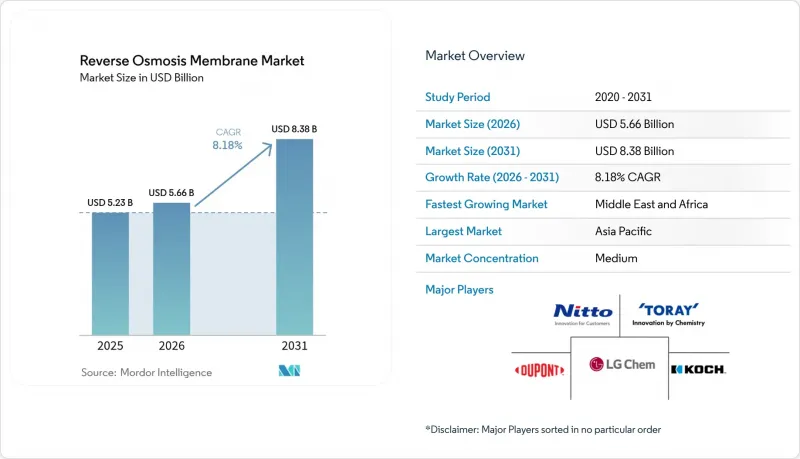
Mordor Intelligence에 의하면, 역삼투막 시장 규모는 2025년 52억 3,000만 달러에서 2026년에는 56억 6,000만 달러로 확대되어 2026년부터 2031년까지 CAGR 8.18%로 성장을 지속하여, 2031년까지 83억 8,000만 달러에 이를 것으로 예측됩니다.
본 보고서는 막의 유형(박막 복합막, 셀룰로오스계), 구조(나선형, 중공사 등), 최종 이용 산업(주거, 상업·공공시설, 지자체 및 해수 담수화 시설, 산업용 공정수, 발전 등), 그리고 지역(아시아태평양, 북미, 유럽 등)별로 분류되어 있습니다. 시장 전망은 금액(달러) 기준으로 제시되어 있습니다.
전 세계 역삼투막 시장 동향 및 인사이트
순수 및 음용수에 대한 수요 증가
기후 변화로 인해 전 세계 인구의 40%가 물 부족 문제에 직면하고 있으며, 기수나 오염된 수원을 대규모로 처리할 수 있는 막 정화 기술의 매력이 높아지고 있습니다. 인도, 베트남, 나이지리아의 지방 자치 단체 상수도 유틸리티자들은 고플럭스 TFC 시트 덕분에 2020년 이후 운영 비용이 25% 감소함에 따라, 현재 5개년 자본 계획에 역삼투막 업그레이드를 예산에 포함시키고 있습니다. 도시의 성장은 이러한 압박을 더욱 가중시키고 있으며, 메가시티에서는 처리 시설의 설치 면적을 확대하지 않고도 새로운 음용수원을 확보해야 합니다. 플라즈마 강화 표면 개질을 통해 바이오파울링 발생을 더욱 억제할 수 있어 CIP(정지 세척) 주기 간격을 늘릴 수 있습니다. 따라서 모듈 가격 하락은 2030년까지 지속가능발전목표(SDG) 6을 달성하려는 공공 부문의 목표와 부합합니다.
해수 담수화 능력 확대
사우디아라비아의 NEOM 프로젝트만 해도 현재 전 세계 연간 생산량의 15%에 해당하는 막이 필요하며, 고유량·저압 시트의 사전 주문이 가속화되고 있습니다. 모로코의 아가디르 확장 계획과 요르단의 홍해 프로젝트 역시 마찬가지로 공급 부족을 초래하고 있으며, 이에 따라 한국과 중국의 아시아 제조업체들은 2026년까지 생산 라인 확장을 계획하고 있습니다. 메가 플랜트의 규모의 경제 효과로 인해 균등화 수처리 비용은 현재 1입방미터당 0.50달러 미만으로 떨어졌으며, 신규 설비에서 RO가 표준 기술로서의 입지가 더욱 공고해지고 있습니다. 이러한 동향은 역삼투막 시장에 진입한 기업들에게 장기적인 수요 전망의 확실성을 높여주고 있습니다.
막의 높은 구입 및 교체 비용
막 엘리먼트는 총 운영비의 35-45%를 차지하는 경우가 많으며, 폴리아미드 원자재 가격 변동에 따라 8인치 스파이럴 1개당 단가가 300달러에 달하기도 하여, 비용에 민감한 시장에서의 도입을 저해하고 있습니다. 동남아시아의 소규모 지자체 운영 사업자 중에는 제조업체의 가이드라인을 초과하여 엘리먼트의 수명을 연장하고, 단기적인 설비 투자를 줄이는 대신 에너지 소비량을 늘리는 사례도 볼 수 있습니다. 현재 금융 기관은 프로젝트 모델에서 5년 치의 교체용 예비 자금 적립을 요구하고 있으며, 이로 인해 초기 자금 수요가 증가하고 투자 회수 기간이 장기화되고 있습니다. 부품의 재사용 및 재활용은 여전히 제한적이지만, 스페인과 싱가포르의 시범 프로그램에서는 폴리프로필렌 하우징의 재활용에 유망한 성과가 나타나고 있습니다. 중고 시장과 재활용 흐름이 성숙해지기 전까지는 예산에 제약이 있는 구매자에게 교체 비용이 도입 확대를 억제하는 요인이 될 것입니다.
부문 분석
2025년, 박막 복합 시트는 99.5%의 염분 제거율과 폭넓은 화학적 안정성을 강점으로 역삼투막 시장에서 81.90%의 점유율을 차지했습니다. 자동 코팅 라인에 대한 적극적인 투자로 현재 하루 10,000 m²를 넘는 안정적인 롤-투-롤 처리 능력을 실현하여, 비용 절감과 품질 향상을 동시에 달성하고 있습니다. 셀룰로오스계 대체재는 제거 효율보다 생분해성이나 내염소성이 중시되는 음료 및 유제품 정제 분야에서 여전히 일정한 입지를 유지하고 있습니다. 그러나 무용매 계면 중합 기술을 통해 50 nm 미만의 초박형 배리어층이 형성됨에 따라 성능 격차는 해마다 확대되고 있으며, 이로 인해 펌프의 에너지 소비량을 10-15% 절감하고 있습니다.
2026년부터 2031년까지 TFC 수요는 연평균 성장률(CAGR) 8.49%로 증가할 것으로 전망됩니다. 이는 해수 담수화 메가 플랜트가 3 kWh/m³ 미만의 에너지 목표를 달성하기 위해 고플럭스·저압형 제품을 지정하고 있기 때문입니다. 규제가 수명이 길고 폐기물이 적은 솔루션을 우선시하는 경향이 있기 때문에 아세트산 셀룰로오스 역삼투막 시장 규모는 2031년까지 1억 4,500만 달러 미만으로 축소될 것으로 예측됩니다. 지속가능성에 대한 관심이 높아짐에 따라 바이오 유래 막에 대한 관심이 다시 높아질 가능성은 있지만, TFC 엘리먼트의 재활용 기술이 더 빠르게 발전하고 있어 그 우위는 점차 약화되고 있습니다. 각 공급업체들은 현재 성능을 저하시키지 않으면서도 향후 환경 규제에 대응할 수 있도록, 퍼플루오로알킬 및 폴리플루오로알킬이 포함되지 않은 합성 경로를 시험하고 있습니다.
지역별 분석
2025년, 아시아태평양은 중국의 ‘폐수 무방류’ 추진과 인도의 ‘스마트 시티’ 구축을 배경으로 역삼투막 시장 매출의 45.60%를 차지했습니다. 2024년 기준, 중국의 섬유, 전자, 석유화학 시설은 전 세계 막 생산량의 30% 이상을 소비했습니다. 장쑤성과 절강성의 국내 제조업체들은 생산 규모를 급속히 확대하고 있으며, 이로 인해 리드 타임이 단축되고 수입 시트에 비해 입고 비용이 낮아지고 있습니다. 인도의 ‘국가 물 미션(National Water Mission)’은 2030년까지 20%의 재이용을 의무화하고 있으며, 이에 따라 각 주(州)의 유틸리티체는 푸네, 수라트, 첸나이에서 진행 중인 새로운 물 재이용 프로젝트의 핵심으로 역삼투(RO) 기술 도입을 추진하고 있습니다.
중동 및 아프리카는 2031년까지 연평균 성장률(CAGR) 8.78%를 기록하며 이 지역에서 가장 빠른 성장세를 보일 전망입니다. 이는 사우디아라비아의 ‘비전 2030’에 기반한 200억 달러 규모의 해수 담수화 투자와 UAE, 카타르,오만에서 진행 중인 다수의 민관 협력 사업이 원동력이 되고 있습니다. 케냐나 가나 등 아프리카 국가들에서는 전력망이 미비한 농촌 지역을 대상으로 태양광 발전식 RO 설비의 시범 운영을 진행하고 있으며, 이는 걸프 국가들의 메가 프로젝트와는 다른 분산형 전개를 시사하고 있습니다.
북미 및 유럽은 성숙한 시장이지만, 설비 갱신 수요와 규제 준수가 견조한 매출을 뒷받침하고 있어 여전히 수익성이 높은 시장입니다. 유럽연합 집행위원회의 ‘산업 배출 지침’에 따라 화학 제조업체는 다층 배리어 시스템 도입이 의무화되어 있으며, 배출 기준을 충족하기 위해 중공사 프리필터에 이어 TFC 스파이럴을 결합하는 방식이 자주 채택되고 있습니다.
기타 혜택:
- 엑셀 형식 시장 예측(ME) 시트
- 3개월간의 애널리스트 지원
자주 묻는 질문
목차
제1장 서론
제2장 조사 방법
제3장 주요 요약
제4장 시장 구도
제5장 시장 규모와 성장 예측
제6장 경쟁 구도
제7장 시장 기회와 향후 전망
JHS 26.08.26According to Mordor Intelligence, the reverse osmosis membrane market size is expected to grow from USD 5.23 billion in 2025 to USD 5.66 billion in 2026 and is forecast to reach USD 8.38 billion by 2031 at 8.18% CAGR over 2026-2031.
This report is Segmented by Membrane Type (Thin-Film Composite, Cellulose-Based), Configuration (Spiral-Wound, Hollow-Fiber, and More), End-Use Industry (Residential, Commercial and Institutional, Municipal and Desalination Utilities, Industrial Process Water, Power Generation, and More), and Geography (Asia-Pacific, North America, Europe, and More). The Market Forecasts are Provided in Terms of Value (USD).
Global Reverse Osmosis Membrane Market Trends and Insights
Increasing Demand for Pure and Potable Water
Climate change intensifies water stress for 40% of the global population, amplifying the appeal of membrane purification that can process brackish or contaminated supplies at scale. Municipal utilities in India, Vietnam, and Nigeria now budget reverse osmosis upgrades into five-year capital plans because operating costs have fallen 25% since 2020 thanks to higher-flux TFC sheets. Urban growth compounds this pressure as megacities must secure new potable sources without increasing treatment footprints. Plasma-enhanced surface modification further cuts biofouling episodes, allowing longer run times between clean-in-place cycles. Declining module prices therefore align with public-sector objectives to achieve Sustainable Development Goal 6 targets by 2030.
Expansion of Seawater Desalination Capacity
Saudi Arabia's NEOM utility alone will demand membranes equal to 15% of current annual global production, accelerating pre-order activity for high-flux, low-pressure sheets. Morocco's Agadir expansion and Jordan's Red Sea Project similarly tighten supply, prompting Asian producers in South Korea and China to plan line expansions by 2026. Scaling efficiencies at mega-plants now cut levelized water costs below USD 0.50 per cubic meter, reinforcing RO as the default technology for new capacity. These trends reinforce long-term demand visibility for reverse osmosis membrane market participants.
High Acquisition and Replacement Cost of Membranes
Membrane elements often represent 35-45% of total operating expenditure, and price volatility in polyamide feedstocks can push unit costs to USD 300 per 8-inch spiral, deterring adoption in cost-sensitive markets. Smaller municipal operators in Southeast Asia sometimes extend element lifetimes beyond manufacturer guidelines, trading higher energy usage for lower near-term capital outlay. Financing institutions now request five-year replacement reserve accounts in project models, raising up-front cash requirements and elongating payback. Component reuse and recycling remain limited, though pilot programs in Spain and Singapore show promise for reclaiming polypropylene housings. Until secondary markets or recycling streams mature, replacement expense will curb installation growth among budget-constrained buyers.
Other drivers and restraints analyzed in the detailed report include:
- Stricter Industrial-Effluent Discharge Norms
- Growth in Residential POU/POE Filtration Units
- Persistent Fouling and Scaling Issues
For complete list of drivers and restraints, kindly check the Table Of Contents.
Segment Analysis
Thin-film composite sheets captured an 81.90% reverse osmosis membrane market share in 2025, benefitting from 99.5% salt rejection and broad chemical stability. Robust investment in automated coating lines now yields consistent roll-to-roll throughput above 10,000 m2 per day, lowering costs while improving quality. Cellulose-based alternatives retain footholds in beverage and dairy clarification where biodegradability and chlorine tolerance matter more than rejection efficiency. Nonetheless, the performance gap widens each year as solvent-free interfacial polymerization creates ultra-thin barrier layers under 50 nm, reducing pump energy by 10-15%.
Across 2026-2031, TFC demand will rise at an 8.49% CAGR as desalination mega-plants specify higher-flux, low-pressure variants to hit sub-3 kWh/m3 energy targets. The reverse osmosis membrane market size for cellulose acetate products is set to shrink to less than USD 145 million by 2031 as regulation favors longer-life, lower-waste solutions. Sustainability narratives could revive interest in bio-derived membranes, yet recycling schemes for TFC elements are advancing faster, dulling that advantage. Suppliers now trial per- and polyfluoroalkyl-free synthesis routes to anticipate future environmental scrutiny without sacrificing performance.
Complete Report Scope:
- By Membrane Type
- Thin-Film Composite (TFC)
- Cellulose-Based (CA and CTA)
- By Configuration
- Spiral-Wound
- Hollow-Fiber
- Plate and Frame
- Tubular
- By End-use Industry
- Residential
- Commercial and Institutional
- Municipal and Desalination Utilities
- Industrial Process Water
- Power Generation
- Food and Beverage
- Healthcare and Pharmaceuticals
- By Geography
- Asia-Pacific
- China
- India
- Japan
- South Korea
- Rest of Asia-Pacific
- North America
- United States
- Canada
- Mexico
- Europe
- Germany
- United Kingdom
- France
- Italy
- Rest of Europe
- South America
- Brazil
- Argentina
- Rest of South America
- Middle-East and Africa
- Saudi Arabia
- South Africa
- Rest of Middle-East and Africa
- Asia-Pacific
Geography Analysis
Asia-Pacific accounted for 45.60% of reverse osmosis membrane market revenue in 2025 on the back of China's zero-liquid-discharge drive and India's Smart Cities rollouts. Chinese textile, electronics, and petrochemical facilities together consumed over 30% of global membrane output as of 2024. Domestic producers scale quickly in Jiangsu and Zhejiang provinces, shortening lead times and lowering landed cost versus imported sheets. India's National Water Mission mandates 20% recycling by 2030, prompting state utilities to integrate RO as the backbone of new water reuse projects across Pune, Surat, and Chennai.
Middle East and Africa will register the fastest regional growth at 8.78% CAGR through 2031, driven by USD 20 billion in desalination spending under Saudi Arabia's Vision 2030 and multiple public-private partnerships in the UAE, Qatar, and Oman. African states such as Kenya and Ghana pilot solar-powered RO units for rural communities where grid ties are unavailable, signaling a decentralized trajectory distinct from Gulf mega-projects.
North America and Europe remain mature yet lucrative as replacement business and regulatory compliance underpin steady sales. The European Commission's Industrial Emissions Directive now forces chemical producers to retrofit multi-barrier systems, often selecting hollow-fiber pre-filters followed by TFC spirals to hit discharge thresholds.
- applied membranes, inc.
- Aquatech
- Axeon Water Technologies
- BNKO Environmental Techology (Shanghai) Co., Ltd
- DuPont
- GEA Group Aktiengesellschaft
- Koch Membrane Systems, Inc
- Lenntech B.V.
- LG Chem
- Membranium
- NITTO DENKO CORPORATION
- Pentair
- Permionics Membranes Private Limited
- Pure Aqua, Inc.
- Samco Technologies, Inc
- Scinor Water America, LLC
- Synder Filtration, Inc
- TORAY INDUSTRIES, INC.
- Toyobo.Co.Ltd
- Veolia Water Technologies
Additional Benefits:
- The market estimate (ME) sheet in Excel format
- 3 months of analyst support
TABLE OF CONTENTS
1 Introduction
- 1.1 Study Assumptions and Market Definition
- 1.2 Scope of the Study
2 Research Methodology
3 Executive Summary
4 Market Landscape
- 4.1 Market Overview
- 4.2 Market Drivers
- 4.2.1 Increasing demand for pure and potable water
- 4.2.2 Expansion of seawater-desalination capacity
- 4.2.3 Stricter industrial-effluent discharge norms
- 4.2.4 Growth in residential POU/POE filtration units
- 4.2.5 Low-pressure RO membranes enabling off-grid usage
- 4.3 Market Restraints
- 4.3.1 High acquisition and replacement cost of membranes
- 4.3.2 Persistent fouling and scaling issues
- 4.3.3 Supply-chain risk for specialty polyamide feedstocks
- 4.4 Value Chain Analysis
- 4.5 Porter's Five Forces Analysis
- 4.5.1 Bargaining Power of Suppliers
- 4.5.2 Bargaining Power of Buyers
- 4.5.3 Threat of New Entrants
- 4.5.4 Threat of Substitutes
- 4.5.5 Degree of Competition
5 Market Size and Growth Forecasts (Value)
- 5.1 By Membrane Type
- 5.1.1 Thin-Film Composite (TFC)
- 5.1.2 Cellulose-Based (CA and CTA)
- 5.2 By Configuration
- 5.2.1 Spiral-Wound
- 5.2.2 Hollow-Fiber
- 5.2.3 Plate and Frame
- 5.2.4 Tubular
- 5.3 By End-use Industry
- 5.3.1 Residential
- 5.3.2 Commercial and Institutional
- 5.3.3 Municipal and Desalination Utilities
- 5.3.4 Industrial Process Water
- 5.3.5 Power Generation
- 5.3.6 Food and Beverage
- 5.3.7 Healthcare and Pharmaceuticals
- 5.4 By Geography
- 5.4.1 Asia-Pacific
- 5.4.1.1 China
- 5.4.1.2 India
- 5.4.1.3 Japan
- 5.4.1.4 South Korea
- 5.4.1.5 Rest of Asia-Pacific
- 5.4.2 North America
- 5.4.2.1 United States
- 5.4.2.2 Canada
- 5.4.2.3 Mexico
- 5.4.3 Europe
- 5.4.3.1 Germany
- 5.4.3.2 United Kingdom
- 5.4.3.3 France
- 5.4.3.4 Italy
- 5.4.3.5 Rest of Europe
- 5.4.4 South America
- 5.4.4.1 Brazil
- 5.4.4.2 Argentina
- 5.4.4.3 Rest of South America
- 5.4.5 Middle-East and Africa
- 5.4.5.1 Saudi Arabia
- 5.4.5.2 South Africa
- 5.4.5.3 Rest of Middle-East and Africa
- 5.4.1 Asia-Pacific
6 Competitive Landscape
- 6.1 Market Concentration
- 6.2 Strategic Moves
- 6.3 Market Share (%)/Ranking Analysis
- 6.4 Company Profiles (includes Global level Overview, Market level overview, Core Segments, Financials as available, Strategic Information, Market Rank/Share for key companies, Products and Services, and Recent Developments)
- 6.4.1 applied membranes, inc.
- 6.4.2 Aquatech
- 6.4.3 Axeon Water Technologies
- 6.4.4 BNKO Environmental Techology (Shanghai) Co., Ltd
- 6.4.5 DuPont
- 6.4.6 GEA Group Aktiengesellschaft
- 6.4.7 Koch Membrane Systems, Inc
- 6.4.8 Lenntech B.V.
- 6.4.9 LG Chem
- 6.4.10 Membranium
- 6.4.11 NITTO DENKO CORPORATION
- 6.4.12 Pentair
- 6.4.13 Permionics Membranes Private Limited
- 6.4.14 Pure Aqua, Inc.
- 6.4.15 Samco Technologies, Inc
- 6.4.16 Scinor Water America, LLC
- 6.4.17 Synder Filtration, Inc
- 6.4.18 TORAY INDUSTRIES, INC.
- 6.4.19 Toyobo.Co.Ltd
- 6.4.20 Veolia Water Technologies
7 Market Opportunities and Future Outlook
- 7.1 White-space and Unmet-Need Assessment


