

|
시장보고서
상품코드
2114721
목재 접착제 : 시장 점유율 분석, 업계 동향 및 통계, 성장 예측(2026-2031년)Wood Adhesives - Market Share Analysis, Industry Trends & Statistics, Growth Forecasts (2026 - 2031) |
||||||
 Mordor Intelligence
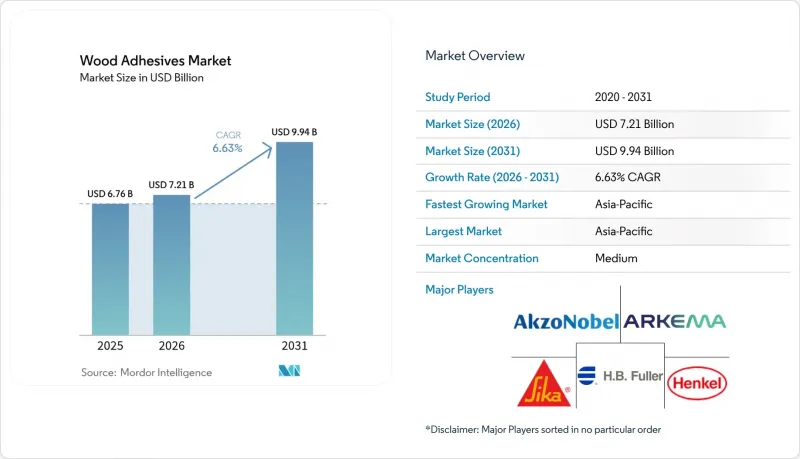
Mordor Intelligence에 의하면, 목재 접착제 시장 규모는 2025년에 67억 6,000만 달러로 평가되었습니다. 2026년 72억 1,000만 달러에서 2031년까지 99억 4,000만 달러에 이를 것으로 예상되며, 예측 기간(2026-2031년) CAGR은 6.63%를 나타낼 전망입니다.
본 보고서는 수지 유형(천연, 합성), 기술(수성, 용제계, 기타 기술), 용도(가구, 합판, 캐비닛 등), 최종 사용자(주택 건설, 상업용 건설 등), 지역(아시아태평양, 북미, 유럽, 남미, 중동 및 아프리카)별로 분류되어 있습니다. 시장 전망은 금액(달러) 기준으로 제시되어 있습니다.
세계의 목재 접착제 시장 동향 및 인사이트
아시아태평양의 엔지니어드 우드 생산 급증
2024년, 중국의 합판 생산 능력은 8% 증가하여 2억 2,100만 m3에 도달했지만, 생산자 수는 19% 감소했습니다. 이는 규모의 경제가 작용하고 있으며, 고성능 접착제에 대한 수요를 높이고 있음을 보여줍니다. 베트남의 미국으로의 목재 제품 수출이 사상 최고 수준을 기록하고, 중국의 합판 수출량이 1,327만 m³에 달한 것은 이 지역의 생산이 전 세계 밸류체인을 뒷받침하고 있음을 보여줍니다. 지역의 성장이 내수 소비를 견인하는 한편, 수출 지향형 제조로 인해 내수성 및 내열성이 뛰어난 접착제에 대한 수요가 확대되고 있습니다. 또한 중국, 태국, 인도에서 바이오폴리머에 대한 투자가 잇따르고 있어 지속 가능한 수지 개발을 더욱 촉진하고 있습니다.
저VOC·수성 시스템으로의 급속한 전환
수성 화학제품은 이미 38.12%의 점유율을 차지하고 있으며, 규제 강화에 따라 7.14%의 성장세를 보이고 있습니다. 캘리포니아주의 CARB 2단계에서는 활엽수 합판의 포름알데히드 함유량을 0.05 ppm으로 제한하고 있으며, EU에서는 2026년 8월까지 배출량을 0.062 mg/m3로 제한할 예정입니다. H.B. 풀러를 비롯한 각 제조업체는 현재 연구개발 예산의 60%를 재활용 가능한 포장재를 위한 ‘Swiftmelt 1850’과 같은 지속 가능한 배합 기술에 할당하고 있습니다. 수성 시스템은 취급 비용을 절감하고 현장의 안전성을 향상시키는 한편, 폴리머 가교제의 발전으로 인해 기존에 존재하던 성능 격차도 점차 해소되고 있습니다.
변동이 심한 석유계 원료 가격
2024년, 페놀·포름알데히드 수지의 비용이 급격히 변동하여, H.B. 풀러사의 보고에 따르면 원자재비가 수익원가의 75%를 차지하는 상황에서 이익률이 압박을 받았습니다. 중소 제조업체들은 가격 변동에 대한 헤지 방안에 고심하고 있으며, 계약 내용 개정이나 현물 시장에 대한 의존도가 높아지고 있습니다. 가격 급등은 공급망 전체에 고르지 않게 파급되고 있어, 가구 및 패널 제조업체가 접착제 비용 상승을 흡수하지 못할 경우 수요가 대체될 위험이 있습니다.
부문별 분석
2025년 매출에서 합성 수지가 차지하는 비중은 56.25%를 나타냈으며, 환경적 규제가 강화되는 상황에서도 비용 대비 성능 면에서의 우위가 두드러졌습니다. 초저배출(ULEF) 및 무첨가 포름알데히드(NAF) 화학 기술이 상업적 성숙 단계에 도달함에 따라, 이 부문은 2031년까지 7.05%의 성장률을 보일 것으로 예측됩니다. 각 제조업체는 접착 강도를 최대 19.6% 향상시키는 개질 옥수수 속대 분말 등의 바이오 필러를 배합함으로써 배출량을 27.8% 줄이고 있습니다. 이처럼 합성 수지 플랫폼은 성능 기준을 확립하는 동시에 환경 부하를 꾸준히 줄여가며, 목재 접착제 시장에서 우위를 유지하고 있습니다.
친환경 기술의 도입이 가장 빠르게 진행되고 있는 곳은 실내 공기질에 관한 규제가 엄격한 지역이며, 그곳에서는 구조적 무결성을 훼손하지 않으면서 페놀계 접착제의 대체재 개발을 위한 연구 개발이 진행되고 있습니다. 0.93 MPa의 전단 강도에 달하는 도토리 유래 성분을 강화한 페놀 수지는 하이브리드 화학 기술을 통해 바이오 성분과 검증된 경화 거동을 양립시킬 수 있음을 보여줍니다. 또한, IoT 대응 반응 장치가 반응 속도와 공급 정밀도를 최적화함으로써, 제조업체는 일관성과 처리 능력 면에서 향상을 실현하고 있습니다.
수성 공정은 2025년에 37.90%의 점유율을 차지했으며, 전 세계적인 배출량 상한 규제가 강화됨에 따라 연평균 6.95%의 속도로 확대될 전망입니다. 이러한 배합은 고온에서의 플래시 오프가 필요하지 않아 용매 회수 비용을 절감함으로써 공장의 에너지 부하를 줄여줍니다. 세레네즈(Selenese)와 헨켈(Henkel)은 현재 회수한 CO₂를 폴리머 골격으로 변환하고 있으며, 이를 통해 ‘크래들-투-게이트(cradle-to-gate)’ 환경 부하를 25% 줄이고 있습니다. 도포 장치도 진화하고 있어, 레이저 유도 노즐을 사용하여 얇고 균일한 막을 도포함으로써, 기존에 높았던 물의 중량을 상쇄하고 있습니다.
반응성 핫멜트, UV 경화형 분산액, 디지털 최적화 하이브리드 에멀젼이 기술 라인업을 풍부하게 하고 있으며, 각각 특정 처리 능력이나 환경 요건에 적합합니다. 지속적인 인라인 모니터링을 통해 점도를 실시간으로 조정할 수 있게 되어, 고속 접착의 재현성을 확보함과 동시에 목재 접착제 시장의 운영 효율을 향상시키고 있습니다.
지역별 분석
아시아태평양은 2025년 지출의 41.70%를 차지했으며, 수출 지향적인 패널 공장과 대규모 국내 인프라 계획에 힘입어 2031년까지 연평균 성장률(CAGR) 7.12%를 나타낼 것으로 예측됩니다. 중국은 2024년에 대만, 베트남, 중동의 바이어를 대상으로 1,327만 m3, 총액 52억 7,100만 달러 상당의 합판을 출하했습니다. 북미의 대규모 목조 고층 빌딩 건설 붐과 연방 정부의 인프라 정비 계획이 특수 구조용 접착제 수요 증가를 뒷받침하고 있습니다. 유럽에서는 화학 물질 및 재활용에 관한 규제가 강화됨에 따라 저VOC 시스템으로의 급속한 전환이 진행되고 있으며, 이는 종종 다른 지역으로의 기술 파급을 촉진합니다.
브라질과 칠레는 계속해서 임업용 제재소에 대한 투자를 이어가고 있으며, 시카(Sika) 등 신규 진출기업들에게 현지에서 혼합 설비를 설치하도록 장려하고 있습니다. 중동의 엔지니어드 우드 생산 라인 생산 능력 확대는 원료, 기술, 최종 용도의 동향이 상호 영향을 미치며 전 세계 목재 접착제 시장을 발전시키고 있다는 점에서 세계 공급망의 상호 의존 관계를 여실히 보여주고 있습니다.
기타 혜택 :
- 엑셀 형식 시장 예측(ME) 시트
- 3개월간의 애널리스트 지원
자주 묻는 질문
목차
제1장 서론
제2장 조사 방법
제3장 주요 요약
제4장 시장 구도
제5장 시장 규모 및 성장 예측
제6장 경쟁 구도
제7장 시장 기회 및 향후 전망
KTH 26.08.28According to Mordor Intelligence, the wood adhesives market size was valued at USD 6.76 billion in 2025 and estimated to grow from USD 7.21 billion in 2026 to reach USD 9.94 billion by 2031, at a CAGR of 6.63% during the forecast period (2026-2031).
This report is Segmented by Resin Type (Natural, Synthetic), Technology (Water-Based, Solvent-Based, Other Technologies), Application (Furniture, Plywood, Cabinets, and More), End-User (Residential Construction, Commercial Construction, and More), and Geography (Asia-Pacific, North America, Europe, South America, Middle East and Africa). The Market Forecasts are Provided in Terms of Value (USD).
Global Wood Adhesives Market Trends and Insights
Surging Engineered-Wood Production in Asia Pacific
China's plywood capacity rose 8% to 221 million m3 in 2024 even as producer numbers fell 19%, revealing scale efficiencies that heighten demand for sophisticated adhesives. Vietnam's record wood-product exports to the United States and China's 13.27 million m3 plywood export volume show r egional output feeding worldwide value chains. Local growth drives domestic consumption, while export-oriented manufacturing multiplies volumes for water-resistant, heat-stable bonding agents. Concurrent bio-polymer investments across China, Thailand, and India further stimulate sustainable resin development.
Rapid Shift to Low-VOC, Water-Based Systems
Water-based chemistries already command 38.12% share and are growing 7.14% as regulations tighten. California's CARB Phase II limits formaldehyde to 0.05 ppm for hardwood plywood, while the EU will cap emissions at 0.062 mg/m3 by August 2026. Producers, notably H.B. Fuller, now allocate 60% of R&D budgets to sustainable formulations such as Swiftmelt 1850 for recyclable packaging. Water-based systems lower handling costs and improve shop-floor safety while advances in polymer cross-linkers are closing historical performance gaps.
Volatile Petro-Feedstock Prices
Phenol-formaldehyde resin costs fluctuated sharply in 2024, squeezing margins when feedstock represents 75% of cost of sales as reported by H.B. Fuller. Smaller manufacturers struggle to hedge volatility, prompting contract revisions and greater reliance on spot markets. Price spikes pass through the supply chain unevenly, risking demand substitution when rising adhesive costs cannot be absorbed by furniture or panel producers.
Other drivers and restraints analyzed in the detailed report include:
- Renovation Boom in Europe Furniture Sector
- Mass-Timber (CLT & Glulam) Adoption in High-Rise Projects
- Limited Supply of Bio-Based Polyols/Starches
For complete list of drivers and restraints, kindly check the Table Of Contents.
Segment Analysis
Synthetic resins accounted for 56.25% of 2025 revenue, underscoring cost-to-performance leadership even as environmental scrutiny intensifies. This segment is expected to clock 7.05% growth through 2031 as ultra-low-emitting (ULEF) and no-added-formaldehyde (NAF) chemistries reach commercial maturity. Makers are blending bio-fillers-such as modified corn-cob powder that hikes bond strength up to 19.6%-to curb emissions by 27.8%. Synthetic platforms thus set performance benchmarks while steadily lowering environmental footprints, sustaining their primacy in the wood adhesives market.
Eco-adoption is fastest in jurisdictions with tight indoor-air codes, channeling R&D toward phenol substitutes without compromising structural integrity. Acorn-enhanced phenolic resins attaining 0.93 MPa shear strength show that hybrid chemistry can marry bio-content with proven curing behavior. As IoT-enabled reactors optimize reaction kinetics and feed precision, manufacturers unlock further gains in consistency and throughput.
Water-based processes held 37.90% share in 2025 and will scale at 6.95% as global emission caps converge. These formulations reduce plant energy loads because they forgo high-temperature flash-off and lower solvent recovery expenses. Celanese and Henkel now convert captured CO2 into polymer backbones, shrinking cradle-to-gate footprints by 25%. Application equipment has evolved, using laser-guided nozzles that meter thin, uniform films to offset historically higher water weight.
Reactive hot-melts, UV-curable dispersions, and digital-tailored hybrid emulsions round out the technology mix, each suited to niche throughput and environmental profiles. Continuous inline monitoring enables real-time viscosity adjustments, ensuring bond repeatability at speed and elevating the wood adhesives market's operational efficiency.
Complete Report Scope:
- By Resin Type
- Natural
- Synthetic
- By Technology
- Water-based
- Solvent-based
- Other Technologies
- By Application
- Furniture
- Plywood
- Cabinets
- Doors and Windows
- Other Applications
- By End-User
- Residential Construction
- Commercial Construction
- Industrial and Specialized Woodwork
- By Geography
- Asia-Pacific
- China
- India
- Japan
- South Korea
- Rest of Asia-Pacific
- North America
- United States
- Canada
- Mexico
- Europe
- Germany
- United Kingdom
- France
- Italy
- Rest of Europe
- South America
- Brazil
- Argentina
- Rest of South America
- Middle East and Africa
- Saudi Arabia
- South Africa
- Middle East and Africa
- Asia-Pacific
Geography Analysis
Asia Pacific accounted for 41.70% of 2025 spending and is tracking 7.12% CAGR to 2031 due to export-oriented panel plants and vast domestic infrastructure programs. China shipped 13.27 million m3 of plywood worth USD 5.271 billion in 2024, servicing buyers in Taiwan, Vietnam, and the Middle East. North America's wave of mass-timber towers and federal infrastructure packages fuels specialty structural adhesive uptake. Europe's stricter chemical and recycling mandates push rapid conversion to low-VOC systems, often catalyzing technology spillovers into other regions.
Brazil and Chile continue to invest in forestry mills, inviting entrants such as Sika to add local blending units. Middle East capacity additions in engineered-wood lines underscore global supply interdependencies, where feedstock, technology, and end-use trends cross-pollinate to advance the wood adhesives market worldwide.
- 3M
- Aica Kogyo Co. Ltd
- Akzo Nobel N.V.
- Arkema Group (Bostik)
- Ashland
- BASF SE
- Dow
- Dynea AS
- Franklin International
- H.B. Fuller Company
- Henkel AG & Co. KGaA
- Huntsman Corporation
- Jowat SE
- Jubilant Agri and Consumer Products Limited (JACPL)
- KLEIBERIT
- Pidilite Industries Ltd
- Sika AG
- Weyerhaeuser
Additional Benefits:
- The market estimate (ME) sheet in Excel format
- 3 months of analyst support
TABLE OF CONTENTS
1 Introduction
- 1.1 Study Assumptions and Market Definition
- 1.2 Scope of the Study
2 Research Methodology
3 Executive Summary
4 Market Landscape
- 4.1 Market Overview
- 4.2 Market Drivers
- 4.2.1 Surging engineered-wood production in Asia Pacific
- 4.2.2 Rapid shift to low-VOC, water-based systems
- 4.2.3 Renovation boom in Europe furniture sector
- 4.2.4 Mass-timber (CLT and glulam) adoption in high-rise projects
- 4.2.5 Integration of Industry 4.0 technologies enhancing precision in adhesive application and curing.
- 4.3 Market Restraints
- 4.3.1 Volatile petro-feedstock (phenol, formaldehyde) prices
- 4.3.2 Stricter indoor-air VOC caps in California and EU
- 4.3.3 Limited supply of bio-based polyols/starches
- 4.4 Value Chain Analysis
- 4.5 Porter's Five Forces
- 4.5.1 Bargaining Power of Suppliers
- 4.5.2 Bargaining Power of Buyers
- 4.5.3 Threat of New Entrants
- 4.5.4 Threat of Substitutes
- 4.5.5 Degree of Competition
5 Market Size and Growth Forecasts (Value and Volume)
- 5.1 By Resin Type
- 5.1.1 Natural
- 5.1.2 Synthetic
- 5.2 By Technology
- 5.2.1 Water-based
- 5.2.2 Solvent-based
- 5.2.3 Other Technologies
- 5.3 By Application
- 5.3.1 Furniture
- 5.3.2 Plywood
- 5.3.3 Cabinets
- 5.3.4 Doors and Windows
- 5.3.5 Other Applications
- 5.4 By End-User
- 5.4.1 Residential Construction
- 5.4.2 Commercial Construction
- 5.4.3 Industrial and Specialized Woodwork
- 5.5 By Geography
- 5.5.1 Asia-Pacific
- 5.5.1.1 China
- 5.5.1.2 India
- 5.5.1.3 Japan
- 5.5.1.4 South Korea
- 5.5.1.5 Rest of Asia-Pacific
- 5.5.2 North America
- 5.5.2.1 United States
- 5.5.2.2 Canada
- 5.5.2.3 Mexico
- 5.5.3 Europe
- 5.5.3.1 Germany
- 5.5.3.2 United Kingdom
- 5.5.3.3 France
- 5.5.3.4 Italy
- 5.5.3.5 Rest of Europe
- 5.5.4 South America
- 5.5.4.1 Brazil
- 5.5.4.2 Argentina
- 5.5.4.3 Rest of South America
- 5.5.5 Middle East and Africa
- 5.5.5.1 Saudi Arabia
- 5.5.5.2 South Africa
- 5.5.5.3 Middle East and Africa
- 5.5.1 Asia-Pacific
6 Competitive Landscape
- 6.1 Market Concentration
- 6.2 Strategic Moves
- 6.3 Market Share Analysis
- 6.4 Company Profiles (includes Global level Overview, Market level overview, Core Segments, Financials as available, Strategic Information, Market Rank/Share for key companies, Products and Services, and Recent Developments)
- 6.4.1 3M
- 6.4.2 Aica Kogyo Co. Ltd
- 6.4.3 Akzo Nobel N.V.
- 6.4.4 Arkema Group (Bostik)
- 6.4.5 Ashland
- 6.4.6 BASF SE
- 6.4.7 Dow
- 6.4.8 Dynea AS
- 6.4.9 Franklin International
- 6.4.10 H.B. Fuller Company
- 6.4.11 Henkel AG & Co. KGaA
- 6.4.12 Huntsman Corporation
- 6.4.13 Jowat SE
- 6.4.14 Jubilant Agri and Consumer Products Limited (JACPL)
- 6.4.15 KLEIBERIT
- 6.4.16 Pidilite Industries Ltd
- 6.4.17 Sika AG
- 6.4.18 Weyerhaeuser
7 Market Opportunities and Future Outlook
- 7.1 White-space and Unmet-Need Assessment
- 7.2 Development of Eco-friendly Adhesives


