

|
시장보고서
상품코드
2114726
죽상동맥경화증 치료제 시장 : 점유율 분석, 업계 동향과 통계, 성장 예측(2026-2031년)Atherosclerosis Drugs - Market Share Analysis, Industry Trends & Statistics, Growth Forecasts (2026 - 2031) |
||||||
 Mordor Intelligence
Mordor Intelligence에 의하면, 죽상동맥경화증 치료제 시장 규모는 2025년에 343억 9,000만 달러로 평가되었고 2026년 354억 3,000만 달러에서 2031년까지 410억 8,000만 달러에 이를 것으로 예측되며, 예측 기간(2026-2031년) CAGR은 3.01%를 나타낼 전망입니다.
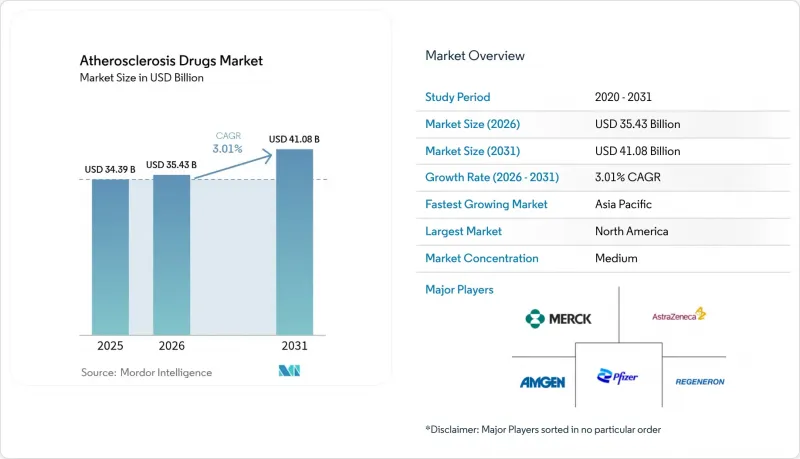
본 보고서는 약물 분류별(스타틴, PCSK9 억제제, 벤페드산 및 ACL 억제제, 항혈소판제, 오메가-3 지방산 유도체, RNA 기반 치료제, 기타),유통 채널(소매, 병원, 온라인 약국), 지역(북미, 유럽, 아시아태평양, 중동 및 아프리카, 남미)별로 분류되어 있습니다. 시장 예측은 금액(미 달러) 기준으로 제시되어 있습니다.
전 세계 죽상동맥경화증 치료제 시장 동향 및 인사이트
심혈관 질환(CVD) 유병률 증가 및 고령화
세계 평균 수명의 연장, 도시 지역의 앉아 있는 생활 방식, 그리고 대사성 동반 질환이 복합적으로 작용하여 ASCVD(동맥경화성 관상동맥질환)는 여전히 전 세계 주요 사망 원인으로 남아 있습니다. 현재 심혈관 질환으로 인한 사망의 80%가 저·중소득 지역에서 발생하고 있으며, 합리적인 가격에 대규모로 전개 가능한 지질 개선 요법에 대한 구조적으로 높은 미충족 수요가 발생하고 있습니다. 당뇨병과 비만이라는 이중 부담이 플라크 형성을 촉진하고 발병 연령을 젊은 층으로 낮추고 있기 때문에 평생에 걸친 약물 노출 기간이 길어지고 있습니다. 유병률 추세는 다제 병용에 따른 제약이 있는 고령층에서 치료 강도가 높아지고 있음에도 불구하고, 죽상동맥경화증 치료제 시장 전체의 지속적인 판매량 증가를 뒷받침하고 있습니다. 장시간 작용형 주사제나 6개월마다 siRNA를 투여하는 요법은 만성 질환 관리에서 흔히 볼 수 있는 복약 순응도 문제를 해결하는 한편, 고정 용량의 경구 병용제는 자원이 제한된 지역의 1차 진료 현장에서 치료를 간소화합니다.
지침에 따른 스타틴 및 PCSK9 억제제 채택
2025년 ACC/AHA 가이드라인에서는 급성 관상동맥 증후군에 대해 고용량 스타틴을 필수로 규정하고 있으며, 치료에도 불구하고 LDL-C가 70 mg/dL 이상인 경우에는 스타틴 이외의 추가 요법을 권장하고 있습니다. 이와 병행하여, 유럽 및 국제 지질 전문가 패널의 견해도 이중 요법의 조기 시작을 권장하고 있으며, PCSK9 억제제의 적용 범위를 기존의 스타틴 불내성 환자층을 넘어 확대되고 있습니다. 실제 임상 등록 연구에서는 달성된 LDL-C 수치에 비례하여 심혈관 사건이 감소하는 것으로 나타났으며, 보험사가 목표 달성에 대해 보상을 제공함으로써 가이드라인이 처방 행위에 미치는 영향이 더욱 강화되고 있습니다. 목표치의 통일을 통해 지역 간 공통 기준이 확립되고 있지만, 그 시행은 여전히 각 지역의 보험 환급 규정, 의사의 지식 및 이해, 그리고 의료기술평가(HTA) 결과에 좌우됩니다.
스타틴 특허 만료 후 제네릭 의약품에 의한 시장 잠식
아토르바스타틴 및 로스바스타틴의 독점권 상실로 인해, 제네릭 의약품 출시 후 18개월 이내에 80% 이상의 급격한 가격 하락이 나타났습니다. 2025년 5월 리바록사반과 2025년 중반 사쿠비트릴/발사르탄의 특허 만료가 예정되어 있어, 이는 수축 효과를 더욱 확대시켜 브랜드 의약품의 매출을 압박할 뿐만 아니라, 보험사의 처방약 목록을 최저 비용의 선택지로 전환시킬 것입니다. 제약사들은 시장 점유율 감소를 늦추기 위해 고정 용량 복합제나 새로운 제형과 같은 라이프사이클 관리 전략을 추구하고 있지만, 이러한 전환 전략이라 해도 다중 공급원 제품으로의 급격한 수요 이동을 상쇄하기는 거의 불가능합니다. 제네릭 의약품은 치료에 대한 접근성을 확보하는 한편, 스타틴 계열 약제가 처방 총량의 대부분을 차지하는 지역에서는 죽상동맥경화증 치료제 시장의 총 가치를 축소시키는 결과로 이어지고 있습니다.
부문 분석
스타틴은 확립된 유효성, 저렴한 비용, 그리고 광범위한 진료 지침에서의 권고 덕분에 2025년 죽상동맥경화증 치료제 시장 점유율의 58.74%를 차지했습니다. 스타틴이 가져오는 판매량 증가로 인해, 표면적인 가격 압박에도 불구하고 죽상동맥경화증 치료제 시장 규모는 여전히 큰 임베디드니다. PCSK9 억제제는 극히 고위험 환자에 대한 적응증 확대와 결과 기반 계약에 대한 지불 측의 수용을 배경으로, 2031년까지 연평균 성장률(CAGR) 5.18%를 나타낼 것으로 예측됩니다. 또한, 스타틴 요법에 더해 LDL-C를 50-60% 추가로 낮추어 결과적으로 심혈관 사건의 감소로 이어진다는 사실을 뒷받침하는 성숙한 실세계 데이터도 매출 확대에 기여하고 있습니다. 벤페드산 등의 경구용 ATP-시트르산 리파제(ACL) 억제제는 그동안 적절한 대체 요법이 없었던 스타틴 불내성 환자층을 끌어들이며, 1차 진료 현장에서의 처방량을 끌어올리고 있습니다.
RNA 기반 치료법을 둘러싼 파이프라인의 기세는 더욱 강해지고 있습니다. 인크리시란은 반년마다 투여하는 새로운 모델을 확립해 가고 있는 반면, 지단백질(a)을 표적으로 하는 ASO(안티센스 올리고뉴클레오티드)는 2026년에 세계 최초로 승인 신청을 할 준비가 되어 있습니다. 이러한 신규 진입으로 인해 고부가가치 생물학적 제제의 범위가 확대되고, 작용기전의 위험이 분산됨에 따라 스타틴 제네릭 의약품으로 인한 매출 감소의 일부를 상쇄하게 될 것입니다. 한편, 저용량 콜히친이나 IL-1B에 대한 단일클론 항체 등의 항염증 요법은 위험을 줄이기 위한 보조적인 치료 경로를 제공하며, 대상 환자층을 확대하는 다각적인 치료 요법의 가능성을 시사하고 있습니다. 종합해 보면, 기존 카테고리의 판매량 증가세가 정체되는 상황에서도 혁신을 통해 죽상동맥경화증 치료제 시장의 프리미엄 부문이 지속되는 기간이 연장되고 있습니다.
지역별 분석
북미는 가이드라인 채택, 고부가가치 바이오의약품에 대한 보험사의 급여, 그리고 혁신 주기를 단축하는 탄탄한 임상시험 생태계의 뒷받침을 받아 2025년 매출의 38.12%를 계속 차지했습니다. 이 지역은 FDA의 ‘획기적 치료제 지정(Breakthrough Designation)’의 혜택을 받고 있으며, CRISPR 기반의 VERVE-102와 같은 퍼스트-인-클래스(first-in-class) 치료법이 다른 관할 구역보다 먼저 시장에 출시되고 있습니다. 그러나 메디케어의 가격 협상 및 주 차원의 수입 촉진 정책으로 인해 가격 탄력성이 높아지고 있으며, 전략적 계약 및 성과 연동형 계약이 촉진되고 있습니다. 디지털 기술 도입률도 높아, 원격 지질 모니터링, 처방전 앱, AI를 활용한 복약 순응도 지도 등이 병용 요법의 가치를 높여, 죽상동맥경화증 치료제 시장에서 프리미엄 부문의 유지에 기여하고 있습니다.
아시아태평양은 2031년까지 연평균 성장률(CAGR)이 6.07%로 가장 빠르게 성장하고 있는 지역입니다. 보편적 의료 보장(UHC)의 확대, 도시화, 식생활의 서유럽화가 ASCVD 유병률을 높이는 한편, 현지에서 PCSK9 바이오시밀러가 출시됨에 따라 합리적인 가격으로 약물을 구할 수 있게 되었습니다. 인도는 PLI(제약 연계 인센티브) 제도를 활용하여 저비용 공급을 확대하고, 제네릭 의약품의 수출과 국내 수요를 늘리고 있습니다. 일본에서는 규제 개혁을 통해 다국적 기업의 임상시험 투자가 촉진되고 있지만, 급속한 고령화가 보험 예산에 부담을 주고 있습니다. 전반적으로 지역별 차이에 대응하기 위해서는 세심한 가격 책정과 현지화 전략이 필요하지만, 한편으로는 죽상동맥경화증 치료제 시장에서 가장 큰 판매량 증가가 예상되는 지역이기도 합니다.
유럽에서는 EMA(유럽의약품청)의 통일된 지침과 광범위한 공중보건 선별 검사 프로그램의 지원에 힘입어 꾸준한 성장이 나타나고 있습니다. 의료기술평가기관은 엄격한 비용 대비 효과 기준을 적용하고 있으며, 치료 효과가 동등한 것으로 입증된 경우 고정용량 복합제나 제네릭 의약품의 도입이 촉진되고 있습니다. 동유럽 시장은 인프라 개선에 따라 시장 점유율을 확대하고 있으며, 서유럽 국가들의 예산이 압박을 받는 가운데 성장을 이어받을 주역으로 부상하고 있습니다. 중동 및 아프리카 및 남미는 여전히 발전 단계에 있지만, 장기적으로는 매력적인 시장입니다. 심혈관 질환에 대한 인식이 높아지면서 걸프협력회의(GCC) 회원국과 브라질에서는 민간 보험의 보급이 진행되고 있으나, 공공 부문의 예산이 이를 따라가지 못해 고비용 생물학적 제제의 당면한 도입을 제한하고 있습니다. 그럼에도 불구하고, 정부 수입 기관 및 현지 판매업체와의 파트너십 모델은 죽상동맥경화증 치료제 시장의 향후 확대를 위한 기반을 마련하고 있습니다.
기타 혜택:
- 엑셀 형식 시장 예측(ME) 시트
- 3개월간의 애널리스트 지원
자주 묻는 질문
목차
제1장 서론
제2장 조사 방법
제3장 주요 요약
제4장 시장 구도
제5장 시장 규모와 성장 예측
제6장 경쟁 구도
제7장 시장 기회와 향후 전망
JHS 26.08.26According to Mordor Intelligence, the atherosclerosis drugs market size was valued at USD 34.39 billion in 2025 and estimated to grow from USD 35.43 billion in 2026 to reach USD 41.08 billion by 2031, at a CAGR of 3.01% during the forecast period (2026-2031).
This report is Segmented by Drug Class (Statins, PCSK9 Inhibitors, Bempedoic-Acid & ACL Inhibitors, Antiplatelet Agents, Omega-3 Fatty-Acid Derivatives, RNA-Based Therapies, Others), Distribution Channel (Retail, Hospital, Online Pharmacies), and Geography (North America, Europe, Asia-Pacific, Middle East & Africa, South America). The Market Forecasts are Provided in Terms of Value (USD).
Global Atherosclerosis Drugs Market Trends and Insights
Rising Prevalence of CVD & Aging Population
Global life expectancy gains, urban sedentary lifestyles, and metabolic comorbidities combine to keep ASCVD the top cause of mortality worldwide. Low- and middle-income regions now account for 80% of cardiovascular deaths, creating structurally high unmet need for lipid-modifying therapies that are both affordable and scalable. The dual burden of diabetes and obesity escalates plaque formation and shifts onset to younger adults, extending lifetime drug exposure. Prevalence trends underpin sustained unit growth across the atherosclerosis drugs market, even as therapeutic intensity increases in elderly cohorts with polypharmacy constraints. Long-acting injectables and six-monthly siRNA regimens address adherence gaps common in chronic disease management, while fixed-dose oral combinations simplify treatment for primary-care settings in resource-constrained geographies.
Guideline-Driven Uptake of Statins & PCSK9 Inhibitors
The 2025 ACC/AHA guideline mandates high-intensity statins for acute coronary syndrome and advocates non-statin add-ons once LDL-C remains >=70 mg/dL despite therapy. Parallel European and International Lipid Expert Panel positions promote earlier dual-therapy initiation, broadening the eligible pool for PCSK9 inhibitors beyond historic statin-intolerant niches. Real-world registries demonstrate cardiovascular event reduction proportional to achieved LDL-C levels, reinforcing guideline influence on prescribing as payers reward goal attainment. Harmonized targets build a common language across regions, yet implementation still hinges on local reimbursement rules, physician familiarity, and health-technology-assessment outcomes.
Generic Erosion Post-Patent Expiry of Statins
Loss of exclusivity for atorvastatin and rosuvastatin demonstrated rapid price declines of more than 80% within 18 months of generic launch. Forthcoming expiries rivaroxaban in May 2025 and sacubitril/valsartan mid-2025 extend contractionary effects, squeezing brand revenues and shifting payer formularies toward lowest-cost options. Manufacturers pursue lifecycle-management tactics such as fixed-dose combinations and novel delivery forms in an effort to delay share attrition, yet these pivots rarely offset the steep volume shift to multisource products. While generics preserve therapy accessibility, they also compress overall atherosclerosis drugs market value in regions where statins dominate total prescriptions.
Other drivers and restraints analyzed in the detailed report include:
- Higher Healthcare Spending & Drug Accessibility
- Awareness Campaigns & Lipid-Screening Programs
- Poor Long-Term Adherence Due to Side-Effects
For complete list of drivers and restraints, kindly check the Table Of Contents.
Segment Analysis
Statins anchored 58.74% of the atherosclerosis drugs market share in 2025, owing to well-established efficacy, low cost, and broad guideline endorsement. The volume uplift they provide keeps the atherosclerosis drugs market size substantial despite headline price compression. PCSK9 inhibitors are forecast to deliver a 5.18% CAGR through 2031 on expanded indications for very high-risk patients and on payer acceptance of outcome-based contracting. Sales acceleration is also aided by maturing real-world evidence confirming 50-60% incremental LDL-C reductions on top of statins, translating into fewer cardiac events. Oral ATP-citrate lyase (ACL) inhibitors such as bempedoic acid attract statin-intolerant populations that previously lacked convenient alternatives, nudging prescription volumes higher in primary-care settings.
Pipeline momentum intensifies around RNA-based modalities: inclisiran solidifies a semi-annual dosing archetype, while ASOs targeting lipoprotein(a) line up for first global submissions in 2026. These additions enlarge the high-value biologic cohort and diversify the mechanism risk, offsetting some revenue lost to statin generics. Meanwhile, anti-inflammatory therapies like low-dose colchicine and monoclonal antibodies against IL-1B offer adjunctive pathways for risk reduction, hinting at multi-modal regimens that will expand the addressable pool. Collectively, innovation lengthens the premium tail of the atherosclerosis drugs market even as unit growth in legacy categories flattens.
Complete Report Scope:
- By Drug Class
- Statins
- PCSK9 Inhibitors
- Bempedoic-acid & ACL inhibitors
- Antiplatelet Agents
- Omega-3 Fatty-acid Derivatives
- RNA-based Therapies (ASO & siRNA)
- Others
- By Distribution Channel
- Retail Pharmacies
- Hospital Pharmacies
- Online Pharmacies
- By Geography
- North America
- United States
- Canada
- Mexico
- Europe
- Germany
- United Kingdom
- France
- Italy
- Spain
- Rest of Europe
- Asia-Pacific
- China
- Japan
- India
- Australia
- South Korea
- Rest of Asia-Pacific
- Middle East & Africa
- GCC
- South Africa
- Rest of Middle East & Africa
- South America
- Brazil
- Argentina
- Rest of South America
- North America
Geography Analysis
North America retained 38.12% of 2025 sales, sustained by guideline adoption, payer coverage for premium biologics, and a deep clinical-trial ecosystem that keeps innovation cycles short. The region benefits from FDA breakthrough designations that bring first-in-class treatments like CRISPR-based VERVE-102 to market ahead of other jurisdictions. Nevertheless, Medicare price negotiations and state-level importation initiatives heighten price elasticity, prompting strategic contracting and outcome-based deals. Digital adoption is high: remote lipid monitoring, prescription apps, and AI adherence coaching reinforce the value of combination regimens and help protect premium segments within the atherosclerosis drugs market.
Asia-Pacific is the fastest-growing region, with a 6.07% CAGR to 2031. Universal health coverage expansion, urbanization, and dietary westernization drive ASCVD prevalence, while local biosimilar PCSK9 launches improve affordability. India amplifies generic exports and internal demand, leveraging its PLI scheme to scale low-cost supply. Japan's regulatory reforms incentivize multinational trial investment, though its rapidly aging population strains insurance budgets. Collectively, regional heterogeneity requires nuanced pricing and localization strategies but presents the single largest volume upside for the atherosclerosis drugs market.
Europe registers steady expansion supported by harmonized EMA guidelines and widespread public-health screening programs. Health-technology-assessment bodies impose stringent cost-effectiveness thresholds, fostering uptake of fixed-dose combinations and generics where outcome parity is demonstrated. Eastern European markets gain share as infrastructure improves, offering a growth relay as Western budgets tighten. Middle East & Africa and South America remain nascent but attractive in the long term. Cardiovascular disease awareness is rising, and private insurance penetration is widening in Gulf Cooperation Council states and Brazil, yet public-sector budgets lag, limiting the immediate uptake of high-cost biologics. Nonetheless, partnership models with government import agencies and local distributors lay the groundwork for future expansion of the atherosclerosis drugs market.
- AstraZeneca
- Amgen
- Merck
- Regeneron Pharmaceuticals
- Novartis
- Pfizer
- Sanofi
- GlaxoSmithKline
- Bayer
- Viatris
- Eli Lilly and Company
- Boehringer Ingelheim
- Amarin Corporation
- Esperion Therapeutics
- Ionis Pharmaceuticals
- Alnylam Pharmaceuticals
- CSL Behring
- Daiichi Sankyo
- Silence Therapeutics
- Roche
Additional Benefits:
- The market estimate (ME) sheet in Excel format
- 3 months of analyst support
TABLE OF CONTENTS
1 Introduction
- 1.1 Study Assumptions & Market Definition
- 1.2 Scope of the Study
2 Research Methodology
3 Executive Summary
4 Market Landscape
- 4.1 Market Overview
- 4.2 Market Drivers
- 4.2.1 Rising Prevalence of CVD & Aging Population
- 4.2.2 Guideline-Driven Uptake of Statins & PCSK9 Inhibitors
- 4.2.3 Higher Healthcare Spending & Drug Accessibility
- 4.2.4 Awareness Campaigns & Lipid-Screening Programs
- 4.2.5 RNA-Based Lipid-Lowering Therapies Pipeline Surge
- 4.2.6 Polygenic Risk Scoring Enabling Early Intervention
- 4.3 Market Restraints
- 4.3.1 Generic Erosion Post-Patent Expiry of Statins
- 4.3.2 Poor Long-Term Adherence due to Side-Effects
- 4.3.3 High Cost of Biologics in Low-Income Regions
- 4.3.4 Payer Push-Back on LDL-C Surrogate Endpoints
- 4.4 Regulatory Landscape
- 4.5 Porter's Five Forces Analysis
- 4.5.1 Threat of New Entrants
- 4.5.2 Bargaining Power of Buyers
- 4.5.3 Bargaining Power of Suppliers
- 4.5.4 Threat of Substitutes
- 4.5.5 Intensity of Competitive Rivalry
5 Market Size & Growth Forecasts (Value in USD)
- 5.1 By Drug Class
- 5.1.1 Statins
- 5.1.2 PCSK9 Inhibitors
- 5.1.3 Bempedoic-acid & ACL inhibitors
- 5.1.4 Antiplatelet Agents
- 5.1.5 Omega-3 Fatty-acid Derivatives
- 5.1.6 RNA-based Therapies (ASO & siRNA)
- 5.1.7 Others
- 5.2 By Distribution Channel
- 5.2.1 Retail Pharmacies
- 5.2.2 Hospital Pharmacies
- 5.2.3 Online Pharmacies
- 5.3 By Geography
- 5.3.1 North America
- 5.3.1.1 United States
- 5.3.1.2 Canada
- 5.3.1.3 Mexico
- 5.3.2 Europe
- 5.3.2.1 Germany
- 5.3.2.2 United Kingdom
- 5.3.2.3 France
- 5.3.2.4 Italy
- 5.3.2.5 Spain
- 5.3.2.6 Rest of Europe
- 5.3.3 Asia-Pacific
- 5.3.3.1 China
- 5.3.3.2 Japan
- 5.3.3.3 India
- 5.3.3.4 Australia
- 5.3.3.5 South Korea
- 5.3.3.6 Rest of Asia-Pacific
- 5.3.4 Middle East & Africa
- 5.3.4.1 GCC
- 5.3.4.2 South Africa
- 5.3.4.3 Rest of Middle East & Africa
- 5.3.5 South America
- 5.3.5.1 Brazil
- 5.3.5.2 Argentina
- 5.3.5.3 Rest of South America
- 5.3.1 North America
6 Competitive Landscape
- 6.1 Market Concentration
- 6.2 Market Share Analysis
- 6.3 Company Profiles (includes Global level Overview, Market level overview, Core Segments, Financials as available, Strategic Information, Market Rank/Share for key companies, Products & Services, and Recent Developments)
- 6.3.1 AstraZeneca
- 6.3.2 Amgen Inc.
- 6.3.3 Merck & Co., Inc.
- 6.3.4 Regeneron Pharmaceuticals, Inc.
- 6.3.5 Novartis
- 6.3.6 Pfizer Inc.
- 6.3.7 Sanofi
- 6.3.8 GlaxoSmithKline
- 6.3.9 Bayer AG
- 6.3.10 Viatris
- 6.3.11 Eli Lilly and Company
- 6.3.12 Boehringer Ingelheim
- 6.3.13 Amarin Corporation
- 6.3.14 Esperion Therapeutics
- 6.3.15 Ionis Pharmaceuticals
- 6.3.16 Alnylam Pharmaceuticals
- 6.3.17 CSL Behring
- 6.3.18 Daiichi Sankyo
- 6.3.19 Silence Therapeutics
- 6.3.20 F. Hoffmann-La Roche Ltd
7 Market Opportunities & Future Outlook
- 7.1 White-space & Unmet-Need Assessment


