

|
시장보고서
상품코드
2114732
산업용 염류 : 시장 점유율 분석, 업계 동향 및 통계, 성장 예측(2026-2031년)Industrial Salts - Market Share Analysis, Industry Trends & Statistics, Growth Forecasts (2026 - 2031) |
||||||
 Mordor Intelligence
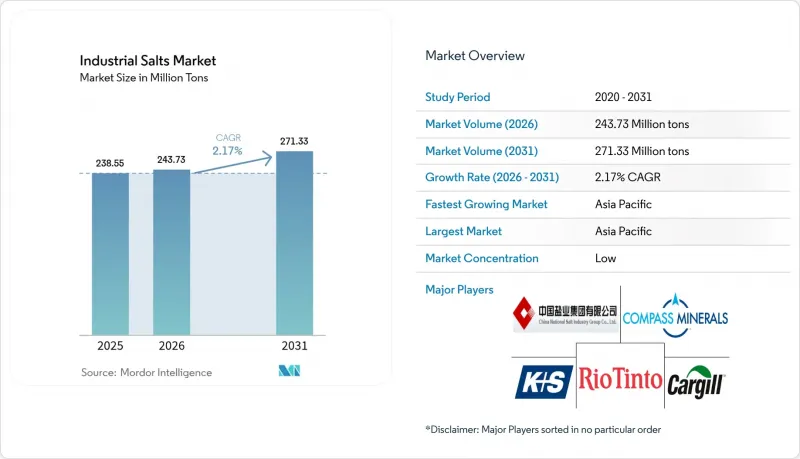
Mordor Intelligence에 의하면, 2026년 산업용 염류 시장 규모는 2억 4,373만 톤으로 추정되고 2025년 2억 3,855만 톤으로부터 확대해, 2031년에는 2억 7,133만 톤에 이를 것으로 예측됩니다.
2026년부터 2031년까지 연평균 성장률(CAGR) 2.17%로 성장할 것으로 전망됩니다.
본 보고서는 원료별(암염 및 천연 염수), 제조 공정별(태양 증발법, 진공 증발법 및 기존 채굴 방식), 용도별(화학 처리, 수처리, 제설, 석유 및 가스,기타 용도), 지역별(아시아태평양, 북미, 유럽, 남미, 중동 및 아프리카)로 분류되어 있습니다. 시장 전망은 수량(톤) 기준으로 제시되어 있습니다.
세계의 산업용 염류 시장 동향 및 인사이트
아시아 및 중동의 염소-알칼리 생산 능력 확대
2024년 중국에서 막식 전해조를 통한 가성소다 생산 능력을 210만 톤 증설함에 따라 소금 수요가 연간 약 180만 톤 증가하고 있으며, 인도 및 걸프 국가들의 유사한 프로젝트 역시 저칼슘·저마그네슘 등급 소금에 대한 장기적인 수요를 뒷받침하고 있습니다. 막 기술은 순도를 더욱 높이고 불순물 허용치를 50ppm 미만으로 낮추며, 고급 세정, 하이드로사이클론 및 이온 교환 정제를 통한 업스트림 공정에 대한 투자를 촉진하고 있습니다. 사우디아라비아에 기반을 둔 생산자들은 저비용 에너지를 활용하여 염소 유도체를 수출하고 있으며, 지역 가격을 안정화하기 위해 수년에 걸친 소금 인수 계약을 체결하고 있습니다.
도시 상수도 처리 분야의 채택 확대
인구 10만 명 이상의 도시에서 이온 교환식 연수화 및 역삼투(RO) 시스템의 업그레이드 시, 막의 오염을 억제하기 위해 입자 직경이 엄격하게 관리된 의약품 등급의 재생용 소금이 필요합니다. 걸프 지역 및 남유럽의 해수 담수화 거점에서는 소금을 제품별로 회수하여 재판매하는 ‘제로 액체 배출(ZLD)’형 결정화 장치의 시범 운영이 진행되고 있습니다. EU의 ‘도시 폐수 처리 지침’ 등의 규제 목표에 따라 상수도 유틸리티자는 염화물 농도를 250 mg/L 미만으로 억제하는 방향으로 나아가고 있으며, 이에 따라 고순도 원료에 대한 수요가 더욱 증가하고 있습니다.
EU·미국의 염수 배출 규제 강화
미국 환경보호청(EPA)의 규칙 82(2024년)에 따라 감시 및 보증금 비용이 우물 1기당 최대 500만 달러까지 증가하는 한편, EU 지침에서는 영향을 받기 쉬운 유역의 염화물 배출량을 250 mg/L로 제한하고 있습니다. 중규모 시설은 결정화 설비 도입을 위해 1,000만-2,000만 달러의 예산을 확보하지 못하면 폐쇄될 수밖에 없으며, 그 결과 기존 폐수 처리 자산을 보유한 종합 대기업으로 공급이 이동하게 될 것입니다.
부문별 분석
2025년, 암염은 산업용 염류 시장의 57.10%를 차지했으며, 이는 성숙한 지하 광산과 확립된 철도 및 바지선을 통한 물류 체계에 의해 뒷받침되고 있습니다. 제설제 및 일반 화학 용도가 기초적인 수요를 유지함에 따라, 이 부문은 2031년까지 연평균 성장률(CAGR) 2.73%를 나타낼 것으로 예측됩니다. 천연 염수는 여전히 규모는 작지만, 제약 및 막 등급 밸류체인에서 고부가가치 분야를 차지하고 있으며, 특히 용액 채굴을 통해 토지에 미치는 영향을 줄일 수 있는 분야에서 그 존재감을 높이고 있습니다.
천연 염수의 성장은 순도 요건의 강화와 심부 시추에 대한 환경적 압력에 달려 있습니다. 압력 억제 침투법과 결합된 용액 우물은 염수의 농축 효율을 높이는 동시에, 선택적 추출을 통해 대수층의 혼합을 억제합니다. 중국 칭하이 분지와 미국 오대호 지역의 생산자들은 리튬 정광을 병행 생산하는 이중 용도형 염수 방식을 시범적으로 도입하고 있으며, 이를 통해 선택의 폭이 넓어지고 톤당 실현 가격이 상승하고 있습니다.
지역별 분석
아시아태평양은 2025년에 전 세계 생산량의 45.50%를 차지했으며, 2031년까지 연평균 성장률(CAGR) 2.82%를 나타낼 것으로 전망됩니다. 중국은 연간 9,500만 톤 이상을 생산하고 있으며, 그중 약 60%가 산업용으로 배정되어 있습니다. 인도의 소비량은 의약품 및 도시 용수의 품질 개선에 힘입어 매년 4-5% 증가하고 있습니다. 인도네시아와 태국에서는 염소-알칼리 사업 및 수산 양식 사업에 공급하기 위해 새로운 솔라 폰드와 염수 우물이 개설되고 있습니다.
북미는 2위를 차지하며, 2025년에는 연간 약 4,000만 톤을 소비했습니다. 겨울철 성수기에는 미국 소비량의 35-40%를 도로 안전 기관이 흡수하는 한편, 중서부에 위치한 화학 산업 클러스터는 오대호 주변 광산에서 고순도 원료를 조달하고 있습니다. 캐나다의 사업자들은 프레리 포타시 지역 인근에서 염수 배출 허가 규제가 강화되는 상황에 직면해 있으며, 멕시코의 태양열 프로젝트는 미국 멕시코만 연안 지역의 화학제품 수입 수요를 흡수하기 위해 확대되고 있습니다.
유럽은 성숙한 시장이지만 규제가 엄격한 것이 특징입니다. 독일은 염소-알칼리 및 의약품 등급 수요에 힘입어 2024년에는 1,200만 톤을 구매하여 1위를 차지했습니다. 영국과 프랑스에서는 대규모 제빙 프로그램이 지속되고 있지만, 환경 규제 하에서 유기 아세테이트 수요가 가장 빠르게 증가하고 있습니다. 중동 및 아프리카는 상대적으로 가장 높은 성장 잠재력을 보이고 있습니다. 사우디아라비아는 사막의 태양열 증발을 활용하여 수출용 염소 유도체를 생산하고 있는 반면, 남아프리카공화국은 다각화된 광업 포트폴리오에 소금을 포함시키고 있습니다.
기타 혜택 :
- 엑셀 형식 시장 예측(ME) 시트
- 3개월간의 애널리스트 지원
자주 묻는 질문
목차
제1장 서론
제2장 조사 방법
제3장 개요
제4장 시장 구도
제5장 시장 규모 및 성장 예측
제6장 경쟁 구도
제7장 시장 기회 및 향후 전망
KTH 26.08.31According to Mordor Intelligence, industrial salts market size in 2026 is estimated at 243.73 Million tons, growing from 2025 value of 238.55 Million tons with 2031 projections showing 271.33 Million tons, growing at 2.17% CAGR over 2026-2031.
This report is Segmented by Source (Rock Salt and Natural Brine), Manufacturing Process (Solar Evaporation, Vacuum Evaporation, and Conventional Mining), Application (Chemical Processing, Water Treatment, De-Icing, Oil and Gas, and Other Applications), and Geography (Asia-Pacific, North America, Europe, South America, and Middle East and Africa). The Market Forecasts are Provided in Terms of Volume (Tons).
Global Industrial Salts Market Trends and Insights
Expanding Chlor-Alkali Capacity in Asia and Middle East
China's 2024 membrane-cell additions of 2.1 million tons caustic soda lift salt demand by almost 1.8 million tons a year, and similar projects in India and the Gulf are reinforcing long-run pull for low-calcium, low-magnesium grades. Membrane technology doubles down on purity, cutting impurity thresholds to below 50 ppm and prompting upstream investments in advanced washing, hydrocyclone, and ion-exchange polishing. Saudi-based producers are leveraging low-cost energy to export chlorine derivatives, locking in multi-year salt offtake contracts that stabilize regional pricing.
Rising Adoption in Municipal Water Treatment
Ion-exchange softening and reverse-osmosis upgrades by cities above 100,000 residents now require pharmaceutical-grade regenerant salt with tight particle-size controls to limit membrane fouling. Desalination hubs in the Gulf and Southern Europe are piloting zero-liquid-discharge crystallizers that capture salt by-products for resale. Regulatory targets such as the EU Urban Waste-Water Treatment Directive move utilities toward chloride caps below 250 mg/L, further amplifying demand for high-purity inputs.
Tighter EU/US Brine-Discharge Regulations
U.S. EPA Rule 82 (2024) lifts monitoring and bonding costs by up to USD 5 million per well, while EU directives cap chloride discharges at 250 mg/L in sensitive basins. Mid-size facilities must budget USD 10-20 million for crystallizers or face closure, shifting supply to integrated majors with existing wastewater assets.
Other drivers and restraints analyzed in the detailed report include:
- Growing De-Icing Demand Amid Harsher Winters
- Ultra-High-Purity Salt for Next-Gen Membranes
- Substitution by CaCl2 and Organic De-Icers
For complete list of drivers and restraints, kindly check the Table Of Contents.
Segment Analysis
Rock salt controlled 57.10% of the industrial salts market in 2025, supported by mature underground mines and established rail and barge logistics. The segment should post a 2.73% CAGR through 2031 as de-icing and general chemical uses sustain baseline demand. Natural brine remains smaller but captures higher-value slots in pharmaceutical and membrane-grade supply chains, especially where solution-mining mitigates land disturbance.
Natural brine's growth hinges on rising purity needs and environmental pressure against deep-shaft mining. Solution wells paired with pressure-retarded osmosis increase brine concentration efficiencies, while selective extraction curbs aquifer mixing. Producers in China's Qinghai basin and the U.S. Great Lakes are piloting dual-purpose brine schemes that co-produce lithium concentrates, introducing optionality and raising realized prices per ton.
Complete Report Scope:
- By Source
- Rock Salt
- Natural Brine
- By Manufacturing Process
- Solar Evaporation
- Vacuum Evaporation
- Conventional Mining
- By Application
- Chemical Processing
- Water Treatment
- De-icing
- Oil and Gas
- Agriculture
- Food Processing
- Other Applications
- By Geography
- Asia-Pacific
- China
- India
- Japan
- South Korea
- ASEAN Countries
- Rest of Asia-Pacific
- North America
- United States
- Canada
- Mexico
- Europe
- Germany
- United Kingdom
- France
- Italy
- Russia
- NORDIC Countries
- Rest of Europe
- South America
- Brazil
- Argentina
- Rest of South America
- Middle East and Africa
- Saudi Arabia
- South Africa
- Rest of Middle East and Africa
- Asia-Pacific
Geography Analysis
Asia-Pacific accounted for 45.50% of global volume in 2025 and is expected to log a 2.82% CAGR to 2031. China produces over 95 million tons annually, allocating nearly 60% to industrial routes. India's consumption rises 4-5% each year on pharmaceuticals and municipal water upgrades. Indonesia and Thailand open new solar ponds and brine wells to feed chlor-alkali and aquaculture operations.
North America ranks second, consuming roughly 40 million tons a year in 2025. Road safety agencies absorb 35-40% of U.S. tonnage during winter peaks, while Midwest chemical clusters draw high-purity feedstock from Great Lakes mines. Canadian operators face stricter brine-discharge permits near the Prairie Potash region, and Mexican solar projects expand to capture U.S. Gulf Coast chemical import demand.
Europe is mature but regulation-intensive. Germany leads with 12 million tons purchased in 2024, driven by chlor-alkali and pharma grade demand. The U.K. and France keep large de-icing programs, yet organic acetates grow fastest under environmental mandates. Middle East and Africa exhibit the highest relative upside; Saudi Arabia leverages desert solar evaporation for export-oriented chlorine derivatives, while South Africa integrates salt into diversified mining portfolios.
- ACIL
- Cargill, Incorporated
- China National Salt Industry Corporation
- Compass Minerals
- Delmon Co., Ltd.
- Dev Salt Pvt Ltd
- Dominion Salt
- Donald Brown Group
- K+S Aktiengesellschaft
- MITSUI & CO., LTD.
- Morton Salt, Inc.
- Rio Tinto
- Salins IAA
- Tata Chemicals
- Wacker Chemie AG
Additional Benefits:
- The market estimate (ME) sheet in Excel format
- 3 months of analyst support
TABLE OF CONTENTS
1 Introduction
- 1.1 Study Assumptions and Market Definition
- 1.2 Scope of the Study
2 Research Methodology
3 Executive Summary
4 Market Landscape
- 4.1 Market Overview
- 4.2 Market Drivers
- 4.2.1 Expanding Chlor-Alkali Capacity in Asia and Middle East
- 4.2.2 Rising Adoption in Municipal Water Treatment
- 4.2.3 Growing De-Icing Demand Amid Harsher Winters
- 4.2.4 Ultra-High-Purity Salt for Next-Gen Membranes
- 4.2.5 Drone-Enabled Yield Gains in Solar-Pond Operations
- 4.3 Market Restraints
- 4.3.1 Tighter EU/US Brine-Discharge Regulations
- 4.3.2 Substitution by Cacl2 and Organic De-Icers
- 4.3.3 Opposition to Inland Solution Mining Near Aquifers
- 4.4 Value Chain Analysis
- 4.5 Porter's Five Forces
- 4.5.1 Bargaining Power of Suppliers
- 4.5.2 Bargaining Power of Buyers
- 4.5.3 Threat of New Entrants
- 4.5.4 Threat of Substitutes
- 4.5.5 Degree of Competition
5 Market Size and Growth Forecasts (Volume)
- 5.1 By Source
- 5.1.1 Rock Salt
- 5.1.2 Natural Brine
- 5.2 By Manufacturing Process
- 5.2.1 Solar Evaporation
- 5.2.2 Vacuum Evaporation
- 5.2.3 Conventional Mining
- 5.3 By Application
- 5.3.1 Chemical Processing
- 5.3.2 Water Treatment
- 5.3.3 De-icing
- 5.3.4 Oil and Gas
- 5.3.5 Agriculture
- 5.3.6 Food Processing
- 5.3.7 Other Applications
- 5.4 By Geography
- 5.4.1 Asia-Pacific
- 5.4.1.1 China
- 5.4.1.2 India
- 5.4.1.3 Japan
- 5.4.1.4 South Korea
- 5.4.1.5 ASEAN Countries
- 5.4.1.6 Rest of Asia-Pacific
- 5.4.2 North America
- 5.4.2.1 United States
- 5.4.2.2 Canada
- 5.4.2.3 Mexico
- 5.4.3 Europe
- 5.4.3.1 Germany
- 5.4.3.2 United Kingdom
- 5.4.3.3 France
- 5.4.3.4 Italy
- 5.4.3.5 Russia
- 5.4.3.6 NORDIC Countries
- 5.4.3.7 Rest of Europe
- 5.4.4 South America
- 5.4.4.1 Brazil
- 5.4.4.2 Argentina
- 5.4.4.3 Rest of South America
- 5.4.5 Middle East and Africa
- 5.4.5.1 Saudi Arabia
- 5.4.5.2 South Africa
- 5.4.5.3 Rest of Middle East and Africa
- 5.4.1 Asia-Pacific
6 Competitive Landscape
- 6.1 Market Concentration
- 6.2 Strategic Moves
- 6.3 Market Share (%)/Ranking Analysis
- 6.4 Company Profiles (includes Global level Overview, Market level overview, Core Segments, Financials as available, Strategic Information, Market Rank/Share, Products and Services, Recent Developments)
- 6.4.1 ACIL
- 6.4.2 Cargill, Incorporated
- 6.4.3 China National Salt Industry Corporation
- 6.4.4 Compass Minerals
- 6.4.5 Delmon Co., Ltd.
- 6.4.6 Dev Salt Pvt Ltd
- 6.4.7 Dominion Salt
- 6.4.8 Donald Brown Group
- 6.4.9 K+S Aktiengesellschaft
- 6.4.10 MITSUI & CO., LTD.
- 6.4.11 Morton Salt, Inc.
- 6.4.12 Rio Tinto
- 6.4.13 Salins IAA
- 6.4.14 Tata Chemicals
- 6.4.15 Wacker Chemie AG
7 Market Opportunities and Future Outlook
- 7.1 White-space and Unmet-Need Assessment


