

|
시장보고서
상품코드
2114746
실리콘 코팅 시장 : 점유율 분석, 업계 동향과 통계, 성장 예측(2026-2031년)Silicone Coating - Market Share Analysis, Industry Trends & Statistics, Growth Forecasts (2026 - 2031) |
||||||
 Mordor Intelligence
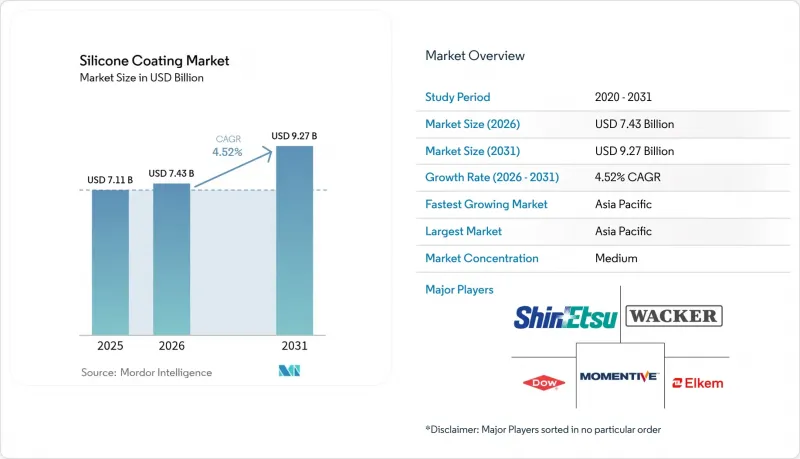
Mordor Intelligence에 의하면, 실리콘 코팅 시장 규모는 2025년에 71억 1,000만 달러로 평가되었고 2026년 74억 3,000만 달러에서 2031년까지 92억 7,000만 달러에 이를 것으로 예측되며, 예측 기간(2026-2031년) CAGR은 4.52%를 나타낼 전망입니다.
본 보고서는 조성 유형(폴리머, 100% 실리콘, 발수제, 첨가제), 기술(무용제, 용제계, 기타),기재(금속, 콘크리트 및 석조, 기타), 최종 사용자 산업(건축 및 건설, 전자, 기타), 지역(아시아태평양, 북미, 유럽, 기타)별로 분류되어 있습니다. 시장 전망은 금액(미 달러) 기준으로 제시되어 있습니다.
세계 실리콘 코팅 시장 동향 및 인사이트
에너지 절약 건물을 위한 쿨 루프 개조 급증
캘리포니아주의 ‘타이틀 24’ 건축 기준에서는 경사가 완만한 상업용 지붕에 대해 노후 후 태양 반사율 0.63 및 열복사율 0.75를 최소 기준으로 의무화하고 있으며, 이 규제가 고반사율 실리콘 코팅에 대한 즉각적인 수요로 이어지고 있습니다. 건물 소유주들은 지붕을 전면 교체하는 대신 실리콘을 이용한 개조를 선택하는 경우가 많으며, 이를 통해 자본 지출을 최대 40% 절감하면서 내구 연수를 연장할 수 있습니다. 캘리포니아주 에너지 위원회의 현장 조사에 따르면, 고온 기후에서는 쿨 루프를 통해 연간 에너지 사용량을 최대 15%까지 절감할 수 있는 것으로 나타났습니다. 유사한 성능 기준에 기반한 건축 기준이 현재 유럽과 급성장 중인 아시아의 대도시권에서도 도입되고 있으며, 실리콘 솔루션이 장기적인 개보수 예산에 포함되고 있습니다. 전기 요금이 계속 상승하는 가운데, 실리콘 쿨 루프 시스템의 투자 회수 기간은 단축되고 있으며, 이는 실리콘 코팅 시장에서 지속적인 수요의 원동력이 되고 있습니다.
건축 및 건설 업계 수요 증가
건설 업계는 사후 대응적인 보수에서 예방적인 외피 보호로 전환하고 있으며, 실리콘 화학은 이러한 전략적 전환점에 위치해 있습니다. 콘크리트 열화의 주된 원인은 여전히 습기 침투이지만, 투습성이 있는 실리콘 배리어는 기층 재료의 통기성을 확보하면서도 구조물의 수명을 20년에서 30년까지 연장합니다. 장스팬 교량에서 시험된 나노 티타늄 개질 실란 코팅은 70년을 넘는 잠재적 수명을 입증했습니다. 공공 인프라 조달의 보증 체계에서는 실리콘 기술만이 충족하는 최소 유지보수 주기가 점점 더 명확하게 명시되고 있으며, 이는 이러한 수요 요인의 장기적인 영향을 확고히 하고 있습니다. ‘전 생애주기 탄소 배출량’ 산정을 위한 정부의 새로운 인센티브는 고내구성 실리콘 필름의 채택률을 더욱 높여, 실리콘 코팅 시장의 성장 모멘텀을 증폭시키고 있습니다.
실록산 및 흄드 실리카 원자재 가격 변동
금속 실리콘의 가격 변동은 시록산 및 흄드 실리카와 같은 중간재에도 파급되어, 코팅 제형 제조업체의 비용 예측 가능성을 저해하고 있습니다. 에너지 집약적인 제련 능력이 특정 지역에 집중되어 있기 때문에 중국의 지역적 전력 공급 제한이나 환경 규제에 따른 가동 중단은 수 주일 내에 전 세계 원자재 지수를 급등시킬 가능성이 있습니다. 이에 대응하여 코팅 제조업체들은 공급 계약을 통한 헤지나 재활용 재료의 배합 비율 확대와 같은 조치를 취하고 있습니다. 또한, 새로운 해중합 기술을 통해 사용 후 실리콘을 모노머 원료로 재전환하는 움직임도 진행되고 있습니다. 자본 집약적인 후방 통합은 이익률 확보로 이어지지만, 그 혜택을 누리는 것은 극히 일부 다국적 기업으로 한정됩니다. 그로 인해 단기적인 가격 변동은 하류 사용자들의 신중한 재고 전략으로 이어져, 실리콘 코팅 시장의 확장을 다소 둔화시키고 있습니다.
부문별 분석
2025년에는 100% 실리콘 등급이 총 매출의 41.02%를 차지하며, 가혹한 자외선 및 열 사이클 하에서도 타의 추종을 불허하는 내구성을 발휘하고 있습니다. 이러한 제품은 가동 중단 비용이 재료의 높은 가격을 상회하는 석유 화학, 선박 및 지붕재 시장에서 산업용 유지 보수 예산의 기반을 이루고 있습니다. 발수성 화학제품은 생산량은 적지만, 건축가들이 넷 제로 빌딩을 위해 “통기성이 있으면서도 습기를 차단하는” 파사드를 지정하는 사례가 증가하고 있어, 2031년까지 5.28%라는 가장 높은 연평균 성장률(CAGR)을 나타낼 전망입니다. 초발수성 실리콘 수지의 발전으로 정적 접촉각이 160°를 넘는 수준에 도달함에 따라, 파사드 패널, 기념물, 나아가 태양전지 모듈에 있어서도 새로운 보호 패러다임이 열리고 있습니다.
현재 조사 파이프라인에서는 높은 접촉각을 유지하면서 탄소 강도를 낮추는 바이오 알킬 폴리실록산이 개발되고 있어, 공공 인프라에서 지속가능성을 중시하는 입찰 요건을 충족시키고 있습니다. 동시에, 실세스퀴옥산 및 나노 지르코니아를 포함한 첨가제 패키지는 VOC 수준을 높이지 않으면서 내마모성을 실현하여, 배출 규제가 있는 스프레이 부스에서 유용합니다. 따라서 경쟁적 차별화는 기본적인 폴리머 변환에서 독자적인 표면 에너지 제어 방식으로 전환되고 있으며, 이를 통해 고객 충성도를 확보하고 실리콘 코팅 시장 전체의 가격 결정력을 뒷받침하고 있습니다.
2025년에는 건축 분야 및 OEM 시설에서 VOC 함량을 제한하는 환경 규제의 영향으로 무용제 시스템이 매출의 37.85%를 차지했습니다. 가연성 캐리어 용제를 사용하지 않음으로써 공장 안전 감사도 간소화되고, 시공 업체의 보험료도 절감됩니다. 그러나 UV 경화형 플랫폼은 연평균 성장률(CAGR) 5.33%를 나타낼 것으로 예측되며, 생산 라인이 1분 미만의 타크프리 시간과 에너지 소비량 감소를 추구하는 가운데 그 격차를 빠르게 좁혀가고 있습니다. 근적외선 광개시제의 기술적 혁신으로 25mm를 초과하는 경화 깊이가 실현되어, 기존에는 열 소성에 의존하던 구조용 접착제 및 두꺼운 포팅이 가능해졌습니다.
수성 하이브리드 제품은 실내 공기 규제로 인해 용제 노출이 제한되는 학교나 병원에 점차 보급되고 있는 반면, 방사선 경화형 에폭시 수지는 플럭스 납땜 공정으로부터 미니 LED 백플레인을 보호하고 있습니다. 이러한 기술적 선택지들이 결합되어 실리콘 코팅 시장의 적용 범위를 확대하고, 사양 수립자에게 처리량과 지속가능성이라는 두 가지 지표 모두를 충족하는 점점 더 정교한 툴킷을 제공합니다.
지역별 분석
아시아태평양은 2025년에 전 세계 매출의 45.70%를 차지하고, 2031년까지 연평균 성장률(CAGR) 4.92%를 나타낼 것으로 전망됩니다. 이는 중국, 인도, 베트남의 협력적인 인프라 투자와 더불어 한국 및 대만의 전자기기 제조 포화 상태를 반영한 것입니다. 현지 기업들은 전기차(EV)의 열 관리 및 반도체 패키징 기술에 대한 연구개발(R&D) 투자를 점점 더 늘리고 있으며, 단순한 생산량에 그치지 않는 지역적 부가가치 창출을 확대되고 있습니다. 다국적 제조업체들은 최종 사용자와의 근접성을 확보하고 물류 리스크를 완화하기 위해 합작 투자를 강화하고 있으며, 이를 통해 실리콘 코팅 시장에서의 리더십을 유지하고 있습니다.
북미는 여전히 기술적으로 성숙한 시장이며, 캘리포니아주의 ‘타이틀 24’와 같은 에너지 규제로 인해 쿨 루프에 대한 수요가 제도화되어 있습니다. 지붕 시공업체들은 실리콘 보수 시스템을 활용하여 매립 처리 비용을 절감하고 있으며, 이로 인해 선벨트 주들에서의 도입이 촉진되고 있습니다. 캐나다에서는 연방 그린빌딩 기준에 따라 투습성 파사드 코팅의 중요성이 높아지고 있는 반면, 멕시코의 자동차 산업 클러스터는 열 인터페이스용 실리콘에 대한 꾸준한 수요를 창출하고 있습니다. 이러한 동향이 총 판매량이 정체된 상황에서도 꾸준한 가치 성장을 뒷받침하고 있습니다.
유럽 시장에서는 순환 경제 목표를 추구하고 있어, 수명이 길고 유지보수가 간편한 화학제품이 높이 평가받고 있습니다. 이에 따라 교량 개보수나 해상 풍력 발전의 모노파일 분야에서 실리콘이 표준적인 선택지로 자리 잡고 있습니다. 독일과 북유럽 국가에서는 실리콘 라이너 폐기물의 공정 내 재활용이 선도적으로 이루어지고 있어, 지역 공급망의 탄력성이 강화되고 있습니다. 그 밖의 지역에서는 남유럽의 개보수 붐에 힘입어, 도시의 열섬 현상을 완화하기 위한 지붕용 반사 코팅에 경제 부양 자금이 투입되고 있습니다. 남미와 중동 및 아프리카의 신흥 경제국에서는 항만 확장 및 에너지 프로젝트를 통해 수요가 서서히 증가하고 있지만, 환율 변동과 시공 업체의 전문 지식 부족으로 인해 이들 지역에서의 보급은 완만한 수준에 그치고 있습니다.
기타 혜택:
- 엑셀 형식 시장 예측(ME) 시트
- 3개월간의 애널리스트 지원
자주 묻는 질문
목차
제1장 서론
제2장 조사 방법
제3장 주요 요약
제4장 시장 구도
제5장 시장 규모와 성장 예측
제6장 경쟁 구도
제7장 시장 기회와 향후 전망
JHS 26.08.26According to Mordor Intelligence, the silicone coating market size was valued at USD 7.11 billion in 2025 and estimated to grow from USD 7.43 billion in 2026 to reach USD 9.27 billion by 2031, at a CAGR of 4.52% during the forecast period (2026-2031).
This report is Segmented by Composition Type (Polymers, 100% Silicone, Water Repellents, Additives), Technology (Solvent-Less, Solvent-Based, and More), Substrate (Metal, Concrete and Masonry, and More), End-User Industry (Building and Construction, Electronics, and More), and Geography (Asia-Pacific, North America, Europe, and More). The Market Forecasts are Provided in Terms of Value (USD).
Global Silicone Coating Market Trends and Insights
Surge in Cool-Roof Refurbishments for Energy-Efficient Buildings
California's Title 24 code enforces a minimum aged solar reflectance of 0.63 and thermal emittance of 0.75 on low-slope commercial roofs, converting regulatory language into immediate demand for high-reflectance silicone membranes. Building owners frequently choose silicone restoration rather than full reroofing, trimming capital expenditure by as much as 40% while extending service life. Field studies from the California Energy Commission indicate that cool roofs cut annual energy use by up to 15% in hot climates. Similar performance-based codes now appear across Europe and fast-growing Asian megacities, embedding silicone solutions in long-range retrofit budgets. As electricity tariffs continue to rise, the payback period for silicone cool-roof systems shortens, reinforcing a durable demand driver in the Silicone coatings market.
Growing Demand from the Building and Construction Industry
The construction sector is shifting from reactive repairs toward proactive envelope protection, and silicone chemistry sits at that strategic pivot point. Moisture ingress remains the dominant degradation mechanism in concrete, yet vapor-permeable silicone barriers extend structural life by two to three decades while allowing substrates to breathe. Nanotitanium-modified silane coatings tested on long-span bridges have demonstrated potential lifetimes exceeding 70 years. Warranty frameworks in public-infrastructure procurement increasingly specify minimum service intervals that silicone technology uniquely satisfies, anchoring the long-term influence of this driver. Emerging government incentives for "whole-life-carbon" accounting further lift specification rates for high-durability silicone membranes, amplifying growth momentum in the Silicone coatings market.
Volatile Raw-Material Prices for Siloxanes and Fumed Silica
Silicon-metal price swings cascade through to siloxane and fumed-silica intermediates, undermining cost predictability for coating formulators. Concentrated smelting capacity in energy-intensive provinces means that local power curtailments or environmental shutdowns in China can spike global raw-material indices within weeks. Coating producers respond through supply-contract hedging and greater recycle content, with emerging depolymerization technologies converting post-consumer silicone back into monomeric feedstock. Capital-intensive backward integration shelters margins yet favors only a handful of multinational players. Short-term volatility therefore translates into cautious inventory strategies among downstream users, mildly dampening expansion in the Silicone coatings market.
Other drivers and restraints analyzed in the detailed report include:
- Rapid Adoption in Consumer and Industrial Electronics Conformal Coatings
- Increasing Demand from the Automotive Industry
- Supply-Chain Concentration of Silane Monomer Feedstocks
For complete list of drivers and restraints, kindly check the Table Of Contents.
Segment Analysis
In 2025, 100% silicone grades generated 41.02% of total revenue, reflecting their unrivaled durability under severe UV and thermal cycling. These products anchor industrial-maintenance budgets in petrochemical, marine, and roofing markets where downtime costs exceed material premiums. Water-repellent chemistries, although smaller in volume, post the highest 5.28% CAGR to 2031 as architects increasingly specify breathable yet moisture-blocking facades for net-zero buildings. Advancements in super-hydrophobic silicone resins have achieved static contact angles above 160°, opening facade panels, monuments, and even solar modules to new protective paradigms.
Research pipelines now blend bio-based alkyl-polysiloxanes that retain high contact angles while cutting carbon intensity, answering sustainability tenders in public infrastructure. Concurrently, additive packages containing silsesquioxanes and nano-zirconia enable abrasion resistance without raising VOC levels, a benefit in emission-regulated spray booths. Competitive differentiation therefore migrates from basic polymer conversion to proprietary surface-energy control, locking in customer loyalty and supporting pricing power across the Silicone coatings market.
Solvent-less systems captured 37.85% revenue in 2025, propelled by environmental regulations that cap VOC content in architectural and OEM facilities. Absence of flammable carrier solvents also simplifies plant-safety audits, lowering insurance premiums for applicators. Yet UV-cured platforms, forecast to grow at 5.33% CAGR, are rapidly closing the gap as production lines chase sub-minute tack-free times and lower energy footprints. Breakthroughs in near-infrared photoinitiators achieve cure depths exceeding 25 mm, unlocking structural adhesives and thick-section potting that previously defaulted to thermal bakeouts.
Water-borne hybrids edge into schools and hospitals where indoor-air regulations restrict solvent exposure, while radiation-cured epoxies protect mini-LED backplanes against flux-solder processing. Collectively, these technology options expand the addressable footprint of the Silicone coatings market, supplying specifiers with an increasingly granular toolkit aligned to both throughput and sustainability metrics.
Complete Report Scope:
- By Composition Type
- Polymers
- 100 % Silicone
- Water Repellents
- Additives
- By Technology
- Solvent-less
- Solvent-based
- Water-borne
- Radiation/UV-cured
- By Substrate
- Metal
- Concrete and Masonry
- Plastics and Composites
- Glass and Ceramics
- By End-user Industry
- Building and Construction
- Electronics
- Automotive and Transportation
- Other End-user Industries (Energy and Power,etc.)
- By Geography
- Asia-Pacific
- China
- Japan
- India
- South Korea
- ASEAN Countries
- Rest of Asia-Pacific
- North America
- United States
- Canada
- Mexico
- Europe
- Germany
- United Kingdom
- France
- Italy
- Spain
- Russia
- NORDIC Countries
- Rest of Europe
- South America
- Brazil
- Argentina
- Rest of South America
- Middle East and Africa
- Saudi Arabia
- South Africa
- Rest of Middle East and Africa
- Asia-Pacific
Geography Analysis
Asia-Pacific accounted for 45.70% of global revenue in 2025 and is projected to register a 4.92% CAGR to 2031, reflecting concerted infrastructure investment in China, India, and Vietnam alongside electronics manufacturing saturation in South Korea and Taiwan. Local firms increasingly channel R&D into EV thermal-management and semiconductor encapsulation, broadening regional value capture beyond basic volume. Multinational producers deepen joint ventures to secure proximity to end-users and buffer logistics exposure, thereby sustaining leadership within the Silicone coatings market.
North America remains a technologically mature arena where energy codes, such as California's Title 24, institutionalize cool-roof demand. Roofing contractors leverage silicone restoration systems to sidestep landfill disposal fees, boosting adoption in sun-belt states. In Canada, federal green-building standards elevate vapor-permeable facade coatings, while Mexico's automotive clusters generate steady pull for thermal-interface silicones. These dynamics anchor steady value growth, even as overall unit volumes plateau.
Europe's market pursues circular-economy goals that reward long-life, low-maintenance chemistries, positioning silicone as the default for bridge refurbishment and offshore wind monopiles. Germany and the Nordics pioneer in-process recycling of silicone liner waste, reinforcing local supply resilience. Elsewhere, Southern Europe's renovation wave channels stimulus funds toward roof-reflective coatings to mitigate urban heat islands. Emerging economies in South America and the Middle East & Africa add incremental demand through port expansions and energy projects, though currency volatility and limited applicator expertise moderate uptake in these regions.
- Akzo Nobel N.V.
- BASF
- Carlisle Companies Inc.
- Chase Corp.
- CHT Germany GmbH
- Dow
- Elkem ASA
- Evonik Industries AG
- GAF Materials LLC
- Hempel A/S
- Huntsman International LLC
- KCC CORPORATION
- Milliken and Company
- Momentive
- PPG Industries, Inc.
- Shin-Etsu Chemical Co., Ltd.
- Sika AG
- The Sherwin-Williams Company
- Wacker Chemie AG
Additional Benefits:
- The market estimate (ME) sheet in Excel format
- 3 months of analyst support
TABLE OF CONTENTS
1 Introduction
- 1.1 Study Assumptions and Market Definition
- 1.2 Scope of the Study
2 Research Methodology
3 Executive Summary
4 Market Landscape
- 4.1 Market Overview
- 4.2 Market Drivers
- 4.2.1 Surge in cool-roof refurbishments for energy-efficient buildings
- 4.2.2 Growing demand from building and construction industry
- 4.2.3 Rapid adoption in consumer and industrial electronics conformal coatings
- 4.2.4 Increasing demand for silicone coatings from the automotive industry
- 4.2.5 Urban-heat-island mitigation programs driving reflective silicone roofs
- 4.3 Market Restraints
- 4.3.1 Volatile raw-material prices (siloxanes, fumed silica)
- 4.3.2 Supply-chain concentration of silane monomer feedstocks
- 4.3.3 Stricter indoor-air fire-safety codes limiting interior silicone use
- 4.4 Value Chain Analysis
- 4.5 Porter's Five Forces Analysis
- 4.5.1 Bargaining Power of Suppliers
- 4.5.2 Bargaining Power of Buyers
- 4.5.3 Threat of New Entrants
- 4.5.4 Threat of Substitutes
- 4.5.5 Degree of Competition
5 Market Size and Growth Forecasts (Value)
- 5.1 By Composition Type
- 5.1.1 Polymers
- 5.1.2 100 % Silicone
- 5.1.3 Water Repellents
- 5.1.4 Additives
- 5.2 By Technology
- 5.2.1 Solvent-less
- 5.2.2 Solvent-based
- 5.2.3 Water-borne
- 5.2.4 Radiation/UV-cured
- 5.3 By Substrate
- 5.3.1 Metal
- 5.3.2 Concrete and Masonry
- 5.3.3 Plastics and Composites
- 5.3.4 Glass and Ceramics
- 5.4 By End-user Industry
- 5.4.1 Building and Construction
- 5.4.2 Electronics
- 5.4.3 Automotive and Transportation
- 5.4.4 Other End-user Industries (Energy and Power,etc.)
- 5.5 By Geography
- 5.5.1 Asia-Pacific
- 5.5.1.1 China
- 5.5.1.2 Japan
- 5.5.1.3 India
- 5.5.1.4 South Korea
- 5.5.1.5 ASEAN Countries
- 5.5.1.6 Rest of Asia-Pacific
- 5.5.2 North America
- 5.5.2.1 United States
- 5.5.2.2 Canada
- 5.5.2.3 Mexico
- 5.5.3 Europe
- 5.5.3.1 Germany
- 5.5.3.2 United Kingdom
- 5.5.3.3 France
- 5.5.3.4 Italy
- 5.5.3.5 Spain
- 5.5.3.6 Russia
- 5.5.3.7 NORDIC Countries
- 5.5.3.8 Rest of Europe
- 5.5.4 South America
- 5.5.4.1 Brazil
- 5.5.4.2 Argentina
- 5.5.4.3 Rest of South America
- 5.5.5 Middle East and Africa
- 5.5.5.1 Saudi Arabia
- 5.5.5.2 South Africa
- 5.5.5.3 Rest of Middle East and Africa
- 5.5.1 Asia-Pacific
6 Competitive Landscape
- 6.1 Market Concentration
- 6.2 Strategic Moves
- 6.3 Market Share(%)/Ranking Analysis
- 6.4 Company Profiles (includes Global level Overview, Market level overview, Core Segments, Financials as available, Strategic Information, Market Rank/Share, Products and Services, Recent Developments)
- 6.4.1 Akzo Nobel N.V.
- 6.4.2 BASF
- 6.4.3 Carlisle Companies Inc.
- 6.4.4 Chase Corp.
- 6.4.5 CHT Germany GmbH
- 6.4.6 Dow
- 6.4.7 Elkem ASA
- 6.4.8 Evonik Industries AG
- 6.4.9 GAF Materials LLC
- 6.4.10 Hempel A/S
- 6.4.11 Huntsman International LLC
- 6.4.12 KCC CORPORATION
- 6.4.13 Milliken and Company
- 6.4.14 Momentive
- 6.4.15 PPG Industries, Inc.
- 6.4.16 Shin-Etsu Chemical Co., Ltd.
- 6.4.17 Sika AG
- 6.4.18 The Sherwin-Williams Company
- 6.4.19 Wacker Chemie AG
7 Market Opportunities and Future Outlook
- 7.1 White-space and Unmet-need Assessment


