

|
시장보고서
상품코드
2114753
나선형 멤브레인 시장 : 점유율 분석, 업계 동향과 통계, 성장 예측(2026-2031년)Spiral Membrane - Market Share Analysis, Industry Trends & Statistics, Growth Forecasts (2026 - 2031) |
||||||
 Mordor Intelligence
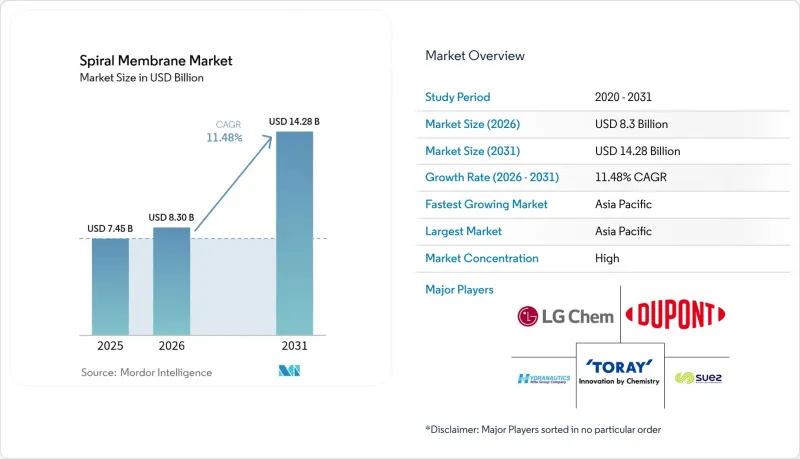
Mordor Intelligence에 의하면, 나선형 멤브레인 시장 규모는 2025년에 74억 5,000만 달러로 평가되었고 2026년 83억 달러에서 2031년까지 142억 8,000만 달러에 이를 것으로 예측되며, 예측 기간(2026-2031년) CAGR은 11.48%를 나타낼 전망입니다.
본 보고서는 고분자 소재(폴리아미드(TFC), 폴리에테르설폰(PES) 등), 분리 기술(미세 여과, 한외 여과 등), 최종 사용자 산업(도시 수처리, 식품 및 음료 등),및 지역(아시아태평양, 북미, 유럽 등)별로 세분화되어 있습니다. 시장 예측은 금액(미 달러) 기준으로 제시되어 있습니다.
세계 나선형 멤브레인 시장 동향 및 인사이트
식품 및 음료 업계에서 단백질 분획에 대한 수요 증가
유제품 가공업체와 주스 병입 업체들은 40-60%의 가격 프리미엄을 받고 판매할 수 있는 고부가가치 단백질 분리물을 생산하기 위해 열농축에서 막 분리로 전환하고 있습니다. 최신 나선형 마이크로 여과 라인은 기능성을 유지하면서 유청 단백질을 99%의 효율로 분리하므로, 제조업체는 스포츠 영양, 의료용 영양, 유아용 조제분유 시장에 제품을 공급할 수 있게 됩니다. 최근 스페이서의 재설계로 인해 크로스플로우 유속이 향상되고, 파울링이 억제되며, 세척 주기가 연장되었습니다. 플랜트 관리자들은 설치 면적이 작다는 점도 높이 평가했습니다. 나선형 모듈은 동급의 중공사 유닛에 비해 2-3배의 표면적을 가지고 있어 토목 공사 비용을 절감합니다.
중공사로부터 고플럭스 나선형 권선 모듈로의 전환
공업용수 운영 담당자들 사이에서는 나선형 권선 구조가 중공사형에 비해 최대 3배 높은 충전 밀도를 실현하여 스키드의 소형화와 교체 비용 절감이 가능해진 점이 주목받고 있습니다. 세척 프로토콜도 개선되었습니다. 새로운 피드 스페이서의 형상으로 인해 난류가 촉진되어 약품 사용량이 절감됩니다. 이러한 장점은 중공사막이 급속히 파울링이 발생하기 쉬운 유제품, 설탕, 젤라틴 등의 고점도 유체에서 결정적인 역할을 합니다.
막의 파울링과 세정 약품 비용
네덜란드의 해수 담수화 플랜트 전체에서 세척 비용은 RO(역삼투) 운영비의 24%를 차지합니다. 바이오 파울링은 멤브레인의 수명을 단축시키며, 특히 유리 염소에 내성이 없는 폴리아미드 재질의 엘리먼트에서는 이러한 경향이 두드러집니다. 각 개발사는 양이온성 폴리머를 이용한 표면 코팅 및 펄스 플로우 세척을 활용하여 화학약품 사용량을 절반으로 줄이는 노력을 추진하고 있습니다. 이러한 기술이 성숙하기 전까지는 높은 세척 비용과 가동 중단 비용이 생물학적 활성이 매우 높은 유체에서의 도입을 억제하는 요인이 될 것입니다.
부문 분석
폴리아미드 박막 복합재는 99.5%의 염분 제거율이 표준인 해수 담수화 분야에서 수십 년에 걸친 성능 최적화의 뒷받침을 받아, 2025년에도 나선형 멤브레인 시장에서 42.58%의 점유율을 유지했습니다. PES는 반복되는 증기 사이클을 견딜 수 있기 때문에 바이오프로세스 분야에서 틈새 용도로 활용되고 있습니다. PVDF 및 PTFE와 같은 불소 수지는 현재 극히 일부에 불과하지만, 리튬 브라인, 반도체 및 부식성이 높은 용매 처리 분야에서 기회를 포착하여 연평균 12.34%의 성장이 예상됩니다. 이러한 소재는 pH 0-14 및 120°C까지의 온도를 견딜 수 있으며, 이러한 특성으로 인해 프리미엄 가격 책정이 정당화됩니다. 표면 활성화 기술(플라즈마 에칭, UV 그래프팅)을 통해 본래 지닌 소수성이 극복되어, 물 플럭스는 폴리아미드 수준에 가까워지고 있습니다.
폴리아미드 부문은 성숙한 공급망과 경쟁력 있는 가격 책정이 강점이지만, 염소에 대한 민감도가 높아 오염 발생 후 재사용이 제한되므로, 사업자들은 불소계 폴리머로 전환하도록 권장받고 있습니다. 세라믹 및 복합재 설계는 생산수 정화 등, 가동 시간이 설비 투자 비용을 상회하는 가혹한 환경에서 널리 채택되고 있습니다. 이들은 특수 화학제품 및 광업 서비스용 나선형 멤브레인 시장에서 규모는 작지만 전략적으로 중요한 부분을 차지하고 있습니다.
지역별 분석
아시아태평양은 2025년에 33.74%라는 나선형 멤브레인 시장 점유율에서 가장 큰 비중을 차지하고 있으며, 2031년까지의 연평균 성장률(CAGR) 12.63%는 다른 모든 지역을 상회합니다. 환경 규제가 강화됨에 따라, 현재 중국의 공장에서는 첨단 막의 도입이 의무화되어 있는 반면, 인도에서는 ‘Jal Jeevan Mission’과 같은 계획에 따라 공공 자금이 도시 인프라 구축에 투입되고 있습니다. 대만, 일본, 한국의 반도체 제조 공장에서는 총 유기탄소(TOC)가 5 ppt 미만인 초순수가 필요하며, 이로 인해 선택성이 높은 RO 및 UF 스택에 대한 수요가 증가하고 있습니다. 호주에서는 장기화되는 가뭄에 직면한 도시의 식수 확보를 위해 나선형 RO에 의존하고 있습니다.
북미는 인프라 투자 및 고용법에 따라 550억 달러가 상수도 시스템 현대화에 투입됨에 따라 두 번째로 큰 소비 시장이 되었습니다. 2000년대 초에 도입된 노후화된 RO 플랜트는 에너지 소비를 20-25% 절감하는 고투과성 설계의 플랜트로 교체되고 있습니다. 시장 동향은 PFAS 제거 능력 향상과 산업용수 재사용에 초점이 맞추어져 있습니다. 멕시코의 자동차 산업 회랑에서는 제로 액체 배출(ZLD)에 대한 투자가 진행되면서 현지 나선형 멤브레인의 수입이 확대되고 있습니다.
유럽에서는 ‘물 프레임워크 지침’에 따라 엄격한 방류 기준이 유지되고 있으며, 식품 및 음료·제약 공장 전반에서 설비 개조가 진행되고 있습니다. 스칸디나비아의 유틸리티자들은 PFAS를 대상으로 한 나노여과 시범 운영을 진행 중이며, 한편 남부 국가들에서는 장기화되는 가뭄을 보완하기 위해 해수 담수화가 도입되고 있습니다. 사업자들이 에너지 효율 및 순환형 경제 목표를 준수하고 있기 때문에 공급업체들은 애프터마켓에서 견조한 매출을 기대하고 있습니다.
라틴아메리카 수요는 광업 거점에 집중되어 있습니다. 칠레와 아르헨티나에서는 리튬 염호에 나선형 나노 여과 장치를 도입하여 배터리용 등급의 원료를 추출하는 동시에 염수를 재활용하고 있습니다. 브라질의 펄프·제지 공장에서는 폐쇄형 표백 회로에 RO를 채택하여 화학적 산소 요구량(COD) 배출량을 85% 감축하고 있습니다. 중동 및 북아프리카에서는 대규모 RO 플랜트가 중시되고 있으며, 국영 전력 회사는 전력 부족을 보완하기 위해 에너지 회수 장치 도입을 검토하고 있습니다. 사하라 이남 아프리카에서는 도입률이 여전히 낮은 편이지만, 물 부족으로 어려움을 겪는 도시에서 다자간 금융 기관이 하수 재이용 프로젝트에 자금을 지원함에 따라 도입이 증가하는 추세입니다.
기타 혜택:
- 엑셀 형식 시장 예측(ME) 시트
- 3개월간의 애널리스트 지원
자주 묻는 질문
목차
제1장 서론
제2장 조사 방법
제3장 주요 요약
제4장 시장 구도
제5장 시장 규모와 성장 예측
제6장 경쟁 구도
제7장 시장 기회와 향후 전망
JHS 26.08.26According to Mordor Intelligence, the spiral membrane market size was valued at USD 7.45 billion in 2025 and estimated to grow from USD 8.3 billion in 2026 to reach USD 14.28 billion by 2031, at a CAGR of 11.48% during the forecast period (2026-2031).
This report is Segmented by Polymer Material (Polyamide (TFC), Polyethersulfone (PES), and More), Separation Technique (Microfiltration, Ultrafiltration, and More), End-User Industry (Municipal Water Treatment, Food and Beverage, and More), and Geography (Asia-Pacific, North America, Europe, and More). The Market Forecasts are Provided in Terms of Value (USD).
Global Spiral Membrane Market Trends and Insights
Expanding Food and Beverage Protein-Fractionation Needs
Dairy processors and juice bottlers are migrating from thermal concentration to membrane fractionation so they can produce value-added protein isolates that sell at 40-60% price premiums. Modern spiral-wound microfiltration lines separate whey proteins with 99% efficiency while preserving functional properties, allowing manufacturers to serve sports-nutrition, medical-nutrition, and infant-formula channels. Recent spacer redesigns lift cross-flow velocity, which suppresses fouling and stretches run times between cleanings. Plant managers also appreciate the smaller footprint; spiral modules pack two to three times more surface area than equivalent hollow-fiber units, lowering civil-work costs.
Shift from Hollow-Fiber to High-Flux Spiral-Wound Modules
Industrial water operators notice that spiral-wound designs deliver up to three-fold higher packing density than hollow-fiber counterparts, enabling smaller skids and lower replacement costs. Cleaning protocols also improve: new feed-spacer geometries enhance turbulence, reducing chemical use. These benefits are decisive in viscous streams such as dairy, sugar, and gelatin, where hollow-fiber membranes foul rapidly.
Membrane Fouling and Cleaning-Chemical Costs
Across Dutch desalination plants, cleaning accounts for 24% of RO operating expenses. Biofouling shortens membrane life, especially in polyamide elements that cannot tolerate free chlorine. Developers are coating surfaces with zwitterionic polymers and leveraging pulsed-flow cleaning to cut chemical use in half. Until these tools mature, elevated cleaning and downtime costs will temper adoption in heavily bio-active streams.
Other drivers and restraints analyzed in the detailed report include:
- Adoption of Hot-Sanitizable Spiral Membranes in Bioprocessing
- Stricter Industrial and Municipal Wastewater Discharge Norms
- High Energy/Pressure Demand for RO Operations
For complete list of drivers and restraints, kindly check the Table Of Contents.
Segment Analysis
Polyamide thin-film composites retained a 42.58% spiral membrane market share in 2025, propelled by decades of performance optimization in desalination where 99.5% salt rejection is routine. PES holds niche utility in bioprocessing because it withstands repeated steam cycles. Fluoropolymers such as PVDF and PTFE, though only a small slice today, are on track to grow 12.34% annually, capturing opportunities in lithium brine, semiconductor, and aggressive-solvent streams. These chemistries tolerate pH 0-14 and temperatures to 120 °C, features that justify premium pricing. Surface-activation techniques-plasma etching, UV grafting-now overcome their intrinsic hydrophobicity, pushing water flux toward polyamide territory.
The polyamide segment draws strength from mature supply chains and competitive pricing, but its chlorine sensitivity restricts reuse after fouling events, nudging operators toward fluoropolymer retrofits. Ceramic and composite designs populate extreme environments such as produced-water clean-up, where uptime outweighs capital intensity. They represent a small yet strategic fragment of the spiral membrane market size for specialty chemicals and mining services.
Complete Report Scope:
- By Polymer Material
- Polyamide (TFC)
- Polyethersulfone (PES)
- Fluoropolymers (PTFE, PVDF)
- Others (Cellulose Acetate, Ceramic, Composite)
- By Separation Technique
- Microfiltration (MF)
- Ultrafiltration (UF)
- Nanofiltration (NF)
- Reverse Osmosis (RO)
- By End-user Industry
- Municipal Water Treatment
- Food and Beverage
- Healthcare
- Oil and Gas
- Others (Chemicals, Pulp and Paper, Mining, Power, Textiles)
- By Geography
- Asia-Pacific
- China
- India
- Japan
- South Korea
- ASEAN
- Australia and New Zealand
- Rest of Asia-Pacific
- North America
- United States
- Canada
- Mexico
- Europe
- Germany
- United Kingdom
- France
- Italy
- Spain
- Russia
- Rest of Europe
- South America
- Brazil
- Argentina
- Rest of South America
- Middle East and Africa
- Saudi Arabia
- United Arab Emirates
- South Africa
- Rest of Middle East and Africa
- Asia-Pacific
Geography Analysis
Asia Pacific commands the largest slice of spiral membrane market share at 33.74% in 2025, and its 12.63% CAGR through 2031 outpaces all other regions. Environmental enforcement now compels Chinese factories to install advanced membranes, while India funnels public funds into municipal upgrades under schemes such as the Jal Jeevan Mission. Semiconductor fabs in Taiwan, Japan, and South Korea require ultra-pure water below 5 ppt total organic carbon, pushing demand for high-selectivity RO and UF stacks. Australia leans on spiral-wound RO to secure potable water for cities facing protracted drought.
North America is the second-largest consumer as the Infrastructure Investment and Jobs Act channels USD 55 billion into water-system modernization. Aging RO trains from the early-2000s are being swapped for high-permeability designs that cut energy 20-25%. Market activity centers on upgrading PFAS removal and industrial reuse. Mexico's automotive corridor invests in zero-liquid-discharge, boosting local spiral membrane imports.
Europe maintains strict effluent norms under the Water Framework Directive, spurring retrofits across food, beverage, and pharmaceutical plants. Scandinavian utilities pilot PFAS-targeted nanofiltration, while southern states deploy seawater desalination to offset prolonged drought. Suppliers see healthy aftermarket sales as operators adhere to energy-efficiency and circular-economy targets.
Latin American demand concentrates in mining hubs. Chile and Argentina fit spiral nanofiltration for lithium salars, extracting battery-grade feedstock while recycling brine. Brazil's pulp-and-paper mills adopt RO for closed-loop bleaching circuits, trimming chemical oxygen demand discharges by 85%. The Middle East and North Africa emphasize megascale RO plants where state utilities explore energy-recovery devices to offset power constraints. Sub-Saharan Africa's uptake remains low but climbs as multilateral lenders finance sewage-reuse projects in water-scarce cities.
- Alfa Laval
- Asahi Kasei Corporation
- AXEON Water
- DuPont
- Hydranautics (Nitto)
- IDE Technologies
- Koch Separation Solutions
- Lanxess
- LG Chem
- MANN+HUMMEL
- Membranium (JSC RM Nanotech)
- Merck KgaA
- Pall Corporation
- Pentair PLC
- Synder Filtration, Inc
- SUEZ
- Toray Industries Inc
- Toyobo Co., Ltd
- Veolia
- Xylem
- ZwitterCo.
Additional Benefits:
- The market estimate (ME) sheet in Excel format
- 3 months of analyst support
TABLE OF CONTENTS
1 Introduction
- 1.1 Study Assumptions and Market Definition
- 1.2 Scope of the Study
2 Research Methodology
3 Executive Summary
4 Market Landscape
- 4.1 Market Overview
- 4.2 Market Drivers
- 4.2.1 Expanding food and beverage protein-fractionation needs
- 4.2.2 Stricter industrial and municipal wastewater discharge norms
- 4.2.3 Shift from hollow-fiber to high-flux spiral-wound modules
- 4.2.4 Adoption of hot-sanitizable spiral membranes in bioprocessing
- 4.2.5 Lithium-brine concentration via spiral Nano Filtration in battery supply chain
- 4.3 Market Restraints
- 4.3.1 Membrane fouling and cleaning-chemical costs
- 4.3.2 High energy/pressure demand for RO operations
- 4.3.3 Volatile pricing of ultra-pure polyamide casting films
- 4.4 Value Chain Analysis
- 4.5 Porter's Five Forces
- 4.5.1 Threat of New Entrants
- 4.5.2 Bargaining Power of Buyers
- 4.5.3 Bargaining Power of Suppliers
- 4.5.4 Threat of Substitute Products
- 4.5.5 Degree of Competition
5 Market Size and Growth Forecasts (Value)
- 5.1 By Polymer Material
- 5.1.1 Polyamide (TFC)
- 5.1.2 Polyethersulfone (PES)
- 5.1.3 Fluoropolymers (PTFE, PVDF)
- 5.1.4 Others (Cellulose Acetate, Ceramic, Composite)
- 5.2 By Separation Technique
- 5.2.1 Microfiltration (MF)
- 5.2.2 Ultrafiltration (UF)
- 5.2.3 Nanofiltration (NF)
- 5.2.4 Reverse Osmosis (RO)
- 5.3 By End-user Industry
- 5.3.1 Municipal Water Treatment
- 5.3.2 Food and Beverage
- 5.3.3 Healthcare
- 5.3.4 Oil and Gas
- 5.3.5 Others (Chemicals, Pulp and Paper, Mining, Power, Textiles)
- 5.4 By Geography
- 5.4.1 Asia-Pacific
- 5.4.1.1 China
- 5.4.1.2 India
- 5.4.1.3 Japan
- 5.4.1.4 South Korea
- 5.4.1.5 ASEAN
- 5.4.1.6 Australia and New Zealand
- 5.4.1.7 Rest of Asia-Pacific
- 5.4.2 North America
- 5.4.2.1 United States
- 5.4.2.2 Canada
- 5.4.2.3 Mexico
- 5.4.3 Europe
- 5.4.3.1 Germany
- 5.4.3.2 United Kingdom
- 5.4.3.3 France
- 5.4.3.4 Italy
- 5.4.3.5 Spain
- 5.4.3.6 Russia
- 5.4.3.7 Rest of Europe
- 5.4.4 South America
- 5.4.4.1 Brazil
- 5.4.4.2 Argentina
- 5.4.4.3 Rest of South America
- 5.4.5 Middle East and Africa
- 5.4.5.1 Saudi Arabia
- 5.4.5.2 United Arab Emirates
- 5.4.5.3 South Africa
- 5.4.5.4 Rest of Middle East and Africa
- 5.4.1 Asia-Pacific
6 Competitive Landscape
- 6.1 Market Concentration
- 6.2 Strategic Moves
- 6.3 Market Share Analysis
- 6.4 Company Profiles (includes Global level Overview, Market level overview, Core Segments, Financials as available, Strategic Information, Market Rank/Share for key companies, Products and Services, and Recent Developments)
- 6.4.1 Alfa Laval
- 6.4.2 Asahi Kasei Corporation
- 6.4.3 AXEON Water
- 6.4.4 DuPont
- 6.4.5 Hydranautics (Nitto)
- 6.4.6 IDE Technologies
- 6.4.7 Koch Separation Solutions
- 6.4.8 Lanxess
- 6.4.9 LG Chem
- 6.4.10 MANN+HUMMEL
- 6.4.11 Membranium (JSC RM Nanotech)
- 6.4.12 Merck KgaA
- 6.4.13 Pall Corporation
- 6.4.14 Pentair PLC
- 6.4.15 Synder Filtration, Inc
- 6.4.16 SUEZ
- 6.4.17 Toray Industries Inc
- 6.4.18 Toyobo Co., Ltd
- 6.4.19 Veolia
- 6.4.20 Xylem
- 6.4.21 ZwitterCo.
7 Market Opportunities and Future Outlook
- 7.1 White-space and Unmet-need Assessment


